1. Setting the scene
How do you find the words to tell the story of the environmental emergency of our times? (Alexis WrightFootnote 1 )
In a sense, we are bereft. The all-too-human idioms of anxiety, grief and fear, hubris and humility provide the currents of the affective lives that are lived in relation to the environment. I live in Melbourne, Australia. An hour away, the clear-felling of old-growth forests has destroyed the habitats of the Leadbeater’s Possum and the Greater Glider, both native species of the opossum. The supply chain of Japanese-owned paper mills includes the fibre from these logging operations. Bushfires, both recent and from the early decades of the twentieth century, have contributed considerably to the loss of floral, faunal, and human lives. Summers are angry, we are told.
As Alexis Wright, novelist and essayist of the Waanyi people in the Gulf of Carpentaria, writes in the new language of climate change:
A dense haze of smoke crawled over Melbourne and embraced us for a day in its lonely pilgrimage, inviting us to contemplate its mourning rite, its long prayer,
The smoke came from a cremation of the natural world—the bushfires from the Bunyip state forest that had begun during days of a major heatwave running across the country. The forest lies 65km east of Melbourne where mountain ash grow, prickly tea-trees, stringy barks and heathland swamps. In the Woiwurrung mythology of the Kulin nation, the Bunyip is a spirit that punishes bad people who disturb its home in the swamps of the Bunyip River, and according to the Parks Victoria information sheet on the park, local Aboriginal people avoided the area.Footnote 2
A concatenation of events—the warming of Earth, protracted and abrupt bouts of extreme atmospheric temperatures, the prevalence of government-sanctioned water theft—has generated massive native fish kills and images of cod, golden perch, and bony bream going belly-up near Menindee on the Darling River. At the same time in the tropical north of the country, storms and massive flooding added a contrapuntal tune to the events of fire. To the north and west of the country, rising temperatures have been weaponized by prison administrations that incarcerate First Nations people, young and old. The dredging of Port Phillip Bay has all but extinguished oyster reefs. The coral reefs of the Great Barrier Reef are being bleached white; aerial photos of the blue seas show its extent. Nearby, Adani’s Carmichael mine is extracting and exporting coal in an operation from pit in Australia to plug in India. The environmental emergency proceeds on so many fronts—local, state, federal, transnational, global; earth and sky, river and sea, mountain and valley; communities, institutions, country; bird, possum, plant, and tree. Moreover, extreme weather events continue, at a pace that exceeds our ability to learn the unfamiliar words and images that are fed back into our accounts of the environmental emergency.
A sense of urgency pervades the atmosphere; it is hard to pin down. Is this what it means to say the environmental emergency is traumatic? From where could such be articulated? Our contemporary habits of language and of thought have become unmoored and derailed. Amitav Ghosh says: deranged, unthinkable.Footnote 3 Established topics and ways of speaking about the environment no longer seem to get a hold on the variety of events. At best, they catch at the edges of traumatic events. Long-held distinctions between nature and culture, human and culture that gave form to our productions and technologies disintegrate. Geological and biological taxonomies are essentially contested; biodiversity and the environment cannot be held in place, fixed. Public speech is deracinated. Finding the words and images for environmental emergencies is one part of the predicament. There is also the enframing of people, places, and events through which the emergency is known, imagined, and experienced. The stories need to be crafted, rough-hewn from old frameworks in the midst of being undone, while here and there, making a difference is put together bit by bit, piecemeal.
The analysis of this article returns the questions of environment and climate change to the place-making of law. The institutions and languages of law give form and technique through which to respond to the environmental emergency. They inscribe both the topics of legal speech and a sense of place.
A sense of place binds our accounts as jurists, as well as the conduct and naming of law: the Paris Agreement, the Kyoto Protocol, and G20 Osaka are familiar; the Central Highlands, the Galilee Basin, or Rocky Hill in Australia and Yoyogi Park in Tokyo, perhaps less so. The Central Highlands is the site and concern of a recent landmark judgment on the lawfulness of logging coupes that destroy the habitat of native species of possum. The Galilee Basin is the site of the Carmichael Coal mine, an approved thermal coal mine by the Adani Mining group, and which will use both open-cut and underground methods. There has been a decade of litigation. Another open-cut mine was proposed as part of the Rocky Hill Coal Project; a landmark judgment refused consent for the development citing the social impacts on a sense of place and the impacts on climate change. Yoyogi Park is the site of various protests, and specifically an Extinction Rebellion (XR) protest in Tokyo. Such a language of place names, or toponymy, begins to craft a sense of place attached to our accounts of law.
The topics of legal speech also inscribe a sense of place, whether these are the topics of jurisprudence, subject area, or legal categories. Public order and the procedures of criminal law circumscribe the places of protest and the jurisdiction of policing. Earth jurisprudence and wild law, Rights of Nature and constitutional law, heritage and planning laws, climate change and corporate law, human rights law and laws of country are some of the many other fields of knowledge. Each jointly and severally give witness to the undoing of language and legal speech in the face of the environmental emergency. “Sense of place” is a legal category of planning assessments, “habitat” provides the site and figure for the lawfulness of logging coupes and habitat destruction, and the legal “impacts” on an experience of place are legion.
There are now many legal theories—critical and otherwise—that train the scholar to learn and teach with a sense of place. Andreas Philippopoulos-Mihalopoulos has developed an all-encompassing account of what he calls the “lawscape”: “law is entrenched in everything that takes place in geographical space (to wit, everything).”Footnote 4 Margaret Davies has drawn into relation studies of law and space, location and place, in her construction of a materialist account of legal discourse.Footnote 5 Genovese, McVeigh, and Rush have revised a jurisprudence of place within the conduct of life tradition shaped around lives lived with law.Footnote 6 It would be an invidious task to summarize them here. The point of this essay is to hold a renewed jurisprudence of place to an account of the institutions, judgments, and address of law.Footnote 7 Rhetorically, this is a question, for me, of the languages of law—of the various attachments to the order and ordering of the topics of legal speech. Analytically, it is a question of working through the questions and problems of law by way of a theoretically attuned close reading of the textuality of law. The reading follows the folds of a sense of place.
The close reading and analysis proceed through three vignettes. Each vignette pays attention to the form and topics of legal speech, as well as the techniques through which a sense of place is attached to the institution and address of law. The first concerns protest and the policing of public places. The example is XR, and mainly the Spring Rebellion in Melbourne in late 2019. The public form of the protest is quite precisely keyed both to the scale of the emergency and to the places of public order. The techniques or gestures reinscribe the urgency of the extinction emergency with the everyday occupation of a city. Policing the protest returns attachment to place to the administrative order of the city, through informal and legalized techniques of policing—audiovisual monitoring, arrest, but also bail. In describing the form and topics, techniques and places, of policing and protest, the analysis situates law in relation to the social discourses of public order. The topic and place of law appear, in this account, as the governance of social administration.
The second and third vignettes turn the analysis towards the jurisprudence of law and the humanities. The task is to analyze judicial judgment as topography, the writing of place. Both are concerned with landmark judgments and their textuality.
The second vignette reads the images of a judgment on the lawfulness of logging and forestry operations by a government agency. What is noticed is the unremarked, undiscussed, and uncited incorporation of two photographs in the judgment. The photographs are uncanny, out of place in the topography of law. Yet the form and technique of judgment, it will be argued, are emblematic of the lawful quality attached to the habitat of two native species of opossum threatened with extinction. The vignette thus supplements, dangerously perhaps, the study of law and society in relation to XR. The analysis is concerned not so much with the scientific as with the aesthetic production of legal categories (the habitat of threatened species) that attach the authority of judgment to a sense of place.
The third and final vignette turns to another landmark judgment. In this instance, the judgment is concerned with the social impacts of a proposed open-cut mine, but what makes it a landmark of sorts is its engagement with the problem of global climate change. The analysis pulls back from the reading of emblems, in order to unfurl the argumentation of the judgment. How does the judgment hold the global problem of climate change in relation to the topics of legal speech in a planning determination? The analysis follows an aporetic reading of the legal topics of “impact” and “sense of place.” What comes into view is not so much an administrative discourse of policy, but the institution of a judgment addressed to climate change before the law.
The reading, argument, or analysis traverses the discourses of order and administration, of science and aesthetics, as well as the jurisdictions of law and of policy. The tonality of each vignette thus introduces a difference that makes sense of the places of law. The variety is the point, at least if the environmental emergency is held, as jurists, to the institution and languages of law. What the examples and vignettes collectively assay is the craft of legal place-making—the material forms and techniques of touching, seeing, speaking, and writing law. This is topography as the topics of legal speech attached to a sense of place and their impacts.
2. Place, protest, public order
It will not have escaped notice in the last years that public spaces have been beset by numerous public and mass protests—not only concerned with climate change, mining, and fossil fuels, but also movements concerned with Black Lives Matter, police killings, and Indigenous deaths in custody. To protest, etymologically and politically, is to witness (testis) forth (pro). As a mode of civil participation and disobedience, it is to put one’s body on the line in public and before the contemporary nation-state. As a practice of witnessing, it is attached to public speech and public places.
In this first vignette, my focus is on the public performances of XR. The concern is to attend to the official and not-so-official ways of place-making—both the place-making of the protests and the place-making of the policing of public order. Attention to these performances and their sense of place has the advantage of drawing out the ways in which XR resignifies and remakes the place of the environmental emergency. The narrative moves from the choreography of the protests to the procedures of law and policing in response. Emergency is met by the time and place of the everyday, the corporeal gestures of rebellion encounters, the prose of order and administration before law.
Yoyogi Park in Shibuya, Tokyo has been the scene and site of gatherings and protests. In the aftermath of the Fukushima triple disaster in March 2011, there was a 170,000-plus anti-nuclear rally. Rainbow Pride marches have taken place. In addition, people gather to watch the rockabilly dancers, play games, bask in the weekend sun. It is a short walk from Harajuku train station, which is itself adjacent to the Harajuku police station.Footnote 8
It was also the location for an XR protest—one of the first in Japan. Some 16 protesters gathered at the south-west entrance to the park on Saturday 19 October 2019. It is important that the protest—albeit small—takes place at the transitional entrance.Footnote 9 Concentric circles are etched in the liminal forecourt that leads into the park. A graphic design of vines is interweaved around the circles. The protesters lay down, with their banners and flags, overlapping the circles and vines, feet pointing towards the centre circle. Eyes were closed, faces exposed to the sky. Corpses. It is a die-in, one of the many forms of action that XR will use and perform in Japan, in Melbourne, in London, and elsewhere. A month later, XR Japan conducted a die-in at Tokyo University. A month later again, on 21 December 2019, another die-in took place, this time at Shiba Park in Tokyo. It was designed to take place at the same time as a die-in in Los Angeles. As with the scale of the anthropogenic emergency, XR has established itself as a local and global movement.
As the British founders of the movement had planned, the second half of 2019 was when XR went global. In October 2019, the city of Melbourne witnessed the Spring Rebellion of XR Australia. It took place over a week, on a daily basis, and in particular places. As with the Yoyogi Park and Shiba Park protests in Japan, Melbourne was attuned to the city’s parks. Base camp was in Carlton Gardens, a park in the inner north of the city. Its techniques were familiar from other XR protests; die-ins were also a component of the Melbourne protests.
In the various rebellions—whether in Melbourne or in Tokyo—protest is a technique of place-making, from the very beginning of this environmental movement. Consider the importance of the blockade as a procedure for reconstructing the scale at which civic participation is engaged. Test runs were conducted to determine whether protesters would be able to take hold of and maintain a hold on city intersections, such as bridges and other prominent sites for the public movements of people that inscribe urban lives. No matter how prosaic, it would become important to know which specific intersections would be possible, how many protesters would be needed, how to respond to the reactions by other inhabitants of the city spaces. The first blockade was in November 2018 in London: the protest occupied five bridges—Blackfriars, Lambeth, Southwark, Waterloo, and Westminster—and closed them off. As Gail Bradbrook, one of the founders of XR, put it: “Given the scale of the ecological crisis we are facing this is the appropriate scale of disobedience. Occupying the streets to bring about change as our ancestors had done before us.”Footnote 10 Sometimes the bridge blockades were en masse; sometimes small activist units would “swarm” like bees and temporarily close the street intersection.
XR rebellions are composed of many elements—social media, consciousness-raising, skill sharing in localized groups as well as the invention of specific localized actions. It also has its idioms—its hourglass emblem, the three demands (“tell the truth,” “act now,” “beyond politics”) reiterated and expanded across platforms and protests, as well as the various banners distributed and unfurled across and within marches and rallies. All this and more were in evidence in the performances of Melbourne’s Spring Rebellion, and continued afterwards. More generally, the movement engages in peaceful action, non-violent civil disobedience, mass disruption of city centres. As public performances, they join place and gesture in the conduct of protest.
Melbourne’s performances included blockades of bridges, closures of street intersections, locking arms together, gluing hands to surfaces, die-ins, and swarms. They also included hunger strikes, vigils (“no forest, no future”), collective meditation on the steps that look down the long stretch of Collins Street and lead up to the state Parliament. The processions enfolded many more: banners (“how dare you,” “don’t tell me there’s no climate emergency”); funeral processions (in black with coffins and a roll call of environmental protesters killed defending the Rights of Nature, the forests, the environment); chanting and singing, often set off and prompted by organizers in the crowd in the long and wide river of the march; drown-ins, die-ins, dancing, and the now iconic Red Rebels.
As with Tokyo, and with London, the affordances of public places are public things: streets, city intersections, buildings and institutions of state governance, bridges. A grid formation of streets inscribes the settler city of Melbourne and its central business district, or CBD. Collins Street, mentioned previously, links the state government area to the state and federal courts of the forensic precinct at the western end of the grid. The grid provided the occasion for many blockades and closures of streets (with and without the co-operation of police). Consider the taking of the intersection of Russell and Bourke streets. The protesters sat down and blocked off the intersection to cars. Chanting was amplified and sometimes led by organizers with loud hailers. Gossamer thin blue cloth billowed in the movement of air; the loud hailer amplified voices. Sometimes, the sit-downs involved protesters locking arms and gluing hands to the macadam of the street. The blockades of intersections in this respect were often timed to close off the thoroughfares to automobile traffic, as cars proceeded coming into and through the city-grid. However, participation, disruption, and disobedience were reframed and downplayed by politicians, as well as occasional passers-by amplified by the mainstream media, as “inconvenient”: a disruption to be sure, but framed as a matter of the convenience of the ordinary lives of ordinary people going about their business. Of course, this downplayed the emergency and its urgency, as well as opened up a space for policing.
More than this tactical procedure, though, the public performances are choreographies of gesture: they put bodies on the line, hands glued, or else acting out the grief and other corporeal affects associated with the climate emergency.
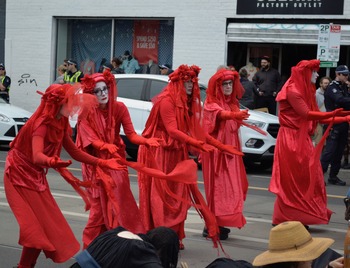
Consider the Red Rebels. On the final day of the Spring Rebellion in Melbourne, a march set off from base camp in the gardens and headed into Fitzroy, an adjacent suburb of the inner north. It takes some training to align one’s walking style so that you do not step on each other, bump into each other. The walking is measured but not without incident and often under the watchful eye of police officers, or at least their cameras with face-recognition capability. The outer limit of the march was on Brunswick Street, Fitzroy. Police in uniform formed a line to mark the point at which the marchers would be required to return to base camp. The marchers slowed, paused, and came to a halt. Beyond the police line, white police vans had been assembled, waiting to be used. The organizers made speeches and gave instructions. The drown-in was choreographed. Bodies lay down, as at the blockade. There was silence. You could hear the murmur of pedestrians, most having paused to watch and listen. The street itself was silent. Again, the cloth wave of blue over the bodies this time in postures both supine and torqued. After the drown-in, the Red Rebels performed against the backdrop of the police line (see Figure 1).
Red Rebels, Spring Rebellion 2019, Melbourne © Peter D. Rush.

The Red Rebel Brigade is a group aligned with XR; it was initially formed by a Bristol circus group in response to the XR Spring Uprising in April 2019, London. It draws on the gestural vocabulary of the Butoh tradition of Japanese theatre. Butoh performance is a training of the body and the self that disrupts the force of socialization, through crafting moments of shock and randomness. It disrupts so that the movement of the dance becomes sensitive to the human environment in which it is enveloped:Footnote 11 “Butoh specifically developed as a physical performance intentionally overlaid with strata of gestures, images and text that was meant to resist interpretations.”Footnote 12 Draped in red flowing folds, with white painted faces, the Red Rebels move in procession and tableaux. The performers are slow, unspeaking, and silent. It is a matter of “slowing everything down in all your movements” and makes it “a challenge in the quite hectic and intense environments and situations we often find ourselves in.”Footnote 13 On Brunswick St Fitzroy, they stand in line, bodies bent slightly forward from the hip and knee, leaning forward with arms outstretched and hands turned palm up. Sometimes the arms rise above their heads in a chorus of supplication, holding “their stances in this stillness”Footnote 14 as they move forward together. It is a tensile choreography of stasis,Footnote 15 of a mourning rite and grief at a standstill.
XR’s repertoire of bodily gestures reinscribes the place of the city within a tactical as well as an affective movement of protest. How then did policing respond?
Policing also uses an extensive repertoire of place-making. Marches that process along streets are kept to the road, as police walk along the footpaths on either side. In effect, the procession is funnelled as a canal orients a river. Site-specific protests were also enclosed. When intersections are occupied, protesters are encircled by police; arrivals and departures are controlled. The sheer presence of horses and vans, as well as the massification of police, contribute to this experience of threat. The use of audiovisual recording monitors the movement here and into the future. These are some of the techniques that realize shifting institutional—both legal and social—policies of policing. Operational decisions are increasingly structured by the use of public order response teams and strategic operations units within Victoria Police. In this, the policing of protest is part of an orientation that supplements the formal approach of “negotiated management” with “strategic incapacitation.”Footnote 16 In addition, media communications are used to pre-emptively frame the protest as unlawful or at least disorderly, even while the negotiated management is on foot.
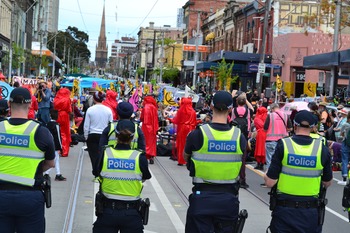
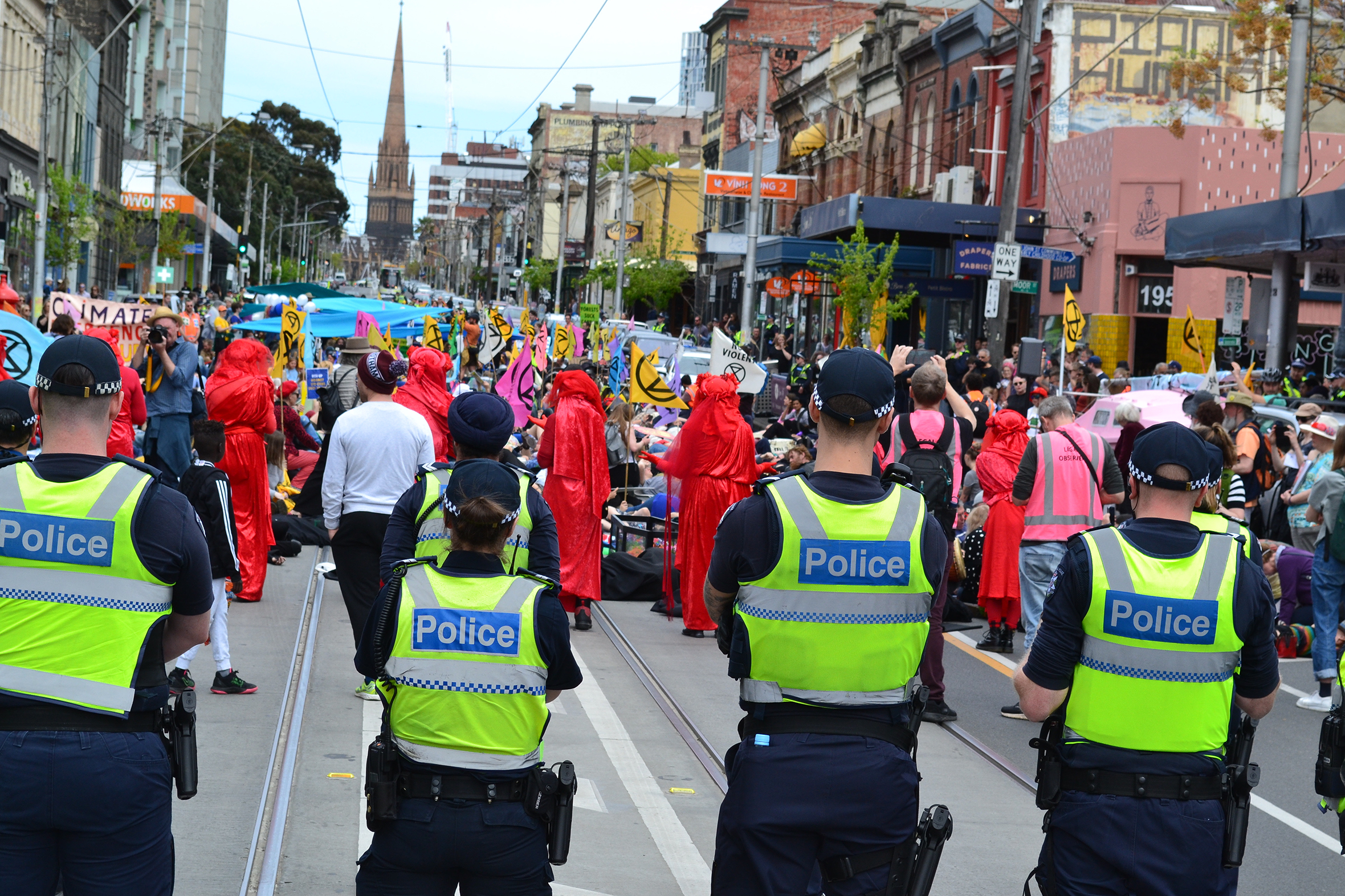
Everyday police decision-making about persons in place is structured by an association of public order with public places. Funnelling, enclosing, massification both pedestrian and equestrian, uniforms, and the wearing of holstered guns and capsicum spray canisters—all these repertoires and more choreograph the protest as always already a problem of disorder in public places (see Figure 2). This association is so pervasive that all public order is always and already in the process of turning into disorder because it is in public places. Place-making is part of what Alison Young has called the atmospheres of criminal justice, and Illan rua Wall the atmotechnics that generate the affectivity of policing public order.Footnote 17 The jurisdictions of policing are expanded, at the same time as the sense of place attached to public disorder is intensified.
Policing and protest, Spring Rebellion 2019, Melbourne © Peter D. Rush.
It is in this context of policing that XR’s Spring Rebellion in Australia can be understood. To the above-mentioned repertoire of place-making was added the police use of strip searches, arrests, charging practices, and bail decisions.
Nearly all XR protests have involved arrests by police.Footnote 18 They have increasingly used “preventative” arrests when policing protests. The question is not whether you will be arrested, but whether the exercise of the power to arrest will be suspended on this particular occasion. As one police officer was overheard to say to a number of other police officers on the outskirts of XR Melbourne’s base camp, “I’ve just been told there will be no arrests today.”Footnote 19 This was the last day of the Spring Rebellion. Yet during the week there had been more than 200 arrests in the various Spring Rebellions that took place in Melbourne, Sydney, Brisbane, and Perth.
The charges that provided the basis of arrest were mainly “obstruction” charges. They are a legal species of assault and in this instance are more specifically characterized as resisting or obstructing a police officer in the execution of their duty. Relevantly, the obstruction charge may also extend to the activities of an emergency worker,Footnote 20 as when protesters block intersections and bridges, which could (but may in fact not) prevent passage of an ambulance. Ironically, the police response to the blockade of Princess Bridge during the Spring Rebellion was itself to block the bridge, so pedestrians had to find other avenues to cross Birrarung/Yarra River. During the Spring Rebellion, fines of $360 were levied against those arrested. Yet others were charged with offences that had a maximum penalty of five years’ imprisonment. For example, more serious charges with sentences of imprisonment were brought against those whose linked arms at intersections within tubes that were glued to the street surfaces.
Once arrested and charged, the question of bail arises. Reforms to bail in recent years have made it more difficult for many accused to get bail; instead, the people are held on remand, with consequential hyper-incarceration in Victoria and New South Wales. Moreover, bail provides the most explicit and formal link between law and place in relation to policing protests. Bail, as we have come to expect, has place-based conditions.Footnote 21 Protesters were bailed subject to place-based conditions, such as exclusion of the bailed protester from being in the city centre or from being in touch with other members of XR.
As an illustration of all these legal techniques used by police, consider the Warner and Ludlam case. At the start of a week of protests in Sydney, dozens of protesters were arrested. Some pleaded guilty and were fined, others were released on bail without conditions. Kim Warner and Scott Ludlam, the latter being a former Green Party senator, were physically removed from a sit-down blockade and then charged with an obstruction offence, for disobeying police directions regarding a road closure. The offence carries a maximum fine of $2,200.Footnote 22 The police bailed them both. In respect of Ludlam, they attached a condition that he not come within a 2.5-kilometre radius of the CBD. In respect of Warner, they attached a condition requiring her not to associate with other members of XR. In addition, in relation to both bailees, they were required not to attend further protests. Both then successfully brought a court challenge to these person-and-place-based conditions. The magistrate replaced the conditional bail with unconditional bail. Unconditional bail simply requires the bailee to be of good behaviour and does not attach place-based conditions. The place-based conditions that had been imposed by the police were absurd and excessive: absurd because they could not appear in the Local Court at the Downing Centre in the Sydney legal precinct that is located within the 2.5-kilometre exclusion zone; and excessive because the person conditions were more associated with those charged with terrorist offences or charges levied against bikie gang members.Footnote 23
The Ludlam and Warner case condenses the choreography of place-making embodied in policing the rebellion. Just as XR is a remaking of place and its senses, so too is policing a remaking of public places. Policing reinscribes place—through the exercise of searches and arrests, through charging practices and bail conditions—within an administrative order of regulation. The policing of XR takes place within an order that at once expands and intensifies the juridical value and meaning of public places.
The environmental emergency, and specifically the climate emergency, has introduced a sense of urgency to the responses and responsibility for addressing the emergency. As one banner on the XR marches puts it, “how dare you.” Without disagreeing that the social and political situation of climate change demands, as with a letter of demand, an urgent response, in this vignette the account has focused on the ways in which place-making and a sense of place are generative. Place has appeared in this account in various ways: as a question of scale (local and global representing the scale of the emergency), as a matter of location (the territorial occupation and representation of specific sites such as bridges and city intersections), as well as a choreography of bodies and their affective attachments to place (die-ins, drown-ins, funeral marches, and the slow movements and gestures of the Red Rebels). From a law and society perspective, what comes into view is a practice of law understood as administration. Such administration attaches laws, not so much to rule as to the regulation of social spaces in the ordering of civil society.
In the next two vignettes, I turn to the question of law not so much in terms of the administrative ordering, but as the form and topic, technique, and place of judicial judgment. While the administration of civil society provides much material for our accounts of the context of climate change, the concern in what follows is with the textuality of law and its judgments. In doing so, the account moves from law and society to the jurisprudential concerns of law and humanities.
3. Landmark judgments
A landmark, from the Old English word landmearc, is an “object in the landscape which, by its conspicuousness, serves as a guide in the direction of one’s course.”Footnote 24 The Gloucester Bucketts in New South Wales might be such a landmark, or the Central Highlands in Victoria—the former because of the way it stands out against the pastures and the town of the valley, the latter because the Highlands are the habitat of native species of possum and the tall eucalypt forests of mountain ash. Both landmarks are sites of landmark judgments concerned with anthropogenic environments—species extinction and logging operations in the Central Highlands, climate change, and coal mining in Gloucester.
But a landmark judgment takes its bearing from the landscape of law and its decision runs its course guided by a sense of place. In one sense, and simply as a metaphor, the landscape of law here might refer to the taxonomy of legal subjects and their specific legal categories or causes of action—planning law oriented much of the terrain of environment law and specifically climate-change law, but the subject matter of other legal forms of speech have begun to make their marks—human rights law, negligence law, financial law, corporate law. These are the already-existing places of legal discourse. In another sense, however, the metaphor of landscape draws our attention to the address of law—the topoi or places of forensic and judicial speech. These are the topics that orient, guide, or order the languages of law. In this sense, this part is concerned with the topography of judicial judgment. The wager is that reading this topography can assist in understanding the ways in which climate change and species extinction are held, or not, in relation to the jurisdiction of law.
3.1 Uncanny emblems of judgment: possum, place, and extinction
The law communicates itself in each image.Footnote 25
How is it possible to write a judgment that draws the extinction of wildlife into relation to the conduct of law? The lineaments of a response can be ordered in terms of the topic and place, the form and technique, of law. These will be unfurled by reference to the text of the recent judgment in Friends of Leadbeater’s Possum Inc. v. VicForests (No 4) [2020] FCA 704.
Central to the legal proceedings in the case was the lawfulness of the operations of VicForests, a Victorian state agency, and the effect of those operations on two native species of possum—namely the Greater Glider and the Leadbeater’s Possum. Both species of possum are at risk of extinction either immediately or in the medium-term future. But more importantly, they are listed as threatened species and as such the operations of VicForests are regulated by the Environmental Protection and Biodiversity Conservation Act 1999 (Cth). This is an Australian commonwealth statute implementing obligations under international environment law. It regulates conduct that affects “matters of national environmental significance.” Such matters include National Heritage places, wetlands of international importance, and listed threatened species and populations. The Greater Glider possum is listed as “vulnerable” and the Leadbeater’s Possum is listed as “critically endangered.”Footnote 26
The proceedings in the case were brought before the Federal Court of Australia. The court held that VicForests logging operations in some 67 coupes were not or were not likely to be conducted in accordance with the Central Highlands Regional Forest Agreement, an intergovernmental agreement between Victoria and the Commonwealth.Footnote 27 Given that it was found that the logging operations in relation to the coupes were not being conducted in accordance with the agreement, VicForests was unsuccessful in its argument that its operations were exempt under the Environmental Protection and Biodiversity Conservation Act 1999 (Cth). Furthermore, its operations contravened the statutory prohibition on engaging in actions that had or were likely to have a significant impact on listed threatened species—and here specifically the two native species of possums.Footnote 28
The evidence in the digital trial proceeding is mainly scientific, and mainly composed of testimony and reports. Justice Mortimer found that the evidence demonstrated that the relevant logging coupes in the Central Highlands contained high-quality habitat critical to the survival of the Greater Glider and the Leadbeater’s Possum as species. The logging coupes were in conflict with the habitat of the native possums, and inimical to the survival of the species. Moreover, the forestry management was contributing to their extinction or, in the negative terms of prevailing legal discourse, was failing to put a stop to the extinction of the possums. The court found that VicForests’ forestry management of logging and conservation, which was designed to arrest the decline of the possum populations, was ineffective in achieving its aims. This was because of the destruction of species habitat.Footnote 29 But it was also because of the “fragmented landscape.” The landscape does not exist in a vacuum: it has been parcellized by legal taxonomies into national parks, reserves, and state forests. The resulting fragmentation negatively impacts the habitat of the possums: it isolates communities, affecting genetic diversity needs and biodiversity values. In sum, the long-lasting effects of the destruction of habitat and of the fragmented landscape dramatically impact the continued existence of the possum populations in the region. The risks of extinction were either high (for the Greater Glider) or extremely high (for the Leadbeater’s Possum) and VicForests, despite its aims, were not preventing but in fact exacerbating their extinction. Moreover, as Justice Mortimer remarks:
it is well-accepted on the scientific evidence, and in the expert opinion, that there are large and presently unaddressed risks to species such as the Greater Glider from climate change and the warming of the environments in which they live.Footnote 30
On a first read, the foundation of the judgment is based on the state and commonwealth laws, the scientific evidence, and the impacts of VicForests’ actual conduct. The focal images of the judicial narrative are of native possums and their habitat, juxtaposed with the logging operations and their coupes.
While it is the legal framework and the evidence of scientific experts that relate these images to species conservation or extinction, nevertheless, it will be argued, they are enfolded within an aesthetic inscription of environmental values,Footnote 31 and specifically of habitat values. The spur to this reading is the appearance in the court’s judgment of two photographs. Both photographs are of possums and, although not stated as such in the judgment, their placement implies that one is an image of the Greater Glider and the other is an image of the Leadbeater’s Possum.
While photographs increasingly make an appearance in contemporary legal discourses of judgment, they remain out of place according to the conventional and word-based grammar of legal reasoning. At most, they appear as evidence—in this instance scientific evidence and its methods of visualization. For example, the two attachments to the judgment are concerned with mapping the Central Highlands Regional Forestry Agreement Area in terms of its logging coupes, forest management zones, public land, as well as in terms of a biodiversity atlas of species. Yet here the two photographs are placed early in the judgment, before the evidence is recounted. Moreover, they are untitled, uncredited, and unmentioned. The images are out of place and it as such that they should be read. This gives form and figure to the writing of law in its relation to the representation of habitat values and the threatened extinction of the possums. They are uncanny emblems of legal speech in relation to the environmental emergency embodied in species extinction.
Amitav Ghosh, novelist and essayist, speaks in The Great Derangement: Climate Change and the Unthinkable of the “environmental uncanny.” This can help frame the close reading of the two photographs. In trying to find words, a word, for the “strangeness of what is unfolding around us,” Ghosh has recourse to the uncanny. The events associated with changing climate conditions are
[n]ot merely strange in the sense of being unknown or alien; their uncanniness lies precisely in the fact that in these encounters [with climate events] we recognize something we had turned away from: that is to say, the presence and proximity of nonhuman interlocutors. Yet now our gaze seems to be turning again.Footnote 32
Although the event of climate change is radically non-human, specific conditions are nevertheless animated by cumulative human actions, put together piecemeal yet also resistant to our habitual frames of reference. The novelistic form and the writing of history and of politics are the references for Ghosh. His account nevertheless assists in reading the way in which the two photographs are emplaced and enfolded within the textuality of law. They are uncanny emblems of legal place-making because they speak of place in terms of habitat and of extinction, but also because they are the topic of legal speech.
Emblems have a long history in the legal tradition:
what is most striking is that in the mens emblematica—the emblem tradition—it is the image, the implant, the visibility inserted that takes priority over both word and text. The image, in making visible, in bringing the dead letters of the law to life, is itself a form of legislation, a making of the rules, an enactment of the norm.Footnote 33
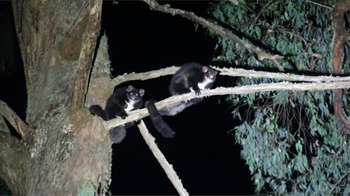
The first photograph is an image of the Greater Glider and its habitat (see Figure 3). It is the first of the “species in issue” in the judgment. But the species must be read in conjunction with its habitat. The Glider is an arborial species. During the day, it shelters in tree hollows formed especially in old-growth eucalypts and montane ash. It is a hollow-dependent species and, as one of the experts remarks in evidence, “there are no fauna species that make hollows in Australia” and so “it depends upon the rot and decay and senility of the trees themselves for the hollows to form.”Footnote 34 The eucalypt is here an emblem of senility, of old age. It takes time to make a place, a habitat, for the marsupial verging on extinction. Moreover, this is said to be a distinctively Australian ethic, since unlike the woodpecker in the US, there is no faunal assistance in producing hollows in which the possum is able to dwell. It also carries the different times of habitat and extinction: habitat takes time but their extinction will be quick.
Greater Glider, image included in Friends of Leadbeater’s Possum Inc. v. VicForests (No 4) [2020] FCA 704.

The Glider is also a nocturnal species. It waits for the going down of the sun; the photograph is taken at night. Although it is a colour image, what the image picks out is the play of dark and light. The two Greater Gliders are placed in the centre foreground of the image, crouching in the forked branch of a eucalypt, lit against a pitch-black background. The camera captures the Greater Gliders bright-eyed and staring back at the viewer of the photograph, as if both viewer and viewed are caught in freeze-frame. The affect of the pitch-black tonality can be understood as melancholic. As Justice Mortimer will end her account of her general findings regarding the Greater Glider species in The Life of Marsupials (Reference Tyndale-Biscoe2005), a key source of one of the scientific experts is a
text which paints a gloomy picture of the capacity of the Greater Glider to survive forestry operations even in the short to medium term, if they are not killed by the logging event itself. It paints an equally gloomy picture of the capacity of the Greater Glider to move to unlogged forest, or to recolonise logged forest.Footnote 35
The lustre of the photographic image carries what the words of scientific description cannot say and do. It narrates not only the impact on and loss of habitat, not only the admittedly high risk of extinction. It is an emblem that visually narrates the attachment of judgment to the dark and saturnine humours of a melancholy. This landmark judgment of law is uncanny because, as a landmark, it is attached to the scientific representation of the evidence, yet as a judgment, the photograph of the Greater Gliders relates law to the affective emblem of senile and arborial habitats for a nocturnal and dark marsupial.
The second photograph also concerns a small nocturnal and arborial marsupial, but the species in issue is the Leadbeater’s Possum (see Figure 4). In the Latin idiom of scientific taxonomies, it is Gymnobelideus leadbeateri. But it is the emblematic idiom that will concern me. As many have noted and moved on, the Leadbeater’s Possum is the faunal emblem of the state of Victoria and is endemic to that state. It is worth tarrying awhile with a photographic image that also claims the title and authority of emblem.
Leadbeater’s Possum, image included in Friends of Leadbeater’s Possum Inc. v. VicForests (No 4) [2020] FCA 704.

The possum is named after John Leadbeater, a taxidermist at the Museum of Victoria at the time that two specimens were brought to the museum in 1867. It was thought to be extinct in the early years of the twentieth century due to both the clearing of habitat and also the scarcity of specimens. However, it was sighted in Maryville in the Central Highlands of Victoria in the 1970s by Eric Wilkinson, a geologist working at the museum as an assistant in the fossil department. Two days later, Wilkinson gets evidence in the form of photographs: one side-on and one from the rear.
Sideways seems to be the preferred posture for photographs of the Leadbeater’s Possum. Here, the possum is displayed side-on, upright, and nestled amongst foliage. Again, possum and habitat are framed against an impenetrable black background. The provenance of this photograph is also unclear and uncredited. Perhaps it is one of the many that have emerged from the new wildlife survey technique, developed by David Lindenmayer, known as “stagwatching.”Footnote 36 Lindenmayer describes the technique as observing and counting animals emerging from stag trees—old and large trees in which hollows become their nest and den sites. These ancient trees with their hollows are central features of the Leadbeater’s Possum habitat. The technique takes place at dusk, and watching involves sitting on the forest floor and looking up to the silhouette of the stag tree against the night sky.
But the possum needs to be read against the dark sky and in relation to the cultural production of the possum. The photograph is a pictorial emblem whose allegoresis is not only confined to the scientific and technical description of taxa and habitat, but extends also to the legal and cultural significance of the possum.
Possums are an emblem with a multivalent wealth of associations. As the specific focus of stag watching, the Leadbeater’s Possum speaks of scientific method and the immersive contribution of the public to that method.Footnote 37 It is the name of the community group that brings the legal proceedings against VicForests in the Federal Court of Australia: The Friends of Leadbeater’s Possum Inc. was formed to “give a voice” to the possum.Footnote 38 “Voice” here is a mode of relating, of forms of association—whether friendship or scientific.
The Leadbeater’s Possum is also colloquially known as a fairy possum, and is often used in environmental campaigns by environmental organizations such as the Wilderness Society. More generally, the opossum is the friendly furry creature, sometimes a rowdy neighbour, that takes up residence in the roofs of city dwellings and forage on the garden flowers. The flowering money tree (Crassula ovata, or jade tree) is popular. Backyards are inundated by possums sitting on the Hills Hoist clothesline staring at the human settler. Ring-tailed possums have featured in picture books and Christmas displays. Jo Watson’s Larry Leadbeater: Field Notes from a Fairy Possum tells the story of finding a home that is just right.Footnote 39 Mem Fox’s Possum Magic has sold nearly 5 million copies, and was the subject of a Christmas diorama in the shop windows of the Myer department store in Melbourne. The “soft and cute” possum, according to the author, was chosen because of its iconic association with Australian native fauna.Footnote 40 And in a more hermeneutic vein, the possum is a trickster and cryptic. As the commonplace puts it, “playing possum” is a matter of acting dead to avoid its predators. Across the Tasman Sea in New Zealand, the possum is despised: legalized extermination is rewarded. “It is the possum’s close historical affinity with the pakeha (European) New Zealanders that,” according to Nicholas Holm, “underpins the persistent presence of possum-hatred.”Footnote 41 The possum haunts the ecology and image-work of the nation-state, creating a “sense of things being out of place”—not so much metamorphosis as anamorphosis.Footnote 42 Indigenous communities and artists in Victoria have taken up possum-skin cloaks as an emblem of the loss associated with the colonial destruction of community, as well as the resurgence, healing, and vitality of culture, and especially the place of women in their craft and law.Footnote 43 In a strange way, the history of the possum cloaks parallels and crosses with the naming, loss, and rediscovery of the Leadbeater’s Possum. The cloak, and its designs, creates a sense of place and forges a renewed attachment to country.Footnote 44
So far, this account has argued that the two photographs can be and are understood as emblems. They are out of place and overlooked in conventional accounts of legal judgments. Indeed, they are unacknowledged in the judgment under discussion here. Nevertheless, they have an uncanny significance as the topic of the judgment. They give a sense of place to the legal category of habitat. And as a technique of law, the emblematic photographs place law into relation to species extinction and climate change. If such a performance of jurisdiction seems surprising, one last example from the judgment makes explicit the link between faunal and floral emblems and the creation and maintenance of legal authority.
Consider emblems of the Federal Court of Australia itself. Water provides the insignia of the courts of federal jurisdiction: entrances to the court buildings in Melbourne, Adelaide, and Canberra are accompanied by bodies of water, often in motion, sometimes dried up as if in drought. In the Commonwealth Court complex in Melbourne, the written text of the Commonwealth Constitution is inscribed on the glass exterior of the building instead of on the traditional vellum, or calf skin. Just as the design of court buildings must perform the jurisdiction of the court, so too must its texts: they must create and maintain the form and topic, the techniques and places, through which judgment takes place. Perforce, floral and faunal emblems proliferate, even if unacknowledged by many.
The judgment in the Leadbeater’s Possum proceedings is framed and preceded by the emblem of the Commonwealth coat of arms. On the court’s website, it makes an appearance on the top left of the judgment. As Cornelia Vismann recounts: “The emblem establishes a frame in order to see at all …. One sees nothing without the framing or instruction of what one is supposed to be seeing.”Footnote 45 The emblems here are kangaroo and emu, and golden wattle, all of which frame and uphold the specifically federal jurisdiction of the Commonwealth in relation to the several state jurisdictions. The composition of this emblem creates, conserves, and communicates legal authority through faunal and floral emblems.
The Commonwealth coat of arms was granted by royal warrant (King George V) in 1912.Footnote 46 Although often presented in colour, here it is in black and white. How is it composed? At the top is the seven-pointed Star of Federation resting on a wreath. In some official versions, the word Australia is emblazoned on the image, as if the word confirmed the image. In the Federal Court, the image does all the work of jurisdiction. In the middle is a shield inscribed with the six states of Australia. Analogically, the shield represents the nation as a federation of states. The shield however is supported by two animals, pictured: a red kangaroo and an emu. They are in profile, with heads slightly skewed as if glancing at the viewer. Although not the official animal emblems of the Australian nation, the kangaroo and emu are often treated unofficially as emblematic of native fauna, in much the same ways as the opossum. The animals stand on and are supported by a golden wattle. This arborial signifier is an official emblem. Not only does it support the animals that themselves prop up the heraldic icons of the states on the shield, but also the expanding branches and leaves of the golden wattle visually tie the separate components of the design together. The wattle wraps all the signifiers of place and authority in an embrace. In fact, it is the official and not-so-official images of flora and faunal emblems that inscribe the authority to make laws for the peace, order, and good government of Australia.Footnote 47
And this is also the case in the judgment of the proceedings brought by the Friends of the Leadbeater’s Possum Inc. The lawfulness of the actions of VicForests was a question that took place at the intersection of two laws—commonwealth and state, and in relation to an intergovernmental agreement and state codes of practice for the timber industry. The photographs of the Greater Glider and the Leadbeater’s Possum precede and shape the hierarchies of law, and of relations between law and the administration of logging and other forestry operations, in the context of wildlife extinction.
The question of relations between law, logging operations, and the extinction of threatened species of possum has been addressed here as a matter of both science and aesthetics. Where the science provided the evidence in the judgment, aesthetics has drawn our attention to the affective technique of emblems that shape the contest between logging coupes and possum habitats. The allegoresis of the emblems construct both the place-making of coupe and habitat, as well as the place-making of judgment. In the final vignette, the narrative follows the thread of place-making into the topic of the impacts of coal mining on climate change. Rather than reading the emblems of judgment, the focus is on the idiom of “impacts”—a commonplace category and problem of environmental law. In doing so, it becomes possible to more precisely locate the impact on a sense of place in relations between law and policy in discourses of climate change.
3.2 An embrace of topography
Jurisdiction consists less in enunciating the absolute of law, or in unfolding its reasons, than in saying what the law can be here, there, now, in this case, in this place. (Jean-Luc NancyFootnote 48 )
Australia’s natural environment and iconic places are in an overall state of decline and are under increasing threat. The pressures on the environment are significant—including land-use change, habitat loss and degradation, and feral animal and invasive plant species. The impact of climate change on the environment is building, and will exacerbate pressures, contributing to further decline. Given its current state, the environment is not sufficiently resilient to withstand these threats. The current environmental trajectory is unsustainable. (Independent Review of the EPBC ActFootnote 49 )
The Gloucester Bucketts is a toponym—both a place name and a title of a painting. The place—call it a valley or hill or rocky range, a town, or landscape—is the subject of a landmark judgment in the legal discourses of climate change: Gloucester Resources Limited v. Minister for Planning [2019] NSWLEC 7 (hereafter Gloucester). The question of place in the previous vignette concerned wildlife extinction—constructed legally and emblematically as the habitat of two native possum species that were listed as threatened species and hence of national environmental significance. In this vignette the question of place-making is turned towards relations between law, judgment, and climate change. The Land and Environment Court’s consent to a planning application for an open-cut mine is narrated in terms of the “impacts” of the proposed mine on a “sense of place.” Of interest is the way these impacts on a sense of place are related to the idioms of climate change as well as the address of judgment.
Staying for a moment with the aesthetic production of place, it can be noted that, in the course of handing down its judgment, the Land and Environment Court of NSW, in the person of Preston C.J., makes reference to Gloucester Buckets, a 1894 painting by Arthur Streeton held in the Art Gallery NSW collection.Footnote 50 Streeton is a late nineteenth-century artist associated with an Australian species of impressionism that was itself something of a rebellion. The activity of painting would be conducted outdoors rather than in the studio, and would not follow the rules of academic painting. Australian impressionism paid attention to the problems of light and heat and space and distance—understood as momentary effects—in the painting of place. In our landmark judgment, the visual impact experts evidenced the “high aesthetic significance and landmark quality” of the Gloucester Bucketts.Footnote 51 Similarly, the landscape and its scenic quality were adjudged by another expert:
In my view, the area surrounding the proposed mine site is a unique and distinctive setting, given the presence of the monolithic Bucketts Range which is both unique and imposing, particularly when viewed in its juxtaposition with the human scale of the town. The Bucketts Range and its surrounding scenery is clearly the dominant element within the surrounding context.Footnote 52
Area, site, setting, scale, scenery, context … landmarks dominate in an idiom of place that is geographic and representational. Or as in Streeton’s painting, the landscape obtains its “emotive and iconic” significance through the juxtaposition of the Buckett Ranges with the “rolling pasture.”Footnote 53
Their dominance is legible in the scene-setting of the judicial judgment. It deserves to be quoted at length:
There is a valley, near Rocky Hill, that a coal mine proposes to cut and fill. The Gloucester valley is a creature of a unique topographic feature. The valley is the floor of a nest, the sides being ranges east and west. The Bucketts is the rocky range to the west. The Mograni range is the mountain range to the east. Both ranges are forest clad. Over aeons, the ranges have eroded. The foothills are talus and slopes, broken by gullies and creeks. The valley floor is an alluvial plain, through which the Avon River flows.
In this topographical embrace nestles the country town of Gloucester. The valley and footslopes surround the town. The higher ranges complete the enclosure. The setting is scenic and serene. An idyll, some suggest.
Beneath the surface of the valley lies the mineral resource of coal. Geological forces have pushed productive seams of coal near to the surface in the valley beneath Rocky Hill.
A mining company, Gloucester Resources Limited (GRL), wishes to mine this coal. It has proposed an open cut coal mine to produce 21 million tonnes of coal over a period of 16 years.Footnote 54
These opening paragraphs of the Gloucester judgment are redolent of a judicial narrative of place. With its recourse to a rhythm and rhyming of language, and the density of its linguistic evocation of a “topographical embrace,” it inscribes a sense of place. This is judgment as a topography, as a writing of place—here in a pastoral genre that pits landscape against the incursions of industrial technology. From the outset, we know what the judgment will conclude—even before the narrative has traversed the cross-currents of the various environmental impacts evidenced, argued, and recounted. The Gloucester judgment comes to a punctual conclusion: “In short, an open cut coal mine in this part of the Gloucester valley would be in the wrong place at the wrong time.”Footnote 55
The legal setting can be stated in short compass. GRL submitted a development application for its Rocky Hill Coal Project to the NSW Minister for Planning. The Project involved building an open-cut mine and conducting associated activities, for the purpose of extracting coking coal from a valley near Rocky Hill on the north coast of the state. The coal would be used overseas to manufacture steel. While the mine itself would directly generate carbon emissions, the extraction of fossil fuels and the downstream greenhouse gas (GHG) emissions would also contribute to climate change. As is well known, Australia is one of the biggest fossil-fuel extractors and indeed this is one of the main ways in which the country contributes to climate change.
Several local communities were formed specifically to oppose the Rocky Hill Coal Project. The names of the groups referenced iconic toponyms in the area: Gloucester Groundswell, Barrington-Stroud Preservation Alliance. In addition, the indigenous custodians in the region—the Worimil and Gooreengai peoples—attested to the loss of connection to country both now and into the future should the mining project go ahead. The Minister for Planning refused development consent. And it is against this refusal that GRL appealed in the Land and Environment Court. The task of the court was to conduct a merits review—the court itself was now obliged as a matter of law to grant consent or not to the development application. As mentioned, the court refused: the mine was in “the wrong place at the wrong time.”
Its judgment is expansive in its narrative of the proposal for the mine and in its representation of landscape that is not so much a featureless expanse, as a dramatic, iconic and emotive experience. The narrative inscribes not simply a place, but a sense of place. This is significant enough in itself to mark it out in the annals of planning and environmental law. But the legal topography here is more specific: it concerns “impacts” on such a sense of place. It is to the judgment’s account of impacts then that we can turn to unfold the way in which a legal topography is held to both climate change and the address of judgment.
The idiom of impacts is a commonplace one in planning and environmental law. As the judgment in Minister for Environment and Heritage v. Queensland Conservation Council [2004] FCAFC 190, at [53] argued, the definitional scope of impact is expansive:
“Impact” in the relevant sense means the influence or effect of an action: Oxford English Dictionary, 2nd ed. vol VII, 694–695. As the respondents submitted, the word “impact” is often used with regard to ideas, concepts and ideologies: “impact” in its ordinary meaning can readily include the “indirect” consequences of an action and may include the results of acts done by persons other than principal actor. Expressions such as “the impact of science on society” or “the impact of drought on the economy” serve to illustrate the point.
Impact spells out a relation. Causality is often used in policy discourses: as in the above quotation, impacts attribute a relation of cause and effect. To build a mine could thus cause a range of impacts on various scales of place (local, national, international, global), as well as various registers of sense and sensibility (air, sound, sight, touch, but also emotional). When addressing impacts on a sense of place, the relations signified are sensory: an affective encounter of bodies. Impact includes the contact of two bodies in motion: an impingement or an impression, the force of an impression on the eye or other bodily senses. The legal idiom of impacts speaks not so much of cause and effect as “affects,” “contributions,” and “influences.”Footnote 56
The impacts on a sense of place that the judgment narrates are several and various. Three are illustrative. The first concerns the vicinity or amenity of a place, and relates the impact of the proposed mine to the local community. The second concerns Indigenous attachment to country and relates the impact of the proposed mine to the legal significance of visual amenity, landscape aesthetics, and cultural heritage values. Both of these are treated as social impacts on a sense of place. The third concerns climate change and relates the impact of the mine on a sense of place to the global reduction of GHG emissions. It is this last that turns the judgment into a landmark judgment, not because it is an illustration of a new direction of policy and ideology, but because of its account of legal judgment. They can be taken in turn.
One of the legal considerations under the relevant statutory scheme when assessing the impact of the proposed mine is its impact on the uses of land in the “vicinity” of the mine. The court evidenced and argued that such considerations involve “not only the proximity or nearness in space of the uses of land to the proposed mine, but also visual considerations and ‘demographic and geographic features of the area’.”Footnote 57 From a planning perspective, being in the neighbourhood of the open-cut mine extends beyond the uses of the land directly abutting the site of the Rocky Hill Coal Project. In fact, what lies within the vicinity will turn on the nature and extent of the impacts of the proposal. Or put in terms of a sense of place, it depends on the experience of the vicinity. As a corollary, it is the impacts themselves that establish what counts as vicinity. Consider the visual sense of vicinity: this is not restricted to a fixed person or a fixed geographical point from which the neighbourhood is viewed. The legal determination of vicinity is not only a matter of whether you can see the Buckett Ranges while sitting in an armchair in your living room and looking out the window; it may include riding your horse through the pastures and landscape. While point of view may move, it is also attached to a person who may also move: residents and tourists come in and out of the neighbourhood of the mine.Footnote 58
Such an expansive sense of vicinity begins to shade into the “amenity of a place.” Impacts on visual, acoustic, and air-quality amenity are often reduced to the behavioural idiom of cause and effect. But what has received less attention in the discourses of policy is what the judgment calls the amenity of a place. As with vicinity, “the concept of the amenity of a place or locality is wide and flexible” and “may embrace the effect of a place on the senses and the residents’ perception of the locality.”Footnote 59
Vicinity, amenity of place, and their associated geographical and visual considerations are in fact taken up and framed by the judgment in terms of the social impacts on a sense of place.Footnote 60 The Rocky Hill Coal Project, the judgment stated, “will severely impact on people’s sense of place.”Footnote 61 The concept of a sense of place draws the judgment into a legal consideration of the cognitive and affective senses through which local communities attach to and experience place. Impacts are not so much causal effects as bodily and corporeal affects, albeit socially constructed.
The experience of Indigenous peoples and their place-making is also narrated as the material of social impacts on a sense of place. The cultural significance of attachment to country for the Woromi and the Gooreengai of the Wonnaruah nation is heard throughout the judgment.Footnote 62 Reference is made to testimony of initiation rites, scar trees, burial sites, birthing sites, as well as a history of communal displacement and fragmentation. The significance of particular landmarks in the landscape was analogized to Uluru. And a “deep connection” is presented in the testimony of Kim Eveleigh, an elder of the Gooreengai:
We are the Aboriginal people of this land, so don’t you dare ignore us, pay attention and listen as this is our Spiritual connection to our land, we the Gooreengai people belong to the Significa[nt] Buckan Valley in Gloucester it is our past, present and future. If you allow it to be destroyed you cannot fix It, stop it before it begins. Everything from our Ancestors has been removed all we have left is our Dreaming of our land …
This is our land that has a strong spiritual history of the Dreaming, scar trees, grave sites, stories of Elders that dance upon this ground, men, women and family bora rings. …
Along the range there are many birthing water holes and shelters and there were once women’s paintings that were destroyed by Europeans. The valley is a Significant Sacred place as this is our Ancestors daughters birthing and naming area, as they travelled over this part of the land they shared knowledge of our Ancestor’s medicines, hunting and gathering of food, the weaving of fishing baskets while singing to the spirits of the Ancestors.”
In setting out the evidence on connection to country, the judgment corrects the record of the mining company. Its reports on the social impacts that failed to assess those impacts, either by surveying sites, engaging in proper consultation, or by making an adequate “acknowledgement of Country and landscape to the Aboriginal people.”Footnote 63 Nevertheless, the account of the social impact on a sense of place understood as attachment to country is assimilated to the legal values of landscape aesthetics and particular sensitivity to place,Footnote 64 as well as culture and heritage values. The latter is treated on a par with the social impacts on the cultural and heritage values of the local settler communities. Country however is not land to be planned and regulated by state law, not a matter of quiet contemplation as in a museum or lounge room, nor landmarks for tourists, although all of these are part of the contemporary encounter of First Nations people and settler laws of Australia.
The account so far has tracked the ways in which a sense of place is crafted in relation to the formal and textual legal categories of environmental and planning law. The final example is less straightforward. It concerns how the judgment relates the proposed open-cut mine to climate change. The route it takes is via GHG emissions.
The judgment’s approach to the topic of climate change generated quite a good deal of heated media and government commentary. The first point to note is that the conclusion of the judgment—“wrong place at the wrong time”—is primarily a reason derived from the social impacts on a sense of place. As the judgment states, “refusal of the Project will not only prevent the unacceptable planning, visual and social impacts. It will prevent a new source of GHG emissions.”Footnote 65 The argument from a climate-change narrative is simply an additional and supplementary reason for rejecting the Rocky Hill Coal Project.
The second and more important point for the account developed here is that climate change is also presented in terms of impacts on a sense of place. The impacts of the proposed coal mine are adverse to climate change. This is so in two ways: one, the construction and operation of an open-cut mine would directly contribute to GHG emissions in Australia; and second, since the mine will extract coking coal that will be used overseas, it will indirectly impact on global climate change. As the judgment condenses both ways, “[a]ll anthropogenic GHG emissions contribute to climate change.”Footnote 66 What then of a sense of place? One obvious response is that “global” provides a sense of place. This is now familiar in debates about the environmental emergency. But the judgment introduces a specific difference: social relations of local and global are framed by the obligation of handing down a judgment according to law. On my analysis, the account of the impact of the coal mine is joined to a sense of place yet it is not only the place of global climate change, but also the particular address of judgment. This is why it contributes to a renewed jurisprudence of place in relation to climate change.
The first move in the jurisprudence of the judgment is to construe the GHG emissions of the proposed coal mine. We could readily admit that there might be some argument to be had about how to calculate the actual GHG emissions of the proposed coal mine. We could also concede that the amount of GHG emissions from the Rocky Hill Coal Project would be proportionally quite small when compared with the total amount of global GHG emissions. However, such an admission and concession are not to the point. They are a red herring. Chief Justice Perram says as much and affirmatively: “The global problem of climate change needs to be addressed by multiple local actions to mitigate emissions by sources and remove GHGs by sinks.”Footnote 67
The relation between the proposed mine on the one hand and local and global GHG emissions and thence climate change on the other is framed by the judgment in causal terms, at least initially, and eventually in the relations of contribution and affect. The proposed mine would be a cause of global climate change because the problem of climate change is generated incrementally, piecemeal, and cumulatively. Yet this is not straightforwardly a matter of causation, but of impact since, as Gray v. Minister for Planning [2006] NSWLEC 720, at [98] remarks:
that the impact from burning coal will be experienced globally as well as in NSW, but in a way that is currently not able to be accurately measured, does not suggest that the link to causation of an environmental impact is insufficient.
What it does suggest is that the idiom of causation needs to be redressed. If climate change works incrementally and cumulatively, or better piecemeal, then the language of impacts is better phrased in terms of contribution and affect. This idiom can also be read in the Gloucester judgment of Perram C.J. and the various state, interstate, and overseas judgments he references.Footnote 68 And it is the language appropriate to the precautionary principle of environmental law. The judgments in Urgenda Foundation v. The State of Netherlands, itself regarded as a landmark judgment, is perhaps the most relevant here.Footnote 69 Perram C.J. however makes explicit the variable idioms with which to phrase differential relations between terms:
There is a causal link between the Project’s cumulative GHG emissions and climate change and its consequences. The Project’s cumulative GHG emissions will contribute to the global total of GHG concentrations in the atmosphere. The global total of GHG concentrations will affect the climate system and cause climate change impacts. The project’s cumulative GHG emissions are therefore likely to contribute to the future changes to the climate system and impacts of climate change. In this way, the project is likely to have indirect impacts on the environment, including the climate system, the oceanic and terrestrial environment, and people.Footnote 70
How then is this plural idiom of impacts related to a sense of place as the address of judgment? This is the second step in the judgment and is figured in terms of law and policy.
The policy question in this context would be: How is it best to make emissions reductions—either by reference to cost-efficiencies or by reference to alternative means—that achieve the global task of abating climate change? Notice that the question itself is phrased in the instrumental terms of means and ends, causes and effects rather than contribution and affect: is the refusal of consent to a mining development application the best means to achieve the reduction of GHG emissions, at the same time as balancing other imperatives such as profit-generating efficiencies?
More specifically, this is the commonplace argument of market substitution and carbon leakage. Market substitution is the argument that if the mine is not approved then it will be built elsewhere, and hence no reduction or abatement of GHG emissions; refusal of consent to development will have no impact on the problem of climate change. Carbon leakage is similar. It is the argument that the mine will be built elsewhere but in countries where climate policies are worse than in Australia, or better but less efficient. These would be countries that are heavily reliant on coal, such as China, India, Japan, and South Korea.Footnote 71
The Gloucester judgment has two responses. One is that Australia, being a developed country, has a responsibility, as Perram C.J. put it, “to take the lead.” This responsibility is an obligation under the Climate Change Convention, the Kyoto Protocol, and the Paris Agreement.Footnote 72 Prevailing discourse tends to treat these conventions, protocols, and agreements as policy documents rather than legal obligations. The second response is that the court itself has an obligation: the task of judgment is not policy, but law. It is not a matter of “formulating a policy as to how best to make emissions reductions to achieve the global abatement task.” Perram C.J. explains it is not a matter of weighing the abatement task in the balance with social and economic harms. Rather:
The consent authority’s task is to determine the particular development application and determine whether to grant or refuse consent to the particular development the subject of that development application. Where the development will result in GHG emissions, the consent authority must determine the acceptability of those emissions and the likely impacts on the climate system, the environment and people. The consent authority cannot avoid this task by speculating on how to achieve “meaningful emissions reductions from large sources where it is cost-effective and alternative technologies can be brought to bear” (Fisher Report, [13]). Such emissions reductions from other sources are unrelated to the development that is the subject of the development application that the consent authority is required to determine.Footnote 73
The task is not one of policy—neither speculating nor balancing seemingly competing considerations. The wisdom or expediency of policy is for the government, and will be assessed by its obligation “to lead.” Rather, the legal problem of climate change is, in this court, a procedural matter before anything else. As procedure, we could think of it as the address or sense of place of a judgment on planning a coal-mining project. It is a judgment finely attuned to the speech and forum, the language and institution, of the court. As the epigraph from Jean-Luc Nancy recalls for us, jurisdiction—the topics and place of legal speech—consists of “saying what the law can be here, there, now, in this case, in this place.”Footnote 74 The mine is in the wrong place at the wrong time, and the judgment of the court is held to the place and time of the court and the planning application that it hears and determines. A landmark judgment, we might say, is punctual, even if for that reason it remains exceptional.
4. Coda: topogram
The environmental emergency of our times has been exemplified, in this article, by the extinction of wildlife species, the GHG emissions of fossil-fuel operations, as well as protests and the problem of climate change, all of which have become transnational and global. The question that animates the analysis has been: How to hold that emergency in relation to the prudence of law? My approach has been to work through the writing of place, or topography.
This article has been written in two places in two different times. I live and work in Melbourne, Australia, on the land of the Wurundjeri people of the Kulin nation. The topic was developed for presentation at the fourth annual meeting of the Asian Law and Society Association. The meeting took place in Osaka, Japan. Each morning and evening, I would walk between my hotel in the Kita area of Osaka to the University of Osaka where the meeting was being held, just as I walk when I go to my home university to work. In Osaka, I walked on Mido-suji Boulevard beside the river. This boulevard is the sister street of Swanston Street, Melbourne, just as Osaka has, for over 40 years, been the sister city of Melbourne. When I am in Japan, as in any city, I walk a lot. On this occasion, I would think about the meeting for the day and the paper to be presented. As often happens, my thoughts would become stuck on a phrase. This time it was two passages. They are related.
The first was from a speech that Shuzo Kuki, Japanese philosopher and sometime law student, had given on “The Expression of the Infinite in Japanese Art”: dotted along Mido-suji are sculptures, small and large. The speech or propos was given at a meeting he attended in Pontigny, France in 1928. Towards the end of his consideration of Japanese poetry and before he moved onto music, he speaks of a philosophy of the instant by repeatedly recurring to the place in which he speaks and those whom he addresses at the meeting. The instant, he says, exists as:
this moment we pass here … where I speak to you of Semimaru and where we wonder if we might not have lived this moment before, if we might not live it again, if we might not already become acquainted an indefinite number of times, if we might not become acquainted anew.Footnote 75
The Semimaru to which Shuzo Kuki refers is a poet of the ninth/tenth century. He is also credited with a topogram. The following is the second passage that occupied my thinking as I walked along the boulevard; it is a tiny poem that conjures a scene:
O, here is Osaka Gate,
When those going east
And those returning part,
Where those who know and
Those who do not know one another meet.Footnote 76
Like many tanka, the poetic quality of this topogram is characterized by compression and polysemy. Osaka Gate was east of Kyoto, near modern-day Lake Biwa. It was a meeting place and the first part of the name Osaka has been interpreted as a homonym of meeting.Footnote 77 The poem begins and ends with the place of meeting.
There are many translations of the tanka.Footnote 78 Shuzo Kuki presents the poem to his audience as the double time of the instant. Osaka Barrier or Osaka Gate—“portico with two faces”—whose “name is found inscribed on the pediment”Footnote 79 is the instant. It is the instant in which two roads meet: the past and the future.
As with Osaka Gate or Barrier, this essay, both at the beginning in Osaka and its completion in Melbourne, exists in two places and two times. It is their meeting that matters. The predicament and task of this article have been to hold law in relation to the environmental emergency. A last image, then, of relations: in the courts, streets, and seminars, at the crossroads and the gates, on the barriers and bridges, these we might say are the places where the writing of law and emergency meet.
Acknowledgements
Thanks to Hiroshi Fukurai for the provocation and encouragement that initiated these reflections, and to Alison Young for her engagement with the issues and the text.