Introduction
Learner autonomy has been a major area of interest in language education for more than 30 years, often applied to the language learning process and the development of second-language proficiency (Little, Reference LITTLE2007). Despite numerous studies investigating strategies, pedagogies and curriculum changes to foster students’ learner autonomy in language education (e.g., Benson & Ying, Reference BENSON and YING2013; Wenden, Reference WENDEN1991), research on learner autonomy in music education has been lacking. The language of music shares a number of basic processing mechanisms with other languages, in which both languages could be able to convey and express particular meanings and emotions (Cooke, Reference COOKE1959; Henver, Reference HENVER1935, Reference HENVER1936; Patel, Reference PATEL2007); yet music can also transcend the limit of representation as determined by language (Dayan, Reference DAYAN2006). Because of its social function as an integrated part of people’s life and the non-literal way of carrying out unrepresentable meanings, the discrepancy between music and other languages has been an area of research interest that could be vital to the development and organisation of societies (Susam-Sarajeva, Reference SUSAM-SARAJEVA2008). The potential development of learner autonomy in the musical learning process remains largely undiscovered because of the considerable interactional effort needed between teachers and learners (Reeds, Reference REED2017). The acquisition of musical skills is different from that of natural languages skills in which the former one also includes the training of motor skills, cognitive abilities and other attributes that are unique to music as a language (National Association of Schools of Music, 2014).
Most higher education music programmes offer individual instrumental/vocal teaching to students as part of the curriculum to enhance their musicianship through practice and performance. The individual lessons normally take place once or twice a week and are usually scheduled outside the academic timetable. Tutors may assign studies or exercises for their students’ individual practice, relying on the students’ autonomy to further the training of their skills after class. Learner autonomy therefore plays an important role in performance skills and musicianship training. It also helps students adapt to ever diversifying and rapidly changing cultural and economic workplaces (Bassett, Reference BASSETT2013; Mills, Reference MILLS2006). To address the unknown potential of learner autonomy in music education, this study aims to assess the effects of cultivating music students’ learner autonomy in performance practice through a series of curriculum changes in an undergraduate music education programme. More specifically, it focuses on how the fostering of learner autonomy could change the way students practice and perform, and their autonomous characteristics in response to the curriculum changes.
Conceptual framework
The notion of learner autonomy originated in foreign language education in the early 1980s. It places learners rather than teachers at the centre of the language acquisition process, emphasising that students should take full responsibility for their own learning rather than depending on the teacher (Holec, Reference HOLEC1981). Learner autonomy is different from self-directed learning or self-regulated learning in that the former addresses the learner’s broader approach to the learning process rather than to a particular mode of teaching or learning. It confers the power to carry out learning under conditions of total responsibility and total independence (Holec, Reference HOLEC1988). The shift of responsibility from teachers to learners does not exist in a vacuum but is the result of a concatenation of changes to the curriculum itself towards a more learner-centred way of learning (Thanasoulas, Reference THANASOULAS2000). Chan (Reference CHAN2001) proposed a set of dispositions that an autonomous learner displays:
1. Sets his/her learning goals and identifies and develops learning strategies to achieve such goals;
2. Develops his/her learning, which includes identifying problem areas and means of addressing these problems;
3. Identifies and selects relevant resources and the necessary support;
4. Assesses his/her own progress and defines his/her own criteria for evaluating performance and learning (including strategies, materials, etc.).
This framework provides a general and clear guidance for higher education institutions to formulate teaching and learning strategies that fosters students’ learner autonomy especially on the design of classroom activities. As the development of musical performance skills involves some attributes that are not associated with natural language learning, more references are needed to address the autonomous training for performance-specific-related attributes.
Aim
This study aims to assess the effectiveness of fostering music students’ learner autonomy in performance practice through a series of curriculum changes. It examines the behavioural changes and self-assessed achievement in autonomous attributes after experiencing the latest curriculum with autonomous training. The following research questions guided the study:
1. How does fostering learner autonomy change the way students practice and perform?
2. What autonomous characteristics do the students demonstrate?
Literature review
Most literature concerning learner autonomy has its roots in language education, investigating the fostering and benefit of autonomous training for developing learners’ language proficiency. Cotterall (Reference COTTERALL1995, Reference COTTERALL2000) proposed several course design principles and mechanisms for promoting learner autonomy within English language courses, which were adopted by Chan (Reference CHAN2001) to examine university students’ attitudes and expectations of language learning. She found that students from traditional and authoritarian backgrounds demonstrated positive attitudes towards an autonomous approach to language learning, through which they gained an initial awareness of the different roles played by the teacher and themselves, various learning approaches and the choice of different learning practices and procedures. Wachob’s (Reference WACHOB2006) survey study also reported that students responded positively to teaching strategies that promoted autonomous training, including cooperative learning, learner choice, reflection and learning activities outside classrooms. Dafei (Reference DAFEI2007) found through a survey study that English proficiency was significantly and positively related to the learner autonomy of college students in China. Through another questionnaire survey and interview study, Balçıkanlı (Reference BALÇIKANLI2010) found that students were positive towards the adoption of learner autonomy principles and recommended out-of-class tasks to engage students in language learning.
Studies of learner autonomy in the field of music education have been rare, and most of the related literature focuses on other attributes or particular characteristics of autonomous training such as self-directed and self-motivated learning. Green (Reference DAYAN2006) argued that informal practice of popular music could offer school students a level of autonomy from their teachers, which would increase their capacity to continue their learning independently and subsequently encourage further participation in both formal and informal music-making within and beyond the classroom. McPhail (Reference MCPHAIL2010) argued that instrumental teachers should consider ways to increase students’ autonomy as a means of enhancing a broader educational purpose for one-to-one instrumental lessons. He also applied Green’s (Reference GREEN2002, Reference GREEN2008) concepts from informal music learning to one-to-one lessons to enhance student ownership by developing more autonomous approaches to learning (McPhail, Reference MCPHAIL2013). Hargreaves and Marshall’s (Reference HARGREAVES and MARSHALL2003) findings from a survey that examined students’ attitudes to music in and out of school showed that students’ engagement and motivation were influenced by their ownership of and autonomy in their own music-making. Sloboda (Reference SLOBODA2001) argued that a loss of autonomy would lead to dropping out or a decrease of engagement in music because of the loss of self-determination and motivation behind the freedom to choose. Green (Reference GREEN2002) pointed out that school music tends to involve the teacher’s control of the curriculum and direction of activity, whereas music out of school usually involves far more autonomy and ownership on the part of the learner.
Research design
The aforementioned studies included viewpoints from practitioners and scholars emphasising the need to cultivate music students’ learner autonomy for their better engagement in music learning, yet the issue of how autonomous training could benefit music students within the curriculum has not been addressed. The study presented in this paper investigated the achievement of autonomous training from the perspectives of music students and their teachers through a series of curriculum changes in a Bachelor of Education (Music), undergraduate teacher education programme in Hong Kong.
After the British colonial history and the return of sovereignty from Britain to China in 1997, the east-meets-west cultural spectrum has been deeply rooted in Hong Kong. School education emphasises a globalised music curriculum (Curriculum Development Council, 2017), which is also characterised by its meritocratic and highly competitive environment aligning with the free market approach of the city’s economic development. Certified achievement in musical learning such as graded qualifications in public examinations and prizes in competitions have always been favoured by parents and schools (Ho, Reference HO2011), who thought that these achievements would add value to the students’ academic profile for survival in the competitive learning environment of the traditional and authoritarian Chinese society (Tai, Philipson, & Philipson, Reference TAI, PHILIPSON and PHILIPSON2018). The utilitarian view on music learning led to a comparatively low competence belief and value from the perspective of school students in Hong Kong (Leung & McPherson, Reference LEUNG and MCPHERSON2010; McPherson & O’Neill, Reference MCPHERSON and O’NEILL2010). When continuing their music studies in higher education, the attributes of learner autonomy become important because of the need for one to make decisions and take care of the learning process on his/her own. Putting the current study in the context of Hong Kong higher music education is an effective way to measure the development of learner autonomy attributes because of the lack of environmental condition for one to be an autonomous learner prior to the study.
The music education curriculum differs from that of language education in its inclusion of a range of learning activities outside the classroom, including ensemble practice, individual instrumental/vocal lessons, rehearsals and performances. Adopting existing autonomous training frameworks from the discipline of language education may not accurately address the particularities of attribute training in music education. Given the lack of an existing framework for music education, the curriculum changes in this study referenced both autonomous training frameworks from language education and literature that focused on constructivism to support the training of the various dispositions of learner autonomy noted by Chan (Reference CHAN2001).
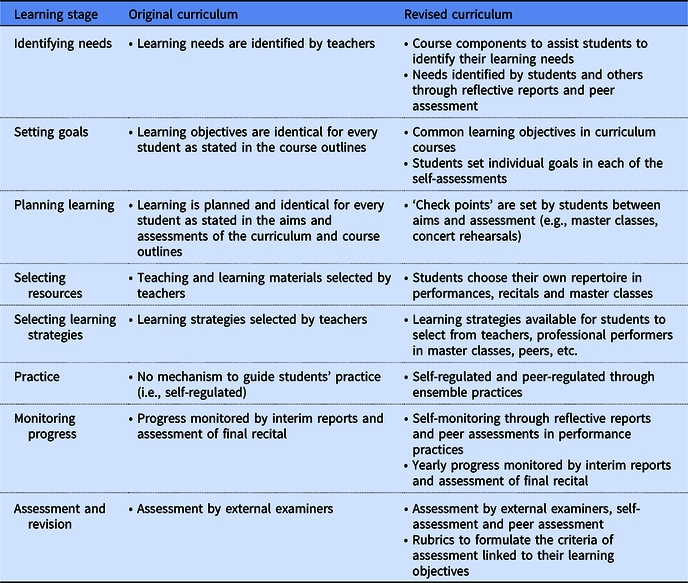
Reinder’s (Reference REINDERS2010) framework of skills for developing learner autonomy in language education was adopted to illustrate the curriculum change for autonomous training in this study. It has been widely used in language education to frame the development of learner autonomy in various contexts (e.g., Kahraman, Reference KAHRAMAN2015; Lau, Reference LAU2017; Lear, Li, & Prentice, Reference LEAR, LI and PRENTICE2016). It divides the development of learner autonomy into eight stages: (1) identifying needs; (2) setting goals; (3) planning learning; (4) selecting resources; (5) selecting learning strategies; (6) practice; (7) monitoring progress; and (8) assessment and revision. These learning stages were mapped with corresponding music teaching and learning strategies from previous literature that supports the training of various dispositions of learner autonomy, including Blom and Poole’s (Reference BLOM and POOLE2004) peer assessment approach in musical performance, McPherson and Zimmerman’s (Reference MCPHERSON, ZIMMERMAN, Colwell and Webster2011) dimensions of musical self-regulation and its development, O’Neill and McPherson’s (Reference O’NEILL, MCPHERSON, Parncutt and McPherson2002) model of motivation for instrumental learning and Stanley, Brooker and Gilbert’s (Reference STANLEY, BROOKER and GILBERT2002) assessment criteria for musical performance. These strategies were embedded to revise the original curriculum for better fostering students’ learner autonomy in performance practice. Table 1 illustrates how the music curriculum was revised for the adoption.
Curriculum change at different learning stages for autonomous training

The research team planned and implemented the curriculum change at both programme and course level with formal procedures governed by the university, including the preparation and submission of course revision, collaboration and negotiation with course lecturers and instrumental tutors, drafting of rubrics and briefing to fellow students. The team met regularly to evaluate the progress of curriculum reform and ensure the changes aligning with the agenda for autonomous training.
Methodology
This longitudinal study used a mixed-methods approach including semi-structured interviews and a questionnaire survey to investigate the effect of curriculum change on students’ autonomous training in a 4-year music teacher education programme. The mixed-methods approach allows triangulation of data to strengthen the validity of the findings (Greene, Caracelli, & Graham, Reference GREENE, CARACELLI and GRAHAM1989).
Participants
Two cohorts of final-year students (N = 74) from a music education undergraduate programme (Bachelor of Education – Music) in Hong Kong completed the questionnaire survey. They had experienced the curriculum change for autonomous training in performance practice overseen by the research team of this study. This programme is the only degree in Hong Kong offering a major in music education. It covers music knowledge content, pedagogy and other educational aspects such as educational studies, languages, general education and special requirements including participation in lessons in the major instrument or vocal training, musical ensembles and supervised teaching practice. Ten students were invited to take part in a semi-structured interview. Two students were selected from each category of performance major – vocal, piano, woodwind, string and percussion – to comprehensively reflect the context of the students’ autonomous training.
Due to the complexity and diversity of the curriculum, performance practice accounts for a relatively small part of the programme compared with the music undergraduate programmes offered by sister universities in Hong Kong, which aim at training professional musicians rather than music teachers. Nevertheless, adequate music performance proficiency is needed in the music teacher education programme to ensure that teachers-to-be acquire sufficient fluency such that they will be able to transfer knowledge to their future students. Similar to other music programmes, it is a graduation requirement that students in the music teacher education programme perform a vocal recital or a recital on their major instrument in the final year. Professional musicians in the region are hired to provide one-to-one instrumental or vocal lessons to improve the music students’ performance skills throughout their studies.
Questionnaire survey and semi-structured interviews
The questionnaire was divided into two parts. The first part collected demographic information and information about the participants’ instrumental/vocal experience, such as years of instrumental training, level of graded instrumental/vocal examinations attained,and solo and ensemble performance experience.
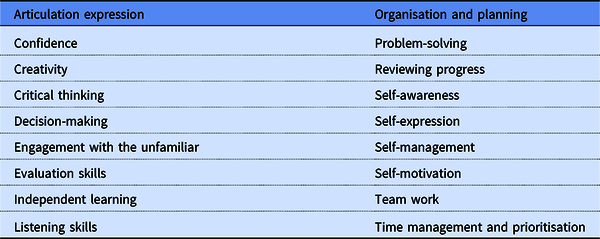
The second part, which focused on self-assessed transferable skills, was developed from the report of the National Association for Music in Higher Education, which identified a list of transferable skills that could be developed during a music degree (Dockwray & Moore, Reference DOCKWRAY and MOORE2008). The potential transferable skills that could be developed through autonomous training in performance practice were selected as items to be rated on five-point Likert scales in the questionnaire (Table 2).
Potential transferable skills developed through autonomous training in performance practice

Interview questions were designed to follow up on the data obtained from the questionnaire and triangulate with the quantitative data collected in the questionnaire survey in which the findings from the two independent collection methods complement one another at the interpretation stage. Qualitative data collected from the interviews revealed the participants’ perceptions of their achievement in autonomous training within the scope of performance study under the new curriculum. The interview was guided by the following open-end key questions according to the different learning stages in Table 3:
1. What strategic changes have been made regarding the way you practice your instrument?
2. What differences have you experienced between the concert participations within and outside the curriculum?
3. What is the difference between performing your instrument alone and in an ensemble setting?
4. How do you identify the learning needs in performance?
5. What kinds of factors would you consider when setting your learning goals in performance practice?
Descriptive analysis of self-assessed transferable skills development

Administration of questionnaire survey and semi-structured interview
A formal invitation email was sent to the targeted participants, asking them to participate and explaining the purpose of the study and the data collection process. Ethical review was applied through the Human Research Ethics Committee of the participants’ university before invitation to safeguard them from any harms. Potential bias of the purposely targeted participants included their subconsciousness or otherwise to provide data that are positively appealing to the study because of the teacher–student relationship, and mitigation was attempted by setting the data collection period after the release of grades and degree classifications. They were asked for their consent to use anonymous assessment data about courses related to their performance practice. The duration of the interviews was about 30–45 min. Each interview commenced with a brief introduction outlining the purpose of the study and permission was requested to audio-record the interview.
The interviews were transcribed from the audio recordings and double-checked by the researchers. An email with the interview script attached was sent to each participant after the transcriptions were completed, thanking them for their participation and asking them to confirm the validity of the interview transcripts.
Data collection and analysis
Quantitative data from the questionnaire survey and assessments were analysed statistically using SPSS. Open coding (Charmaz, Reference CHARMAZ, Hesse-Biber and Leavy2004) was used to analyse the qualitative data. It consists of reading line by line and carefully coding each line, sentence, and paragraph, and then compiling a set of recurring ‘themes’ as findings.
Reliability testing
Cronbach’s alpha, an empirical test used to estimate the reliability of a questionnaire containing multiple items measuring the same construct, was used as a measure of the internal reliability of the set of items for transferable skills in the questionnaire survey. Internal consistencies of the entire set and individual items ranged from 0.76 to 0.84, indicating ‘acceptable’ or ‘good’ reliability (George & Mallery, Reference GEORGE and MALLERY2003).
Inter-coder reliability was used for the semi-structured interview data. Members of the research team independently coded segments of text, then discussed and resolved any discrepancies in the coding process until the inter-coder reliability scored higher than 90% (Krippendorff, Reference KRIPPENDORFF2004).
Findings
Rehearsal process
The participants talked about changes in their instrumental/vocal rehearsals. Before the curriculum change for autonomous training, the students received no guidance on how to practice their instrument or singing; and seldom did their instrumental/vocal tutor instruct them on this aspect of learning. Three students reported differences in their rehearsal process before and after the autonomous training:
I used not to do warm-up exercises at the beginning of rehearsals, and go directly to the songs I needed to practice … yet after these four years of studies I realised the importance of those exercises – it makes the rehearsal purposeful, rather than a random practice. (Vocal student A)
I feel the difference too. I used to repeatedly practise sections of a piece where I can’t get through; yet afterwards I learnt that it is not as simple as ‘practise makes perfect’. The bottleneck could be due to wrong hand posture, or conceptual understanding about the rhythmic motif … There is a lot more beyond the musical notes on the score. (Piano student A)
Before learning the rehearsal strategies, practising meant sitting in front of the piano and drilling the pieces that I was required to play [by the piano tutor] for an hour. Now I will firstly decide what I am going to achieve in the rehearsal: it could be overcoming certain difficult sections, or getting familiar with a section not played before. (Piano student B)
These changes in strategy and awareness effectively improved the rehearsal process. Regarding the initiative for such changes in the rehearsal process, students reported two sources of knowledge – their instrumental/vocal tutors and courses from the music curriculum. The second source, the main concern of this study paper, shed light on the training of musical sensitivity, which reminded the students to ‘pursue the best musical voice of the instrument’ (Woodwind student A).
The participants also gained new perspectives on approaching repertoire that they had not played before. Those new perspectives included but were not limited to the following:
Before entering the [undergraduate] programme, I would listen to the piece on YouTube, and imitate the one [audio-video recording] I liked. I had no idea whether the approach I chose was appropriate or not … I have learnt to read through background about the composer, and understand the historically informed practice of the time. (String student A)
Performance
The participants reflected on their learning from performance experiences over their years of study. They reported that in addition to the feedback from formal assessments that examine performance skills, alternative assessment tools such as reflective reports and peer assessments, as well as the right to choose their own repertoire, had cultivated ‘a sense of ownership’ (String student B) of the performance, either in a solo recital or as part of an orchestral concert. For example, several participants responded positively to the peer assessment in campus concerts, which enabled them to ‘compare the standards of the others as a performance indicator of self’ (Percussion student A). Performance opportunities across the years of study also added value to their autonomous learning, such as when overcoming difficulties in performance practice as demonstrated by the following example:
I could ‘trial’ the pieces for graduation recital in the in-class performance and master class, which gradually improved the quality of my performance … I was therefore able to overcome the stage fright … so that I was fully prepared for the final performance. (Piano Student B)
The participants reflected on the benefits of autonomous training in terms of the ownership of their music learning. They responded that practising and self-improvement were part of their routine regardless of the pressure of formal assessment:
I have been practising a lot for the performances as required by the curriculum. In each performance, I was able to realise some of my weaknesses, and try to improve them for the next performance. I do enjoy the process of improvement, and I wish to continue the learning process after my recital. (Piano student A)
The ownership of students’ learning was also reflected by the autonomy to set their learning goals and select their own repertoire for various performances. They spoke of their experiences organising a campus concert entirely on their own.
Most of us did not have any experience in organising a concert. There were a lot of unexpected matters that we would never have known within this experience. For example, the restrictions of using the performance venue, design of the promotional materials, discussion among the performers about the theme of the concert, the gathering and setting up of equipment … It is a good experience for us since we will have to hold student concerts in the future when we become music teachers. (Woodwind student B)
It was exciting to decide what we could do in our own concert. We could form small ensembles among our own group to perform pieces that we like, and set up a storyline among all the pieces that we chose. (String student B)
In addition to the development of ensemble skills, the participants also experienced the process of peer learning through participating in different types of ensemble. The following quotes from two participants reflect how participation in ensembles strengthened the sense of ownership:
I am not very good at sight-reading even though I am seated at the second desk [of the first violin section] … so I have to practise my own part before each rehearsal, making sure that I will not ‘drag down’ the whole section. (String student C)
I have participated in the handbell ensemble for three years. It is a very special kind of ensemble that requires a lot of teamwork. If I didn’t pay attention to the flow of the music, the whole team would collapse and we could not even complete the rehearsal or performance. (Piano student C)
Transferable skills
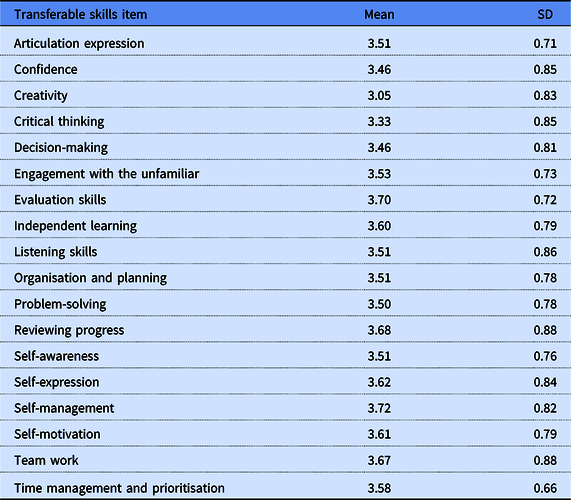
Table 3 presents a descriptive analysis of the survey on the participants’ (N = 74) self-assessed development of transferable skills. Among all of the transferable skills items, self-management was rated the highest (mean (M) = 3.72, SD = 0.82), followed by evaluation skills (M = 3.70, SD = 0.72) and reviewing progress (M = 3.68, SD = 0.88). Creativity (M = 3.05, SD = 0.83) was rated the lowest, followed by critical thinking (M = 3.33, SD = 0.85), confidence (M = 3.46, SD = 0.85) and decision-making (M = 3.46, SD = 0.81).
One participant reflected as follows on her evaluation process when undertaking a self-assessment of her own recorded performance:
It was an uncomfortable experience to listen to my own performance at the beginning … but I was able to know what exactly I had done wrong, what weakness I was encountering – which could not be realised during the performance. It reminded me to always be critical of myself. (Vocal student B)
The participants also reported a developed ability to review their own learning process through yearly self-assessment:
I could hear the difference between my own performances before and after two years … It may be due to my improved skills, or a new perspective on self-evaluation learnt during these years. (Percussion student B)
Curriculum impact
Performance is an integrated subject area embedded in different parts of the music curriculum including both credit-bearing courses and activities. Students’ feedback revealed the benefits of autonomous learning on other subject areas:
The courses for western music tradition were assessed through an integrated assignment that required us to compose, perform and evaluate our own work. It was like an independent project that helped us to gradually develop our creative idea and ‘scaffold’ our learning based on the previous work with the concept that we learnt in the pedagogy class. (String Student B)
In response to the teaching and learning strategies that applied in the curriculum change, students were able to articulate the attributes of learner autonomy that they employed in their learning process, including self-regulation and motivation, critical reflection, and goal-oriented learning. These attributes together with the achievement in transferable skills added value to the holistic learning experience that could be extended to their life-long learning.
Discussion
The findings of this study reflect the effect of the cultivation of learner autonomy on music students’ performance practice. Besides improving the effectiveness of the rehearsal process, the students were able to discover their weaknesses and take the appropriate remedial steps to correct their shortcomings, in addition to gaining new perspectives on approaching new pieces. Learner autonomy allowed the students not only to master their own learning process but also learn more independently without instructions from a tutor, as reflected by the high ratings for independent learning and reviewing progress of the self-assessed transferable skills development. Curriculum changes could be effective in enhancing the transition experiences for students with different cultural backgrounds or prior autonomous training, as shown by the achievement of those who were conditionally disadvantaged before the changes. It increased the students’ ownership of their learning, which motivated them to continue their learning process out of school and in line with the research findings by Hargreaves and Marshall (Reference HARGREAVES and MARSHALL2003). As they continue their further study at conservatoire or postgraduate level and develop their career as musicians or music educators, the discovery of knowledge and skills in performance studies would become more self-initiated. The competence of learner autonomy would help them to cope with the unknown future in an independent and self-directed manner.
As an important element in music learning, performance opportunities were embedded in the curriculum, including annual in-class performance, master classes, compulsory participation in ensembles and a graduation recital. By performing in various situations at different stages of learning, the students were able to gain experience in coping with stage fright, performance anxiety and adapting to different performance contexts. As reflected in both the interview and the survey, they were able to evaluate and determine the non-musical factors that were affecting the quality of their performance, which could not be learnt through classroom learning.
The students also learnt to formulate their own learning strategies in various stages of performance practice. The curriculum included various strategies for students to learn more independently without the presence of a teacher, using skills that they could apply in the future, including self-assessment, writing a reflective report, selecting their own repertoire and setting learning goals. This allowed students to express their musicality not only through the musical qualities of each piece but also by attending to stylistic characteristics by conceptualising their themes for performances through repertoire selection, preparation of promotional materials and programme notes. These strategies helped the students to develop as self-regulated and autonomous learners able to monitor, evaluate, assess and manage their own learning.
The students’ autonomous characteristics were also demonstrated in the results of the questionnaire survey. Among all of the items listed as self-assessed transferable skills, independent learning, reviewing progress, evaluation skills, self-management and self-motivation were rated highest by the participants. These are attributes that characterise an autonomous learner. Although a control group comparison is not available, interview data revealing the autonomous characteristics of the participants serve as a triangulation tool validating the survey data.
The results of this study reveal that learner autonomy in music education – specifically in performance practice – demonstrates similar characteristics to that in language education. These include learners’ positive attitudes towards the adoption of an autonomous approach in teaching, motivation in taking responsibility of their own learning and similar teaching strategies adopted for autonomous training. This finding suggests that despite the discrepancy between music and other languages, the fostering of learner autonomy could also benefit music students by developing them to be autonomous learners.
Conclusion
This study demonstrates the effective fostering of learner autonomy in music performance practice through a series of curriculum changes in a music education undergraduate programme. Students were able to demonstrate characteristics of an autonomous learner, including the ability to formulate their own learning strategies, identify weaknesses in both musical and non-musical qualities and take appropriate steps to improve their performance skills. Students’ feedback indicated their perceived achievement and positive attitude towards the autonomous training, which demonstrated the effectiveness of curriculum change on fostering music students’ learner autonomy in performance practice.
The findings of this study reveal that music shares similar autonomous characteristics with other languages when autonomous training is a feature of the curriculum. The study fills a gap in the literature by investigating the effect of autonomous training on performance practice, which is a unique area in music that distinguishes it from other languages. While it is not the intention of this study to generalise its findings to cover the discipline of music education as a whole, several future research directions could be informed by these findings to reveal the potential of learner autonomy in music education. These include (1) a similar research study fostering autonomous training in another learning context, such as primary or secondary school music education; (2) investigating the effects and benefits of autonomous training from music teachers’ perspective; and (3) examining pre- and in-service music teachers’ readiness to implement autonomous training in school music education.