INTRODUCTION
Age-related cognitive decline and neurodegenerative disorders such as Alzheimer’s disease (AD) are of great concern, particularly considering the increasing age of the general population. Intervention efforts are most effective in the earliest stages of AD, motivating efforts towards early identification of the disease.
Tests of olfactory function have shown great promise as a preclinical indicator of AD (Albers et al., Reference Albers, Gilmore, Kaye, Murphy, Wingfield, Bennett, Boxer, Buchman, Cruickshanks, Devanand and Zang2014; Djordjevic et al., Reference Djordjevic, Jones-Gotman, De Sousa and Chertkow2008; Lehrner et al., Reference Lehrner, Pusswald, Gleiss, Auff and Dal-Bianco2009; Murphy, Reference Murphy2019; Ottaviano et al., Reference Ottaviano, Frasson, Nardello and Martini2016; Quarmley et al., Reference Quarmley, Moberg, Mechanic-Hamilton, Kabadi, Arnold, Wolk and Roalf2017; Schubert et al., Reference Schubert, Carmichael, Murphy, Klein, Klein and Cruickshanks2008) with prodromal declines in olfactory function occurring due to very early proliferation of AD-related neuropathology in the entorhinal and transentorhinal cortices, regions critical for processing olfactory information (Braak & Braak, Reference Braak and Braak1991; Christen-Zaech et al., Reference Christen-Zaech, Kraftsik, Pillevuit, Kiraly, Martins, Khalili and Miklossy2003). These regions also serve an important role in hippocampal networks that are critical for memory. For example, impaired odor recognition has been demonstrated in patients with hippocampal lesions (Levy et al., Reference Levy, Manns, Hopkins, Gold and Squire2003). Accordingly, odor tests can serve as an early indicator for later cognitive impairment. Indeed, epidemiological research has reported that olfactory function predicts cognitive decline over a 5-year period, with results suggesting that odor testing is useful in high-risk settings (Schubert et al., Reference Schubert, Carmichael, Murphy, Klein, Klein and Cruickshanks2008).
The ε4 allele of the apolipoprotein E (ApoE) gene, a genetic risk factor of AD, has also been associated with declines in a number of olfactory tasks, even in cognitively normal adults (Calhoun-Haney & Murphy, Reference Calhoun-Haney and Murphy2005; Finkel et al., Reference Finkel, Reynolds, Larsson, Gatz and Pedersen2011; Gilbert & Murphy, Reference Gilbert and Murphy2004; Larsson et al., Reference Larsson, Hedner, Papenberg, Seubert, Bäckman and Laukka2016; Olofsson et al., Reference Olofsson, Josefsson, Ekström, Wilson, Nyberg, Nordin, Adolfsson, Adolfsson, Nilsson and Larsson2016). Studies have shown that olfaction declines more rapidly than global cognitive function among carriers of the ε4 allele, with higher-level olfactory processing abilities, such as odor identification, declining faster than more peripheral functions, such as odor detection (Calhoun-Haney & Murphy, Reference Calhoun-Haney and Murphy2005), with measurable declines in these abilities occurring as early as middle age in ε4/ε4 homozygotes (Josefsson et al., Reference Josefsson, Larsson, Nordin, Adolfsson and Olofsson2017).
However, testing for ε4-positive status does not carry full sensitivity or specificity for the disease, and approximately 42% of those with non-familial and late-onset AD are not ε4 carriers (Bekris et al., Reference Bekris, Yu, Bird and Tsuang2010; Bird, Reference Bird2008). Thus, additional factors must be contributing to the pathogenesis of AD, and research into the modifiable risk factors has become a growing area of interest. Worry, or the act of dwelling on specific negative or troubling thoughts, is one such modifiable risk factor that has been linked to an increased chance of developing AD, with structural degeneration in the hippocampus and other regions posited as a potential neural mechanism (Mah et al., Reference Mah, Szabuniewicz and Fiocco2016).
Worry is a behavioral (e.g., the act of and actions associated with allowing one’s mind to dwell on concerns or problems) and cognitive (e.g., thoughts about concerns, actual or potential problems, or danger) manifestation of negative emotions and physiological experiences (e.g., fear, uncertainty, disgust, stress), and is a hallmark symptom of generalized anxiety disorder (American Psychiatric Association, 2013). Anxiety in aging has been associated with an increased risk of the development of neuropathology associated with AD, such as the proliferation of beta-amyloid (Palmer et al., Reference Palmer, Berger, Monastero, Winblad, Bäckman and Fratiglioni2007). The same biological risk factors for increased amyloid, such as the possession of an ApoE ε4 allele, have also been associated with elevated levels of anxiety (Caselli et al., Reference Caselli, Reiman, Hentz, Osborne and Alexander2004; Holmes et al., Reference Holmes, Esterlis, Mazure, Lim, Ames, Rainey-Smith, Martins, Salvado, Dore and Villemagne2016) in older adults. Worry and other perseverative thought processes (i.e., rumination) have been found to predict negative outcomes associated with emotional problems over and above the diagnostic categories, even at subsyndromal levels (Ruscio et al., Reference Ruscio, Seitchik, Gentes, Jones and Hallion2011). Among cognitively normal older adults, those with minimally elevated worry symptoms have been shown to demonstrate poorer performance in visual and paired associate learning and are also more likely to show clinically significant visual learning and memory declines over a 2-year period than those with minimal levels of worry (Pietrzak et al., Reference Pietrzak, Maruff, Woodward, Fredrickson, Fredrickson, Krystal, Southwick and Darby2012). Subclinical levels have also been associated with functional impairments, physical disability, and decreased quality of life in cognitively normal older adults (Braam et al., Reference Braam, Copeland, Delespaul, Beekman, Como, Dewey, Fichter, Holwerda, Lawlor, Lobo and Skoog2014). In line with the Research Domain Criteria (RDoc; Insel et al., Reference Insel, Cuthbert, Garvey, Heinseen, Pine, Quinn, Sanislow and Wang2010) initiative, these findings suggest that worry may be a functional mechanism that cuts across diagnostic categories.
Worry is also associated with the physiological stress response, which refers to the biological or physiological symptoms occurring in response to a perceived threat. The perseverative nature of worry serves to prolong the physiological stress response beyond the time constraints of a stressful event, potentially increasing the risk for poor stress-related health outcomes (Ottaviani et al., Reference Ottaviani, Thayer, Verkuil, Lonigro, Medea, Couyoumdjian and Brosschot2016). Studies of the effect of stress and genetic risk of AD on verbal memory have found that older adults who reported high levels of chronic stress, defined by the authors as at least one high stress event in the past year, performed worse on long-delay free recall than those with low stress, and performance was the worst in those reporting high stress who also tested positive for the ApoE-ε4 allele (Peavy et al., Reference Peavy, Lange, Salmon, Patterson, Goldman, Gamst, Mills, Khandrika and Galasko2007). Similarly, increased cortisol levels, a hormone associated with worry and the experience of stress and anxiety, were negatively correlated with the performance on verbal memory and learning, and this effect was significantly more pronounced in ε4-positive individuals (Lee et al., Reference Lee, Glass, Wand, McAtee, Bandeen-Roche, Bolla and Schwartz2008). Taken together, research exploring the relationships among stress, anxiety, worry, and cognitive function suggest that worry may mediate some of the negative cognitive outcomes associated with stress and anxiety.
While no studies to date have directly examined the relationship between worry and odor memory, links between olfactory, emotion, and memory processing have been reliably shown. A wide variety of cognitive and behavioral studies have demonstrated effects such as olfactory cuing of emotional memories (Galliot et al., Reference Galliot, Comte, Magnin, Tatu, Moulin and Millot2013), facilitation of the memory for specific unique events as a function of the emotion carried by odors (Saive et al., Reference Saive, Royet, Ravel, Thévenet, Garcia and Plailly2014), and heightened responses to odors in conditions with dysfunction in affective processing, such as generalized anxiety disorder and post-traumatic stress disorder (Cortese et al., Reference Cortese, Leslie and Uhde2015).
Connections between olfactory, memory, and emotion have also been demonstrated at the neural level (Soudry et al., Reference Soudry, Lemogne, Malinvaud, Consoli and Bonfils2011). The primary olfactory cortex (i.e., piriform cortex) shares a wide number of direct and indirect connections with regions known to be critical for functions such as emotional regulation, integration of affective and sensory information, emotional learning and memory, and reward-based decision making (e.g., the amygdala, cingulate cortex, hippocampus, orbitofrontal cortex [OFC], and insular cortex; Cerf-Ducastel & Murphy, Reference Cerf-Ducastel and Murphy2001; Frasnelli et al., Reference Frasnelli, Lundström, Boyle, Djordjevic, Zatorre and Jones-Gotman2010; Lehn et al., Reference Lehn, Kjønigsen, Kjelvik and Håberg2013; Smitka et al., Reference Smitka, Puschmann, Buschhueter, Gerber, Witt, Honeycutt, Abolmaali and Hummel2012). Thus, unlike other sensory systems in which primary sensory information is routed to sensory-associated regions via the thalamus, olfactory information is sent directly to regions within the prefrontal cortex and limbic system, resulting in important neurologically based relationships between mood, emotion, memory, and olfactory processing that affect cognitive, emotional, and social functioning across the lifespan (Sullivan et al., Reference Sullivan, Wilson, Ravel and Mouly2015).
For example, these frontolimbic networks have been shown to play an important role in the functional integration of primary olfactory information with information about important associated emotion and memory-related content (Benarroch, Reference Benarroch2010; Cerf-Ducastel et al., Reference Cerf-Ducastel, Haase and Murphy2012; Murphy et al., Reference Murphy, Cerf-Ducastel, Calhoun-Haney, Gilbert and Ferdon2005). A recent study investigating functional connectivity using a cross-modal olfactory recognition memory paradigm also highlighted the relationships between medial temporal regions implicated in AD (e.g., entorhinal cortex) and the OFC in odor memory processing, and suggested that associations between regions may vary as a function of memory accuracy and feelings of certainty or familiarity (Haase et al., Reference Haase, Wang, Green and Murphy2013).
Importantly, while genetic and other non-modifiable risk factors for AD serve as useful biomarkers for who will develop the disease, they offer little with regard to intervention and prevention. In contrast, modifiable risk factors for AD such as worry can be directly treated and reduced to potentially improve health and quality of life. Thus, investigations into the relationship between chronic worry, aging, and preclinical markers of risk of AD have important implications.
To the authors’ knowledge, no study to date has investigated the effects of worry on odor memory performance. The present study sought to characterize the relationships between worry and odor memory as a function of age and ApoE-ε4 status in healthy young and older adults, which represents an important step towards understanding these relationships in relation to AD. We hypothesized significant differences in odor memory measures as a function of age, ApoE-ε4 status, and worry level, such that: (1) younger adults would perform better than older adults across all odor memory measures; (2) odor memory performance would be associated with worry levels; and (3) the effect of worry on odor memory performance would vary as a function of ApoE-ε4 status.
METHODS
Participants
Participants were 53 young (18–26 years; 27 males, 26 females) and 45 older (62–84 years; 23 males, 22 females) healthy adults. There were 21 ApoE-ε4-positive and 32 ApoE-ε4-negative young adults, and 18 ApoE-ε4-positive and 23 ApoE-ε4-negative older adults. ApoE genotype was not available for four of the older adults, so these cases were excluded from the final analyses.
Younger adults were primarily recruited from undergraduate psychology courses at the San Diego State University, and older adults were primarily recruited through information and presentations at community centers and local businesses. The study was in compliance with regulations of the San Diego State University Institutional Review Board, and subjects gave informed consent. Participants who met the age requirements were screened for significant medical or psychiatric conditions that could affect cognition (e.g., history of traumatic brain injury, substance abuse, psychological diagnosis requiring medical or in-patient treatment). The study was part of a larger investigation exploring the effects of cortisol; thus participants were also excluded if they were diagnosed with any condition that could affect cortisol production (e.g., diabetes, uncontrolled hypothyroidism, post-traumatic stress disorder), or were currently using medications that may affect cortisol production (e.g., corticosteroids, steroid inhalers, antidepressants).
On the day of testing, participants were screened for depression using the Beck Depression Inventory II (BDI-II; Beck et al., Reference Beaudreau, Hantke, Mashal, Gould, Henderson and O’Hara1996) for younger adults, and the Geriatric Depression Scale (GDS; Yesavage et al., Reference Yesavage, Brink, Rose, Lum, Huang, Adey and Leirer1982) for older adults. Individuals were excluded if they scored ≥20 on either scale, indicating the presence of moderate to severe depression. Older adult participants were screened for dementia using either the Mini-Mental State Examination (MMSE) or the Dementia Rating Scale (DRS), and excluded if they scored below the recommended cut-offs of 26 on the MMSE (Folstein et al., Reference Folstein, Folstein and McHugh1975) or 123 on the DRS (Lucas et al., Reference Lucas, Ivnik, Smith, Bohac, Tangalos, Kokmen, Graff-Radford and Petersen1998). All participants were assessed by a butanol threshold odor test (procedures are described in Murphy et al., Reference Murphy, Gilmore, Seery, Salmon and Lasker1990) and were excluded from the final analyses if testing revealed anosmia or severe hyposmia (i.e., butanol threshold odor test score <4 in both nostrils).
Procedures
Participants were administered screening tests, mood questionnaires, and tests of olfactory and cognitive function in the laboratory or their home. The testing session lasted approximately 2–3 hours, and participants received either monetary compensation or, when applicable, course credit for their participation.
ApoE Genotyping
All participants were genotyped for ApoE allele type using a polymerase chain reaction with oligonucleotide, followed by digestion with the HhA1 restriction enzyme and polyacrylamide chain gel electrophoresis. Participants were categorized as ε4-positive if they had at least one ε4 allele (i.e., ε2/4, ε3/4, and ε4/4).
California Odor Learning Test
The California Odor Learning Test (COLT) was developed by Murphy et al. (Reference Murphy, Nordin and Acosta1997) as an olfactory analogue to the California Verbal Learning Test (CVLT; Delis et al., Reference Delis, Kramer, Kaplan and Ober1987) that uses odors instead of verbally presented words. Odors are distributed into four semantic categories of spices and herbs, fruits, personal products, and sauces and condiments (e.g., cinnamon, oranges), and were matched on a one-to-one basis with the word items from the CVLT to allow for the calculation of odor memory measures using the computerized scoring system developed for the CVLT (Delis et al., Reference Delis, Kramer, Kaplan and Ober1987).
Stimuli were presented to participants at suprathreshold levels in opaque jars to avoid visual cues. During the odor presentation phases, participants were asked to close their eyes and presented with each odor for 5 seconds, with a 10-second inter-stimulus interval. The test consisted of five immediate recall trials of 16 odors (List A) followed by a distracter trial of 16 different odors (List B); a short-delay recall of List A (free and category-cued; SDFR, SDCR), which was assessed directly after immediate recall of List B; a long-delay recall of List A (free and category-cued; LDFR, LDCR), which was assessed 20 minutes following the short-delay portion; recognition memory; and lastly odor identification.
Penn State Worry Questionnaire
Worry was measured using the Penn State Worry Questionnaire (Meyer et al., Reference Meyer, Miller, Metzger and Borkovec1990), which measures the participants’ general tendency to worry. The self-report questionnaire includes 16 items that are rated on a five-point Likert scale, ranging from 1, “not at all typical of me,” to 5, “very typical of me.” Possible scores range from 16 to 80, with higher scores indicating higher worry. Items on the PSWQ measure aspects of worry such as rate, intrusiveness, and pervasiveness. The PSWQ has moderate to excellent psychometric properties across adult age groups (Crittendon & Hopko, Reference Crittendon and Hopko2006; Hopko et al., Reference Hopko, Stanley, Reas, Wetherell, Beck, Novy and Averill2003). It has been shown to have strong internal consistency and adequate convergent validity in both young and older adult samples (Beck et al., Reference Beck, Stanley and Zebb1995) as well as samples with clinical anxiety disorders (Brown et al., Reference Brown, Antony and Barlow1992). It has also been shown to have clinical utility as a screening measure for generalized anxiety disorder (Fresco et al., Reference Fresco, Mennin, Heimberg and Turk2003) and the ability to identify worry over and above anxiety and depression (Meyer et al., Reference Meyer, Miller, Metzger and Borkovec1990).
Statistical Analyses
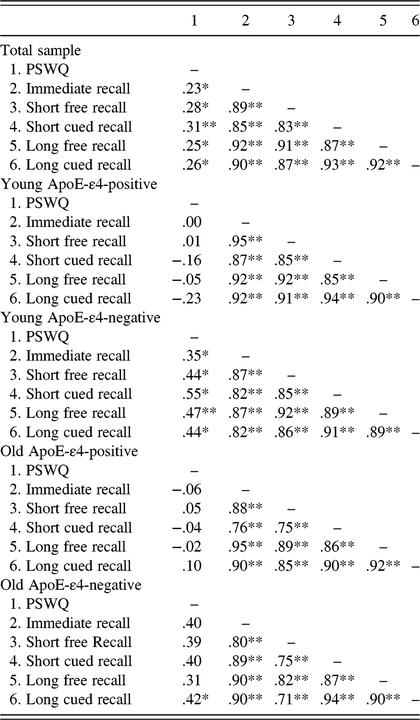
Dependent variables of interest were highly correlated (see Table 1 for correlations between COLT free and cued recall measures, and PSWQ scores); thus, multivariate analyses of covariance (MANCOVA) were conducted to determine the effect of age (young, older), ApoE-ε4 status (negative, positive), PSWQ scores, and all two-way interaction terms (Age × ApoE, Age × PSWQ, ApoE × PSWQ) on COLT recall memory measures. Two separate MANCOVAs were conducted, one to examine the effects on the free odor recall memory-dependent variable (i.e., short- and long-delay free recall) and a second to examine the effects on the cued odor recall memory-dependent variable (i.e., short- and long-delay cued recall).
Pearson’s correlations between scores on the California Odor Learning Test outcome variables and the PSWQ

Note: ApoE = apolipoprotein E; PSWQ = Penn State Worry Questionnaire.
*p < .05. **p < .001.
In all cases, Box’s Test indicated that the assumption of homogeneity of covariance matrices across groups was met. Follow-up analyses were conducted using univariate analysis of variance tests. To protect the family-wise p-value of .05, a p-value of .025 (.05/number of dependent variables) was used to determine the significance of univariate post hoc tests. Levene’s test indicated that the homogeneity of variance assumption was met for each dependent variable. Analyses were performed with SPSS statistical software, version 18.0 (SPSS Inc., Chicago, IL).
RESULTS
Participant Characteristics
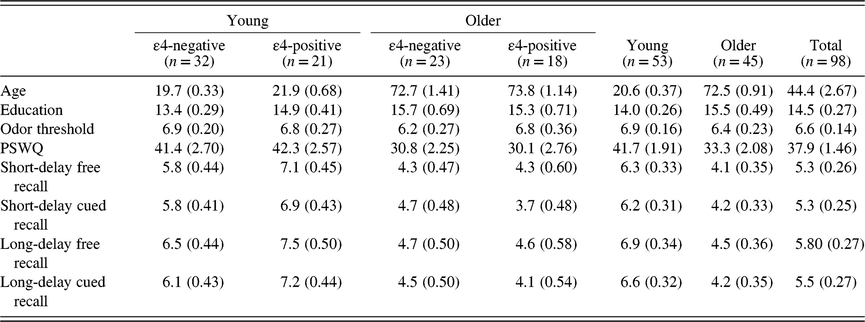
Demographic and clinical characteristics are listed in Table 2. All adults scored within the normal range on self-report measures of depression and global cognitive function. No significant age or ApoE group differences in odor threshold, MMSE, BDI-II, DRS, and GDS scores were found (p’s > .05). Younger adults rated their current level of worry significantly higher than older adults, F(3, 90) = 17.64, p < .001. There was no significant effect of ApoE status on the PSWQ, F(3, 90) = .001, p > .97.
Means (standard error) for demographic variables, psychophysical tests, self-report measures, and the California Odor Learning Test outcome variables by apolipoprotein E-ε4 genotype, age, and in total

Note: PSWQ = Penn State Worry Questionnaire.
Free Odor Recall Memory
There were no significant effects of age or ApoE on free recall (p’s > .09). The main effect of PSWQ was significant, Wilks’ Λ = .90, F(2, 86) = 4.73, p = .01, partial η 2 = .10, observed power = .78. No significant two-way interactions were found (p’s > .15).
Follow-up univariate tests of significant multivariate effects indicated that the PSWQ had a significant effect on both short-delay free recall, F(1, 87) = 9.37, p = .003, partial η 2 = .10, and long-delay free recall, F(1, 87) = 8.38, p = .005, partial η 2 = .09, such that across age and ApoE groups, higher free recall scores were associated with higher PSWQ scores. In other words, higher self-reported worry was associated with more odors recalled on the free recall tasks.
Cued Odor Recall Memory
The results of MANCOVA revealed significant main effects of the PSWQ [Wilks’ Λ = .85, F(2, 86) = 7.45, p = .001, partial η 2= .15], ApoE [Wilks’ Λ = .92, F(2, 86) = 3.79, p = .03, partial η 2 = .08], and age [Wilks’ Λ = .93, F(2, 86) = 3.29, p = .04, partial η 2 = .07] on cued recall. These main effects were qualified by a significant ApoE × PSWQ interaction [Wilks’ Λ = .91, F(2, 86) = 4.32, p = .016, partial η 2 = .09], and a significant age × ApoE interaction [Wilks’ Λ = .86, F(2, 86) = 7.19, p = .001, partial η2 = .14]. The age × PSWQ interaction was not significant (p > .24).
Follow-up testing revealed that the PSWQ had a significant main effect on both short-delay cued recall, F(1, 87) = 15.08, p < .001, partial η 2 = .15, and long-delay cued recall, F(1, 87) = 12.46, p = .001, partial η 2 = .13, such that across age and ApoE groups, higher cued recall scores were associated with higher PSWQ scores (i.e., higher self-reported worry).
ApoE also had a significant main effect for both short-delay cued recall, F(1, 87) = 7.64, p = .007, partial η 2 =.08, and long-delay cued recall, F(1, 87) = 6.68, p < .05, partial η 2 = .07, such that across age and controlling for PSWQ, ε4-negative adults recalled significantly fewer odors during cued recall than ε4-positive adults (short delay: M = 3.71 vs. 7.49; long delay: M = 3.85 vs. 7.66).
The main effect of age was only significant for long-delay cued recall, F(1, 87) = 5.17, p = .025, partial η 2 = .06 (short-delay cued recall: p > .11). Young adults recalled significantly more odors than older adults (M = 7.40 vs. 4.10), across ApoE groups and controlling for PSWQ.
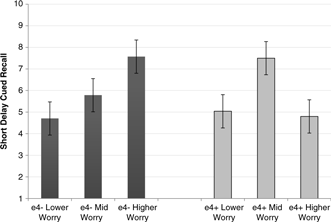
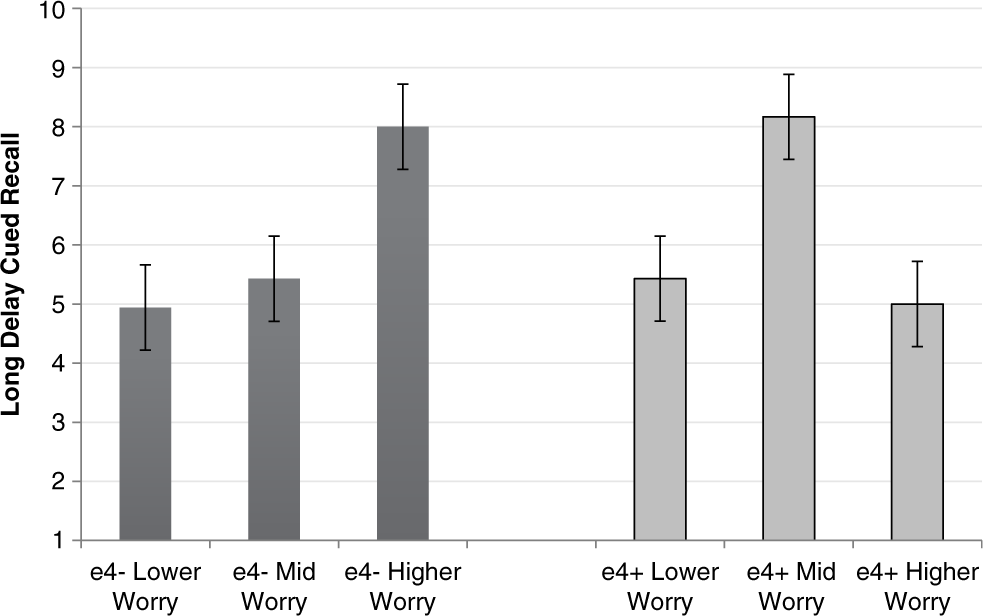
Univariate analysis of the ApoE × PSWQ interaction indicated that the effect was significant for both short-delay cued recall, F(1, 87) = 8.50, p = .005, partial η 2 = .09, and long-delay cued recall, F(1, 87) = 6.10, p = .015, partial η 2 = .07 (Figure 2). The results suggest that cued recall scores have a positive linear association with PSWQ scores in ApoE-ε4-negative adults (i.e., higher cued recall scores are associated with higher PSWQ scores), whereas the relationship appeared quadratic in ApoE-ε4-positive adults (i.e., lower cued recall scores are associated with low and high PSWQ scores, whereas mid-range PSWQ scores are associated with higher recall scores). For ease of interpretation, Figures 1 and 2 display the interaction effect with PSWQ categorized according to cut-offs suggested by Korte et al. (Reference Korte, Allan and Schmidt2016) to represent low, mid, and high levels of worry.
Bar graph depicting the relationship between Penn State Worry Questionnaire and short-delay cued recall score within ApoE groups, collapsed across age.

Bar graph depicting the relationship between Penn State Worry Questionnaire and long-delay cued recall score within ApoE groups, collapsed across age.

The age × ApoE interaction effect was also significant for both short-delay cued recall, F(1, 87) = 11.85, p = .001, partial η 2 =.12, and long-delay cued recall, F(1, 87) = 6.13, p = .015, partial η 2 = .07. One-way ANOVAs were conducted within age groups to examine the simple effects of age × ApoE interaction. However, simple effects of ApoE were not significant within young (p > .08) or older (p > .12) adults.
DISCUSSION
This is the first study to report on the relationships among odor recall, worry, and ApoE-ε4 status. While higher cued recall scores were associated with higher PSWQ worry scores among ε4-negative adults, the positive effect of worry on cued recall memory for odors diminished with high levels of worry among ε4-positive adults (Figures 1 and 2). Moreover, those with the highest and lowest levels of worry in the ε4-positive group performed comparably low on the odor memory task, whereas mid-range worry levels were associated with better odor memory, consistent with a quadratic relationship. In contrast, higher worry was associated with better recall among ε4 non-carriers, indicating a linear relationship. This effect was found for both short- and long-delay cued recall scores, whereas the effect was not significant for free recall scores. Notably, there were no ApoE group differences in PSWQ scores; thus, the significant interaction effect was not driven by group differences in worry.
The present findings are particularly interesting given known deficits in semantic categorization and the ability to use cues to aid recall in AD (Heindel et al., Reference Heindel, Salmon and Butters1990). For example, fMRI studies have shown that sustained activity levels in the entorhinal cortex, one of the earliest locations to develop AD neuropathology, are correlated with subsequent performance on a cued recall task (Fernández et al., Reference Fernández, Brewer, Zhao, Glover and Gabrieli1999). Research also supports the utility of cued recall tests in distinguishing depression from mild cognitive impairment (MCI) and early AD (Dierckx et al., Reference Dierckx, Engelborghs, De Raedt, De Deyn and Ponjaert-Kristoffersen2007; Vogel et al., Reference Vogel, Mortensen, Gade and Waldemar2007), and in predicting conversion from MCI to AD (Dierckx et al., Reference Dierckx, Engelborghs, De Raedt, Van Buggenhout, De Deyn, Verté and Ponjaert-Kristoffersen2009).
There are several possible reasons that might explain the unique impact of worry and ApoE on cued recall. A proposed mechanism of action for the expected findings is an overall reduction in neurological reserves as a result of compounding neurodegeneration in neural correlates of worry that overlap with olfactory processing pathways (Canteras et al., Reference Canteras, Resstel, Bertoglio, Carobrez and Guimarães2010; Mah et al., Reference Mah, Szabuniewicz and Fiocco2016; Sapolsky, Reference Sapolsky1992). For example, hippocampal lesions have been shown to result in reduced levels of anxiety, and the ventral hippocampus has been particularly linked to anxiety-related behavior and cognition (Bannerman et al., Reference Bannerman, Rawlins, McHugh, Deacon, Yee, Bast, Zhang, Pothuizen and Feldon2004). The effects of anxiety on cognitive functions outside of memory have also been found, with studies showing differences in prefrontal functioning and sustained attention abilities (Forster et al., Reference Forster, Nunez Elizalde, Castle and Bishop2015).
Notably, semantic clustering during encoding, as well as item-specific search during recall, is associated with activity in the prefrontal cortex (Long et al., Reference Long, Oztekin and Badre2010). Cortical association areas in the temporoparietal regions as well as parahippocampal cortex may also be important for cued memory retrieval (Hayama et al., Reference Hayama, Vilberg and Rugg2012). Metabolic and functional differences have been observed between ApoE-ε4-positive and ε4-negative adults in these regions, and activity in these same regions in younger adults correlates with areas of atrophy in early stages of AD, all of which has led to the hypothesis that alterations in connectivity may create conditions that lead to age- and AD-related atrophy (Buckner et al., Reference Buckner, Snyder, Shannon, LaRossa, Sachs, Fotenos, Sheline, Klunk, Mathis, Morris and Mintun2005; Machulda et al., Reference Machulda, Jones, Vemuri, McDade, Avula, Przybelski, Boeve, Knopman, Petersen and Jack2011). Given that brain regions associated with anxiety and anxious responses overlap with these areas (Arnsten, Reference Arnsten2009; Pardon & Rattray, Reference Pardon and Rattray2008), we might speculate that individuals with high levels of worry may be primed to activate anxiety-related networks that are also associated with memory search. ApoE-related metabolic and functional differences within these networks could alter the effect of worry on performance.
Neuropsychological correlates are also important to consider. Previous research has reported impaired executive functioning performance associated with state anxiety in ApoE-ε4 carriers (Stonnington et al., Reference Stonnington, Locke, Dueck and Caselli2011). Cued recall invokes the executive functions via the use of memory strategy (categorical association); thus, the present findings of significant differences in the scores on cued, but not free, recall in ApoE-ε4 carriers may be related to underlying relative differences in executive functioning. Future studies may wish to include measures of additional cognitive abilities (e.g., executive functions, attention, and working memory) in order to determine their influence on the relationship between worry and memory.
An unexpected finding that is noteworthy was that the direction of the main effects for age on PSWQ scores was such that younger adults rated their current level of worry an average of 11 points higher compared to older adults. We speculate that this discrepancy could be understood under the rubric of the socioemotional selectivity theory, which suggests that there is a positivity bias in older adults whereby positive information is more likely to be attended to than negative information (Carstensen et al., Reference Carstensen, Turan, Scheibe, Ram, Ersner-Hershfield, Samanez-Larkin, Brooks and Nesselroade2011; Lee & Knight, Reference Lee and Knight2009). Some insight into this finding comes from research on stress showing that it can have paradoxical effects on performance, with the direction of the effect changing depending on type, timing, duration, and other factors of the stressor. Under low and high levels of stress, performance tends to be negatively affected; however, under moderate levels of stress, performance may be positively affected (Pardon, Reference Pardon2007). The findings in the present study may be reflecting the positive portion of an underlying quadratic relationship whereby performance is enhanced as worry increases from low to moderate levels, but impaired as worry increases from moderate to high levels.
The lack of an effect of ApoE-ε4 carrier status on free recall of odors is also worthy of discussion given the previous findings showing declines in performance on a number of olfactory tasks in those with the ε4 allele. Whereas impairments on odor identification tasks among ApoE-ε4 carriers have been well documented in the extant literature, the relationship between ApoE-ε4 status and recall of odors is less well studied (for review see Albers et al., Reference Albers, Gilmore, Kaye, Murphy, Wingfield, Bennett, Boxer, Buchman, Cruickshanks, Devanand and Zang2015 and Murphy, Reference Murphy2019). One possible explanation for the current findings is that the exclusion of individuals with anosmia or severe hyposmia may have inadvertently excluded individuals with underlying ε4-related pathology. However, a complete loss of olfactory function is not typical of preclinical AD, and declines in odor detection (i.e., such as those resulting in hyposmia or anosmia) have been found to occur later than declines in higher-order olfactory processing such as odor identification (Calhoun-Haney & Murphy, Reference Calhoun-Haney and Murphy2005); thus, it is not likely that excluding individuals with severe olfactory impairment fully explains the present findings. The performance on free recall tasks can be affected by multiple factors in addition to impaired memory processes, including the use of an inefficient memory strategy or impaired attentional processes, and with regard to the current findings, this increased variability could have made it more difficult to detect group differences with regard to ApoE-ε4 if they existed. Consequently, cued recall tasks that provide a memory strategy scaffolding (i.e., semantic cues) are thought to be better indicators of impaired memory processes, and have been found to be better than free recall at discriminating older adults with dementia from older adults without dementia (Grober & Buschke, Reference Grober and Buschke1987). The current findings revealed impaired cued but not free recall among ApoE-ε4 carriers, which might suggest that ApoE-ε4 carriers may be less able to benefit from the provision of semantic cues, perhaps due to pathology in prefrontal cortex as described earlier. It is also interesting that among the younger adults in the current sample, the trend for ApoE-ε4 carriers to perform better than ε4 non-carriers at cued recall of odors approached (p > .08), though it did not reach, significance. See Table 2. Mondadori et al. (Reference Mondadori, de Quervain, Buchmann, Mustovic, Wollmer, Schmidt, Boesiger, Hock, Nitsch, Papassotiropoulos and Henke2007) reported similar findings with regard to verbal episodic memory. Across a series of experiments, the authors found that young ε4 carriers demonstrated better episodic memory performance than ε4 non-carriers, and that ε4 carriers recruited fewer neural resources during the learning and retrieval process even when participants were matched by performance. The authors hypothesized that cellular processes associated with ApoE-ε4 that are beneficial to learning and memory early in life may contribute to neuronal damage later in life or be negated by the development of amyloid plaques and neurofibrillary tangles in middle to old age (Mondadori et al., Reference Mondadori, de Quervain, Buchmann, Mustovic, Wollmer, Schmidt, Boesiger, Hock, Nitsch, Papassotiropoulos and Henke2007).
Additionally, the finding that those with higher levels of worry have better odor free recall may be unexpected given the previous findings of worse cognitive and functional outcomes among those with minimal or subclinical levels of worry. There is some evidence in the literature to support an enhancing effect of worry on performance. Beaudreau et al. (Reference Beaudreau, Hantke, Mashal, Gould, Henderson and O’Hara2017) found that elevated worry improved performance on tests of cognitive control and delayed verbal memory in older adults with anxiety or depression; however, this effect was only found among participants with high levels of depressive symptoms, which would not be consistent with the current findings given low depressive symptoms in the current sample. The processing efficiency theory of anxiety (Eysenck & Calvo, Reference Eysenck and Calvo1992) may provide additional insight into these findings. According to the processing efficiency theory, worry interferes with memory processes by consuming attentional resources necessary for holding information in working memory. If attentional resources are not depleted, some individuals may be able to compensate and continue to perform effectively, but with reduced efficiency. In contrast, if attentional resources are depleted, performance effectiveness will be impaired. With regard to the current findings, ε4 carriers may be more vulnerable to the negative effect of worry on attentional resources, whereas ε4 non-carriers may be better able to recruit additional cognitive resources to maintain or improve performance effectiveness, albeit at reduced efficiency. This could be an explanation for lower olfactory recall scores among ε4 non-carriers compared to carriers at higher levels of worry (Figures 1 and 2). The findings of Mondadori et al. (Reference Mondadori, de Quervain, Buchmann, Mustovic, Wollmer, Schmidt, Boesiger, Hock, Nitsch, Papassotiropoulos and Henke2007) as described above seem to lend some support to this hypothesis, but future studies of worry that include brain imaging methods to compare brain activity between ε4 carriers and non-carriers during olfactory learning and memory tasks are needed to test this hypothesis.
As in all studies, several limitations should be noted. In particular, the study was cross-sectional, and thus causality cannot be determined. Additionally, the sample included a relatively small number of participants who reported high levels of worry and did not include objective measures of worry or anxiety beyond self-report. Thus, further research including longitudinal data and samples with clinical levels of worry and other symptoms of anxiety measured using a variety of measures (e.g., objective, observational, in vivo) are warranted. However, a notable strength of the current study was the use of a novel and comprehensive odor learning and memory test (i.e., the COLT). While the COLT does not have published reliability and validity information available, a number of olfactory tasks have been shown to be sensitive in detecting neurodegenerative declines, and thus the present results may be particularly helpful in elucidating the role of anxiety and stress-related factors, such as worry, on cognitive declines in AD.
Strikingly, the performance deficits associated with having an ε4 allele and high worry were present not only in older adults but also were evident in adults below the age of 30 years. Given that ApoE groups did not differ with regard to the level of worry, it is plausible that pathological differences among ApoE-ε4 carriers may affect brain regions that are associated with both memory and worry (e.g., hippocampus, prefrontal cortices), and that these differences may be evident on olfactory testing as early as young adulthood. Given that ApoE-ε4 carrier status and olfactory declines are associated with increased risk of AD, the present findings also add to evidence that cognitive deficits related to worry levels might compound deficits related to AD pathology. If this mechanism is supported, it suggests that there may be a potential to reduce the risk of developing cognitive impairment in those with genetic risk of AD by means of interventions for those who report chronically high levels of worry.
ACKNOWLEDGMENTS
Supported by NIH grant #s R01AG004085-26 and R01AG062006-01 from the National Institute on Aging to C.M. The authors thank the members of the Lifespan Human Senses Center for assistance, UCSD for genotyping, and the subjects for their participation. The study was conducted in partial fulfillment of the requirements for the first author’s master’s degree. The preparation of this article was supported in part by the Veterans Affairs Advanced Fellowship in Mental Illness Research and Treatment. The sample discussed does not include veterans. The authors have no conflicts to declare.