Astrobiology courses
The topic of extraterrestrial life is one that is inherently fascinating to a diverse population of undergraduate students. While specialized courses addressing topics in astrobiology have been offered since the 1960s, recent advances in the discovery of exoplanets and the surprising revelations of locales within our own Solar System that appear to have subsurface liquid water have expanded the scope of the study of astrobiology to the point where an introductory course on the topic has become an attractive option to replace the standard astronomy survey course that is a staple of so many college and university course catalogues. Like those astronomy courses, courses in astrobiology can be quite popular with undergraduates who are not science majors. But an astrobiology course is also an excellent opportunity to present students with a truly interdisciplinary exploration of a scientific topic, as the course can include elements of astronomy, geology, physics, biology, chemistry and various sub-fields of each. This makes a course in astrobiology a good choice for a ‘general education’ science experience that helps improve general science literacy and exposes students to a broad spectrum of interesting and important topics – from evolution to climate science.
Course overview
A course, titled ‘Life in the Cosmos’, was delivered to a group of 24 undergraduate students in a lecture setting. Most of the students were non-science majors taking the course at a liberal arts college that had no explicit science requirement. The course followed the basic structure of the textbook ‘Life in the Universe’ (3rd Edition) by Jeffrey O. Bennett and Seth Shostak. The course content was qualitative in nature, requiring only simple ‘plug-in’ problem solving from time to time. Topics covered in the course included basic stellar and planetary astronomy, the history and geology of the Earth, the basic chemistry of life and speculations about life's origin on Earth, evolution and natural selection, the evolution of human intelligence, the current status of exoplanet searches, and various approaches to SETI.
In order to measure student perceptions about how common or uncommon habitable planets, the emergence of life, and the development of intelligence are in our Galaxy, students were given a pre/post-test based on the terms of the Drake Equation.
The Drake Equation
Astronomer Frank Drake developed his equation in 1961 while preparing for one of the first conferences on SETI. (1) Recognizing that the meeting needed a way to structure its agenda, he constructed the equation as a way to compartmentalize each piece of information that was necessary in order to estimate the abundance of intelligent life in the Galaxy (Drake 2003). The method is reminiscent of the ‘Fermi Problem’ approach to estimating quantities by breaking a question down into a number of successive estimates, each one of which is presumably easier to estimate reliably than the value as a whole.
The terms of the Drake Equation as it is typically presented today differ slightly from Drake's original. The terms are as follows (Bennett Reference Bennett2012):
-
N *: The number of stars in the Milky Way;
-
f p: The fraction of stars with planetary systems;
-
n e: The number of ‘Earthlike’ or ‘habitable’ planets in a planetary typical system;
-
f l: The fraction of potentially habitable planets on which some sort of life actually arises;
-
f i: The fraction of inhabited planets on which intelligent life (by some definition) evolves;
-
f c: The fraction of intelligent life that develops interstellar radio communication;
-
f L: The typical fraction of the lifetime of a star that is occupied by a technological civilization.
The product of these terms provides us with N – the number of advanced civilizations that are present in the Galaxy at a given moment in time. (In Drake's original, N and f L were replaced with the rate of star formation per year (R) and the total lifetime of the average civilization in years (L). Multiplying these factors out yields the same N.)
Even when individual astronomers, planetary scientists and biologists make informed estimates of these terms, their results can vary wildly. This has led to criticism that that Drake Equation is not particularly useful, because its unknowns are so unknown that the resulting estimate is no better than a wild guess. One can argue that the Drake Equation serves less as an informed scientific estimate, and more as a measure of an individual's personal prejudices and relative optimism or pessimism on the question of the abundance of life in the Galaxy. However, in a scenario where one is teaching astrobiology to undergraduates, student prejudices and optimism are interesting things to try to measure in-and-of themselves. This makes the Drake Equation, despite (or perhaps because of) its flaws, a useful tool for the task.
Student survey
On the first day of the course, students were shown a slide presentation describing each of the factors that make up the Drake Equation, along with brief explanations of each term. An astronomical estimate was given for the starting value of N *, the number of stars in the Milky Way. Students were then encouraged to estimate a value for each remaining term based on their own intuition, and were assured that there were no wrong answers for any of the terms, and that no grades were being assigned for their responses. Student responses were gathered at the end of the class. At the end of the course, students were given an assignment to list each of their estimates for the Drake Equation terms and to provide a short written justification of each estimate based on what they learned over the course of the semester. Every effort was made not to suggest any specific numerical estimates for any of the values in the Drake Equation, while the course was being taught.
Results were tabulated at the end of the course. Because estimates of terms in the Drake Equation can vary greatly from person to person, no meaning was assigned to the absolute number of the student's estimate. Only the change in the estimate was tallied. For example, if Student A estimated f l = 1/100 at the beginning of the course and f l = 1/10 at the end, while Student B's estimate went from f l = 1/10 000 at the beginning of the course and f l = 1/1000 at the end – both Students A and B would be recorded as being ‘more optimistic’ after the course, even though Student B remained comparatively pessimistic relative to Student A.
As a way to provide an indication of the amount of the change, the degree to which student responses changed was categorized as ‘a bit more’ optimistic or pessimistic if the relative change in their response was a factor of ten or less. If the change was more than an order of magnitude, the change in optimism or pessimism was categorized as ‘a lot more’ more optimistic or pessimistic.
Results
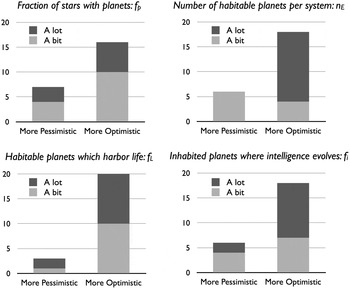
The results for the astrobiology-related terms f p, n e, f l and f i are shown in Fig. 1. For each of these four quantities, the majority of students were more optimistic about factors contributing to the abundance of extraterrestrial life after the course than they were before the course. More specifically, the number of students who were more optimistic about one of the quantities was consistently greater than the number of more pessimistic students by at least a factor of 2 to 1.
The stacked bar graphs show the number of student responses that were more pessimistic or more optimistic after the course than before the course, for four of the astrobiology-relevant quantities of the Drake Equation. Estimates that changed by more than a factor of 10 were coded as ‘a lot’ more optimistic/pessimistic.

Discussion
The results show that a majority of students came away from this course more optimistic about many of the factors that would contribute to the abundance of life in the Galaxy. For each of the terms of the Drake Equation measured, two-thirds or more of the students were more optimistic in their estimates at the end of the course than they were at the beginning.
These results suggest that, while the specific goal of a course in astrobiology might not be to explicitly change student beliefs about the abundance or rarity of extraterrestrial life, it seems clear that such changes in opinion can and do occur. It is of interest to instructors in these courses to be aware of the ways in which their approach to this topic may be affecting student perceptions about these questions. This type of pre/post-test shows promise as a tool for instructors in such courses who wish to know how students are interpreting the larger meaning of the factual course content. It could be of interest for individual instructors to see how results from their own courses compare with the results obtained by others, in order to reveal how instructor biases towards optimism/pessimism regarding these questions are communicated, perhaps unintentionally, to their students.
Acknowledgements
Portions of this research were performed at the author's previous institution, Eugene Lang College.