While Muslim-Americans have lived in the United States for over a century, they have grown in importance in recent years.Footnote 1 The most notable reason for this is that, since the terrorist attacks of September 11, members of this growing religious community have increasingly lived under a microscope. This change represents a paradox since, while this group has grown in the attention it receives, there is still much about Muslim-Americans that is not well understood. This is true for many aspects of the Muslim-American community, but it is perhaps most true when it comes to political attitudes and the behavior that directly affects the interests of this community.
This article seeks to fill this gap by shedding light on the political behavior of mosque-attending Muslim-Americans and the impact that political and religious attitudes have on this behavior. Findings reported herein are based on data collected in surveys taken in more than 70 Mosques throughout the United States in the Fall of 2006. These were mail surveys administered at mosques during the holy month of Ramadan, which allowed us to sample from as large and diverse a population of practicing Muslim-Americans as possible.Footnote 2 These surveys resulted in a participation rate of just under 25 percent which originally led to a working sample of 894 respondents.Footnote 3
The questionnaire administered to mosque-attendees contained a variety of political, religious, and sociological questions.Footnote 4 Naturally, respondents were questioned about their education, income, age, country of birth, ethnic background, gender, and marital status. Concerning religious attitudes and behavior, mosque-attending respondents were asked how important Islam is in their life and how often they attended the mosque. They were also asked to identify themselves as Muslim, Muslim-American, or just American and whether or not they considered themselves to be a member of a particular school or fiqh.Footnote 5 Finally, respondents were presented with an extensive battery of questions regarding their political attitudes and behavior.
The attitude questions included the ideology and party identification questions contained in standard election studies, and they also included political efficacy and media exposure questions as well as attitudes on a number of relevant issues. The issue questions probed respondents’ views of the war in Iraq, taxes, and gay marriage, but these questions also involved issues more directly related to the interests of Muslim-Americans such as perceptions of how the media portrays Muslims and whether or not respondents thought Muslim females should wear the Islamic scarf.
In addition to these attitude questions, our survey endeavored to map the political behavior of mosque-attending Muslim-Americans. Perhaps most interesting in this regard were two sets of questions that related directly to respondents’ participation in the 2000 and 2004 presidential elections. First, respondents were asked to report their vote choices in these two elections, and, second, they were presented with a hypothetical situation where they had to choose between two presidential candidates who represented different positions on a foreign policy issue and a domestic morality issue. This forced respondents to select from two candidates who cut across their essential interests.Footnote 6
With these surveys, we were able to map mosque-attending Muslim-Americans in terms of their religious and political attitudes. This is important in and of itself but even more significant is the fact that we could track the changing political behavior of Muslim-Americans who attended mosque during Ramadan in 2006 in the last two presidential elections. This is interesting because it is well-known that the September 11 terrorist attacks occurred after George W. Bush was elected to his first term as president. We show in the analysis that follows that, while many mosque-attending Muslim-Americans were attracted to Bush in 2000,Footnote 7 a significant number switched their vote to the Democratic candidate, John Kerry, in 2004 because of how foreign policy issues came to exert more influence on their voting decisions. This is shown in a multivariate analysis conducted below, but we also in our hypothetical candidate analysis below show how being more sensitive to a pro-Muslim foreign policy position trumped social conservatism in the vote choices of mosque-attending Muslim-Americans in 2004.
Our mapping and analysis of the political behavior of Muslim-Americans begins with a discussion of the survey data we used for this analysis. Specifically, we start with a definition of the population from which our sample was drawn and then discuss the manner in which we drew the sample.
SAMPLING MUSLIM-AMERICANS
Muslim- Americans can be broadly divided into two major categories, immigrants and converts. Both groups exist in the United States, but there is no accurate estimation of the total number in each category, especially for the latter group.Footnote 8 This is because neither the U.S. Census Bureau nor the Immigration and Naturalization Service (INS) is allowed to collect data based on religious identification. Some Muslim-American organizations such as Council on American Islamic Relations (CAIR) estimated the number of Muslim-American to be between 6 and 7 million.Footnote 9 Other estimates estimated the total number of Muslim-Americans as low as 1.5 million.Footnote 10 In spite of these debates about the size of the Muslim-American population, there is no dispute about the growing significance of this religious community in the United States. As a result, we wanted to draw a sample from this population that avoided some of the problems we have witnessed in previous studies of Muslim-Americans.
This meant designing a sampling process that avoided certain flaws but, at the same time, allowed us to investigate certain issues that either had not been given adequate attention in past studies or involved possible sample bias. Perhaps most important was the necessity to produce a sample of Muslim-Americans that was not derived by over-sampling in this community in a general survey of the American population.Footnote 11 Moreover, we also wanted to avoid the drawbacks that are associated with telephone surveys, some of which identify potential respondents simply through their surnames. This approach is problematic because it is largely dependent on the use of land lines and, thus, misses those respondents who are exclusive cell phone users. Moreover, this approach is potentially problematic because there are a growing number of Muslim-Americans who do not have common Muslim names, and there are instances where Arabic names have come to be used by non-Muslims.Footnote 12 Finally, we wanted to be sure that we interviewed respondents who identified with the Muslim-American community in the city or town in which they live.
According to CAIR, by the summer of 2003, there were over 1,200 mosques in the United States. This is important because we believed that interviewing Muslim-Americans at their respective mosques, a place where Muslim-Americans are most comfortable being members of this community, offered a way around these problems. Nonetheless, the one problem we faced is that Muslim-Americans do not all attend mosque with the same frequency, and, as a result, we needed to be sure that we administered our mail surveys at a time when mosque attendance was at its height. To this end, we administered the surveys during the Muslim holy month of Ramadan, a time when the number of mosque goers increases throughout the entire world. Fasting during Ramadan constitutes the third pillar of the Islamic faith where all adult Muslims who are physically fit are required to participate. Thus, showing up in mosques during Ramadan is a positive sign for someone's apparent commitment to his or her faith.
While there are mosques in nearly every corner of the United States, they are not equally distributed across the states. California contains the most mosques at 17 percent of all in the United States.Footnote 13 Moreover, communities that contain mosques are also very diverse. Consequently, to be sure that we obtained a representative sample of mosques, we selected mosques in 20 different states plus Washington, D.C. to which to send our mail questionnaires.Footnote 14 These communities reflected the diversity of the Muslim community: sampled mosques were in large cities like Los Angeles, Houston, and New York, and they were also in smaller communities such as Manhattan, Kansas, and Lubbock, Texas.
We selected 70 mosques to survey, and we then got in touch with contact persons in each of these mosques. In most cases, these were Imams,Footnote 15 but, in other cases, the contact person was a community leader such as a well-known local physician or professor. Our purpose in making some initial contact was to establish trust between the mosque and its attendees and our research team. We explained the purpose of the survey and how the individual questionnaires were to be administered. Depending on the size of the mosque, packages of surveys were sent to our contact persons in each of these mosques. As instructed, these surveys were to be completed individually and then placed into the individual postage paid envelopes we supplied and then sent back to us through the mail.Footnote 16 Overall, we sent out 4,000 individual questionnaires to these mosques and received just short of 900 in return, all in the individual postage paid envelopes that we supplied.Footnote 17
With the method of data collection discussed, we complete this subsection by briefly describing the characteristics of the mosque-attending Muslim-Americans that we interviewed. Perhaps more than anything else, our survey data indicate that the community of Muslim-Americans attending mosque during Ramadan in 2006 is very diverse. The data in Table 1 identify the respondents in our sample by place of birth and by region of United States residence. With respect to place of birth, we see that, while nearly one-fourth of the respondents in our sample had been born in North America,Footnote 18 Muslims who currently reside in the United States have come from nearly every corner of the globe. The most represented areas were not unexpected and included South Asia and the Middle East from which areas more than 45 percent of our respondents migrated. However, mosque-attending Muslim-Americans in our sample also came from North and Sub-Saharan Africa as well as Southeast Asia, Europe, and Latin America.
Country of birth and current United States residence for Muslim-Americans

* Based on ANES classifications.
** This large percentage was due to the higher than average response rate from Mosques in Houston, Dallas, and Lubbock.
Source: Compiled by the authors from the 2006 Mosque Survey of Muslim-Americans (MSMA, 2006).
We also know from past research that Muslim-Americans live in every region of the United States, something that the data we collected support. The South had the largest number of respondents in our sample because of the high response rate from mosques that were surveyed in Houston, Dallas, and Lubbock, Texas. Also, the large number of respondents living in the West came mostly from California (96.9 percent).
Despite reflecting these characteristics of diversity, nearly all of our respondents stated that Islam was important in their lives.Footnote 19 In light of this, it is not surprising that more than half (54.22 percent) of our respondents identified themselves as Muslim-American while another one-third (36.55 percent) identified themselves as Muslim only.Footnote 20 Aside from these similarities, respondents in our sample were somewhat different in terms of their attendance at mosque. Respondents in our sample attended mosque an average of just under three days a week, with less than one-fourth stating that they attended almost every day and just less than 30 percent stating that they attended for only Friday prayers. Moreover, our analysis of these data found that respondents who identified themselves as strictly American attended mosque at slightly lower rates than those who identified themselves as Muslim-Americans or just Muslims.Footnote 21
POLITICAL ATTITUDES AND POLITICAL BEHAVIOR
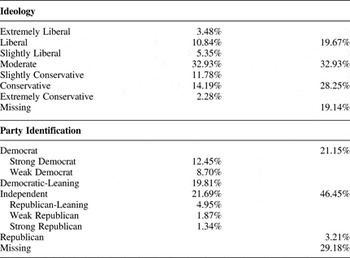
Like Americans in general, Muslim-Americans are hardly homogeneous in their basic political orientations. As the data in Table 2 indicate, ideologically, mosque-attending Muslim-Americans in our sample identified themselves as being liberal, moderate, and conservative. Clearly, moderates were the largest group with just about one-third of our sample identifying themselves that way. Next were those who identified themselves as conservative, a group that comprised 28 percent of our sample. Finally, those who identified themselves as liberals comprised just less than 20 percent of our sample.Footnote 22 In addition to these basic ideological groups, very few respondents in the liberal and conservative camps identified themselves as being extreme. Indeed, most respondents, whether liberal or conservative, saw themselves as representing a moderate version of these ideological positions.
Ideology and party identification of Muslim-Americans

Source: Compiled by the authors from the 2006 Mosque Survey of Muslim-Americans (MSMA, 2006).
While nearly 20 percent of the sample refused to report an ideological identification, this percentage was exceeded by 10 percentage points when we asked our respondents whether or not they identified with a political party. Despite this, most respondents in our sample identified themselves as being politically independent (46.45 percent).Footnote 23 Pure independents represented nearly 22 percent of the sample, and this amount was almost matched by those who reported being independent but leaning toward the Democratic Party. In light of this, it was not that surprising that democrats outnumbered republicans in the sample by more than five times. In fact, despite being far more moderate and conservative ideologically, mosque-attending Muslim-Americans were much more likely to identify with the Democrats than with the Republicans.Footnote 24
Given the ideological orientations of mosque-attending Muslim-Americans, we would expect respondents in our sample to have attitudes similar to conservative Christian-Americans on such social issues as abortion and gay marriage. These issues have become highly salient in recent national and state elections,Footnote 25 and the data in Table 3 indicate that this is very much the case. This is particularly true with respect to the issue of gay marriage where the overwhelming majority of our respondents opposed any allowance for civil unions for gays or lesbians. Views on the abortion issue were still conservative but not to the same extent. A clear majority of mosque-attending Muslim-Americans reported supporting a government ban on abortion, but one-quarter each either were neutral on this issue or disagreed with a government ban altogether.
Attitudes of Muslim-Americans on selected issues

*Percentages do not add to 100% because respondents choosing not to answer have not been eliminated.
Source: Compiled by the authors from the 2006 Mosque Survey of Muslim-Americans (MSMA, 2006).
While attitudes on these issues were no doubt conservative, this does not mean our respondents were conservative on all issues that were contained in the sample. Mosque-attending Muslim-Americans were generally unsupportive of raising taxes for welfare and social security purposes, but only a very small number took the conservative position of supporting the war in Iraq. Indeed, more than 90 percent did not believe that this war was important for promoting the national security interests of the United States.Footnote 26
Table 3 contains responses of mosque-attending Muslim-Americans on two other issues. These issues are of direct concern to members of this community, and responses indicate a significant degree of consensus among this sample of Muslim-Americans. This was certainly true of the question of whether or not the civil rights of Muslim-Americans were hurt in the wake of September 11. Like the distribution of opinion on the Iraq War question, mosque-attending Muslim-Americans were in near universal agreement that their civil rights have suffered since the attacks of September 11.Footnote 27 On the question of whether or not adult Muslim females should wear the Muslim head scarf, respondents were clearly in a conservative position but not universally so. Still two-thirds of respondents in our sample agreed with females wearing the Islamic scarf, while one-third either were neutral or did not agree.Footnote 28
What is interesting is that, despite the overall conservatism of mosque-attending Muslim-Americans, voting behavior in the last two presidential elections was more complicated than one might expect. We see from the data in Table 4 that mosque-attending Muslim-Americans were more favorably disposed to the Republican candidate, George W. Bush, in the 2000 presidential election. In that contest, one-fourth of respondents reported voting for Bush while less than 17 percent reported voting for Gore. The results in the following contest, however, were entirely different. Despite the salience of the gay marriage issue in that presidential contest, Kerry received the bulk of support from Muslim-Americans who reported turning out and voting.Footnote 29 Between the two contests, it is true that consistent Democratic Party voters were more numerous than consistent Republican Party voters, but we see from the table that even the former category of voter was somewhat smaller than those who voted Republican in 2000 but Democratic in 2004.
Voting in the 2000 and 2004 presidential elections and a hypothetical vote choice

Source: Compiled by the authors from the 2006 Mosque Survey of Muslim-Americans (MSMA, 2006).
This pattern of change appears to be related to the importance that mosque-attending Muslim-American voters attached to issues surrounding the war in Iraq in 2004, and we investigate this more thoroughly with the addition of a question that forced respondents in our mosque surveys to make a choice between two candidates, one who took a position coincident with their domestic issue interests (Smith) and the other who took a position coincident with their foreign policy interests (King). As the data in the lower portion of Table 4 indicate, mosque-attending Muslim-Americans were clearly in favor of the candidate (King), who better represented their foreign policy interests than the candidate (Smith), who better represented a domestic policy issue favored by respondents. This may have been expected, given other data presented above, but the fact that King received more than eight times as many “votes” as Smith was not expected. This was interesting to us, but we want to be clear that this result does not mean that mosque-attending Muslim-Americans completely abandoned their domestic concerns when confronted with the choice our survey presented. Evidence for this is witnessed in the fact that nearly 30 percent of those polled stated that they would not vote when presented with this kind of forced hypothetical choice.
EXPLAINING THE VOTING BEHAVIOR OF MUSLIM-AMERICANS
With the attitudes and voting behavior of our mosque-attending Muslim-Americans mapped, we turn next to exploring these relationships more thoroughly in order to explain why vote choice patterns in the 2000 and 2004 presidential elections changed in the way they did. Using the data we collected in the 2006 MSMA survey, we wanted to determine those factors that led our respondents to abandon George W. Bush and vote in much higher numbers for John Kerry in the 2004 presidential election. Moreover, we were interested in seeing if there is a specific set of factors that accounts for those who voted Republican in 2000 but Democrat in 2004. This effort begins with a discussion of the variables we have defined for the analysis and the manner in which we specified the models to be estimated.
Dependent Variables
We defined three dependent variables to identify the factors that explain the voting behavior of Muslim-Americans in our mosque surveys. The first of these refers to the voting choices of respondents in the 2004 presidential election. While this is a polytomous variable, we created two dummy variables, one to indicate a vote for Bush and the other to indicate a vote for Kerry.Footnote 30 We approached the vote choice for our two hypothetical candidates, Smith and King, in the same way, creating a dummy variable for respondents who selected Smith and another dummy variable for those who selected King. In addition to this, we wanted to examine more closely those respondents who reported changing their votes between the 2000 and 2004 presidential elections, particularly, those who reported voting for Bush in 2000 but Kerry in 2004. To this end, we created three dummy variables, whereby we first coded consistent Republican voters a 1 and all others a 0. Second, we coded consistent Democratic voters a 1 and all others a 0. Finally, we coded those who switched from a Republican choice in 2000 to a Democratic choice in 2004 were coded a 1 while all others a 0.
Independent Variables
Our selection of explanatory factors that can account for the voting patterns identified above benefited greatly from the rich literature that exists on voting in presidential elections in the United States. This includes an interesting set of studies on presidential elections in general,Footnote 31 and it also includes some interesting work on the last two presidential elections.Footnote 32 While scholars have included numerous explanatory variables in their models of voting in presidential elections, we divided the explanatory factors we investigate in the remainder of this article into five categories.
Our first category concerns variables that help us differentiate our respondents in terms of religion and religious identity.Footnote 33 Despite the fact that our respondents were all Muslim-American, we noted above that they were not all the same in terms of how they identified themselves and how frequently they attended mosque. In light of this, we first created two dummy variables, one for American only identifiers and the other for Muslim only identifiers. Second, to distinguish our respondents in terms of how frequently they reported attending mosque, we created a scale variable whereby higher values indicate higher rates of mosque attendance.
From the earliest voting studies, we know that socio-economic variables have significant impacts on voting behavior, both as explanatory factors of primary concern as well as control variables.Footnote 34 To this end, we have included a number of socio-economic variables to distinguish respondents from each other. These included income, which is an ordinal variable consisting of five categories, and education, which we organized in the same way. We also included a gender variable that was coded as a dummy,Footnote 35 and we included a variable recording the age of respondents.
Third, we asked a battery of questions in this survey about how respondents obtained relevant political information, specifically, about how often they paid attention to different news sources.Footnote 36 This effort involved nearly 20 questions where we distinguished respondents’ news sources as being television, print, or internet, identifying them as specifically as we could. We also asked respondents to report whether their news sources were in English, Arabic, or some other language. While we could not realistically use all the questions pertaining to news sources in the analysis conducted below, we did create two scales that captured how much time respondents spent watching the news and reading newspapers. We also asked respondents to state how they thought media outlets represented Muslims. This variable was combined into a five-point scale with a 1 indicating the “very negatively” held point of view and a 5 representing the “very positively” held view.Footnote 37
Fourth, we included a number of variables that captured the political-psychological orientations of our respondents. These included the two traditional questions that are asked in voting studies, viz., the questions that lead to the construction of the seven-point party identification scale, and the ideology self-placement question.Footnote 38 In addition to this, respondents were asked other attitude questions, including their level of trust in the United States government.Footnote 39 Finally, as shown above, respondents were queried about their attitudes on a number of important issues. These issue questions began with respondents’ view of the war in Iraq.Footnote 40 We also included questions on abortion and gay marriage, which are salient social issues that have been important determinants of voting for social conservatives.Footnote 41 Moreover, we included two other issues that were asked in our sample.Footnote 42
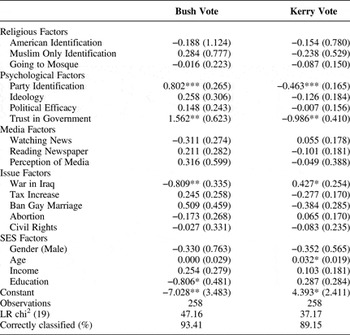
With the dependent and independent variables defined, we can now turn to issues concerned with the estimation of our models of vote choice. Given that our dependent variables are dichotomous, the appropriate method for estimation is logistic regression. Results for the 2004 election are presented in Table 5, and they involve the estimation of two models. The first model is the vote choice for Bush in the 2004 presidential election, while the second model is the vote for Gore.
Vote choice in the 2004 presidential election

Standard errors in parentheses. *significant at 10%; **significant at 5%; ***significant at 1%.
The statistical results in Table 5 confirm our expectations about the voting behavior of mosque-attending Muslim-Americans in the 2004 presidential election. Specifically, the party identification of respondents was a strong and statistically significant predictor of respondents’ vote choice in the 2004 presidential election, where the more strongly a respondent identified as a Republican, the more likely that respondent was to report Bush as his/her choice for president in 2004 and the less likely he/she was to report supporting Kerry. As the data in the table also show, equally important for predicting candidate choice in the 2004 presidential election was a respondent's view on the Iraq war. Opposing the war in Iraq lowered the probability of choosing Bush while increasing the probability of supporting Kerry.Footnote 43 Finally, what was most important for candidate choice in 2004 was whether or not a mosque-attending Muslim-American reported trusting the government in Washington, D.C. Having trust in government raised the probability of choosing Bush much more than either of the previous variables while reducing the probability of selecting Kerry.
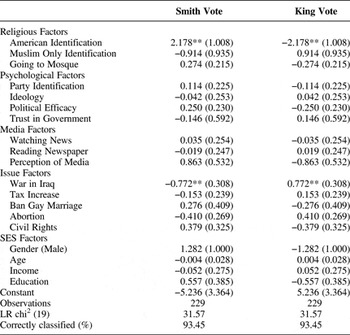
The data in Table 6 help us investigate more thoroughly the role that issues played in the vote choices of mosque-attending Muslim-Americans. Like the previous results, the only statistically significant coefficient was that on the war in Iraq, where the sizes were similar to previous results and signs were in the expected direction. These results tell us that being opposed to the Iraq war reduced the probability of supporting the pro-war candidate (Smith) and increasing the probability of choosing the anti-war candidate (King). What was surprising in this analysis was the lack of significance of any other variable save for one, the variable capturing how respondents identified themselves, particularly, the small percentage in our sample identifying themselves as American only. This group strongly supported the pro-war candidate, even though its members were no different from respondents overall in terms of religion.
Vote choice in the hypothetical question

Standard errors in parentheses. *significant at 10%; **significant at 5%; ***significant at 1%.
Finally, the data in Table 7 concern whether or not a respondent reported voting consistently democratic or republican in the 2000 or 2004 elections or reported switching from a republican choice in 2000 to a democratic choice in 2004. Immediately noticeable from the table is the substantive and statistical significance of the coefficients on the party identification variable across the three groups of respondents. Expectedly, the stronger one's identification with the Republican Party, the more likely that a mosque-attending Muslim-American respondent was to report voting consistently Republican in the 2000 and 2004 presidential elections and, similarly, the less likely he/she was to report voting consistently for a Democrat. What appears to be somewhat unexpected, however, is the statistically significant, positive coefficient on the party identification variable for republican to democratic switchers. While one may conclude from this result that a republican identification increased the probability of a respondent switching from a Republican choice in 2000 to a Democratic choice in 2004, the appropriate interpretation we believe is much less substantive. Specifically, this category of switchers occupied 18 percent of our sample overall and, thus, included many respondents who identified themselves as Republican. Consequently, it would be expected that a Republican identification would be associated with respondents reporting switching from an initial Republican vote in 2000 to a Democratic vote in 2004.
Vote choice in 2000 and 2004 presidential elections

Standard errors in parentheses. *significant at 10%; **significant at 5%; ***significant at 1%.
In addition to party identification, the issue of the war in Iraq appears again as an important explanatory factor. As the data indicate, being opposed to the Iraq war reduced the probability of reporting a consistent Republican vote, but opposition to the war also rendered a respondent more likely to report switching from Republican to Democrat. Even though this coefficient is substantively significant, it is statistically significant at the p < 0.10 level. Finally, one other statistically significant variable was income, which suggests that, as the income level of respondents increased, their probability of being a consistent Republican voter dropped substantially.
The results presented above are clear that the one explanatory factor consistently important across all the analyses was opposition to the War in Iraq. We are confident that this is an important explanatory factor, but, to be sure of this conclusion, we must address certain statistical issues. The first is the issue of multi-collinearity across our independent variables, specifically the potential problem that the presence of multi-collinearity may reduce the confidence we have in coefficient estimates for our independent variables.Footnote 44 The first test for this potential problem involves inspecting the standard errors of the coefficients in our models to insure that they are moderate in nature.Footnote 45 Examining the standard errors on coefficients in Tables 5, 6, and 7 above revealed that they are moderate in size and that no multi-collinearity exists. This gave us more confidence in our results, but we took the next step by inspecting the variance inflation factors (VIF) for independent variables in the models we estimated.Footnote 46 The highest values for our independent variables were 1.52 (the income variable) and 1.07 (the tax increase variable). These are well below the threshold for VIFs indicating that multi-collinearity is not a problem with our models.
Another potential problem with our analysis concerns the possibility that our models were underspecified. We mention this because there are other NES-type variables that could help explain the vote choices of the respondents in our survey. Perhaps the most important here would be measures of respondents’ views of the most important problems facing the United States in general and the Muslim-American community more specifically. Using the most important problem approach rather than the forced issue choices we used may have produced a different set of issues from the ones we used in our survey. Moreover, NES-type voting studies use feeling thermometer readings for respondents to evaluate the objects of politics. Using feeling thermometers for important objects of politics such as the President, the parties, and other political institutions in the United States may have led us to uncover variables that help explain the vote choices we noted in this survey.
While it is true that having more questions is always better in survey studies of respondent vote choices, we were constrained by the format of our questionnaire and, thus, could not include more questions than we had in our original survey document. Also, we agree that it would be interesting to include the kinds of questions mentioned above in an expanded survey of this important religious community in the United States. Nonetheless, we are confident that the results we have presented here are substantively and statistically significant and that the overall conclusion of this research about the importance of attitudes toward the war in Iraq is sound. Indeed, we believe that as long as war continues in Iraq, this issue will continue to be a prime influence on the manner in which mosque-attending Muslim-Americans evaluate the objects of American politics and make their choices in elections.
Finally, in order to calibrate the impact that our principal independent variables had on respondents’ vote choices, we calculated the predicted probabilities produced by allowing our variables of interest to vary from their minimum to maximum values while holding all other variables constant.47 We selected three factors for this analysis, Party Identification, Trust in Government, and the War in Iraq. First, varying the Party identification variable from Strong Democrat to Strong Republican raised the probability of voting for Bust by 33 percent and lowering the probability for Kerry by 36 percent. Similarly, varying Party identification in this way raised the likelihood that our mosque-attending Muslim-Americans reported voting consistently Republican by 40 percent and reducing the likelihood of voting consistently Democrat by 62 percent.
In our analysis, the Trust in Government variable was varied from the lowest to the highest levels, and doing this raised the probability that a voter would choose Bush by 12 percent while lowering the probability of selecting Kerry by 22 percent. Contrary to this, varying trust in government in this way did not have a substantively significant affect on the probability that a respondent reported voting consistently between the two presidential elections or switching from a republican choice in 2000 to a democratic choice in 2004. This, however, is not true for the “War in Iraq” variable. The minimum value of this variable indicated strong support for the war in Iraq while its maximum value indicated strong opposition to this conflict and moving from its minimum to maximum value lowered the probability of selecting Bush by 27 percent while increasing the probability of choosing Kerry by 25 percent. Moreover, varying this attitude variable from its minimum to maximum value raised the probability of a respondent stating that he/she switched from a Republican to a Democratic choice by 33 percent.
As the United States government continues to formulate and implement policies to wage the war on terrorism, its primary area of focus is naturally the regions of the world with predominantly Muslim populations. Understanding the world's Muslims is undoubtedly crucial to the success of United States efforts, and any effort to better understand this religious community naturally begins with understanding the Muslims who currently live in the United States. While much more research is necessary to accomplish this, we believe that the research completed in this article represents a beginning on which future efforts can be built.