





Introduction
A typical sensory reactivity denotes unusual behavioral responses to everyday sensory input and is conventionally grouped into three patterns: hyperreactivity (exaggerated, aversive, or avoidant responses), hyporeactivity (diminished, delayed, or absent responses), and sensory seeking (active craving for intense sensory stimulation) (Ben-Sasson et al., Reference Ben-Sasson, Hen, Fluss, Cermak, Engel-Yeger and Gal2009; Dunn, Reference Dunn1999). Once considered a peripheral clinical curiosity, sensory reactivity now occupies a central place in neurodevelopmental nosology: since 2013, hyper- or hyporeactivity to sensory input, or unusual interest in the sensory aspects of the environment, has been a diagnostic criterion for autism spectrum disorder in the DSM-5 (American Psychiatric Association, 2013). Meta-analytic evidence shows that sensory modulation symptoms are highly prevalent and markedly elevated in autistic individuals relative to typically developing peers (Ben-Sasson et al., Reference Ben-Sasson, Hen, Fluss, Cermak, Engel-Yeger and Gal2009), and that sensory features are among the earliest observable signs of atypical development, often detectable in the first years of life (Baranek et al., Reference Baranek, David, Poe, Stone and Watson2006).
Crucially, sensory atypicalities are not confined to autism. They are frequently reported in attention-deficit/hyperactivity disorder (ADHD; Ghanizadeh, Reference Ghanizadeh2011; Little et al., Reference Little, Dean, Tomchek and Dunn2018), in childhood anxiety (Carpenter et al., Reference Carpenter, Baranek, Copeland, Compton, Zucker, Dawson and Egger2019; Green & Ben-Sasson, Reference Green and Ben-Sasson2010), and in a substantial minority of children in the general population (Van Hulle et al., Reference Van Hulle, Schmidt and Goldsmith2012). Direct transdiagnostic comparisons indicate that the two conditions share elevated sensory atypicality but differ in degree and profile: autism is generally associated with more pronounced and pervasive differences, most consistently sensory hyporesponsiveness (low registration) and sensory over-responsivity, whereas sensation seeking is elevated in both conditions and discriminates them less well, and the overall severity gradient tends to run autism > ADHD > typical development (Dellapiazza et al., Reference Dellapiazza, Michelon, Vernhet, Muratori, Blanc, Picot and Baghdadli2021; Little et al., Reference Little, Dean, Tomchek and Dunn2018; Scheerer et al., Reference Scheerer, Pourtousi, Yang, Ding, Stojanoski, Anagnostou, Nicolson, Kelley, Georgiades, Crosbie, Schachar, Ayub and Stevenson2024).This cross-cutting distribution aligns with a family of dimensional and transdiagnostic frameworks. The Research Domain Criteria initiative advocates studying neurobehavioral dimensions across rather than within diagnostic boundaries (Insel et al., Reference Insel, Cuthbert, Garvey, Heinssen, Pine, Quinn, Sanislow and Wang2010); Gillberg’s ESSENCE concept emphasizes that early symptomatic syndromes rarely occur in isolation and jointly forecast diverse outcomes (Gillberg, Reference Gillberg2010); the general psychopathology or p factor describes a shared liability underlying most mental disorders (Caspi et al., Reference Caspi, Houts, Belsky, Goldman-Mellor, Harrington, Israel, Meier, Ramrakha, Shalev, Poulton and Moffitt2014); the Hierarchical Taxonomy of Psychopathology (HiTOP) organizes symptoms into empirically derived internalizing and externalizing spectra rather than discrete categories (Kotov et al., Reference Kotov, Krueger, Watson, Achenbach, Althoff, Bagby, Brown, Carpenter, Caspi, Clark, Eaton, Forbes, Forbush, Goldberg, Hasin, Hyman, Ivanova, Lynam, Markon and Zimmerman2017); and a broader transdiagnostic turn is reshaping neurodevelopmental research more generally (Astle et al., Reference Astle, Holmes, Kievit and Gathercole2022). Whether early sensory atypicalities primarily index autism liability or a broader vulnerability shared across neurodevelopmental and emotional disorders remains unresolved, in part because most studies examine a single diagnostic group and a single outcome, precluding formal tests of specificity.
A second, largely unaddressed question concerns modality- and direction-specificity. Sensory hyperreactivity, particularly to auditory and tactile input, has been linked both concurrently and prospectively to anxiety and internalizing problems, plausibly through heightened threat detection and avoidance (Carpenter et al., Reference Carpenter, Baranek, Copeland, Compton, Zucker, Dawson and Egger2019; Green & Ben-Sasson, Reference Green and Ben-Sasson2010). The opposite pole of reactivity has received far less attention. The clearest example is pain: autistic individuals are often described as showing altered, often reduced, behavioral pain reactivity, yet the empirical picture is heterogeneous and sometimes paradoxical, and the available studies are typically small, clinical, and cross-sectional (Bogdanova et al., Reference Bogdanova, Bogdanov, Pizano, Bouvard, Cazalets, Mellen and Amestoy2022; Riquelme et al., Reference Riquelme, Hatem and Montoya2016). Whether diminished pain reactivity and sensory seeking align with externalizing rather than internalizing outcomes, yielding differential associations across sensory modalities; that is, opposite-signed relations with internalizing versus externalizing outcomes has, to our knowledge, not been tested prospectively in a general population.
A third pattern, sensory seeking, the active pursuit of intense or unusual sensory input, has been comparatively neglected in prognostic work, despite being one of the most consistently elevated sensory features in early childhood. In Dunn’s framework it reflects an active behavioral response to a low neurological threshold (Dunn, Reference Dunn1999), and it is prominent in both autism and ADHD (Ben-Sasson et al., Reference Ben-Sasson, Hen, Fluss, Cermak, Engel-Yeger and Gal2009; Little et al., Reference Little, Dean, Tomchek and Dunn2018). Cross-sectionally, seeking co-occurs with restricted and repetitive behavior and, behaviorally, with hyperactivity, impulsivity, and other externalizing features, pointing to links with difficulties in behavioral and attentional regulation (Dellapiazza et al., Reference Dellapiazza, Michelon, Vernhet, Muratori, Blanc, Picot and Baghdadli2021). Prospective evidence remains sparse, but developmental studies of infants at elevated likelihood of autism indicate that early sensory seeking has distinct developmental and neurophysiological correlates (Damiano-Goodwin et al., Reference Damiano-Goodwin, Woynaroski, Simon, Ibañez, Murias, Kirby, Newsom, Wallace, Stone and Cascio2018). Because seeking may index a broad regulatory vulnerability rather than a single symptom dimension, we include it alongside hyper- and hyporeactivity and examine its associations across the full range of neurodevelopmental, emotional, and behavioral outcomes.
Three methodological features constrain the current evidence base. First, most studies are cross-sectional, leaving open whether early sensory atypicalities antedate later difficulties and whether their persistence matters. The few longitudinal birth-cohort studies that model sensory trajectories indicate that children with elevated and worsening sensory features show poorer school-age adaptive and autistic outcomes (Chen et al., Reference Chen, Sideris, Watson, Crais and Baranek2024), but such work has rarely extended prediction across the full spectrum of neurodevelopmental and emotional outcomes. Second, samples are predominantly clinical and English-speaking, limiting generalisability, precluding population-level prevalence estimates, and prompting explicit calls for replication in non-English community cohorts (Niedzwiecka et al., Reference Niedzwiecka, Domasiewicz, Kawa, Tomaszewski and Pisula2020). Third, sensory atypicalities and their putative outcomes are often measured with overlapping items, so apparent autism-specificity may partly reflect criterion contamination rather than genuine predictive validity.
These gaps carry practical weight. Early identification of neurodevelopmental difficulty is a public health priority, yet widely used early screeners, including autism-specific instruments applied within MoBa, miss a large proportion of children who later receive a diagnosis (Stenberg et al., Reference Stenberg, Schjolberg, Shic, Volkmar, Oyen, Bresnahan, Svendsen, von Tetzchner, Hornig, Lipkin and Stoltenberg2020). If early sensory atypicalities are broad, transdiagnostic markers, they might strengthen early identification across diagnostic categories rather than within them; and if particular modalities forecast particular outcome profiles, they might also help indicate the likely direction (internalizing vs. externalizing) of later difficulty.
The present study addresses these gaps using a large subsample of the population-based Norwegian Mother, Father, and Child Cohort Study (MoBa), in which the same parent-reported sensory items are available at 18 months, 3 years, and 8 years, alongside a broad battery of validated outcome measures at age 8. Building on prior MoBa work characterizing the phenotypic and genetic structure of early neurodevelopmental traits (Hegemann et al., Reference Hegemann, Corfield, Askelund, Allegrini, Askeland, Ronald, Ask, St Pourcain, Andreassen, Hannigan and Havdahl2023), we move from cross-sectional structure to prospective, transdiagnostic prediction. We draw on two complementary summaries of early sensory atypicality that answer different questions. A composite indicator, whether any of the three markers is present at age 3, captures overall exposure and addresses whether early sensory atypicality is broadly, transdiagnostically associated with later outcomes (RQ1). A cumulative load score, the number of co-occurring atypical modalities (0–3), instead tests whether risk increases in a graded, dose–response manner with the degree of atypicality (RQ3). In short, the composite asks whether sensory atypicality matters across domains at all, whereas the load score asks whether more atypicality confers more risk. We ask: (RQ1) Are age-3 sensory atypicalities specific to later autism traits, or do they predict ADHD, disruptive, and internalizing outcomes to a comparable degree? (RQ2) Do sensory modalities show distinct outcome profiles? Specifically, does auditory hyperreactivity forecast internalizing problems, whereas reduced pain reactivity forecast externalizing problems? (RQ3) Does cumulative sensory load, defined as the number of co-occurring atypical modalities, relate to risk in a graded, dimensional way? (RQ4) Does persistent sensory atypicality carry stronger prognostic information than transient atypicality? To limit criterion contamination, we score autism traits after removing the overlapping sensory item and foreground non-overlapping outcome instruments (ADHD, anxiety, and mood measures).
Method
Sample and design
The MoBa is a population-based pregnancy cohort study conducted by the Norwegian Institute of Public Health (Brandlistuen et al., Reference Brandlistuen, Kristjansson, Alsaker, Valen, Birkeland, Røyrvik, Page, Aamelfot, Vangbæk, Ask, Havdahl, Brantsæter, Rortveit, Håberg and Magnus2025). Participants were recruited from across Norway between 1999 and 2008. Women consented to participate in 41% of pregnancies. The cohort comprises approximately 114,500 children, 95,200 mothers, and 75,200 fathers. MoBa is governed by the Norwegian Health Registry Act. The current study was approved by the Regional Committees for Medical and Health Research Ethics (REC reference 2018/1864).
The present analyses used a subsample of 113,785 children with parent-reported questionnaire data collected from pregnancy through age 8. Sensory items at age 3 were reported for approximately 57,000–58,000 children, and outcomes at age 8 for approximately 43,000; complete-case analytic samples were n ≈ 31,000–33,000 per model. Participation was 41% of invited pregnancies, and MoBa participants are, on average, more likely than the general Norwegian population to be older, more highly educated, non-smoking, and to report fewer adverse health behaviors and pregnancy outcomes (Nilsen et al., Reference Nilsen, Vollset, Gjessing, Skjærven, Melve, Schreuder, Alsaker, Haug, Daltveit and Magnus2009). Attrition across waves is similarly selective, retaining a comparatively advantaged and healthy subsample (Vejrup et al., Reference Vejrup, Magnus and Magnus2022). In the present data, children retained at age 8 had somewhat older mothers and marginally lower rates of sensory atypicality and maternal distress but did not differ in sex (all |d| ≤ 0.14; see Table 4). Because children with more sensory atypicality were somewhat more likely to be lost to follow-up, this selection would, if anything, bias the reported associations toward the null. We quantify its impact in the sensitivity analyses (inverse-probability weighting and multiple imputation) and return to residual, unobserved selection in the Limitations.
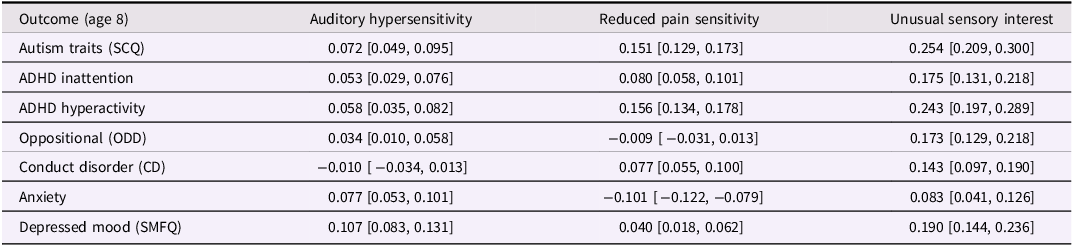
Standardized associations (β) with 95% confidence intervals between age-3 sensory modalities and age-8 outcomes

Table 1. Long description
Rows: seven age-8 outcomes. Columns: auditory hypersensitivity, reduced pain sensitivity and unusual sensory interest, each giving a standardized beta with 95% confidence interval from one model adjusted for covariates. Unusual sensory interest has the largest values, from 0.08 (anxiety) to 0.25 (autism traits). Reduced pain sensitivity ranges from −0.10 (anxiety) to 0.16 (ADHD hyperactivity) and is near zero for oppositional behaviour (−0.01). Auditory hypersensitivity ranges from −0.01 (conduct disorder) to 0.11 (depressed mood). Intervals that exclude zero indicate p < .05; only auditory hypersensitivity for conduct disorder and reduced pain sensitivity for oppositional behaviour include zero.
Note: Values are standardized β [95% CI] with HC3 heteroscedasticity-robust standard errors; all three modalities and covariates were entered in the same model. Intervals excluding 0 correspond to p < .05.
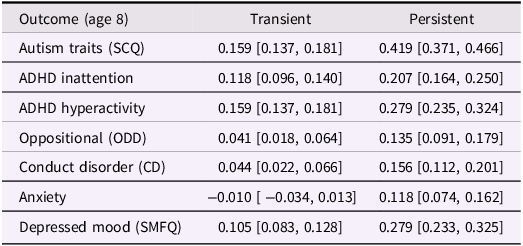
Persistence of sensory atypicality: Standardized associations (β) with 95% confidence intervals for age-8 outcomes

Table 2. Long description
Rows: seven age-8 outcomes. Columns: transient atypicality (one of three waves) and persistent atypicality (two or more waves), each giving a standardized beta with 95% confidence interval relative to children never showing atypicality. Persistent estimates (0.12 to 0.42) exceed transient estimates (−0.01 to 0.16) for every outcome. The largest values are for autism traits (persistent 0.42, transient 0.16). The smallest are for anxiety, where the transient estimate (−0.01) is the only interval that includes zero.
Note: Values are standardized β [95% CI] with HC3 robust standard errors; reference = “never.” Intervals excluding 0 correspond to p < .05; only anxiety (transient) was nonsignificant.
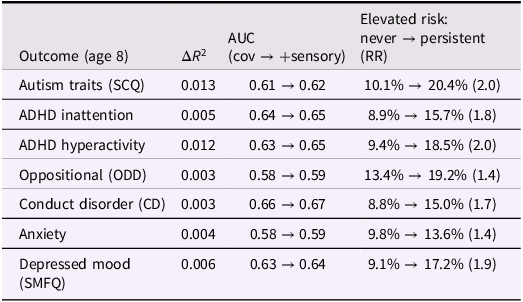
Incremental variance, discrimination, and absolute-risk differences for age-3 sensory markers

Table 3. Long description
Rows: seven age-8 outcomes. Columns: variance explained by the sensory markers beyond covariates (delta R squared); area under the ROC curve (AUC) for identifying the top decile without and with the sensory markers; and the percentage in the top decile among children never versus persistently showing atypicality, with the risk ratio (RR). Delta R squared is small (.003 to .013). AUC improves by at most .02 (from .58–.66 to .59–.67). Risk of an elevated score roughly doubles with persistent atypicality for autism traits (10.1% to 20.4%, RR 2.0), ADHD hyperactivity (9.4% to 18.5%, RR 2.0) and depressed mood (9.1% to 17.2%, RR 1.9), with smaller ratios for inattention (1.8), conduct disorder (1.7), oppositional behaviour (1.4) and anxiety (1.4).
Note: ΔR 2 = incremental variance explained by the three sensory modalities beyond covariates (total model R 2 ranged 2.0%–5.9%). AUC = area under the ROC curve for predicting the top decile of each outcome, covariate-only versus with sensory markers added. Elevated risk = proportion in the top decile among children with never versus persistent (≥2 waves) sensory atypicality; RR = risk ratio.
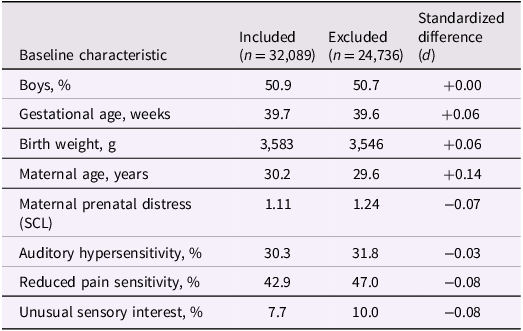
Comparison of included and excluded participants (among children with complete age-3 sensory data)

Table 4. Long description
Among 56,825 children with complete age-3 sensory data, 32,089 were included and 24,736 excluded. Rows: boys, gestational age, birth weight, maternal age, maternal prenatal distress, and each sensory marker. Columns: included, excluded, standardized difference (d). Boys 50.9% vs 50.7% (d = 0.00); gestational age 39.7 vs 39.6 weeks (0.06); birth weight 3,583 vs 3,546 g (0.06); maternal age 30.2 vs 29.6 years (0.14); prenatal distress 1.11 vs 1.24 (−0.07); auditory hypersensitivity 30.3% vs 31.8% (−0.03); reduced pain sensitivity 42.9% vs 47.0% (−0.08); unusual sensory interest 7.7% vs 10.0% (−0.08). All differences are small (|d| < 0.20).
Note: Eligible sample = 56,825 children with complete age-3 sensory data. d = standardized difference (Cohen’s d); |d| < 0.20 is conventionally small. Inclusion was defined by complete data on all covariates and on the ADHD hyperactivity score, the reference outcome for the sensitivity analyses.
Sensory markers (predictors)
At age 3, three binary parent-reported items were used: auditory hypersensitivity (covering ears; hyper), reduced pain sensitivity (getting hurt without seeming to care, high pain threshold; hypo), and unusual sensory interest (preoccupied with the look, feel, sound, taste, or smell of things; seeking). The auditory-hypersensitivity item was administered with identical wording at 18 months, 3 years, and 8 years, and the pain- and seeking-related items with near-identical wording at 3 and 8 years, so the persistence analysis compares the same (not merely analogous) items across waves. All items were recoded to 0/1 (atypicality = 1), and ambiguous responses, the “more than one box checked” code, affecting 66 (0.06%), 245 (0.22%), and 9 (0.01%) children for the auditory, pain, and seeking items, respectively (320 in total), were set to missing.
Outcomes at age 8
Disruptive-behavior dimensions were measured with the parent-reported Rating Scale for Disruptive Behavior Disorders (RS-DBD), which operationalizes the DSM-IV symptom lists as four subscales: ADHD inattention (9 items), ADHD hyperactivity/impulsivity (9 items), oppositional defiant disorder (ODD; 8 items), and conduct disorder (CD; 8 items) (Silva et al., Reference Silva, Alpert, Pouget, Silva, Trosper, Reyes and Dummit2005). Items were rated on a four-point frequency scale and recoded to 0–3, and subscale scores showed acceptable-to-good internal consistency (Cronbach’s α = 0.87 inattention, .86 hyperactivity/impulsivity, 0.84 ODD, 0.70 CD). Depressed mood was measured with the 13-item Short Mood and Feelings Questionnaire (SMFQ; Angold et al., Reference Angold, Costello, Messer, Pickles, Winder and Silver1995), rated on a three-point scale (α = 0.79). Anxiety was measured with a brief five-item parent-report scale included in the MoBa 8-year questionnaire, with items tapping unspecified fearfulness (“gets really frightened for no reason”), separation-related fear (“afraid to be alone in the house”), and excessive worry, each rated on a three-point scale; its internal consistency was low (α = 0.47), so the anxiety estimates should be read as noisy and are interpreted cautiously throughout. Autism traits were scored using the full 40-item SCQ with the official key (Rutter et al., Reference Rutter, Bailey and Lord2003): 14 items were scored “yes” (atypical behavior present), and 24 were reverse-keyed “no” (absence of typical behavior); item 1 was not scored, and the sensory item (item 14) was excluded to avoid criterion contamination with the predictor. Scale sums were prorated when ≥80% of items were completed, and all outcome scores were standardized to a mean of 0 and a standard deviation of 1 (z-scored) within each analytic sample; the binary sensory predictors were left unstandardized so that regression coefficients express the change in outcome standard deviations associated with the presence versus absence of a marker.
Covariates and analyses
All models were adjusted for child sex, gestational age, birth weight, maternal age, maternal prenatal psychological distress (SCL), and child age at the age-8 assessment. We estimated linear regressions with heteroscedasticity-robust (HC3) standard errors and applied a Benjamini–Hochberg correction. Specificity was tested by stacking the autism and ADHD outcomes and testing a predictor × outcome-type interaction with cluster-robust standard errors. Modality-specific contributions were estimated with the three markers entered simultaneously. To index cumulative burden, we regressed each outcome on the number of co-occurring atypical modalities at age 3 (a 0–3 load score). Because three binary indicators cannot robustly support a latent class model (a two-class solution is just-identified, with no residual degrees of freedom), we ran a latent class analysis (StepMix) only as an exploratory check on whether the load score obscured qualitatively distinct profiles. Persistence was defined from a sensory-atypicality indicator at each of the three waves; 18 months, 3 years, and 8 years, restricted to children with complete data at all three: children were classified by the number of waves showing atypicality (0–3) and grouped as never (0 waves), transient (1 wave), or persistent (≥2 waves). To characterize effect magnitude and guard against overinterpretation, we additionally report the incremental variance explained by the sensory markers (change in R2), and, for a dichotomized elevated-outcome definition (top decile of each outcome), their added discrimination (area under the ROC curve) and the absolute risk associated with persistent versus absent atypicality. To assess the impact of attrition and missing data, we compared included and excluded participants on baseline characteristics and repeated the primary models using inverse-probability-of-inclusion weighting and multiple imputation by chained equations (10 imputations). Analyses were run in Python (statsmodels, scikit-learn, StepMix). Full coefficients for all covariates in the primary modality-specific models are reported in Supplementary Table S1.
Results
Prevalence and co-occurrence
At age 3, 31.1% of parents reported auditory hypersensitivity, 44.7% reported reduced pain sensitivity (a strikingly high endorsement rate for a single yes/no item), and 8.7% reported unusual sensory interest; at least one of the three occurred in 61.7%. Auditory hypersensitivity at 18 months was reported in 12.3%. Auditory hypersensitivity and reduced pain sensitivity co-occurred more often than chance (OR = 1.41). Reliability was good for the RS-DBD scales (α = 0.70–0.87) and SMFQ (α = 0.79) but low for the anxiety scale (α = 0.47). Reduced pain sensitivity was the only marker to differ markedly by sex: it was reported for 49.5% of boys versus 39.1% of girls (auditory hypersensitivity and unusual sensory interest differed little, ≤2 percentage points; see Supplementary Table S2). We scrutinize the interpretation of this sex difference in the Discussion.
Item-level missingness reflected questionnaire non-return and cohort attrition. The age-3 sensory markers were missing for 48.9%–49.3% of the 113,785 children, the 18-month auditory item for 38.2%, and the age-8 outcome scores for 62.0%–62.3%. Among covariates, missingness ranged from 10.7% (maternal age) to 30.9% (gestational age), with 13.0% for prenatal distress and 28.8% for both child sex and birth weight.
Transdiagnostic versus autism-specific risk
A composite sensory indicator at age 3 predicted all neurodevelopmental outcomes, with the strongest associations for autism traits (β = 0.18), ADHD hyperactivity (β = 0.17), ADHD inattention (β = 0.12), and depressed mood (β = 0.11), as well as CD (β = 0.06) and ODD (β = 0.05; all p < .001), but not anxiety (β = −0.02, ns). Autism traits were thus among the most strongly predicted outcomes. However, the association was not unique to autism: in the specificity test, the effect on autism traits was only 0.05 SD stronger than on ADHD inattention (p < .001). Early sensory atypicalities are therefore a broad, transdiagnostic marker that affects autism and ADHD to a similar degree.
Modality-specific profiles: Differential associations
With the three modalities in the same model, a clear pattern of differential associations emerged (Figure 1, Table 1). Auditory hypersensitivity was particularly associated with internalizing outcomes (anxiety β = 0.08; depressed mood β = 0.11), with near-zero effects for CD. Reduced pain sensitivity showed the opposite pattern: positive for externalizing outcomes (hyperactivity β = 0.16; CD β = 0.08; inattention β = 0.08) and for autism traits (β = 0.15), but negative for anxiety (β = –0.10). Unusual sensory interest was the broadest and strongest marker, positively associated with all domains (β = 0.08–0.25), with the strongest association for autism traits.
Standardized associations between age-3 sensory modalities and age-8 outcomes. Markers show standardized β with 95% confidence intervals from models entering the three modalities simultaneously and adjusting for covariates: circles, auditory hypersensitivity; squares, reduced pain sensitivity; triangles, unusual sensory interest. The dashed vertical line marks no association. Note the opposite signs for auditory hypersensitivity and reduced pain sensitivity in relation to anxiety.

Cumulative sensory load
Cumulative sensory load, defined as the number of atypical modalities at age 3 (0–3; present in 21,535, 24,103, 9,756, and 1,431 children, respectively), showed a graded, monotonic relation with autism, ADHD, disruptive, and mood outcomes. Each additional atypical modality was associated with higher autism traits (β = 0.13 per unit), ADHD hyperactivity (β = 0.13), depressed mood (β = 0.09), inattention (β = 0.08), conduct problems (β = 0.05), and oppositional problems (β = 0.04; all p < .001). The mean standardized outcome rose stepwise across load levels (e.g., autism traits: −0.15, 0.02, 0.15, and 0.45 for loads of 0, 1, 2, and 3). Cumulative load was, however, unrelated to anxiety (β = −0.002, ns), as expected given that its constituent modalities carry opposite-signed anxiety associations that cancel in a simple sum, underscoring that a unidimensional burden score cannot substitute for the modality structure. An exploratory latent class analysis of the three binary items returned only a low- versus high-load two-class split (larger class ≈ 75%; two-class vs. one-class BIC = 180,777 vs. 181,999, AIC = 180,714 vs. 181,973, entropy = 0.35, indicating poor class separation); with three indicators, this model is just-identified and is best read as a coarse rendering of the same underlying severity dimension rather than as evidence of qualitatively distinct profiles.
Persistence and dose–response
Among children with complete sensory data across all three waves (n = 33,976), 12,221 never showed atypicality, 18,579 showed transient atypicality, and 3,176 (≈ 9%) showed persistent (≥2 waves) atypicality. The number of waves with atypicality showed a clear dose–response across all outcomes (strongest for autism traits, β = 0.19, and hyperactivity, β = 0.15, per wave). Persistent atypicality yielded consistently stronger associations than transient atypicality (Figure 2, Table 2): for example, autism traits β = 0.42 (persistent) versus 0.16 (transient), and depressed mood β = 0.28 versus 0.11. For anxiety, only persistent atypicality was associated with increased risk (β = 0.12), whereas transient atypicality was not.
Transient versus persistent sensory atypicality and age-8 outcomes. Markers show standardized β with 95% confidence intervals relative to children never showing atypicality, adjusted for covariates: open circles, transient atypicality (one wave); filled squares, persistent atypicality (two or more waves). The dashed vertical line marks no association. Persistent atypicality yields consistently stronger associations than transient atypicality.

Effect sizes and predictive utility
Because standardized coefficients of this magnitude are easily overinterpreted, we quantified effect sizes directly (Table 3). The sensory markers explained little additional variance: the three modalities together added 0.3% to 1.3% beyond covariates (composite marker 0.01% to 0.8%), and the total model R-squared ranged from 2.0% to 5.9%. Consistent with this, adding the sensory markers to a covariate-only model marginally improved discrimination of children in the top decile of each outcome (increase in area under the ROC curve of 0.005 to 0.018; full-model AUC 0.59 to 0.67), indicating negligible value for identifying individual children. At the group level, however, the same associations corresponded to meaningful differences in absolute risk: children with persistent sensory atypicality were roughly twice as likely as those never showing atypicality to score in the top decile for autism traits (20.4% vs. 10.1%; risk ratio [RR] = 2.0), ADHD hyperactivity (18.5% vs. 9.4%; RR = 2.0), and depressed mood (17.2% vs. 9.1%; RR = 1.9), with smaller differences for conduct problems (RR = 1.7), inattention (RR = 1.8), anxiety (RR = 1.4), and oppositional problems (RR = 1.4).
Sensitivity analyses for attrition and missing data
Children included in the analytic sample differed only modestly from eligible children (those with complete age-3 sensory data) who were lost to follow-up (Table 4). The groups did not differ in sex (50.9% vs. 50.7% boys; standardized difference d = 0.00), and included children had somewhat older mothers (d = 0.14). They also had marginally lower rates of the sensory markers and slightly lower maternal prenatal distress (all |d| ≤ 0.08). All standardized differences were small (|d| ≤ 0.14), and the direction indicates that children with greater sensory atypicality were somewhat more likely to be lost, which would bias associations towards the null rather than inflate them. Two sensitivity analyses indicated that this selection did not materially affect the estimates. Inverse-probability-of-inclusion weighting left the modality-specific coefficients essentially unchanged (e.g., for ADHD hyperactivity, reduced pain reactivity β = 0.159 complete-case vs. 0.159 weighted; sensory seeking β = 0.247 vs. 0.246; for anxiety, reduced pain reactivity β = −0.102 vs. −0.102; outcomes standardized within the analysis sample). Multiple imputation (10 imputations) of missing outcomes and covariates among all children with complete sensory data reproduced the associations with no change in direction, significance, or approximate magnitude (e.g., ADHD hyperactivity: sensory seeking β = 0.26, reduced pain reactivity β = 0.16, auditory hyperreactivity β = 0.05).
Discussion
Using a large, prospective, population-based cohort, we found that parent-reported sensory atypicality at age 3 predicted a broad range of neurodevelopmental and emotional outcomes at age 8. Four results stand out. First, prediction was transdiagnostic: a composite sensory marker was associated with autism traits, ADHD, disruptive behavior, and depressed mood, and its effect on autism traits exceeded that on ADHD inattention by only 0.05 SD. Second, the sensory modalities showed differential associations: auditory hyperreactivity predicted internalizing outcomes, reduced pain reactivity predicted externalizing outcomes and lower anxiety, and sensory seeking predicted every domain. Third, cumulative sensory load related to most outcomes in a graded, dose–response fashion, though not to anxiety, for which the modalities’ opposing signs cancel. Fourth, atypicality that persisted across 18 months, 3 years, and 8 years conferred substantially greater risk than transient atypicality, following a graded dose–response. Below, we situate these findings within the transdiagnostic, developmental, and clinical literatures and consider their methodological implications.
Sensory atypicality as a transdiagnostic marker
That early sensory atypicality predicted autism traits, ADHD, disruptive behavior, and depressed mood, with only a negligible advantage for autism over ADHD, indicates a broad rather than disorder-specific liability. This extends cross-sectional reports of overlapping sensory profiles in autism and ADHD (Dellapiazza et al., Reference Dellapiazza, Michelon, Vernhet, Muratori, Blanc, Picot and Baghdadli2021; Scheerer et al., Reference Scheerer, Pourtousi, Yang, Ding, Stojanoski, Anagnostou, Nicolson, Kelley, Georgiades, Crosbie, Schachar, Ayub and Stevenson2024) and twin evidence that sensory over-responsivity is only partly separable from general behavior problems (Van Hulle et al., Reference Van Hulle, Schmidt and Goldsmith2012), and, to our knowledge, provides the first prospective, population-level demonstration of prediction across the full internalizing–externalizing spectrum, closely aligned with the dimensional premise of RDoC (Insel et al., Reference Insel, Cuthbert, Garvey, Heinssen, Pine, Quinn, Sanislow and Wang2010). The pattern fits a family of neurodevelopmental frameworks at least as well as RDoC: Gillberg’s ESSENCE concept, in which early syndromes seldom occur in isolation and jointly predict wide-ranging difficulties (Gillberg, Reference Gillberg2010); a general psychopathology (p) factor, explaining why risk indicators ignore diagnostic boundaries (Caspi et al., Reference Caspi, Houts, Belsky, Goldman-Mellor, Harrington, Israel, Meier, Ramrakha, Shalev, Poulton and Moffitt2014); and the HiTOP internalizing/externalizing spectra (Kotov et al., Reference Kotov, Krueger, Watson, Achenbach, Althoff, Bagby, Brown, Carpenter, Caspi, Clark, Eaton, Forbes, Forbush, Goldberg, Hasin, Hyman, Ivanova, Lynam, Markon and Zimmerman2017), onto which our modality dissociation maps directly. Importantly, breadth is not irrelevance to autism: autism traits were the single most strongly predicted outcome for the composite, cumulative, persistent, and seeking markers, so sensory features remain especially pertinent to autism, but that pertinence is shared with, not exclusive to, other conditions. Without clinical diagnoses or genetic data, however, we cannot establish non-specificity at the etiological level.
Differential associations across sensory modalities
The clearest novel contribution is the modality- and direction-specific pattern of prediction. The link from auditory hyperreactivity to later anxiety and depressed mood replicates and extends prospective work identifying sensory over-responsivity as an early risk factor for anxiety and behavioral challenges (Carpenter et al., Reference Carpenter, Baranek, Copeland, Compton, Zucker, Dawson and Egger2019) and models positing bidirectional relations between anxiety and sensory over-responsivity (Green & Ben-Sasson, Reference Green and Ben-Sasson2010). Reduced pain reactivity, a common and coarsely measured marker whose validity we examine below, showed the mirror-image pattern, predicting hyperactivity and conduct problems and, notably, lower anxiety. This side of the pattern has rarely been examined prospectively and is consistent with under-arousal and sensation-seeking accounts of externalizing behavior; it also complements the heterogeneous and sometimes paradoxical literature on pain in autism, which has been constrained by small, clinical, cross-sectional samples (Bogdanova et al., Reference Bogdanova, Bogdanov, Pizano, Bouvard, Cazalets, Mellen and Amestoy2022; Riquelme et al., Reference Riquelme, Hatem and Montoya2016). Because the externalizing, anxiety, and mood outcomes share no items with the sensory predictors, this differential pattern is robust to the autism-scoring issue noted above. Sensory seeking behaved as a broad, comparatively nonspecific marker, positively associated with every outcome and most strongly with autism traits, suggesting it may index general neurodevelopmental atypicality or difficulties in behavioral regulation rather than a single symptom dimension.
Sensory seeking as a broad, cross-cutting marker
Sensory seeking was the strongest and least specific predictor, exceeding auditory hyperreactivity on every outcome and showing the largest association with autism traits. Within Dunn’s model, seeking reflects an active behavioral response to a low neurological threshold, closely tied to under-arousal, novelty, and reward approach, and difficulties in behavioral and attentional regulation (Dunn, Reference Dunn1999); it may therefore index a domain-general regulatory dimension rather than a single perceptual channel, which would explain why it forecasts outcomes as diverse as hyperactivity, conduct problems, and depressed mood, and mirrors reports that seeking is elevated across both autism and ADHD (Little et al., Reference Little, Dean, Tomchek and Dunn2018; Scheerer et al., Reference Scheerer, Pourtousi, Yang, Ding, Stojanoski, Anagnostou, Nicolson, Kelley, Georgiades, Crosbie, Schachar, Ayub and Stevenson2024).
Part of seeking’s apparent superiority likely reflects item breadth: the item is intrinsically multimodal (sight, feel, sound, taste, smell), whereas the auditory item is unimodal, and although we removed the overlapping SCQ item, unusual sensory interest belongs conceptually to the restricted-and-repetitive-behavior domain, so the seeking–autism estimate is partly confirmatory. Reassuringly, seeking’s associations with non-overlapping outcomes (ADHD, conduct problems, depressed mood) were themselves substantial (β = 0.14–0.19) and cannot be explained by overlap. Finally, seeking was rare (8.7%), so its strong per-child associations identify a small, higher-risk group rather than a common trait, and, being parent-reported, may be inflated by reporters already attuned to atypical development.
Persistence, timing, and developmental cascades
Prognostic information was carried disproportionately by persistence and by dimensional load rather than by discrete profiles. With only three binary indicators, a latent class model is just-identified and cannot adjudicate profile shape; the two-class solution merely separated low- from high-load children and is most parsimoniously read as a coarse cut through a severity continuum. The dimensional analyses were more informative: cumulative load related to risk in a graded, monotonic fashion, though not to anxiety, whose components pull in opposite directions. The most informative dimension, however, was temporal. Atypicality sustained across waves carried substantially more prognostic weight than its cross-sectional breadth, and children atypical at two or more waves fared markedly worse than those with transient atypicality, converging with the most comparable birth-cohort study, in which an elevated-and-worsening trajectory showed the poorest school-age outcomes (Chen et al., Reference Chen, Sideris, Watson, Crais and Baranek2024). That only persistent, not transient, atypicality predicted anxiety suggests chronic exposure may be required for some internalizing sequelae to accrue, consistent with developmental-cascade models in which small early differences compound into clinically meaningful outcomes.
Possible neurobiological substrates
Although we did not measure neural function, the pattern of results is consistent with several cross-diagnostic mechanistic accounts. Altered sensory reactivity has long been attributed to an imbalance between cortical excitation and inhibition (Rubenstein & Merzenich, Reference Rubenstein and Merzenich2003), which can either sharpen or blunt responses and has been implicated in autism and ADHD alike. Predictive-coding models add that atypical weighting of sensory prediction errors relative to prior expectations can yield hyper- or hyporesponsive phenomenology depending on which computations are affected (Pellicano & Burr, Reference Pellicano and Burr2012), naturally accommodating the co-occurrence of hyper- and hyporeactivity within the same children, while differences in salience assignment by the insula and its network (Uddin, Reference Uddin2015) could bias development towards threat-oriented, internalizing outcomes or towards sensation-seeking, externalizing ones. We offer these as hypotheses to guide mechanistically informed studies, not as conclusions supported by the present data.
Clinical and screening implications
Early identification of neurodevelopmental difficulty is a public-health priority, and autism-specific screeners miss many children in this cohort who are later diagnosed (Stenberg et al., Reference Stenberg, Schjolberg, Shic, Volkmar, Oyen, Bresnahan, Svendsen, von Tetzchner, Hornig, Lipkin and Stoltenberg2020). Brief sensory items could complement existing tools as transdiagnostic risk indicators, flagging risk across rather than within diagnostic boundaries, with the modality profile hinting at direction (hyperreactivity → internalizing; reduced pain reactivity → externalizing). These implications must be weighed against effect size. Associations were small, most modality-specific coefficients fell between β = 0.05 and 0.15 (rising to 0.42 for persistent atypicality), the markers added only 0.3%–1.3% to explained variance, and conferred negligible individual discrimination (ΔAUC <0.02), exactly what is expected for distal, single-item predictors in unselected population samples (Funder & Ozer, Reference Funder and Ozer2019). Yet the same associations corresponded to a near-doubling of the absolute risk of elevated symptoms among persistently atypical children (Table 3). The appropriate reading is therefore etiological and population-level: these items index shared vulnerability and motivate mechanistic research, not individual case-finding, and any screening use would require calibration, external validation, and evaluation of net benefit before implementation.
Strengths and limitations
Strengths include the very large, prospective, population-based design; repeated measurement of sensory atypicality across three developmental waves; a broad battery of validated outcomes; a non-English-speaking community cohort, responding to explicit calls for replication (Niedzwiecka et al., Reference Niedzwiecka, Domasiewicz, Kawa, Tomaszewski and Pisula2020); a formal test of outcome specificity; and a design attentive to criterion contamination.
The principal limitation is measurement. The sensory construct rests on three single parent-reported items, covering the ears, getting hurt without seeming to care, and unusual sensory interest, drawn from autism-screening content rather than validated multi-item instruments such as the Sensory Profile (Dunn, Reference Dunn1999) or the Sensory Experiences Questionnaire (Baranek et al., Reference Baranek, David, Poe, Stone and Watson2006); single items are less reliable and cannot separate genuine sensory reactivity from correlated behavioral tendencies such as impulsivity, irritability, or restricted interests. The pain item is especially coarse: endorsed for nearly half of children (44.7%; 49.5% of boys vs. 39.1% of girls), it most likely indexes a common, largely normative indifference to minor knocks rather than clinically significant hypoalgesia, so no inference about pain processing can be drawn, and its large, heterogeneous “positive” group probably dilutes rather than inflates per-child effects. Relatedly, because sensory content is often embedded within autism instruments, overlapping items can inflate apparent specificity or, through mis-scoring, obscure real associations; we therefore fixed the SCQ scoring a priori by its published algorithm (Rutter et al., Reference Rutter, Bailey and Lord2003) and removed the overlapping sensory item, and we recommend that future work residualize shared content and pre-register scoring rules. Replication with validated multi-item scales and, ideally, objective psychophysical or psychophysiological measures (pain thresholds, auditory habituation, autonomic reactivity) will be needed to establish how much of the signal is specifically sensory.
A second major limitation is that a single informant, the mother, reported both the age-3 markers and all age-8 outcomes, so common-method variance (halo effects, response bias; De Los Reyes & Kazdin, Reference De Los Reyes and Kazdin2005) could inflate the broad, transdiagnostic pattern that is the paper’s central claim. Three features argue against a purely artefactual reading: the five-year interval limits state carryover; adjustment for maternal prenatal distress left the associations essentially unchanged; and, most importantly, a uniform reporting bias predicts same-signed inflation across all outcomes and cannot produce the modality-specific dissociation we observe (reduced pain reactivity predicting more externalizing but less anxiety, auditory hyperreactivity the reverse). Even so, a stable bias could still inflate the overall magnitude, which these data cannot quantify; multi-informant outcomes, teacher ratings, or registry-based diagnoses available in MoBa and linked Norwegian registries but not in the present extract are needed for definitive resolution.
Further limitations are briefer. Outcomes are traits and screeners rather than clinical diagnoses, and the five-item anxiety scale showed low internal consistency (α = 0.47), adding noise to the anxiety estimates. This extract did not include parental socioeconomic status, leaving potential residual confounding that registry linkage could address. As a self-selected cohort with differential attrition (Nilsen et al., Reference Nilsen, Vollset, Gjessing, Skjærven, Melve, Schreuder, Alsaker, Haug, Daltveit and Magnus2009; Vejrup et al., Reference Vejrup, Magnus and Magnus2022; see Methods and Sensitivity analyses), MoBa likely yields conservative rather than inflated estimates, and inverse-probability weighting and multiple imputation left the results essentially unchanged. Finally, effect sizes are small, population-level signals, and the observational design precludes causal inference: the associations could reflect shared genetic or environmental liability rather than sensory atypicality per se.
Future directions
Several extensions follow directly. Linkage to registry diagnoses, such as the Norwegian Patient Registry, would provide contamination-free outcomes and permit calibration of sensory markers against clinical endpoints. Genetically informed and within-family designs available in MoBa (Hegemann et al., Reference Hegemann, Corfield, Askelund, Allegrini, Askeland, Ronald, Ask, St Pourcain, Andreassen, Hannigan and Havdahl2023) could distinguish direct from environmentally mediated effects and clarify whether sensory atypicality shares liability with the disorders it predicts. Multi-informant and objective measures, for example, psychophysical pain thresholds and autonomic reactivity, could test the arousal-based mechanisms proposed here to explain the contrasting hyper- versus hyporeactivity associations. Finally, formal mediation and cascade models could establish whether early sensory atypicality operates through intermediate regulatory or behavioral pathways, informing whether and when sensory-focused monitoring or intervention might alter developmental trajectories.
Conclusion
In a large population-based cohort, sensory atypicality at age 3 was a broad, modality-specific, and partly persistent marker of neurodevelopmental and emotional difficulties at age 8. Autism traits were among the most strongly predicted outcomes, but the signal was transdiagnostic rather than unique to autism. Auditory hyperreactivity and reduced pain reactivity pointed in opposite directions, towards internalizing and externalizing outcomes, respectively, and persistent atypicality carried the strongest prognostic information. Taken together, the pattern fits contemporary models of general neurodevelopmental vulnerability, including the ESSENCE concept, the general psychopathology (p) factor, and the dimensional spectra of HiTOP, as well as the broader transdiagnostic turn in neurodevelopmental research (Astle et al., Reference Astle, Holmes, Kievit and Gathercole2022; Caspi et al., Reference Caspi, Houts, Belsky, Goldman-Mellor, Harrington, Israel, Meier, Ramrakha, Shalev, Poulton and Moffitt2014; Gillberg, Reference Gillberg2010; Kotov et al., Reference Kotov, Krueger, Watson, Achenbach, Althoff, Bagby, Brown, Carpenter, Caspi, Clark, Eaton, Forbes, Forbush, Goldberg, Hasin, Hyman, Ivanova, Lynam, Markon and Zimmerman2017), at least as well as it fits a narrower, autism-centered account. Early sensory features are best understood as dimensionally distributed indicators of shared neurodevelopmental liability, whose modality structure maps onto internalizing and externalizing spectra; realizing their promise for early risk identification will require careful, contamination-aware measurement.
Supplementary material
The supplementary material for this article can be found at https://doi.org/10.1017/S095457942610217X.
Data availability statement
Data from the MoBa are managed by the Norwegian Institute of Public Health. Because participant consent does not permit storage of individual-level data in public repositories or journals, the data cannot be shared openly. Researchers can apply for access to MoBa data through helsedata.no; access requires approval from the Regional Committees for Medical and Health Research Ethics (REC), compliance with the GDPR, and approval from the data owner.
Acknowledgements
The Norwegian Mother, Father, and Child Cohort Study is supported by the Norwegian Ministry of Health and Care Services and the Ministry of Education and Research. We are grateful to all the participating families in Norway who take part in this ongoing cohort study.
Funding statement
This research received no specific grant from any funding agency, commercial or not-for-profit sectors.
Competing interests
The authors declare none.
Availability of code
The analysis code that reproduces all reported analyses, tables, and figures, together with a record of the software environment, is available from the first author.
Availability of methods/material
The MoBa questionnaires, including all items used in this study, are publicly available from the Norwegian Institute of Public Health (www.fhi.no/en/ch/studies/moba). The questionnaire variables used and the scoring of all measures are described in the Method section and documented in the analysis code.
Pre-registration statement
Reasons: This study was not pre-registered. It is a secondary analysis of existing data from an ongoing population-based cohort, and the analysis plan was developed after the data had been collected and made available to the authors. To support transparency, all analytic decisions, including those made in response to peer review, are reported in the Method section and Supplementary Materials, and the complete analysis code is openly available (see Availability of Code).


 Open access

