Bowel (colorectal) cancer includes cancers of the colon, rectum, and appendix. Bowel cancer is the second most common cancer in England and Wales, with 30,790 cases reported in 2006, accounting for 12 percent of all cancer cases (18). Bowel cancer is associated with significant mortality with 13,049 deaths reported in 2007 (19). Prognosis is strongly associated with age and the stage of cancer at diagnosis. Cancers diagnosed at a late-stage are often unsuitable for resection and are associated with a poor prognosis. Five-year survival rates for bowel cancer are between 47 and 51 percent, depending on age and sex. Survival rates in England have historically lagged behind those reported in mainland Europe and North America. The poorer survival rate in England has been attributed to late presentation and delays in initiating appropriate treatment (Reference Ciccolallo, Capocaccia and Coleman3;Reference Coleman, Gatta and Verdecchia4).
Attempts to derive the financial cost of bowel cancer services are complicated by differences in treatment pathways across centers. Research from the United States (Reference Yabroff, Mariotto, Feuer and Brown31) projected the costs of bowel cancer care for patients aged 65 and over, based on practice patterns derived from the Medicare program. The US study included both direct costs of medical care and indirect costs such as time spent by the patient travelling to hospital, waiting for care, and receiving care. The US study estimated that the total direct and indirect cost of bowel cancer was $7.49 billion (£4.94 billion) in 2000 with projections of an increase to $11.43 billion (£5.78 billion) by 2020.
Despite the significant impact on the health-related quality of life and life expectancy, the financial burden of bowel cancer to the National Health Service (NHS) remains largely unknown; this problem is not unique to bowel cancer. The National Institute for Health and Clinical Excellence (NICE) has produced several individual treatment guidance for bowel cancer to the NHS over the past decade. However, it could be argued that a more useful approach would be to model the entire treatment pathway. The World Class Commissioning handbook suggests that Primary Care Trusts (PCTs) develop program budgeting or equivalent methodology demonstrating a whole system approach to investment and disinvestment (6). This study describes a potential methodology for this. Programme Budgeting and Marginal Analysis (PBMA) is a process which involves considering how healthcare resources are distributed across a range of programs and assessing changes to these programs (Reference Ruta, Mitton, Bate and Donaldson22). This approach, first, requires evidence on the current service pathway to map current activity and expenditure for strategic development of cancer services, and in particular, for balanced investment across the pathway.
The primary objective of this study was to estimate the direct cost of bowel cancer services for a 1-year period in England. Service pathways’ modeling was used to estimate the costs associated with a cross sectional cohort of bowel cancer patients, including newly diagnosed patients as well as those already in the system. The secondary objective of this study was to consider the costs for different components of bowel cancer pathway to provide a baseline for PBMA which is used by healthcare decision makers to consider future investment and disinvestment opportunities in the service pathway. The research was commissioned by the Department of Health to inform the Cancer Reform Strategy (9). A second related component of this research program was to consider the cost-effectiveness of several options for service development using a discrete event simulation model (DES) for which the results are reported in a separate study (Reference Pilgrim, Tappenden and Chilcott21).
METHODS
Service Pathway
A detailed service pathway intended to represent bowel cancer services provided by the NHS in England was developed based on literature, guidelines and clinical input. In the context of this study, bowel cancer services include services provided to individuals with diagnosed bowel cancer (as defined by ICD C18, C19, and C20) as well as those provided to individuals with suspected bowel cancer who undergo diagnostic tests. Whereas the latter group may subsequently be diagnosed as not having colorectal cancer, these patients consume bowel cancer services.
The treatment pathway was developed in the form of a pathways model. The service pathways model is intended to show the possible options for an individual at each stage of the bowel cancer service pathway.
The service pathway includes the following seven components: (i) Screening (using Tappenden et al. [25], screening model); (ii) Diagnosis (including surveillance of individuals with adenomatous polyps); (iii) Primary treatment (comprising surgery, pre- or post-operative chemotherapy with or without radiotherapy and adjuvant chemotherapy); (iv) Follow-up (comprising surveillance of patients over a 5 year period after primary treatment), and the management of recurrence; (v) Stoma care (including surgery and maintenance); (vi) Palliative treatments (comprising chemotherapy, stenting, bypass surgery, stoma, and radiotherapy) and end of life care; and (vii) Management of individuals at high-risk (for example, individuals with familial adenomatous polyposis [FAP] and hereditary non-polyposis colorectal cancer [HNPCC]).
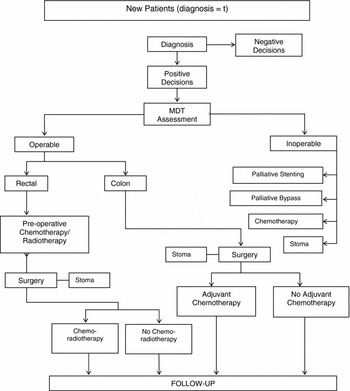
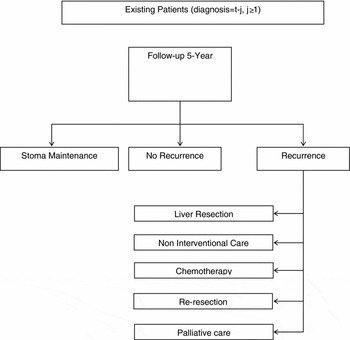
At each stage of the pathway, costs associated with each activity were identified. An overview of the service pathway can be found in Figure 1 and Figure 2. The detailed service pathways have been illustrated in the Supplementary Figures 1–6 (which can be viewed online at www.journals.cambridge.org/thc2010025), which provide pathways diagrams for components 2 to 7. Details of the screening model (component 1) can be found in Tappenden et al. (Reference Tappenden, Chilcott and Eggington25).
Service summary pathway incident cases (t = time of diagnosis).

Service Summary pathway of prevalent cases (t = time of diagnosis, j = years post diagnosis).

Data Synthesis
The service pathways model was developed and populated using Excel (14) with add-on Crystal Ball (5). The evidence used to populate the pathways model was obtained from a detailed literature review of published and gray literature (Reference Trueman, Lowson and Bending28), NHS Reference Costs (8), and Hospital Episode Statistics (7).
The annual current cost of the entire bowel cancer service was estimated by using 1-year period prevalence of patients with bowel cancer in England in 2005. Discounting was not required because the analysis was based upon all costs occurring in a 1-year period. The prevalent cases include those patients undergoing primary treatment that have been diagnosed within the year period (17) and those patients that are undergoing subsequent treatment for bowel cancer which were diagnosed in previous years. The costs of the current prevalent patients that were diagnosed and underwent primary treatment in the 1-year period were costed at each node of the service pathway. The prevalence data (Reference Forman, Stockton and Moller10) was used to cost those remaining patients that had been diagnosed in previous years and were receiving treatment for bowel cancer such as follow-up, palliative care and stoma care. Figure 1 represents the pathways for those new patients diagnosed in the current year and Figure 2 represents those diagnosed in previous years.
The main results generated were annual estimates of the following: (i) Direct cost of illness which consists of the prevalent cost of bowel cancer patients, non-cancer patients (those suspected of bowel cancer but who are subsequently diagnosed negative for bowel cancer), screening cost, and increased-risk patient cost; and (ii) The average annual cost of prevalent patients, which includes the diagnosis cost of incident bowel cancer patients, primary treatment cost for patients, follow-up cost (including the treatment of recurrence, stoma care cost, and palliative care cost), and primary treatment cost of new patients diagnosed with bowel cancer in a 1-year period.
Health Service Resource Use
The patient pathways were developed using evidence sourced from a comprehensive literature review (Reference Trueman, Lowson and Bending28) and informal elicitation of clinical advisors. Clinical advice was also sought from the advisory group appointed by the Department of Health to oversee the project. The patient pathways were populated based upon the literature review, data from relevant health technology assessments of bowel cancer interventions (Reference Hind, Tappenden and Tumur12;Reference Pandor, Eggington and Paisley20;Reference Tappenden, Jones, Paisley and Carroll26;Reference Ward, Kaltenthaler, Cowan and Brewer30) and Hospital Episode Statistics (HES) (7). Formal elicitation around unknown parameters was also undertaken around the diagnosis and treatment of bowel cancer for which details of the process and methods can be found in a separate study (Reference Garthwaite, Chilcott, Jenkinson and Tappenden11). The elicitation process used methods developed by the Bayesian Elicitation of Expert Probabilities (BEEP) collaborative research team (Reference O'Hagan, Buck and Daneshkhah16). The expert elicitation was used in areas where evidence was either weak or did not exist for parameters such as alternative diagnostic investigations for bowel cancer symptoms, use of emergency stenting, chemotherapy treatment, and survival of patients with metastatic colorectal cancer. The parameter values for activities and costs are reported in Supplementary Table 1, which can be viewed online at www.journals.cambridge.org/thc2010025.
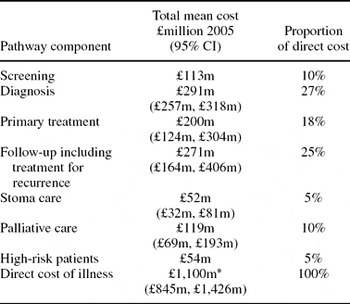
Summary of the Main Costs of Bowel Cancer Services in England

*The cost was calculated by the assumption that 29% of cases were rectal cancer and 71% of cases were colon cancer (Office for National Statistics, 2003).
CI, confidence interval.
Screening Data
At the time of the model development, the national bowel cancer screening program had been announced, but not rolled out into practice. The aim of this study was to estimate the costs of the current service and screening activity was not considered to be part of this current service pathway in 2005; hence, it was not included within the initial model. However, because screening would have a substantial impact upon the bowel cancer service once it had been rolled out, a supplementary analysis was undertaken to estimate the additional direct costs associated with screening. This analysis was based upon an updated version of a model previously developed by the authors, which comprises the natural history of bowel cancer, colonoscopic surveillance, subsequent treatment, and the impact of screening upon these (Reference Tappenden, Chilcott and Eggington25).
Unit Cost Data
Unit cost data were derived from NHS Reference Costs published by the Department of Health (8) and the Unit Costs of Health & Social Care (Reference Netten and Curtis15). These two sources provided much of the cost data required for primary and secondary care episodes considered in the service pathway. Previously completed health technology assessments and other published literature identified from the literature review provided further sources of cost data (Supplementary Table 1).
All costs were inflated to 2005 price levels where necessary using the Hospital & Community Health Services (HCHS) inflation indices (Reference Netten and Curtis15). Only direct costs attributable to the NHS and/or Personal Social Services (PSS) were considered in the analysis. No attempt was made to capture indirect costs, incurred by the patient or society as a whole (e.g., lost productivity and travel time).
Survival Data
The survival curves were taken from the discrete event simulation model reported in a separate related study which explored the expected lifetime costs and health outcomes resulting from several options for colorectal cancer service development (Reference Pilgrim, Tappenden and Chilcott21). The service pathway includes four causes of mortality: (i) Endoscopic perforation; (ii) Operative mortality; (iii) Metastatic recurrence; and (iv) Other causes than due to colorectal cancer.
The survival curves were fitted using Weibull regression with trial data from several sources (Reference Andre, Boni and Mounedji-Boudiaf1;Reference Mawdsley, Glynne-Jones and Grainger13;17;Reference Sebag-Montefiore, Steele and Quirke23;Reference Seymour24;Reference The Clinical Outcomes of Surgical Therapy Study Group27;Reference Twelves, Wong and Nowacki29). The 1-, 3-, and 5-year overall survival rates for rectal cancer were estimated to be 84 percent, 66 percent, and 51 percent, respectively. The 1-, 3-, and 5-year survival rates for colon cancer were estimated to be 86 percent, 72 percent, and 59 percent, respectively.
Handling Model Uncertainty
Probabilistic sensitivity analysis was undertaken to characterize the second order uncertainty surrounding the mean cost parameters and activity parameters (Reference Briggs, Sculpher and Claxton2). Unique probability distributions were used to describe the uncertainty surrounding the mean value of each model parameter. Distributions were defined by an assessment of the magnitude and nature of the uncertainty surrounding the mean parameter estimates obtained from the literature. The joint uncertainty surrounding all of the model parameters was analyzed using Monte Carlo sampling techniques. The Monte Carlo simulation was run over 10,000 iterations. The expected mean cost results were reported with 95 percent confidence intervals.
RESULTS
Direct Cost of Bowel Cancer Services
The total annual cost of bowel cancer services in England is estimated to be approximately £1.1 billion (95 percent confidence interval, £0.8 billion–£1.4 billion).
The largest component is the cost of diagnosis which makes up an estimated £291 million of the direct cost of bowel cancer services. The diagnosis costs include the costs of managing all referrals from general practice, emergency wards, or from elsewhere in secondary care with suspected bowel cancer. A significant proportion of the total costs of diagnosis are attributable to individuals who are referred for diagnosis but are subsequently diagnosed as cancer-free (£270 million). Primary treatment costs (e.g., surgery and pharmacotherapy) make up approximately £201 million of the direct cost. Primary treatment for colon cancer patients accounts for an estimated £129 million; the equivalent estimate for rectal cancer patients is around £72 million. The total cost of follow-up is estimated to be £271 million (£203 million for colon cancer and £68 million for rectal cancer) accounting for approximately 25 percent of the direct cost. The costs associated with stoma care for patients that have undergone surgery and stoma maintenance amount to around £52 million, whereas palliative care is associated with a cost of £119 million.
The costs of managing patients at high-risk of developing bowel cancer (FAP and HNPCC) accounted for approximately £54 million of the direct cost of care. However, due to the paucity of data on the management of these individuals, this cost estimate should be treated with caution.
Screening costs represent the first year of the screening program for individuals aged between 60 and 69 years using fecal occult blood testing (FOBT) and the resulting costs of treating the additional cancers detected by the program. The total treatment cost for the first year of screening was estimated to be £113 million. This cost consisted of £50 million in testing and diagnostic costs and £63 million in additional treatment costs. The cost of screening is predicted to fall over subsequent years (Reference Tappenden, Chilcott and Eggington25).
Lifetime Cost Per Case of Bowel Cancer
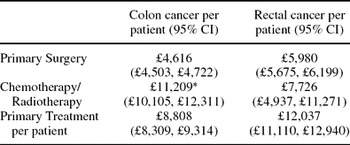
The mean cost per case is estimated to be £12,037 for rectal cancer and £8,808 for colon cancer (see Table 2). Even in the presence of higher per patient adjuvant chemotherapy costs in colon cancer patients, the overall per patient cost of rectal cancer patients is greater due to the higher rates of stoma procedures, pre- and post-operative chemoradiation, and adjuvant chemotherapy for rectal cancer patients.
Bowel Cancer Primary Treatment Cost per Patient
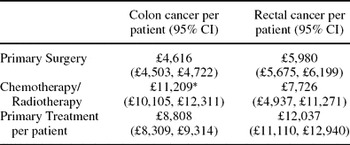
*Colon cancer patients only underwent adjuvant chemotherapy. This is the per patient cost for adjuvant chemotherapy.
CI, confidence interval.
Prevalence Cost Estimates
The prevalence estimates assumed for the study were 137 per 100,000 population for colon cancer and 104 per 100,000 population for rectal cancer (Reference Forman, Stockton and Moller10). The total annual cost for people currently living with bowel cancer (prevalence cost) in England was estimated to be £663 million. This cost included the costs associated with diagnosed bowel cancer patients including surgery costs, follow-up, recurrence, stoma maintenance, and palliative care. The cost of primary treatment of the new cases of bowel cancer was estimated to be £420 million, which is a component of the total annual cost of people currently living with bowel cancer.
CONCLUSIONS
The model-based analysis suggests that the annual direct cost of managing bowel cancer is approximately £1.1 billion (2005 prices); however, this is subject to considerable uncertainty. Nevertheless, this study represents the most comprehensive attempt to identify the costs of managing bowel cancer across the entire service. A substantial proportion of the direct cost is allocated to the screening and testing of patients with suspected bowel cancer who are subsequently diagnosed as cancer-free. However, primary treatment, follow-up, and palliative care is also associated with substantial costs. The estimate is subject to uncertainty, mainly due to the paucity of data on aspects of the treatment pathway.
The results of this study could be used as a basis for the production of national bowel cancer guidelines. The approach adopted could be useful to assist local decision makers in identifying those aspects of the pathway that are most uncertain in terms of their cost-effectiveness and as a basis to explore the implications of re-allocated resources from one area of the pathway (surgery) to another (early detection) through a PBMA.
Limitations of the Analysis
The main limitation of the analysis concerns the absence of accurate data on current service pathways and poor quality of some of the unit costing data. Information on the unit costs of treatments was very limited in some cases, particularly in relation to surgical procedures. There was also wide variation in the NHS Reference Costs of some procedures, such as colonoscopy and flexible sigmoidoscopy, over consecutive years (8).
A second challenge was to generate a “common” treatment pathway when there was a large degree of variation in practice across the country. The service pathway in this study reflects a cross between what actually happens in practice and what should happen as reflected by the current clinical guidelines. Although every attempt was made to ensure that the costs and outcomes in the pathway reflect current practice, it became clear throughout the course of the study that there were significant differences around England for example, in relation to type of patient follow-up regimen.
A third challenge of estimating the financial burden of bowel cancer is the dynamic nature of the service pathway. For example, initial roll-out of the NHS Bowel Cancer Screening commenced in June 2007, with the aim of detecting bowel cancer at an earlier stage when the disease is still asymptomatic. Estimates of the cost of screening were generated separately as an additional analysis, because it was not considered to be a part of the current treatment pathway at the time of the study.
A fourth limitation was that there is inevitably a time lag for the data on current services becoming available for use within research, which has resulted in evidence being several years out of date. However, in a field such as cancer, there are relatively few step changes in treatment pathways in this short space of time. The service pathways included in the analysis therefore remain relevant to current practice, with the exception of screening, which was assessed within an additional analysis as discussed above.
Areas for Further Research
The pathways used to generate the model were elicited from clinical experts and the current best available evidence from a comprehensive literature review and support of clinicians and advisers on the expert advisory group. Whereas the model explicitly attempts to capture the uncertainty surrounding the costs of the current service, it is possible that geographic variations in current practice have not been fully captured. The differences between regions in terms of cost of service could be a useful area of future research, over and above difference in patient needs, which would additionally complement national audits of the bowel cancer service.
The published evidence concerning the costs of various surgical techniques is very limited and a study costing the different types of surgical procedure representing differences in complexity would be useful to more accurately capture the treatment cost.
The published evidence for those patients at high-risk of developing bowel cancer (i.e., FAP HNPCC) was very limited and therefore required a large number of assumptions to enable modeling of the cost of service provision for these patients. In addition, there may be an even higher degree of variability in practice for this group of patients.
SUPPLEMENTARY MATERIAL
Supplementary Table 1
Supplementary Figure 1
Supplementary Figure 2
Supplementary Figure 3
Supplementary Figure 4
Supplementary Figure 5
Supplementary Figure 6
www.journals.cambridge.org/thc2010025
CONTACT INFORMATION
Matthew W. Bending, MSc, BSc (mwb501@york.ac.uk), Research Fellow, York Health Economics Consortium, University of York, Level 2, Market Square, University of York, York YO10 5NH, United Kingdom
Paul Trueman, MA, BSc (Paul.Trueman@brunel.ac.uk), Professor of Health Economics, Director, HERG, Brunel University, Uxbridge, Middlesex UB8 3PH, United Kingdom
Karin V. Lowson, MSc, BA, CPFA (kvl2@york.ac.uk), Project Director, York Health Economics Consortium, University of York, Level 2, Market Square, University of York, York YO10 5NH, United Kingdom
Hazel Pilgrim, MSc (h.pilgrim@sheffield.ac.uk), Research Fellow, ScHARR, University of Sheffield, Regent Court, 30 Regent Street, Sheffield, S1 4DA, United Kingdom
Paul Tappenden, MSc, BSc (p.tappenden@sheffield.ac.uk), Senior Research Fellow, ScHARR, University of Sheffield, Regent Court, 30 Regent Street, Sheffield S1 4DA, United Kingdom
Jim Chilcott, MSc, BSc (j.b.chilcott@sheffield.ac.uk) Senior Research Fellow, Technical Director Public Health Collaborating Centre (PHCC), ScHARR, University of Sheffield, Regent Court, 30 Regent Street, Sheffield S1 4DA, United Kingdom
Janine Tappenden, MBChB (janinetappenden@hotmail.com), Registrar, Royal Hallamshire Hospital, University of Sheffield, Glossop Road, Sheffield S10 2JF, United Kingdom
CONFLICT OF INTEREST
All authors’ institutions have received funding from the Department of Health.