INTRODUCTION
In estuarine systems, environmental variations of short and long periods can limit the diversity of species (Nagelkerken et al., Reference Nagelkerken, Blaber, Bouillon, Green, Haywood, Kirton, Meynecke, Pawlik, Penrose, Sasekumar and Somerfield2008). However, the maintenance of great numbers of individuals in these ecosystems is assured by the large amount of food sources and by the great structural complexity which promotes the occurrence of several ecological niches (Odum & Herald, Reference Odum and Herald1972). Among the different estuarine habitats, tidal flats are areas that are exposed and submerged regularly by tides and that can be distributed from estuarine to marine areas. These flats are transitional systems between the terrestrial and the aquatic environments and, generally, they limit the narrow strips between salt marshes and/or mangroves and brackish waters (Reise, Reference Reise1985).
Tidal flats are important for the growth of several fish species (Manderson et al., Reference Manderson, Pessuti, Hilbert and Juanes2004) and characterized by large variations in environmental conditions and in the structure of fish assemblages (Godefroid et al., Reference Godefroid, Spach, Schwarz, Queiroz and Oliveira-Neto2003). The species of fish that inhabit these places are generally small and most of them do not present migratory behaviour (Weinstein & Heck, Reference Weinstein and Heck1979). In tropical tidal flats tides are usually important to distribute nutritious and minerals resources especially where primary productivity is reduced (Carter, Reference Carter1988). The intertidal zone provides an important, but temporary, accessible foraging ground for coastal fish and other nektonic species (e.g. shrimps and gastropods) (e.g. Wolff et al., Reference Wolff, Vand Etten, Hiddink, Montserrat, Schaffmeister, Vonk, De Vries and Symoens2005). Thus, it is expected that spatial and temporal patterns of fish abundance in tidal flats are related to patterns of feeding, although avoidance of predation, reproduction, and appropriate environmental conditions may also explain changes in abundance (Gibson, Reference Gibson and Ali1992, Reference Gibson1996; Rountree & Able, Reference Routree and Able1993; Gibson et al., Reference Gibson, Pihl, Burrows, Modin, Wennhage and Nickell1998).
The Paraguaçu River, the main tributary of the Baía de Todos os Santos (BTS) is one of the most important aquatic systems of the Bahia State. This system is of high value for wildlife conservation and provides the main source of protein and income (i.e. consumption and commercialization of fish and shellfish) for the local communities (Barros et al., Reference Barros, Hatje, Figueiredo, Magalhães, Dórea and Emídio2008). In spite of the ecological and economic importance of the Paraguaçu River estuary, there is no published work addressing communities of fish, only work addressing expansion of geographical distribution (Santos et al., Reference Santos, Oliveira-Silva, Moura and Sena2008).
In Brazil, a few studies considered the influence of the moon and tide for estuarine fish, most for sub-tropical areas (Corrêa et al., Reference Corrêa, Cerdeiras and Peckzarka1988; Godefroid et al., Reference Godefroid, Hofstaetter and Spach1998, Reference Godefroid, Spach, Schwarz, Queiroz and Oliveira-Neto2003; Reference Godefroid, Spach, Santos, McLaren and Schwarz2004). The variation of the level of water with the tide and the lunar phase, in tidal flats, are ecologically relevant, for instance air exposure can affect the maturation time and patterns of feeding (Nybakken & Bertness, Reference Nybakken and Bertness2004). These changes can modify the distribution and the density of fish species (Rozas & Minello, Reference Rozas and Minello1998). A review of the literature shows that, despite studies on seasonal variations of the ichthyofauna in estuaries (Rozas & Minello, Reference Rozas and Minello1998; Lin & Shao, Reference Lin and Shao1999; Giarrizzo & Krumme, Reference Giarrizzo and Krumme2009), few studies evaluated the influence of time (Santos & Nash, Reference Santos and Nash1995; Gray et al., Reference Gray, Check and Mcellegot1998), tide (Rozas, Reference Rozas1995; Catellanos & Rozas, Reference Castellanos and Rozas2001) and phase of the moon (Quinn & Kojis, Reference Quinn and Kojis1981) on the structure of the ichthyofauna assemblages. Furthermore, information about temporal variations of intertidal fish from estuarine environments (Brenner & Krumme, Reference Brenner and Krumme2007) are scarce, thus making predictions of general patterns of intertidal fish is difficult. This way, the present study evaluates the following null hypothesis that the structure and composition the ichthyofauna are the same in different lunar phases (waning and full) and tidal stages (ebb and flood).
MATERIALS AND METHODS
Study area
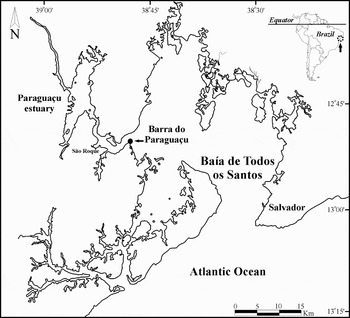
The studied tidal flat is located at Barra do Paraguaçu (12°50′S 38°47′W), in the western section of the Baía de Todos os Santos (BTS), in the estuarine portion of the Paraguaçu River (Figure 1). This river is the main contributor of freshwater for BTS. The sediments are a mixture of terrigenous material with biogenic material produced in or near the tidal flat. In this area, the bottom is predominantly sandy with deposition of coarse fractions, mainly biogenic gravel (shell and coral fragments) and plant debris. The deposition of fine sediment or organic matter is generally restricted to nearby areas of low energy. The tides are semi-diurnal with currents in the bay mainly bi-directional and stronger during the ebb tide in most of the bay (Lessa et al., Reference Lessa, Dominguez, Bittencourt and Brichta2001). The circulation inside the BTS is mostly tidally driven and does not vary significantly throughout the year (Cirano & Lessa, Reference Cirano and Lessa2007).
Map of the channel of outlet of Paraguaçu River locating the sampling point in the tidal flat.

Sampling design
Fish assemblages of the tidal flat were sampled monthly at flood and ebb tide of the spring (full moon) and neap (waning moon) tides, between June 2007 and May 2008. At each sampling occasion two parallel drags were accomplished to the coast, in the same direction as the current, in 100 m long areas marked on the beach beforehand, using a seine net (15 m × 2 m, 12 mm between knots). After capture, all individuals were identified and the length (mm) and the biomass (weight of individual fish; g) were recorded.
Trophic categories
The feeding habits of each species were described using a trophic classification adapted from Bouchon-Navarro et al. (Reference Bouchon-Navaro, Bouchon and Louis1992): herbivores, fish that consume algae and seagrass beds; planktivores, fish that consume plankton; omnivores, which eat invertebrates and algae; first-order carnivores (CI) that preferentially consume small benthic invertebrates; second-order carnivores (CII) that mostly eat invertebrates and fish; and third-order carnivores (CIII), whose diet consists of more than 80% of fish. One category, illiophagy-scavenger, was added to this classification (Zavala-Camin, Reference Zavala-Camin1996). The scientific nomenclature followed Nelson (Reference Nelson1994), Eschmeyer (Reference Eschmeyer2006) and Froese & Pauly (Reference Froese and Pauly2006).
Statistical analysis
Differences in fish assemblage composition and in abundance were tested by analysis of variance (ANOVA) using STATISTICA 8.0 software (Statsoft, Inc.) where tide and moon were fixed factors both with two levels. The monthly averages of the numbers of fish, number of species, weight of the capture and the indices of richness (Margalef), diversity (Shannon–Wiener) and evenness (Pielou) were also tested. The alpha value was corrected by the Bonferroni method (0.008) to avoid the Type I error. Before the ANOVA, data were fourth-root transformed to down-weight the influence of dominant species and reduce the significant correlation between the variance and mean (Chang & Winnell, Reference Chang and Winnell1981). The independence of the means were evaluated by the correlation among the mean and the standard deviation, and the homogeneity of the variances and data normality were tested by the Bartlett and Shapiro–Wilk tests, respectively (Sokal & Rohlf, Reference Sokal and Rohlf1995).
A Bray–Curtis distance was computed where the most abundant species were considered attributes (Clarke & Warwick, Reference Clarke and Warwick2001). These data were log (x + 1) transformed, to avoid the high value units, and used to compare samples and identify groupings graphically using cluster analysis. A similarity matrix using the Bray–Curtis index was computed using PRIMER 5 following Clarke & Warwick (Reference Clarke and Warwick2001).
In the tidal flat, the associations of fish were identified through the ordering technique non-metric multidimensional scaling (nMDS). As abundances between the species differed by two orders of magnitude, so data were log (x + 1) transformed. To evaluate the similarity between groups of samples corresponding tide and moon analysis of similarity (ANOSIM) were performed.
RESULTS
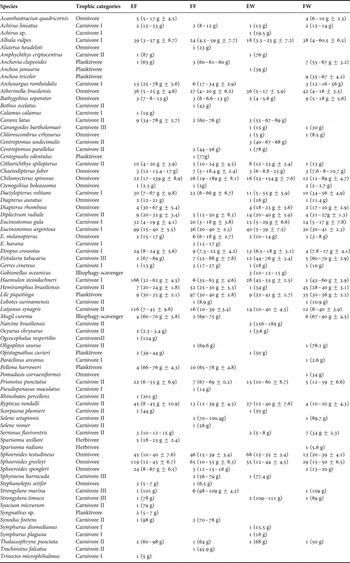
There were 2312 fish captured, weighing 26.53 kg, belonging to 75 species of 45 families (Table 1). The captures of the ebb tide of full moon (EF) were 948 individuals, weighing 8.30 kg, belonging to 49 species and 35 families, while in the flood tide of the full moon (FF) 551 individuals were collected, weighing 6.84 kg, belonging to 46 species of 30 families. In periods of the ebb tide of the waning moon (EW) 442 fish were captured, with weight of 5.88 kg corresponding to 44 species of 29 families, and, in the flood tide of the waning moon (FW), 375 fish, weighing 5.69 kg, belonging to 44 species of 27 families (Table 1).
Species collected, trophic categories, number of individuals and biomass (weight of individual fish) (maximum, minimum and standard deviation) of the different moons and tides sampled in the tidal flat of Barra do Paraguaçu, during the period June 2007–May 2008.

EF, ebb tide full moon; FF, flood tide full moon; EW, ebb tide waning moon; FW, flood tide waning moon. Carnivores I, first order; II, second order; III, third order.
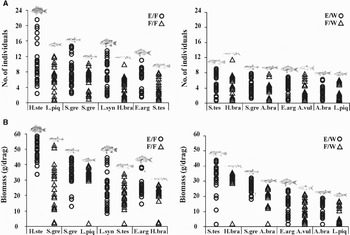
The dominant species and their biomass in the EF were Haemulon steindachneri (Jordan & Gilbert, 1882), Sphoeroides greeleyi Gilbert, 1900, Lutjanus synagris Linnaeus, 1758 and Eucinostomus argenteus (Baird & Girard, 1855), corresponding to 52.6% of the total number of individuals and 67.8% of the total biomass in these conditions. In FF the species Lile piquitinga (Schneider & Miranda Ribeiro, 1903), Sphoeroides greeleyi, Hemiramphus brasiliensis Linnaeus, 1758 and Sphoeroides testudineus Linnaeus, 1758 prevailed, representing 47.1% of the total of fish captured (Figure 2). At EW, the dominant species and biomass were Sphoeroides greeleyi, Sphoeroides testudineus, Eucinostomus argenteus and Atherinella brasiliensis (Quoy & Gaimard, 1824), representing 45.1% of the total captured and 59.8% of the total biomass. In the FW, the dominant species were Hemiramphus brasiliensis, Atherinella brasiliensis, Albula vulpes Linnaeus, 1758 and Lile piquitinga accounting for 42.6% of the total captured (Figure 2).
Dominant species, number of individuals (A) and biomass (B) in the flood and ebb tide of the full moon and waning moon. E/F, ebb tide/full moon; F/F, flood tide/full moon; E/W, ebb tide/waning moon; F/W, flood tide/waning moon; H.ste, Haemulon stendachneri; L.piq, Lile piquitinga; S.gre, Sphoeroides greeleyi; L.syn, Lutjanus synagris; H.bra, Hemiramphus brasiliensis; E.arg, Eucinostomus argenteus; A.bra, Atherinella brasiliensis; A.vul, Albula vulpes.

In the present work several species (i.e. L. synagris, H. stendachneri, E. argenteus, S. testudineus, S. spengleri (Bloch, 1785), S. greeleyi, Pellona harroweri (Fowler, 1917), L. piquitinga, A. vulpes, Caranx latus (Agassiz, 1831) and Etropus crossotus Jordan & Gilbert, 1882) occurred frequently during the full moon, and some species were specifically captured in singular situations (e.g. 80% of S. spengleri in the full moon of April). Narcine brasiliensis (Olfers, 1831), Anchoa januaria (Steindachner, 1879), Anchoa tricolor (Agassiz, 1829), C. bartholomaei (Cuvier, 1833), Chloroscombrus crhysurus (Linnaeus, 1766), Sparisoma radians (Valenciennes, 1840), Paraclinus arcanus (Guimarães & Bacelar, 2002) and Gobionellus oceanicus (Pallas, 1770) were captured only at waning moons.
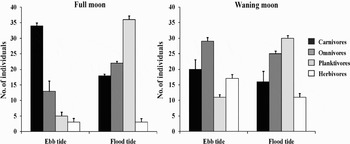
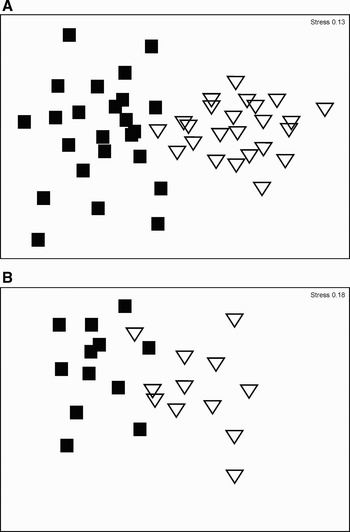
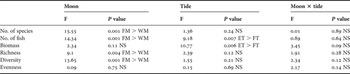
There was significant difference in number of species (P = 0.001), number of fish (P = 0.001), richness (P = 0.004) and diversity (P = 0.001) between full and waning moons. At each tide, the number of fish (P = 0.007) and biomass (P = 0.006) were also significantly different. The number of species, individuals, richness and diversity were significantly higher in the full than in the waning moon. The number of fish and biomass were significantly higher at ebb than at flood tide (Table 2). The trophic groups of the full moon were dominated by the carnivores. In the ebb tide, the first order carnivores, followed by omnivores, were more abundant. At flood tide, planktivores followed by omnivores were more abundant. In the waning moon, omnivores dominated overall. At ebb tide, omnivores followed by first order carnivores were the most abundant, and in the flood tide, planktivores followed by omnivores reached the higher values of capture (Figure 3). The ANOSIM test revealed significant differences on fish assemblages during the flood and ebb tides (R global = 0.58; P = 0.002) and the full and waning moon (R global = 0.55; P = 0.006), which can be observed in the nMDS plots (Figure 4A and Figure 4B, respectively).
Number of individuals (mean and standard deviation) for trophic groups in the ebb and flood tide of full and waning moon.

Non-metric multidimensional scaling ordination showing differences between ebb and flood assemblages (A) and between full and waning assemblages (B). Each individual point represents a sample. Squares, flood tide and waning moon; triangles, ebb tide and full moon.

Result of two-way analysis of variance, analysing the effect of the moon and of the tide on the number of species, number of individuals, biomass, richness of Margalef, diversity of Shannon–Wiener, and evenness of Pielou, of the fish assemblages in the tidal flat of Barra do Paraguaçu, during the period June 2007–May 2008.

FM, full moon; WM, waning moon; FT, flood tide; ET, ebb tide; NS, not significant.
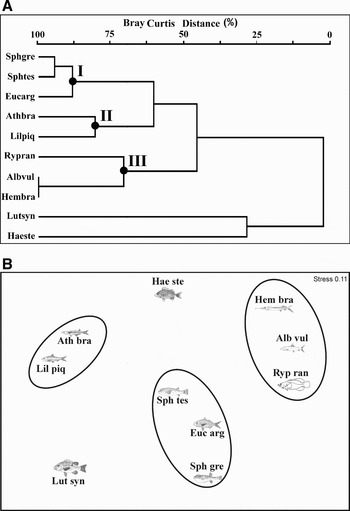
The cluster analysis distinguished three main groups among the 10 most frequent species (Figure 5A). Group I was formed by the species Sphoeroides greeleyi, S. testudineus and Eucinostomus argenteus grouped in a level above 90% similarity. These species were the most abundant of the assemblage and occurred in all months of the year, occurring more frequently in the full moon, with Sphoeroides greeleyi and E. argenteus more often captured in ebb tides with full moon. Group II was formed by the species Atherinella brasiliensis and Lile piquitinga, with similarity of 77%, in the area throughout the sampling period. But, L. piquitinga used primarily the flood tide with emphasis on full moon, while Atherinella brasiliensis was numerically similar between the tides and moons. Group III consisted of Albula vulpes, Hemiramphus brasiliensis and Rypticus randalli Courtenay, 1967, with the first two together at a level of 100% similarity. These two species followed a similar variation in their abundances, with larger values in August, September, October, December and January with decline from February until May. However, Hemiramphus brasiliensis was numerically dominant in the flood tide. The species Lutjanus synagris and Haemulon stendachneri became isolated probably due to the high number of captures in the dry period (January to March) and had preferential dominance in the EF. The obvious groups over 65% of the cluster are also visible in the nMDS, indicating that the proximity between the species is almost equivalent to the original similarities (Figure 5B).
Cluster (A) and non-metric multidimensional scaling (B), based on the abundance of the dominant species data, sampled in the tidal flat of Barra do Paraguaçu. The groups of the species delineated in the similarity level above 65% are surrounded in the ordering graph. Sph gre, Sphoeroides greeleyi; Sph tes, Sphoeroides testudineus; Euc arg, Eucinostomus argenteus; Hem bra, Hemiramphus brasiliensis; Hae ste, Haemulon stendachneri; Ryp ran, Rypticus randalli; Lut syn, Lutjanus synagris; Ath bra, Atherinella brasiliensis; Lil piq, Lile piquitinga; Alb vul, Albula vulpes.

DISCUSSION
Moon and tide effects
In the studied tidal flat, there was a clear separation of fish assemblages in relation to the tide, as shown by Bonecker et al. (Reference Bonecker, Castro and Bonecker2009) in another tropical estuary in Brazil. The significant differences observed in abundance and composition between assemblages sampled in the different tide stages emphasizes the importance of the tidal cycles in the structure of the ichthyofauna. Tidal variation can change behaviour in fish, making them more active in slow currents and less active when current increases (Kleypas & Dean, Reference Kleypas and Dean1983).
In the present study, the diversity showed no significant differences between tides, only a small increase in ebb tide. However, the abundance and biomass were greater on ebb than on flood, contrasting with the results of Godefroid et al. (Reference Godefroid, Spach, Schwarz, Queiroz and Oliveira-Neto2003), where diversity was greater in flood tide and abundance and weight did not show any significant differences. The species Lile piquitinga, Hemiramphus brasiliensis, S. greeleyi, A. brasiliensis and A. vulpes were more abundant in flood tides. These results suggest that these species follow the movements of the tides for food or protection. Godefroid et al. (Reference Godefroid, Spach, Schwarz, Queiroz and Oliveira-Neto2003) also observed this pattern in Albula vulpes in the south of Brazil.
The lunar phases may influence the specific composition of the ichthyofauna, either by its action on the tidal level (Quinn & Kojis, Reference Quinn and Kojis1981), and/or caused by variation in light (Rooker & Dennis, Reference Rooker and Dennis1991). Moreover, it was suggested that reproductive aggregations associated with lunar cycles can have significant implications in the abundance of fish (Johannes, Reference Johannes1978). Krumme et al. (Reference Krumme, Saint-Paul and Rosenthal2004) observed for mangrove creeks that the structure of fish assemblages was more homogeneous in the full moon of spring tide than at other situations corroborating Reis-Filho et al. (Reference Reis-Filho, Nunes, Menezes and Souza2010) in a semi-urban estuary on the northern coast of Bahia, Brazil. Differently, we found a more heterogeneous structure associated with the full moon. Perhaps this difference can be attributed to the distinction of topographical and hydrological features peculiar to these estuarine environments (mangrove creeks versus tidal flats). Furthermore, functional characteristics of the use of this estuarine habitat by fish species may explain this difference. According to Elliot et al. (Reference Elliot, Whittfield, Potter, Blaber, Cyrus, Nordlie and Harrison2007), fish that occur in the river mouths (salinities below 35) are marine stragglers that spawn at sea and typically enter estuaries only in low numbers, most frequently in the lower reaches. On the other hand, mangrove creeks species may be estuarine residents capable of completing their entire life cycle within the estuary environment. Although the effect of the moon on the structure of fish communities is still little studied, works conducted in Baía de Paranaguá, south-east Brazil (Godefroid et al., Reference Godefroid, Hofstaetter and Spach1998, Reference Godefroid, Spach, Schwarz, Queiroz and Oliveira-Neto2003) and Joanes River estuary, north-east Brazil (Reis-Filho et al., Reference Reis-Filho, Nunes, Menezes and Souza2010) found that the moon influenced the occurrence of species.
Rooker & Dennis (Reference Rooker and Dennis1991) and Krumme et al. (Reference Krumme, Saint-Paul and Rosenthal2004) found no significant difference between the average number of individuals collected during the full and waning moons and Reis-Filho et al. (Reference Reis-Filho, Nunes, Menezes and Souza2010) found no significant difference between number of individuals and species. Contrasting with the data found in the present study, where the number of fish captured were greater in the full than at the waning moon. However, Godefroid et al. (Reference Godefroid, Spach, Schwarz, Queiroz and Oliveira-Neto2003) showed significant differences between the number of species during the two moon stages, with more species in the full moon. This corresponds to what was observed in the present study where significant differences were found in the number of species captured in full and waning moons. Although Krumme et al. (Reference Krumme, Brenner and Saint-Paul2008) have suggested that the factor moon phase can only be sampled once every month, efficient temporal sampling is difficult within a short period (i.e. to avoid confusion between month and moon phase). Thus, we advocate the need to evaluate the lunar cycle effect on the variation of water level and the consequent availability of habitat for fish.
The ichthyofauna of the tidal flat studied was characterized by dominance of juvenile of marine migrant forms with small size that use it as areas of growth and feeding, a fact confirmed in the same region by Oliveira-Silva et al. (Reference Oliveira-Silva, Peso-Aguiar and Lopes2008) and in an estuary of southern Brazil by Barletta et al. (Reference Barletta, Amaral, Corrêa, Guelbert, Dantas, Lorenzi and Saint-Paul2008). An important characteristic of fish assemblages in intertidal mangrove zones is that there are several residents (Barletta et al. Reference Barletta, Saint-Paul, Barletta-Bergan, Ekau and Schories2000) that do not move over large distances during their tidal migration (Horn et al. Reference Horn, Martin and Chotkowski1999). However, we observed a small number of resident species that regularly frequent the tidal flat, which does not mean that the same group of individuals is constantly present in the area throughout the period. Although there are differences between the tidal flats in relation to the pattern of species dominance, the dominant fish are a few taxonomic groups (Day et al., Reference Day, Hall, Kemp and Yanez-Arancibia1989) as shown in the present study.
Functional aspects
In the present study more than 60% of species were carnivores. The dominance of species with generalized diet with a strong tendency to carnivory (especially invertebrates) was also documented in other tropical estuaries (Blaber, Reference Blaber2000; Paiva et al., Reference Paiva, Chaves and Araújo2008). The carnivores and omnivores dominance found in the present study indicates that tide changes modified trophic categories, just altering the dominant species. Another observation associated with change of tide is the preference of planktivore species for the flood tide. During high tide, the physical and chemical conditions of the water in the tidal flat almost mirror those of the adjacent marine area, tending to be uniform during flood tide (Barletta et al., Reference Barletta, Barletta-Bergan, Saint-Paul and Hubold2003). Thus, this condition is favourable to these species (generally nektonic) for entering the tidal flat. Krumme et al. (Reference Krumme, Saint-Paul and Rosenthal2004), studying mangrove creeks, explained that many species emigrate with filled stomachs, feeding being considered the most important factor for fish immigration into the tidal flat. Thus, the territorial occupation may be linked to behavioural characteristics and availability of food (Koch, Reference Koch1999) due to the implications of the lunar cycle and flood–ebb tide cycle on the movement of water (Krumme et al., Reference Krumme, Brenner and Saint-Paul2008).
Another aspect that the results of this study show is about traditional measures of species diversity, which few estimates are predictive of the structure and functioning of the community (Webb, Reference Webb2000; Díaz & Cabido, 2001; Petchey, Reference Petchey2004; Ricotta et al., Reference Ricotta, Avena and Chiarucci2005). Cianciaruso et al. (Reference Cianciaruso, Silva and Batalha2009) provides an example where, due to the environmental change, the community that had species in the different genus was replaced by another with most species belonging to the same genus. Keeping the same number of species and the same abundance distribution, traditional analysis of diversity will not reveal any effect. In the present study, we faced the problem that the species composition and the trophic guild showed differences in the community structure, but there were no observed differences in the diversity indices. Therefore, we suggest that diversity measures that incorporate information about the functional characteristics (Diaz & Cabido, Reference Diaz and Cabido2001; Petchey & Gaston, Reference Petchey and Gaston2006) and even phylogeny (Webb, Reference Webb2000; Ricotta et al., Reference Ricotta, Avena and Chiarucci2005) should be better than traditional measures.
The strategy of different fish species to use the tidal flats, conditioned by the tolerance of some species to certain environmental conditions, follows short term variations. The interplay of the ebb–flood tide pulse together with the lunar phase affects the fish assemblage composition. Additionally, the trophic category in the tidal flat studied also changed. Thus, despite the different forces that imply movement of immigration and emigration of species in the tidal flat, the functional structure responds to environmental variation. Therefore, we argue that the functional diversity has been more sensitive to detect community responses to environmental changes compared to species diversity.
ACKNOWLEDGEMENTS
We thank the Institute of Aquatic Mammals for the logistic support in the accomplishment of this work. The Universidade Católica do Salvador for supplying logistics in the screen process and Universidade Federal da Bahia for depositing every material. We pay tribute to Geronimo who with his song ‘Dandá’ shows the traditional knowledge about the moon and tidal interactions. We also thank the two anonymous referees for their thoughtful comments. This research received no specific grant from any funding agency, commercial or not-for profit sectors. F.B. was supported by a fellowship PQ-CNPq (No. 302642/2008-0).