

Polly Hill's study of the dramatic expansion of the cocoa industry in Ghana (1963) is justifiably famous and describes the local and bottom-up growth of one of Ghana's major income earners. But Hill's work, particularly from the 1950s, focuses on the role of traditional relationships among men from the Krobo and Akuapem communities in the expansion and development of their cocoa farms. Discussion of the role played by wives in the same processes is absent from this early work. This article builds on newer and more gender-aware work that establishes the dynamic interplay between marriage, land tenure relations, wives’ labour and cocoa in southern Ghana.Footnote 1 Based on field research conducted between April 2006 and November 2007 in four matrilineal and two patrilineal communities located in the Brong Ahafo, Western and Volta regions, it sets out important changes taking place within the institutions of marriage, land tenure and conjugal labour relations, with cocoa production serving as the major vector.
The article shows that the inextricable linkages between these forces, as established by previous authors, are not only applicable in contemporary times, but have also intensified and assumed new and different dimensions. It stresses that cocoa production, especially in matrilineal communities, is increasingly being viewed as ‘conjugal business’ by people in a range of conjugal unions. This is because the conjugal unit (whether formal or informal) is a fundamental factor in the cocoa labour force and there are now expectations of rewards in land as compensation for labour. My research shows that new and previously undocumented forms of informal conjugal union may be coming into existence in the context of cocoa production. There are also indications of a recent shift towards women accepting support for children's education instead of land or farm resources. The discussion is embedded within varying contexts of cocoa production in three regions of Ghana.
SOME CONTEXTUAL ISSUES
Matrilineal and patrilineal systems
The Gender and Agricultural Development Strategy of Ghana (Ministry of Food and Agricuture Reference Mikell2001: 17) underscores the continued influence of matrilineal and patrilineal systems in access to land by sex. Bortei-Doku Aryeetey (Reference Bortei-Doku, Aryeetey, Harringan and Nissanke2000: 331), Bukh (Reference Bukh1979: 52, 54) and Grier (Reference Grier1992: 322) find that male kin play the land-allocating role in both matrilineal and patrilineal societies: secure access rights for women therefore depend on the nature of their relationships with male relatives, although signs of increasing flexibility are being witnessed in present times. While patriarchy influences land distribution – women under both systems tend to have smaller parcels of land compared to men – the situation is more pronounced in patrilineal systems where the norms of tenure favour the latter (Bukh Reference Bukh1979; FAO 2004).
An FAO study (2004: 18) shows that in patrilineal systems men – viewed as the custodians over land – tend to be given more access rights to land than women. The same study notes that the assumption that women will marry and obtain land from their husbands tends to affect the extent to which women can access lineage lands. But in as much as marriage is regarded as the main channel for women's access to land, it is also perceived as a potential conduit through which land can be lost to another lineage (FAO 2004: 10). Women in intra-clan marriages (endogamy) therefore tend to possess greater land security than those who marry outside their clans (exogamy). Bukh (Reference Bukh1979: 54) contends that the patrilineal rule assigning a woman's children to a different lineage from her own is a special problem facing women of this society. She explains that a woman's own family will not allow her to use lineage forest land to grow tree crops for fear that her children will claim her trees, conveying land from her own lineage to their father's.
Marriage also tends to be a major source of land for women in matrilineal systems. Nevertheless, sources for these groups of women are widening as they are now able to source land from brothers, uncles and fathers (Duncan Reference Duncan2009). But the pattern of land loss and consolidation is different. In his study of some matrilineal communities in Akyem Abuakwa, Amanor (Reference Amanor2001: 90, 93) shows that female lineage members of those communities tend to have a preference for passing on their lands to daughters, in response to what they regard as unfair male control over land. These women felt that their male counterparts had wrongly usurped their traditional rights over land, taking it for themselves and for wives and children who are not members of the matrilineage. He uses the term ‘matrifocal alliances’ to describe a conscious effort by mothers and grandmothers to ensure the devolution of their lands to their daughters and granddaughters respectively.
Marriage obligations and quasi rewards in land
An understanding of the basic norms and practices associated with customary marriage and property rights is central to the discussion. Abu (Reference Abu and Oppong1983), Danquah (Reference Danquah1928) and Opoku (Reference Opoku1976) show that norms of customary marriage recognize the separate identities of the parties in addition to their rights to acquire property independently of each other. This tends to be whittled down, however, by the obligation placed on wives to assist their husbands in their accumulation of property (Danquah Reference Danquah1928: 154).
Writers such as Boni (Reference Boni2001: 24), Danquah (Reference Danquah1928), Fortes (Reference Fortes, Radcliffe-Brown and Forde1950: 280) and Rattray (Reference Rattray1929: 25) suggest that the various stages of a marriage ceremony serve as indicators measuring the reciprocal services expected of a man by his wife. The final stage, involving the payment of etiri aseda (thank-offering for the giving of the head), usually signalled that the man had become the recognized husband of the woman. At this stage, a husband could exercise both productive and sexual rights over his wife, who for her part acquired the right to be maintained, clothed and housed.
The role of the post-independence conjugal unit in the development of new cocoa farms is significant (see, for example, Bray Reference Bray1959; Hill Reference Hill1963; Okali Reference Okali1983; Konings Reference Konings1986; COCOBOD 1998; Mikell Reference Mikell1975, Reference Mikell1984, Reference Mikell1989; Takane Reference Takane2002; and Austin 2005). It has been suggested that such involvement cushioned the husband from the effects of high labour costs during the initial stages of farm development. Hill, for instance, suggests that ‘the systematic large-scale employment of farm [wage] labourers marked the second, not the first, stage of the developing capitalistic process’ (1963: 187).
While the existing literature gives much prominence to the labour of wives in the conjugal context, there is also evidence to suggest labour support was expected to be mutual. Men were expected to extend labour support to their wives in respect of their lineage land (Allman Reference Allman and Tashjian2000: 63). In his study of Ahafo, Konings (1986: 83–8) found that in classifying nuclear family contributions to the labour effort, the generic term ‘spouse’ was more useful in demonstrating the potential contributions of both husbands and wives. He noted that labour supplies from the families of cocoa producers remained largely restricted to ‘wives and husbands’ during the 1979–80 season.
Many scholars have documented systems of land exchange between husbands and wives for services rendered within the context of cocoa farming (see, for example, Mikell Reference Mikell1975; Okali Reference Okali1983; Takane Reference Takane2002; and Duncan Reference Duncan2009). In the case of matrilineal women, land transfers have been influenced by a number of socio-cultural and economic factors.Footnote 2 Of these, the power of the lineage in shaping the property relations of the married members was overwhelming, particularly during the early days of cocoa farming. COCOBOD's explanation is that a shift in the provision of labour from the level of subsistence to male cash crop farms was, in the view of the matrilineage, a channel for enhancing the wealth of lineages to which women and children did not belong. The principle of traditional law that a man's wealth belongs to his abusua (lineage) (Mikell Reference Mikell1975: 71) was a point of contention, exacerbated by the migration process, which resulted in a dislocation of women's economic activities (Tashjian and Allman 2002: 245). Reference might also be made to the fact that under the Akan kinship system the father's authority over his offspring was not to be directed towards economic gain, as this was the traditional preserve of their uncle (Mikell Reference Mikell1975: 71). Under the Akan system of marriage, the husband was also expected to make labour and financial contributions to his wife's lineage, and not vice-versa (Field Reference Field1948: 85). Matrilineages therefore viewed the use of the labour of their members for high economic pursuits with seriousness, and often advised wives against joining their husbands in the latter's farming villages, unless efforts were made to assign part of the cocoa farms on which they worked to them (Adomako-Sarfoh Reference Admoako-Sarfoh and Oppong1974: 137–8).
THE FIELD SETTING
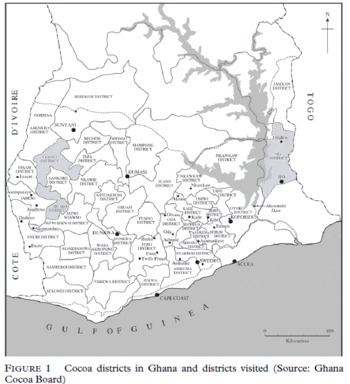
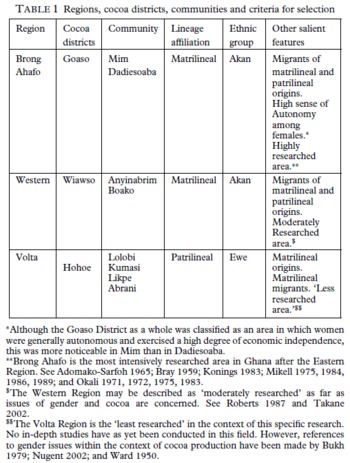
The discussions that follow are based on the field research mentioned earlier. In all, 204 male and female cocoa farmers aged between 25 and 70 years of age were interviewed through three separate field surveys, focus group discussions and in-depth interviews. Table 1 below reviews the communities by region, cocoa district and criteria for selection, while the map (Figure 1) shows the cocoa districts of Ghana and the location of the communities.3
Presented in five ensuing parts, the field findings lead to an appreciation of the interconnections between cocoa, marriage, labour and land. They are based on comparative contemporary perspectives from the matrilineal and patrilineal communities visited and are interspersed with oral testimonies of informants who provide graphic illustration of the situation in the communities.
Perspectives on cocoa and marriage
The field data established the reproductive, domestic, social and economic underpinnings of marriage within both the matrilineal and patrilineal communities. The economic dimensions tended to be more pronounced in the matrilineal communities, however, where an intense nexus between cocoa and marriage was found to exist. Respondents intimated that marriage is essentially a business transaction, entered into principally with a view to mutually enhancing the (cocoa) productive capacities of the parties. Though some writers have given a central place to the domestic and reproductive aspects of marriage (for example, McCaskie Reference McCaskie1981; Sarpong Reference Sarpong1975; Tufuo Reference Tufuo1969), field findings established that the productive purpose of marriage occupied the pre-eminent position. Akan communities are fond of the saying awaree boa cocoa, (literally, ‘marriage helps cocoa’), while one of Busia's (1951) informants was quoted as saying that cocoa papae abusua (‘cocoa breaks up kinship relations’). Both responses are relevant in appreciating social transformations brought about by cocoa production, especially as regards the shift in emphasis from the lineage to the conjugal family.
Although marriage serves as the conduit through which mutual support is expected in cocoa production, shades of differences may be noticeable in terms of how this mutuality is shared between spouses. First, it is thought that women tend to be more dependent on male spousal support in view of the differences in physical and financial capacities of men and women. Physical strength is not only a necessity in cocoa production, but also a requirement for success. Men thus have the advantage in initiating and expanding cocoa farming activities compared to women when spousal support is lacking. This point is linked to the well-researched area of the gender division of labour in agrarian communities, and the finding that historically land clearance has given men an advantage in terms of land access and control (Boserup Reference Boserup1970; Duncan Reference Duncan2004; Kotey and Tsikata Reference Kotey and Kuenyehia1998). An entry point to understanding this is provided by Yaa Saah, a 38-year-old woman informant from Dadiesoaba, interviewed in 2006:
Husbands may do the activities that wives can't do. In farming it is the men who can fell the trees, by climbing on top of them to cut them. Most of the farm work is done by men and that is why their cocoa farms are more beautiful. They prune and maintain their farms nicely. We depend on them for such activities. You see that even farm labourers and abusa Footnote 4 are mostly men.
In the labour distribution, women dominate in the tasks of weeding, planting (mainly of food crops), carriage of seedlings to farmsteads, planting and selling of food crops, carriage of food crops and cooking for husband and labourers on the farm. Men's tasks generally cover felling, chopping, clearing, burning, planting (of cocoa seedlings), harvesting, farm maintenance (pruning, thinning and spraying), land border protection (by planting special marker trees), weaving of drying mats and the raising of platforms for the drying of cocoa beans. Although the tasks discussed here do not generally differ from those outlined by the previous researchers noted above, female tasks continue to be more varied and time-consuming, whereas male tasks are intense during the initial stages and phase out by the time of maturity of the farm. Land clearance remains a dominant male activity and is said to constitute the most difficult task associated with cocoa farming, one for which women hire labour in the absence of spousal support.
Hence the broad division of labour existing within the cocoa sector by sex (for example, Beckett 1944) translates into labour relations between husband and wife – although, in some cases, the man substitutes wage labour for his own labour. Men and women are expected to reinforce each other on the labour front by engaging in activities appropriate to their strengths and skills, and this is formalized in a marriage relationship.
In the Western Region the degree to which marriage was considered crucial to cocoa farming was demonstrated by the frequent rates of marriage, divorce and remarriage among respondents and community members. As a case in point, my field notes described the situation of one female respondent of Anyinabrim, Adjoa Mumford (40 years old), as follows:
Respondent indicates that at the time of her marriage, her husband, a native, was a divorcee with four children. They have been married for 30 years. It was only four years prior to the field research that her husband had effected a transfer of land inter vivos to her, although she explained that their six children were yet to receive their share. She was among the few who had received any land from her husband. She also has her own ancestral land on which she receives help from her husband. This relationship therefore quintessentially represents one in which the support from both sides has been mutual. She calls the land from her husband, awaree asaase, ‘marriage land’. According to her, transfer of land from husband to wife and the time duration can vary. It can be during the early stages, mid stages or later stage of the marriage. (Field notes 2006: 42)
The conjugal and cocoa farming experience of the queen mother of the reigning chief of Anyinabrim, Nana Afua Amanie (then 72 years of age) is an indication that age is no barrier to consolidating the gains to be made between cocoa and marriage. My field note account provides her perspective:
Respondent is the natural mother of the reigning chief of Anyinabrim, Nana Etsebure II. She was widowed but, upon reaching menopause, decided to remarry because she needed a man to assist her in her farming activities. Her land size was 40 acres, acquired substantially through her position as a member of the royal family. Her second husband through consensual union is younger than her by 12 years. He also lives in the palace. The arrangement between them is abusa, so at the end of the harvesting period, he collects one-third of the proceeds. (Field notes: 35)
Communities of the Western Region also typically used a series of local proverbs to demonstrate labour synergies between husbands and wives, two examples of which are provided in Nzema and English:
Twi mienu kabomaa, obru oyuo: If two people come together, there is nothing they can't do/When a man weeds, it is the woman that gathers the weeds.
Hu menisu, nti atwi mienu nnam: When two people are walking it is the partner that assists the other when something falls in his/her eyes.
In support of the significant place of marriage in cocoa farming, respondents also commented on the comparative benefits of monogamy and polygamy. Males and females generally did not differ in their opinion that polygamy tends to compromise the consensus required in marriage for successful cocoa enterprise. The majority were of the view that polygamy is a disincentive to cocoa farming because of its potential to result in disunity within the conjugal unit. Monogamous relationships on the other hand enable cocoa farmers and their wives to reason together. Having one wife would involve one contractual relationship, whereas polygamy would result in a multiplicity of contractual relationships, each with its own expectations and obligations. Neatly summed up, ‘polygamy leads to more cocoa but less peace’ as one respondent noted.
Three factors continue to place marriage at the epicentre of cocoa farming operations of matrilineal communities. First, a woman expects her husband to assist in the development of her own ancestral land. Second, she expects him, in return for her assistance, to provide her with additional land from his own plots and further assist with its development. The need for male labour tends to be an overriding force in these situations and this will be further demonstrated by subsequent discussions and case studies. The third factor, which appears to be of growing importance in contemporary times, is the growth of a mutual understanding in favour of educating children in place of giving land. This is especially so in situations where the persons involved had been in previous marriages and the cocoa farms in question were already developed prior to the new marriage.
In view of the fact that marriage plays a crucial role in cocoa production, farming women who are married to formal sector working men tend to experience immense frustrations at the inability or unwillingness of their husbands to devote significant attention to their farming activities. Such is the case of women who are married to teachers, social workers or policemen. The case study of Madam Abena Maaboa of the Brong Ahafo Region, who became the first female National Best Cocoa Farmer in 2003, attests to this:5
Q: What role has your husband played in your occupation as a cocoa farmer?
A: My first husband was very supportive. He assisted me financially and this enabled me to hire labourers to clear or weed most of my cocoa farms. However after his death I remarried another man. He was in a white-collar job and never came to my farm or assisted me financially but rather requested or demanded that I should stop my farming occupation and come to settle in Kumasi in the Ashanti Region where he was working, which I declined. This made me realize that he was an obstacle to my farming occupation; hence I sought for divorce and concentrated on my farming.
Q: As a woman, do you think that marriage is important to cocoa farming?
A: Yes and no. Yes, in the sense that marriage will provide women with companionship and, through that, they can also have children. Again husbands provide assistance to their wives, both financial and land. Others will work with you on your farm. No, in the sense that, husbands who are not interested in farming can serve as obstacles or barriers to woman by asking them to follow them to wherever they will go. They can make derogatory remarks that will discourage you from farming such as obaa denden – Iron Lady – obaa bayifour [meaning ‘witch’, among other things]. Here, it depends on the type of husband. (Field notes 2008: 62).
While farm tasks were described as mutually reinforcing, they appeared less so at the domestic and reproductive levels, where women dominate in the care of children, cooking and fetching water. These activities are regarded as integral aspects of cocoa production, which from the perspective of men enables them to give undivided attention to their farming. Another consideration affecting the mutual exchange of assistance is that the scale of the obligation to assist tends to weigh more heavily on women, given the customary expectations of marriage as previously discussed (Danquah Reference Danquah1928). In short, women tend to spend more of their productive time on their husbands’ farms than husbands spent on theirs.
It has been noted that the connection between marriage and cocoa was not clearly established in patrilineal communities, where they were viewed as inseparable. The integral nature of the obligation in the institution of marriage was expressed by 47-year-old Peter Dutorwovor (interviewed in Lolobi-Kumasi in 2007), who told me that ‘women are requested by tradition to assist their husbands on their farm land’. What one finds in the two communities of the Volta Region thus approaches an assumption inherent in marriage that a woman needs to fulfil her domestic roles without expectation of reward in labour or land. To put this more explicitly, women's contributions to their husbands’ farming efforts are regarded as part of the necessity of assisting their husbands to provide food for the family, and thus purely as an extension of their domestic obligations.
Quasi rewards in land
Similarities between Brong Ahafo Region and Western Region abound as regards the underlying basis of reciprocity. In both areas, the concept of reciprocity is grounded in the view that a person must be rewarded for his/her labour efforts. They also apply similar standards in relation to the time it takes for husbands to hand over land to their wives. While no specific time period is recognized, the general expectation is that transfer could take effect any time from the point at which the labour is provided to the time when the cocoa farm in question has matured. It is also a general rule that a wife can only benefit from land on which she has worked. Hence a woman who marries her husband after a given farm has matured is denied any right to such a farm. This is expressed as: you came to meet the farm.
In the Western Region, transfers of land from wives to husbands and vice-versa in exchange for their labour support were found to be common. This is to be contrasted with the Brong Ahafo Region, where such transfers were usually considered taboo. In the former, therefore, the general rule is that where a woman assists her husband on his lineage plot, she is entitled to one third of that land; whereas, where a man assists his wife on the latter's lineage land, he is entitled to a half of that land. Although the same rules of division apply where the land in question has been acquired for sharecropping, division is made only in respect of the crops and not the land.Footnote 6 The rules favour men in this way because men are thought to contribute more physical labour to their wives’ farms than wives contribute to their husbands’.
As noted previously, the field data also offered evidence that women who provide cocoa labour to either husbands or partners would be willing to accept the education of their children by the men with whom they are involved as acceptable substitutes for land. A number of Western Region respondents were in this situation, among them Afua Doku from Boako, 48 years old when she was interviewed in 2006:
I was previously married with four children whom I brought into my second marriage. My second husband was already married to another woman, with whom he had one child. Although I was unable to conceive in this second marriage, my second husband took full responsibility for my four children, who in turn assisted very much on their stepfather's farms. I and my children did not receive any land from my second husband. Although he made promises, he kept postponing the transfer until he died after 36 years of marriage. The reward rather came in the form of maintaining the children, and I saw this as an appropriate form of reward.
The differences between the two matrilineal communities and the patrilineal Volta Region are, however, more far-reaching. I have shown that in the Volta Region expectations of rewards in the form of land are generally not attached to a woman's primary obligation to assist her husband. This situation stems primarily from the stringent view that lineage lands cannot be lost to other lineages (Bukh Reference Bukh1979). This was underscored by John Mantey (62 years old when interviewed in Likpe Abrani in 2006), who noted that ‘land is not given to someone who is not part of the family’, as such a transfer would run contrary to the basic underpinnings of the patrilineal system (cf. Kludze 1974: 130). This distinction may also be linked to the lack of connectivity between marriage and cocoa in these communities.
However, the point made about patrilineal communities does not rule out altogether the possibility of gifts inter vivos in favour of wives. For such a transfer of land to be recognized, it must be in respect not of lineage lands but of land independently acquired by the husband (for example through purchase). What seemed more common in the region was the prominent role of fathers and not spouses as vital and predominant sources of land transfer to women. While this type of transfer is carried out in response to the harsh effects of the patrilineal system, the overall patriarchal nature of land distribution prevents such lands from being transferred to the children of women beneficiaries. On the principle that land must pass on through the male line, father to daughter transfers remain temporary arrangements, lasting only for the lifetime of daughters. On their deaths, the land reverts to their brothers or the latter's children.
Some changing dimensions of marriage and their impact on land rights
So far this discussion has assumed the prevalence of formal conjugal unions in which the persons involved have undergone the necessary customary marriage rites. In the matrilineal communities especially, however, formal marriage arrangements appear to be more of an exception than the prevailing norm. Evident across all the communities was the growing importance of informal unions (see, for example, Ardayfio-Schandorf and Sam 2006), and more peculiar to the Western Region was the incidence of ‘contract marriages’.
Consensual unions (known as mpena aware in the Akan areas of Brong Ahafo and Western Regions and as dze hia in the Ewe-speaking Volta Region), were found to exist in all the communities. Like previous researchers (for example, Manuh 1995) and the 2005 regional censuses in Brong Ahafo and Western Region, my findings showed that these unions are increasing on account of the inability of the vast majority of the youth to meet the required marriage payments associated with marriage rites (the equivalent of £500 on average): this was identified as the main cause of mpena marriages.Footnote 7 Indeed, poor families tend to be relieved by the relocation of their daughters to the homesteads of other men, even though this reduction of their financial burdens is not actively sought. Older respondents attributed the situation to a lowering of marriage values among the youth, who fail to take the advice of their parents and instead rush into premarital sex. Women indicated that once they had conceived one child with a man (‘born one’) it became more difficult for them to leave that relationship in pursuit of another. Many were also of the view that mpena relationships were only temporary and that by living with the man and assisting on his farms, the woman would be facilitating the payment of the marriage fee. The causes and current status of consensual relationships were summed up by a 35-year-old male respondent from Mim:
The mpena aware situation has arisen because the monetary aspects of customary rites are too high. New arrangements must be put in place to assist the youth to get married. The mpena aware situation becomes formalized as a marriage where the woman becomes pregnant. When this happens, the practice is for the woman to inform her father about the pregnancy. Her father then calls the man and his relatives to confirm the woman's story. The man is then asked to look after the woman and, when he gets the money, to perform the customary rites. This is the meaning of mpena aware. Where the man has an issue with the woman, this would entitle her to inherit part of his property. This would not have been the case if she had been childless.
The question, therefore, is how do these relationships impact on the land rights of men and women involved? Even though these relationships do not qualify as formal marriages, the findings show that communities possess criteria for determining the ‘strength’ of an mpena union, and the stronger it is the more the land rights and obligations of the parties can be defined and protected. Three criteria identified were the duration of the relationship, the provision of labour by the woman and whether it produced any children. These were based on three corresponding principles: first, that the labour supply of one to the other must be ‘paid for’; second, that the children of the relationship must be fed; and third, that economic activities which eventually assist the parties to pay for the marriage debt must be encouraged. Communities have their own way of deciding each case on its merits and in some situations would accept a woman's claim for land on the basis of one or more of these criteria.
It is important to establish that Ghanaian courts are increasingly appreciating and endorsing these aspects of customary law in their decision making. In the Sekondi High Court in the case of Owusu versus Nyarko (Ghana Law Reports Digest, 1980, p. 428), for example, the court upheld the view that women in mpena relationships are entitled to a one-third share of cocoa land which they have assisted their partners to develop.
The ‘contract marriages’ mentioned above as typical of the Western Region have yet to surface in the literature. Although researchers like Konings (1986) and Takane (2002) discuss various forms of labour arrangement such as annual, casual and contract labour, they do not refer to contract marriages – though Mikell (1989: 128–9) alludes to a marriage arrangement in Sunyani which appears to be similar. She notes of the Sunyani District in the 1950s, 1960s and 1970s:
One of the less recognized results of the cocoa economy was increasing inter-ethnic contact between Akan farm owners and northern migrant workers. There was subtle intermarriage which satisfied both the labour and economic needs of cocoa farms. … Akan men sought to create dependent affinal relationships with northern migrant cocoa labourers; and, conjunctively, Akan women made efforts to create viable conjugal units with northerners so they could maintain cocoa farms.
At a pre-field research brainstorming session held at the Bonsu College in Koforidua in 2006, a retired Cocoa District Officer of Boako Cocoa District (Mr Essuman) offered the following insight:
Men and women cocoa farmers ‘contract’ persons of the opposite sex during cocoa seasons when harvesting is at its peak to assist them in their cocoa farming engagements. Men enter into casual relationships with women from other regions such as Ashanti, while women generally enter into unions with Kusasi men for their labour support.
These relationships, so prevalent in the Western Region, demanded more in-depth investigation. The outcome showed that contract marriages are seasonal arrangements made between men and women particularly during the cocoa harvesting season, which lasts for a period of three to six months, after which the relationship is either renewed or terminated. Although described as a kind of ‘marriage’, its labour dimensions tend to outweigh its conjugal aspects, even though the hired person lives with the farmer as a married person on a short-term basis and is paid off at the end.
What is particularly interesting is that these contracts, although entered into by both males and females, tend to be described as relationships between male farmers and female ‘wives/labourers’. In the Sefwi language they are referred to in various ways. One common term is nhyehyeye aware, which literally means an arranged marriage or ‘a woman who comes to help you and then is “seen off” ’. The relationship is also described through two key words: kangima (to cook, wash your clothes and to farm with you) or nzordzo (to sleep with her). Combined in a single phrase, kangima nzordzo means an unknown relationship or marriage: ‘one who cooks for you, washes for you, worships you and in addition sleeps with you, and you pay her off when the contract ends’.Footnote 8 The Chief Farmer of Anyinabrim, Adjei Karikari (interviewed in 2007), captured the combined casual and formal nature of these relationships:
It is an agreement between people either at the ‘beer bar’, the street or other such place. It is not a proper marriage; it is a sort of part-time marriage. It does not give respect to the two people because you don't know whether the person is a ghost or not. Where the woman is a stranger the man who wants to engage her sees her caretakers with a drink as witness, so that if something happens they can ask him and the contract is then signed in their presence. The woman calls witnesses and the man also calls witnesses before the agreement is announced that: ‘This man wants me to stay with him for 2 to 6 months for 2–3 bags of cocoa.’
It may be appreciated at this point that women who are contracted into such relationships are not entitled to land. Instead, they are rewarded in cash or in kind, based on what is stipulated in the agreement. Neither do women in such relationships have any specific rights to land should the relationship end in ‘divorce’. In some situations, the family of the woman would meet the man to agree on an appropriate reward based on the agreement. Additionally, in situations where the man breaches the agreement, the woman would be entitled to institute an action in court to protect her rights. But it was also found that the character of the relationship could change in the event of a pregnancy. Where this occurred, the father of the child would be obliged to provide maintenance and the intestate succession law would operate in that child's favour.
The question as to why a farmer would prefer this form of arrangement to hired labour was asked. The responses reinforce the point that male cocoa farmers, especially, tend to view both the productive and domestic contributions of women as important to their productive engagement. Beyond these, we also see the reproductive aspects at play here. The following were typical assessments of the advantage of this form of arrangement over hired labour:
Though it is bad, people prefer it to hiring labour because labourers cannot go beyond certain limits. This one can cook, fetch water for you and go to bed with you. (Thomas Asare, Boako, 2007)
I heard some people saying that people involved in this can do certain jobs in addition to jobs that the labourer will not do, for example a labourer cannot cook, fetch water or wash your clothes; they only come and work and go their way. (Kwame Nkuah, Anyinabrim, 2007)
Respondents were also asked to compare the security of women in such relationships to those in mpena unions and formal marriages.Footnote 9 This question generated the following responses, among others:
Mpena aware is far better because it can become better: that is, the man can later on perform the rites. But for contract marriage the woman goes after the season. (Kwame Nkuah, Anyinabrim, 2007)
Mpena is a bit better. If after the season the woman contracts a serious disease, the man would never mind; he will only pay her off according to the agreement. (Afua Amanie, Anyinabrim 2007)
Formal marriage is everlasting and it is the well-accepted form that gives respect to a woman. (Susana Donkor, Boako 2007)
A picture of different degrees and levels of security in conjugal relations in these cocoa-growing communities emerges, and it becomes clear that marriages which are formalized provide the best and longest-term security for women.
Contemporary views on self-acquired land
The field study demonstrates that the extent of land availability can influence the spousal land arrangements outlined above. Like Amanor's work on the Eastern Region, this study establishes that land scarcity has brought the practice of rewarding wives and children from the usufructory interests of lands acquired by husbands and fathers from their lineages to the verge of extinction in the Brong Ahafo Region. There are indications that younger-generation farmers are unable to access lineage and stool lands in the same degree as their predecessors. The response has been an increase in the desire of these farmers to acquire their own lands, either through purchase or sharecropping. This individual access to land has led to a situation in which the two communities in the region are beginning to integrate the concept of ‘self-acquired’ land into spousal relations.
Hence the field findings distinguish between women who are working on their husbands’ lineage lands and those working on lands acquired by their husbands independently of the lineage system. Women working on the former tend to be excluded from such lands, and therefore are not rewarded for their labour owing to the shortage of such lands. In Dadiesoaba, for instance, Kwame Soko (41 years old when interviewed in 2007), explained the situation as follows:
It is good and acceptable that you give your wife a piece of land at least to encourage her that she never wasted her time with you. But he can only give his self-acquired land. You cannot give family land to your wife. If the land is family land, the family will take it back but if it is self-acquired property of the man, then the wife can claim it.
The dynamics involved in relation to women working on lands which their husbands have personally acquired, either through sharecropping or through purchase, are different. Prior to the passage of the Intestate Succession Law (PNDC Law 111) in 1985, such property would have passed to the family of the man automatically upon his death. After 1985, however, the law established a process which enables the conjugal unit to acquire at least three quarters of such property, with the remainder devolving to the extended family. In the wake of land scarcity and the increase in independent land acquisition, the communities of the Brong Ahafo Region are dispensing with the traditional notion of ‘separateness’ in property rights in marriage (see introduction) and are moving towards a situation of ‘jointness’. Hence the present position is that where the land was purchased by the man during the marriage and the woman expended her labour consequent to that, such lands tend to be regarded as the joint property of both the man and the woman (and children), in most cases to the exclusion of the extended family of the man. There are indications that this emerging situation has itself been shaped by Law 111, which elevates self-acquired property to an independent position, free of extended family influence. Investigations showed that the Brong Ahafo Region has been benefiting from extensive public education on the law, and the resulting creative interpretation has succeeded in giving more pre-eminence to the nuclear family as majority shareholders in the self-acquired property of a man.
The developments taking place in the Brong Ahafo Region present new perspectives on the access rights of women, demonstrating the need in contemporary times to draw a clear distinction between the access rights of women working on their husbands’ lineage lands and those working on self-acquired lands. The findings reinforce the point made by earlier researchers (for example Hill Reference Hill1963; Takane 2002) that male and female cocoa farmers are not a homogeneous group.
The Brong Ahafo Region situation may be contrasted sharply with the Western Region, which has not reached the point of critical land scarcity. In the communities there, the expediency of individual natives acquiring lands through means other than their respective stools or lineages (Bentsi-Enchill Reference Bentsi-Enchill1964) was not found to be the general situation. Thus wives who assist their husbands on their cocoa land tend to benefit from the latter's communally owned land. This practice has been confirmed by Kasanga and Kotey (2001:15) who in their comparative study of the Western Region made the following critical observations:
Recently, village land is increasingly being inherited directly by wives and children and even family land is often transferred to them with the consent of other family members. Such inter vivos transfers are termed ‘gifts’ in the study areas and individual rights to such land are firmly established.
The Volta Region, where cocoa development began at about the same time as in the Brong Ahafo Region (Nugent Reference Nugent2002), is also experiencing severe land scarcity. The impact is that this is further squeezing out women who are already disadvantaged within the patrilineal system. Even though it has been noted previously (see, for example, FAO 2004) that women of endogamous marriages are better placed in accessing land, the present situation of land shortages has made it imperative for lineage heads to position husbands as the principal custodians of such lands, leaving women of such marriages with less autonomy over land than was described in that study. The more equitable land arrangements which existed previously seem to be declining, seen for example in the tendency for some clan husbands to take overall charge of landed properties.
CONCLUSION
This article has traced some interconnecting threads between cocoa and marriage, labour and land, and the key principles and practices governing land distribution. Various points of similarity and difference between matrilineal and patrilineal communities have been identified. Marriage is a determining factor in acquiring land for most women, whereas for men it secures labour for them in cocoa farming. The pre-existing customary land tenure system, in addition to the division of labour by gender, tends to influence the extent of male and female access and control under both systems. The centrality of females, albeit limited to matrilineal contexts, tends to give them greater opportunities for acquiring land from their lineages and husbands, while at the same time being empowered to transmit land to their children, especially daughters. By contrast, in patrilineal communities, prevailing patriarchal tendencies – rules regarding marriage as well as the looming fear that lineages will lose land through married women – continue to serve as a brake on the land rights of wives. Semi-permanent forms of gifts inter vivos tend instead to flow from fathers to daughters. Varied forms of inheritance practices dominate the cocoa-producing scene, with clear tendencies to overlook modern laws.
In both systems women (as compared to men) are exposed to a far greater risk of labouring in vain, and have therefore deployed various coping strategies to overcome this challenge. There is clearly a need for further research in areas such as the growing phenomenon of consensual unions and their impact on the property rights of women. There is also an urgent need to engage communities in dialogue with the objective of arriving at a more suitable and acceptable property distribution pattern in marriage and on intestate death. Whatever may be the weaknesses and strengths inherent in the land tenure systems of matrilineal and patrilineal communities, we are left in no doubt that cocoa, marriage, labour and land will remain ‘quadruplets’ as long as cocoa remains a dominant force in the rural economy.
Cocoa districts in Ghana and districts visited (Source: Ghana Cocoa Board)


* Although the Goaso District as a whole was classified as an area in which women were generally autonomous and exercised a high degree of economic independence, this was more noticeable in Mim than in Dadiesoaba.
** Brong Ahafo is the most intensively researched area in Ghana after the Eastern Region. See Adomako-Sarfoh Reference Admoako-Sarfoh1965; Bray Reference Bray1959; Konings Reference Okali1983; Mikell Reference Mikell1975, Reference Mikell1984, Reference Mikell1986, 1989; and Okali Reference Okali1971, Reference Okali1972, Reference Okali1975, Reference Okali1983.
$ The Western Region may be described as ‘moderately researched’ as far as issues of gender and cocoa are concerned. See Roberts 1987 and Takane 2002.
$$ The Volta Region is the ‘least researched’ in the context of this specific research. No in-depth studies have as yet been conducted in this field. However, references to gender issues within the context of cocoa production have been made by Bukh 1979; Nugent Reference Nugent2002; and Ward Reference Ward1950.