Substantial research evidence has suggested that morphological awareness transfers across languages and transferred morphological awareness facilitates second language Footnote 1 reading subskills acquisition, even between two distinct writing systems such as morphophonemic English and morphosyllabary Chinese (e.g., Luo et al., Reference Luo, Chen and Geva2014; Tong et al., Reference Tong, McBride, Ho, Waye, Chung, Wong and Chow2018; Wang, Yang, & Cheng, Reference Wang, Yang and Cheng2009). The English orthography maps the oral language at the level of the phoneme; and morphemic boundaries in English coincide with phonemic boundaries (as in “cats” and “beds”, “heal” and “health”) (Frost, Reference Frost2012). The Chinese orthography is morphosyllabary because the basic grapheme unit (character) usually encodes a morpheme which also corresponds to a syllable. However, the majority of evidence is based on child Chinese–English bilingual readers whose linguistic and literacy competencies in both languages are still developing, and much less attention has been paid to adult foreign language readers who have well-developed English literacy competence when they begin to learn Chinese as an additional language. It remains unclear as to whether morphological awareness transfers in a similar manner in adult second language readers of two different writing systems and whether the transferred facilitation effect of first language morphological awareness can be altered by second language linguistic knowledge (Ke, Miller, Zhang & Koda, Reference Ke, Miller, Zhang and Koda2021; Chung et al., Reference Chung, Chen and Geva2019).
The present study examined how and to what extent a learner’s morphological awareness developed in two languages jointly contribute to word reading in a foreign language in American English-speaking adult readers of Mandarin Chinese, a morphosyllabic orthography, and whether Chinese linguistic knowledge affects the degree of facilitation stemming from transferred first language (English) morphological awareness in Chinese multicharacter word reading. Morphological awareness (MA henceforth) is often cited as a learner’s ability to reflect upon, analyze, and manipulate the morphemes and morphological structures of words (Carlisle, Reference Carlisle and Feldman1995, Reference Carlisle2000; Kuo & Anderson, Reference Kuo and Anderson2006). It is anticipated that the findings of the study can contribute to the understanding of the transfer facilitation mechanism through which first language resources (including MA) facilitate second language reading development in a typologically distinct writing system. From a pedagogical perspective, in university foreign language education, reading is often viewed as a by-product of oral language development and current practices tend to focus on fostering tacit linguistic knowledge (vocabulary and grammar) in the target language; it is not until recently that more attention has been paid to explicit MA instruction in adult foreign language readers (e.g., Koda & Ke, Reference Koda, Ke, Malovrh and Benati2018). It is expected that the findings of this research will not only improve existing understanding the transfer facilitation mechanism in second language reading but also provide pedagogical implications for the optimal use of first language and second language resources, such as MA, in promoting reading development in university learners of Chinese as a foreign language.
Literature review
Transfer facilitation in adult foreign language reading vis-à-vis child bilingual reading
“Transfer” refers to “an automatic activation of well-established first-language competencies, triggered by second-language input” (Koda, Reference Koda, Koda and Zehler2008, p.78). Since transfer is involuntary, it is important for researchers to examine what is transferred and how transferred resources can facilitate second language reading development. In Koda’s transfer facilitation model, rather than treating first language reading ability as a unitary holistic construct, she focused on the transfer of first language metalinguistic awareness (a learner’s ability to identify, analyze, and manipulate language forms) to reading in an additional language because learning to read involves learning to map spoken language elements onto graphic symbols in the writing system. As to a facilitation effect, it is the result of a learner’s exploitation of prior literacy resources that is aimed at accelerating second language reading development.
In the past two decades, the transfer facilitation effects of MA have been examined in a substantial body of empirical research conducted in children learning to read in two typologically distinct writing systems (e.g., abjad Arabic and morphophonemic English in Saiegh-Haddad & Geva, Reference Saiegh-Haddad and Geva2008; abjad Hebrew and morphophonemic English in Schiff & Calif, Reference Schiff and Calif2007; and morphosyllabary Chinese and morphophonemic English in Luo et al., Reference Luo, Chen and Geva2014). Child biliteracy researchers have contended that first language MA contributes to second language word reading indirectly via the mediation of second language MA (i.e., transfer occurs at the construct level); and there is no crossover transfer of first language MA directly to second language word reading (Ke & Xiao, Reference Ke and Xiao2015).
Regarding the extent of facilitation stemming from transferred MA in second language reading subskills development, it might be subjected to the influence of a range of learner-internal factors (e.g., age, first and second language writing system types, second language proficiency/linguistic knowledge), learner-external as well as methodological factors (e.g., word formation rules, educational context, reading outcomes such as word reading, word meaning inferencing and passage reading comprehension, and MA measurements) (see a recent systematic review and meta-analysis by Ke et al., Reference Ke, Miller, Zhang and Koda2021). Ke et al. (Reference Ke, Miller, Zhang and Koda2021) examined the interlingual correlation strengths between first language and second language MA as well as second language reading subskills (word reading and reading comprehension) in 34 studies of child bilingual reading and found that all interlingual correlations were small and significant; age was a significant moderator (with higher correlations for upper grade children); there was no significant moderating effect of first and second language writing system types. Ke et al. also noted that it is uncommon for studies of child biliteracy development to consider a so-called second language linguistic knowledge construct, in spite that oral vocabulary and general reading achievement with some standardized tests were considered and measured as covariates. In contrast, it is generally agreed that second language linguistic knowledge is a vital prerequisite for efficient second language reading in adult learners (Clarke, Reference Clarke1980; Bernhardt, Reference Bernhardt2005).
Second language linguistic knowledge is often measured as vocabulary or grammar knowledge or categorized as general instructional proficiency levels like novice, intermediate, advanced, and superior (American Council on the Teaching of Foreign Languages/ACTFL, 2012). Previous research of adult second language reading has mainly probed the relative contributions of first language reading ability and second language linguistic knowledge to second language ability and treated them as holistic constructs. To date, only a few studies have taken a componential and cross-linguistic perspective to examine whether second language linguistic knowledge may alter the effect of transferred MA in adult second language reading subskills acquisition (e.g., Chen, Reference Chen2018; Ke & Koda, Reference Ke and Koda2017). For instance, Chen (Reference Chen2018) compared the contribution of Chinese MA to Chinese word meaning inferencing between a group of more skilled second language Chinese learners and a group of less skilled learners. The participants’ first languages were alphabetic (i.e., English, Spanish, French, and Russian), had studied Chinese for a year in mainland China, and had a command of at least 1,000 Chinese characters and 1,600 words. Chen found that Chinese MA contributed significantly to Chinese word meaning inferencing in the more skilled learner group over and above Chinese vocabulary knowledge yet did not have any significant contribution in the less skilled learner group. Although Chen (Reference Chen2018) did not measure participants’ first language MA, his findings seem to provide indirect evidence supporting that the facilitation effect of transferred MA on second language reading acquisition is moderated by second language linguistic knowledge.
Defining and measuring MA in Chinese
As mentioned earlier, Chinese orthography is morphosyllabic with the basic grapheme (i.e., character) that encodes the sound of a morpheme at the syllable level. It is thus not surprising to find that MA plays an important role in Chinese reading development. There might be doubt about the differentiation between a word and a character in Chinese. Following Packard (Reference Packard2000, p.12), we define a word as “an independent occupant of a syntactic form class slot.” Words in written English are salient because they are separated by spaces in written texts. In Chinese, written texts are not word-based but character-based, with no spaces inserted between words. Notably, words in Chinese vary in the numbers of characters that comprise them: 6% are single-character lexical morphemes/words, 72% are two-character words, 12% are three-character words, and 10% are four-character words (Lexicon of Common Words in Contemporary Chinese Research Team, 2008). In other words, the numbers of two-character and three-character words significantly exceed the number of single-character words. Recent neurobehavioral research has suggested that the unit of reading processing in Chinese as a first language and as a second language is not a character, but a lexical morpheme/word (for a review, see Li et al., Reference Li, Bicknell, Liu, Wei and Rayner2014).
While acknowledging the uniqueness of MA in Chinese reading, researchers in the area of second language reading development have sought to explore MA as a complex multifaceted construct and to better understand which facets are universal and more shareable between Chinese and another language (English) as well as which facets are specific to Chinese (e.g., Pasquarella et al., Reference Pasquarella, Chen, Lam and Luo2011). In prior research, Chinese MA has often been defined as derivational awareness (e.g., children understand that the function of the suffix 者 /zhě/ as in 作者 /zuòzhě/ “writer” denoting a person with expertise in a field) and compound awareness (e.g., children are sensitive to the compound structure in morphologically complex words and can tell that 糖盒/tánghé / “sugar-box” is a better name for a box packed with candy than 盒糖 /hétáng / “box-sugar”). Researchers generally agree that compound awareness is a shareable resource and transfers between Chinese and English, whereas first language Chinese derivation awareness does not have a significant effect on second language English reading subskills acquisition (e.g., D. Zhang, Reference Zhang2013). However, the concept of a “compound word” (复合词, /fùhé-cí/) in written Chinese can be confusing since it carries two meanings: 1) a multimorphemic word, as termed in western linguistics; or 2) a printed word consisting of more than one character (Packard, Reference Packard2000). As shown in the example below, of the two multicharacter words that share the initial character 非/fēi/, the former represents a monomorphemic word (非常, /fēicháng/,), while the latter corresponds to an affixed word (非-正式, /fēi-zhèngshì/, “in-formal”). Moreover, MA correlates highly with vocabulary knowledge because MA includes knowledge of morpheme functions, which makes it difficult to distinguish the two constructs and casts doubt on the validity of MA measurement (Ke & Koda, Reference Ke and Koda2019; D. Liu, McBride-Chang, Wong, Shu, & Wong, Reference Liu, McBride-Chang, Wong, Shu and Wong2013).
More recently, D. Zhang and Koda (Reference Zhang and Koda2013) proposed that current measures of MA can be operated on a continuum: some being language-general/basic, others being language-specific/refined. D. Zhang and Koda (Reference Zhang and Koda2013) refer to the former as “the ability to segment words into constituent morphemes and to identify […] the structural relations between constituent morphemes” and the latter as “the knowledge of the function of affixes” (p. 906). As to the language-specific facet of Chinese MA, three frequently cited measures are homophone awareness, lexical compounding awareness, and semantic radical awareness (as cited in Wang, Cheng, & Chen, Reference Wang, Cheng and Chen2006). Homophone awareness refers to the ability to differentiate different morphemes in homophones (see D. Zhang, Reference Zhang2017). For example, in both 商业 and 商品,, the first character 商 has the same sound /shāng/ and the same meaning “related to business”, whereas in 商量, 商, /shāng/ means “to discuss”. Lexical compounding awareness is often operationalized as the ability to construct new compound words for novel objects or concepts based on previously learned morphemes. In D. Zhang’s (Reference Zhang2017) study, children of native Chinese and English–Chinese bilingual backgrounds were asked in Chinese “Which is the best name for candies packed in a box that is made out of bronze: 铜糖盒 ‘bronze candy box’, 铜盒糖 ‘bronze box candy’, 糖盒铜 ‘candy box bronze’, or 盒铜糖 ‘box bronze candy’?” (Answer: 铜盒糖”bronze box candy”). Radical awareness refers to the understanding of the role of semantic radicals in the Chinese complex character reading (e.g., the semantic radical 口 /kǒu/ “mouth” appears in the characters such as 吃 /chī/ “eat”, 喝 /hē/“drink”, and 唱 /chàng/ “sing” that relate to the meaning “mouth”).
As to the language universal/basic facet of MA in Chinese, in a study of adult learners of Chinese as a foreign language, Ke and Koda (Reference Ke and Koda2017) proposed that it should be related to the way in which morphemes are encoded in printed words and how Chinese readers grasp that mapping principle, that is, a character corresponds to a productive morpheme with a fixed position in a multicharacter word. They used a computerized affix shifting task to capture Chinese MA in American university third-year learners of Chinese as a second language and found that Chinese MA contributed significantly to Chinese unknown multicharacter word meaning inferencing indirectly via the mediation of Chinese linguistic knowledge.
The utility of MA in Chinese word reading
To our knowledge, there have been only a few studies examining the relationship between MA and reading single-character or multicharacter words in Chinese as an additional language. These studies examined the potential influence of first language literacy learning impact on the utility of MA in Chinese word reading by either comparing second language learner groups that vary in their first language orthographies (e.g., Tong et al., Reference Tong, Kwan, Wong, Lee and Yip2016) or comparing the relationship between MA and Chinese word reading between native Chinese and non-native Chinese learner groups (e.g., D. Zhang, Reference Zhang2017; Zhou & McBride, Reference Zhou and McBride2013).
Tong et al. (Reference Tong, Kwan, Wong, Lee and Yip2016) conducted a study to validate the Dynamic Interactive Model of non-native Chinese character processing and compared the performance of English-, Korean-, and Japanese-speaking adult learners of Chinese in a picture-character mapping task. The results indicated that, with about four years of formal Chinese learning experience, the three groups of Chinese learners were sensitive to both semantic and phonetic radical cues during novel character encoding. They also found that the English group relied more on semantic radical cues during character encoding and the English group’s semantic radical awareness was weaker than the Japanese group’s and not significantly different from the Korean groups. Tong et al.’s (Reference Tong, Kwan, Wong, Lee and Yip2016) findings seemed to indicate that the contribution of radical awareness to Chinese word reading is affected by first and second language orthographic distance as Japanese is closest to Chinese as the target second language, followed by Korean and English.
D. Zhang (Reference Zhang2017) compared the functioning of orthography, phonology, and morphology in Chinese word reading in fourth-grade native Chinese children and English-dominant children of Chinese as an additional language in Singapore. Two Chinese-specific MA tasks were used (i.e., homophone and lexical compounding awareness). Different patterns were found between the two groups: In the native Chinese group, MA was a significant predictor of Chinese word reading and its effect was over and above other Chinese predictors (including phonological awareness, orthographic processing, and vocabulary knowledge). In the English-dominant group, children relied less on Chinese MA, yet more on phonological awareness to support their reading of Chinese words as the effect of Chinese phonological awareness on Chinese word reading was still significant after effects of Chinese MA, orthographic processing and vocabulary knowledge were controlled for. Zhang pointed out that even with four years of formal instruction, English-dominant child learners of Chinese did not develop insights regarding Chinese MA to the same level of their native Chinese counterparts and called for more explicit morphological instruction for the second language group. Similar findings can be found in Zhou and McBride’s (Reference Zhou and McBride2013) studies in two groups of eight- and nine-year-old children (i.e., native and non-native Chinese) recruited from English-speaking international schools in Hong Kong: Chinese vocabulary knowledge was the most significant predictor in Chinese word reading in the non-native Chinese speaking children, and there was no significant effect of MA.
Notably, the child participants in the studies by D. Zhang (Reference Zhang2017) as well as Zhou and McBride (Reference Zhou and McBride2013) were still developing biliteracy skills in two or multiple languages and were exposed to rich Chinese oral and print exposure with Chinese as one of the subjects in school education. The findings might not be generalizable to adult learners of Chinese in a foreign language context, who have well-developed literacy competence in their first language, yet limited linguistic knowledge and print exposure in Chinese (e.g., H. Zhang & Koda, Reference Zhang and Koda2018). As a comparison, H. Zhang and Koda (Reference Zhang and Koda2018) compared the relative contributions of Chinese MA and vocabulary knowledge to Chinese word meaning inferencing in American university intermediate-level (second year) learners of Chinese who varied in their Chinese heritage backgrounds. H. Zhang and Koda (Reference Zhang and Koda2018) found that, in both Chinese-heritage and non-Chinese-heritage English-speaking adult learners, Chinese MA contributed significantly to Chinese word meaning inferencing over and above Chinese vocabulary knowledge. This finding was different from that of Chen (Reference Chen2018), who identified a significant modulating effect of Chinese vocabulary knowledge on the contribution of MA to Chinese word meaning inferencing. It was possible that there was a task effect because H. Zhang and Koda measured Chinese word meaning inferencing with a multiple-choice receptive task, whereas Chen (Reference Chen2018) used a multiple-choice perception and a translation productive task. The translation task could more linguistically demanding than the multiple-choice task.
Viewed collectively, regarding the transfer facilitation mechanism in second language reading of two typologically distinct writing systems, it is generally agreed in child bilingual reading literature that first language MA transfers at the construct level and contributes to second language word reading indirectly via the mediation of second language MA (Luo et al., Reference Luo, Chen and Geva2014; Wang et al., Reference Wang, Yang and Cheng2009). However, three major gaps remain: (1) it is unclear whether first language MA transfers in a similar manner in adult second language readers who have well-established first language literacy resources at their disposal. (2) Previous adult second language reading research varied in their conclusions about the interaction between transferred/second language MA and second language linguistic knowledge in predicting the acquisition of Chinese word-level reading subskills (e.g., Chen, Reference Chen2018; H. Zhang & Koda, Reference Zhang and Koda2018). Notably, the two pertinent studies reviewed above both focused on word meaning inferencing that involves morphological analysis. Recent research has suggested that MA contributes to reading development through two distinct pathways, including morphological analysis and morphological decoding (e.g., Levesque et al., Reference Levesque, Kieffer and Deacon2017). There is a need for examining morphological decoding in adult learners of Chinese as an additional language. (3) Also, prior adult second language reading studies have mainly focused on single- or two-character word decoding/reading or word meaning inferencing, in spite that multicharacter words (i.e., three- and four-character words) account for a significant portion of modern Chinese lexicons (Lexicon of Common Words in Contemporary Chinese Research Team, 2008). To fill these gaps, the present study aimed to examine the transfer facilitation effects of English MA on multicharacter word reading in adult learners of Chinese as a foreign language.
Research questions and hypotheses
Two research questions and two hypotheses were posed in this study.
-
1. Do university English-speaking learners of Chinese as a foreign language form sensitivity to the internal morphological structure of printed words with restricted print input (e.g., after approximately three years’ formal learning and exposure to 1000 characters)? Based on the existing literature of adults reading Chinese as a second language (e.g., Chen, Reference Chen2018; Tong et al., Reference Tong, Kwan, Wong, Lee and Yip2016; H. Zhang & Koda, Reference Zhang and Koda2018), we hypothesize that (1) English-speaking adult late learners of Chinese as a second language can develop intraword morphological structure awareness in Chinese and decode multicharacter words formed with productive morphemes (e.g., affixoids) more efficiently than multicharacter words with unreliable morphological information (e.g., when characters do not correspond to productive morphemes).
-
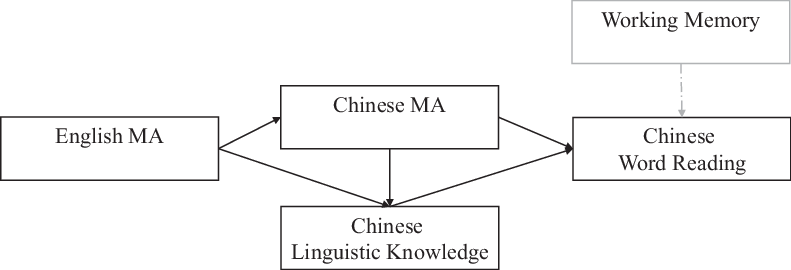
2. How do English MA, Chinese MA, and Chinese linguistic knowledge jointly contribute to Chinese word reading? Is there any direct effect of English MA on Chinese word reading above and over Chinese MA? Is there any additional influence from Chinese linguistic knowledge on the transfer of English MA? Our hypothesis is as follows: Interlingually, due to the writing system difference between morphophonemic English and morphosyllabic Chinese, the transfer facilitation effect of English MA is mediated by Chinese MA (i.e., there is no crossover or direct transfer effect from English MA to Chinese word reading); intralingually, due to the associations between MA and linguistic knowledge (e.g., Chen, Reference Chen2018, Reference Chen2020) and between MA and word reading (e.g., Tong et al., Reference Tong, Kwan, Wong, Lee and Yip2016), Chinese MA contributes both directly and indirectly via Chinese linguistic knowledge to Chinese multicharacter word reading (as shown in Figure 1).
Figure 1.Conceptual model of the four-way interactions among English MA, Chinese MA, Chinese linguistic knowledge, and Chinese word reading. Note. Working memory was treated as a control variable.


Methods
Participants
Fifty English-speaking American university learners of Chinese as a foreign language (21 males and 29 females) participated in this study. The mean age of the participants was 20.3 years (SD = 1.9). They were advanced Footnote 2 learners enrolled in the fifth or seventh semester of studying Chinese at one of seven major research universities in the Northeast and the South in the U.S. Three criteria were used for selecting study participants: 1) a minimum of two years’ experience learning Chinese; 2) reading was a major learning and instructional component in their programs, and there was no delay in learning Chinese characters; and 3) English was their native language. Also, participants who have Chinese heritage backgrounds or exposure to hancha in Korean or kanji in Japanese were excluded from the study. From the fifth semester onward, participants received 135 to 360 hours of instruction for 15 weeks per semester. At the completion of the semester, they were expected to have learned about 1,000 Chinese characters according to course syllabi obtained from the universities (in comparison, Chinese children will have learned about 2,000 characters by the end of third grade in mainland China, Taylor & Taylor, Reference Taylor and Taylor2014). A linguistic knowledge test that followed new HSK (Hanyu Shuiping Kaoshi/Chinese Proficiency Test) measurement format (Center for Language Education and Cooperation, 2020) and included vocabulary and grammar sections was administered to the participants (see more details of the measure below). Their mean accuracy rates for the two sections were 60.3% (SD = 16.3%) and 66.7% (SD = 16.4%), respectively. As to their English reading proficiency, they were above average in reading comprehension, with Scholastic Aptitude Test reading scores ranging between 610 and 800 (M = 717.5, SD = 52.2, Maximum Score Possible/MSP = 800) and American College Testing reading scores ranging between 27 and 36 (M = 32.3, SD = 2.8, MSP = 36).
Procedure
This study used five computerized or paper-and-pencil tasks, including Chinese word reading, English MA, Chinese MA, Chinese linguistic knowledge, and working memory. A post-test background questionnaire was distributed to the participants after these tasks were completed. The tasks and the questionnaire were administered individually by the first author in a quiet room on the university campuses. The time to complete all tasks was around 45 minutes.
Measure: Chinese word reading
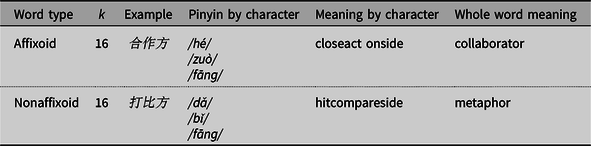
Chinese word reading was measured by a computerized naming task that required participants to read multicharacter strings as quickly and accurately as possible. Four sets of stimuli, each consisting of 16 items, were used in this task, with a total number of 64 items (see examples in Table 1). The pseudoword set was composed of legally formed, bimorphemic three-character pseudo words (开始方) generated by combining an affixoid Footnote 3 with a monomorphemic two-character base word, as shown in 开始+方, /kāishǐ-fāng/, “initiator”. The nonword set included 16 bimorphemic three-character illegally formed words, which were created by combining an affixoid appearing at an illegal position and a monomorphemic two-character base word (e.g., 方+喜欢, /fāng-xǐhuan/). Therefore, pseudowords and nonwords vary in whether they are complied with affixoid position constraint in Chinese. A similar approach of manipulating character position in a word to produce pseudowords and nonwords in Chinese can be found in the study by D. Liu, Chung, McBride-Chang and Tong (Reference Liu, Chung, McBride-Chang and Tong2010). In addition, three character strings formed with unrelated characters (e.g., 爱常爸 / ài-cháng-bà /, love-often-father) were selected. Each item in the unrelated set can be viewed as three unrelated words or morphemes (i.e., neither the three characters nor two out of the three characters can form a word). Responses to bimorphemic pseudowords served as the baseline, and the prediction was that, if the participants relied on morphological cues in reading Chinese words, the responses to bimorphemic nonwords were slower (due to affixoid position violation), and the responses to trimorphemic unrelated words were slower too (slowed down due to the greater number of morphemes). Finally, the real word set included 16 monomorphemic two-character monomorphemic real words (e.g., 世界, /shìjiè/, “world”). Response time data for the two-character monomorphemic real word set were treated as a covariate in subsequent analyses because base words in the pseudoword and nonword sets were two-character monomorphemic words (see a similar approach to control for baseword reading in the examination of morphological contributions to word reading by Goodwin et al., Reference Goodwin, Gilbert, Cho and Kearns2014). The mean frequency counts of the two-character words (occurrences per million words in the SUBLEXCH corpus, Cai & Brysbaert, Reference Cai and Brysbaert2010) were 284.1, 289.6, and 283.5 in the “real word”, “pseudoword”, and “nonword” sets, respectively. Item selection procedures and item list are provided in Appendices A and B, respectively, in the Supporting Information online.
Sample Items in Chinese Word Reading Task

Regarding the task administering procedures, all stimuli were presented individually on a computer screen. The presentation order was randomized across participants. Before the participants began the word reading task, the 16 affixoids were introduced and tested to ensure their familiarity to the participants. For each trial in the experiment, first, a fixation point ‘+’ appeared at the center of the screen for 200 milliseconds (‘ms’ henceforth), followed by the stimulus. The participants were asked to read it aloud. The stimulus disappeared after 2000 ms, followed by the fixation point to signal the beginning of a new trial. The participants were told to be as fast and accurate as they could. A lapse between the onset of the target word’s presentation and the participant’s voice onset was measured in ms with oral response accuracy by Presentation Footnote 4 . There were four practice trials. Both reaction times (RTs, lapses between the onset of a stimulus item and the onset of voice) for correct items and accuracy rates were recorded. Responses due to foreign accent or non-native-like tones in Chinese were not penalized.
Measure: English MA
A computerized affix shifting task (adapted from Feldman et al., Reference Feldman, Frost and Pnini1995) was used to measure MA in English. The participants were first presented with an affixed word in upper case (e.g., LEADER), asked to strip the affix (e.g., ER) from the word, and attach the stripped affix to another word (e.g., KICK). In addition, monomorphemic source words sharing the same letter sequences as the affixes used in the task (e.g., CLEVER) were also included. They then were asked to name the resulting word (KICKER) aloud as quickly as possible. The time lag between the onset of the target word’s presentation and the participant’s voice onset was measured in ms with oral response accuracy. To discourage participants from stripping letter clusters mechanically without processing them, equal numbers of prefixed and suffixed words were used as source words. A total of 32 source words (8 prefixed words, 8 suffixed words, and 16 monomorphemic words) were presented in a randomized order (see item list in Appendix C in the Supporting Information online). Mean RTs for corrected items were taken as an index of English MA in subsequent analyses. RTs for inaccurate items or RTs with 2.5 SDs above or below the mean RT were removed. As a result, 7.8% of the responses were removed from subsequent analyses.
It should be noted that the adoption of a computer-controlled metalinguistic awareness task that recorded RTs is not new to the field (e.g., Bialystok et al., Reference Bialystok, Peets and Moreno2014; Berstein et al., Reference Bernstein, Flipse, Jin and Odegard2020). Bialystok et al. (Reference Bialystok, Peets and Moreno2014) measured bilingual children’s metalinguistic awareness with both paper-and-pencil and computer-controlled tasks that vary in the demands of executive control. More recently, Berstein et al. (Reference Bernstein, Flipse, Jin and Odegard2020) have investigated whether a computer-controlled word-level morpheme counting task and a paper-and-pencil sentence-level task (adapted from the Test of Morphological Awareness by Carlisle, Reference Carlisle and Feldman1995, Reference Carlisle2000) measure the same construct (i.e., morphological awareness/MA) in English-speaking university students. Exploratory factor analysis results confirmed that the word-level experimental task that recorded RTs is a valid measure of MA and that both word- and sentence-level tasks measure the same underlying construct. With regard to the affix shifting task used in this research, according to Feldman (Reference Feldman1991), it is different from lexical decision or word naming experimental tasks that examine more implicit morphological processing because the affix shifting task requires explicit manipulation of the morpheme(s) in a word. We hold that our MA task selection is aligned with the construct definition widely cited in the literature (i.e., a learner’s ability to reflect upon, analyze and manipulate the morphemes and morphological structures of words, Carlisle, Reference Carlisle and Feldman1995, Reference Carlisle2000; Kuo & Anderson, Reference Kuo and Anderson2006).
Measure: Chinese MA
Chinese MA was measured using the affix-shifting tasks described above. Two sets of three-character source words (i.e., a word in which the designated character is an affixoid versus a nonaffixoid) were constructed according to Chinese-specific properties (see item list in Appendix D in the Supporting Information online). To rule out individual affixoid effects, the 16 affixoids appearing in the word reading task were used to form stimuli in this task as well (for a similar approach using the same sets of morphemes to form word items in different reading-related tasks, see Deacon et al., Reference Deacon, Tong and Francis2017).
As shown in Table 2, in the affixoid set, the designated character 方 /fāng/ corresponds to a bound morpheme indicating “side” and combines with a two-character base word to form the source three-character word (e.g., 合作, /hézuò/ + 方/fāng/, meaning “collaborator”); in the nonaffixoid set, the same character no longer serves as a productive morpheme in the three-character source word (i.e.,打比方, /dǎbǐfāng/, “metaphor”). In this task, participants were asked to strip the designated character (e.g., 方 /fāng/, from the source three-character word (e.g., 合作方, /hézuò-fāng/ “collaborator”) and attach the segment to the target two-character word (e.g., 挑战, /tiǎozhàn/, meaning “challenge”). They then had to name the resulting multicharacter word (挑战方, /tiǎozhàn-fāng/, meaning “challenger”) aloud as quickly as possible. Responses due to foreign accents or non-native-like tones in Chinese were not penalized. Again, RTs for inaccurate items or RTs with 2.5 SDs above or below the mean RT were removed. As a result, 25.4% of the responses in the Chinese MA task were removed from subsequent analyses.
Two Sets of Three-character Source Words in Chinese MA Task

Measure: Chinese linguistic knowledge
A paper-and-pencil task of 100 items was adopted from Liu (Reference Liu2013). It consisted of two sections, vocabulary and grammar knowledge. In both sections, one point was awarded for each correct answer. The Chinese vocabulary knowledge section had 60 items (Cronbach’s α = .92), including single-character and two-character words selected from the New HSK. The participants were asked to translate one- and two-character words into English (e.g., 周末 means “weekend”). The Chinese grammar knowledge section was a multiple-choice test designed to tap into the participants’ knowledge of the functions of several grammatical elements, including word order, conjunctions, tense and aspect, and rhetorical questions in Chinese. For instance, the sentence 我要继续学下去 (“I want to continue learning”) contains five words (wǒ yào jìxù xué xiàqù; literally meaning “I want continue learn down”). Participants were given four options with the correct order and another three sentences that scrambled the five words in different orders. They were required to choose the one option with the correct order. There were 40 items in the grammar section (Cronbach’s α = .82).
Measure: Working memory
For the purpose of gauging the unique contributions of MA measured by a computerized task, the effect of working memory needed to be controlled for, as its direct and indirect impact on word reading has been identified in existing literature (Arrington et al., Reference Arrington, Kulesz, Francis, Fletcher and Barnes2014; Peng et al., Reference Peng, Barnes, Wang, Wang, Li, Swanson and Tao2018; Siegel, Reference Siegel1994). Working memory is relevant in the context of word reading because the reader must decode and/or recognize words while remembering what has been read and retrieving information such as grapheme-phoneme/morpheme mapping (Da Fontoura & Siegel, Reference Da Fontoura and Siegel1995). Working memory was measured by a backward digit span task adopted from the Wechsler Adult Intelligence Scale (Wechsler, Reference Wechsler2008). The first author asked individual participant to repeat the numbers the first author said each time in reverse order. There were seven different spans, ranging from two to eight digits in each span. Each span has two items. The test was stopped after two consecutive failures of the same span length. The total number of correct trials and the longest number sequence repeated correctly prior to the two failed trials were recorded manually by the first author. The reliability (Cronbach’s α) was .67.
Analyses and results
English-speaking adult learners of Chinese’ sensitivity to the internal morphological structure of printed words
To recapitulate, Research Question 1 is concerned with whether English-speaking adult learners of Chinese as a foreign language develop intraword morphological sensitivity with limited Chinese print input. The descriptive statistics of the participants’ performances in the Chinese word reading task as well as the other four measures (i.e., English MA, Chinese MA, Chinese linguistic knowledge, and working memory) are illustrated in Table 3.
Descriptive Statistics for Chinese Word Reading, English MA, Chinese MA, Chinese Linguistic Knowledge, and Working Memory (means and SDs) (N = 50)

Note. TCW, monomorphemic two-character real words; TPW, bimorphemic three-character pseudowords; TNW, bimorphemic three-character nonwords; TUW, trimorphemic three-character unrelated words; RT, reaction time; MSP, Maximum score possible.
A Repeated-Measures ANOVA (RMANOVA) was conducted with Chinese word reading efficiency (reaction times for accurate items) as the dependent variable, and word type (monomorphemic two-character real words, bimorphemic three-character pseudowords and bimorphemic three-character nonwords, and trimorphemic three-character unrelated words) as the within-subject independent variable. The results of RMANOVA suggested that there was a significant main effect of word type on Chinese word reading both by subject [F1 (1, 49) =2518.66, p < .001] and by item [F2 (1, 63) = 19.42, p < .001] (as illustrated in Figure 2).
Mean reaction times and accurate rates of Chinese word reading by word type. Note. TCW, monomorphemic two-character real words; TPW, bimorphemic three-character pseudowords; TNW, bimorphemic three-character nonwords; TUW, trimorphemic three-character unrelated words.

Post-hoc pairwise comparisons were conducted using the Bonferroni method. The post-hoc results indicated that the time to name monomorphemic two-character real words was significantly shorter than the time to name any of the three-character items (ps < .001); there was no significant difference between the time to decode three-character nonwords and unrelated words (p = .228); the time to name bimorphemic three-character pseudowords was significantly shorter than that of bimorphemic three-character nonwords (p = .018) and that of trimorphemic three-character unrelated words (p = .029).
These results indicate that word reading efficiency among L2 learners of Chinese was affected by the number of morphemes in a word. Thus, it would seem to suggest that with only about three years of formal study and limited print input, learners of Chinese developed intraword morphological structure sensitivity and were able to distinguish affixoids from base morphemes and process them differently.
The joint contributions of English MA, Chinese MA, Chinese linguistic knowledge to Chinese multicharacter word reading
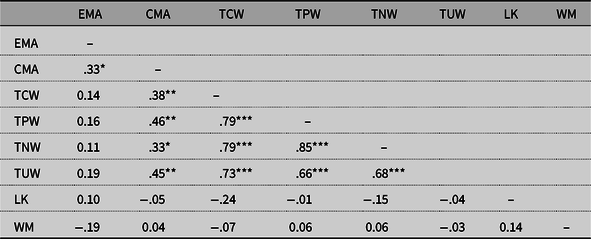
To answer Research Question 2 regarding how English MA, Chinese MA, and Chinese linguistic knowledge jointly contribute to Chinese word reading, and Research Question 3 to what extent English MA facilitates Chinese word reading, we first compared the participants’ performance between English MA and Chinese MA tasks. Two rounds of two (language: English and Chinese) by two (affixation: affixed versus nonaffixed) RMANOVA were conducted with RTs and accuracy rates as the respective dependent variables. We did not identify any interactional effects between language and affixation on MA RTs (F1, 49 = 0.03, p = .870), or any significant effect of affixation (F1, 49 = 1.37, p = .248), yet a significant effect of language (F1, 49 = 81.24, p < .001). In addition, there was a significant interactional effect between language and affixation on MA accurate rates (F1, 49 = 456.39, p < .001). The results suggested that the participants responded slower in the Chinese MA task, and they relied more on morphological analysis in the target second language than in their first language. In subsequent analyses, English MA and Chinese MA were indexed by RTs for accurate affixed items (after Ke & Koda, Reference Ke and Koda2017). We then explored the intercorrelations among all variables (as shown in Table 4).
Bivariate Correlations among English MA, Chinese MA, L2 Word Reading, Chinese Linguistic Knowledge, and Working Memory (N = 50)

Notes. EMA, English MA; CMA, Chinese MA; TCW, monomorphemic two-character real words; TPW, bimorphemic three-character pseudowords; TNW, bimorphemic three-character nonwords; TUW, trimorphemic three-character unrelated words; LK, Chinese linguistic knowledge; WM, Working memory. *, p < .05; **, p < .01; ***, p < .001.
Interlingually speaking, English MA correlated significantly with Chinese MA only (r = .33, p = .021) and had nonsignificant correlations with Chinese linguistic knowledge (r = .10, p = .482), monomorphemic two-character real word reading (r = .14, p = .329), bimorphemic three-character pseudoword reading (r = .16, p = .266), bimorphemic three-character nonword reading (r = .11, p = 460), trimorphemic three-character unrelated word reading (r = .19, p = .190), as well as working memory (r = −.19, p = .195). Intralingually speaking, Chinese MA correlated significantly with monomorphemic two-character real word reading (r = .38, p = .007), bimorphemic three-character pseudoword reading (r = .46, p = .001) and bimorphemic three-character nonword reading (r = .33, p = .019), and trimorphemic three-character unrelated word reading (r = .45, p = .001), yet insignificantly with Chinese linguistic knowledge (r = −.05, p = .717) or working memory (r = .04, p = .801); Chinese linguistic knowledge had a small correlation with monomorphemic two-character real word reading, which approached significant level (r = −.24, p = .098), as well as marginal and nonsignificant correlations with other variables (as shown in Table 4); there was a large and significant correlation between monomorphemic two-character real word reading and bimorphemic three-character pseudoword reading (r = .79, p < .001).
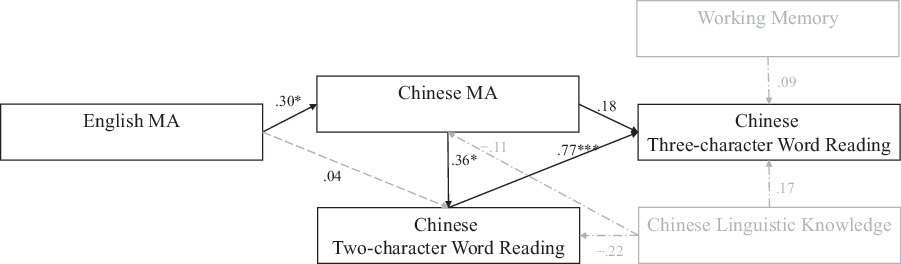
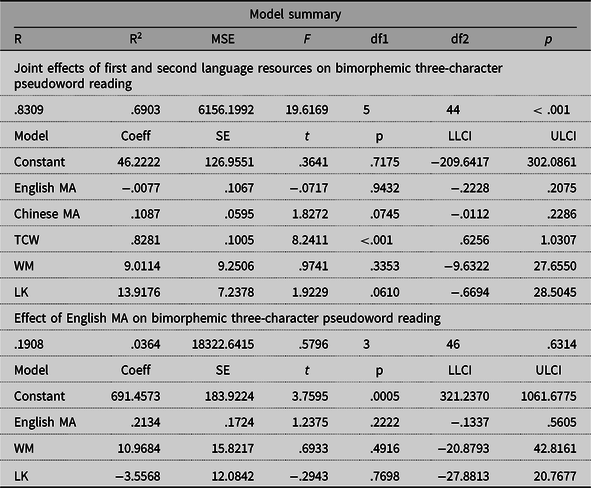
For the purpose of examining the joint contributions of first and second language resources to Chinese multicharacter word reading efficiency, regression analyses were conducted using SPSS and Process version 3.5 (Hayes, Reference Hayes2013) with Chinese bimorphemic three-character pseudoword reading as the criterion variable, English MA as the predictor, Chinese MA and monomorphemic two-character real word reading as the joint serial mediators, and working memory and Chinese linguistic knowledge as the covariates. Chinese linguistic knowledge was no longer treated as a mediator (as hypothesized in Figure 1) yet probed as a covariate since it did not correlate significantly with any of the word reading subscores (as shown in Table 4). Indirect effects were computed for each of 5000 bootstrapped samples, and the 95% confidence interval was computed by determining the indirect effects at the 2.5th and 97.5th percentiles. The significant findings are presented in Figure 3 and Table 5.
Regression-based path model of the four-way interactions among English MA, Chinese MA, monomorphemic Chinese two-character real word reading, and bimorphemic Chinese three-character pseudoword reading. Notes. Working memory and Chinese linguistic knowledge were treated as control variables. *, p < .05; ***, p < .001.

The Direct and Indirect Effects of English MA on Bimorphemic Three-character Pseudoword Reading (N = 50)

Note. TCW, monomorphemic two-character real word reading; WM, working memory; LK, linguistic knowledge.
As shown in Figure 3, the direct effect from English MA to Chinese multicharacter word reading was insignificant (as zero fell between the 95% CI) (direct effect = −.0077, 95% CI = −.2228, .2075). The shortcut indirect effect of English MA→ Chinese MA→ Chinese multicharacter word reading was significant (indirect effect = .0005, 95% CI = .0000, .0015); the shortcut indirect effect of English MA → Chinese two-character word reading→ Chinese multicharacter word reading was insignificant (indirect effect = .0003, 95% CI = −.0018, .0024); the long-way mediation effect of English MA → Chinese MA → Chinese two character word reading→ Chinese multicharacter word reading was significant (indirect effect = .0009, 95% CI = .0000, .0021). In addition, the results in Table 5 suggested that first and second language resources (i.e., English MA, Chinese MA, Chinese monomorphemic two-character word reading) jointly explained about 69.03% of the variance in Chinese bimorphemic three-character pseudoword reading; English MA alone explained about 3.64% of the variance. Last, two indexes (i.e., the variance inflation factor [VIF] and tolerance statistic) regarding risk of multicollinearity were checked. According to Field (Reference Field2009), caution should be taken when the VIF is bigger than 10 and the tolerance statistic is below 0.2. In this study, the VIFs and the tolerance statistics were all within the acceptable range (see Appendix E in the Supporting Information online). Therefore, multicollinearity should not have interfered with the findings presented above.
Thus, to answer Research Question 2, the results described above indicate that there was no direct transfer facilitation effect from English MA to Chinese bimorphemic three-character pseudoword reading, yet English MA had indirect effects on Chinese bimorphemic three-character pseudoword reading jointly mediated by Chinese MA and Chinese monomorphemic two-character word reading. There was no additional contribution from Chinese linguistic knowledge to bimorphemic three-character pseudoword reading. English MA explained about 3.64% of the variance in Chinese bimorphemic three-character pseudoword reading.
Discussion
To reiterate, this study examined the transfer facilitation effects of English MA on Chinese multicharacter word reading in American university learners of Chinese as a foreign language. As indicated earlier, there has been plenty of research of the transfer of MA in Chinese–English bilingual readers; yet, the child learners are either immersed in the target second language context (e.g., Chinese heritage children in North America in Wang et al., Reference Wang, Yang and Cheng2009) or have learned the target language for an extensive period (e.g., English as a foreign language in mainland China in D. Zhang, Koda & Sun, Reference Zhang, Koda and Sun2014). In comparison, this study focused on adult learners of Chinese in the foreign language context (i.e., in North America) who have relatively short (three years) formal education experience in Chinese and limited Chinese linguistic (vocabulary and grammar) knowledge and explored whether these learners can acquire language-specific MA in Chinese and benefit from their well-developed first language (i.e., English) literacy experience. In addition, the present study measured an underexamined reading outcome (i.e., multicharacter word reading) in existing literature of learners of Chinese as an additional language. It is hoped that the findings will help expand current understanding of the transfer of MA in adult second language reading as well as the interactional effect between transferred MA and second language linguistic knowledge on second language word reading. There were three major findings: (1) with approximately three years of formal Chinese instruction and limited Chinese print input (about 1,000 characters), English-speaking adult learners developed sensitivity to the internal morphological structure of multicharacter words in Chinese and were able to perform basic morpho-orthographic decomposition in word reading. (2) Specifically, English MA did not directly contribute to Chinese bimorphemic three-character pseudoword reading; it contributed indirectly via the joint serial mediation by Chinese MA and Chinese monomorphemic two-character real word reading. (3) There was no additional influence from Chinese linguistic knowledge. And, English MA explained about 3.64% of the variance in Chinese bimorphemic three-character pseudoword reading.
Our observation of second language adult learners’ morphological sensitivity in Chinese was consistent with that in Tong et al. (Reference Tong, Kwan, Wong, Lee and Yip2016)’s study of adult learners of Chinese as a second language. It should be noted that Tong et al. (Reference Tong, Kwan, Wong, Lee and Yip2016) focuses on subcharacter-level (i.e., radical) MA, whereas the present study examined character-level MA. Also, Tong et al. (Reference Tong, Kwan, Wong, Lee and Yip2016) modeled single- and two-character processing, while we included two- and three-character words that vary in word length and morphological complexity in the word reading task. According to recent findings of the (Mandarin) Chinese Lexical Database project, it appears that single-character word naming and lexical decision efficiencies are affected by effects of the family size of the semantic radical; yet multicharacter word naming and lexical decision efficiencies are affected by the combinatory properties at the character level (e.g., the character frequency for the final character in a multicharacter word) (Sun et al., Reference Sun, Hendrix, Ma and Baayen2018). There is a need for future studies to examine Chinese MA at both character and subcharacter levels in second language learners.
Notably, our findings differed from the morphological insensitivity identified by D. Zhang (Reference Zhang2017) and Zhou and McBride (Reference Zhou and McBride2013) in child English–Chinese bilingual learners. D. Zhang (Reference Zhang2017) found that orthographic and phonological skills were significant predictors of Chinese word reading in the English-speaking child learners of Chinese in Singapore and observed a positive effect of MA on word reading in native Chinese children only, not in English-speaking children. We contend that the participants in this research are adult foreign language learners whose first language MA should be more readily facilitative in the formation of Chinese MA than those English–Chinese bilingual children in D. Zhang’s study who are still developing grapheme-morpheme mapping ability in two languages. However, it should be noted that we did not measure orthographic and phonological skills in this study.
Finally, we did not identify any significant additional influence of Chinese linguistic knowledge on the facilitation effect of transferred MA to Chinese multicharacter word reading, which was consistent with the findings of H. Zhang and Koda (Reference Zhang and Koda2018). In comparison, Chen (Reference Chen2018) observed that the contribution of transferred MA to Chinese word meaning inferencing was constraint by a linguistic threshold. A possible explanation is that the extent to which second language linguistic knowledge influences the transfer facilitation of first language MA depends on the linguistic demands of the target reading outcomes. The joint contributions of MA in two languages seemed to be sufficient for efficient decontextualized word decoding that required grapheme-sound-morpheme mappings in this present study, whereas sentence-level word meaning inferencing in Chinese as second language examined in Chen (Reference Chen2018) entails more demanding Chinese linguistic (vocabulary and grammar) knowledge. It is also possible that, as pointed out by one of the anonymous reviewers, the results were affected by task modality because Chinese MA and word reading tasks were computerized and designed to capture reaction times, whereas the Chinese linguistic knowledge task was paper-and-pencil-based and measured accuracy rates.
Limitations and implications
We acknowledge that this research has a few limitations to be addressed in the future. First, the interrelationships examined in this study are correlational, which does not warrant any causal inference. Future longitudinal or interventional research is needed to examine the causal effect of first language MA on subsequent second reading subskills development (e.g., D. Zhang, Reference Zhang2016). Second, the research has focused on word reading as the target reading outcome and found no significant influence of second language linguistic knowledge, future studies should also measure meaning-related reading subskills such as word meaning inferencing and passage reading comprehension. Also, multiple measures of MA (e.g., paper-and-pencil and computer-controlled) should be administered. Third, given the vast range of individual differences commonly found in second language learners, it was necessary for us to tap the participants’ knowledge of the 16 Chinese affixoids at the beginning of the experiment, but we could not rule out any possible priming effect. With a larger sample size, item response theory (e.g., Goodwin et al., Reference Goodwin, Gilbert, Cho and Kearns2014) or linear mixed effects modeling (e.g., Tong et al., Reference Tong, Deng, Deacon, Saint-Aubin and Wang2020) can be applied to examine reader by word characteristics when the same set of affix(oid) or bases is repeatedly used in items in different reading-related tasks in a single study. Also, although we found that Chinese word reading was not affected by word length (i.e., the number of characters in a word), a real word reading task that includes one-, two-, and three-character monomorphemic words or a morpheme counting task should be added for researchers who are interested in any possible interactional effect between word length and morphological complexity on Chinese word reading efficiency. Yet, a foreseeable challenge is to identify a considerable amount of three-character monomorphemic words in Chinese because very few words of this nature exist. Fourth, we found that English MA only explained a small proportion of the variance in Chinese multicharacter word reading; there is a need to measure other first language reading subskills such as first language word reading and include additional covariates like Rapid Automatized Naming (RAN). As suggested by one of the anonymous reviewers, RAN might be a more relevant predictor of metalinguistic, linguistic, and reading skills than working memory measured by a backward digit span task in this study (for a theoretical account of the relationship between RAN and oral reading fluency, see Papadopoulos et al., Reference Papadopoulos, Spanoudis and Georgiou2016). It should also be noted that the working memory (backward digit span) task was administered in person, which might have led to the relatively low reliability (i.e., Cronbach’s alpha = .67). Future research may use examiner-administered computer-controlled measures to improve the reliability and precision of digit span assessments (e.g., Woods et al., Reference Woods, Kishiyama, Yund, Herron, Edwards, Poliva and Reed2011). Finally, participants’ multilingual backgrounds (whether a participant uses any other language other than Chinese and English) were not considered in the analyses. There is a need to pay more attention to potential interactions among first language literacy experience, second language, and third language linguistic knowledge in multilingual reading development (e.g., Bérubé & Marinova-Todd, Reference Bérubé and Marinova-Todd2012).
Based on the findings of this study, two implications can be drawn for teaching Chinese as a foreign language to university learners. First, instructions that simultaneously focus on oral and written language with no delay in teaching Chinese characters should be encouraged. Early introduction of Chinese characters might enhance adult foreign language learners’ exposure to the writing system and help them grasp the mapping principles among morphemes, characters and syllables. Second, focusing on improving learners’ vocabulary and grammar in Chinese alone is insufficient for skilled word-level reading, given that it was found in this research that there was no additional influence of Chinese linguistic knowledge on Chinese three-character word reading over and above the joint effects of English MA, Chinese MA, and Chinese two-character word reading. Fast and accurate word naming is a prerequisite for successful passage reading comprehension because efficient retrieval of phonological information during reading will help mitigate second language readers’ cognitive load (Hamada & Koda, Reference Hamada and Koda2010). Even advanced Chinese learners need to reply on the strategies of sounding aloud words during reading (e.g., Everson & Ke, Reference Everson and Ke1997). It is held that explicit training of Chinese MA could be beneficial to improving second language learners’ Chinese word reading ability. Even short trainings can positively affect advanced-level university learners’ Chinese MA, which will further contribute to their ability to learn printed words (e.g., Chen, Reference Chen2020).
Supplementary material
To view supplementary material for this article, please visit https://doi.org/10.1017/S014271642100031X
Acknowledgements
We would like to extend our gratitude to all those people who have made this research project possible. They are Dr. G. Richard Tucker, Dr. Charles A. Perfetti, Dr. Susan Polansky, Dr. Yueming Yu, Dr. Feng Xiao, Dr. Yan Liu, Dr. Wenwen Zhu, Dr. Yi Xu, Ms. Liling Huang, and Dr. Lin Zhu. This research has been supported by the CMU Modern Languages Dietrich College Dissertation Completion Fellowship, and the Language Learning Dissertation Grant. We are also grateful for the comments of Dr. Yuuko Uchikoshi, Dr. Stefka H. Marinova-Todd, and the anonymous reviewers who have helped us improve this manuscript.