Introduction
Dementia is a significant and rapidly worsening public health problem. Psychiatric symptoms and disturbing behaviors affect almost 90% of dementia patients. These symptoms are associated with a poorer prognosis and higher health care costs and are a major cause of institutionalization (Mangone and Arizaga, Reference Mangone and Arizaga1999; Pagés Larraya et al., Reference Pagés Larraya, Gracco and Mari2004; Allegri et al., Reference Allegri2007; Prince et al., Reference Prince, Livingston and Katona2007).
Disturbing behaviors, depression symptoms and memory impairment of people with dementia are strongly associated with caregiver burden, anxiety and depression (Teri, Reference Teri1997; Allegri et al., Reference Allegri2006; Logsdon, Reference Logsdon2008). In the Italian Hospital of Buenos Aires, Argentina, the Dementia Caregivers Workshop is aimed to reduce caregiver distress and the incidence of patients’ symptoms (Ostwald et al., Reference Ostwald, Hepburn, Caron, Burns and Mantell1999; Mittelman et al., Reference Mittelman, Drentea, Clay and Roth2006; Katona et al., Reference Katona, Livingtoon, Cooper, Ames, Brodaty and Chiu2007).
The use of standardized scales is critical for monitoring the interventions within and between different populations, but the current Spanish tools are dispersed in several scales. A simple tool for simultaneously and exhaustively evaluating patients’ symptoms and caregiver distress in Spanish-speaking groups is needed (Zarit and Toseland, Reference Zarit and Toseland1989; Hinton et al., Reference Hinton, Haan, Geller and Mungas2003).
The Revised Memory and Behavior Problems Checklist (RMBPC) is a 24-item, self-administered caregiver-report measure of observable behaviors and memory problems in dementia patients and caregiver reactivity. Several studies have shown that the RMPBC provides an adequate scoring of the occurrence of memory, depression and behavior problems and the subjective burden associated with these three distinct domains from the caregiver's point of view (Teri et al., Reference Teri1992; Weiner et al., Reference Weiner, Logsdon, Uomoto, Zarit and Vitaliano2000). A large, multisite and multiethnic study has provided an independent replication of this scale that allowed the generalizability of its use (Roth and Gitlin, Reference Roth and Gitlin2003). It has already been translated into French and Mandarin, and preliminary Spanish-versions were tested among Latino caregivers from Anglo-Saxon countries (Harwood et al., Reference Harwood, Barker, Ownby, Bravo, Aguero and Duara2001; Coon et al., Reference Coon2004).
The aims of this study were to translate, culturally adapt and validate the complete RMBPC scale in order to obtain a reliable tool for assessing dementia patients’ symptoms and caregivers’ distress in Spanish-speaking populations.
Methods
This cross-sectional study was carried out in the Health Maintenance Organization of the Italian Hospital of Buenos Aires, Argentina (HIBA-HMO).
Translation process
The original RMBPC scale was developed to assess the overall level of behavioral problems and caregiver reactivity in Alzheimer's disease (AD), as well as the specific areas of memory, depression and disruption (Teri et al., Reference Teri1992). This scale was translated into Spanish following the forward-backward translation technique for cross-cultural research (Del Grecco et al., Reference Del Grecco, Walop and Eastridge1987).
In the forward translation process, two initial Spanish versions of the RMBPC were produced by independent translators, who were instructed to aim for conceptual rather than literal translation and to keep the language colloquial and compatible with a reading age of 14. The translators were also asked to give three possible translations for each response choice (giving 18 different options).
These two translations were compared and items were included in a reconciled version only after the research team reached a consensus. For those items that were linguistically or culturally problematic, the team decided on the most acceptable option after the translators suggested all reasonable options. The ordinal and interval properties of the translated response choices were evaluated in a Thurstone scaling exercise. This initial forward-translation version was formally assessed by two other native Spanish speakers and bicultural experts. They compared the initial Spanish version with the original English version. For each question item and each response choice, they gave numerical ratings (from 0 to 100) for clarity, conceptual equivalence, and use of common language. They also supplied more culturally and linguistically equivalent Spanish phrases. The project team then met to define a final forward-translation version.
The backward translation process and development of the final version of SpRMBPC involved two bilingual and bicultural professional translators: one American-English and one British-English native speaker. The translations were discussed item by item and response choice by response choice at a research meeting that included the translation team, and five bilingual physicians, where modifications were made to some translations.
Validation process
In validating the scale, stability (test-retest), reliability, discriminant and concurrent validity and factor-structure were evaluated.
Study population
The study population comprised caregiver/dementia patient dyads of the HIBA-HMO who attended the Workshop for Dementia Caregivers during 2006 and 2007. Patients were evaluated with a local adaptation of the Mini-mental State Examination (MMSE) (Allegri et al., Reference Allegri, Ollari and Mangone1999; Butman et al., Reference Butman, Arizaga and Harris2001) administered by the geriatric HIBA-HMO team. AD was classified according to the National Institute of Neurological and Communicative Disease and Stroke-Alzheimer's Disease and Related Disorders Association. All patients met dementia diagnostic criteria according to the Diagnostic and Statistical Manual of Mental Disorders, 4th edition (DSM IV). Illiterate caregivers were excluded.
Data collection
The SpRMBPC questionnaire (see Appendix 1, published as supplementary material online attached to the electronic version of this paper at http://www.journals.cambridge.org/ipg) was completed by the caregivers at the beginning of the workshops. For assessing concurrent and discriminant validity, a battery of assessment instruments was also administered: Clinical Dementia Rating (CDR); MMSE – locally adapted (Allegri et al., Reference Allegri2007); Neuropsychiatric Inventory questionnaire (NPIq), for measuring NPI intensity and NPI distress (Hughes et al., Reference Hughes, Beeg and Danziger1982; Boada et al., Reference Boada, Cejud-Bolivar and Tarraga2002); Hospital Anxiety and Depression Scale (HADS) (Herrero et al., Reference Herrero, Blanch and Peri2003); and the Zarit Burden Interview (Zarit et al., Reference Zarit, Reever and Bach-Peterson1980).
In order to correlate the patient's depression and disruption subscales from the NPIq questionnaire, two other subscales were utilized: NPI depression (mean of items Depression and Apathy from the NPIq original scale), and NPI disruption (means of items Delusions, Hallucinations, Agitation or aggression, Anxiety, Euphoria, Disinhibition, Irritability, Motor disturbance, Night-time behaviors).
Caregiver's anxiety, depression and burden were considered positive when HADS-A ≥ 8; HADSD ≥ 9 and Zarit Burden Interview ≥ 44 respectively.
For the test-retest analysis, 15 caregivers were asked to fill the SpRMBPC questionnaire between three to fourteen days after the workshop.
Scoring
The scale provides two total scores: one for patient symptoms (Frequency scale: Ft) and another for caregiver distress (Reaction scale: Rt). It also provides three subscores for patient symptoms: Memory (Fm: items 1 to 7), Disruptive behavior (Fdis: items 8 to 15) and Depression (Fdep: items 16 to 24), and three subscores for caregiver reaction (Rm; Rdis; Rdep respectively). Each score was calculated as the average of the answers, excluding Frequency items rated as 0 or as “don't know” (Teri et al., Reference Teri1992).
As the reaction answers depend upon the occurrence of the patient's corresponding behavior, the reaction score was computed only when the patient displayed the relevant behavior. If no problems were reported over the past week within a certain domain, the average reaction score was coded as missing. With this metric, it was possible for caregivers to have high average reaction ratings even though the number of reported problems was relatively small.
In order to follow up caregivers longitudinally from the diagnosis, we defined a new reaction scale (Global Reaction), computed as the mean of all the reaction answers, independently of the occurrence of patient symptoms (including in the average the Reaction rating as zero when Frequency items were rated as zero). The global reaction scales and their subscales (RGt; RGm; RGdis; RGdep) measure the total burden or stress experienced by the caregiver. The aim of these scales is to measure caregiver distress even in cases of a few symptoms, in order to analyze longitudinally the caregiver burden.
Statistical analysis
Cronbach's coefficient α was used to assess reliability. Spearman's rank correlation coefficients were generated for test-retest reliability calculations and for concurrent validity. Mann-Whitney analysis was performed to compare the RMBPC scores with the severity of dementia. To test the loading of each questionnaire item to the subscales identified previously by factor analysis (Teri et al., Reference Teri1992; Roth and Gitlin, Reference Roth and Gitlin2003), standard principal component analyses, setting in three the number of factors, were conducted on the frequency and the reaction ratings separately. Mean and standard deviation (SD) are expressed for continuous variables; proportions and their 95% confidence interval (CI) for categorical ones. STATA software was used for the statistical analysis.
Results
Transcultural adaptation
During forward translation, the original verbs in the infinitive were translated as subjunctives, as generally used in Spanish. After the backward translation, there was disagreement on the meaning of only four items and on the synonym of one item. The group of experts discussed these discrepancies until they arrived at a consensus.
In the Thurstone scaling exercise for assessing the interval properties of the scale, the Spanish anchors were determined from the pool of 18 different options, where option 0 = “nada” (not at all) and option 4 = “muchísimo” (extremely). Then 22 native speakers, heterogeneous in terms of age and education level, were asked to position each of the remaining 16 options (“un poco”, “regular”, “moderado”, “bastante”, “mucho”, etc) on a 100-mm linear analogue scale. The mean scores for each response choice were computed. This exercise provided the translation team with additional information for selecting the best answer choice for each question.
Validation
Patient and caregiver characteristics
Out of a total of 92 patient-caregivers dyads, 87 (96%) completed the questionnaire. Among the completed surveys the proportion stating “don't know” was 5.4% (CI 4.7–6.1%) and the proportion of missing data was 7.5% (CI 6.8–8.4%)
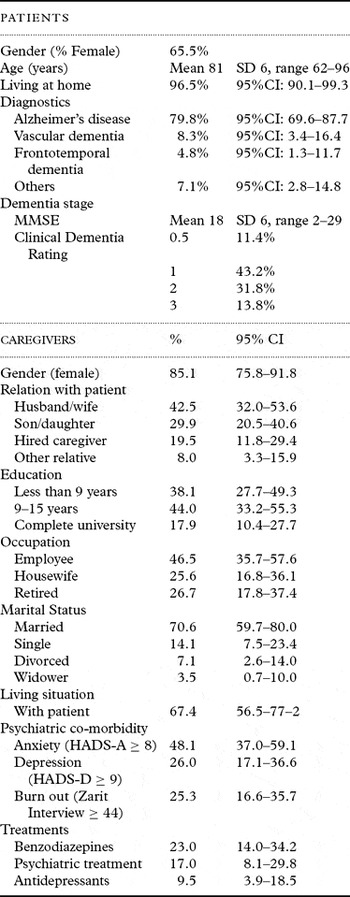
As Table 1 shows, most of the patients were elderly women living at home, diagnosed with mild or moderate Alzheimer's disease (MMSE ≥ 20: 40.0%; MMSE 15–19: 37.5%; MMSE ≤ 14: 22.5%). Most of the caregivers were female relatives, with lower or medium levels of education. Half of them (48.1%) reported anxiety in the HADS-A scale, 26% depression in the HADS-D scale and 25.3% burden according to Zarit Burden Interview. Other patient and caregiver baseline characteristics are shown in Table 1.
Patients’ and caregivers’ characteristics

MMSE = Mini-mental State Examination; HADS = Hospital Anxiety and Depression Scale.
Descriptive results
Memory symptoms were the most frequent, similar to the English population in which the scale was originally validated (Teri et al., Reference Teri1992): “Forgetting the day” (“Que se olvide qué día es”) 54.1%, “Forgetting recent events” (“Que tenga problemas para acordarse cosas recientes”) 50.6%, and “Repeated questions” (“que el paciente pregunte muchas veces los mismo”) 44.7% (Table 2).
SpRMBPC frequency and reactivity scores

The symptoms that severely distressed the caregivers (rated as “extremely bothering” by the caregivers) were depression and disturbance behaviors: “engaging in behavior potentially dangerous to self or others” (29%) (“Que haya tenido comportamientos que potencialmente pueden ser peligrosos para él o para otras personas”), “threats to hurt oneself” (“que haya amenzado con lastimarse”) (25%) and “commenting about death of self or others” (“que comente sobre su propia muerte o la de otras personas”) (22%). As result of this, Rdis and Rdep were higher than Rm.
As expected, the Global Reaction ratings were lower than the corresponding Reaction ratings, and RGm was higher than RGdis and RGdep.
Reliability study
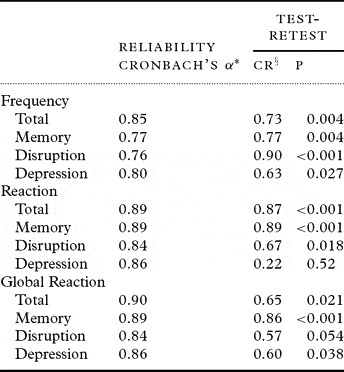
The Cronbach's α and the test-retest analysis displayed good internal consistency and reliability respectively for the whole scales and subscales, except the test-retest of the Rdep subscale that displayed moderate retest correlation (Table 3).
Reliability: internal consistency and test-retest analysis

*Standardized Cronbach's α coefficient.
§Spearman's ρ.
Concurrent and discriminant validity
It was expected that the Ft scale would show a positive correlation with all of the patient symptom scales, and that the Fdis and Fdep subscales would be positively related to depression and disruption measures (concurrent validity) but not to cognitive measures (discriminant validity). Conversely, it was predicted that the Fm subscale would be positively associated with cognitive impairment measures but not depression measures.
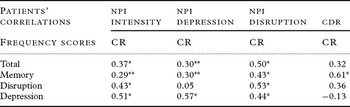
Regarding the concurrent validity, Tf was correlated with the disruption and depression measures, but not with CDR (Table 4); MMSE only correlated with Ft in the early stages of dementia (MMSE ≥ 20; Spearman's ρ −0.52 p 0.027). Neither frequency subscale nor CDR or NPIq showed correlation with MMSE.
Correlation of the frequencies scales

CR: Spearman's ρ.
* p < 0.001; ** p < 0.05.
NPI = Neuropsychiatric Inventory; CDR = Clinical Dementia Rating.
Fm displayed strong correlation with the stage of dementia; Fdis was correlated with disruption and Fdep with depression measures. Regarding the discriminant validity, Fdis was neither correlated with CDR nor with NPI depression as expected, but both Fm and Fdep correlated with NPI disruption.
All reaction scales and subscales, even the Global scores, showed strong correlation with all of the caregiver psychiatric and burden scales tested (NPI-12 distress, Zarit, HADS-A and HADS-D).As expected, no correlations were found between total Frequency or Reaction scores and patients’ age.
Loading factor analysis of questionnaire items
The three factors extracted by principal component analysis accounted for 46% and 58% of the total variance for the Frequency and the Global Reaction ratings respectively. The Reaction ratings were not analyzed because only those items that occurred in the previous week could be rated.
The highest loading factor of each item was as predicted by Teri et al. (Reference Teri1992) and Roth and Gitlin (Reference Roth and Gitlin2003). The exception within the Frequency answers was the item “Arguing” which loaded 0.50 to Fdep, a little higher than the loading factor to Fdis (0.48). Regarding the Global Reaction answers, the item “Appears sad or depressed” loaded a little higher to RGdis than to RGdep (0.42 and 0.32 respectively) and the item “Comments about loneliness” loaded to RGdis instead of to RGdep as expected.
Discussion
The RMBPC scale was translated for a Spanish-speaking population, producing a self-administered questionnaire which takes only 15 to 20 minutes to complete. Even though caregivers had a “don't know” option, only a small proportion of them chose this, with just a few missing answers. These observations suggest that the SpRMBPC is an easy tool that can be used by both formal or informal caregivers. It was adapted for poorly educated caregivers from Argentina, and is probably easy for other Spanish-speaking South American countries to understand. In Latin America, the language of the educated is very similar to that of Spain, but popular and familiar speech shows wide zonal diversity. Local testing would be needed to evaluate its comprehensibility before using it among caregivers with low levels of education in other Spanish-speaking countries (Mondragón Espinoza, Reference Mondragón Espinoza2002).
Although the present study has been done within the context of workshops, the profile of the dyads included in this study is that frequently found in primary care settings (caregivers: adults, relatives, co-residents, with some degree of distress; patients: mostly diagnosed with Alzheimer's disease and living at home). These results strongly suggest that the SpRMBPC scores could be applied in regular practice, in spite of the high rates of anxiety among the caregiver sample.
This may be because many of them were referred by their physician to the Dementia Caregivers Workshop due to their concerns and worries. In this regard it is possible too that the international cut-point of the HADS-A ≥ 8 (Herrero et al., Reference Herrero, Blanch and Peri2003) could be high for our population, as no Argentinean cut-off has yet been determined.
Like the original RMBPC, these Spanish scores displayed high internal consistency and reproducibility, except for the test-retest Rdep subscale; this may be because the retest questionnaire was administered after the first workshop session which may have changed the caregivers’ feelings about their patient's depression symptoms.
Since the preliminary principal component analysis results were similar to those previously published (Teri et al., Reference Teri1992; Roth and Gitlin, Reference Roth and Gitlin2003) it is suggested that the SpRMBPC displays a similar factor structure to the original RMBPC. The main exception was the item “Comments about loneliness” of the Global Reaction rating, which loads to the RGdis subscale instead of to the RGdep subscale, as reported previously (Roth and Gitlin, Reference Roth and Gitlin2003). Due to the scant number of cases available for the factor analysis (Hair et al., 1999), further studies are needed to confirm the factor structure of this Spanish version.
The concurrent and the discriminant validity of the frequency scales of SpRMBPC suggest that Ft, Fm and Fdis could be good estimators of a patient's psychiatric symptoms, dementia stage and disruptive behaviors respectively. We did not find the specific correlation reported by Teri et al. between the Fm subscale and MMSE test (Teri et al., Reference Teri1992). Other authors previously observed that the RMBPC scores tended to display only small positive associations with MMSE (Roth and Gitlin, Reference Roth and Gitlin2003). At the same time these authors identified an inverted curvilinear relationship between RMBPC measures and the MMSE, suggesting that fewer problems are reported as MMSE scores decreased because patients with mild and severe dementia are generally those who bother the caregivers least (Roth and Gitlin, Reference Roth and Gitlin2003). It is possible that the same happens with Argentinean caregivers, since the median of the frequency scale is higher in moderate dementia patients (for instance, median Ft: 1.3; 0.9 and 1.0 for severe, moderate and mild dementia respectively). It is also probable that physicians and caregivers rank patient symptoms differently as previously reported (Mangone et al., Reference Mangone1993), as neither other frequency subscales nor CDR or NPIq showed correlation with MMSE.
The correlations observed between the Reactivity scales and anxiety, depression and caregiver burden suggest the usefulness of Rt and RGt for assessing caregiver distress, as previously shown for the original scale and for preliminary translations (Roth and Gitlin, Reference Roth and Gitlin2003). These subscales also correlated with their respective Frequency subscales but not with the other Reactivity subscales (data not shown), suggesting the specificity of each of them for measuring specific domains of caregiver reactivity.
This study also suggests that the RGt score could be used to study populations and to determine the need for interventions. Further investigations are needed to ascertain the usefulness of these scores in clinical settings and for cost-effective analysis.
In summary, this is the first complete Spanish cross-cultural translation of the RMPBC. Since the previously standardized clinician tools for assessing outpatients may be limited because patients may not be symptomatic at the time of evaluation (Harwood et al., Reference Harwood, Barker, Ownby, Bravo, Aguero and Duara2001), the SpRMBPC is proposed as a public useful tool for following patients diagnosed with AD and vascular dementia, living in the community, at any stages of the disease. Because it gives a reliable and valid score of a patient's problems and caregiver distress, as well as the severity in specific areas (memory, disruption and depression); it could be used for research purposes in primary care.
Conflict of interest
None.
Description of authors' roles
M. Gonzalez Salvia was the project leader and the supervisor of the data collection. A. Dawidowski analyzed the data, discussed the results and wrote the paper. S. Figar designed the methodology and discussed the results; M.E. Söderlund, D. Seinhart and L. Cámera collected the data and discussed the results. Linda Teri was the study advisor. All the authors made changes and approved the final paper.
Acknowledgments
The authors thank Fiorella Amodio and Mercedes Mattiussi for assistance with writing; Leticia Policastro, María Belén Outumuro and Verónica Perazzoli for data collection; Lavinia Sabelli, Verónica Pereiro and Mercedes Soriano for technical assistance; Cathy Blackburn and Ignacio Tobia for general support.