1. Introduction
The acquisition of subsystems in interlanguage grammar involves the relationship between forms and their meanings, and how the connections between the two are established. During the process of second language acquisition (SLA), in which learners try to link a form of a target language to a real-world referential meaning, beginner learners tend to transfer their first language (L1) to the target language (L2) in a one-to-one fashion (Andersen, Reference Andersen, Gass and Selinker1983). Very often, the match between the target form and the form in the learner's L1 is not perfect. For example, Spanish copulas ser and estar have one corresponding matching form in English (to be) in most contexts. In contrast, Spanish copulas in the pre-adjective position have no corresponding match in Chinese. English-speaking learners, who are used to assigning multiple meanings to one form, “to be”, need to make the distinction between ser and estar when they establish the form–meaning relationships during the acquisition of Spanish copulas. Chinese-speaking learners, on the other hand, have to learn a new syntactic structure by inserting a form in what was a zero position (empty copula) in their L1 as they map ser and estar to their corresponding meanings. How do learners acquire a form when there is no form to match in their L1? Furthermore, how do learners acquire two related forms when no matching forms exist in their L1? This study sets out to address a subset of these questions by examining the production of a target structure in learner written output. It investigates the factors that are likely to associate with more frequent use of the late acquired form, estar, in pre-adjective position in a free writing task by adult Mandarin-Chinese-speaking learners.
2. A comparison between Spanish and Chinese copulas
The Spanish copulas, ser and estar, link grammatical categories and carry little or no lexical meaning in comparison to other verbs. However, given the opposition between ser and estar, these forms do carry some semantic value. Ser is used to describe characteristics and express identification, profession, origin, possession, time, and personality, whereas estar is used to describe physical and temporal situation and state, as well as progressive action. Though the two verbs do not occur in complementary distribution, they share most structural environments and are both acceptable with a large number of adjectives (e.g. viejo “old”), though some adjectives can occur only with estar (e.g. lleno “full”) while others can occur only with ser (e.g. responsible “responsible”) under normal conditions. That is, Spanish predicate adjectives fall into three groups: (i) those that allow only ser, (ii) those that allow only estar, and (iii) those that allow both ser and estar. In addition, the copula allowed for certain adjectives also differs among Spanish-speaking communities. The factors associated with the copula distinction in Spanish will be discussed throughout the paper, especially in sections 3 and 4.3.
In Chinese, the Spanish copulas could be interpreted as shì (a connector between two nouns), zài (a connector between a referent and a locative), lė (an aspectual marker), and none (an empty copula in pre-adjective position) (Li and Thompson, Reference Li and Thompson1981). This study examines the acquisition of the Spanish copula in pre-adjective position, the copula + adjective structure in which Spanish ser and estar have no equivalent forms in Chinese (i.e. no copula verb exits between a referent and an adjective in Chinese).
Because the Chinese language does not posses a pre-adjectival copula, both states and qualities are generally expressed with stative verbs without a copula. For example, es bonita “is beautiful” is expressed as “piào liàng”; está cansado “is tired” is expressed as “pí juàn”. These predicates are usually preceded by an adverb such as hěn “very” or bù “not”. This contrast between Chinese and Spanish is illustrated below.
(1)

(2)

The examples above show that the copula + adjective structure in Spanish is very different from Chinese because the Chinese structure contains no element in the syntactic position where the Spanish copula would occur. This is further illustrated in examples (3)–(5). In addition, the predicates in Chinese in (3b) and (4b) are required to be preceded by degree modifiers such as hěn “very”. Furthermore, in the Chinese language, aspectual markers such as lė are often used with an adjective of physical or mental change such as in (5b) bìng lė is “(become) sick” to express the result of becoming, which is often expressed with copula estar in Spanish está efermo “is sick”, as shown in (5a). Moreover, according to Tang (Reference Tang1980) and Li and Thompson (Reference Li and Thompson1981), shì “to be” behaves as a copula of affirmation (“cop.aff” in the examples below) to confirm the characteristics of a referent and express contrastive meaning, as shown in (3c)–(5c). However, this usage usually occurs in conversational situations, rarely in written statements or descriptions.
(3)
(4)
(5)
The potential role of these linguistic differences between Chinese and Spanish on the SLA of Spanish will be explored in the review of existing research that follows.
3. The second language acquisition of Spanish copulas
The complexity of Spanish copula choice poses a great deal of difficulty for foreign language learners. Even though ser and estar are generally introduced in the first few chapters of textbooks and used very frequently in the classroom, they are not acquired as early or as accurately as expected. Previous studies on the SLA of Spanish copulas have asked two questions: (1) What is the developmental sequence of the acquisition of all of the functions of the two copulas? (2) What are the variables that affect copula choice? To address the first question, researchers have investigated the stages of acquisition of ser and estar by English-speaking adult learners. It has been found that English-speaking learners acquire the ser and estar contrast late (VanPatten, Reference VanPatten1985, Reference VanPatten, VanPatten, Dvorak and Lee1987; Finnemann, Reference Finnemann1990; Guntermann, Reference Guntermann1992; Ryan and Lafford, Reference Ryan and Lafford1992; Briscoe, Reference Briscoe1995; Ramírez-Gelpi, Reference Ramírez-Gelpi1995). Because the copula is a connector that carries little or no lexical meaning for English learners from the perspective of communicative value (Bransdorfer, Reference Bransdorfer1991), the choice of ser or estar is determined by the intended meaning of the adjective or sentence. Very often sentences containing these verbs are interpretable via the content of lexical items and the context, rather than the semantic values of the copulas (see also VanPatten, Reference VanPatten and VanPatten2004). For L2 learners whose L1 has only one form of copula, the distinction in meaning conveyed by the copula contrast becomes neutralized. Therefore, the difference between Juan está enfermo “Juan is sick” and Juan es alto “Juan is tall” may be obvious for native speakers but could be subtle for learners.
The generally accepted view, following VanPatten (Reference VanPatten1985), is that the beginner L2 learner omits copulas during the initial stages of development, much as children do in acquiring a first language. Later, learners appear to use ser as the default in most contexts. In a classroom environment, the acquisition of estar with progressive structures (están trabajando “is working”) precedes the acquisition of locatives (está en casa “is at home”), which, in turn, comes before the acquisition of other estar constructs (such as estar + adjective, e.g. estoy contenta “I am happy”). Therefore, ser is acquired before estar in most of the copula contexts and acquisition is marked by the gradual increase of estar usage as learners incorporate estar into their developing grammar system. This means that rates of use of estar can be good indicators of proficiency level.
VanPatten (Reference VanPatten, VanPatten, Dvorak and Lee1987) argued that form–meaning mapping by learners during the acquisition of Spanish copulas is based on multiple factors such as simplification, communicative value, input frequency, and first language transfer. These factors account for the initial stage of omission and the earlier developmental emergence of ser over estar in the oral production of adult English-speaking learners. Other factors such as learning environment (Ryan and Lafford, Reference Ryan and Lafford1992) account for different developmental sequences, in which estar + adjectives of condition are acquired before estar + locatives.
While SLA studies on the acquisition of Spanish copulas in the 1980s and the early 1990s tended to focus on the developmental sequence of ser and estar in various linguistic environments, research since 1995 has focused exclusively on the last stage of the developmental sequence, estar + adjectives (as suggested by VanPatten and others), by examining the variables that affect the choice between ser and estar among learners at various proficiency levels. Recent research breaks away from investigating developmental stages and from focusing on judging the accuracy of learner production. Findings by Geeslin (Reference Geeslin, Leow and Sanz2000, Reference Geeslin2001, Reference Geeslin2003), Geeslin and Guijarro-Fuentes (Reference Geeslin, Guijarro-Fuentes and Eddington2005, Reference Geeslin and Guijarro-Fuentes2006) and Guijarro-Fuentes and Geeslin (Reference Guijarro-Fuentes and Geeslin2003) provide an insightful overview with regard to linguistic environments that affect learner preference in selecting ser and estar in the pre-adjective position.
Geeslin (Reference Geeslin, Leow and Sanz2000) was the first study to depart from the error-analysis research approach to defining the path of copula acquisition, instead investigating linguistic features that affect copula choice in SLA. Geeslin used data from seventy-seven high school learners obtained through semi-structured interviews, a picture-description task, and a contextualized questionnaire. According to the contextual features, the data were coded in terms of “grammatical accuracy”, “adjective class”, “semantic transparency”, “animacy”, “susceptibility to change”, “dependence on experience”, “directionality”, “dynamicity”, “perfectivity”, “frame of reference”, “task”, and “telicity” (these and other factors employed in the current study will be described in section 4.3 and examples will be found in Table 1 below). In the investigation of the overall distribution of copulas with adjectives, Geeslin found that the relative importance of discourse features varied across groups of beginner and intermediate learners at different levels of course enrollment. Her study was especially significant among SLA studies in that she incorporated sociolinguistic research into investigating the interactions among the various contextual features in copula choice by Spanish learners.
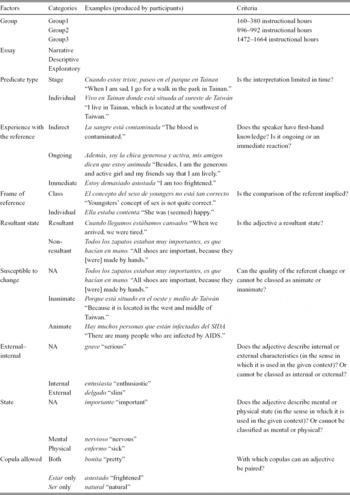
Summary of the coding scheme.

Not satisfied with the inconsistency of some contextual features (e.g. “animacy”, “dependence on experience”) in predicting usage of estar, Geeslin subsequently revised the coding scheme in papers based on theoretical arguments drawn from a range of linguistic research. In more recent studies (e.g. Geeslin, Reference Geeslin2002, Reference Geeslin2003; Geeslin and Guijarro-Fuentes Reference Geeslin and Guijarro-Fuentes2006), the classification of contextual features has been revised into the following variables: “predicate type” (stage vs. individual), “susceptible to change”, “frame of reference” (a comparison of the referent: implied or not implied), “experience with the referent”, “animacy” (though not in Geeslin, Reference Geeslin2003), “adjective class” (age, size, physical appearance, description/evaluation, description of personality, color, mental state, physical state, sensory characteristic, status), and “copulas allowed”.
Among various contextual features, Geeslin (Reference Geeslin, Leow and Sanz2000, Reference Geeslin2002) found that the feature “susceptible to change” was a good predictor of the use of estar at early stages of acquisition, whereas the feature “frame of reference” was a significant predictor for learners at beginner and intermediate levels. That is, L2 learners appeared to acquire the feature “susceptible to change” earlier, manifested by a tendency to select estar over ser more readily when the relationship between the referent (i.e. subject) and the attribute (e.g. adjective) was susceptible to change (e.g. Juan es inteligente “Juan is intelligent”, an inherent characteristic, not changing vs. Juan está alegre “Juan appears happy”, a transient state, changing) than when the construct had other contextual features. “Frame of reference” refers to a context in which a speaker implies comparison between a referent and its class or a referent and itself. For example, class frame of reference, María es bonita “Mary is pretty” expresses the idea that María is pretty in the sense that her beauty is greater than that of average girls. In contrast, estar is used to present the referent within an individual frame of reference; that is, the subject is compared with itself under different conditions. For example, the proposition María está bonita ahora “María is pretty now” asserts that María looks pretty in the sense that her appearance is prettier than it usually is. Findings in Geeslin's studies suggest that L2 learners at the intermediate level differed from those at the beginner level in this regard in selecting ser and estar. Comparing the subtle differences between advanced learners and native speakers in making copula choices, Geeslin (Reference Geeslin2003) found that pragmatic constraints on the copula contrast overruled lexical and semantic constraints when advanced learners determined copula choice, as evident in the variable “frame of reference”, whereas native speakers demonstrated an opposite preference.
In addition to linguistic features of the copula + adjective structure, other studies have also investigated the impacts of non-linguistic factors such as learner language background and study abroad context on learner copula choice. Geeslin and Guijarro-Fuentes (Reference Geeslin, Guijarro-Fuentes and Eddington2005) found that a learner L1 which does not possess copula contrast like Spanish (i.e. English, French, and German), does not influence learner copula choice and that knowledge of additional languages (Italian, Portuguese, French, German, and Turkish) other than English and Spanish also had no effect. In addition, the experience of study abroad and length of study made no difference in copula choice by adult learners beyond beginner and intermediate levels. In considering the universality of the SLA of Spanish copula choice, Geeslin and Guijarro-Fuentes (Reference Geeslin and Guijarro-Fuentes2006) found that Portuguese speakers, who are considered near-native speakers of Spanish, like the advanced English-speaking learners, were willing to override semantic constraints when encountering conflicting pragmatic constraints. Portuguese, like Spanish, possesses a copula contrast whereas English does not. However, these two groups of learners with different first languages share a preference in selecting Spanish copulas in pre-adjectival contexts. Their study demonstrates the universality of the Spanish copula choice acquisition process in the context of copulas with adjective.
4. Motivations of the current study
A limitation of studies on the acquisition of Spanish copula choice from the 1980s and the early 1990s is that they make a binary distinction to assess learner accuracy in making copula choice with adjectives. Geeslin (Reference Geeslin, Leow and Sanz2000) argues that assessing the appropriate use of copula + adjective in terms of absolute accuracy in its obligatory contexts is not practical. First, in a case like Spanish copula choice, in which several linguistic features such as aspect, semantics and pragmatics interact to determine learner production, judging the accuracy of copula choice is difficult. In determining if an estar token was used correctly in a composition, the writer's intention must be known. For instance, Juan es callado “Juan is shy” is correct if the writer intended to describe Juan's personality, but is incorrect if he or she intended to describe Juan's current condition (Juan is quiet) (See also Woolsey, this volume). Therefore, in some instances, the binary distinction is not clear-cut. Second, the correctness of Spanish copula choice is not clearly defined. Spanish estar uses are undergoing changes historically and socially (Gutiérrez, Reference Gutiérrez1992; Silva-Corvalán, Reference Silva-Corvalán1994) through which native-speaker variation has allowed either copula to be used with certain adjectives. For instance, es grande “is big” and está grande “is (becomes) big/tall” are increasingly interchangeable among native speakers. Therefore, the current study moves away from error analysis in obligatory contexts to an approach that does not require subjective evaluation of accuracy.
Several researchers have found that task type and elicitation tools and procedures (e.g. degree of planning) lead to variation in foreign language production (Tarone, Reference Tarone1988; Tarone and Parrish, Reference Tarone and Parrish1988; Skehan and Foster, Reference Skehan and Foster1997, Reference Skehan and Foster1999). In measuring the effects of task type on learner performance, Geeslin (Reference Geeslin, Klee and Face2006) found the frequency of the use of estar, and the predictors of that use varied between the picture-description task and the guided interview task. The results of the study show a significantly higher frequency of estar + adjective uses in the picture-description task than in the guided interview task. Because the picture-description task lasted for fifteen minutes and the guided interview task lasted for ten minutes it is not clear if, in addition to different elicitation tools, the length of utterances by each participant per task also contributed to the difference. Furthermore, Geeslin found that one variable, “susceptibility to change”, was not a significant predictor of estar usage in the picture-description task but was a significant predictor in the interview task, while three other contextual features were the same across tasks. She attributed the higher frequency of estar usage in one task to the prompt or the contextual cues that elicited learner data. She suggested that future studies take elicitation condition and task design into account in interpreting confounding results across tasks.
Except for one study by Ramírez-Gelpi (Reference Ramírez-Gelpi1995) in which students' in-class compositions were collected at the beginning and at the end of a semester, earlier studies on the developmental stages of copula choice examined the oral output of English-speaking learners. Recent studies by Geeslin (Reference Geeslin2001, Reference Geeslin2002, Reference Geeslin2003, Reference Geeslin2004), Geeslin and Guijarro-Fuentes (Reference Geeslin, Guijarro-Fuentes and Eddington2005, Reference Geeslin and Guijarro-Fuentes2006), and Guijarro-Fuentes and Geeslin (Reference Guijarro-Fuentes and Geeslin2003) used written preference tests to elicit learner knowledge of the target form. In order to understand the full extent of the changes in learner estar use across tasks, the current study examines the uses of estar in a free written production task in which learners have a longer time to search the vocabulary and grammatical rules stored in their existing knowledge of the target language, monitor their output, and plan their writing in the target language.
As mentioned earlier, VanPatten (Reference VanPatten, VanPatten, Dvorak and Lee1987) argued that first language transfer could influence the acquisition of ser and estar, particularly for novice learners. Learner knowledge of a language other than their L1 could also affect the acquisition process of a third language (Cenoz, Reference Cenoz, Cenoz and Jessner2000; Cenoz, Hufeisen and Jessner, Reference Cenoz, Hufeisen and Jessner2001). As discussed earlier, Geeslin and Guijarro-Fuentes (Reference Geeslin, Guijarro-Fuentes and Eddington2005) found that first language (English, French, and German) was not a significant factor in the acquisition of Spanish copulas for learners at the less advanced level. The majority of previous studies on the acquisition of Spanish copula choice since the 1980s have examined English-speaking learners, while a few have investigated Portuguese speakers (Guijarro-Fuentes and Geeslin, Reference Guijarro-Fuentes and Geeslin2003; Geeslin and Guijarro-Fuentes, Reference Geeslin and Guijarro-Fuentes2006). The question of the influences of non-western L1s on the acquisition of Spanish copulas remains open.
4.1 Research questions
Rather than using preference tests or elicitation tasks, this study focuses on learner production of the target form in a natural situation where learners are not obliged to make a copula contrast in a controlled task. The following research questions guide the current investigation:
1. What is the rate of production of Spanish estar relative to ser in a free writing task by Chinese-speaking learners at various developmental stages?
2. What linguistic features are associated with the rate of estar usage in a pre-adjective position in a free writing task by Chinese-speaking learners of Spanish?
The first question investigates the relative distribution of estar and ser uses in general in the pre-adjective position across three groups of learners at different levels of proficiency. Because earlier studies reported rates of use, this will allow us to connect our own findings to previous research. The second research question investigates the use of estar with adjectives in association with the contextual features of the Spanish copula in a non-controlled task. It examines the linguistic features associated with copula choice to identify linguistic features associated with higher usage rates of estar in the pre-adjective position. Hypothesizing expected results in either case is difficult because the current research is the first to examine the acquisition of Spanish copulas by learners whose first language is not a western language.
4.2 Data source and participants
The data for the current study were extracted from the Corpus de Aprendices Taiwaneses de Español (Corpus of Taiwanese Learners of Spanish – CATE) consisting (in the year 2005) of 460 compositions (98,014 words), written by 460 students at the college level and beyond at eleven universities in Taiwan. The data in the CATE include learners' written work at a wide range of proficiency levels ranging from beginners to heritage Chinese speakers raised in a Spanish-speaking country. Due to variation in program goals and curricula across universities, the level of proficiency in this corpus was defined as hours of classroom instruction, rather than years of study or other measures of Spanish proficiency. The data entered into analysis in the current study were a subset of the CATE. The researchers screened all 460 essays collected in 2005 and identified 248 texts to be included in the data pool based on participant profiles, which will be discussed in the next section. The essays were written outside of the classroom as a part of course assignments during the months of April and June in 2005. The essays, which were handwritten initially and then keyed into the CATE database, were submitted voluntarily by students with the collaboration of their instructors. The time in composing the written work was not controlled. Each participant wrote one essay included in the CATE.
The participants were divided into three groups based on their hours of classroom instruction in Spanish. Because learners had little direct contact with native speakers of Spanish, which is not a dominant foreign language in Taiwan, the hours of instruction in the corpus could be considered as contact hours with the target language overall. All participants in this study learned Mandarin Chinese as their L1 and studied English in a traditional approach, in which students learned grammatical rules and practiced mechanical drills and translation, as a required school subject in secondary school. The participants did not start to learn Spanish until college. All of the essays written by those who had lived in Spanish-speaking countries (including exchange students, study abroad students and heritage Chinese speakers from Spanish-speaking contexts) were excluded from this study. The first group consisted of 70 participants from one university with Spanish instructional hours ranging from 160 to 380. Subjects from this university were selected because they represented learners from a homogeneous background, having similar language proficiencies in Chinese and in English as measured by the National University Entrance Examinations and studying Spanish in the same curriculum. The second group included 91 students from two universities with 896–992 hours of classroom instruction in Spanish. The third group consisted of 87 students from two universities with 1472–1664 hours of instruction. While group 1 included students from various disciplines, the majority being English majors who took Spanish to fulfill a foreign language requirement for graduation, groups 2 and 3 entered their colleges as Spanish majors from their freshman year.
4.3 Data analysis and coding
Rather than using error analysis of the target forms in obligatory contexts, the present study examines the overall distribution of the use of estar in written work. As discussed earlier, because estar is an indicator of progress in Spanish copula acquisition, the contextual features that attend its emergence are of interest. To investigate these contextual features, each instance of copula + adjective that appeared in the essays was analyzed as an individual token and the association of its contextual features with estar production was characterized. The association of the linguistic features of the tokens with the rate of estar use in the essays in which the tokens appeared is determined through a Poisson regression. The results give an insight into, for example, which token contextual features emerge as noticeably related to high estar use rates. However, this research is not a controlled stimulus–response study, so a feature appearing associated with high estar use essays does not necessarily imply the same feature would induce an estar choice in a preference judgment test or an elicitation task. Furthermore, while some of the relationships analyzed could be considered causal, the relationship of the contextual features to the estar rate cannot.
We used WordSmith 4.0, a popular program used for lexical analysis in corpus-based research to extract the target structures from the corpus, and the R statistical language and environment for statistical analysis (R Development Core Team, 2008). In the concordance analysis, each form of ser and estar conjugated in all the tenses (present, preterit, imperfect, simple future, present perfective, past perfective, and future perfective) in indicative and subjunctive moods as well as in conditional with six subject persons, was entered to extract the target forms and their surrounding 40 words (20 words before and after). Because of technical problems in recognizing the diacritical marks used in Spanish, some items, such as seria (an adjective), or demonstrative adjectives (este and esta), selected by the program could be mistaken as copula verbs and had to be screened and deleted manually. To examine only the structure which is the subject of the present study, copulas in all constructs except copula + adjective were removed manually from the data extracted by WordSmith tools as well. Of these, the estar + adjective tokens were coded for contextual analysis.
In order to take into account all the variables in each context, a structure like Estoy animado y alegre “I am lively and glad” was considered as two different tokens in the coding of contextual features rather than as a single token. A construct which mistook the past participle for the present participle (e.g. Está hecho deportes instead of Está haciendo deportes “is doing sports” was not considered an estar + adjective token in coding.
The coding scheme was based on the model by Geeslin (Reference Geeslin, Leow and Sanz2000, Reference Geeslin2003), which drew on research in sociolinguistics, theoretical linguistics, and second language acquisition. The model included the contextual variables which described lexical, semantic, and pragmatic features of the discourse context, taking into account the relationship among referent, copula, and predicate adjectives. The initial coding of this study used the classification established by Silva-Corvalán (Reference Silva-Corvalán1986, Reference Silva-Corvalán1994) and Geeslin (Reference Geeslin2002, Reference Geeslin2003). In Geeslin's model, the contextual features that determined the selection of the Spanish copulas included “predicate type” (stage vs. individual), “susceptibility to change”, “animacy of the referent”, “frame of reference” (whether a referent is compared to itself at another point in time), speaker's direct experience with the referent (indirect, ongoing, or immediate), “copula allowed” (whether an adjective is permissible with both copulas or only one), and “adjective class” (age, size, physical appearance, description/evaluation, description of a personality, color, mental state, physical state, sensory characteristics, status).
The coding scheme is modified slightly for our study. In our statistical analysis, we treat the contextual features as categorical variables and are interested in the size of coefficient estimates. The statistical term for a categorical variable, or a variable that takes non-numeric values, is “factor” and the values the factor can take are “factor levels”. We thus use the statistical terms “factor” and “factor level” in discussing the modeling of these linguistic features. Each token has been coded according to the above contextual features, and then adjusted to a modified categorization scheme. We next present a description and tabulation of our categorization, followed by an explanation of the new categories that were formed.
In our coding, we found that some categories of token codings were mutually exclusive. That is, a token that belongs to one category cannot belong to its mutually exclusive counterpart. For example, a token coded as “external” cannot also be coded as “internal” (mutually exclusive) but a token coded “external” could also be coded “physical” (not mutually exclusive). In our coding, categories that appear to be mutually exclusive are coded as levels of a single factor encompassing those categories. This provides for a succinct expression of the model and logically excludes the possibility of meaningless statistics, such as interaction terms between variables that are known to be mutually exclusive. The tokens were coded prior to grouping into factors. Categories that appeared to be mutually exclusive were found in data processing and, after review, the final groupings were deemed reasonable. Other researchers may, however, reach different conclusions from their data sets for some of the less clear-cut categories.
Some categories that were grouped as levels of a single factor were mutually exclusive and exhaustive. That is, all tokens could be classed into one or another of the categories. For example, for the “essay type” factor, all tokens necessarily came from one of the three essay types. The first level in each factor, as listed in the tables below, was set as the baseline level. This is the level that does not appear in the regression results, and it is the point of comparison to which the regression coefficients refer. The choices of baseline are mathematically equivalent, but we tried to select baselines that produced coefficients whose interpretations were most direct.
Some categories were not exhaustive. That is, some tokens did not fit into one or the other of a set of mutually exclusive categories of a factor. In these cases, an “NA” (does not apply) level was added to the factor and that level was generally used as the baseline. The analysis conducted under these conditions was mathematically equivalent to doing a regression on 0–1 dummy variables coding the presence or absence of each linguistic feature.
A summary of the coding schedule for the factors in the statistical analysis is presented in Table 1.
Given the statistical constraints on our data, a number of categories were re-coded or merged into levels of new factors. All tokens coded as “animate referent” were also coded “susceptible to change”, so “animacy” and “susceptibility to change” were re-coded as levels of a single factor. The merged factors were re-coded with levels “animate”, “inanimate”, and “NA” of the “susceptible to change” factor. Since there were not enough “NA” cases for all the analyses in the “susceptible to change” factor, the “inanimate” level was used as the baseline. Three types of coding differentiated a writer's experience with a situation as “indirect”, “ongoing”, and “immediate”. These variables were grouped as a three-level factor in the regression analysis. Among categories describing adjective class, “sensory characteristic”, “descriptions of personality”, and “status” were recoded as “internal” in an “external–internal” factor. “Color” and “size” appeared only with “physical description”. These three were coded as the level “external” in the “external–internal” factor. An “NA” level of the “external–internal” factor was assigned to tokens that could not be classified into the other categories. “Mental state” and “physical state” were grouped as levels of the “state” factor. The “age” category was not considered in the multiple regressions because no token in this study could be coded under that variable.
In order to control for the length of essay in the free writing task, the number of words per essay was coded as a variable in the data analysis. We assumed topics and text types affect lexical choice in a free writing task and may lead to frequent uses of certain linguistic structures (e.g. the Spanish subjunctive and the conditionals would be used more frequently in hypothetical situations). Based on classroom teaching experience and observations of learner production, we assumed ser/estar + adjective were more likely to appear in texts that described feelings, physical objects, places, people or events. (Contexts that allow both ser and estar are considered here because learners might overextend the estar uses to contexts where ser should have been used.) Therefore, the essays in our database were also coded in terms of purpose of communication according to the classification of O'Hair, Friedrich, Wienmann and Wienmann (Reference O'Hair, Friedrich, Wienmann and Wienmann1995). They were categorized as: descriptive text, narrative, explanatory text, demonstration, and transformative text. The first three types are self-explanatory. The demonstration type is written to show understanding of how something works or to offer instructions on how to do something. The transformative is written to persuade someone to adopt a view or rethink an idea. However, the categorization of an essay written by lower proficiency learners could be questionable. Sometimes in this corpus an essay title and topic sentence indicated a transformative type but the essay later shifted to a demonstration or an explanatory type. Other times, an essay had a topic which implied a demonstration but it was written with information presented in explanatory style. Therefore, based on the content of the learner writings, demonstration, transformative, and explanatory texts were recoded as an exploratory type, also a common category in reading research.
5. Results and discussion
5.1 Frequency (the rate of production of Spanish estar relative to ser)
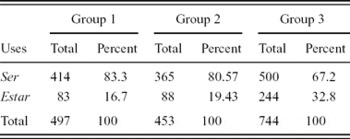
Among the 248 compositions (43,693 words), based on the frequency counts by WordSmith tools, a total of 1,694 copula tokens were collected, consisting of 1,279 ser tokens and 415 estar tokens. The overall distribution of the copulas for each of the three groups for all copula functions is presented in Table 2. The distribution described in Table 2 shows differences in the frequency of copula choice for the three groups of participants. The proportion of ser tokens in each group was higher than that of estar tokens.
Overall distribution of Spanish copulas uses.

The frequency with which estar appeared increased with the increase of instructional hours across groups. A Chi-squared test showed that the sample size was large enough to resolve the difference between group 1 and 3 and group 2 and 3 with precision corresponding to the customary 90 and 95 percent statistical significance levels. Given the increasing differences between the groups, the results seem to be in line with previous studies on the SLA of copula choice.
While we do not have a comparison with native speakers, the between group results suggest that the notably higher proportion of ser tokens in Table 2 was due to overgeneralization of ser in the contexts where estar should have been used.
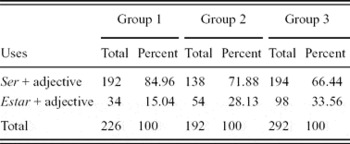
The data contained a total of 524 ser + adjective tokens and 168 estar + adjective tokens. Table 3 presents the distribution of the copula + adjective constructs across the three groups of learners. The percentage of ser + adjective tokens in each group was higher than that of estar + adjective tokens. The proportion of estar + adjective tokens increased gradually as the numbers of instructional hours increased across groups. The proportion of estar + adjective tokens of group 3 was about one fifth greater than that of group 2 and three times that of group 1. Here, despite the smaller sample size, the difference between the learners with the smallest number of hours and the others could be resolved by a Chi-squared test at the customary 95 percent statistical significance level.
Overall distribution of the copula + adjective construct.

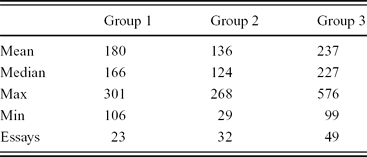
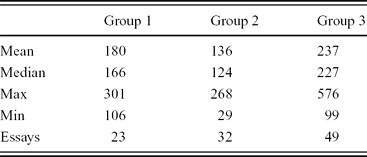
While, in addition to the shift in proportions, the quantity of estar and estar + adjective usage also increased over groups, the two sets of counts do not reflect the length of the essays. The length of essays containing estar + adjective tokens in group 1 ranged from 106 to 301 with an average of 180 words, and a median of 166 words per essay. The essay length in group 2 ranged from 29 to 286 words, with an average of 136 words, and a median of 124 words per essay. The essay length in group 3 ranged from 99 to 576 words, with an average of 237 words, and a median of 227 words per essay.
A summary report of the mean, median, range, and essay length across groups is presented in Table 4. The essay lengths varied to a certain extent within each group and across groups. Thus, to answer whether learners not only shifted their preference between ser and estar but also increased their preference to use estar in absolute terms, further analysis which controlled for the variation of essay length and other factors was merited and will be discussed later.
Mean, median and range of essay length across groups.
5.2 Features (linguistic features associated with the rate of estar usage in a pre-adjective position)
To address the second research question, this study examined the semantic, lexical, and pragmatic features of estar in pre-adjective position as well as factors such as essay length and types in learners' free written work. A total of 21 contextual features that may describe the copula contrast as studied in previous research were coded initially. Factors such as “predicate type”, “susceptible to change”, “animate referent”, “frame of reference”, and “resultant state” seemed to be associated with the production of estar + adjective most strongly, given the higher percentage of these variables. On the other hand, features such as “age”, “size”, “color”, “sensory characteristics”, “status”, and “ser only” appeared in few observations overall. These categories of the adjective class with few observations are semantic features, the appearances of which are associated with the content of each essay and the intended ideas of the writers. For example, if none of the themes in an essay are related to age, adjectives of that class would be unlikely to appear in the coding. While the age variable showed no observations, the color variable occurred within group 2 only and sensory characteristics appeared within group 3 only. It is plausible that uses of adjectives with attributes of age, color or sensory characteristics were affected by the topics or themes of the essays across groups.
We conducted a regression analysis to determine the relationships among the number of estar + adjective tokens in an essay within which an analyzed token appeared, the token's contextual traits, the length and type of the essay, and the proficiency level of the essay's author. We assumed the estar + adjective tokens were uncommon events generated with some probability as the learners performed a free writing task. Thus, the counts were modeled as a Poisson process. Categorical variables were coded as factors, and essay length was included as a numeric variable. The model was fitted as a generalized linear model by maximum likelihood in the R statistical language and environment.
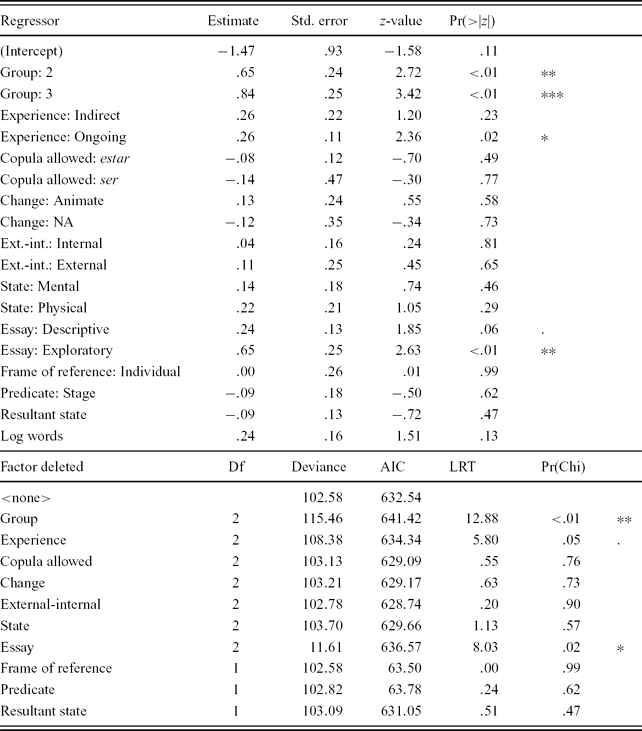
The regression of the rate of estar use against the other covariates was done with individual tokens as the units of analysis. The mathematical interpretation of the coefficient magnitudes is that for a factor level having that coefficient, if a token had that factor level rather than the baseline level, the number of estar instances in the essay it was drawn from would be expected to be e^(coefficient) times the value expected given the baseline level of that factor. To illustrate the relationship between the estar rate and a level of a factorial covariate, consider the case of a strong positive coefficient on a given factor level. The strong positive coefficient implies that when that level was present in fitting the data, excess estar rate existed that could not be accounted for by the increasing coefficients of levels of the other covariates without deteriorating the fit of the regression. This is likely to have meant that level was associated with higher estar rate essays. See McCullagh and Nelder (Reference McCullagh and Nelder1989) for a full discussion of generalized linear models. This approach allowed us to analyze which factors were associated with higher estar use. With all groups pooled, this analysis allowed us to control for factors in order to compare usage rates between groups.Footnote 1 Within groups, it suggested the developmental change in the pattern of contexts associated with estar use. The results of the regression analysis for all groups are summarized in Table 5. Included model diagnostics suggest the contribution of each factor to describing the data (see the documentation for the R commands glm in chapter 7.3 of Venables and Ripley (1999) and dropl in chapter 4 of Chambers (Reference Chambers, Chambers and Hastie1992) for details).
Results of multiple regression for all groups (the p-value (Pr(>|z|)) for estimates is based on standard error (Std. error) and the standard normal distribution (z-value)).
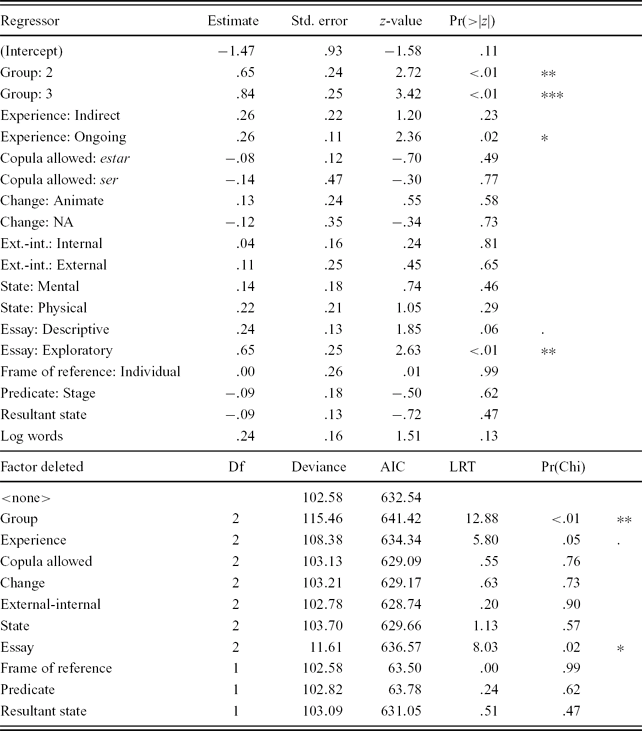
. = p < .1, * = p < .05, ** = p < .01, *** = p < .001
Note: Model diagnostics include degrees of freedom (Df); likelihood based measure of fit (Deviance); Akaike's information criterion for model selection (AIC); likelihood ratio test for factor excluded vs. full model (LRT); and p-value for LRT (Pr(Chi)).
Aggregate analysis
Controlling for other variables, the strongest coefficients were on the levels of the “group” factor. The levels above the baseline group 1, group 2 and group 3, had the two largest positive magnitudes and were most pronounced relative to other effects given their variability and the size of the sample, as measured by their p-values, p = .006 and p = .0006, respectively. The results revealed that increasing hours of instruction were most strongly associated with higher estar use. The results were consistent with previous SLA studies of copula choice. Findings in previous studies suggested that for English-speaking learners, estar was slower to emerge and the use of estar + adjective of condition appeared at the last stage of the developmental sequence (VanPatten, Reference VanPatten1985, Reference VanPatten, VanPatten, Dvorak and Lee1987; Finnemann, 1992). The results of the current study also suggested the estar + adjective construct was not fully incorporated into the interlanguage system of Chinese-speaking learners until very late.
Confirming what was suggested by the initial summary statistics, the regression analysis showed that essay type was important, appearing as the next strongest factor in frequency of estar use. Of special interest here is the size of the change in moving from the baseline narrative type essay to the relatively more demanding exploratory type. Writing an exploratory text may, for example, require learners to bring their knowledge of structure and subject matter to bear in persuading someone, to explain arguments, or to demonstrate some procedures. This could be more demanding than describing or narrating an event. The complexity of the task of producing descriptive, narrative, and exploratory texts varies the demands on cognitive processing and on the resources that learners bring to writing an essay. This is known to have implications for learner production, which could explain our finding (Robinson, Reference Robinson2001). The effect of essay type was comparable in size to the effect of an extra 500–600 hours of language experience, represented by the similar coefficient on the group 2 level. This suggests that essays that tend to be of a more demanding type evoked the more advanced usage. Conversely, this could suggest that more contact hours with the target language brought a level of facility to the baseline task that resulted in estar evocation equivalent to that which would otherwise have been produced with the effort of writing the more demanding essay style.
Though the estar + adjective token is often used to describe things, people and feelings, which are characteristic subjects of narrative essays, it is interesting that descriptive and exploratory essay types were associated with higher estar usage rates in this study. In a closer examination of essay topics and frequency of essay types across groups, we noticed that group 1 had the largest count of exploratory type essays. These mostly addressed issues related to AIDS (comprising 70% of the essays). Tokens such as está infectado “is infected” appeared in almost all of the essays regarding AIDS. On the other hand, group 3 had no exploratory essays, and group 2 had only two exploratory essays.
The treatment of the number of words in this regression departed from that in the other regressions. To model a rate as a Poisson process, the rate must be converted to a count, while taking account of the size of the denominator (in our case, the length of essay). This is normally done by adding the log of the denominator to the model as an offset, meaning the coefficient on that term is forced to one rather than being estimated. When this is done, the coefficients are conveniently interpretable as the above described multiplicative effects on the modeled rate. However, this entails an assumption that the rate is not affected by the offset term (length of essay in our case). The pooled regression was far from this assumption, so the coefficient of the log length of essay was estimated. In the group-by-group regressions, the violation was not as severe, so the more interpretable form of the model was fit.
The above variables all apply at the essay level. Thus, their interpretation is relatively direct: other things held constant, more language experience and demanding essay types elicit higher estar usage. The contextual features, in contrast, cannot be interpreted in an elicitation or cause-and-effect manner.
Among the contextual features attending Spanish copula choice, the experience factor stood out in the results. This pragmatic feature distinguishes contexts in which a writer has indirect experience with a referent from those in which a writer has first-hand experience. The variable further differentiates contexts between a writer's ongoing experience and a writer's immediate reaction to a situation. The results showed an estimate coefficient of 0.26 resolved at a p-value of p = .02 for the “ongoing” level. That is, token usage referring to ongoing experience had a strongly resolved positive association with higher estar usage per essay. The effect of indirect experiences was of similar magnitude, though its lower incidence in the sample made its p-value deteriorate. It seems that when learners wrote about their personal experience or observations to express their subjective feelings or reactions they tended to use more estar + adjective constructs.
Developmental analysis
In order to investigate participant performance within each group and participant progress developmentally, we conducted three separate regressions using the same model. The modeling task for such a data set posed a number of challenges. The Poisson regression implied more appropriate assumptions and consequently fit better than an ordinary least squares regression but, especially in the smallest data set, that of group 1, the modeling task remained problematic.
Group 1
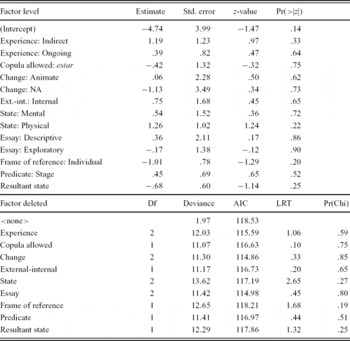
In group 1, the “physical” level of the “state” factor had the strongest positive coefficient (1.26), followed by the “indirect” level of the “experience” factor with a coefficient of 1.19, as shown in Table 6. The levels of these two factors had similar magnitudes and were resolved with similar precision. On closer examination of the contexts, these two factors may have stood out from the rest of the factors because a few adjectives paired with estar appeared repeatedly throughout the essays in group 1. For instance, estar with an adjective of “physical state” – infectado “infected” – appeared in almost every essay with a topic related to AIDS, which happened to be the dominant topic in this group of essays. Also, the adjective situado “located”, associated with the context of “indirect experience”, appeared repeatedly in essays describing the writer's hometown. The findings suggest that learners at the beginner level tend to use estar + adjective in formulaic phrases with which they are familiar. It is also plausible that the higher uses of certain adjectives with estar in particular essay topics are related to pedagogical effects within this group of classroom learners. Analysis with a larger group of participants or more varied topics is needed to provide more revealing outcomes.
Results of multiple regression for factors associated with estar usages per essay in Group 1 (the p-value (Pr(>|z|)) for estimates is based on standard error (Std. error) and the standard normal distribution (z-value)).

Note: Model diagnostics include degrees of freedom (Df); likelihood based measure of fit (Deviance); Akaike's information criterion for model selection (AIC); likelihood ratio test for factor excluded vs. full model (LRT); and p-value for LRT (Pr(Chi)).
Looking at the negative coefficients in the results of the multiple regression, individual “frame of reference” had a strong association, comparable to the positive factors in size. Given the instances of the “class” level of the “frame of reference” factor, the strong association suggests a few tokens with high discriminating power in contrast to the more widely used context which necessarily appears in both high and low estar essays, relatively diluting its power to discriminate. Examining the three tokens with the “class” level, one instance which appeared in a very high estar rate essay was an example of overcorrection, using estar in a context in which ser was required (ser is often associated with the “class” “frame of reference”). With such a small number of cases, this may well have driven much of the result. However, overcorrection would probably also be detectable in larger data sets, so this might be a real effect, suggesting that learners at the beginner level who display high estar usage rates might be displaying overcorrection in addition to, or instead of, greater facility with estar usage.
The “NA” level of the “susceptible to change” factor had a large coefficient (−1.13), but the very poor high p-value reflected the fact that this class contained only two tokens. Findings in Geeslin (Reference Geeslin, Leow and Sanz2000) showed “susceptibility to change” as a significant predictor of copula acquisition for low proficiency level learners (first year of enrollment). The fact that almost all estar tokens in this group were observed to be susceptible to change makes this relationship difficult to assess with our approach. The factor “resultant state” was associated with lower estar usage with a coefficient of −0.68, suggesting that this context was more typical of essays with low estar usage. This might suggest usage with a “resultant state” context was more characteristic of learners who had not acquired the estar form as strongly as their peers. An analysis of a larger group of participants is necessary to provide more informative results on learners at this level.
Group 2
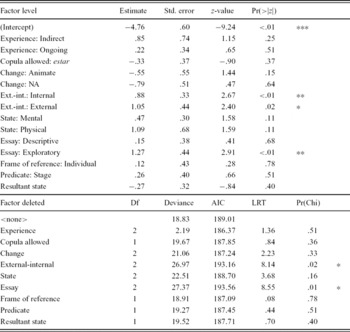
In group 2, the factors “essay type” and “external–internal” had the strongest coefficients and were most marked relative to other factors given the precision of the estimates as measured by their p-values. As shown in Table 7, the level above the baseline descriptive essay, the exploratory essay, had the largest positive magnitude with an estimated coefficient of 1.27 with a p value of .0036. This suggests exploratory essays evoked a higher estar usage rate. In an examination of the topics of the two exploratory essays, we found that one dealt with how to plan a trip abroad and the other with how to buy fashionable clothing.
Results of multiple regression for factors associated with estar usages per essay in Group 2 (the p-value (Pr(>|z|)) for estimates is based on standard error (Std. error) and the standard normal distribution (z-value)).

. = p < .1, * = p < .05, ** = p < .01, *** = p < .001
Note: Model diagnostics include degrees of freedom (Df); likelihood based measure of fit (Deviance); Akaike's information criterion for model selection (AIC); likelihood ratio test for factor excluded vs. full model (LRT); and p-value for LRT (Pr(Chi)).
Semantic constraints on adjectives such as internal and external characteristics of an adjective also showed a strong relationship with estar use in group 2. The results showed the levels “external” (physical appearance) and “internal” (sensory characteristic, description of personality, and status) had similar, highly resolved, positive coefficients. This implied that tokens making such distinctions were more strongly associated with essays with higher estar use than tokens not making such distinctions. Another semantic adjective feature, “physical state”, also showed a strong estimated coefficient of 1.09, whereas “mental state” showed an estimated coefficient of 0.47. Controlling for other factors, tokens with the “physical” level of the “state” factor (e.g. está cansado “is tired”) were likely to be associated with essays containing higher estar usage rates. Learner lexical choice of adjectives is largely dependant on vocabulary knowledge of the target language and the characteristics of people, things, or feelings described. These results suggest adjective classes with these semantic features seem to discriminate between higher estar and lower estar usage essays more strongly than other contextual features.
Group 3
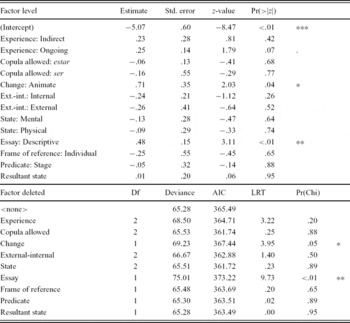
In group 3, levels of the factors “essay type”, “susceptibility to change”, and “experience” had the strongest coefficients. The results of the regression analysis for group 3 are presented in Table 8. The descriptive essay type had higher expected estar usage rates compared to the baseline narrative essay type with a coefficient of 0.4765, implying 1.6 times as many estar instances per essay. This suggests some feature of descriptive essays evoked a higher usage rate in the most experienced group. This is in notable contrast with the intermediate learners (group 2), in which essay type strongly evoked estar usage, but in which there was little difference between the association of descriptive and narrative essays.
Results of multiple regression for factors associated with estar usages per essay in Group 3 (the p-value (Pr(>|z|)) for estimates is based on standard error (Std. error) and the standard normal distribution (z-value)).

. = p < .1, * = p < .05, ** = p < .01, *** = p < .001
Note: Model diagnostics include degrees of freedom (Df); likelihood based measure of fit (Deviance); Akaike's information criterion for model selection (AIC); likelihood ratio test for factor excluded vs. full model (LRT); and p-value for LRT (Pr(Chi)).
With regard to “prior experience”, “indirect experience”, and “ongoing experience”, the levels above the baseline “immediate experience” had similar coefficients, with “ongoing experience” at 0.25, resolved by the sample size at a p-value of .07. That is, writing about such contexts was associated with essays with higher estar use than the baseline.
Like the “prior experience” factor, other pragmatic/semantic constraints – “animacy” and “susceptibility to change” – were associated with higher estar rate essays, with an estimated coefficient of 0.71.
Among the negative coefficients in the results of the multiple regression, the “individual” level of “frame of reference”, a pragmatic and semantic feature, was weakly associated with reduced estar usage with a coefficient value of –0.24 but with a p-value of .65. That is, in contexts in which a learner in group 3 compared a referent with itself or with an experience at a different point in time were associated with lower estar use essays. Although the frequency counts of this variable were quite high and “frame of reference” could be important in selecting estar, this multiple regression weighted features of the estar token according to their tendency to differentiate between usage rates. Given the nature of this analysis, this might suggest that learners who made estar uses in the baseline level of the “frame of reference” context “class” might have acquired the target form more strongly.
In short, the estar + adjective uses by learners in group 3 were more related to the pragmatic/semantic features of copula contrast. Among them, the “prior experience”, “animate-change”, and “frame of reference” factors were closely associated with the uses of estar in pre-adjectival position.
6. Conclusions and future studies
This study sought to investigate the rates of ser and estar production by Mandarin-Chinese-speaking learners acquiring the Spanish copula and to examine factors associated with estar + adjective production in a free writing task. As with previous research on English-speaking learners, this study suggests that Chinese-speaking learners of Spanish tend to use ser over estar at early stages and to increase their use of estar as their proficiency improves. The results support the strategy of simplification of ser over estar by learners of Spanish with backgrounds on the one hand and Mandarin-Chinese L1 on the other. It should be noted that the participants in this study learned Spanish as an L3, with the knowledge of English as an L2. While neither English nor Chinese have forms exactly matching the Spanish copulas, English is closer to Spanish than Chinese given its use of the copula be in the pre-adjectival position as opposed to the empty copula in Chinese. Hammarberg (Reference Hammarberg and Cenoz2001) argued that typological similarity should be taken into account regarding the influence of L1 and L2 on L3. The L2 has more influence than the L1 on the L3 if the L2 is closer typologically than the L1. Future studies should investigate copula omission in the production of Spanish copulas by comparing English-speaking and Chinese-speaking learners, particularly in the initial stage of the development of copula acquisition.
The second research question investigated the uses of estar with adjectives in association with the contextual features of the Spanish copula in a free writing task across three groups of learners. It examined the variables associated with copula choice to find factors associated with higher uses of estar in pre-adjectival position per essay word. The variables included semantic, pragmatic, and lexical features that may affect copula contrast as well as essay length and essay type. Considering the production of the whole group, essay type was a strong factor in association with estar token rate. The results suggest that a higher estar usage rate was likely in exploratory and descriptive type essays relative to a narrative essay baseline. An examination of the essay content suggests that the essay topics may have led to certain essay type and lexical choices that contributed to these associations in groups 1 and 2. Further studies should include larger corpora to include a greater variety of text types and essay topics so that such associations can be better differentiated statistically. With regard to contextual features that associate with higher estar usage rates in written texts, the experience factor was most pronounced when the three groups were considered as a whole. The experience factor was also associated with essays with high token rates in the group-by-group analysis, with advanced learners favoring higher estar usage rates when they had produced an ongoing experience token, and the others favoring higher estar usage rates when they had produced an indirect experience token. That is, a pragmatic feature such as dependence on experience is more likely to discriminate between high and low estar usage rates by Chinese-speaking learners in a planned production.
In contrast, prior experience with a referent was found not to be a good predictor of acquisition in Geeslin (Reference Geeslin, Leow and Sanz2000, Reference Geeslin2003). However, because the current research is a study of the salient features of free production rather than a study of the predictive factors of copula choice, we cannot draw direct comparisons with previous studies. The results suggest an important future study by examining the predictors of copula contrast in order to reach an understanding of copula acquisition to a full extent across learners from various language backgrounds.
In the within-group analysis, the results for group 1 were unclear and strongly driven by certain frequently used adjectives associated with the essay topic. The result for the “class” level of the “frame of reference” factor in group 1, apparently driven by overcorrection, highlights an important distinction between planned production and elicitation, demonstrating that a marker of high usage might not be one that theory would expect to yield high elicitation.
The results in group 2 showed that lexical contexts, “external” (physical appearance) and “internal” (sensory characteristic, description of personality, and status) were associated with higher estar + adjective use. Chinese-speaking learners of Spanish at the beginner and intermediate levels seemed to acquire copula choice from a lexical and semantic approach. As learner knowledge of vocabulary expanded, it was pragmatic and semantic features (“prior experience” and “animate-change”) of estar + adjective use that were associated with a higher estar usage rate in a free writing task.
The present study suggests new insights to be gleaned from the SLA process of Chinese-speaking learners. The results of the current research suggest that future investigation of forms whose meaning difference appears subtle to L2 learners based on free writing tasks will benefit from the use of similar multifactor analyses, based not only on linguistic variables, but also on text types and text length. Future research of this kind should also explore detailed categorization of features of Spanish copulas, particularly lexical classes of adjectives.
 ) [studies in Chinese syntax].