




No CrossRef data available.
Article contents
Predicting the development of infant emotionality from maternal characteristics
Published online by Cambridge University Press: 13 April 2004
Abstract
Few studies have examined the associations between environmental conditions and developing infant emotionality or the differential susceptibility to those conditions. The present longitudinal study aims to make a contribution to close that gap. We analyzed whether positive emotionality, negative emotionality/irritability, and withdrawal/fear at the end of the first year of life are predictable from preceding caregiver's depression/anxiety, social support, and sensitivity in the interaction with the infant while controlling for antecedent states of emotionality. Furthermore, the question of whether associations between maternal characteristics and subsequent fear are stronger in the subgroup of infants high in irritability as opposed to those who are low in irritability was investigated. Subjects were 101 healthy firstborn infants and their primary caregivers. Assessments were conducted at infant ages of 4, 8, and 12 months. Depression, anxiety, and the social support of the caregiver were assessed by questionnaire. Sensitivity in the caregiver–infant interaction was assessed by behavior observations within the scope of home visits. Temperament characteristics were observed in standardized laboratory episodes. Whereas negative emotionality and withdrawal/fear were significantly predictable from the maternal characteristics, no predictability could be shown for developing positive emotionality. There were indications of a stronger association between the maternal characteristics and developing withdrawal/fear in irritable infants.The research for this article was supported by a grant from the Deutsche Forschungsgemeinschaft (DFG) to U. Pauli–Pott and D. Beckmann (Grant PA 543/2-1, 2-2, 2-3). The sample was recruited from the maternity wards of two hospitals in Giessen. The authors thank PD Dr. C. Schubring, Head of the Department of Obstetrics and Gynecology at the Evangelical Hospital, and Dr. A. Esch, Dr. K. D. Fleck, and Dr. H. J. Meier of St. Josef's Hospital, as well as the neonatal nurses in both hospitals for the friendly cooperation with which they supported the present study. Finally, special thanks are given to the families who participated in the study.
Information
- Type
- Research Article
- Information
- Copyright
- © 2004 Cambridge University Press
In recent years there has been growing interest in research on discontinuities in early temperament development (Belsky, Fish, & Isabella, 1991; Emde & Spicer, 2000; Garcia–Coll, Halpern, Vohr, Seifer, & Oh, 1992; McCall, 1986; Rothbart, 1989, 1991; Rothbart & Posner, 1985; Rothbart, Derryberry, & Hershey, 2000; van den Boom & Hoeksma, 1994). However, there are few empirical studies on this topic. The present study aims to contribute to this field by increasing understanding of the conditions and correlates of change in infant temperament.
Difficult temperament, a pattern that, among other aspects, includes negative emotionality and difficulty in adapting to new situations, is considered a risk factor for child behavioral problems (Bates, 1980, 1989; Thomas & Chess, 1977). The New York Longitudinal Study, the pioneering study in temperament research conducted by Thomas and Chess (1977), revealed associations between the “difficult temperament” pattern and later behavior problems from the age of 2 years onward. However, temperament measures as well as the assessment of later behavior problems were taken from parent reports. Because parent reports are likely to be affected by perceptual bias on the part of the parent, the association obtained remained ambiguous (Crockenberg, 1986; Mebert, 1991).
More recent studies were able to overcome this confounding problem and demonstrated that negative emotionality/irritability and inhibition/fear are most probably involved in the development of internalizing and externalizing behavior disorders. Belsky, Hsieh, and Crnic (1998) showed that externalizing behavior problems at the age of 3 years were more likely to occur if the children had been high in negative emotionality at the age of 12 months and if parents' behavior had been less favorable. Biederman, Rosenbaum, Bolduc–Murphy, Faraone, Chaloff, Hirshfeld, and Kagan (1993) found that children previously classified as behaviorally inhibited were more likely to have anxiety disorders (see also Rosenbaum, Biederman, Bolduc–Murphy, Faraone, Chaloff, Hirsfeld, & Kagan, 1993; Zeanah, Boris, & Larrieu, 1997). Caspi, Henry, McGee, Moffitt, and Silva (1995) demonstrated that a temperament factor, “lack of control/irritability,” assessed at 3 years predicted internalizing and externalizing problems in late childhood and adolescence. These instructive studies assessed temperament characteristics relatively late, at a point at which rearing experience may already have exerted a major influence on the child's emotionality. The studies of Belsky et al. (1991) and Wolke, Rizzo, and Woods (2002) suggest that it might be precisely the course of the developing emotionality in infancy which is significant for the formation of behavior problems. Belsky et al. (1991) demonstrated that the developmental course of positive emotionality between 3 and 9 months is associated with the development of attachment security, which is considered to be a powerful protective factor. Most recently, Wolke et al. (2002) found that persistent infant crying (negative emotionality) up to the age of 6 months increases the probability of hyperactivity problems at the age of 8–10 years. However, it is still far from clear how exactly early emotionality development takes its particular course and what conditions and experiences are related to this developmental process.
There is ample evidence that normative stability of early emotionality ranges from low to moderately high when a laboratory assessment approach is used (Rothbart et al., 2000; Slabach, Morrow, & Wachs, 1991). These results probably cannot be attributed solely to measurement errors (Belsky et al., 1991). As proposed by Rothbart (1989, 1991), discontinuity in early infancy may be influenced by experience and differences in the speed of maturation. As regards the potential influences of experience, according to Belsky et al. (1991) proximal and distal conditions can be differentiated. Proximal conditions of continuity and discontinuity pertain to actual experiences infants had with their parents, whereas distal conditions refer to the general family conditions and the personality of the caregiver. In the following, current conceptions of the postulated processes as well as empirical studies are reviewed for proximal and distal conditions.
Proximal Conditions
Contemporary perspectives on emotion regulation suggest that the caregiver's role in modulating levels of arousal is especially important for the development of negative emotionality and fear. Sroufe (1995), for instance, conceived the development of affect regulation and affect tolerance as depending on parental interaction behavior and assumed that maternal sensitivity influences the development of infant emotionality. Tronick (1989) pointed out that a lack of maternal sensitivity in interaction with the infant associated with less affective sharing and difficulties in repairing interactive errors can lead the child to feel insecure about his or her capability of influencing the environment. This child is likely to develop high anxiety (see also Tronick, 1982; Tronick, Ricks, & Cohn, 1982). Similarly, in Chorpita and Barlow's (1998) conception, the early experience of low control, as conveyed through unresponsive parental behavior, leads the individual to develop an external locus of control and predisposes him or her to anxiety. These concepts indicate that a lack of consistent and contingent responsivity in parental behavior may attenuate developing self-regulation capacities and affect tolerance. Increased negative emotionality and anxiety are seen as consequences.
In their studies, Fish, Stifter, and Belsky (1991) and Belsky et al. (1991) showed an association between parental behavior and developing infant emotionality. Fish et al. (1991) found that mothers whose infants showed low negative emotionality both in the neonatal period and at the age of 5 months (assessed in standardized laboratory routines) were more sensitive and responsive in an interaction episode at 5 months than mothers of infants with an increase in negative emotionality. Belsky et al. (1991) investigated 148 firstborn infants. Negative emotionality was assessed at the ages of 3 and 9 months (composite of behavioral observations and parent report). Parent–infant interaction was assessed at the infants' age of 3 months in two home observations. The study revealed that mothers of infants who changed their relative position in the sample from high to low negative emotionality compared with those who remained highly negative showed more harmonious, responsive, and complementary interactions with their infants.
Distal Conditions
Maternal depression, lack of social support, and marital problems may cause stress within the family and thus poor quality of maternal care (Belsky, 1984; Crockenberg, 1986; Rutter, 1990, 1997). From the work of Tronick and colleagues (Gianino & Tronick, 1988; Tronick & Weinberg, 1997), as well as Field and colleagues (Field, 1994; Field, Sandberg, Garcia, Vega–Lahr, Goldstein, & Guy, 1985), it is known that depressed mothers show less interactional competence, that is, less sensitivity and shared attention with their babies and more intrusiveness and negative affective expressions (see also Lovejoy, Graczyk, O'Hare, & Neuman, 2000, for a review). Researchers have seen limitations in acquiring effective strategies for emotional regulation, with high negative emotionality the consequence for infant development (Fogel, 1982; Field, 1994; Tronick et al., 1982). Further studies revealed that maternal depression, especially when accompanied by additional unfavorable conditions such as low levels of social and emotional support, particularly in the partnership, are associated with poorer interactional competence in the mother (Lovejoy et al., 2000; Rutter & Quinton, 1984; Teti & Gelfand, 1991; Zeanah et al., 1997).
Taken together, it can be assumed that these distal characteristics, especially if there is an accumulation of strains, predict the development of infant emotionality. Although empirical studies on the subject are rare, there are some interesting results. Belsky et al. (1991) investigated changes in infant positive and negative emotionality between 3 and 9 months. Mothers whose infants showed a decrease in negative emotionality (switching from the upper to the lower part of the negative emotionality distribution) reported higher self-esteem and higher marital satisfaction (assessed during pregnancy). Moreover, in a socioeconomically disadvantaged sample, Fish (1998) showed an association between a decrease in negative emotionality between 2 weeks and 4 months and a higher level of social support of the mother. A further decrease in negative emotionality between 4 and 9 months was associated with financial support to the families from public funds, and an increase in positive emotionality with a higher degree of social support to the caregiver. However, there are also inconsistencies in the empirical results. In a study by Fish et al. (1991), a decrease in negative emotionality between the neonatal period and age 5 months was associated with poorer marital satisfaction. These inconsistencies may be due to underlying interaction effects. The National Institute of Child Health and Human Development Study (NICHD, 1999) showed interaction effects between depression and additional adverse conditions. This study examined associations between infant positive and negative affect in the interaction with the mother and maternal depression symptoms. There was no main effect attributable to maternal depression on either positive or negative affect, but an interaction with the economic situation of the family was significant. If the mothers were chronically depressed and the family income was low, the infant was likely to show less positive affect. Infants of chronically depressed mothers whose economic situation was good did not differ from children of sometimes or never depressed mothers.
Overall, the results reviewed often showed that proximal as well as distal characteristics precede changing infant emotionality. Nevertheless, these studies are few and further research is needed to confirm the findings. The present study is aimed in that direction, expanding previous study designs in two ways. First, the reviewed studies usually considered two points in time whereas the present study examines three measurement points in the first year of life. Second, we examined three dimensions of infant emotionality, namely, positive emotionality, negative emotionality, and fear of the unfamiliar. Regarding the differentiation between positive and negative emotionality, Belsky et al. (1996) showed that negative and positive emotionality are two different, though linked, dimensions of emotionality in infancy. In addition, in the second half of the first year negative emotionality/frustration and fear can be differentiated, and negative emotionality in the first half of the first year may be a precursor of subsequent fear as well as negative emotionality/frustration (Rothbart & Mauro, 1990; Rothbart & Posner, 1985; Rothbart et al., 2000; Sroufe, 1979, 1995). Examining the three dimensions, we relied on Rothbart's (1981) operational definitions: “negative emotionality/irritability” refers to the negative emotional expressions (facial expression and vocalization) of the infant in frustrating situations; “withdrawal/fear” is characterized by negative emotional expressions (facial expression and vocalization), withdrawal, and inhibited approach when confronted with sudden and novel stimuli; and “positive emotionality” refers to the extent of positive emotional expressions (facial expression and vocalization).
The primary goal of this study was to forecast the development of emotionality from the proximal and distal characteristics outlined above. However, Belsky (1997) and others underscored the role of early negative emotionality in moderating the effect of rearing. Particularly with regard to the development of inhibition/fear there is evidence that highly negative children are more susceptible to rearing conditions (Belsky et al., 1998; Mills & Rubin, 1993; Park, Belsky, Putnam, & Crnic, 1997). Considering these suggestions, we intended to explore whether the associations between characteristics of the mother and the development of fear is stronger for highly negative infants; that is, whether the prediction is more successful in these cases. We addressed the following questions: are depression and lack of social support in the caregiver predictive of developing positive emotionality, negative emotionality, and withdrawal/fear? Is maternal reactivity/sensitivity predictive of those changes? Are the relations between these characteristics and fear more pronounced in infants high in negative emotionality in the first months?
As a final issue, the measurement approach of early emotionality is considered. To avoid confounding problems (owing to perceptional bias in parent reports and to influences of concurrent parental behavior in observations in caregiver–infant interaction), we measured infant emotionality adopting a laboratory approach. Different laboratory routines exist in temperament research, and according to Rothbart and Bates (1998), there is no “gold standard.” Creating the assessment procedure for the purposes of the present study, we relied on a combination of different approaches used by other researchers (see below). This means that the particular procedure used here has not yet been validated. An additional goal of the study was thus to examine the convergent validity of those emotionality measures by comparing them with well-established parent report measures, and home as well as laboratory observations in the caregiver–infant interaction.
Method
Subjects
The subjects of the study were 101 healthy firstborn infants (43 girls, 58 boys) and their primary caregivers. Exclusion criteria were single parent status, lack of familiarity with the German language, major birth complications, a birth weight of <2500 g, and twin births. The sample was recruited from the maternity wards of two public hospitals in Giessen, a city in central west Germany. After delivery, all eligible mothers were visited by staff members and invited to participate in the study. Mothers' and fathers' average ages were 28.8 (SD = 3.7) and 31.6 (SD = 4.8) years, respectively. The parents showed a broad spectrum of educational and vocational qualification (see Table 1 for distributions of parental education, vocational qualification, and current employment). Of the 101 mother–infant dyads, 95 took part until the infants reached the age of 12 months.
Description of the sample

Procedure
Assessments were conducted at the infants' ages of 4, 8, and 12 months. At each age, three assessment sessions were conducted within 1 week in the interval 7 days before and after the day the baby was 4, 8, or 12 months old. A first session was scheduled for the morning and took place in the laboratory of our institute. One home visit was conducted between 11:30 a.m. and 2:30 p.m., and a second home visit was in the early evening between 4:30 p.m. and 8 p.m. All visits were arranged for times when, according to the mothers, the babies were most likely to be replete and not tired. The laboratory visit was always the first meeting, whereas there was no fixed order for the two home visits. Owing to limited personnel resources, the midday home visit could not be conducted for the first 37 families. The questionnaires were handed out to the mothers at the end of their first visit and they were asked to complete them by one of the home visits.
Morning laboratory visit
After a short interview on the baby's health conducted with the mother at the beginning of the session, the assessments of infant emotionality took place. Thereafter, we conducted a 10-min mother–infant interaction episode in accordance to the procedure proposed by Esser, Dinter, Jörg, Rose, Villalba, Laucht, and Schmidt (1993). At all ages, the mothers were instructed to change the baby's diaper first and then play with him or her. At 4 months, the entire caregiver–infant interaction took place at the changing table, whereas at the infants' ages of 8 and 12 months, after the mother dressed their infant, she and the infant were seated at a table, handed an age-appropriate toy (board with various buttons, knobs, and wheels) and asked to play. The whole laboratory session was videotaped.
Midday home visit
During the 20-min observation period, the mothers were instructed to avert their attention from the baby and focus on an occupation in the house. Negative and positive emotionality of the infant and his or her motor activity (data not shown) was rated alternately using a 1-min time-sampling technique.
Evening home visit
During the 30-min observation period, the caregiver was instructed to bath the baby first, then play with him or her and proceed as usual. Again, a 1-min time-sampling procedure was used for the observation. The negative and positive emotionality of the infant, maternal sensitivity, and infant reactivity toward the mother (data not considered in the present report) were rated alternately. Subsequently, a highly structured interview was conducted with both parents to assess sociodemographic variables.
Variables
Laboratory assessments
To assess positive and negative emotionality in infancy, Snidman, Kagan, Riordan, and Shannon (1995) as well as Calkins, Fox, and Marshall (1996) used a series of presentations consisting of interesting visual and auditory stimuli of increasing complexity and scored the frequency of negative as well as positive affect during the procedure. Other researchers used the Infant Behavior Record of the Bayley Scales (Bayley, 1969, 1993), which includes global ratings of infant behavior during the test (Braungart, Plomin, DeFries, & Fulker, 1992; Carranza Carnicero, Perez–Lopez, Del Carmen Gonzales Salinas, & Martinez–Fuentes, 2000; Emde, Plomin, Robinson, Corley, DeFries, Fulker, Reznick, Campos, Kagan, & Zahn–Waxler, 1992; Matheny, 1989; Roth, Eisenberg, & Sell, 1984). Our procedure relies on both approaches. At each age, a series of item sets taken from the Bayley Mental Scale (see below) was chosen and presented in a fixed order and controlled manner. At 4 months, the following item sets were used: (a) red ring dangling (Items 37, 46, 33, and 44); (b) sound of bell and rattle, subsequently (Item 28); (c) bell and rattle, alternately (Item 34); (d) play with rattle/take rattle away (Item 36); (e) sound of bell, out of child's range of vision (Item 47); (f) sound of rattle, out of child's range of vision (Item 48); (g) red ball rolling across table (Item 38); (h) red ring dangling (Item 40); (i) move spoon across child's field of vision (Item 41); and (j) red cubes hard to reach and grab (Items 32, 49, 51, 54, 56, 60, 64, 70, and 77). This series is composed of visual stimuli of increasing complexity, auditory stimuli, and instances of limitation or restriction achieved by the removal of toys or making toys difficult to reach. During the first part of the procedure, the infant lies on the changing table (Item sets a–e). The mother stands in front of the changing table at a 1-m distance; the examiner is positioned at the head end to present the stimuli. The examination is continued at a table with the infant sitting on the mother's lap. The procedure was limited to 10 min to avoid the influence of fatigue. Nevertheless, at 4 months the test had to be stopped in 10 cases because the infants were crying inconsolably.
At 8 months, the following item sets were presented: (a) red cubes (Items 60, 64, 70, 77, and 82), (b) cup and cube (Items 90 and 100), (c) doll and cup (Items 63, 73, and 88), (d) spoon and cup (Item 92), (e) box (Items 62 and 75), (f) mirror (Items 65 and 76), (g) peek-a-boo game (Item 81), (h) red ring (Items 67, 71, 80, and 105), (i) paper and crayon (Items 74, 95, and 98), (j) bell (Items 78 and 83), (k) red car and tissue (Items 86 and 99), (l) yellow pegboard (Item 87), (m) picture book (Item 93), (n) blue box (Item 91), and (o) squeaky doll (Item 104).
At 12 months, the following sets were used: (a) mirror (Item 76), (b) rag doll and tissue (Item 86), (c) red cubes (Items 82 and 111), (d) cup and cube (Items 88, 90, 100, and 114), (e) spoon and cup (Item 92), (f) bell (Item 83), (g) blue box (Items 91 and 107), (h) blue box and little monkey (Item 102), (i) red box (Item 115), (j) red car (Item 99), (k) pegboard with yellow pegs (Items 87 and 108), (l) picture book (Items 93 and 103), (m) paper and crayon (Items 95, 98, and 112), (n) squeaky doll (Item 104), (o) red ring (Item 105), (p) small pellet and box (Item 109), (q) blue board with different shaped pieces (Items 110 and 121), and (r) little rabbit and rod (Item 122). These items comprise the confrontation with attractive objects and their removal by the examiner, manipulation tasks that are difficult to solve and therefore contain frustrating elements, and play interactions with the examiner. At 8 and 12 months, the infant sits in a highchair throughout the whole procedure and the mother sits beside the child at a 90° angle. The duration of the 8-month examination was 15 min, and at 12 months 20 min. None of the examinations had to be broken off. At all infant ages, the mothers are instructed to behave in a noncommittal way and react to their child only briefly if he or she directly addresses the mother.
Coding procedures were adapted from those used by Snidman et al. (1995) and Rothbart et al. (2000). Presence versus absence of positive and negative affect is coded for each episode. Ratings of negative and positive expression (facial expression and vocalizations) were carried out according to the Infant Emotion scale of the Mannheim Assessment Battery of Mother–Infant Interaction (Mannheimer Beurteilungsskalen zur Erfassung der Mutter–Kind-Interaktion im Säuglingsalter; MBS-MKI-S) by Esser, Scheven, Petrova, Laucht, and Schmidt (1989) after intensive training at the Mannheim Central Institute of Mental Health (Zentralinstitut für Seelische Gesundheit). Ratings were derived from the videotapes by a single rater (first author). Interrater reliability was checked on the basis of independent ratings of 10 cases by a second rater. Kappa coefficients for negative emotionality were 1.00 (4 months), .94 (8 months), and .79 (12 months), and for positive emotionality 1.00, .91, and .83, respectively. For the positive emotionality score at each age the proportion of episodes (item sets) to which the child showed a positive reaction (smiling, laughter, and positive vocalization) was calculated and for negative emotionality the proportion of episodes to which the child showed a negative reaction was used.
For the assessment of fear at 8 and 12 months, infants were confronted with the increasingly intensive approach of a strange person in a strange setting. Three episodes were arranged. In Episode 1, the female examiner approaches the child up to a distance of 30 cm (approximately 1 ft), kneels down to facilitate face-to-face contact, and talks and smiles at him or her without bodily contact for 30 s. In Episode 2, the examiner takes a small rag doll rattle and moves it in front of the child and within his or her reach. She smiles and continues to talk to the child (60 s). In Episode 3, the examiner removes the doll. She takes the baby into her arms, holds him or her up with outstretched arms (plays at flying), and then holds him or her to her shoulder. The examiner then moves farther away from the mother until she reaches the opposite wall, stays there for a short while, and comes back (60 s). The episodes were videotaped and the coding was made from the tapes. Fear was scored using the rating scales of the fear episode Stranger Approach of the Laboratory Temperament Assessment Battery by Goldsmith and Rothbart (1994). The intensity of the fear expression (facial expression, vocalization, freezing, and escape behavior) and the manner of the escape behavior (turning or twisting away, leaning away, and sinking into the chair) were coded. Furthermore, the latency between presentation and the baby reaching for the rag doll was measured. Interrater reliability (checked on the basis of independent ratings in 10% of the cases) for the ratings was κ = .89; Spearman rank correlation for the latency measure was r = 1.00.
At both ages, we conducted a reliability analysis to generate a homogeneous and internally consistent summary score. The seven rating variables for each Episode 1 and 2, the rating of negative vocalization for Episode 3, and the latency between presenting and reaching for the rag doll were included. Variables with extremely low or no variance (the behavior in question did not occur) and/or very low item–scale correlations (part–whole–corrected) were excluded. At 8 months, the internal consistency of the remaining nine variables was .73 (Cronbach's alpha): facial expression of fear (2 variables), distress vocalization (1 variable), escape behaviors (5 variables), and latency in approaching the rag doll (1 variable). We created a summary score for these variables. At 12 months, the internal consistency of the remaining 12 variables was .76 (Cronbach's alpha): facial expression of fear (2 variables), distress vocalization (1 variable), bodily fear expression (2 variables), escape behaviors (6 variables), and latency in approaching the doll (1 variable).
Parent reports
As pointed out above, for the purpose of validating the laboratory emotionality measures, we conducted comparisons with parent report measures. At each age, the primary caregivers filled out a German adaptation of the Infant Behavior Questionnaire (Rothbart, 1981, 1986). The scales smiling/laughter, distress to limits (negative emotionality/frustration), and distress and latency to approach sudden and novel stimuli (fear) were used for comparison. Levels of internal consistency of these scales were calculated in independent samples for age groups 3–4 months (n = 242), 6–8 months (n = 149), and 10–12 months (n = 109). Cronbach's alpha coefficients were .79, .80, and .77 for the scale smiling/laughter; .79, .82, and .81 for the scale distress to limits; and .72, .69, and .79 for the scale distress and latency to approach sudden and novel stimuli (Pauli–Pott, 2001; Pauli–Pott, Mertesacker, Bade, Bauer, & Beckmann, 2000; Pauli–Pott, Mertesacker, & Beckmann, 2003).
Observations in the caregiver–infant interaction
For the purpose of validating laboratory measures, positive and negative emotionality were also observed in the caregiver–infant interaction on three occasions: the videotaped laboratory interaction and the two home visits. In any of the situations, 1-min intervals were rated using the Infant Emotion scale of the Mannheim Assessment Battery of Mother–Infant Interaction by Esser et al. (1989). This procedure is based on the works of Keller, Gauda, and Miranda (1980), Field (1980), and Clark and Seifer (1983) (cited in Esser et al., 1989). Various studies with large samples verified the objectivity (outstandingly high interrater reliability), reliability, and validity of the procedure (Esser et al., 1989, 1993). The Infant Emotion Scale is a 5-point rating scale that assesses infant negative to positive affective expression (ranging from clear fussing and crying to predominantly smiling and laughter). Scale Points 1 and 2 refer to negative affect of high (1) or low (2) intensity and duration, Scale Point 3 refers to neutral affect, and Scale Points 4 and 5 indicate the display of positive affect of low (4) or high (5) intensity and duration. Interrater reliability was checked regularly and thoroughly. For this purpose, in 20 cases per age group (10 at the beginning and 10 at the end of each wave) two observers carried out home visits (both connected to the same tape for time signaling using earphones). Kappa coefficients for the 4-month assessment were: .90 (midday home visit), .86 (evening home visit), and .85 (assessment of the laboratory videotapes); at 8 months: .93, .88, and .87; and at 12 months: .93, .94, and .90. Negative emotionality/irritability was scored using the number of 1-min intervals in which the infant displayed negative affect (Scale Points 1 and 2 of the MBS-MKI-S Infant Emotion Scale) divided by the number of all available intervals (i.e., the proportion of intervals with negative affect expression). The index score for the infant positive emotionality was calculated analogously using the relative number of 1-min intervals in which the infant displayed positive affect (Scale Points 4 and 5 of the MBS-MKI-S Infant Emotion Scale), that is, the proportion of intervals with positive affect expression.
Maternal reactivity/sensitivity
At each age we assessed maternal reactivity/sensitivity within the scope of the evening home visits. As mentioned above, a 1-min time-sampling procedure was employed. Maternal reactivity/sensitivity was rated using the Reactivity/Sensitivity Scale of the MBS-MKI-S by Esser et al. (1989). Reactivity/sensitivity is defined as the caregiver's ability to perceive infant signals accurately and vary his or her behavior appropriately (e.g., contingent responding, appropriate responding). The 5-point scale ranges from (almost) no contingent and no appropriate responses to infant cues (1) to (almost) always contingent and appropriate responsiveness while interacting with the infant (5). As mentioned above, interrater reliability was checked during 20 home visits with two observers. The kappa values were .85 at 4 months, .66 at 8 months, and .67 at 12 months. At each age, ratings per sampling interval were summed and divided by the total number of available intervals to create total reactivity/sensitivity scores.
Maternal depression/anxiety
At 4, 8, and 12 months, the Depression Scale of the Questionnaire for Assessing Rearing Attitudes of Mothers of Infants and Toddlers (Fragebogen zur Erfassung der Erziehungseinstellungen von Müttern mit Kindern im Kleinstkindalter; EMKK) by Engfer (1984) as well as the Hopelessness Scale by Beck (German adaptation by Krampen, 1994) were applied. Maternal anxiety was assessed using the Trait Anxiety scale of the State-Trait Anxiety Inventory (STAI) by Laux, Glanzmann, Schaffer, and Spielberger (1981).
The EMKK Depression scale (Engfer, 1984) was devised to assess feelings of fatigue, exhaustion, and depression experienced in relation to the child as well as self-doubts concerning motherhood. The internal consistency of the scale is a Cronbach's alpha of .83 (Engfer, 1984).
Hopelessness is defined as a cognitive system of negative expectations concerning the self, the social environment, and future life. The scale is especially suitable in the context of recent childbirth and infant care because, in contrast to symptom checklists, the scale does not include items asking about overall exhaustion or sleeping problems. In the context of infant care, the cause of such complaints is more likely to be the sleeping behavior of the infant than the depression of the caregiver. The split-half reliability is .87 (Spearman–Brown).
The Trait Anxiety Scale provides a measure of anxiety in the sense of a stable tendency to evaluate situations as threatening. The scale is highly correlated with neuroticism and depression scores. The retest reliability is .81 after 3 months and .68 after 6 months (Laux et al., 1981).
We presumed that the depression and anxiety scales were intercorrelated. To reduce the number of variables and avoid redundancies, principal component analyses were computed at each age. There were clear indications of one component solutions (eigenvalue criterion) at 4, 8, and 12 months. The first component explained 65, 70, and 61% of the variance in the three scales at 4, 8, and 12 months, respectively. At each age all loadings of the variables on the first unrotated component were ≥0.50 and at each age the three scales were therefore summed after z transformation. In the following, these summary scores are referred to as depression/anxiety.
Social and marital support
To assess the social support of the caregiver, we applied the Questionnaire of Social Support (Fragebogen zur sozialen Unterstützung; SOZU-K-22) by Fydrich, Sommer, Menzel, and Höll (1987). The SOZU-K-22 assesses emotional support, practical support, and social integration. The internal consistency ranges between .79 and .92, and the retest reliability after 2 and 7 months is .65 and .52, respectively.
Marital support was assessed using the Mutuality Scale (Gemeinsamkeiten) of the Marital Relation Questionnaire (Partnerschaftsfragebogen; PFB) by Hahlweg (1996). The Mutuality Scale assesses feelings of attachment to the partner, joint activities, and communication. The internal consistency of the scale is .88; retest reliability after a 6-month interval is .83. The PFB is intended to measure mutual judgments of partners. Because the present study is mainly interested in the perspective of the primary caregiver, only her or his judgments were included in further analyses.
Correlations of the mutuality and social support scales were r = .43, p < .001 at 4 months, r = .32, p < .005 at 8 months, and r = .32, p < .005 at 12 months. Therefore, at each age summary scores were created after z transformation to reduce the number of variables. The summary scores are referred to as social and emotional support.
Statistical analysis
We calculated parametric and nonparametric correlations as well as hierarchical multiple regression analyses. The procedure in detail is as follows: After a preliminary analysis to examine the convergent validity of the laboratory emotionality measures, the concurrent relations with parent reports and observations in the caregiver–infant interaction were calculated. Interrelations of the emotionality dimensions and their stability were then analyzed. Thereafter, we addressed the first research question regarding the forecast of developing emotionality by distal variables, followed by the second research question, or the forecast of developing emotionality by maternal reactivity/sensitivity. Finally, we differentiated two subgroups (infants high and low in negative emotionality/irritability at 4 months) and examined whether the prediction is more successful for the subgroup of highly negative infants—that is, the question of whether there is a closer relation between characteristics of the caregiver and infant fear development for this subgroup.
The distributions of the laboratory scores negative emotionality/irritability and withdrawal/fear were skewed to the left (showed skewness values above 1.00). For these variables, nonparametric correlation coefficients were used. For multiple regressions skewed predictor variables (i.e., 4-month positive and negative emotionality scores and 8-month negative emotionality and fear scores) were log transformed and criterion variables (i.e., 12-month negative emotionality and withdrawal/fear) were dichotomized by median split. All calculations were carried out using SPSS 9.0 (SPSS Inc., Chicago).
Results
Preliminary analysis
We examined possible associations of infant positive and negative emotionality as well as withdrawal/fear with infant gender and maternal educational level (representing the social status of the family). After transformation of the emotionality variables and maternal education to dichotomous variables (median split), chi-square tests were conducted. There were no gender differences, χ2, df = 1; positive emotionality at 4, 8, and 12 months: 3.71, 3.20, 0.15; negative emotionality at 4, 8, and 12 months: 0.10, 0.24, 0.38; withdrawal/fear at 8 and 12 months: 0.30, 0.09; nor were there statistically significant associations between the temperament variables and maternal education, χ2, df = 1; positive emotionality at 4, 8, and 12 months: 0.67, 0.52, 0.23; negative emotionality at 4, 8, and 12 months: 0.31, 0.11, 2.30; withdrawal/fear at 8 and 12 months: 2.10, 2.36. We therefore dispensed with controlling these variables. Table 2 contains descriptive statistics of all variables referred to subsequently.
Descriptive statistics

Concurrent relations among infant measures
To evaluate the convergent validity of the laboratory emotionality measures, we calculated correlations of these measures with concurrently assessed questionnaire scores and observed infant affective behavior in the interaction with the caregiver. In the case of skewed distributions, we used Spearman rank correlations. Of the 15 correlation coefficients between laboratory scores and criterion variables, 14 proved significant or highly significant (Table 3, bold coefficients). The one exception was the correlation between negative emotionality/irritability and the questionnaire scale distress to limits at 8 months, which approached statistical significance. Furthermore, Table 3 shows that except for the negative correlations of laboratory negative emotionality with positive affect expression in mother–infant interaction at 4 months and fear with positive affect expression at 8 months, none of the in between emotionality correlations reached statistical significance, which indicates a good degree of discriminant validity.
Convergent and discriminant correlations of the laboratory emotionality measures at each age

Stability of the emotionality characteristics
Table 4 shows the stability coefficients at 4, 8, and 12 months. Although there was no stability of positive emotionality between 4 and 8 months, it proved to be moderately stable between 8 and 12 months. The correlation between positive emotionality at 4 and 12 months approached statistical significance. The stability coefficient of negative emotionality reached statistical significance only between 4 and 8 months. Withdrawal/fear showed no stability between 8 and 12 months, nor were there indications of continuity between negative emotionality/irritability at 4 months and withdrawal/fear in the second half of the first year.
Stability of the emotionality scores

Predicting infant emotionality
Distal variables as predictors
We conducted three hierarchical regressions to examine the multiple relations of maternal depression/anxiety, social support, and their interaction with 12-month emotionality. The procedure is as follows: the 4-month emotionality measure was entered into the regression equation to control for the state of emotionality at the beginning of the process. Thereafter, as second and third steps, 4-month maternal depression/anxiety and social support were entered, followed by their interaction to examine whether these variables contributed unique explained variance to the criterion variable, the 12-month emotionality measure. Next, the 8-month emotionality score was entered into the equation, controlling for its state at 8 months. It was again followed by entering depression/anxiety, social support, and the interaction at 8 and 12 months (see Aiken & West, 1991; Cohen & Cohen, 1983). The regressions reflect the developmental process. Their results indicate whether the maternal characteristics mentioned forecast the developmental outcome in emotionality at 12 months while controlling for the influences of the preceding and concurrent emotionality states.
There were no statistically significant associations between maternal depression and social support and the development of negative emotionality or positive emotionality. However, the regression model predicting withdrawal/fear at 12 months proved significant (Table 5). After controlling for 4-month negative emotionality, the main effects of 4-month maternal depression/anxiety and social support contributed 15% to the variance explained in 12-month withdrawal/fear. The interaction was entered as the next step and added significantly to the explained variance of 12-month withdrawal/fear. Maternal characteristics at 8 and 12 months did not contribute additional significant variance. Figure 1 illustrates the significant interaction of depression/anxiety with social support at infants' age of 4 months showing regressions of withdrawal/fear on social support at three different levels of depression/anxiety (Aiken & West, 1991). If the mother reported low depression/anxiety (solid line), there was only a weak association between maternal social support and withdrawal/fear at 12 months. When high depression/anxiety (dotted line) and high social and emotional support of the mother at 4 months coincided, infants displayed high withdrawal/fear at age 12 months.
Hierarchical multiple regression predicting 12-month withdrawal/fear from maternal depression/anxiety and social support


The interaction effect of maternal depression/anxiety and social support at infant age 4 months on infant withdrawal/fear at 12 months.
Maternal reactivity/sensitivity as a predictor
The results of the significant hierarchical multiple regressions are depicted in Table 6. Whereas there was no significant relation between maternal reactivity/sensitivity and changing positive emotionality, negative emotionality as well as withdrawal/fear were related to preceding maternal reactivity/sensitivity. With regard to the prediction of 12-month negative emotionality, the 8-month reactivity/sensitivity score over and above the 4- and 8-month negative emotionality and the 4-month reactivity/sensitivity score added a significant 7% of the explained variance: High sensitivity in the interaction with the 8-month-old is associated with lower negative emotionality at 12 months.
Hierarchical multiple regressions predicting 12-month negative emotionality and withdrawal/fear from maternal reactivity/sensitivity

In the case of withdrawal/fear, after controlling for 4-month negative emotionality, maternal reactivity/sensitivity at 4 months was significantly related to 12-month withdrawal/fear. High sensitivity of the caregiver in the interaction with the 4-month-old was associated with lower withdrawal/fear at the end of the first year. In the following steps no further significant explained variance could be added.
Prediction from distal and proximal variables
As has been shown, withdrawal/fear could be significantly predicted from maternal sensitivity as well as from depression/anxiety and social support. To determine whether depression/anxiety and social support and maternal sensitivity contribute unique explained variance to withdrawal/fear, we conducted a further hierarchical multiple regression with the significant predictors of the previous analyses (Table 7). After entering 4-month negative emotionality, 4-month maternal depression/anxiety, social support, and the interaction into the equation, 4-month maternal reactivity/sensitivity was entered and contributed a unique and significant 9% of the explained variance. Thus, low maternal reactivity/sensitivity was independent of the constellation of high maternal depression/anxiety accompanied by high social and emotional support related to high withdrawal/fear at 12 months.
Hierarchical multiple regression analysis predicting withdrawal/fear at 12 months from 4-month maternal depression/anxiety, social support, and 4-month reactivity/sensitivity

Prediction of withdrawal/fear in infants high and low in negative emotionality
In the following, we examine the assumption that the relation between maternal characteristics and the development of withdrawal/fear may be stronger in a group of highly irritable infants compared with a group of infants low in irritability. To generate subgroups of infants high and low in negative emotionality/irritability, 4-month negative emotionality was split at the median. Because the distribution was skewed to the left, n = 51 infants were low in negative emotionality, and n = 36 were high in negative emotionality. As mentioned in Method section, in 10 cases the 4-month laboratory procedures had to be discontinued owing to unsoothable fussing and crying. In all probability, these infants were highly irritable. To increase the group size, they were therefore assigned to the high irritability group. (The results of the following analyses are almost uninfluenced by this procedure.) In view of the smaller group sizes, the complexity of the regression models was reduced. Because none of the analyses in the entire group revealed significant contributions by the 12-month measures, these were not considered. First, we examined whether there had already been group differences in maternal variables at the age of 4 months. The biserial correlation coefficients of 4-month negative emotionality/irritability (dichotomized) were r = .04 with maternal depression/anxiety (4 months), r = −.02 with maternal social support (4 months), and r = −.12 with maternal sensitivity (4 months). None of the coefficients reached statistical significance. Table 8 presents the results of the hierarchical regression analyses. The regression model predicting withdrawal/fear from maternal depression/anxiety and social support proved highly significant for the highly irritable infants. Consistent with the results for the entire group (Figure 2), high depression/anxiety in the caregiver was associated with high withdrawal/ fear, especially in cases in which the mother received high social and emotional support. The regression predicting withdrawal/fear from maternal sensitivity was statistically significant as well. Low maternal sensitivity preceded high withdrawal/fear at 12 months. The third regression showed that maternal sensitivity, independently of maternal depression/anxiety and social support, contributed to the explained criterion variance. In the low negative group, the regression models did not reach statistical significance. To further analyze these differences between groups, we compared the bivariate within-group correlations of the predictors (4 months' depression, social support, and reactivity/sensitivity in turn) and the criterion variable. In no case did the difference between the correlation coefficients reach statistical significance. However, contrasting the multiple correlation coefficients (the correlation between predicted values in the criterion and observed values), the approximated z value proved significant (z = 2.31, p < .05).
Hierarchical multiple regressions predicting 12 months' withdrawal/fear within the groups of high and low negative infants


The interaction effect of maternal depression/anxiety and social support at infant age 4 months on infant withdrawal/fear at 12 months in the high negative group.
Discussion
Rothbart and Bates (1998) delineated the developmental course and plasticity of temperament systems as one of three major issues in future temperament research. The description and explanation of these developmental processes is also salient in developmental psychopathology, because temperament characteristics are clearly involved in the process of the individual's adjustment (Rothbart & Bates, 1998). The main goal of the present study was to examine whether distal and proximal characteristics of the caregiver, which are highlighted in the literature as potential influences on temperament development, predict emotionality development at the end of the first year of life. In addition, our data provide descriptions of patterns of continuity and discontinuity in three dimensions of infant emotionality at three points in time during the first year of life. In the following, we discuss the results for the dimensions of positive emotionality, negative emotionality, and fear in turn, focusing on the specific patterns of change and the results regarding proximal and distal antecedents of 12-month emotionality.
However, the results of the convergent validity of our laboratory measures should be considered first. The laboratory measures were compared with well-established parent report measures as well as home and laboratory observations of infant affective behavior in caregiver–infant interaction. In comparison with the literature, the concordance with these measures was satisfactory (see Goldsmith & Rothbart, 1991; Slabach et al., 1991, for reviews), indicating a good degree of convergent validity of our emotionality measures. Furthermore, it could be shown that the measures were largely independent of each other, indicating no redundancies in the results.
Positive emotionality
For infant positive emotionality, moderate stability was found between 8 and 12 months, whereas there were almost no indications of continuity between 4 and 8 and between 4 and 12 months. These results correspond well to findings of other studies based on laboratory measures. Belsky et al. (1991), Fish (1998), and Halpern and Garcia–Coll (2000) found no continuity of positive emotionality or sociability in the first half of the first year, and Halpern and Garcia–Coll (2000), Kochanska (2001), and Riese (1988) demonstrated modest to moderate stability within the second half of the first year. On average, positive affect expression becomes manifest at the ages of 6 weeks (exogenous smiling) and 4 months (laughter; Walker–Andrews, 1997). There is, however, considerable interindividual variability in this time course, which might explain the lack of continuity in the first months. Furthermore, according to Sroufe (1979, 1995), there is a qualitative transition in emotional development between the first and second halves of the first year of life. Only in the second half, within the scope of maturing cognitive processes, do the mature emotions, which are linked to the processing of the meaning of an event, develop. This change may also be reflected in the patterns of continuity and discontinuity.
In the present study, we found no correlations between the development of positive emotionality and the distal characteristics. As mentioned above, the NICHD study (NICHD, 1999) revealed a relation between chronic depression accompanied by an unfavorable economic situation and less positive affect in the mother–infant interaction; and Fish (1998) found an increase in positive emotionality associated with high social support of the caregiver in a socioeconomically disadvantaged sample. Most probably, the economical strains on the mothers in these studies were more intense than those on mothers participating in the present study. This difference may be responsible for the divergent results. However, further research is needed to clarify this issue.
There was no relation between changing positive emotionality and maternal sensitivity. This finding is in line with the results presented by Kochanska (2001), who found no associations between attachment security at 14 months and the change in positive emotionality up to 33 months. Although the relation between sensitive mothering and developing positive emotionality (as mediated by attachment security) can be derived from attachment theory, few studies have found evidence for this notion. Exceptions are the studies conducted by van den Boom (1994) and Seifer, Schiller, Sameroff, Resnick, and Riordan (1996). In the study by van den Boom, however, positive infant affective expressions were observed in the mother–infant interaction, and Seifer et al. used a bipolar scale ranging from negative to positive mood. Based on the results of various longitudinal studies on attachment security from infancy to adolescence, Grossmann, Grossmann, and Zimmermann (1999) recently developed a concept that may provide an explanation for the lack of association. Grossmann and colleagues differentiated “security of exploration” and “security of attachment” as two interconnected aspects of infant behavioral organization. Whereas security of attachment is particularly important for the regulation of negative affect (as, e.g., provoked by harm), security of exploration becomes relevant when challenges occur in the exploration of new environments and situations. Slightly different parental behavioral patterns seem to be responsible for the representation of these two aspects of security. The core element of maternal sensitivity, as conceived by Ainsworth, Blehar, Waters, and Wall (1978), consists of a reliable and adequate reaction to infant negative affect and is associated with security of attachment (i.e., the anticipation of parental support in situations of strain). Security of exploration seems to require the support of the infant's efforts at autonomy and his or her orientation toward his or her own goal, especially through uncertainties. Pleasure, approach, and security in exploring the environment are related to this aspect of parental sensitivity.
The main focus of the rating scale reactivity/sensitivity used in the present study is, as in most studies, on the reliable and appropriate response to infant negative affect. Accordingly, the expected relations between maternal reactivity/sensitivity and the development of negative emotionality and fear could be shown (see below). It is probable, however, that we did not capture the rearing influences connected with security of exploration and therefore found no relation with positive affect.
Negative emotionality
For negative emotionality, we found a low but statistically significant association between 4 and 8 months, whereas there was no statistically significant continuity between 8 and 12 months and between 4 and 12 months. Again, these results correspond well with those of other studies relying on laboratory assessments. Fish (1998), Fish et al. (1991), Garcia–Coll et al. (1992), Stifter and Fox (1990), and Stifter and Jain (1996) found no continuity throughout the first year of life. Shapiro, Fagen, Prigot, Carroll, and Shalan (1998) found moderate stability in a negative emotionality parameter between 3 and 6 months, in the same period for which a low but significant continuity was found in the present study. As can be drawn from studies on birth complications (see Field, 1980, 1982; Rose, Feldman, McCarton, & Wolfson, 1988; Zarling, Hirsch, & Landry, 1988) and primary excessive crying (Barr, 1989; Pauli–Pott, Becker, Mertesacker, & Beckmann, 2000; St. James–Roberts, Bowyer, Varghese, & Sawdon, 1994), irritability during the first months may be based on transitory maturational delays caused by minor pregnancy or birth complications or by hereditary conditions. The continuity in negative emotionality during the first half year may be due to this transitory component. Between 6 and 8 months the mature emotions anger and fear evolve (Kagan, 1998; Sroufe, 1979, 1995). As with positive emotionality, individual differences in the speed of maturation, resulting in only some 8-month-olds displaying mature emotion, may be responsible for the lack of continuity of negative emotionality between 8 and 12 months.
There was no association between the distal characteristics and negative emotionality at 12 months. The ages studied and the degree of economic strains on the families differed between our study and those of Belsky et al. (1991) and Fish (1998), in which the expected relation was shown. However, whether these differences are responsible for the divergent results has to be determined in further studies. Reactivity/sensitivity of the mother was a significant predictor of 12-month negative emotionality. High reactivity/sensitivity was related to lower negative emotionality/frustration at the end of the first year. This result is consistent with that of Kochanska (2001), who found a relation between security of attachment at 14 months and decreasing anger up to 33 months. Moreover, our result is in line with the assumptions of attachment theory, according to which reactivity/sensitivity of the primary caregiver leads to the development of internal working models characterized by trust in others and a more cooperative behavior of the children.
Fear
In the present study there were no indications of continuity for the development of fear. Most probably, continuity between negative emotionality in the first months and inhibition/fear at 8 and 12 months exists for extreme groups, but not for unselected samples (see Calkins et al., 1996; Snidman et al., 1995). Fear first evolves in the second half of the first year, at about 8–9 months, with a clear increase in frequency thereafter (Kagan, 1998; Sroufe, 1979, 1995). At the age of 8 months, some infants may already display fear expressions, whereas others do not. Thus, again individual differences in maturational speed could explain the lack of continuity between 8 and 12 months.
However, there were significant associations between developing fear and the distal and proximal characteristics. We hypothesized that a constellation of high maternal depression and anxiety and low social and emotional support would be associated with high withdrawal/fear at the end of the first year. The interaction effect was highly significant but showed a different pattern. The 12-month-old exhibits high withdrawal/fear if his or her mother had described herself as being highly depressed/anxious and receiving high social and emotional support at the infant's age of 4 months. As mentioned in the introduction, the findings regarding the relation between social and marital support and the development of negative emotionality are not consistent. Fish et al. (1991), for example, found that a decrease in negative emotionality was linked to poorer marital satisfaction, contrary to expectations. Results of studies by Levy–Shiff, Dimitrovsky, Shulman, and Har–Even (1998) and Clark, Hyde, Essex, and Klein (1997) are instructive. Clark et al. (1997) found that mothers who reported high emotional support in their partnership displayed significantly less sensitive behavior in the interaction with their baby, again contrary to expectations. Levy–Shiff et al. (1998) found that the coping strategy of “support-seeking behavior,” which is composed of talking to others to obtain a better understanding of one's situation and addressing others for comfort and sympathy, was related to less adequate parenting and feelings of lower effectiveness regarding motherhood. With these results in mind, it seems possible that in the present study mothers' self-descriptions as highly socially and emotionally supported and highly depressed/anxious might reflect a high degree of dependency and support-seeking behavior. Mediated by poor parenting behavior, higher withdrawal/fear of the infant may develop. As Rutter (1997) pointed out, the risk connected with maternal depression is probably due in some degree to inadequate parenting, but may also be in part genetically mediated. The specific correlation of maternal depression/anxiety/social and emotional support to fear (not to negative emotionality/frustration) found in the present study which, moreover, was not been mediated by lack of maternal sensitivity, could be interpreted as supporting the notion of hereditary effects. It is also possible, however, that other interaction parameters, such as a negative and/or frequent anxious affective expression by the mother, had an effect. The present study does not answer this question. Nevertheless, the description of the existing associations is important and may enable other studies to elaborate the role of heredity and experience.
Independently of maternal depression/anxiety, reactivity/sensitivity predicted the development of fear at the end of the first year. High maternal reactivity/sensitivity preceded lower fear at 12 months. This result is in line with contemporary hypotheses that assumed that the experience of reliable and appropriate maternal behavior leads to security and self-efficacy on the part of the infant and enables him or her to explore the environment without anxiety. Furthermore, the results correspond to those of Kochanska (2001), who found that children who are more securely attached to their mothers show a decline in fear.
Susceptibility of infants high in negative emotionality
To examine whether negative emotionality moderates the associations between maternal characteristics and the development of fear, the sample was split into subgroups of infants high and low in negative emotionality at 4 months. In the subgroup of highly negative infants the relation between maternal characteristics and subsequent withdrawal/fear was stronger than in the subgroup of infants low in negative emotionality. Similarly, in a sample of firstborn boys, Belsky et al. (1998) showed that externalizing problems and behavioral inhibition at the age of 36 months were related to parental interaction behavior, particularly in boys who had been high in negative emotionality at the age of 12 months. However, regarding 3-year-olds' inhibition there was no association with maternal behaviors but a positive relation with more positive interaction behaviors of the fathers. Most probably the associations between parental behavior and developing withdrawal/fear, inhibition, and shyness are complex. They obviously depend on the child's negative emotionality and may as well depend on the child's age and sex. The present study revealed that in the presence of poor maternal sensitivity and high maternal depression/anxiety, 4-month-olds high in negative emotionality showed more fear at 12 months. To completely elucidate the phenomenon of susceptibility to rearing influences, more research has to be done. However, the results presented here add further evidence for an organism-specific association and underpin Belsky's (1997) proposition pertaining the role of negative emotionality as a moderator of rearing influences, the notion of a higher vulnerability of infants high in negative emotionality.
Conclusions and implications for developmental psychopathology
Overall, the results of the present study support the notions of the involvement of maternal sensitivity in the development of early negative emotionality and fear and, as mentioned above, of a higher vulnerability of infants high in negative emotionality. This has been shown using nonbiased temperament measures and independent assessments of maternal sensitivity and infant temperament characteristics. As already mentioned, there are also some limitations: We were unable to differentiate between influences of heredity and experience. Moreover, the question of whether parental behavior can be predicted from preceding infant temperament characteristics was not within the scope of the study. We contributed to the description and understanding of early developmental processes of emotionality, that is, the course of development before the stability of infant temperament increases in the second year. As mentioned previously, from that age onward there is clear empirical evidence for associations with adjustment outcomes (Rothbart & Bates, 1998). In the first year of life, the central circuitry of emotion undergoes strong development and there is evidence of a pronounced plasticity during this period (Davidson, Jackson, & Kalin, 2000). In animal studies, several research groups have shown effects of rearing conditions on early brain development (e.g., reactivity of the hypothalamic–pituitary–adrenal axis; see Francis, Diorio, LaPlante, Weaver, Seckl, & Meaney, 1996; Graham, Heim, Goodman, Miller, & Nemeroff, 1999). With reference to the present results and those from others mentioned above, we can speculate that, apart from genetic influences, early rearing experiences have an effect on the developing basic features of emotion systems and that these effects depend on preexisting specific states of the organism.
References
REFERENCES
Aiken, L. S., &
West, S. G.
(1991).
Multiple regression: Testing and interpreting interactions.
Newbury Park, CA:
Sage.
Ainsworth, M. D. S.,
Blehar, M. C.,
Waters, E., &
Wall, S.
(1978).
Patterns of attachment: A psychological study of the strange
situation.
Hillsdale, NJ:
Erlbaum.
Barr, R. G.
(1989).
Recasting a clinical enigma: The case of infant crying. In
P. R. Zelazo &
R. G. Barr (Eds.),
Challenges to developmental paradigms (pp.
43–64).
Hillsdale, NJ:
Erlbaum.
Bates, J. E.
(1980).
The concept of difficult temperament.
Merrill–Palmer Quarterly
26,
299–319.Google Scholar
Bates, J. E.
(1989).
Applications of temperament concepts. In
G. A. Kohnstamm,
J. E. Bates, &
M. K. Rothbart (Eds.),
Temperament in childhood (pp.
321–356).
New York:
Wiley.
Bayley, N.
(1969).
Bayley Scales of Infant Development.
New York:
Psychological Corporation.
Bayley, N.
(1993).
Bayley Scales of Infant Development.
San Antonio, TX:
Psychological Corporation.
Belsky, J.
(1984).
The determinants of parenting: A process model.
Child Development
55,
83–96.Google Scholar
Belsky, J
(1997).
Theory testing, effect-size evaluation, and differential
susceptibility to rearing influence: The case of mothering and
attachment.
Child Development
64,
598–600.Google Scholar
Belsky, J.,
Fish, M., &
Isabella, R.
(1991).
Continuity and discontinuity in infant negative and positive
emotionality: Family antecedents and attachment consequences.
Developmental Psychology
27,
421–431.Google Scholar
Belsky, J.,
Hsieh, K.-H., &
Crnic, K.
(1996).
Infant positive and negative emotionality: One dimension or two?
Developmental Psychology
32,
289–298.Google Scholar
Belsky, J.,
Hsieh, K.-H., &
Crnic, K.
(1998).
Mothering, fathering, and infant negativity as antecedents of
boys' externalizing problems and inhibition at age 3 years:
Differential susceptibility.
Development and Psychopathology
10,
301–319.Google Scholar
Biederman, J.,
Rosenbaum, J. F.,
Bolduc–Murphy, E. A.,
Faraone, S. V.,
Chaloff, J.,
Hirshfeld, D. R., &
Kagan, J.
(1993).
A three-year follow-up of children with and without behavioral
inhibition.
Journal of the American Academy of Child and Adolescent Psychiatry
32,
814–821.Google Scholar
Braungart, J. M.,
Plomin, R.,
DeFries, J. C., &
Fulker, D. W.
(1992).
Genetic influence on tester-rated infant temperament as assessed by
Bayley's infant behavior record: Nonadoptive and adoptive siblings
and twins.
Developmental Psychology
28,
40–47.Google Scholar
Calkins, S. D.,
Fox, N. A., &
Marshall, T. R.
(1996).
Behavioral and physiological antecedents of inhibited and
uninhibited behavior.
Child Development
67,
523–540.Google Scholar
Carranza Carnicero, J. A.,
Perez–Lopez, J.,
Del Carmen Gonzales Salinas, M., &
Martinez–Fuentes, M. T.
(2000).
A longitudinal study of temperament in infancy: Stability and
convergence of measures.
European Journal of Personality
14,
21–37.Google Scholar
Caspi, A.,
Henry, B.,
McGee, R. O.,
Moffitt, T. E., &
Silva, P. A.
(1995).
Temperamental originis of child and adolescent behavior problems:
From age three to age fifteen.
Child Development
66,
55–68.Google Scholar
Chorpita, B. F., &
Barlow, D. H.
(1998).
The development of anxiety: The role of control in the early
environment.
Psychological Bulletin
124,
3–21.Google Scholar
Clark, R.,
Hyde, J. S.,
Essex, M. J., &
Klein, M. H.
(1997).
Length of maternity leave and quality of mother–infant
interactions.
Child Development
68,
364–383.Google Scholar
Cohen, J., &
Cohen, P.
(1983).
Applied multiple regression/correlation analysis for the
behavioral sciences.
London:
Erlbaum.
Crockenberg, S. B.
(1986).
Are temperamental differences in babies associated with predictable
differences in care giving?
New Directions in Child Development
31,
53–73.Google Scholar
Davidson, R. J.,
Jackson, D. C., &
Kalin, N. H.
(2000).
Emotion, plasticity, context, and regulation: Perspectives from
affective neuroscience.
Psychological Bulletin
126,
890–909.Google Scholar
Emde, R. N., &
Spicer, P.
(2000).
Experience in the midst of variation: New horizons for development
and psychopathology.
Development and Psychopathology
12,
313–331.Google Scholar
Emde, R. N.,
Plomin, R.,
Robinson, J.,
Corley, R.,
DeFries, J.,
Fulker, D. W.,
Reznick, J. S.,
Campos, J.,
Kagan, J., &
Zahn–Waxler, C.
(1992).
Temperament, emotion, and cognition at fourteen months: The Mac
Arthur Longitudinal Twin Study.
Child Development
63,
1437–1455.Google Scholar
Engfer, A.
(1984).
Entwicklung punitiver Mutter–Kind Interaktionen im
sozioökologischen Kontext.
Arbeitsbericht an die DFG; Institut für Psychologie,
Universität München.
Esser, G.,
Dinter, R.,
Jörg, M.,
Rose, F.,
Villalba, P.,
Laucht, M., &
Schmidt, M. H.
(1993).
Bedeutung und Determinanten der frühen
Mutter–Kind-Beziehung.
Zeitschrift für Psychosomatische Medizin und Psychoanalyse
39,
246–264.Google Scholar
Esser, G.,
Scheven, A.,
Petrova, A.,
Laucht, M., &
Schmidt, M. H.
(1989).
Mannheimer Beurteilungsskala zur Erfassung der
Mutter–Kind-Interaktion im Säuglingsalter (MBS-MKI-S).
Zeitschrift für Kinder- und Jugendpsychiatrie
17,
185–193.Google Scholar
Field, T.
(1980).
Interactions of high-risk infants: Quantitative and qualitative
differences. In
D. B. Sawin,
R. C. Hawkins,
L. O. Walker, &
J. H. Penticuff (Eds.),
Exceptional infant: Vol. 4. Psychosocial risk in
infant–environment transactions (pp.
120–143).
New York:
Bruner/Mazel.
Field, T.
(1982).
Affective displays of high-risk infants during early interaction.
In
T. Field &
A. Fogel (Eds.),
Emotions and early interaction (pp.
101–125).
Hillsdale, NJ:
Erlbaum.
Field, T.
(1994).
The effects of mother's physical and emotional unavailability
on emotional regulation.
Monographs of the Society for Research in Child Development
59,
208–227.Google Scholar
Field, T.,
Sandberg, D.,
Garcia, R.,
Vega–Lahr, N.,
Goldstein, S., &
Guy, L.
(1985).
Pregnancy problems, postpartum depression and early
mother–infant interactions.
Developmental Psychology
21,
1152–1156.Google Scholar
Fish, M.
(1998).
Negative emotionality and positive/social behavior in rural
Appalachian infants: Prediction from caregiver and infant
characteristics.
Infant Behavior and Development
21,
685–1153.Google Scholar
Fish, M.,
Stifter, C. A., &
Belsky, J.
(1991).
Conditions of continuity and discontinuity in infant negative
emotionality: Newborn to five months.
Child Development
62,
1525–1537.Google Scholar
Fogel, A.
(1982).
Affect dynamics in early infancy: Affective tolerance. In
T. Field &
A. Fogel (Eds.),
Emotion and early interaction (pp.
25–56).
London:
Erlbaum.
Francis, D.,
Diorio, J.,
LaPlante, P.,
Weaver, S.,
Seckl, J. R., &
Meaney, M. J.
(1996).
The role of early environmental events in regulating
neuroendocrine development. In
C. F. Ferris &
T. Grisso (Eds.),
Annals of the New York Academy of Science,
Vol. 794 (pp.
136–152).
New York:
New York Academy of Science.
Fydrich, T.,
Sommer, G.,
Menzel, U., &
Höll, B.
(1987).
Fragebogen zur sozialen Unterstützung.
Zeitschrift für Klinische Psychologie
16,
434–436.Google Scholar
Garcia–Coll, C. T.,
Halpern, L. F.,
Vohr, B. R.,
Seifer, R., &
Oh, W.
(1992).
Stability and correlates of change of early temperamnet in preterm
and full-term infants.
Infant Behavior and Development
15,
137–153.Google Scholar
Gianino, A., &
Tronick, E. Z.
(1988).
The mutual regulation model: The infant's self and
interactive regulation and coping and defensive capacities. In
T. M. Field,
P. M. McCabe, &
N. Schneiderman (Eds.),
Stress and coping across development (pp.
47–68).
Hillsdale, NJ:
Erlbaum.
Goldsmith, H. H., &
Rothbart, M. K.
(1991).
Contemporary instruments for assessing early temperament by
questionnaire and in the laboratory. In
J. Strelau &
A. Angleitner (Eds.),
Explorations in temperament (pp.
249–272).
New York:
Plenum Press.
Goldsmith, H. H., &
Rothbart, M. K.
(1994).
The Laboratory Temperament Assessment Battery, Prelocomotor 2.03.
Department of Psychology, University of Wisconsin, Madison.
Graham, Y. P.,
Heim, C.,
Goodman, S. H.,
Miller, A. H., &
Nemeroff, C. B.
(1999).
The effect of neonatal stress on brain development: Implications
for psychopathology.
Development and Psychopathology
11,
545–565.Google Scholar
Grossmann, K. E.,
Grossmann, K., &
Zimmermann, P.
(1999).
A wider view of attachment and exploration: Stability and change
during the years of immaturity. In
J. Cassidy &
P. R. Shaver (Eds.),
Handbook of attachment.
New York:
Guilford Press.
Hahlweg, K.
(1996).
Fragebogen zur Partnerschaftsdiagnosik (FPD).
Göttingen:
Hogrefe.
Halpern, L. F., &
Garcia–Coll, C. T.
(2000).
Temperament of small-for-gestational-age and
appropriate-for-gestational-age infants across the first year of
life.
Merrill–Palmer Quarterly
46,
738–765.Google Scholar
Kagan, J.
(1998).
Galen's prophecy.
Denver, CO:
Westview Press.
Kochanska, G.
(2001).
Emotional development in children with different attachment
histories: The first three years.
Child Development
72,
474–490.Google Scholar
Krampen, G.
(1994).
Skalen zur Erfassung von Hoffnungslosigkeit (H-Skalen).
Göttingen:
Hogrefe.
Laux, L.,
Glanzmann, P.,
Schaffer, P., &
Spielberger, C. D.
(1981).
Das State-Trait-Angstinventar.
Weinheim, Germany:
Beltz.
Levy–Shiff, R.,
Dimitrovsky, L.,
Shulman, S., &
Har–Even, D.
(1998).
Cognitive appraisals, coping strategies, and support resources as
correlates of parenting and infant development.
Developmental Psychology
34,
1417–1427.Google Scholar
Lovejoy, M. C.,
Graczyk, P. A.,
O'Hare, E., &
Neuman, G.
(2000).
Maternal depression and parenting behavior: A meta-analytic review.
Clinical Psychology Review
20,
561–592.Google Scholar
McCall, R. B.
(1986).
Issues of stability and continuity in temperament research. In
R. Plomin &
J. Dunn (Eds.),
The study of temperament: Changes, continuities and challenges.
Hillsdale, NJ:
Erlbaum.
Matheny, A. P.
(1989).
Temperament and cognition: Relations between temperament and
mental test scores. In
G. A. Kohnstamm,
J. E. Bates, &
M. K. Rothbart (Eds.),
Temperament in childhood (pp.
263–282).
New York:
Wiley.
Mebert, C. J.
(1991).
Dimensions of subjectivity in parents' ratings of infant
temperament.
Child Development
62,
352–361.Google Scholar
Mills, R. S. L., &
Rubin, K. H.
(1993).
Socialization factors in the development of social withdrawal. In
K. H. Rubin &
J. B. Asendorpf (Eds.),
Social withdrawal, inhibition, and shyness in childhood (pp.
117–150).
London:
Erlbaum.
NICHD Early Child Care & Research Network.
(1999).
Chronicity of maternal depressive symptoms, maternal sensitivity,
and child functioning at 36 months.
Developmental Psychology
35,
1297–1310.Google Scholar
Park, S.-Y.,
Belsky, J.,
Putnam, S., &
Crnic, K.
(1997).
Infant emotionality, parenting, and 3-year inhibition: Exploring
stability and lawful discontinuity in a male sample.
Developmental Psychology
33,
218–227.Google Scholar
Pauli–Pott, U.
(2001).
Frühkindliche Temperamentsmerkmale. Normative Stabilität
und Bedingungen ihres Wandels.
Unveröffentlichte Habilitationsschrift.
Pauli–Pott, U.,
Becker, K.,
Mertesacker, T., &
Beckmann, D.
(2000).
Infant with “colic”: Mothers' perspectives on the
crying problem.
Journal of Psychosomatic Research
48,
125–132.Google Scholar
Pauli–Pott, U.,
Mertesacker, B.,
Bade, U.,
Bauer, C., &
Beckmann, D.
(2000).
Contexts of relations of infant negative emotionality to
caregiver's reactivity/sensitivity.
Infant Behavior and Development
23,
23–39.Google Scholar
Pauli–Pott, U.,
Mertesacker, B., &
Beckmann, D.
(2003).
Ein Fragebogens zur Erfassung des “frühkindlichen
Temperaments” im Elternurteil.
Zeitschrift für Kinder- und Jugendpsychiatrie und
Psychotherapie
31,
99–110.Google Scholar
Riese, M. L.
(1988).
Temperament in full-term and preterm infants: Stability over ages 6
to 24 months.
Developmental and Behavioral Pediatrics
9,
6–11.Google Scholar
Rose, S. A.,
Feldman, J. F.,
McCarton, C. M., &
Wolfson, J.
(1988).
Information processing in seven-months-old infants as a function of
risk status.
Child Development
59,
589–603.Google Scholar
Rosenbaum, J. F.,
Biederman, J.,
Bolduc–Murphy, E. A.,
Faraone, S. V.,
Chaloff, J.,
Hirsfeld, D. R., &
Kagan, J.
(1993).
Behavioral inhibition in childhood: A risk factor for anxiety
disorders.
Harvard Review of Psychiatry
1,
2–16.Google Scholar
Roth, K.,
Eisenberg, N., &
Sell, E. R.
(1984).
The relation of preterm and full-term infants temperament to
test-taking behaviors and developmental status.
Infant Behavior and Development
7,
495–505.Google Scholar
Rothbart, M. K.
(1981).
Measurement of temperament in infancy.
hild Development
52,
569–578.Google Scholar
Rothbart, M. K.
(1986).
Longitudinal observation of infant temperament.
Developmental Psychology
22,
356–365.Google Scholar
Rothbart, M. K.
(1989).
Temperament and development. In
G. A. Kohnstamm,
J. E. Bates, &
M. K. Rothbart (Eds.),
Temperament in childhood (pp.
187–248).
New York:
Wiley.
Rothbart, M. K.
(1991).
Temperament: A developmental framework. In
J. Strelau &
A. Angleitner (Eds.),
Explorations in temperament (pp.
61–74).
New York:
Plenum Press.
Rothbart, M. K., &
Bates, J. E.
(1998).
Temperament. In
W. Damon &
N. Eisenberg (Eds.),
Handbook of child psychology: Vol. 3. Social, emotional, and
personality development (pp.
105–176).
New York:
Wiley.
Rothbart, M. K.,
Derryberry, D., &
Hershey, K.
(2000).
Stability of temperament in childhood: Laboratory infant
assessment to parent report at seven years. In
V. J. Molfese &
D. L. Molfese (Eds.),
Temperament and personality development across the life span.
Mahwah, NJ:
Erlbaum.
Rothbart, M. K., &
Mauro, J. A.
(1990).
Questionnaire approaches to the study of infant temperament. In
J. Colombo &
J. Fagan (Eds.),
Individual differences in infancy (pp.
411–430).
London:
Erlbaum.
Rothbart, M. K., &
Posner, M. I.
(1985).
Temperament and the development of self-regulation. In
L. C. Hartlage &
L. F. Telzrow (Eds.),
The neuropsychology of individual differences: A developmental
perspective (pp.
93–123).
New York:
Plenum Press.
Rutter, M.
(1990).
Psychosocial resilience and protective mechanisms. In
J. E. Rolf,
A. S. Masten,
D. Cicchetti,
U. H. Nüchterlein, &
S. Weintraub (Eds.),
Risk and protective factors in the development of psychopathology
(pp.
181–200).
New York:
Cambridge University Press.
Rutter, M.
(1997).
Afterword: Maternal depression and infant development: Cause and
consequence; sensitivity and specificity. In
L. Murray &
P. J. Cooper (Eds.),
Postpartum depression and child development (pp.
295–316).
New York:
Guilford Press.
Rutter, M., &
Quinton, D.
(1984).
Long-term follow-up of women institutionalized in childhood:
Factors promoting good functioning in adult life.
British Journal of Developmental Psychology
18,
225–234.Google Scholar
Seifer, R.,
Schiller, M.,
Sameroff, A. J.,
Resnick, S., &
Riordan, K.
(1996).
Attachment, maternal sensitivity, and infant temperament during the
first year of life.
Developmental Psychology
32,
12–25.Google Scholar
Shapiro, B.,
Fagen, J.,
Prigot, J.,
Carroll, M., &
Shalan, J.
(1998).
Infants' emotional and regulatory behaviors in response to
violations of expectancies.
Infant Behavior and Development
21,
299–313.Google Scholar
Slabach, E. H.,
Morrow, J., &
Wachs, T. D.
(1991).
Questionnaire measurement of infant and child temperament. In
J. Strelau &
A. Angleitner (Eds.),
Explorations in temperament (pp.
205–234).
New York:
Plenum Press.
Snidman, N.,
Kagan, J.,
Riordan, L., &
Shannon, D. C.
(1995).
Cardiac function and behavioral reactivity during infancy.
Psychophysiology
32,
199–207.Google Scholar
Sroufe, A.
(1979).
Social–emotional development. In
J. D. Osofsky (Ed.),
Handbook of infant development (pp.
462–516).
New York:
Wiley.
Sroufe, L. A.
(1995).
Emotional development.
Cambridge:
Cambridge University Press.
St. James–Roberts, I.,
Bowyer, J.,
Varghese, S., &
Sawdon, J.
(1994).
Infant crying patterns in Manali and London.
Child Care and Health Development
20,
323–337.Google Scholar
Stifter, C. A., &
Fox, N. A.
(1990).
Infant reactivity: Physiological correlates of newborn and 5-month
temperament.
Developmental Psychology
26,
582–588.Google Scholar
Stifter, C. A., &
Jain, A.
(1996).
Psychophysiological correlates of infant temperament: Stability of
behavior and autonomic patterning from 5 to 18 months.
Developmental Psychobiology
29,
379–391.Google Scholar
Teti, D. M., &
Gelfand, D. M.
(1991).
Behavioral competence among mothers of infants in the first year:
The mediational role of maternal self-efficacy.
Child Development
62,
918–92-9.Google Scholar
Thomas, A., &
Chess, S.
(1977).
Temperament and development.
New York:
Bruner/Mazel.
Tronick, E. Z.
(1982).
Affectivity and sharing. In
E. Z. Tronick (Ed.),
Social interchange in infancy: Affect, cognition and communication
(pp.
1–6).
Baltimore, MD:
University Park Press.
Tronick, E. Z.
(1989).
Emotions and emotional communication in infants.
American Psychologist
44,
112–119.Google Scholar
Tronick, E. Z.,
Ricks, M., &
Cohn, J. F.
(1982).
Maternal and infant affective exchange: Patterns of adaptation. In
T. Field &
A. Fogel (Eds.),
Emotion and early interaction (pp.
83–100).
Hillsdale, NJ:
Erlbaum.
Tronick, E. Z., &
Weinberg, M. U.
(1997).
Depressed mothers and infants: Failure to form dyadic states of
consciousness. In
I. Murray &
P. J. Cooper (Eds.).
Postpartum depression and child development (pp.
54–81).
New York:
Guilford Press.
Van den Boom, D. C.
(1994).
The influence of temperament and mothering on attachment and
exploration: An experimental manipulation.
Child Development
65,
1457–1477.Google Scholar
Van den Boom, D. C., &
Hoeksma, J. B.
(1994).
The effect of infant irritability on mother–infant
interaction: A growth-curve analysis.
Developmental Psychology
30,
581–590.Google Scholar
Walker–Andrews, A. S.
(1997).
Infants' perception of expressive behaviors: Differentiation
of multimodal information.
Psychological Bulletin
121,
437–456.Google Scholar
Wolke, D.,
Rizzo, P., &
Woods, S.
(2002).
Persistent infant crying and hyperactivity problems in middle
childhood.
Pediatrics
109(6),
1054–1060.Google Scholar
Zarling, C. L.,
Hirsch, B. J., &
Landry, S.
(1988).
Maternal social networks and mother–infant interactions in
full-term and very low birthweight, preterm infants.
Child Development
59,
178–185.Google Scholar
Zeanah, C. H.,
Boris, N. W., &
Larrieu, J. A.
(1997).
Infant development and developmental risk: A review of the past 10
years.
Journal of the American Academy of Child and Adolescent Psychiatry
36,
165–178.Google Scholar
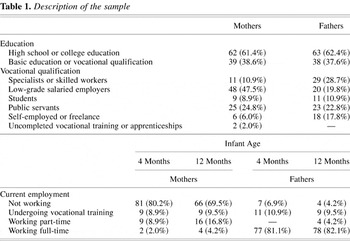
Description of the sample
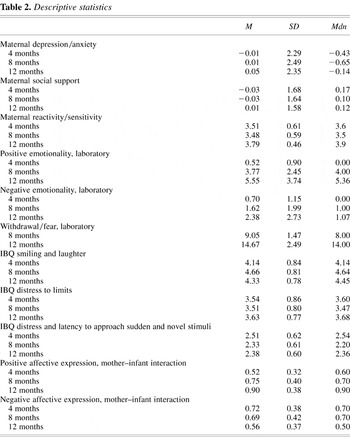
Descriptive statistics
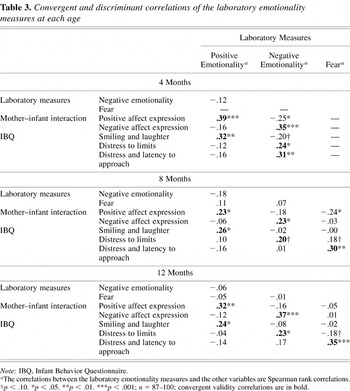
Convergent and discriminant correlations of the laboratory emotionality measures at each age
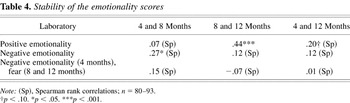
Stability of the emotionality scores
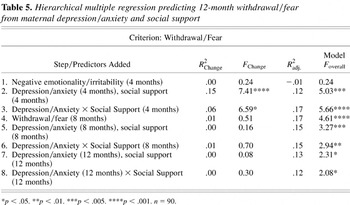
Hierarchical multiple regression predicting 12-month withdrawal/fear from maternal depression/anxiety and social support
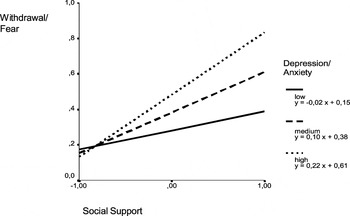
The interaction effect of maternal depression/anxiety and social support at infant age 4 months on infant withdrawal/fear at 12 months.
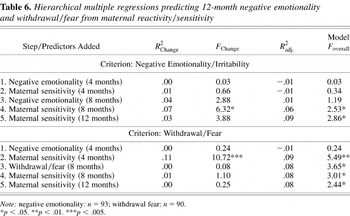
Hierarchical multiple regressions predicting 12-month negative emotionality and withdrawal/fear from maternal reactivity/sensitivity
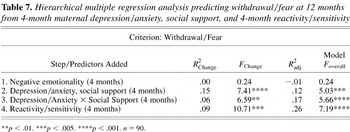
Hierarchical multiple regression analysis predicting withdrawal/fear at 12 months from 4-month maternal depression/anxiety, social support, and 4-month reactivity/sensitivity
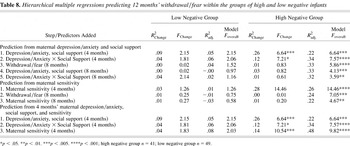
Hierarchical multiple regressions predicting 12 months' withdrawal/fear within the groups of high and low negative infants
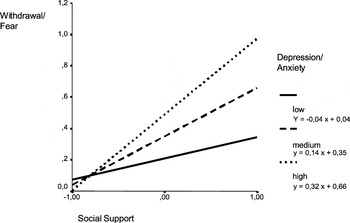
The interaction effect of maternal depression/anxiety and social support at infant age 4 months on infant withdrawal/fear at 12 months in the high negative group.
 You have
Access
- 86
- Cited by