INTRODUCTION
The veined squid, Loligo forbesi Steenstrup (1856), is found throughout the north-east Atlantic, at depths not exceeding 800 m, being more abundant above 300 m (Roper et al., Reference Roper, Sweeney and Nauen1984). Although this species shows a wide geographical distribution, high differentiation levels (both morphological and molecular) between populations of the Azores and elsewhere have been found (Brierley et al., Reference Brierley, Thorpe, Clarke, Martins, Okutani, O'Dor and Kubodera1993, Reference Brierley, Thorpe, Pierce, Clarke and Boyle1995; Pierce et al., Reference Pierce, Hastie, Guerra, Thorpe, Howard and Boyle1994; Shaw et al., Reference Shaw, Pierce and Boyle1999). Furthermore, subtle sub-structuring levels were revealed between offshore banks and continental shelves (Shaw et al., Reference Shaw, Pierce and Boyle1999).
Loligo forbesi is the only loliginid species found in the Azores. It is locally exploited, mainly during the winter, by a distinctive daylight hand-jigging fishery restricted to a few limited geographical spots, where squid are empirically known to seasonally aggregate (Porteiro, Reference Porteiro1994). Life history parameters of this population have been studied by Martins (Reference Martins1982), Martins & Porteiro (Reference Martins and Porteiro1988) and Porteiro & Martins (Reference Porteiro and Martins1994), however little is known about its behaviour. O'Dor et al. (Reference O'Dor, Hoar, Webber, Carey, Tanaka, Martins and Porteiro1994) preformed a tracking study of five individuals, providing baseline information on the behaviour and daily energy budget of this large squid. However, given the great depth habitat at which they are found, the use of such approaches for their study is highly demanding and is the reason why so little information about their behaviour is currently available. Laboratory studies offer a good alternative for obtaining behavioural information (e.g. Hurley, Reference Hurley1977). Porteiro et al. (Reference Porteiro, Martins and Hanlon1990) performed some captive trials revealing some interesting aspects of their behaviour. The authors reported an ethogram composed of 17 chromatic, 6 postural and 5 movement components showing many similarities with other loliginids. Although they did not comprehensively document reproductive behaviour, head to head mating was briefly observed with fifty egg strings found on the bottom of the tank. However, spawning was not observed.
Naturally spawned eggs are rarely encountered in the Azores. In fact, there is only a single record of a recovered egg mass that was found on an octopus trap at 20–30 m off the harbour in Horta, Faial Island (Porteiro & Martins, Reference Porteiro and Martins1992). Since then, naturally laid eggs have not been reported and spawning grounds remain completely unknown.
Common to many exploited cephalopods, fisheries for L. forbesi display large inter-annual variation in catches (Porteiro, Reference Porteiro1994; Pierce et al., Reference Pierce, Bailey, Stratoudakis and Newton1998; Pierce & Boyle, Reference Pierce and Boyle2003). Their short life span and semelparous life history strategy results in little or no overlap between generations and consequently, their abundance is highly dependent on the previous year's recruitment success. As a result, a good understanding of the reproductive biology is of primary importance for fisheries management, especially if fishing grounds overlie spawning aggregations. To date, the reproductive behaviour of L. forbesi is poorly known. This paper attempts to compile and analyse information gathered on various aspects of reproduction in L. forbesi in the Azores. We describe spawning behaviour of L. forbesi (in the laboratory) for the first time, as well as courtship and mate guarding behaviour by males. Furthermore, we analyse seven egg masses obtained on three different occasions: open captivity (N = 2); closed captivity (N = 3); and directly from the field (N = 2).
MATERIALS AND METHODS
Closed seawater system and floating cage design
A total of 51 squid, (275–639 mm, dorsal mantle length, (DML)) were maintained under laboratory conditions during 2 culture trials; from 16 October to 27 December 1994 and from 2 February to 18 April 1995. All squid were caught by jigging, and kept in a closed seawater system. The system consisted of three circular tanks (3.6 m ∅︀, Ø0.90 m high) painted with vertical dark stripes on the walls and with 4 cm of gravel on the bottom (for details see Gonçalves et al., Reference Gonçalves, Porteiro, Cardigos and Martins1995). The tanks were covered by a black lid to keep light at low intensities. A fluorescent light was constantly on, and a small amount of indirect natural light entered the laboratory during daytime. Water quality parameters (pH, ammonia, nitrite and nitrate) were monitored weekly whilst temperature and salinity were recorded daily. Squid were fed on fresh and frozen fish once or twice a day ad libitum. Each squid was tagged on the mantle following the method described by Gonçalves et al. (Reference Gonçalves, Porteiro, Cardigos and Martins1995). A group of three spawning events (C1, C2 and C3) was observed during that period but no mating activity was observed. For the three females (346; 330 and 279 mm DML) that spawned, the total body weight was recorded before and after spawning and the percentage of body mass decrease was computed.
A floating cage (3.0 m ∅︀Ø; 2.5 m high) was placed in Horta harbour (1986–1987), in order to assess the suitability of L. forbesi for tagging studies. During this experiment, two females (350 and 360 mm DML, respectively) laid eggs (H1 and H2), which were collected and preserved.
Field collected egg masses
During 1998, an experimental fishery for octopuses was carried out in an area composed of soft sandy bottoms, offshore of Praia do Almoxarife, Faial Island. Three kinds of fishing traps were then used: clay pots, iron frame traps, and Japanese baited pots, placed between 25–150 m depth (Carreira, Reference Carreira2000). Four squid egg masses were recovered on clay pots and three on Japanese baited pots between 74 and 147 m. Two egg masses were kept for further examination, one collected in March, on clay pots (F1) and one in June, laid on Japanese baited pots (F2).
Egg mass analysis
All egg masses analysed were preserved in ethanol (70%) for further examination. The egg masses typically formed bunches of semi-translucent and gelatinous finger-like strings, according to the descriptions of Holme (Reference Holme1974) and Segawa et al. (Reference Segawa, Yang, Marthy and Hanlon1988). The egg masses were examined by counting the total number of embryos forming each egg string (EES). This procedure was not feasible for the totality of the preserved egg strings, given that disruption frequently occurred (due to preservation conditions), which impeded a fraction of the embryos from being correctly assigned to each string. For this reason, the disrupted strings were discarded from the counting. For C2, however, the totality of strings (N = 43) was damaged, and so the counting was performed for the total number of embryos composing the spawn. We counted a total of 14727 embryos from 197 intact egg strings (63.5% of the total of egg strings that had been preserved). Empty strings were only recorded in the egg masses deposited in captivity (4.7% for H1; 1.9% for H2 and 35.5% for C3). The empty strings were not included in the analysis.
Statistical procedures
The mean EES and respective standard deviations were computed for each egg mass. The total number of embryos composing each egg mass was also estimated by multiplying the mean EES for the total number of strings initially composing each spawn. In the female C2, however, the total number of embryos was counted directly (see above), and the mean EES was estimated afterwards, by dividing the total number of embryos by the number of strings that initially composed the spawn (N = 43).
When comparing the six ranks of the EES (2 from the floating cage, 2 from the field and 2 from closed captivity), a Kruskal–Wallis non-parametric ANOVA, corrected for tied ranks (after excluding C2 from the analysis) and post-hoc Q multiple comparisons were performed, in order to assess for the pattern of differences, according to Zar (Reference Zar1996).
RESULTS
Spawning behaviour in the laboratory
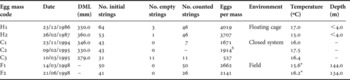
All squid initiated spawning during the afternoon and continued overnight, finishing during the following afternoon. The first spawning female observed (C1) was maintained in the presence of three males (441, 432 and 356 mm DML) and deposited 43 egg strings (Table 1) on the side of the tank's window. After spawning, the female died, whilst all the males were still alive. After dying, the body weight had decreased by 9.7%. The second female to spawn (C2) was held with another male (445 mm DML) and was also seen depositing 43 egg strings under a fold of the PVC liner that covered the tank's wall, close to the water surface and beneath a water outlet. This female lived for 13 days after spawning and was able to feed on four occasions during this period (average meal: 5.2% of body weight after spawning against 7.3% previously). This female showed a 17.6% decrease in body mass upon death. The third spawning event was accomplished by a female kept in isolation (C3). It laid 31 egg strings (of which 11 were empty) on the exact same spot where the previous female (C2) had deposited her spawn, 19 days before. Post mortem, this female had decreased 9.3% in body weight.
Summary of egg masses analysed and collecting conditions (H, floating cage in the harbour; C, closed system; F, field).

*Temperature estimated from the monthly mean temperatures obtained in the area at 140 m depth during 2007 (data obtained from project CIMBA–DRCT (M.1/I/014/2005); Igor Bashmatchnikov personal communication); §embryos totally counted.
The egg laying processes showed distinct behavioural patterns. Females would typically approach the spawning spot (or the egg mass previously laid) with the arms held in a tight cone and, when in contact, splayed the arm tips to attach a new string, in a locomotor behavioural component called egg holding (sensu Hanlon et al., Reference Hanlon, Smale and Sauer1994), approximately lasting 20 seconds. In between each ‘egg holding’, the female swam fast towards the egg strings, and jetted water vigorously toward the spawn with a backward movement—a locomotor component called egg touching (sensu Hanlon et al., Reference Hanlon, Maxwell, Shashar, Loew and Boyle1999). Some distinct chromatic components were consistently exhibited by the females. These were: dorsal stripe and mantle spots (see Porteiro et al., Reference Porteiro, Martins and Hanlon1990 for a full description) and white arms (sensu Hanlon et al., Reference Hanlon, Maxwell, Shashar, Loew and Boyle1999) although restricted to the arm tips.
Pair formation and mate guarding (Hanlon & Messenger, Reference Hanlon and Messenger1996) was observed for the first time in L. forbesi. On the two occasions where males were present, ‘pair formation’ was initiated directly when joined together in the tanks. The male isolated the female from the other squid, constraining her against the tank wall, limiting her swimming space. A short distance was maintained continuously between the two individuals as in parallel positioning (sensu Hanlon et al., Reference Hanlon, Smale and Sauer1994) and prolonged fin to fin contact took place. At this time, a circular motion around the tank was prevalent, contrary to the normal forward–backward radial trajectory. The chromatic component exhibited by the female consisted of ‘dorsal stripe’, ‘mantle spots’ and dark fin line (sensu Porteiro et al., Reference Porteiro, Martins and Hanlon1990). Other chromatic components were observed during more intense interactions including ‘white arms’, red accessory nidamental glands (sensu Hanlon et al., Reference Hanlon, Smale and Sauer1994) and infraocular spot (see Porteiro et al., Reference Porteiro, Martins and Hanlon1990). ‘Mate guarding’ was observed at the initiation of spawning when the paired male swam close to the female (within one body length), and escorting her to the egg mass. Males displayed a courtship body pattern with high iridescence during this behaviour. At least, three dorsal chromatic components formed the courtship body pattern: accentuated testis (sensu Hanlon, Reference Hanlon1982), ‘dorsal stripe’ and ‘white arms’. In addition, strong green iridescence on the dorsal mantle was exhibited. Of those chromatic components, ‘accentuated testis’ was the most frequently observed component during mate guarding. It is a light chromatic component displayed when the chromatophores of the mantle are expanded whilst the ones above the testis are retracted, thus accentuating the testis. Jockeying and parrying (sensu Hanlon et al., Reference Hanlon, Smale and Sauer1994) was a locomotor component not previously reported for L. forbesi that was observed when two males were present (C1), often culminating in violent male–male agonistic interactions. ‘Jockeying’ refers to the swimming movements of an intruder male to approach a paired female. ‘Parrying’ denotes the behaviour of the paired male when countering the intruder's approaches (Hanlon et al., Reference Hanlon, Smale and Sauer1994).
Egg mass analysis
A summary of the information on the analysed egg masses deposited in captivity, in the floating cage and in the field is presented in Table 1. Fresh egg strings presented, when fresh, a mean length of 174.9 mm (mean weight of 11.5 g, obtained from a set of 40 strings randomly chosen from the spawn F2).
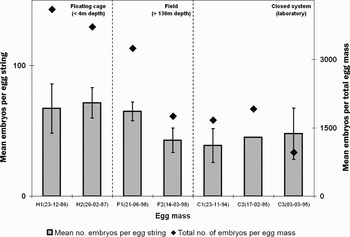
The mean EES and associated variation (standard deviations) are shown in the Figure 1. The Kruskal–Wallis test performed on the ranks of EES has proved to be significant (H c(5, N = 182) = 96.18499, P < 0.01) and the multiple comparisons detected two homogeneous groups: on one side, the closed system group together with F2, and on the other, the floating cage group and F1.
Mean EES (embryos per egg string) and total number of embryos calculated for each egg mass. The maximum values for both were obtained in the field (June) and the lower values were obtained in captivity (November). Vertical lines indicate standard deviations.

DISCUSSION
This study reports the first description of spawning behaviour in L. forbesi. The observed chromatic, postural and locomotor components of both males and females presented many similarities to other loliginid species (e.g. Hanlon, Reference Hanlon1982, Reference Hanlon1988; Moynihan, Reference Moynihan1985; Arnold, Reference Arnold, Gilbert, Adelman and Arnold1990; Hanlon et al., Reference Hanlon, Smale and Sauer1994, Reference Hanlon, Maxwell, Shashar, Loew and Boyle1999; Hanlon & Messenger, Reference Hanlon and Messenger1996; DiMarco & Hanlon, Reference DiMarco and Hanlon1997; Jantzen & Havenhand, Reference Jantzen and Havenhand2003). However, our list of behavioural components is certainly a small fraction of what may happen in nature and it is reasonable to expect this deep water loliginid to share further behavioural traits with its relatives, inhabiting shallower depths. However, natural spawning grounds have been poorly characterized and are unknown in the Azores. Unlike L. opalescens or L.v.reynaudii, which prefer sandy substrata (Hurley, Reference Hurley1977; Sauer et al., Reference Sauer, Smale and Lipinski1992) most of the recovered egg masses of L. forbesi in other parts of the eastern Atlantic and Mediterranean have been found on artificial structures such as crab pots, creel lines, ropes and are occasionally recovered by bottom trawl nets (Table 4), thus pointing to a preference for hard substrates, as suggested by Roper et al. (Reference Roper, Sweeney and Nauen1984). The observations made here suggest that in the Azores, females also prefer to spawn on hard structures. This is confirmed by the fact that egg masses recovered from the field have always been deposited inside (never outside) the traps (Porteiro & Martins, Reference Porteiro and Martins1992; and this study). Therefore, it is probable that L. forbesi spawns in cavities and negative planes of volcanic substrata typical of the area, similarly to what has been observed for L. vulgaris in Madeira (see Wirtz, Reference Wirtz1994).
Another unsolved aspect of the ecology of L. forbesi is the possibility of this species to form spawning aggregations. Although Holme (Reference Holme1974) assumed a lack of direct evidence for mass spawning to occur in this species, we find it likely that, at least in the Azores, L. forbesi aggregate to reproduce around areas seasonally exploited by local fishermen. The first suggestion that jigging takes place upon spawning grounds comes from the fact that a high percentage of squid caught in these areas (87.4% for females and 81.0% for males) is composed of mature animals and that all mature females contained sperm in the spermatheca (also 80% of the maturity stage III and 46% of the maturity stage II females presented sperm in their spermatheca) (Porteiro & Martins, Reference Porteiro and Martins1994). The second evidence comes from the observed ‘mating guarding’ and ‘jockeying/parrying’ behaviour, observed for the first time in males of this species. These two locomotor components are commonly displayed by other loliginids on spawning grounds (Hanlon et al., Reference Hanlon, Smale and Sauer1994, Reference Hanlon, Maxwell, Shashar, Loew and Boyle1999; Jantzen & Havenhand, Reference Jantzen and Havenhand2003). Mate guarding behaviour is probably related to an avoidance of last minute mating by concurrent males (Hanlon & Messenger, Reference Hanlon and Messenger1996) and thus to impede sneakers from obtaining successful fertilizations, as has been recently shown to happen in an aggregating cephalopod (Hanlon et al., Reference Hanlon, Naud, Shaw and Havenhand2005). Accordingly, the presence of small mature males, which may putatively act as mating sneakers, has been presented in several studies, showing that two modal size-classes of mature males are constantly present throughout the populations of L. forbesi in the Atlantic (see Boyle & Pierce, Reference Boyle and Pierce1994 and references therein). Finally, work by Shaw & Boyle (Reference Shaw and Boyle1997) further supports the existence of spawning aggregations in L. forbesi. In a single egg mass, composed of only 10 to 15 egg strings, the authors have shown that neighbouring egg strings can be laid by different females and that multiple paternities also occur within egg strings. Such results in conjunction with our behavioural observations, emphasize that reproduction in L. forbesi may well engage complex sexual selection mechanisms typical of spawning aggregations.
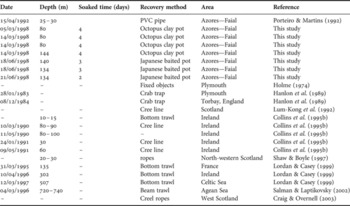
The available information on recovered egg masses of L. forbesi from different locations shows a wide depth distribution for spawning to occur, ranging from 10 to 740 m (Table 2), which represents the widest depth-range for spawning, reported so far for any cephalopod. In the Azores, we show evidence for natural spawning to occur at least between 25 and 144 m. However, it is likely that spawning activity may occur well below this depth, since some of the local fishing grounds are found down to at least 270 m (Martins, Reference Martins1982). In fact, spawning could probably occur even deeper, given that a single individual has been tracked down to 580 m (O'Dor et al., Reference O'Dor, Hoar, Webber, Carey, Tanaka, Martins and Porteiro1994), an animal that also travelled 30 km over two days. This wide home-range also suggests that this species may be more widespread and more abundant than previously thought, given that our current knowledge has been based almost entirely on samples collected from fishing grounds. Furthermore, the short soaking time (2–4 days) practised during the octopus fishery experiment and the effectiveness of the employed traps in collecting seven egg masses, across areas where L. forbesi has not been regularly found, further suggests a higher and more widespread potential habitat for this species.
Compilation of reported egg masses of L. forbesi recovered throughout its distribution.

The variability in EES among egg masses could be due to a large number of factors (both environmental and physiological) that should be, elucidated in the future, despite the difficulty in obtaining this kind of data for such a deep water loliginid.
Loligo forbesi has been suggested to be an intermittent spawner (Boyle et al., Reference Boyle, Pierce and Hastie1995; Collins et al., Reference Collins, Burnell and Rodhouse1995a; Rocha & Guerra, Reference Rocha and Guerra1996). We were not able to trace the spawning history of the females that have spawned in captivity, but by comparing our data with previous published information on fecundity, we can give a preliminary indication of the possible number of spawning events that a female is able to perform. Across other populations of L. forbesi, total fecundity (concerning the oviduct and ovarian in conjunction) has been estimated to vary between 1 000 and 23 000 eggs and oocytes (Mangold, Reference Mangold and Boyle1987; Boyle & Pierce, Reference Boyle and Pierce1994; Boyle et al., Reference Boyle, Pierce and Hastie1995; Collins et al., Reference Collins, Burnell and Rodhouse1995a). A study examining fecundity in Azorean L. forbesi (Santos, Reference Santos1993; Santos & Porteiro, unpublished data) counted an average of 2317±1364 eggs (mean±SD) in the oviduct and 13844±6005 (mean±SD) immature oocytes in the ovary (N = 32 females; 373.5 mm mean DML). We have obtained captive egg masses averaging 2368±1466 eggs (333 mm mean DML), which are comparable to the egg number found in the oviduct of the mature female stage by Santos (Reference Santos1993). If we consider the number of mean immature oocytes found in the ovary in the Azorean population by Santos (Reference Santos1993), in conjunction with the mean number of embryos per spawning obtained directly from the egg masses, we can estimate that a single female may be able to perform up to six distinct spawning events, thus supporting this species as an intermittent spawner and pointing to the need of taking this aspect in consideration for further population studies.
It is important to be able to determine whether each spawning represents the same part of a spawning sequence. The usual method employed for quantification of sexual maturity in fishery biology studies has been based on gonadosomatic indices (GSIs). However, for L. forbesi these indices may not always correlate with the physiological maturity of the females, given that an unknown number of spawning events might have occurred before sample collection. We thus suggest that GSIs should be used with caution when interpreting the average at a population level. Moreover, the jigs catching ability according to sex, size and spawning history should be assessed in order to avoid biased estimation of population reproduction parameters. In other words, it is not certain whether samples obtained by collection methods such as jigging can be seen as satisfactory for non-biased estimation of population structure parameters, especially if samples are to be collected on areas of reproductive aggregation (Hanlon, Reference Hanlon1998).
In summary, spawning L. forbesi displays the behavioural features typical of a loliginid squid. Contrary to other species, however, this species tends to prefer to deposit egg masses on hard structures and it is likely that spawning aggregations exist down to at least 144 m. Evidence points out that in the Azores, most fishing effort is concentrated on those spawning areas. As a result, intense fishing effort must inevitably affect recruitment processes and population abundance. First, this effect may be induced through the direct exploitation of spawning biomass, and, secondly, by disturbing this complex mating system by consistently removing the dominant males through selective fishing, as has been suggested by Hanlon (Reference Hanlon1998). As a result, it is important to further characterize spawning sites of this species in the Azores with more direct approaches, in order to understand the potential impacts of the fishery on natural populations and contribute towards the development of stock management strategies.
ACKNOWLEDGEMENTS
Our thanks are due to Peter Boyle and John Forsythe, who gave us suggestions in order to implement the closed seawater system. A special thank you is addressed to Paulo Martins who conducted a great part of the routine work during this project and Norberto Serpa for all the sea going operations. Our thanks are also due to many collaborators and colleagues who helped us during the course of this project. C.K. Pham was supported by the grant IMAR/INTEREG IIIb/MARTEC-MARTEC2//AQUA1/001-005/2007. G.P. Carreira was supported by the Scholarship (PRAXIS XXI/BM/13047/97) funded by Fundação para a Ciência e a Tecnologia (Ministério da Ciência, Tecnologia e Ensino Superior, Portugal) and part of this Project was supported by the Project RIVA-Apoio Científico à Gestão de Pequenos Recursos Costeiros de Invertebrados dos Açores (Directorate of Fisheries of the Regional Secretariat of Agriculture and Fisheries of the Azores Government). The major part of this work was funded by the European Commission within the frame of the EC research programme in the Agriculture and Fisheries sector (EURSQUID II; AIR, Contract No. AIR1-CT92-573). We also thank the Directorate of Fisheries of the Regional Secretariat of Agriculture and Fisheries of the Azores Government who gave permission to use their facilities at Fábrica da Baleia/Centro do Mar, Horta to install the closed seawater facilities and for supporting the running costs.