Introduction
Atlantic salmon (Salmo salar) are anadromous fish that live in salinities ranging from ~0 ppt in freshwater to 33–35 ppt in the Northwest Atlantic Ocean (Reddin, Reference Reddin2006). Ectoparasites are considered a major threat for wild Atlantic salmon in the Northwest Atlantic region (Clarke et al., Reference Clarke, Ratelle and Jones2014). Species of ectoparasites observed commonly on Atlantic salmon in some home ranges include Lepeophtheirus salmonis, Caligus elongatus and Argulus canadensis. These ectoparasites are observed in freshwater on returning wild Atlantic salmon during passage at hydroelectric dams ~50–150 km from the Atlantic Ocean (Powell et al., Reference Powell, Trial, Dubé and Opitz1999; Clarke et al., Reference Clarke, Ratelle and Jones2014). Lepeophtheirus salmonis and C. elongatus are referred to commonly as sea lice (Copley et al., Reference Copley, Tierney, Kane, Naughton, Kennedy, O'Donohoe, Jackson and McGrath2005), they occur predominantly in marine environments and usually die within a week following the return of their salmon host to freshwater (McLean et al., Reference McLean, Smith and Wilson1990).
Unlike L. salmonis and C. elongatus that are copepods, Argulus spp. are branchiurans. Argulus spp. are distributed broadly and infest fish from equatorial to temperate regions in both hemispheres (Neethling and Avenant-Oldewage, Reference Neethling and Avenant-Oldewage2016). The genus Argulus includes >120 valid species, with some adapted to marine (Devaraj and Ameer Hamsa, Reference Devaraj and Ameer Hamsa1977) or estuarine conditions (Natarajan, Reference Natarajan1982) and nearly two-thirds occurring primarily in freshwater (Neethling and Avenant-Oldewage, Reference Neethling and Avenant-Oldewage2016). Many Argulus spp. are stenohaline, infesting fishes from either freshwater or marine environments, whereas others are euryhaline (Neethling and Avenant-Oldewage, Reference Neethling and Avenant-Oldewage2016). However, general salinity tolerance of Argulus spp. (i.e. Neethling and Avenant-Oldewage, Reference Neethling and Avenant-Oldewage2016) is based primarily on field observations of parasites encountered on wild fishes and not on empirical studies. Argulus spp. are obligate and cosmopolitan parasites of fishes, infesting a wide variety of warm-water species (Carvalho et al., Reference Carvalho, Arruda and Del-Claro2004) and cold-water salmonids (Powell et al., Reference Powell, Trial, Dubé and Opitz1999). Their global distribution in aquatic environments and parasitism of a broad variety of animals suggests high adaptability of Argulus spp. in diverse environments. Their occurrence on an increasing proportion of wild Atlantic salmon is of concern (Clarke et al., Reference Clarke, Ratelle and Jones2014) and raises questions about phenology. Specifically, unknown are sites of parasite acquisition during migration and how spatiotemporal co-localization of these parasites is achieved in the face of depressed Atlantic salmon populations (Chaput, Reference Chaput2012).
Reports of A. canadensis on wild migrating adult Atlantic salmon occur exclusively during upstream passage at hydroelectric dams (Powell et al., Reference Powell, Trial, Dubé and Opitz1999; Clarke et al., Reference Clarke, Ratelle and Jones2014), rather unique sites for population-level assessments and monitoring. These dams occur ~50–150 km from the Atlantic Ocean (Powell et al., Reference Powell, Trial, Dubé and Opitz1999; Clarke et al., Reference Clarke, Ratelle and Jones2014) and ~20–80 km upstream of saltwater influence. Adult salmon are observed rarely and in comparatively small numbers at other locations and times and so many spatiotemporal aspects of A. canadensis biology are unknown. Despite predominant observations of A. canadensis on migratory diadromous fishes in downstream reaches of freshwater systems (Davis, Reference Davis1956; Powell et al., Reference Powell, Trial, Dubé and Opitz1999; Clarke et al., Reference Clarke, Ratelle and Jones2014), neither sites of A. canadensis acquisition by their preferred Atlantic salmon host nor parasite salinity tolerance have been investigated. Initial attempts to hatch metanauplii for empirical investigations using conditions established for many congeneric species (Shafir and Van As, Reference Shafir and Van As1986) were unsuccessful. This promoted our investigation of salinity tolerance of A. canadensis eggs and effects of temperature on embryonic development, survival and hatch to help understand spatiotemporal features of transmission to wild migrating Atlantic salmon and to elucidate life history features that can be exploited to support empirical investigations.
Materials and methods
Ectoparasitic crustaceans and egg collection
Adult A. canadensis were collected from wild Outer Bay of Fundy Atlantic salmon (Salmo salar) handled by Department of Fisheries and Oceans (DFO) Canada personnel at the Mactaquac Biodiversity Facility on the St. John River, New Brunswick. Live female A. canadensis were collected by gentle removal from the fish epidermis using a dull knife. Parasites were transferred to 10-gallon recirculation aquariums (Top Fin®, Pet Smart, Fredericton, Canada) to promote egg laying for up to 48 h at room temperature (~21 °C) in dechlorinated tap water.
Embryonic development, larval hatch and fate of eggs at room temperature
Egg clusters laid by A. canadensis (June 28–July 3) were maintained in dechlorinated tap water at room temperature. Egg clusters were chosen randomly and removed from aquarium glass and silicone using a scalpel blade and individual clusters were contained within 70-μm sieves (Fisherbrand™ Cell Strainers, Fisher Scientific, Ottawa, Canada). Eggs were observed daily for 35 days at ~21 °C to monitor embryonic development.
An aquarium containing 138 adherent egg clusters was maintained at room temperature and monitored daily for ~230 days (229–234 days) to determine number and timing of metanauplius hatch. After ~230 days, 20 egg clusters were selected randomly and examined to determine the fate of embryos in individual eggs contained within each cluster (i.e. dead, live, hatched, unfertilized).
Influence of cold-temperature treatment on hatch
14-day and 28-day cold treatment
Metanauplii hatched prior to the beginning of this experiment (230 days maintenance at room temperature) were counted. Eggs were assessed microscopically to determine whether they were empty (i.e. hatched), not fertilized, contained embryos that were dead, or contained embryos that were live. From these eggs, 10 clusters with at least 60 live unhatched A. canadensis embryos were used to assess the influence of a cold-temperature treatment on their hatch. Each of 10 clusters was cut roughly in half to ensure a minimum of 30 eggs with developed embryos were present in each sibling group. The number of unhatched eggs containing live embryos in each paired group was 30–106 (50.5 ± 19.9). Each sibling group was placed individually into a 70-μm sieve floating in a 100 × 80-mm2 Pyrex dish (No. 3250), with each of the 20 dishes containing 300 mL of dechlorinated tap water. One half of each sibling group was allocated randomly to incubation at either room temperature (~21 °C; control) or 7 °C for cold treatment (Fig. 1). Five of 10 cold treatment clusters were assigned randomly to a 14-day cold treatment and the other five received a 28-day cold treatment. Replacement water was aerated and adjusted to treatment temperature (~21 °C or 7 °C) for 24 h prior to exchange of 100 mL water volume each week. Hatched metanauplii were removed from each sieve daily and were enumerated. Pyrex dishes containing the cold-treatment half of sibling groups were returned to room temperature following 14- or 28-day cold treatments (Fig. 1). Larval hatch was monitored daily in all eggs for another 30 days.
Schematic of experiments assessing ‘influence of cold-temperature treatment on hatch’. Ten egg clusters were cut to yield two siblings groups per cluster. One half of each sibling group (i.e. 10 controls) was maintained at 21 °C with the other half at 7 °C for cold treatment. Ten cold treatment sibling groups were assigned randomly to 14-day (n = 5) or 28-day (n = 5) cold treatment. The other half of each sibling group was maintained at 21 °C. Cold treatment was terminated after 14 days (Day 15) or 28 days (Day 29) with return to 21 °C. Egg hatch was monitored in all sibling egg clusters until experiments were terminated 30 days after return of cold treatments groups to 21 °C.

The effect of cold dormancy on A. canadensis metanauplius hatch was analysed using a linear mixed-effects model using Treatment, Time and their interactions as fixed effects, with Cluster (nested in Treatment) treated as the random effect to test the H o that there was no statistical difference in hatching induction or synchrony between cold treated eggs and their corresponding room temperature controls over time. Fixed-effect correlations were examined and were not highly correlated for any test, suggesting that collinearity was not an issue.
For statistical analyses, 14- and 28-day cold-treated eggs and their associated controls were assessed separately. For the 14-day group, post-cold treatment hatch was compared to its control for the duration of the experiment (days 1–45), to test A. canadensis hatch induction following cold treatment. Additionally, the 30-day period post-cold treatment exposure (days 15–45) was analysed to test A. canadensis hatch synchronization following cold treatment. Similarly, for the 28-day group, post-cold treatment hatch was compared to its control for the duration of the experiment (days 1–59) to assess hatch induction, and hatch synchronization was assessed for the 30-day period post-cold treatment exposure (days 29–59). A t-test was conducted to test the Ho of no significant difference in the overall hatch of A. canadensis metanauplii between cold temperature treated eggs and their associated controls (i.e. cumulative hatch for days 1–45 days for 14-day cold-treated eggs vs controls, and for days 1–59 days for 28-day cold-treated eggs vs controls).
75-day cold treatment
Metanauplii hatched prior to the beginning of this experiment (150 days maintenance at room temperature) were counted. Three egg clusters were subjected to cold treatment (7 °C) for 75 days, after which daily hatches were monitored at room temperature as described above. The average number of eggs in each cluster was 91.3 (84–111). There was no room temperature control for this observation.
Long-term egg viability
Egg clusters containing fully developed embryos were subjected to uninterrupted cold treatment (⩽7 °C) for 2.5 years prior to their return to favourable temperatures (~21 °C). Long-term embryo survival was assessed based on their ability to hatch.
Influence of post-diapause water temperature on hatch
A 10-gallon recirculation aquarium containing dechlorinated tap water and egg clusters laid by A. canadensis over a 22-day period (July 11–August 1) was maintained at room temperature for ~150 days (134–155 days) after egg laying. The aquarium was subjected to cold treatment at 7 °C for 108 days. Six egg clusters were selected randomly and assessed to determine the number of empty eggs prior to initiating the experiment. Egg clusters were cut roughly into thirds to yield three sibling groups per cluster. Each sibling group was placed individually into a 70-μm sieve floating in a 100 × 80-mm2 Pyrex dish (No. 3250), with each of the 18 dishes containing 300 mL of dechlorinated tap water. The average number of eggs in each sibling group was 69.4 (41–102). Each sibling group was assigned randomly to one of three incubation temperatures (9 °C, 13 °C, 17 °C) to assess larval hatch. Treatment temperature and photoperiod were controlled using a Conviron CMP 3246 growth chamber (Controlled Environments Ltd., Winnipeg, Manitoba). Pyrex dishes were secondarily contained and submerged 2/3 depth within a water bath to promote constant water temperature during daily observations. Incandescent light [Sylvania 6000-h bulbs (60 w; 120–125 v)] with 14.5-h light and 9.5-h dark cycle was used in chambers to mimic the light cycle at the estimated time of hatch in the wild (i.e. early May). Replacement water was aerated and adjusted to treatment temperature (9 °C, 13 °C, 17 °C) for 24 h prior to exchange of 100 mL water volume each week. Hatched metanauplii were enumerated and removed daily from each sieve.
The effect of incubation temperature on A. canadensis metanauplii hatch from eggs following cold temperature treatment was analysed using a linear mixed-effects model. Temperature, Time and their interactions were treated as fixed effects, with Cluster (nested in Temperature) treated as the random effect to test the H o that there was no statistical difference in A. canadensis hatch at different temperatures over time. Fixed-effect correlations were examined for all tests and were not highly correlated, suggesting that collinearity was not an issue. A one-way ANOVA was conducted to test the H o of no significant difference in overall hatch success of A. canadensis metanauplii at different temperatures at the end of the experiment (i.e. cumulative hatch over the 21 days of monitoring following cold treatment).
Salinity tolerance of A. canadensis eggs
Egg clusters were collected and maintained at room temperature as described above. Nine egg clusters were selected randomly 1–3 days after laying and were cut from the aquarium using a scalpel blade. Clusters had an average of 111 (76–178) eggs. Clusters were contained individually in 70-μm sieves and were allocated randomly to one-gallon aquariums (Top Fin®, PetSmart) containing one of three water preparations: dechlorinated tap water (0 ppt; Freshwater (FW)); Bay of Fundy seawater diluted 1:1 with dechlorinated tap water (17 ppt; Estuarine water (EST)); and, undiluted Bay of Fundy seawater (34 ppt; Seawater (SW)). All water was filter-sterilized (0.2 μm) prior to egg incubation. Egg development was monitored daily for the first 45 days and periodically for another ~150 days. All three aquariums were then subjected to cold treatment (7 °C) for 33 days. Following cold treatment, all three aquariums were maintained at room temperature and hatched metanauplii were removed daily from each sieve and enumerated.
Statistical analyses
Analyses were completed using the lme4 package (Bates et al., Reference Bates, Maechler, Bolker and Walker2015; version 1.1-21) in R (version 3.6.1, R Core Team, 2019) within RStudio (version 1.2.1335, RStudio Team, 2019). Data were visualized using the ggplot2 package (Wickham, Reference Wickham2016; version 3.2.1).
Results
Embryonic development, larval hatch, and fate of eggs at room temperature
Eggs of A. canadensis were observed daily to monitor embryonic development in freshwater. Eyes began to develop in embryos by day 17, development of the median ‘nauplius eye’ was complete by day 29 and no further changes to embryo morphology were observed after day 35 (Fig. 2). Hatch of a single A. canadensis metanauplius was observed 31 days after egg-laying.
Embryonic development within Argulus canadensis eggs maintained in freshwater at ~21 °C show: the developing embryo contracted away from the egg chorion (13 days after egg laying, A); initiation of eye formation (17 days after egg laying, B; arrows); and, the median ‘nauplius eye’ in each fully developed embryo (35 days after egg laying, C; arrows). White lines in the lower left of each image represent scale bars of 0.4 mm.

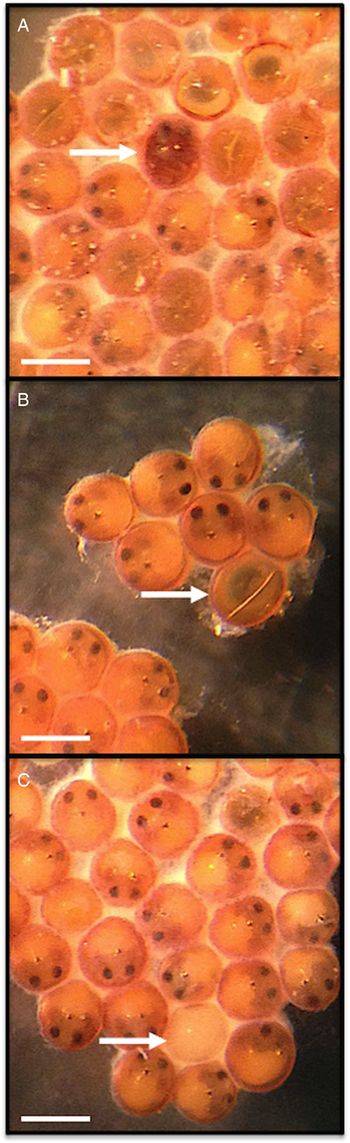
Egg clusters were randomly chosen and removed from an aquarium after ~150 days (n = 9 clusters) and after ~230 days (n = 10 clusters) at room temperature. The fate of eggs from these clusters was assessed regarding whether they: contained embryos that were dead (Fig. 3A); contained embryos that were live (Fig. 3A–C); were empty because metanauplii hatched (Fig. 3B); or, were unfertilized when laid (Fig. 3C). Nine egg clusters removed ~150 days after laying revealed 3.2 ± 3.6% (0–9.1%) of metanauplii hatched. Six of these clusters showed relatively low hatch 0.8 ± 0.8% (0–1.9%; Fig. 4A) whereas the other 3 clusters showed comparatively high hatch 7.9 ± 0.7% (6.7–9.1%; Fig. 4A). Ten egg clusters removed ~230 days after laying revealed 18.6 ± 15.7% (1–45.8%) of metanauplii hatched. Seven of these clusters showed relatively low hatch 8.9 ± 4.5% (1.0–14.9%; Fig. 4A) whereas the other 3 clusters showed comparatively high hatch 41.1 ± 5.5% (35.1–45.8%; Fig. 4A). These results support large variation in per cent metanauplius hatch between different egg clusters in the absence of environmental hatching cues and prompted the examination of a higher number of egg clusters. Data from another 138 egg clusters removed ~230 days after laying were split evenly regarding hatch percentage with 69 clusters showing relatively low hatch 9.8 ± 5.2% (0–17.3%; Fig. 4A) and 69 clusters showing relatively high hatch 34.4 ± 14.5% (18.3–69.2%; Fig. 4A). These 138 clusters had 15–163 eggs per cluster (7241 eggs total) and it was observed that 1.1% (0–19%) of embryos in each cluster died (n = 76), 71.2% (19.0–100%) in each cluster were live within their egg chorion (n = 5158), 22.6% (0–69%) in each cluster hatched (n = 1641) and 5.1% (0–60%) in each cluster were unfertilized (n = 366; Fig. 4B).
Argulus canadensis eggs achieve different developmental outcomes in clusters maintained in freshwater at ~21 °C for ~230 days. Eggs with brown colouration contain a dead or dying embryo (A; arrow). Eggs are live if they contain an intact and non-discoloured eyed embryo (visible in all images). An empty egg with a cleavage furrow signifies metanauplius hatch (B; arrow). Eggs with persistent white colouration and lacking an identifiable embryo are unfertilized (C; arrow). White lines in the lower left of each image represent scale bars of 0.4 mm.

Box and whisker plots show differential per cent hatch of metanauplii from representative egg clusters maintained in freshwater at ~21 °C (A). White boxplots show egg cluster subpopulations demonstrating relatively low per cent metanauplius hatch at ~150 or ~230 days after laying. Gray boxplots show egg cluster subpopulations demonstrating relatively high per cent metanauplius hatch at ~150 or ~230 days after laying. Box and whisker plots show the developmental outcomes for 7241 A. canadensis eggs from 138 clusters (⩾15 eggs per cluster) maintained in freshwater at ~21 °C for ~230 days (B). Eggs with internal brown colouration that contain degrading embryos are considered dead (n = 76). Eggs that contain a fully-developed embryo are considered live (n = 5158). Empty eggs with a cleavage furrow indicate that metanauplii hatched successfully (n = 1641). Eggs with persistent white colouration are unfertilized (n = 366). Horizontal black lines in boxplots represent the median per cent hatch, and boxes showing the lower 25th and upper 75th quartiles of the data. Vertical black lines represent differences in quartile distribution to the minimum and maximum bounded data values, and outliers are shown as dots.

Influence of cold-temperature treatment:
14-day cold treatment
A total of 52 A. canadensis metanauplii hatched from control egg groups at room temperature (26.0 ± 20.0%; 5.0–53.3%; Fig. 5), with a maximum hatch of 2 metanauplii per day over the duration of the experiment (days 1–45; Fig. 6). This includes 33 A. canadensis metanauplii hatched from control egg groups from days 15 to 45 (15.4 ± 11.7%; 5.0–33.3%), with a maximum hatch of 2 metanauplii per day (Fig. 6). No hatches were recorded for any sibling group during cold temperature treatment (days 1–14). For days following cold temperature treatment and after transfer to room temperature (days 15–45), 77 A. canadensis hatched from cold temperature treated egg groups (35.3 ± 15.6%; 20.8–55.1%; Fig. 5), with a maximum hatch of 5 metanauplii per day (Fig. 6). Peak hatch of metanauplii occurred 8 days after return to room temperature (Fig. 6). More metanauplii hatched from cold-treated than control eggs, but the difference was not significant (Welch's two-sample t-test: t = −0.82, d.f. = 7.6, P = 0.44).
Box and whisker plots show that hatch of Argulus canadensis metanauplii is induced by, and per cent hatch increases with, increasing the duration of cold temperature treatment. Control groups (14 and 28 day) were maintained at ~21 °C for the duration of the experiment. Cold temperature treatment groups were maintained for 14-day, 28-day and 75-day cold treatments, respectively, and then returned to ~21 °C for the duration of the experiment. Metanauplius hatch is cumulative over the 30 days at ~21 °C following treatment. The 75-day cold treatment lacks true control. Horizontal black lines in boxplots represent the median per cent hatch and boxes showing the lower 25th and upper 75th quartiles of the data. Vertical black lines represent differences in quartile distribution to the minimum and maximum bounded data values.

Box and whisker plots show that hatch of Argulus canadensis metanauplii is both induced and synchronized by increasing durations of cold temperature treatment. Egg clusters were paired, with one half kept at ~21 °C while the other half received cold temperature treatment for 14 days or 28 days. Additional egg clusters lacking room temperature controls received cold temperature treatment for 75 days. Horizontal black lines in boxplots represent the median per cent hatch and boxes showing the lower 25th and upper 75th quartiles of the data. Vertical black lines represent differences in quartile distribution to the minimum and maximum bounded data values and outliers are shown as dots.

For these data, the interaction term in the linear mixed-effects model is the difference in the slope of the relationship for the cold temperature treatment relative to its room temperature control. For days 1–45, the interaction between A. canadensis metanauplii Hatch and Time did not differ (t = 1.512, P = 0.131), but slightly higher hatch occurred from room temperature controls (β = 0.007). For days 15–45, the interaction between A. canadensis metanauplii Hatch and Time was found to be statistically significant as compared to the room temperature control (t = −3.032; P = 0.003), with slightly higher hatch occurring in the cold temperature treatment (β = −0.003). The random effect of replicates (nested in treatment) for days 1–45 and days 15–45 explained 2.82% and 2.72%, with 95.0% and 93.7% residual variance, respectively.
28-day cold treatment
A total of 58 A. canadensis hatched from room temperature control egg groups (22.7 ± 13.7%; 9.4–43.5%; Fig. 5), with a maximum hatch of 3 metanauplii per day over the duration of the experiment (days 1–59; Fig. 6). This includes 31 A. canadensis metanauplii hatched from control egg groups (days 29–59: 12.0 ± 6.5%, 5.7–21.7%), with a maximum hatch of 3 metanauplii per day (Fig. 6). No hatches were recorded for any egg groups during cold temperature treatment (days 1–28). For days following cold temperature treatment and after transfer to room temperature (day 29–59), 107 A. canadensis hatched from cold treatment egg groups (39.8 ± 10.6%; 31.6–56.1%; Fig. 5), with a maximum hatch of 9 metanauplii per day (Fig. 6). Peak hatch of metanauplii occurred 9 days after return to room temperature following cold temperature treatment (Fig. 6). Differences in per cent egg hatch for 28-day control and 28-day cold temperature treatments (days 1–59) approached significance (Welch's two-sample t-test: t = −2.2, d.f. = 7.5, P = 0.06), with more eggs hatching from cold-treated eggs.
For these data, the interaction term in the linear mixed-effects model is the difference in the slope of the relationship for the cold temperature treatment relative to its room temperature control. For days 1–59, the interaction between Argulus metanauplii Hatch and Time was statistically significant as compared to the cold temperature treatment (t = 2.856, P = 0.004), with slightly higher hatch occurring in the room temperature control over time (β = 0.001). For days 29–59 the interaction between Argulus metanauplii Hatch and Time was statistically significant as compared to the room temperature control (t = −2.390, P = 0.0175), with higher hatch occurring in the cold temperature treatment over time (β −0.316). The random effect of replicates (nested in treatment) for days 1–59 and days 29–59 explained 0.605% and 1.25%, with 98.7% and 94.1% residual variance, respectively.
75-day cold treatment
Following a 75-day cold temperature treatment and return to room temperature, 223 A. canadensis metanauplii hatched from the three replicate treatments over the next 30 days (81.3 ± 4.5%; 76.2–84.8%; Fig. 5), with a maximum hatch of 16 metanauplii per day (Fig. 6). No hatches were recorded during the 75-day cold temperature treatment for any egg cluster. Peak hatch of metanauplii occurred 9 days after return to room temperature following cold temperature treatment (Fig. 6).
Long-term egg viability
Eggs returned to favourable temperatures (~21 °C) after 2.5 years at ⩽7 °C showed successful induction of live metanauplius hatches.
Influence of post-diapause water temperature on hatch
The increasing water temperature had a positive influence on inducing A. canadensis metanauplius hatch. Overall hatches were lowest in the 9 °C treatment (Fig. 7A) but daily hatches trended upwards over the 21-day experiment (Fig. 7B). From the 9 °C treatment, 105 A. canadensis metanauplii hatched (23.4 ± 15.3%; 5.1–42.4%), with a maximum hatch of 7 metanauplii per day from a single cluster (Fig. 7A) and 10 per day for the six clusters combined. Overall hatches for the 13 °C treatment were substantially higher than for the 9 °C treatment (Fig. 7A) and daily hatches trended downwards over the experiment as hatching progressed in each egg cluster (Fig. 7B). From the 13 °C treatment, 318 A. canadensis metanauplii hatched (82.6 ± 12.6%; 72.1–100%), with a maximum hatch of 11 metanauplii per day from a single cluster (Fig. 7A) and 33 per day for the six clusters combined. Overall hatches for the 17 °C treatment were substantially higher than for the 9 °C treatment and slightly higher than the 13 °C treatment (Fig. 7B). Argulus canadensis metanauplius hatch was highest initially in the 17 °C treatment (Fig. 7A), then trended downwards with the steepest slope as hatching progressed in each egg cluster (Fig. 7B). From the 17 °C treatment, 360 A. canadensis hatched (86.5 ± 7.1%; 79.4–98.4%), with a maximum hatch of 20 metanauplii per day for a single cluster (Fig. 7A) and 49 per day for the six clusters combined.
Box and whisker plots show that higher water temperature serves to both induce higher per cent hatch and to synchronize hatch of Argulus canadensis metanauplii to a shorter timeframe (A). Horizontal black lines in boxplots represent the median per cent hatch and boxes showing the lower 25th and upper 75th quartiles of the data. Vertical black lines represent differences in quartile distribution to the minimum and maximum bounded data values and outliers are shown as dots. Scatter plot shows cumulative hatch of A. canadensis metanauplii throughout the duration of the experiment for each treatment (B). Each data point represents the total number of hatched metanauplii for a given day and treatment. The open diamonds, crosses and solid squares represent the 9 °C, 13 °C and 17 °C treatments, respectively. The dashed, dotted and solid lines represent the regression plot for each of the 9 °C, 13 °C and 17 °C treatments, respectively.

Of the remaining unhatched eggs containing embryos following this experiment, all were dead in the 17 °C (11% of total; 7.4–21.1%) and 13 °C (16.2% of total; 6.9–23.1%) treatments, and were either dead or dying in the 9 °C (66.0% of total; 50.6–82.1%) treatment at 270–291 days after they were laid (July 11–Aug. 1).
For experimental analysis, replicate clusters were nested within each temperature, with the 9 °C treatment assigned as the baseline temperature for comparison. The models interaction term is the difference in the slope of the relationship for the 13 °C and 17 °C treatments relative to 9 °C. The interaction between Argulus metanauplius Hatch and Time was statistically significant when comparing the 17 °C and 13 °C to the 9 °C baseline (t = −7.52, P < 0.001; t = −3.247, P = 0.001), with higher hatch occurring in both the 17 °C and 13 °C treatments, over time (β = −0.389; β = −0.168). None of the random effect variances was attributed to differences among replicates (nested in temperature). No significant difference was observed in overall per cent hatch between the 17 °C (87.3%) and 13 °C (84.0%) treatments (P = 0.986). A significant difference was observed in overall per cent hatch for the 9 °C treatment (23.3%) as compared to the 17 °C (P < 0.001) and 13 °C (P < 0.001) treatments by an ANOVA.
Salinity tolerance of A. canadensis eggs
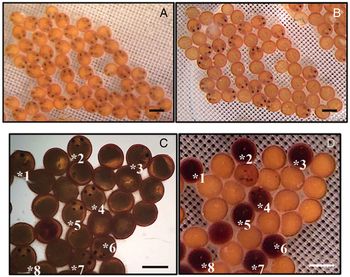
Increasing water salinity had a negative effect on both development of embryos and their eventual hatch to metanauplii. Embryo contraction from the chorion was initiated day 1 (±2 days) for all eggs that eventually developed to the eyed stage for FW and EST treatments, respectively. Eye formation was initiated on days 18 and 20 and was completed for all eggs that eventually developed to the eyed stage by days 23 and 27 for FW and EST treatments, respectively. Nauplius eye formation was initiated on days 22 and 24 and was completed by days 26 and 40 for FW and EST treatments, respectively. An average of 94.4% (90.4–96.6%; Fig. 8A) and 61.7% (36.9–86.1%; Fig. 8C) of eggs completed nauplius eye formation and became fully developed embryos in FW and EST treatments, respectively. Eggs maintained in SW did not develop into discernable embryos (data not shown).
Images show embryonic development of Argulus canadensis in eggs maintained in 0 ppt water (FW) and 17 ppt diluted seawater (EST). A high proportion of embryos developed successfully at 0 ppt (A) whereas development to eyed embryos occurred in a lower proportion of eggs in water at 17 ppt (C). Metanauplius survival at day 213 after egg-laying, following a 33-day cold diapause treatment (7 °C), was ~100% in FW (B). However, all embryos were dead or dying by this same time in eggs maintained in water at 17 ppt (D). Development was greatly restricted in eggs maintained in full-strength seawater (34 ppt) with no evidence of discernable embryo development in any egg (data not shown). Lines in the lower right corner of each image represent scale bars of 0.4 mm.

Following the completion of larval development of A. canadensis to eyed embryos, eggs from FW and EST treatments (Fig. 8A and C) were maintained and monitored at room temperature for an additional 102 days. In total, 10.1% (4.8–19.6%) of A. canadensis metanauplii hatched from eggs in EST treatments but no hatches were recorded from eggs in FW treatment during this time. However, 53.3% (32.4–77.4%) of embryos remaining in EST treatment eggs were dead or dying by day 102 but no such change was observed for embryos from FW treatment eggs. Following maintenance at room temperature, A. canadensis eggs were exposed to 33 days of cold temperature treatment at 7 °C. Following re-acclimation to room temperature, 55.8% (50–64.3%) of FW treatment eggs hatched live metanauplii (Fig. 8B), with peak hatch occurring 7 days after cold treatment. The remaining 44.2% (35.7–50%) of eggs in freshwater appeared live (Fig. 8B) whereas all embryos remaining in eggs in EST treatment water were dead or dying (Fig. 8D). No successful hatches of metanauplii were recorded from EST treatment eggs following cold temperature treatment.
Discussion
Our initial attempts to hatch metanauplii from A. canadensis eggs were unsuccessful. In spite of embryonic development to pharate embryos by 35 days after laying (21 °C), hatch was highly protracted with only ~3% hatch by 150 days and ~23% by 230 days after laying. This is incompatible with many reports of hatch times for Argulus spp. but was compatible with observations of the highly protracted hatch for congeneric species in temperate regions (Pasternak et al., Reference Pasternak, Mikheev and Valtonen2000; Hakalahti et al., Reference Hakalahti, Hakkinen and Valtonen2004a). Increasing daily photoperiod and rising water temperatures signify annual completion of winter and emergence of spring, thus cueing migrations of anadromous fishes like Atlantic salmon (Migaud et al., Reference Migaud, Davie and Taylor2010) and hatch of some crustaceans (Gyllstrom and Hansson, Reference Gyllstrom and Hansson2004). This includes congeneric Argulus species following cold temperature dormancy (Hakalahti et al., Reference Hakalahti, Hakkinen and Valtonen2004a). Hatch of A. canadensis eggs was similarly induced and synchronized following cold-treatment and return to favourable temperatures. High-efficiency hatch of A. canadensis occurs only following termination of diapause by extended cold-temperature exposure (⩾75 days). Such evolutionarily-derived reproductive strategies in parasites often determine their potential for spatiotemporal interactions with a host (Wimberly et al., Reference Wimberly, Yabsley, Baer, Dugan and Davidson2008; Loot et al., Reference Loot, Poulet, Brosse, Tudesque, Thomas and Blanchet2011).
For many parasites, host availability and encounter are considered somewhat random, but essential for survival (Hakalahti et al., Reference Hakalahti, Hakkinen and Valtonen2004a, Reference Hakalahti, Pasternak and Valtonen2004b). Newly hatched Argulus metanauplii must attach to a host quickly as they survive free swimming for only 2–5 days (Pasternak et al., Reference Pasternak, Mikheev and Valtonen2000; Hakalahti et al., Reference Hakalahti, Bandilla and Valtonen2005; Mikheev et al., Reference Mikheev, Pasternak and Valtonen2007). Fecundity can be selected upon to improve odds for host encounter (Poulin, Reference Poulin1995) but synchrony in host-parasite life cycles can promote encounters in space and time for successful infection/infestation (Calero-Torralbo and Valera, Reference Calero-Torralbo and Valera2008). In spite of egg hatch occurring at fixed times following development for numerous species (Stewart et al., Reference Stewart, Jackson, Barber, Eizaguirre, Paterson, van West, Williams and Cable2017), hatch by some parasites relies upon direct (Warkentin, Reference Warkentin2011) or indirect cues that reflect host availability (Calero-Torralbo and Valera, Reference Calero-Torralbo and Valera2008; Warkentin, Reference Warkentin2011). Egg hatch stimulated by abiotic conditions or biotic cues that favour larval survival is referred to as environmentally-cued hatching (Warkentin, Reference Warkentin2011). In absence of appropriate environmental hatching cues, embryos that hatch early could die before suitable hosts are available, whereas those that delay hatch too long can die after exhaustion of energy reserves (Warkentin, Reference Warkentin2011; Wei et al., Reference Wei, Luo, Shi, Wang and Shen2014). Mechanisms for maintenance of egg dormancy are crucial to fitness with selection favouring individuals that emerge coincident with resource/host availability.
Quiescence represents physiological conformity to unfavourable environmental conditions and includes developmental processes restricted by cold temperatures. Conversely, diapause occurs when growth, development, or hatch do not occur at times when suitable conditions (i.e. temperature) support these processes. Diapause is a cessation of physiological processes, seemingly in anticipation of upcoming unfavourable conditions (Hand et al., Reference Hand, Denlinger, Podrabsky and Roy2016). For some temperate invertebrates, cold temperatures terminate diapause during winter, larval reactivation is positively correlated with increasing spring temperatures, and hatch generally is synchronized with food/host availability (see Calero-Torralbo and Valera, Reference Calero-Torralbo and Valera2008; Hodkinson, Reference Hodkinson2009; Wei et al. Reference Wei, Luo, Shi, Wang and Shen2014). Diapause is controlled by a combination of genetic and environmental factors, often viewed as a fitness advantage to avoid harsh environmental conditions (Gyllstrom and Hansson, Reference Gyllstrom and Hansson2004). The adaptive value of diapause includes synchrony of reactivation with the return of favourable conditions (Saunders, Reference Saunders2020), whereby abiotic factors indirectly signal food availability. Similar egg diapause is reported for Argulus species in temperate regions (Meehean, Reference Meehean1940; Shafir and Van As, Reference Shafir and Van As1986; Pasternak et al., Reference Pasternak, Mikheev and Valtonen2000; Mikheev et al., Reference Mikheev, Pasternak, Valtonen and Lankinen2001; Hakalahti et al., Reference Hakalahti, Hakkinen and Valtonen2004a). Overwintering eggs are the only surviving members in these parasite populations (Shimura, Reference Shimura1983; Mikheev et al., Reference Mikheev, Pasternak, Valtonen and Lankinen2001; Hakalahti and Valtonen, Reference Hakalahti and Valtonen2003) and larval hatch occurs once water temperatures warm in spring (Taylor et al., Reference Taylor, Wootten and Sommerville2009; Mikheev et al., Reference Mikheev, Pasternak and Valtonen2015). Our observations are compatible with these temperate Argulus species where eggs overwinter for extended periods and show synchronized hatch upon return to favourable temperatures (Mikheev et al., Reference Mikheev, Pasternak, Valtonen and Lankinen2001; Hakalahti et al., Reference Hakalahti, Hakkinen and Valtonen2004a). Cold temperature diapause termination presumably requires sufficient duration to ensure that only a small fraction of the population emerge if conditions become temporarily ‘suitable’ due to random environmental events, rather than a true change in season that cues resource availability.
Hatches of A. canadensis were best synchronized by cold treatments that mimic overwintering (i.e. ⩾75 days), with hatches synchronized to ~3–4 weeks following acclimation to suitable temperatures. Overwintering congeneric Argulus species show most hatches in spring (Taylor et al., Reference Taylor, Wootten and Sommerville2009; Mikheev et al., Reference Mikheev, Pasternak and Valtonen2015) but hatch of some metanauplii extends into summer (Shimura, Reference Shimura1983; Mikheev et al., Reference Mikheev, Pasternak, Valtonen and Lankinen2001; Hakalahti and Valtonen, Reference Hakalahti and Valtonen2003; Hakalahti et al., Reference Hakalahti, Hakkinen and Valtonen2004a). It was observed that A. canadensis metanauplius hatches were first initiated ⩾9 °C and with hatch induction and synchrony positively correlated with increasing temperature. Cold-temperature treatment terminates diapause and return of favourable temperatures induces hatch of ~86% (72–100%) of eggs. Remarkably similar to A. canadensis is egg diapause demonstrated by terrestrial insects that parasitize one life stage of a migratory bird host, exclusively within their breeding range (Calero-Torralbo and Valera, Reference Calero-Torralbo and Valera2008). These arthropods also show relatively short larval development periods, they enter diapause as pharate embryos, cold exposure terminates diapause, increasing temperature induces physiological activation and hatch is synchronized with host availability (see Calero-Torralbo and Valera, Reference Calero-Torralbo and Valera2008; Hodkinson, Reference Hodkinson2009; Wei et al. Reference Wei, Luo, Shi, Wang and Shen2014).
Argulus canadensis metanauplius hatch is induced/synchronized by extended cold treatment and return of favourable temperatures but protracted hatch of ~75% of eggs eventually occurs at constant favourable temperatures. This phenomenon is similarly documented for congeneric species in temperate regions (Pasternak et al., Reference Pasternak, Mikheev and Valtonen2000; Hakalahti and Valtonen, Reference Hakalahti and Valtonen2003; Hakalahti et al., Reference Hakalahti, Hakkinen and Valtonen2004a). Most eggs are refractory to hatch for 3–5 months in spite of favourable temperatures (Pasternak et al., Reference Pasternak, Mikheev and Valtonen2000; Hakalahti et al., Reference Hakalahti, Hakkinen and Valtonen2004a; and, the current study). The linear hatch of >70% of diapausing eggs then occurs over the subsequent 5–6 months even without cold temperature diapause termination (Pasternak et al., Reference Pasternak, Mikheev and Valtonen2000; Hakalahti et al., Reference Hakalahti, Hakkinen and Valtonen2004a). The requirement for cold temperature to terminate diapause is accordingly time-limited. Diversified diapause length among dormant eggs that promotes extended hatching to ensure the survival of at least some in the cohort is known as bet hedging (Slusarczyk et al., Reference Slusarczyk, Chlebicki, Pijanowska and Radzikowski2019). Delayed hatch by some individuals in congeneric Argulus populations is bet hedging to increase odds of successful infestation during periods of environmental stochasticity or suboptimal host availability (Pasternak et al., Reference Pasternak, Mikheev and Valtonen2000; Mikheev et al., Reference Mikheev, Pasternak, Valtonen and Lankinen2001). We provide evidence supporting both inter- and intra-cluster bet hedging. Protracted hatch by A. canadensis was most commonly observed in eggs lacking cold temperature termination of diapause but further illustrates bet hedging to increase odds for host encounter in the absence of environmental cues.
Diapause was once considered obligate for gypsy moths (Leonard, Reference Leonard1968) but subsequent studies support substantial plasticity across their range (Keena, Reference Keena2016). Some diapausing insects are univoltine in cold parts of their range but multivoltine elsewhere (see Hodkinson, Reference Hodkinson2009). Similar plasticity likely pertains for biological rhythms in host/parasite relationships. The capacity for bet hedging by Argulus spp. supports tremendous plasticity following introduction to non-endemic regions (Avenant-Oldewage, Reference Avenant-Oldewage2001) and during an environmental change in endemic regions (Hakalahti et al., Reference Hakalahti, Karvonen and Valtonen2006). Environmental change and plasticity in biological rhythms can alter relationships such that host/parasite interactions are promoted/inhibited for a given species (Kharouba et al., Reference Kharouba, Ehrlén, Gelman, Bolmgren, Allen, Travers and Wolkovich2018). Diapause is not observed in temperate Argulus species introduced to warmer climes (Shafir and Van As, Reference Shafir and Van As1986). Bet hedging by eggs of A. canadensis and congeneric species held at constant suitable temperatures support their establishment in warmer environments where suitable hosts exist. Diapause is not displayed by tropical Argulus species in their native range but the potential is demonstrated for use diapause in temperate conditions (Shafir and Van As, Reference Shafir and Van As1986; Sahoo et al., Reference Sahoo, Mohanty, Hemaprasanth, Mohanty, Garnayak and Jena2012). Observations from gypsy moths support a genetic basis underlying bet hedging and diapause with variation in regional hatch phenotypes and rapid selection following environmental change (Keena, Reference Keena2016).
Physiological mechanisms for bet hedging in invertebrates remain unknown but sequential degradation of a differentially allocated, maternally-derived, molecule is proposed (Slusarczyk et al., Reference Slusarczyk, Chlebicki, Pijanowska and Radzikowski2019). This is compatible with protracted but linear hatch by Argulus spp. in absence of overwintering (Pasternak et al., Reference Pasternak, Mikheev and Valtonen2000; Hakalahti et al., Reference Hakalahti, Hakkinen and Valtonen2004a; current study). Gray et al. (Reference Gray, Logan, Ravlin and Carlson1991) describe dynamic thermal responses with young insect eggs less sensitive to isolated warming events, presumably to prevent hatch prior to true seasonal warming that promotes survival. Conversely, older, more physiologically advanced eggs, become more responsive to temperature cues over time and are induced to hatch by these same temperatures once spring arrives (Gray et al., Reference Gray, Ravlin, Régnière and Logan1995; Gray, Reference Gray2009). Such age-dependent differences are compatible with observations of temperate Argulus spp. (Pasternak et al., Reference Pasternak, Mikheev and Valtonen2000; Hakalahti et al., Reference Hakalahti, Hakkinen and Valtonen2004a; current study).
Empirical investigations on parasites often require large numbers produced over a short time. Gravid parasites are observed on migrating wild salmon predominantly over a 6-week period from mid-June through early August each year (unpublished data). Water temperatures in the St. John River support egg development to hatch-ready embryos by early September. Failure of eggs to hatch under apparently favourable temperatures in the laboratory prompted investigations of diapause. Previous studies of congeneric Argulus species show hatch is prevented below 10 °C (Shimura, Reference Shimura1983), others report hatching at 8–10 °C (Pasternak et al., Reference Pasternak, Mikheev and Valtonen2000; Mikheev et al., Reference Mikheev, Pasternak, Valtonen and Lankinen2001) and we observed 23% egg hatch at 9 °C. We exposed A. canadensis eggs containing pharate hatch-ready embryos to cold temperature conditions (<7 °C) to terminate diapause and then manipulated temperatures to both induce and synchronize larval hatch to acquire sufficient parasite numbers in support of empirical investigations. Our maintenance of hatch-ready embryos ⩽7 °C permits storage and extends egg viability to 2.5 years with the induction of metanauplius hatches following return to favourable temperatures. Egg viability might persist longer but was not assessed. Whereas cold storage of eggs at earlier developmental stages could promote longer survival, early gypsy moth embryos subjected to cold temperatures can show impaired viability (Bell, Reference Bell1996). Diapausing pharate embryos of Argulus species likely possess low respiration rates, similar to insects (Gray et al., Reference Gray, Logan, Ravlin and Carlson1991), to promote such extended survival.
Abiotic factors influence animal life history with physiological adaptations determining spatiotemporal distribution in the environment. Whereas temperatures vary widely in temperate regions, salinity is relatively constant over time but with spatial variability. For host/parasite interactions, additional complexity exists when parasites have restricted environmental tolerance (i.e. salinity) and their host is both migratory and in specific locations for only short periods. Eggs of A. canadensis fail to initiate development in full strength seawater but the majority developed successfully in estuarine conditions. Embryos of stenohaline freshwater crustaceans typically die before hatch at 7 ppt (Holdich et al., Reference Holdich, Horlioglu and Firkins1997; Susanto and Charmantier, Reference Susanto and Charmantier2001). In total, 11% of A. canadensis eggs hatched live metanauplii at 17 ppt but remaining A. canadensis embryos were unable to hatch and/or died, presumably following depletion of resources. A rapid decrease in the osmolality of periembryonic fluid (Susanto and Charmantier, Reference Susanto and Charmantier2001) occurs due to a change in the inner egg membrane of freshwater crustaceans, including Argulus sp. (Davis, Reference Davis1966), immediately prior to hatch (Davis, Reference Davis1959). A hyposaline freshwater environment promotes water influx and swelling of freshwater crustacean eggs late in embryonic development to induce hatch (Susanto and Charmantier, Reference Susanto and Charmantier2001). Hatch often cannot occur in hyperosmotic solutions due to the absence of an osmotic differential that promotes rapid water influx (Davis, Reference Davis1959; Katre and Pandian, Reference Katre and Pandian1972). Eggs containing hatch-ready embryos at ⩾17 ppt failed to hatch following cold exposure, despite the return to favourable temperatures. Impaired egg development and hatch support A. canadensis as predominantly freshwater parasites with Atlantic salmon likely becoming infested upstream of saltwater influence during return to freshwater systems for spawning. To our knowledge, this is the first assessment of the effect of salinity on Argulus eggs.
Conclusion
Argulus canadensis eggs develop to pharate hatch-ready embryos and likely enter diapause to forego costs of winter survival and limited host availability. Cold winter temperatures terminate diapause to facilitate ectoparasite hatch with increasing water temperatures, hatches are synchronized to ~3–4 weeks following return of favourable conditions and some individuals within an egg cluster are less reliant on the need for cold to terminate diapause (i.e. bet hedging). Phenological synchrony of the A. canadensis life cycle likely promotes spatiotemporal colocalization of metanauplii with their preferred Atlantic salmon definitive host in the St. John River. Similar diapause in temperate congeneric Argulus spp. (Pasternak et al., Reference Pasternak, Mikheev and Valtonen2000; Mikheev et al., Reference Mikheev, Pasternak, Valtonen and Lankinen2001; Hakalahti et al., Reference Hakalahti, Hakkinen and Valtonen2004a) and in some temperate insects (see Calero-Torralbo and Valera, Reference Calero-Torralbo and Valera2008; Hodkinson, Reference Hodkinson2009; Wei et al., Reference Wei, Luo, Shi, Wang and Shen2014) also afford phenological synchrony with their preferred food source/host. Variation in hatch time of individual eggs (inter- and intra-cluster) is likely a mechanism for bet hedging in the event that environmental change impacts phenology. Whereas examples of this egg diapause phenomenon are rare in other crustacean ectoparasites, it is of obvious importance for short-lived parasites such as Argulus, and especially so for univoltine species that occur in temperate regions. Observations of phenology for A. canadensis might be best viewed as one moment in time but with plasticity persisting to accommodate environmental stochasticity.
Acknowledgements
The authors thank Department of Fisheries and Oceans (DFO) Canada for in-kind contributions including use of facilities and personnel support for ectoparasite collection from wild migrating Outer Bay of Fundy Atlantic salmon. Specifically, we thank John Whitelaw and Ross Jones for access to the DFO Mactaquac Biodiversity Facility and the Nashwaak River Counting Fence, as well as support from their dedicated staff who kindly coordinated parasite collections (Leroy Anderson, Stephanie Ratelle, Cindy Hawthorne, Sarah Tuziak, and Becky Graham) and to all of their technical personnel who aided our collections. We thank Wendy Monk for her patience and assistance with statistical analyses, and for providing helpful advice and comments on the manuscript. Undergraduate summer students Brady Gillam and Stephanie Scott provided helpful assistance with both experimental set up and data collection. We thank anonymous reviewers for providing helpful comments and suggestions.
Financial support
This project was funded by grants from the Atlantic Salmon Conservation Foundation (M.S.D., grant number NB-2016-15); the Partnerships and Priorities Fund of the DFO Canada (M.S.D., grant number 132661); the New Brunswick Wildlife Trust Fund (M.S.D., grant number F327-045); and, the New Brunswick Department of Post-Secondary Education, Training and Labour SEED Program (M.S.D., grant number 00162800). Additional graduate student financial support was provided by the University of New Brunswick via Graduate Research and Graduate Teaching Assistantships, and by the Michael D.B. Burt Memorial Scholarship (T.J.L.).
Conflict of interest
The authors declare there are no conflicts of interest.
Ethical standards
Not applicable.