Implications
Tall fescue (TF) and reed canary grass (RCG) are highly productive grasses with important value as forages. Problems arise when alkaloids in these grasses decrease animal intake and performance, in turn decreasing economic efficiency, yet the lack of these compounds negatively affects plant persistence and survival (Asay et al., Reference Asay, Jensen and Waldron2001). Results from this study suggest possibilities for developing pastures and grazing systems that incorporate a variety of complementary plant species with different secondary compounds to increase both plant survivability and livestock productivity when dealing with forages such as TF and RCG.
Introduction
Our understanding of the interaction between plants and herbivores has evolved from a focus on plant structure and nutrients to a growing appreciation for so-called secondary compounds (SC), which limit how much of any particular plant species an herbivore can eat (Provenza, Reference Provenza2003). Interactions among foods that contain SC can lead to complementary relationships such that eating a combination of foods may exceed the benefit of consuming any one food in isolation (Freeland and Janzen, Reference Freeland and Janzen1974; Tilman, Reference Tilman1982). Birdsfoot trefoil (BFT) contains condensed tannins and compounds that bind to proteins in the rumen (Jones and Mangan, Reference Jones and Mangan1977). Alfalfa (ALF) contains saponins, which bind to cholesterol in the gastrointestinal tract causing their excretion in the feces (Malinow et al., Reference Malinow, McLaughlin, Stafford, Livingston, Kohler and Cheeke1979). Reed canarygrass (RCG) and tall fescue (TF) contain alkaloids that are, respectively, either nitrogen-based or steroidal in nature. We thus hypothesized that including either tannin-containing BFT or saponin-containing ALF in the diets of cattle would help neutralize the impact of alkaloids and increase foraging on fescue or RCG, respectively.
On the basis of these hypotheses, we predicted that cattle that ate high-alkaloid varieties of RCG or TF would graze more frequently on high-tannin varieties of BFT or high-saponin varieties of ALF, respectively, than when grazing on low-alkaloid grass varieties (Phase 1). We further predicted that cattle would graze more frequently on high-alkaloid TF and high-alkaloid RCG, respectively, when they first ate legumes high in saponins (ALF+) or tannins (BFT+; Phase 2).
Material and methods
Pasture design
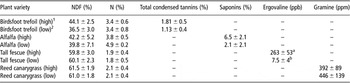
Plant varieties known to have high or low concentrations of alkaloids, tannins and saponins were seeded at the Utah Agricultural Experiment Station Pasture research facility in Lewiston, Utah (41′57 N. 111′52 W). The varieties we seeded were similar to those cited in the following references. In 2006, we planted replicated monocultures of TF (Festuca arundinaceum, Kentucky 31 endophyte-infected and endophyte-free TFs; Rottinghaus et al., Reference Rottinghaus, Garner, Creighton and Ellis1991; Aldrich et al., Reference Aldrich, Paterson, Tate and Kerley1993) and RCG (Phalaris arundinacea L. varieties v.n.s. and palaton) high (+) and low (−) in alkaloids, respectively (Marten, Reference Marten1972; Sheaffer et al., Reference Sheaffer, Peterson and Ehlke1990); BFT (Lotus corniculatus varieties Goldie and Norcen) high (+) and low (−) in tannins, respectively (Terrill et al., Reference Terrill, Rowan, Douglas and Barry1992; Hedqvist et al., Reference Hedqvist, Muller-Harvey, Reed, Krueger and Murphy2000); and ALF (Medicago sativa varieties Vernal and Lahontan) high (+) and low (−) in saponins, respectively (Pedersen, Reference Pedersen1975; Pedersen et al., Reference Pedersen, Barnes, Sorensen, Griffin, Nielson, Hill, Grosheiser, Sonoda, Hanson, Hunt, Peaden, Elgin, Devine, Anderson, Goplen, Elling and Howarth1976; Table 1). TF (+) showed higher concentrations of ergovaline than TF (P < 0.05). However, concentrations of gramine did not differ between varieties of RCG (P > 0.10). Concentrations of condensed tannins in BFT+ were almost 2 × the concentrations of BFT− (P = 0.0879), and concentrations of saponins in ALF+ were 3 × the concentrations of ALF– (P = 0.1847; Table 1).
Plant chemical analyses (means ± s.e.) for NDF, N, alkaloids (RCG (Gramine) and TF (Ergovaline)), tannins (BFT) and saponins (ALF)

N = nitrogen; RCG = reed canarygrass; TF = tall fescue; BFT = birdsfoot trefoil; ALF = alfalfa; SC = secondary compounds.
1Variety with high concentrations of condensed tannins (BFT, Lotus corniculatus variety Goldie), saponins (ALF, Medicago sativa variety Vernal) and alkaloids (ergovaline: TF, Festuca arundinaceum, Kentucky 31 endophyte-infected; gramine: RCG, Phalaris arundinacea L. variety v.n.s).
2Variety with low concentrations of condensed tannins (BFT, L. corniculatus variety Norcen), saponins (ALF, M. sativa variety Lahontan) and alkaloids (ergovaline: TF, F. arundinaceum, Kentucky 31 endophyte-free; gramine: RCG, P. arundinacea L. variety palaton).
abSpecies that showed differences in SC concentration between varieties at P < 0.0001.
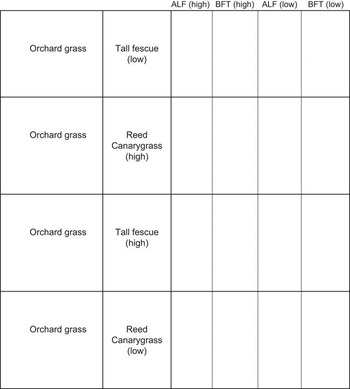
We seeded four replications of four pasture combinations that consisted of a 0.1 ha grass plot with either TF+, TF−, RCG+ or RCG−, and a 0.16 ha legume choice plot, where ALF+, ALF−, BFT+ and BFT− were planted in adjacent monoculture strips. Cattle had free access to all legumes when in the legume choice plots (Figure 1). We also seeded 4.5 ha of orchard grass (OG) as holding areas for the grass and legume plots. Plots were constructed using temporary electric fencing.
Plot layout for Phases 1 and 2 of the study.

Chemical composition of the forages
Representative forage samples (10 randomly collected individual plants along a paced transect across each pasture) from the four replications of each SC × grass treatment combination were hand-harvested at 25 to 50 mm above ground level (grazing height) at the end of the study, placed in plastic bags covered with dry ice immediately after harvest and transported to a freezer where they were kept at −20°C. They were subsequently freeze dried, ground through a Wiley mill with a 1-mm screen and analyzed for NDF (all samples; Goering and Van Soest, Reference Goering and Van Soest1970), nitrogen (all samples; Method 990.03; Association of Official Analytical Chemists, 2002), condensed tannins (BFT; Terrill et al., Reference Terrill, Rowan, Douglas and Barry1992), saponins (ALF; Lee et al., Reference Lee, Stegelmeier and Gardner2001), ergovaline (TF; Rottinghaus et al., Reference Rottinghaus, Garner, Creighton and Ellis1991) and gramine (RCG; Anderton et al., Reference Anderton, Cockrum, Colegate, Edgard and Flower1999). Although plants were harvested at grazing height, primary and SC were not distributed evenly throughout the plants, which may have influenced the chemical analysis of plant species and animal grazing behavior. We harvested plant parts that most reflected observed grazing behavior.
Grazing trials
Thirty-two fall-born Angus calves (269 kg ± 6 kg initial BW) were used for both the trials. Steers and heifers (2 calves per pasture) were randomly assigned to each of the 16 pastures of TF (n = 8) or RCG (n = 8) with high (n = 4) or low (n = 4) concentrations of alkaloids. During daily trials, cattle were moved from OG holding areas to the experimental pastures. Animals were then moved back to the OG until the next day. Forages were in the vegetative stage at heights of 20 to 30 cm. Calves were weighed before and after the study to estimate changes in BW during the two 12-day trials described below. All procedures followed the protocols for animal care and use (IACUC protocol approval number 1270).
Phase 1
The objective of this trial was to determine whether cattle consuming high-alkaloid varieties of grasses subsequently grazed more of BFT+ and ALF+ than BFT− and ALF−, presumably to reduce the negative effects of alkaloids, than animals grazing low-alkaloid varieties of the same grasses. Cattle grazed on either high- or low-alkaloid grass (TF or RCG) pastures for 30 min each morning at 0600 h, and were then offered a choice of BFT+ or BFT− and ALF+ or ALF− pastures for 60 min each day for 12 days. Four replications of four treatment combinations were used: (1) TF+ or TF− with a choice of ALF+ and ALF−, BFT+ and BFT− and (2) RCG+ or RCG− with a choice of ALF+, ALF−, BFT+ and BFT− (Figure 1).
Phase 2
The objective of this trial was to determine whether cattle that first consumed legumes high in SC (ALF+ and BFT+) spent more time foraging on grasses (TF+ and TF− and RCG+ and RCG−). As no differences in forage use were observed between BFT+ or BFT− and ALF+ or ALF− during Phase 1, only the legume varieties containing high amounts of SC were offered in Phase 2, as preference for variety (ALF v. BFT) appeared more influential than preference for SC concentration. Thus, cattle were first offered BFT+ and ALF+ for 30 min at 0600 h and then placed on either high- or low-alkaloid grass (TF or RCG) pastures for 60 min for 12 days.
Once again, four replications of four treatment combinations were used: (1) ALF+ and BFT+ followed by TF+ or TF− and (2) ALF+ and BFT+ followed by RCG+ or RCG− (Figure 1). The cattle used in Phase 1 were used in Phase 2, and they remained in the same pasture units, and thus we could observe whether changing sequence changed their behavior. Cattle were moved from adjacent OG holding pastures to trial pastures for their morning meals, and after grazing the sequences they were moved back to OG pasture, where they had free access to salt, mineral supplement and water, until the next day.
Scan samples
In both phases of the study, one observer recorded whether each animal was grazing and the forage species they were eating using scan samples of the 32 individually marked animals at 2-min intervals throughout each daily trial (Altman, Reference Altman1974). Scans were taken from a 2 m high platform centrally located to enable the observer to see which forage each of the animals was grazing. Animals were considered to be grazing only when they were actually biting and chewing forage; no grazing scan was given if the animal merely had its head in the sward. We then calculated the percent of scans each animal spent grazing each forage each day.
Statistical design
The statistical design for ANOVA for Phase 1 had four replications of two treatments, whole plot factors were SC concentration (high–low) and grass (TF or RCG) in a 2 × 2 factorial randomly assigned to pastures within replicates. The sub-plot factor was legume, assigned in spatial sequence to strips within pastures. The repeated measure was day (n = 12). The response variables were percent of scans for each individual foraging on each plant species each day.
The statistical design for ANOVA for Phase 2 had four replications of two treatments, either high-tannin BFT or high-saponin ALF assigned to pastures within replicates. The sub-plot factor was grass, either TF+ or RCG+, assigned in spatial sequence to strips within pastures. The repeated measure was day (n = 12). The response variables were percent of scans for each individual foraging on each plant species each day.
We also measured changes in BW at the beginning of Phase 1 and at the end of Phase 2.
Results
Chemical composition of forages
Within a species, the different varieties of grasses and legumes were generally similar in concentrations of NDF and N (Table 1). Grass species averaged 60% fiber and 2% N, whereas legume species averaged 40% fiber and 3% to 5% N (Table 1). Endophyte-infected and endophyte-free TF differed in concentrations of alkaloids (263 v.<30 ppb ergovaline; P < 0.0001); however, high- and low-alkaloid varieties of RCG did not differ (392 v. 446 ppm gramine; P = 0.3643; Table 1). High- and low-tannin varieties of BFT tended to differ in concentrations of tannins (1.81 v. 1.13%; P = 0.0879), as did high- and low-saponin varieties of ALF (6.5% v. 2.1%; P = 0.1847; Table 1).
Phase 1: grass → legume choice
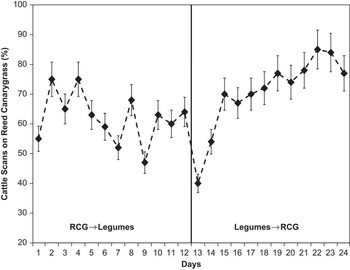
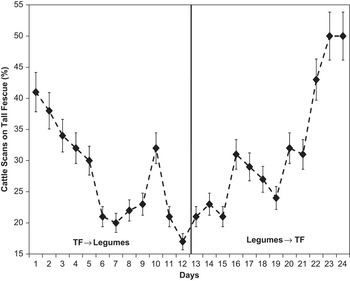
Grass: cattle spent more scans (%) grazing RCG than TF (62% v. 27% averaged across high- and low-alkaloid varieties; P = 0.0015). They did not differ in scans (%) on high- and low-alkaloid varieties of TF (24% v. 31%, respectively; P = 0.3448), and the same was true for high- and low-alkaloid varieties of RCG (66% v. 59%, respectively; P = 0.3448). Cattle consistently cycled (four complete cycles) in % scans foraging on RCG (Figure 1), but they steadily decreased % scans foraging on TF during the 12-day trial (P = 0.0029; Figures 2 and 3).
Average percent scans cattle spent grazing reed canarygrass (RCG) during Sequence 1 (RCG → L) and Sequence 2 (L → RCG). During Sequence 1, cattle first grazed high- or low-alkaloid RCG for 30 min and were then given a choice of high- and low-saponin alfalfa or high- and low-tannin birdsfoot trefoil (BFT) for 60 min (L). During Sequence 2, the order was reversed and cattle were first given a choice of ALF+ or BFT+(L) for 30 min before foraging on high- or low-alkaloid RCG pastures for 60 min. Bars are standard errors.

Average percent scans cattle spent grazing tall fescue (TF) during Sequence 1 (G → L) and Sequence 2 (L → G). In Sequence 1, cattle first grazed either high- or low-alkaloid TF for 30 min and were then given a choice of high- and low-saponin alfalfa or high- and low-tannin birdsfoot trefoil (BFT; L) for 60 min. In Sequence 2 (L→ TF), cattle first grazed either high-saponin alfalfa or high-tannin BFT (L) for 30 min before being offered a choice of high- or low-alkaloid TF for 60 min. Bars are standard errors.

Legume choice
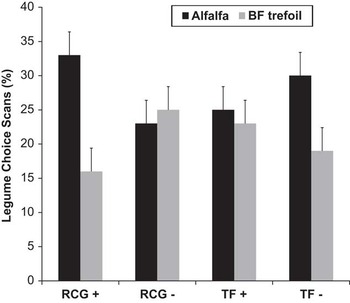
Cattle did not differ in scans (%) on high- and low-saponin varieties of ALF or high- and low-tannin varieties of BFT (P = 0.7105); however, they did differ in preference for ALF and BFT when high- and low-varieties were averaged together for each legume. Cattle that first grazed RCG+ subsequently preferred ALF (+ and −) over BFT (+ and −; 33% v. 16%; P = 0.0065), whereas cattle that first grazed RCG− did not prefer ALF (+ and −) over BFT (+ and −; 23% v. 25%; P > 0.05; Figure 4). Cattle that first grazed RCG+ spent more scans foraging on ALF than cattle that first grazed RCG− (33% v. 23%; P = 0.0065; Figure 3). Conversely, cattle that first grazed TF+ equally preferred ALF and BFT (25% v. 23%, P > 0.05); cattle that first grazed TF− preferred ALF over BFT (30% v. 19%; P = 0.0065). Cattle that first grazed TF+ foraged more on BFT (+ and −) than cattle that first grazed TF− (23% v. 19%; P = 0.0065; Figure 4). Thus, only TF+ caused a shift away from ALF to greater use of BFT.
Average percent scans cattle spent grazing alfalfa and birdsfoot trefoil after grazing high (+) and low (−) alkaloid reed canarygrass or tall fescue in Sequence 1. Bars are standard errors.

Across all groups, cattle offered BFT (+ and −) and ALF (+ and −) preferred BFT+ (36%) followed by ALF− (29%) and ALF+ (26%) and they least preferred BFT− (6%; P < 0.0001). Cattle that first foraged on RCG+ and TF− subsequently preferred ALF over BFT, whereas cattle offered RCG− and TF+ foraged on ALF and BFT equally (Figure 3). Cattle spent the least scans foraging on BFT− (6%), which reduced overall preference for BFT (P < 0.0001).
Phase 2: high PSC legumes → grass
Grass: as in Phase 1, cattle spent much more time (% of scans) grazing RCG than TF (71% v. 32%; P = 0.0005). Again, no differences were observed between high- and low-alkaloid varieties of TF (TF+ 29%, TF− 35%) or RCG (RCG+ 75% and RCG− 66%; P = 0.3242). All groups grazed less on grasses at the beginning of the trial than on legumes at the end of the trial (31% v. 63%; P < 0.0001). One of the most striking findings of the study was that cattle grazing RCG and TF consistently increased the percentage of scans grazing throughout Phase 2 as opposed to Phase 1 of the study (P = 0.0159; Figures 2 and 3).
Legume choice
Cattle grazing TF preferred BFT (+ and −) over ALF (+ and −; 56% v. 44%; P = 0.0868), whereas cattle grazing RCG preferred ALF (+ and −) over BFT (+ and −; 50% v. 44%; P = 0.0868).
Variation among individuals
Individual differences play an important role in grazing preferences, yet they are rarely mentioned in our focus on means (Provenza et al., Reference Provenza, Villalba, Dziba, Atwood and Banner2003). During Phase 1, cattle drastically decreased scans grazing TF, whereas they did the opposite in Phase 2, but how quickly that happened varied by individual. Some individuals, both within and among groups, began to sample and graze TF as soon as day 3 of Phase 2, whereas others continued to avoid the plant altogether even on day 12. Cyclical patterns of grazing were common for each individual, with grazing behavior varying from day to day. When ingesting foods high in SC, intakes are cyclical as individuals eat high amounts of particular forage one day and low amounts of the forage the next day (Provenza, Reference Provenza1996; Pfister et al., Reference Pfister, Provenza, Manners, Gardner and Ralphs1997).
Weight gains
Cattle gained an average of 1.45 ± 0.48 kg/head per day during the 24 days of these trials. No bloat symptoms, or indications of health issues, were observed at any time during the studies.
Discussion
We determined whether plant diversity and foraging sequence enhanced time spent foraging when cattle ate forages that varied in concentrations of alkaloids, tannins and saponins. In general, findings from this study are consistent with the hypothesis that plant diversity and sequence of plant ingestion both affect food selection. These findings are also consistent with a follow-up study of heifers offered more limited choices (Lyman et al., Reference Lyman, Provenza, Villalba and Wiedmeier2010), which built upon the results of this study.
Foraging complementarities in Phases 1 and 2
Saponins bind to steroidal structures such as those found in RCG and TF, and tannins bind with nitrogen-containing compounds such as alkaloids (Jones and Mangan, Reference Jones and Mangan1977; Malinow et al., Reference Malinow, McLaughlin, Stafford, Livingston, Kohler and Cheeke1979). Thus, we predicted that cattle grazing high-alkaloid varieties of RCG and TF would preferentially spend more scans (%) grazing high-tannin BFT or high-saponin ALF when given a four-way choice of high- and low-saponin ALF and high- and low-tannin BFT. Although the varieties of RCG we studied did not differ in concentrations of NDF, N or alkaloids, cattle that first grazed the ‘high-alkaloid’ variety of RCG spent more scans (%) eating ALF than cattle that first grazed the ‘low-alkaloid’ variety of RCG (33% v. 23%; Figure 4). Although RCG contains alkaloids such as gramine, which in too high concentrations reduce forage intake, all commercially available varieties of RCG have been selected for low concentrations of alkaloids that do not adversely affect forage intake (Marten, Reference Marten1972; Lyman et al., Reference Lyman, Provenza and Villalba2008). Although the concentration of gramine we measured in our samples did not differ between the two varieties of RCG used in this study, other alkaloids not measured could have accounted for the different foraging responses observed between the two varieties.
Cattle spent much more time grazing both varieties of RCG than TF throughout the trials, which is consistent with the notion that the kinds and concentrations of alkaloids in RCG less adversely affected time spent foraging than those in TF (Phase 1 – 62% v. 27%; Phase 2 – 71% v. 32%; P = 0.0005; Figures 2 and 3). Cattle that first grazed TF+ spent more time foraging on BFT than cattle that first grazed TF− (23% v. 19%; Figure 4), which suggests that cattle may have benefitted more from tannins in BFT+ when they ingested alkaloids in TF+.
Foraging sequences in Phases 1 and 2
We also hypothesized that the time spent grazing would decrease over a 12-day trial if cattle received no benefit from ingesting forages with tannins and saponins after eating forages with alkaloids. By far, the most striking observations in Phase 1 were the cyclic nature of foraging on RCG (4 dramatic cycles; Figure 2) and the steady decrease in foraging on TF such that cattle grazed only 16% of the time by the end of the 12-day trial (Figure 3). The cyclic patterns of foraging on RCG are indicative of transient food aversions, whereas marked decreases in foraging that occurred with TF are typical of a stronger food aversion (Provenza Reference Provenza1995 and Reference Provenza1996). The differences in the strength of the responses to RCG and TF are consistent with the dramatic differences in percent time foraging by cattle on RCG v. TF during Phases 1 (62% v. 27%) and 2 (71% v. 32%).
We hypothesized that first eating high-tannin or high-saponin legumes would enable cattle to eat more high-alkaloid TF and RCG, such that the percentage of scans spent grazing TF and RCG would be greater for Sequence 2 (legumes → grass) than for Sequence 1 (grass → legumes). Contrary to the cyclic (RCG) or steadily declining (TF) use of these grasses during Phase 1, the most important finding in Phase 2 was the dramatic increase in foraging on both RCG and TF, when cattle were first grazed BFT+ and ALF+ and then grazed one or the other of these high-alkaloid grasses.
Complementarities and sequences
Our findings thus support hypotheses related to SC complementarities and sequences, and they are consistent with findings that lambs eat much more TF+ and RCG+ when they are first offered ALF+ or BFT+ for 30 min (Owens et al., Reference Owens, Provenza, Wiedmeier and Villalba2011); however, we do not have direct evidence of SC interactions for cattle in our trials. However, lambs given intraruminal infusions of tannins increase the use of high-alkaloid varieties of TF relative to lambs not infused with tannins; when offered choices among the three high-SC varieties of forages used in our trials, lambs infused with tannins consumed much more TF+ than lambs not infused (Lisonbee et al., Reference Lisonbee, Villalba and Provenza2009; Villalba et al., Reference Villalba, Provenza, Clemensen, Larsen and Junke2011). Obviously, more experimental analyses are necessary to assess the specific effects because of SC specifically, and to better understand higher order interactions among primary and SC in the various forages we used in our trials (Provenza et al., Reference Provenza, Villalba, Dziba, Atwood and Banner2003 and Reference Provenza, Villalba, Landau, Huffman and Cheney2011).
SC in any plant can limit intake below needs for nutrients such as energy and protein, which causes herbivores to eat a variety of plant species that contain different kinds of SC (Freeland and Janzen, Reference Freeland and Janzen1974). Eating a combination of plants with complementary SC can thus be beneficial compared with eating any one SC in isolation (Provenza et al., Reference Provenza, Villalba, Landau, Huffman and Cheney2011). Rats eat more of a combination of foods containing tannins and saponins, evidently because tannins and saponins chelate in the intestinal tract, reducing the negative effects of both components (Freeland et al., Reference Freeland, Calcott and Anderson1985), although such complementarities were not observed with sheep (Burritt and Provenza, Reference Burritt and Provenza2000). When lambs can choose between foods that contain either amygdalin or lithium chloride, they eat more than lambs offered a food that contains only one of these compounds; the same is true with nitrate and oxalate (Burritt and Provenza, Reference Burritt and Provenza2000). Sheep also eat more when offered foods that contain terpenes, tannins and oxalates than when offered foods with only one or two of these SC (Villalba et al., Reference Villalba, Provenza and GouDong2004). Sheep fed either gramine or ergotamine in combination with tannin- or saponin-containing foods had higher intakes of food than sheep offered only foods with gramine or ergotamine (Lyman et al., Reference Lyman, Provenza and Villalba2008). All of these findings are consistent with the hypothesis that SC can complement one another to increase herbivore's intake of ‘unpalatable’ plant species, with the potential to better maintain the nutrition and health of animals and biodiverse landscapes (Provenza, Reference Provenza2008; Provenza and Villalba, Reference Provenza and Villalba2010).
Although complementarities among SC are an important but little understood area of plant–herbivore interactions, even less is known about how the sequences of eating plants with different compounds affects foraging, although they appear to be critical (Provenza et al., Reference Provenza, Villalba, Landau, Huffman and Cheney2011). Sheep eat much more food with terpenes when they first eat food with tannins (Mote et al., Reference Mote, Villalba and Provenza2008). These findings are consistent with landscape-level studies that show ewes with a high preference for sagebrush, a shrub high in terpenes, also consume more bitterbrush, a shrub high in tannins, compared with ewes that have a lower preference for sagebrush (Seefeldt, Reference Seefeldt2005). Consistent with the findings of this study, heifers eat more TF+ when they first eat BFT+ or ALF+ (Lyman et al., Reference Lyman, Provenza, Villalba and Wiedmeier2010). Although further studies are required to assess how sequence affects food consumption, these data indicate that there is a strong effect, and they are consistent with observations of herders in France who use meal sequences to stimulate the intake of livestock (Meuret et al., Reference Meuret, Viaux and Chadoeuf1994).
Acknowledgments
This research was supported by grants from the Utah Agricultural Experiment Station and the Pasture Initiative, Utah State University. This paper is published with the approval of the Director, Utah Agricultural Experiment Station, and Utah State University, as paper Number 8144.