Since September 11, 2001, public health departments and other traditional public safety and first-responder agencies have been expected to take more prominent roles in preparedness activities for an all-hazards response. Due to the high-profile nature of certain large public events, public health concerns range from possible terrorist or bioterrorism attacks to more common unintentional threats to the public's health, such as food- or waterborne outbreaks or a large-scale exposure to a contagious person with an illness such as measles, as occurred at the 2012 Indianapolis, Indiana, Super Bowl.1
Standard public health surveillance activities during large events include active surveillance of hospital emergency departments (EDs) and increased monitoring of routine manual and electronic syndromic surveillance systems, such as BioSense, from the Department of Health and Human Services for coverage of local hospitals,2, Reference Bradley, Rolka, Walker and Loonsk3 or the Electronic Surveillance System for the Early Notification of Community-Based Epidemics (ESSENCE), which uses mostly Department of Defense health care data.Reference Lewis, Pavlin and Mansfield4 In recent years, health departments have enhanced their traditional surveillance systems with syndromic surveillance activities. In contrast to traditional surveillance systems, which rely on reports of diagnosed disease, laboratory-confirmed tests, or reported overt outbreaks, syndromic surveillance is based on reports of symptom clustersReference Henning5 in individuals presenting to health care providers. This system allows public health epidemiologists to detect early any outbreak and take control of disease spread.
Event-based or “drop-in” syndromic surveillance has been used by the Centers for Disease Control and Prevention (CDC) and other public health agencies for a number of years.6 These systems bring together state and local health departments and hospitals in their jurisdictions to provide temporary surveillance systems that are operational before, during, and after high profile eventsReference Koo7 such as the Olympics in Atlanta, Georgia (1996), and Salt Lake City, Utah (2002),Reference Gesteland, Wagner and Chapman8 and the 2002 Democratic9 and Republican national conventions and G8 Summit in Japan.Reference Osaka, Takahashi and Ohyama10 Capable of being activated quickly, the system was implemented in New York City immediately following the 9/11 attacks in 2001.11
All of these syndromic surveillance systems focus on reports from EDs, and have developed various algorithms for establishing baseline levels of expected disease events and outbreak detection based on spatial-clustering analyses, temporal reports, or a combination of the two.Reference Yan, Zeng and Chen12 While this type of system can be effective for an acute event requiring ED care (such as a chemical release) or for identifying symptoms with onset after the event, it is unable to detect illness not requiring an acutely urgent level of care, whether occurring in clusters at the time of the event or in subsequent days. ED-exclusive systems also require hospital staff to ask additional questions regarding the person's exposure history versus questioning people onsite, resulting in a more labor-intensive process that relies on nonpublic health personnel.Reference Groenewold13
The Maricopa County Department of Public Health (MCDPH), the lead public health agency for the Phoenix, Arizona, metropolitan area, and the third largest local public health jurisdiction in the country, implemented an enhanced routine surveillance and ED-based drop-in syndromic surveillance initially for the World Series games in 2001.Reference Komatsu14 To overcome the limitations of traditional ED-based syndromic surveillance, the MCDPH created an event-targeted syndromic surveillance (EVENTSS) system. The activities of this system were expanded during Super Bowl XLII in 2008 by using trained public health department staff and public health graduate students to collect symptom data at the event itself.
The idea for such a system arose from a previous MCDPH experience during the Fiesta Bowl in 2008, when a group of people experiencing gastrointestinal symptoms such as nausea and vomiting were reported to the operations center. An investigation concluded that the symptoms were due to excessive alcohol intake, and that none of the cases was related to one another. From a health department resource perspective, the ability to quickly rule out a communicable case is as important as confirming or ruling it in. For example, persons reporting vomiting, nausea, and headache may have been experiencing a foodborne illness; however, if they reported a history of drinking excessively, that etiology would be less likely.
Approximately 5 to 10 high-profile events occur within the Phoenix metro area in any given year for which the expected attendance is more than 50 000. Enhanced surveillance has been implemented at most of these events since 2001. However, onsite syndromic surveillance has only been used at 5 separate events since the 2008 Super Bowl: the Fiesta Bowl (2009 and 2012), the National Basketball Association All Star Game (2009), the Arizona State University graduation convocation address by President Barack Obama (2009), and the Major League Baseball All Star Game (2011). These events met our criteria to deploy field staff with situational awareness (ie, what is known about risks and threats at the time of the event, including the political landscape, the dignitary potential, the hazard vulnerability assessment); number of estimated attendees; profile of the event; venue location; site access; collaboration of partner agencies and jurisdictions; and availability of public health resources at the time.
In this report, we describe the development and implementation of this onsite surveillance system and how the data can be used to determine baseline estimates of expected disease and symptom experiences for large events.
Methods
Development of the Onsite Surveillance System
The objectives for the onsite surveillance system were to (1) determine if anyone present at the event (either as a guest or employee) had symptoms associated with known bioterrorism agents and/or naturally occurring outbreaks, such as foodborne illnesses; (2) determine if those cases were potentially linked to other individuals or venues associated with the event; (3) convey this information as rapidly as possible so that decision makers at the emergency operations center (EOC) and/or the intelligence section of the MCDPH incident command center (ICC) could make decisions quickly and with the most complete information possible; and (4) collect data that, over time, could be used in the development of baseline data for similar events.
A review of the literature showed that in all previous onsite surveillance systems, the exposure or harmful event was known and/or overt, so that all available data collection instruments assumed this condition or event.15 A new data collection form was needed to help identify unknown common patterns of illness or exposure. The new syndromic surveillance data collection tool was created with input from epidemiologists and the Glendale Fire Department Emergency Medical Services (EMS) staff. It included the potential for the lead field epidemiologist to modify the instrument as needed for subsequent events (specifically related to site). With participation of infectious disease epidemiologists and EMS staff, a list of symptoms was developed for 4 distinct syndromes and corresponding symptoms: GI (vomiting, diarrhea, nausea), dermatological (rash, edema, excessive perspiration), respiratory (coughing, shortness of breath, asthma attack distress), and neurological (headache, dizziness, vision abnormalities, seizures). Questions were included about exposure history, whether the illness began before arriving at the site, any belief the person had of how or what had caused the illness, if the affected person knew anyone else with similar symptoms or common exposures, their location during the event, and information to locate them if follow up was necessary (Figure 1).
Special Events Syndromic Surveillance Form.

In this system, patients would initially be seen by EMS staff at one of the available first aid stations or by one of the EMS teams patrolling on foot the different venues (many of these events were not limited to a single location, but included a variety of venues in multiple sites around the county, some covering multiple city blocks). At least 1 field epidemiologist (either a public health student or county epidemiologist) was present at each first aid station at all times during surveillance. On average, 4 to 6 volunteers were onsite for each event. Before the 2011 All Star Game, the field epidemiologists would collect patient data using paper forms and return completed forms to the onsite database manager, who would enter the data into an electronic database and transmit the database to the county health department through a secure email system and, if necessary, to the EOC. This method allowed for data to be transferred at regularly scheduled intervals or, if necessary, on demand at the request of the EOC or ICC during the event. In 2011, the system was updated to use an online data collection form and wireless handheld tablets. This update decreased staffing needs, and information that was uploaded to a password-protected web-accessible database was completed within moments. All responses were precoded to allow quick analysis of the data by authorized epidemiologists in the health department or EOC.
Estimating Baseline Values
One of the goals of these surveillance activities was to develop a set of expected baseline values, which, if surpassed, might warrant an expanded response. Existing historical data from similar large-scale events were extremely limited and were mostly derived from reports for EMS ambulance transfers and contained little if any information on symptoms or other demographic or exposure data. Data collection at the site of the event with this new surveillance system should provide, over time, information to estimate predictive syndrome and symptom values that are specific for the duration of the event, the population present, and weather conditions. Currently, the system provides summary rates for each event.
Rates of illness experiences for all events conducted with this surveillance system were determined by calculating the rates observed at each special event averaged for all events and then stratified for hot and cold weather events. Data included the number of illness reports, the estimated attendance, and the duration of the event, resulting in a rate for the number of illness episodes (interviews), and a rate for each syndrome per person-hour seen by EMS during these events. Using GI illness at President Obama's convocation speech as an example of how the rates were calculated, 71 000 people attended the 4-hour event, resulting in 284 000 person-hours. During this time, 25 GI illnesses were reported. The rate therefore was 25 events/284 000 person-hours. To present this information for the most practical application, the rate was multiplied by 50 000 to account for large events, with a resulting rate per hour per 50 000 attendees. These rates were determined for all illnesses, type of illness, and ambient weather (all rates not shown). As more data for additional events are collected, similar events could be grouped together by type, venue, or time of year (ambient temperature).
Results
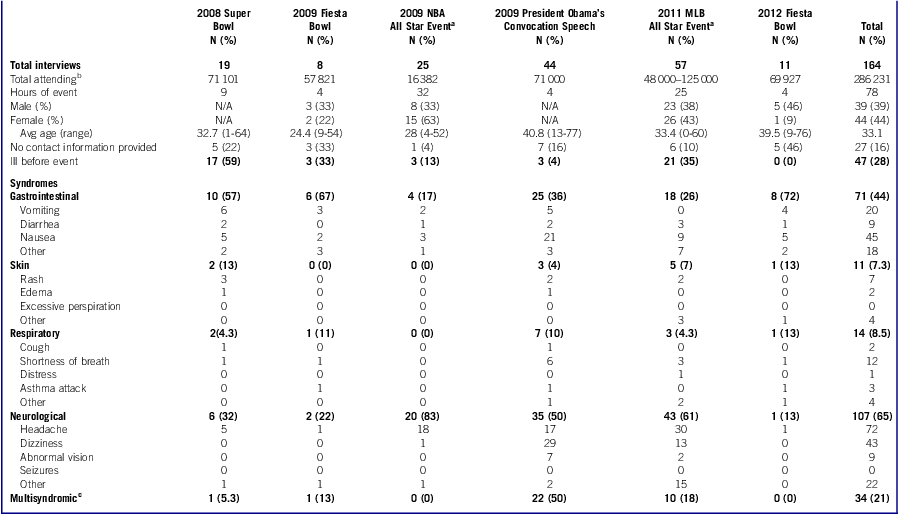
Survey data from 164 individuals seeking medical care at an onsite first aid station at 6 special events are shown in Table 1, including demographics from interviewed patrons, the number who did not provide contact information (name and phone number), and the numbers and percentages of reported syndromes and symptoms. Gender was collected for only 4 of the events (N = 100); 39 (39%) of the patrons seen at these events were men, and 44 (44%) were women. The average age across all events was 33.1 years.
Syndromes and Symptoms by Event
Abbreviations: MLB, Major League Baseball; NBA, National Basketball Association.
Note: Symptom values may be higher than syndrome number if person reported multiple symptoms. The 164 interviews covered 203 separate symptoms. Percentage of each syndrome based on number of interviews.
aMultiday event.
bAttendance is based on single location, 1-day turnstile count.
c34 people were multisyndromic, representing 41 separate symptoms. Each is accounted for in individual syndrome counts.
The 2011 All Star Game and 2012 Fiesta Bowl were the first 2 events using real-time electronic transmission of onsite surveillance data. No significant differences between the 2 methods of collecting data were observed in syndromes or demographics of the patients. As shown in Table 1, GI (44%) and neurological (66%) symptoms were reported most often, although the symptoms varied by the event (17%-72% of cases were GI and 13%-83% were neurological). In addition, 21% of patients reported multiple syndromes, mostly a combination GI and neurological symptoms with combined symptoms of nausea and headache or nausea and dizziness. These latter symptoms were seen much more at events occurring in hotter weather conditions (All Star Game and Obama's convocation speech). The most interviews were conducted during events with higher temperatures, the President Obama's 2009 convocation speech (n = 44) followed by the 2011 All Star Game (n = 57). Both All Star games were multiday events and the completed interviews were reported for all of the days. For GI syndromes, the most common symptoms were nausea (50%) and vomiting (22%), while the 2 most common neurological symptoms were headache (49%) and dizziness (30%). For dermatological syndromes, rash accounted for 54% of complaints, and shortness of breath was reported for 55% of those with respiratory complaints (Figure 2).
Symptoms Experienced by General Syndrom Pattern as Reported by Patients Visiting First Aid Station at a Large Public Event.
From observations in the field, ambient temperature likely played a role in the number of patients reporting to the first aid station and the symptoms they were experiencing. The average daytime temperature for all cold weather events (Fiesta Bowl, Super Bowl, and 2009 All Star Game) was 17.8°C (12.8°-25°C) (64°F; 55°-77°F), while the average hot weather daytime high was 38.3°C (101°F) (2011 All Star Game and Obama's convocation speech). A total of 8 cold weather event days and 6 hot weather event days were measured. For GI syndrome symptoms, the number of reported symptoms was almost the same for hot and cold weather events. However, for all other syndromes the number of illnesses reported during hot weather events was almost double those reported for cold weather events, although the number was only statistically significant for neurological symptoms.
One main concern of the surveillance activity was to determine if the symptoms developed at the event or before the attendees arrived. For all 6 events combined, a total of 47 patients (24%) reported being ill before the event. Of those, 34% of the symptoms were GI, 6% were dermatological, 6% respiratory, and 53% neurological. The self-reported causes of these illnesses were bad food (n = 5), alcohol consumption (n = 4), allergies (n = 4), other causes (n = 16), and unknown source or cause (n = 18) (data not shown).
Average Rates of Syndromes Observed
For these 6 large-scale events, the number of illness reports per person-hour and the number of syndromes experienced per person-hour of event duration were calculated. The overall events per person-hour was 7.27 × 10⁻⁵, with 2.90 × 10⁻⁵ for gastrointestinal syndromes, 3.26 × 10⁻⁶ dermatological syndromes, 5.92 × 10⁻⁶ respiratory syndromes, and 3.51 × 10⁻⁵ neurological syndromes. Figure 3 demonstrates the large disparity between the numbers of syndromes experienced at hot versus cold weather events. At the hot weather events, the total number of interviews per person-hour was 1.43 × 10⁻⁴, with 4.82 × 10⁻⁵ GI syndromes, 6.44 × 10⁻⁶ dermatological syndromes, 1.30 × 10⁻⁵ respiratory syndromes, and 7.32 × 10⁻⁵ neurological syndromes. At cold weather events, the total number of interviews per person-hour was
Syndrome Incidence Reports by Event Temperature. Abbreviations: FBs, Fiesta Bowls; MLB, Major League Baseball; NBA, National Basketball Association; SB, Siesta Bowl.
3.73 × 10⁻⁵, with 1.95 × 10⁻⁵ gastrointestinal syndromes, 1.68 × 10⁻⁶ dermatological syndromes, 2.37 × 10⁻⁶ respiratory syndromes, and 1.60 × 10⁻⁵ neurological syndromes.
Figure 4 and Table 2 both show the event rates per 50 000 people per hour. These event rates allow an estimate of the potential number of events that might occur for different-sized events. For instance, with an expected 60 000 attendees at an event lasting 5 hours, the total number of person-hours would be 300 000 and the public health responders would expect to see 22 total illness reports, with 9 GI, 1 dermatological, 2 respiratory, and 11 neurological syndromes reported. However, if this were a hot weather event, the predicted values would be 43 total events: 15 GI, 2 dermatological, 4 respiratory, and 22 neurological syndromes.
Incidence Rates per 50 000 Person-Hours of General Syndromes by Event. Abbreviations: MLB, Major League Baseball; NBA, National Basketball Association.
Calculated Baseline Rates per Person-Hour

aHot weather events occurred when the outdoor ambient temperature was greater than 37.8°C (100°F). Cold weather events occurred when the outdoor ambient temperature was less than 18.3°C (65°F).
Discussion
Public health agencies have known that for either a bioterrorism event or a naturally occurring outbreak following a large gathering or large public event, the majority of the intensive public health work will occur after the exposure. While other first responders, specifically law enforcement, must focus their efforts on the activities and intelligence gathered on days leading up to and during an event, public health workers must incorporate what is known beforehand with what occurs during the event and afterward. This timeline extends the amount of time in which public health departments must conduct enhanced surveillance and should be incorporated into any response planning.
An onsite surveillance system for a health department to detect potential disease syndromes at a large public event was developed and successfully implemented. In this system, public health personnel and traditional medical care providers worked together on location at the event in coordination with other first responders (eg, EMS personnel). In addition, the system incorporated graduate students in public health working alongside local health department personnel. The onsite surveillance system performed smoothly at 6 large public events, information was transmitted quickly from onsite locations to incident command, and all stakeholders were satisfied with the operation of the system.
While this surveillance system was implemented at 6 public events (total attendees estimated at 286 231 people), no unusual incidents of public health importance were detected. Furthermore, no evidence from traditional postevent monitoring, such as BioSense, showed that the surveillance system missed detecting an actual outbreak. Overall, the total proportion of people interviewed was a fraction of the total estimated event attendees (around .1%). This low percentage would be expected, as the attendees were probably younger and relatively healthier than the general population. Further, even in the presence of an outbreak, the actual numbers of individuals reporting themselves as ill during an event might be low because they either became ill after the event or the symptoms were not considered serious enough to seek medical care at the first aid stations.
The main limitation of the study is that only people who chose to seek care from a first aid station were interviewed. This approach created a bias of people who were ill enough to seek care and able to find the necessary station. However, for most of these events, first aid areas were clearly marked and roaming teams of EMS staff were also available to assist people, as needed.
A goal of this surveillance system is to characterize the various illnesses for which people sought care during the event so as to predict the normal level of expected illness that could occur during a large special event. The results of this evaluation highlight that previous events, in fact, can be used to predict workload for future events. The results also suggest that additional environmental information (eg, weather or ambient temperature), influence the number and type of symptoms reported at first aid stations. With the exception of the GI syndrome, symptoms and syndromes were reported at much higher numbers for events occurring in the summer and at higher ambient temperatures. Without this consideration, increased amounts of symptoms, specifically neurological, reported during a hot weather special event could increase the number of unnecessary investigations.
While traditional ED-based syndromic surveillance systems are useful for tracking potential cases of disease in the community, using an onsite screening tool is complementary and novel in its approach. Recording hospital-only data biases disease tracking to critically ill cases and may not reflect the likely burden of disease in the community after a common exposure. In a large-scale foodborne outbreak, the majority of those affected will not go to an ED or will seek medical care later; therefore, information about a potential exposure can be delayed or lost.Reference Hartnett, Paoli and Schaffner16
Another advantage of this new system is the rapid availability of data. For most large-scale events, a joint operations center (JOC) is activated. Using tablets to collect information allows real-time data to be monitored by health department staff in the JOC and to discuss the implementations of the results with partnering agencies, if necessary, while the event is still ongoing rather than assessing the data hours or days later. Having an onsite surveillance system ensures that the health department has the most up-to-date information and is receiving information of concern to public health and other first responder agencies.
Once the initial planning and implementation procedures were developed and approved among all stakeholder agencies, this new surveillance system proved to be feasible and efficient for use at a large event. This system should be particularly appropriate when real-time electronic onsite surveillance from EMS is unavailable or inaccessible. This specific system used graduate level public health students to complement staffing needs at the event. The graduate students had been trained specifically in outbreak investigation and in procedures for this surveillance system.Reference Pogreba-Brown, Harris, Stewart, Anderson, Erhart and England17 Of note, this program was highly popular as a service activity for the graduate students, and the program coordinator had no difficulty recruiting student volunteers, although the staffing requirements may be a limitation if only paid staff were available for the event.
Future plans include refining the questionnaire to assure that it is collecting appropriate information, continuing to work with public safety partners in analyzing and interpreting real-time public health data, and developing a predictive model that would incorporate other potential variables such as type of venue, attendance, ambient temperature, length of event, spatial clustering, and previous illness in the community. These models could then be used not only to predict numbers of illnesses that might be expected at the event, but also to detect aberrations to aid in recognizing true outbreaks.
Conclusions
An onsite surveillance system used at 6 large, special public events was successful in its goals of identifying and characterizing persons presenting with specific clusters of symptoms at the event venue. This information was then used to evaluate the probability that the occurrence was part of an intentional or unintentional disease outbreak and to identify any ill person who could be contagious. The use of this onsite syndromic surveillance system allowed the local public health agency to gain a greater understanding of what was occurring in real time and to make more efficient use of resources, namely in personnel time, which was needed to follow up cases after the event. This surveillance system added to the public health response for special events and enabled epidemiologists at the public health agency to be better informed and more up-to-date about conditions occurring at the event.
Funding and Support
The Maricopa County Department of Public Health; the Glendale and Phoenix Fire Departments; First Responders Inc; and the Campus Health Staff of Arizona State University provided support for this project. Members of the Student Aid for Field Epidemiology Response (SAFER) from the Zuckerman College of Public Health (MEZCOPH) at The University of Arizona composed the trained public health staff for the onsite surveillance activities. SAFER members are public health graduate students enrolled in an applied field epidemiology course that trains students in outbreak investigations and preparedness training.