There is limited understanding of the cognitive profiles of Spanish-speaking children with Attention-Deficit/Hyperactivity Disorder (ADHD). ADHD is a persistent pattern of inattention and/or hyperactivity-impulsivity (American Psychiatric Association [APA], 2000). It is one of the most common neurodevelopmental childhood disorders (Danielson et al., Reference Danielson, Bitsko, Ghandour, Holbrook, Kogan and Blumberg2018) and is often comorbid with other clinical conditions such as a Learning Disorder (LD; Dupaul, Gormley, Laracy, Montague, & Cavendish, Reference Dupaul, Gormley, Laracy, Montague and Cavendish2013). There are three presentations of ADHD. The combined type (ADHD-C) is the most common and is characterized by symptoms of inattention and impulsivity and/or hyperactivity. The predominantly inattentive type (ADHD-I) is characterized by difficulty in paying attention or focusing in the absence of hyperactivity/impulsivity symptoms. The predominantly hyperactive/impulsive type (ADHD-H) is the least common type of ADHD and is characterized by impulsive and hyperactive behaviors without inattention (APA, 2013; Capdevila-Brophy et al., Reference Capdevila-Brophy, Artigas-Pallarés, Navarro-Pastor, García-Nonell, Rigau-Ratera and Obiols2014).
The prevalence of ADHD significantly varies by gender and ethnicity, with boys being more than twice as likely as girls to have an ADHD diagnosis (Danielson et al., Reference Danielson, Bitsko, Ghandour, Holbrook, Kogan and Blumberg2018). Regarding ethnicity, various studies have found that non-Hispanic White children are more likely to be diagnosed with ADHD than Hispanic children (Danielson et al., Reference Danielson, Bitsko, Ghandour, Holbrook, Kogan and Blumberg2018; Flores & Tomany-Korman, Reference Flores and Tomany-Korman2008; Mehta, Lee, & Ylitalo, Reference Mehta, Lee and Ylitalo2013; Morgan, Staff, Hillemeier, Farkas, & Faczuga, Reference Morgan, Staff, Hillemeier, Farkas and Maczuga2013; Pastor, Reuben, Duran, & Hawkins, Reference Pastor, Reuben, Duran and Hawkins2015), with recent estimates suggesting that the prevalence of ADHD is 10.2% in non-Hispanic White children and 6.7% in Hispanic children (Danielson et al., Reference Danielson, Bitsko, Ghandour, Holbrook, Kogan and Blumberg2018). Research has suggested that this mental health disparity may be due to the under-diagnosis and under-treatment of Hispanic children and not to the over-diagnosis and over-treatment of non-Hispanic White children (Coker et al., Reference Coker, Elliott, Toomey, Schwebel, Cuccaro, Tortolero Emery, Visser, Schuster and Schuster2016). It has also been posited that these disparities may be influenced by sociodemographic and psychosocial factors, for example, social status, language, cultural barriers, and lack of access to healthcare (Morgan et al., Reference Morgan, Staff, Hillemeier, Farkas and Maczuga2013). Therefore, to address this disparity, there is a clear need to better understand the distinct profiles of Spanish-speaking children with ADHD including the role of sociodemographic and psychosocial factors.
Although Hispanic/Latinos are the largest United States (U.S.) ethnic minority group and Spanish is currently the most spoken non-English language in the U.S. (Gonzalez-Barrera & Lopez, Reference Gonzalez-Barrera and Lopez2013; Pew Hispanic Center, 2016), Spanish-speaking children with ADHD represent an understudied population. Major obstacles continue to challenge cross-cultural research and clinical practice with Spanish speakers including the lack of well-trained bilingual professionals with understanding of the role of culture and sociodemographic factors, limited availability of tests in Spanish, translation and conceptual equivalency issues, and absence of adequate normative samples for linguistic and ethnic minorities, among others (Melikyan, Agranovich, & Puente, Reference Melikyan, Agranovich, Puente, Goldstein, Allen and Deluca2019; Puente & Puente, Reference Puente, Puente and Grigorenoko2009).
COGNITIVE PROFILES IN PEDIATRIC ADHD
Children with ADHD may present with varying cognitive profiles, such as deficits in intelligence, executive functioning, working memory, and processing speed, among others (Alloway, Reference Alloway2011; APA, 2013; Cockcroft, Reference Cockcroft2011; Pievsky & McGrath, Reference Pievsky and McGrath2018). Not surprisingly, neuropsychological profiles or tests such as the Wechsler scales may be used to provide insight and assist clinicians in making an ADHD diagnosis and in providing proper treatment recommendations (APA, 2013; Frazier, Demaree, & Youngstrom, Reference Frazier, Demaree and Youngstrom2004; Pievsky & McGrath, Reference Pievsky and McGrath2018; Weiss, Saklofske, Prifitera, & Holdnack, Reference Weiss, Saklofske, Prifitera and Holdnack2006). The Wechsler scales have been often used in research and clinical settings as measures of intelligence and as sensitive tests to assess the cognitive functioning of children with acquired and neurodevelopmental brain disorders, such as traumatic brain injury (TBI; Allen, Thaler, Donohue, & Mayfield, Reference Allen, Thaler, Donohue and Mayfield2010; Thaler et al., Reference Thaler, Bello, Randall, Goldstein, Mayfield and Allen2010), ADHD (Mayes & Calhoun, Reference Mayes and Calhoun2006; Solanto et al., Reference Solanto, Gilbert, Raj, Zhu, Pope-Boyd, Stepak, Vail and Newcorn2007), and LDs (De Clercq-Quegebeur et al., Reference De Clercq-Quaegebeur, Casalis, Lemaitre, Bourgois, Getto and Vallée2010; Loh, Piek, & Barrett, Reference Loh, Piek and Barrett2011). Within the extant ADHD literature, studies have found differences in cognitive functioning among children diagnosed with this disorder. For instance, Thaler, Bello, and Etcoff (Reference Thaler, Bello and Etcoff2012) examined the Wechsler Intelligence Scales for Children-Fourth Edition (WISC-IV) profiles of English-speaking children with ADHD and found support for a five-cluster solution: one cluster evidenced multiple deficits in working memory and processing speeds, a second cluster demonstrated the presence of processing speed impairments, a third cluster was characterized by high average cognitive performance, a fourth cluster demonstrated superior performance on verbal reasoning skills, and a fifth cluster evidenced average processing speed. Their study findings suggested that English-speaking children with ADHD are a cognitively heterogeneous group.
There is additional compelling evidence for working memory deficits in children with ADHD (Alloway, Reference Alloway2011; Cockcroft, Reference Cockcroft2011; Martinussen et al., Reference Martinussen, Hayden, Hogg-Johnson and Tannock2005; Walshaw et al., Reference Walshaw, Alloy and Sabb2010; Willcutt et al., Reference Willcutt, Doyle, Nigg, Faraone and Pennington2005), as well as greater within group variability in working memory performance, when compared to healthy controls (Murphy, Barkley, & Bush, Reference Murphy, Barkley and Bush2001; Thaler et al., Reference Thaler, Bello and Etcoff2012; Gomez, Miranjani Gomez, Winther & Vance, Reference Gomez, Miranjani Gomez, Winther and Vance2014). The high heterogeneity of working memory performance among children with ADHD highlights the importance of conducting additional research on cognitive functioning and ADHD, as it remains unclear why such variability exists.
Other studies have documented that children with ADHD have slow processing speed (Mulder, Pitchford, & Marlow, Reference Mulder, Pitchford and Marlow2011; Shanahan et al., Reference Shanahan, Pennington, Yerys, Scott, Boada, Willcutt, Olson and DeFries2006; Walg et al., Reference Walg, Hapfelmeier, El-Wahsch and Prior2017), with some evidence of more severe impairments among children with ADHD-inattentive compared with ADHD-combined (Kubo et al., Reference Kubo, Kanazawa, Kawabata, Tanaka, Okayama, Fujta, Tsutsumi, Yokota and Yoneda2018; Thaler et al., Reference Thaler, Bello and Etcoff2012). Processing speed deficits, in turn, have been linked to decreased reading efficiency in oral and silent reading tasks among children with ADHD and to decreased performance on tests involving response section (e.g., WISC-IV Coding subtest; Jacobson et al., Reference Jacobson, Ryan, Martin, Ewen, Mostofsky, Denckla and Mahone2011).
Previous research has also shown that non-Hispanic/Latino children with ADHD and comorbid LD have different cognitive profiles than healthy controls, with evidence of greater cognitive impairment in children with ADHD and LD (Huang et al., Reference Huang, Sun, Qian, Liu, Ma, Yang, Cheng, Cao, Su, Gao, Wu, Li, Qian and Wang2016; Parke, Thaler, Etcoff, & Allen, Reference Parke, Thaler, Etcoff and Allen2015; Seidman et al., Reference Seidman, Biederman, Valera, Monuteaux, Doyle and Faraone2006; Snow & Sapp, Reference Snow and Sapp2000). Children with ADHD and co-occurring LD have poorer performance on intelligence tests such as the WISC, with lower scores on the full intelligence quotient (Huang et al., Reference Huang, Sun, Qian, Liu, Ma, Yang, Cheng, Cao, Su, Gao, Wu, Li, Qian and Wang2016; Seidman et al., Reference Seidman, Biederman, Valera, Monuteaux, Doyle and Faraone2006), on Verbal Comprehension Index (VCI; Huang et al., Reference Huang, Sun, Qian, Liu, Ma, Yang, Cheng, Cao, Su, Gao, Wu, Li, Qian and Wang2016), and on the Working Memory Index (WMI; Parke et al., Reference Parke, Thaler, Etcoff and Allen2015). Remarkably, even in the absence of specific LDs, children with ADHD may struggle with certain cognitive tasks (as described above) and have impaired academic performance (APA, 2013). Unfortunately, there is not much information available on the underlying cognitive profiles of Hispanic/Latino children with ADHD and comorbid LD, despite the importance of expanding this line of research to inform educational and clinical treatment interventions for ethnic minority children.
Evidently, cross-cultural neuropsychology research efforts have not kept pace with the rising demand for culturally and linguistically appropriate evidence-based practice for Spanish speakers (Buré-Reyes et al., Reference Buré-Reyes, Hidalgo-Ruzzante, Vilar-López, Gontier, Sánchez, Pérez-García and Puente2013; Melikyan et al., Reference Melikyan, Agranovich, Puente, Goldstein, Allen and Deluca2019; Puente, Ojeda, Zink, & Portillo Reyes, Reference Puente, Ojeda, Zink, Portillo Reyes, Geisinger and Geisinger2015; Saez et al., Reference Saez, Bender, Barr, Rivera Mindt, Morrison, Hassenstab, Rodriguez and Vazquez2014), but there is a small growing body of evidence suggesting that Hispanic/Latino children with neurological disorders also perform worse on working memory and processing speed than healthy controls, as measured by the WISC-IV Spanish (San Miguel Montes et al., Reference San Miguel Montes, Allen, Puente and Neblina2010). With respect to clinical samples of ADHD, a study conducted in Spain found that Hispanic children with ADHD have lower WISC-IV Spanish scores on the WMI and Processing Speed Index (PSI) compared to non-clinical controls (Fenollar Cortés, Navarro Soria, Gonzalez, & Garcia Sevilla, Reference Fenollar Cortés, Navarro Soria, Gonzalez and Garcia Sevilla2015). This study further showed that children with ADHD-combined presentation had a higher score on the WMI than on the PSI and that the opposite pattern holds true for children with ADHD-inattentive presentation (Fenollar Cortés et al., Reference Fenollar Cortés, Navarro Soria, Gonzalez and Garcia Sevilla2015). However, it remains unknown if these findings generalize to children from other Spanish-speaking cultures.
Despite these initial advances in research, to date, there is limited understanding of the cognitive profiles of Spanish-speaking children with ADHD. It remains unclear if Spanish-speaking children with ADHD have comparable cognitive profiles to their English-speaking counterparts. It is possible that the cognitive presentation of ADHD may be influenced by factors such as demographics and the presence of comorbid disorders (e.g., LD; see Parke et al., Reference Parke, Thaler, Etcoff and Allen2015), but this remains empirically unknown among Spanish-speaking children with ADHD. Thus, to provide perspective regarding ADHD and cognition in ethnic minority populations, the current study investigated the cognitive cluster profiles of Spanish-speaking children with ADHD to find homogeneous subgroups using the WISC-IV Spanish Index scores. The external validity of the cluster solution was also examined by comparing the clusters on a number of variables relevant for this population, but that were not included in the cluster analysis (e.g., sociodemographic variables, clinical diagnosis, and academic achievement). Examination of the external validity of the cluster solution is important because cluster analysis uses mathematical models to classify data, even random data (Allen & Goldstein, Reference Allen and Goldstein2013). It is therefore necessary to determine the external validity of the clusters by comparing them on variables that were not included in the cluster analysis. Based on previous studies on the cognitive profiles of English-speaking children with ADHD (e.g., Cockcroft, Reference Cockcroft2011; Fenollar Cortés et al., Reference Fenollar Cortés, Navarro Soria, Gonzalez and Garcia Sevilla2015; Thaler et al., Reference Thaler, Bello and Etcoff2012; Walg et al., Reference Walg, Hapfelmeier, El-Wahsch and Prior2017), we hypothesized that WISC-IV Spanish clusters in Spanish-speaking children with ADHD will show evidence of cognitive heterogeneity. This heterogeneity would be evident by identification of four or five clusters, including one cluster with mild or no deficits, another with multiple cognitive deficits, as well as a cluster with a selective deficit in working memory and another with a selective deficit in processing speed.
METHOD
Participants and Procedures
Participants included 165 Hispanic/Latino children who lived in Puerto Rico and had a primary diagnosis of ADHD (see Table 1). The sample had a mean age of 10.1 years (SD = 2.9), average Full-Scale Intelligence Quotient (FSIQ) was 91.8 (SD = 13.6), 64.8% were male, and 47.9% had a comorbid diagnosis of an LD. Data were archival in nature, and participants were selected from a consecutive series of 392 cases referred for neuropsychological evaluation by pediatric neurologists. The reasons for referral were for diagnosis of psychiatric or neurological disorder and treatment recommendations. Inclusion criteria were the following: (1) self-identified Spanish as their primary language, (2) primary diagnosis of ADHD, and (3) completion of the 10 core WISC-IV Spanish subtests during the neuropsychological evaluation. Children were excluded from the study if they had a diagnosis of intellectual disability, pervasive developmental disorder including autism spectrum disorders, or a coexisting neurological disorder such as TBI, seizure disorder, or cerebrovascular disorder, among others. ADHD diagnoses were made according to the Diagnostic and Statistical Manual of Mental Disorders Fourth Edition (DSM-IV-TR; APA, 2000) based on information from the following sources: interviews with children, behavioral observations, parental reports, medical and educational records, and neuropsychological assessment. The WISC-IV Spanish was administered by a clinical neuropsychologist using standardized procedures (Wechsler, Reference Wechsler2005). All research was conducted in accordance with local institutional review board policies.
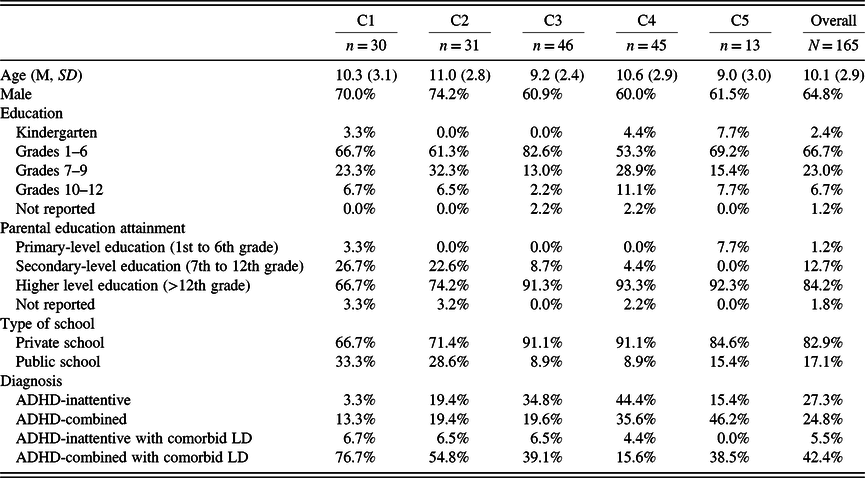
Demographic and clinical characteristics for the five-cluster ADHD solution and the full sample

Note. C = Cluster.
Measures
Demographics
As part of the clinical intake, participants were asked to provide sociodemographic information pertaining to age, sex, type of school attended (public or private), education level, and parental education level. Regarding the Puerto Rican education system, both the public and private sectors were modeled after that of the mainland U.S. (Negrón de Montilla, Reference Negrón de Montilla1975). If relevant, participants also provided information about their clinical diagnoses.
WISC-IV
The WISC-IV Spanish (Wechsler, Reference Wechsler2005) is a translation and adaptation of the WISC-IV (Weschler, Reference Wechsler2003), a widely used intelligence test to measure cognitive ability for children and adolescents aged 6 years to 16 years 11 months. The WISC-IV Spanish provides an FSIQ or global estimate of intellectual functioning (M = 100, SD = 15) based on the sum of scores from the 10 core subtests (Ms = 10, SDs = 3). Additionally, the WISC-IV Spanish yields four index scores: (1) VCI, which includes Similarities, Vocabulary, and Comprehension subtests; (2) Perceptual Reasoning Index (PRI), which includes Block Design, Picture Concepts, and Matrix Reasoning subtests; (3) WMI, which includes Digit Span and Letter–Number Sequencing subtests; and (4) PSI, which includes Coding and Symbol Search subtests. See publisher’s manuals for additional psychometric information (Wechsler, Reference Wechsler2003, Reference Wechsler2005). The WISC-IV Spanish was standardized on a stratified sample of 851 healthy Spanish-speaking children, who were selected to represent U.S. Hispanic children according to the 2001 U.S. census data. The WISC-IV Spanish norms were developed using a reliability sample, which was comprised of 500 of these children from four major geographic regions: West, Midwest, Northeast, and South. Puerto Rico was included in the South region. The FSIQ and Index scores for the WISC-IV Spanish demonstrate adequate evidence of test validity and internal consistency (coefficients ranged from .82 to .97). See the WISC-IV Spanish manual for additional psychometric information (Wechsler, Reference Wechsler2005).
Batería III Woodcock-Muñoz: Pruebas de aprovechamiento (Batería III APROV)
The Batería III APROV (Muñoz-Sandoval, Woodcock, McGrew, & Mather, Reference Muñoz-Sandoval, Woodcock, McGrew, Mather and Schrank2005) is the Spanish version of the Woodcock–Johnson III Test of Achievement (WJ III; Woodcock, McGrew, & Mather, Reference Woodcock, McGrew and Mather2001). It is a broad measure of academic achievement with composite scores estimating mathematical, reading, writing, and language abilities for individuals from 5 to 95 years of age. Some of the tests can be used with individuals as young as 2 years of age. The Batería III data are equated to the WJ III norms. The calibration sample included 1,413 native Spanish-speaking individuals from various Spanish-speaking countries including the U.S., Puerto Rico, Mexico, Spain, Argentina, Panama, Costa Rica, and Colombia. The Batería III APROV subtests and cluster scores demonstrate adequate evidence of validity and reliability (e.g., coefficients range from .78 to .99). See the Batería III APROV manual for additional psychometric information (Muñoz-Sandoval et al., Reference Muñoz-Sandoval, Woodcock, McGrew, Mather and Schrank2005). Batería III APROV data were available for 69 children in the current sample.
Data Analysis
Cluster analyses were conducted to examine cognitive heterogeneity on the WISC-IV Spanish Index scores. Based on previous studies in English-speaking children with ADHD (e.g., Thaler et al., Reference Thaler, Bello and Etcoff2012), we examined four-, five-, and six-cluster solutions using Ward’s method. Ward’s hierarchical agglomerative clustering method (1963) is widely used in clustering studies of cognitive test variables (e.g., Allen, Thaler, et al., Reference Allen, Thaler, Donohue and Mayfield2010, Allen & Goldstein, Reference Allen and Goldstein2013; Thaler et al., Reference Thaler, Bello and Etcoff2012) to partition a population into homogenous subgroups. Ward’s method is appropriate to use with quantitative variables and is resistant to the influence of outliers (Morris, Blashfield, & Satz, Reference Morris, Blashfield and Satz1981). We used the squared Euclidean distance to measure dissimilarities between data points, as this metric is sensitive to pattern and level of performance differences among clusters (Hair, Black, Babin, Anderson, & Tatham, Reference Hair, Black, Babin, Anderson and Tatham2005). To examine the stability of the cluster solutions derived using Ward’s method (as described in Aldenderfer & Bashfield, Reference Aldenderfer and Bashfield1984), we also clustered the data with the k-means procedure, which derives clusters by iteratively adding cases to the group that has the mean value closest to the unassigned data point (Hair et al., Reference Hair, Black, Babin, Anderson and Tatham1992). Cluster centers from the Ward’s solution were used as starting points from k-means clustering. Subsequently, we assessed the extent to which the Ward’s method and k-means solutions agreed using Cohen’s kappa (Reference Cohen1968). Kappa values were interpreted as follows: ≤0 as indicating no agreement, 0.01–0.20 as none to slight, 0.21–0.40 as fair, 0.41–0.60 as moderate, 0.61–0.80 as substantial, and 0.81–1.00 as almost perfect agreement (Cohen, Reference Cohen1968). Additionally, to further validate the clusters obtained using Ward’s method, discriminant function analysis (DFA) was used to determine the accuracy with which the cognitive variables could predict cluster membership (Fisher, Reference Fisher1936). Examination of DFA plots further allowed for determination of the extent to which the clusters overlapped. Finally, Beale’s F-test (Beale, Reference Beale1969) was used to examine parsimony of the cluster solutions and determine whether more complex solutions accounted for significantly more variance than less complex solutions. These approaches were used to identify the most appropriate cluster solution. Lastly, for the optimal solution, analysis of variances (ANOVAs) and chi-square analyses were conducted to compare the clusters on additional characteristics not included in the cluster analysis, such as demographic factors (e.g., age and education), type of ADHD diagnosis (e.g., ADHD subtype, including with and without LD comorbidity), and academic achievement.
RESULTS
Cognitive Clusters
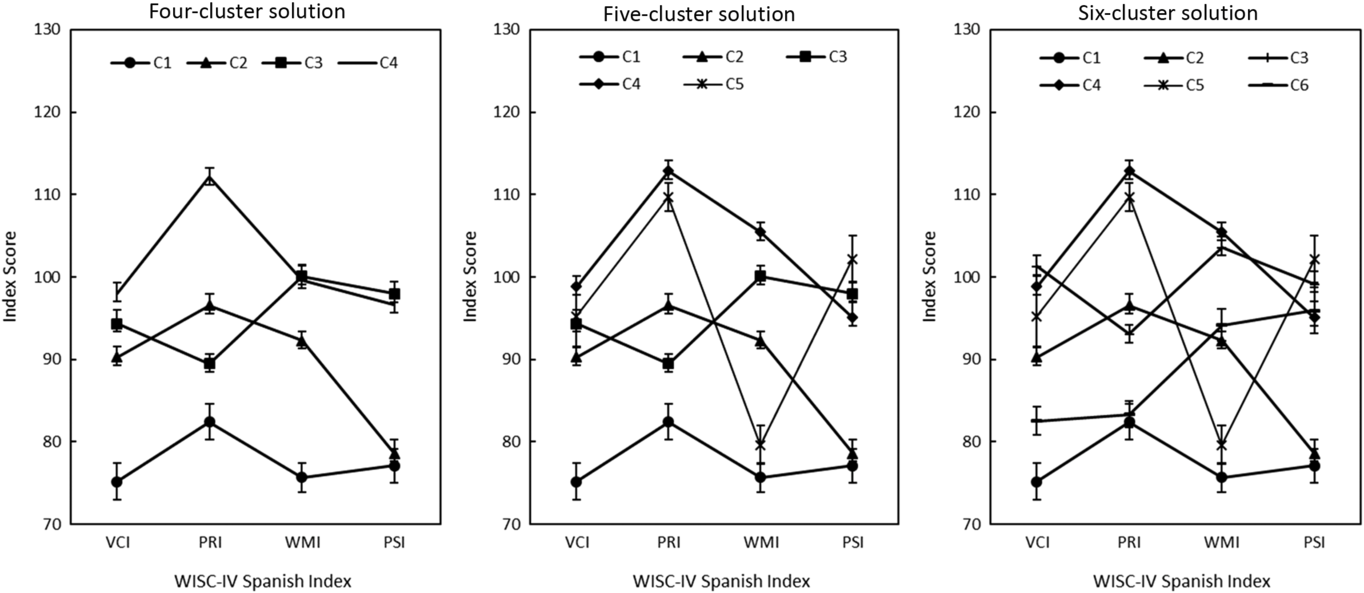
Examination of WISC-IV Spanish Index scores profiles for the four-, five-, and six-cluster solutions indicated that the clusters were differentiated by both level and pattern of cognitive performance differences (see Figure 1). In the four-cluster solution, the first cluster (C1) generally showed borderline performance (on the VCI, PRI, and WMI) and low average performance on the PSI, suggesting the presence of multiple cognitive impairments across the four index scores. The second cluster (C2) showed average range performance on the VCI, PRI, WMI, and borderline performance on the PSI, suggesting processing speed deficits. The third cluster (C3) generally showed average performance with low average performance on the PRI, suggesting no major cognitive deficits. The fourth cluster (C4) showed average performance with strengths in the PRI, as evidenced by high average performance on the PRI. The five-cluster solution further divided C4 into two clusters: one cluster retained its original characteristics of average range performance with strengths in the PRI and the new cluster showed average performance on VCI and PRI, high average performance on the PRI, and borderline performance on the WMI. The six-cluster solution divided C3 into a cluster with average performance on all four index scores as well as a new cluster showing average range performance on the WMI and PSI and low average performance on the VCI and PSI.
WISC-IV Spanish four-, five-, and six-cluster solutions in the ADHD sample.

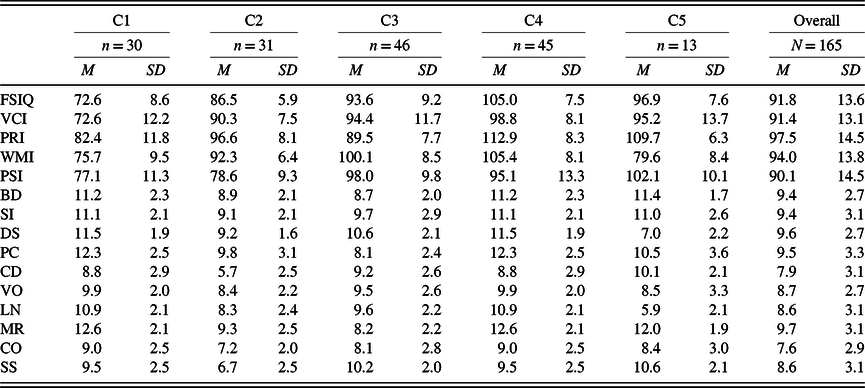
We also examined the stability of the cluster solutions derived with Ward’s method by comparing them with the solutions derived using k-means procedure, which is an optimization clustering technique. Cohen’s kappa was .77 for the four-cluster solution, .78 for the five-cluster solution, and .85 for the six-cluster solution. Regarding accurate discriminant function for classification of participants into the clusters, the indexes accurately predicted 88.5% of the four-cluster cases, 90.3% of the five-cluster cases, and 87.9 % of the six-cluster cases. The Beale’s F-test was significant when comparing the four-cluster solution with the five-cluster solution (F = 2.46, p = .04) and non-significant when comparing the five-cluster solution with the six-cluster solution (F = .37, p = .83) and when comparing the four-cluster solution with the six-cluster solution (F = 1.48, p = .16). Taken together, results suggest that the five-cluster solution is optimal (see Table 2 and Figure 1). The five clusters were named based on their pattern and level of cognitive performance as follows: multiple cognitive deficits with decreased performance across all indexes, as indicated by borderline performance on the VCI, PRI, and WMI and low average performance on the PSI (C1); processing speed deficits with VCI, PRI, and WMI intact (C2); generally average performance with no major deficits, as indicated by average performance on the VCI, PSI, and WMI and marginal average performance on the PRI (C3); perceptual reasoning strengths with VCI, PSI, and WMI intact (C4); and working memory deficits with VCI, PRI, and PRI intact (C5).
Cognitive clusters of Spanish-speaking children with ADHD, as measured by the WISC-IV Spanish

Notes. C = cluster; SI = similarities; CO = comprehension; BD = block design; MR = matrix reasoning; SS = symbol search; CD = coding; DS = digit span; LN = letter-number sequencing; PC = picture concepts; VO = vocabulary.
External Validity of the Five-Cluster Solution
We then examined the association of clusters with demographics and clinical diagnosis. A one-way ANOVA indicated an overall difference across the clusters with respect to age, F(4,160) = 2.88, p = .024; however, Bonferroni post hoc tests revealed no significance among specific clusters. Chi-square test analyses indicated that the clusters did not differ significantly regarding sex, χ 2 (4, N = 165) = 2.83, p = .67, and education, χ 2 (16, N = 165) = 15.83, p = .47. In contrast, there were significant differences among the five clusters for the percentage of participants who were in public vs. private schools, χ 2 (4, N = 165) = 11.93, p = .018, and for parental educational attainment χ 2 (12, N = 165) = 22.82, p = .029 (see Table 1). Participants with multiple cognitive deficits (i.e., C1) were less likely to be in private schools and to have parents with high level of educational attainment. Furthermore, as seen by the frequencies cross tabulated in Table 1, there is a significant relationship between diagnosis and cluster membership, χ 2 (12, N = 165) = 38.72, p < .001. Across the five clusters, participants with multiple cognitive deficits (i.e., C1) were more likely to have a comorbid diagnosis of an LD.
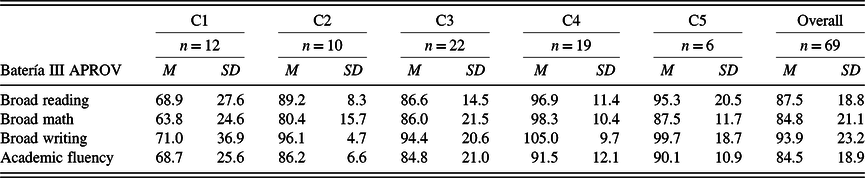
Regarding the Batería III APROV, a multivariate analysis of variance showed a significant multivariate effect for Batería III APROV scores (i.e., Broad Math, Broad Writing, Broad Reading, and Academic Fluency scores) in relation to cluster membership, Wilk’s λ = .60, p = .007, ηp 2 = .122. One-way ANOVAs found significant effects for Broad Math, F(4,64) = 6.26, p < .001, ηp² = .299; Broad Writing, F(4,64) = 5.15, p = .001, ηp² = .244; Broad Reading F(4,64) = 5.59, p = .001, ηp² = .259; and Academic Fluency, F(4,64) = 3.31, p = .016, ηp² = .171. Bonferroni post hoc tests revealed that C1 (multiple cognitive issues) performed significantly worse than C4 (perceptual reasoning strengths) and C3 (generally average) on Broad Math, Broad Writing, and Broad Reading; and significantly worse than C4 on Academic Fluency (see Table 3). Given that Batería III APROV data were available for 69 children, post hoc analyses were conducted to examine if there were significant differences among participants with and without Batería III APROV data. Participants with and without Batería III APROV data did not differ significantly regarding sex, χ 2 (1, N = 165) = 0.06, p = .81, education, χ 2 (4, N = 165) = 3.88, p = .42, parental educational attainment χ 2 (3, N = 165) = 4.12, p = .25, type of school χ 2 (1, N = 158) = .27, p = .61, diagnosis χ 2 (3, N = 165) = 3.62, p = .31, age, F(1,164) = 0.03, p = .86, and FSIQ, F(1,164) = 0.01, p = .10.
Cluster differences on the Batería III Woodcock–Muñoz

Notes. C = cluster; Batería III APROV = Batería III Woodcock–Muñoz: Pruebas de aprovechamiento (Spanish version of the WJ III Test of Achievement).
DISCUSSION
The current study provides valuable information about the cognitive functioning of Puerto Rican Spanish-speaking children with ADHD, an understudied population in neuropsychological research. To our knowledge, the current study is among the first to partition the cognitive profiles of Puerto Rican Spanish-speaking children with ADHD by using cluster analysis, with the objective of providing perspective regarding the intellectual functioning of ethnic minority children with this disorder as this may help inform clinical practice. This study also examined the association of cluster membership with sociodemographic variables, clinical factors (e.g., the presence of a co-occurring LD diagnosis), and academic achievement. Relatedly, previous studies have used cluster analysis to effectively identify homogenous subgroups of patients who exhibit differing patterns of neurocognitive deficits (e.g., Allen, Thaler, et al., Reference Allen, Thaler, Donohue and Mayfield2010; Allen, Leany, et al., Reference Allen, Leany, Thaler, Cross, Sutton and Mayfield2010; Allen & Goldstein, Reference Allen and Goldstein2013; Thaler et al., Reference Thaler, Bello and Etcoff2012). As hypothesized, our results revealed five clusters with distinct cognitive performance based on the WISC-IV Spanish Index scores, including ADHD with multiple cognitive deficits (C1), processing speed deficits (C2), generally average performance (C3), perceptual reasoning strengths (4), and working memory deficits (C5). Among the five clusters, children members of the profile with multiple cognitive deficits (C1) showed poorer performance on the four WISC-IV Spanish Indexes (VCI, WMI, PSI, PRI), suggesting impaired cognition across various domains.
Importantly, our findings provide empirical evidence for cognitive heterogeneity among Puerto Rican Spanish-speaking children with ADHD, suggesting that there is no profile that best typifies these children. Findings are consistent with previous studies conducted with English-speaking children. For example, Thaler et al. (Reference Thaler, Bello and Etcoff2012) cluster analyzed WISC-IV Index scores of English-speaking children with ADHD and found evidence for cognitive heterogeneity in their sample. Consistent with their study, we found clusters evidencing working memory deficits, processing speed deficits, uniform poor performance, and generally average performance. Unlike Thaler et al. (Reference Thaler, Bello and Etcoff2012), we did not find a cluster with superior performance on verbal reasoning skills. Our current findings expand the interpretive power of this line research by attending to cultural, linguistic influences (our study sample was comprised of Puerto Rican Spanish-speaking children with ADHD) and provide empirical evidence that cognitive heterogeneity may be a defining feature of pediatric ADHD transcending across cultures. Future research aimed at expanding current understanding of cognitive heterogeneity in this population and at identifying the endophenotypes underlying the various patterns of cognitive functioning and how they impact behavioral manifestation of ADHD symptoms within their cultural contexts is warranted.
Gaining a deeper understanding of the remarkable variability in cognitive functioning in pediatric ADHD is of critical importance for prevention, intervention, and treatment planning. In this regard, our study findings elucidate that cognitive heterogeneity in Puerto Rican Spanish-speaking children with ADHD may reflect impairment in specific cognitive abilities, such as working memory and processing speed, as illustrated by the identification of C5 and C2. These findings are in alignment with earlier studies on ADHD and cognition that were conducted primarily on English-speaking samples (Alloway, Reference Alloway2011; Cockcroft, Reference Cockcroft2011; Mulder et al., Reference Mulder, Pitchford and Marlow2011; Thaler et al., Reference Thaler, Bello and Etcoff2012) and thus provide evidence that Spanish- and English-speaking children with ADHD may have comparable cognitive profiles in terms of diminished performance on cognitive abilities requiring working memory and processing speed. The current findings may be relevant to clinical practice by providing a means to personalize prescription of intervention strategies based on the unique neurocognitive characteristics of each child with ADHD. For example, findings may help provide direction for prescription of cognitive remediation interventions designed to target attention, working memory, and other cognitive deficits in ADHD. Currently, there is mixed support regarding whether not neurocognitive remediation training improves working memory and sustained attention in non-Hispanic children with ADHD (Johnstone et al., Reference Johnstone, Roodenrys, Blackman, Johnston, Loveday, Mantz and Barratt2012; Kim et al., Reference Kim, Bahk, Oh, Lee, Lee and Choi2018; Orban et al., Reference Orban, Rapport, Friedman and Kofler2014; Rapport et al., Reference Rapport, Orban, Kofler and Friedman2013). Among Puerto Rican children, a recent study by Medina (Reference Medina2018) found preliminary evidence that cognitive training improves reading and other cognitive processes (e.g., attention, successive processing, and simultaneous processing). It may be that in controlled trials the broad application of, for example, an intervention designed to ameliorate working memory deficits will demonstrate limited efficacy when examined at the group level because only a portion of children with ADHD have working memory deficits and are expected to benefit from the intervention. Similarly, more tailored approaches to addressing social skills deficits, impulsivity and risky behaviors, family conflict, educational and occupational attainment, and other areas relevant to ADHD may be developed if it can be demonstrated that cognitive profiles are associated with these outcomes. Additional research is necessary to determine if matching children with ADHD to specific interventions based on cognitive profiles identified using cluster analysis or other statistical techniques would result in increased efficacy and effectiveness.
Additionally, our study found support for the existence of a cluster of Puerto Rican Spanish-speaking children who had generally average cognitive performance (C3) and for another group with strengths on perceptual reasoning (C4), besides having an ADHD diagnosis. These findings help to further explain differences in cognitive functioning among Puerto Rican Spanish-speaking children with ADHD and potentially inform clinical intervention and remediation. Along this vein, noting that intellectual heterogeneity exists in pediatric ADHD may help promote successful, optimal cognitive functioning in this population by maximizing areas of cognitive strength (e.g., perceptual reasoning) and/or minimalizing problems in other areas (e.g., working memory and processing speed).
As mentioned above, this study identified a cluster characterized by having deficits in all four WISC-IV Spanish Indexes (C1). When comparing the five clusters, it became evident that sociodemographic factors influence cognitive functioning in Puerto Rican Spanish-speaking children with ADHD. Specifically, our findings show that members of C1 (multiple cognitive deficits) were more likely to be in public schools, to have parents with low educational attainment, and to evidence a comorbid diagnosis of an LD. In terms of academic achievement, these children with multiple cognitive deficits tended to have poorer academic achievement on broad math, writing, and reading, as measured by the Batería III Woodcock-Muñoz. Although the precise mechanism explaining these relationships remains unclear, our findings highlight the fact that adverse sociodemographic background and clinical comorbidity of an LD may adversely influence cognitive functioning and academic achievement in Puerto Rican Spanish-speaking children with ADHD. Moreover, findings suggest that social class contexts (i.e., parental education and type of school) are important to understanding the relationship between ADHD and cognition in Spanish-speaking children with this disorder. Future research is needed to better understand the profiles of Spanish-speaking children with ADHD including the role of sociodemographic variables and to compare Spanish- and non-Spanish-speaking children with ADHD in the same study.
Relatedly, except for the higher incidence of a co-occurring LD diagnosis with ADHD-combined in C1, there were no salient differences in cognitive functioning across ADHD types with no LD comorbidity (i.e., ADHD-combined or ADHD-inattentive) in the studied sample. Although our data did not provide evidence of significant associations between ADHD types and cognitive performance, we do not negate possibly that these differences may be present, as found by Fenollar Cortés et al. (Reference Fenollar Cortés, Navarro Soria, Gonzalez and Garcia Sevilla2015). Briefly, their study, conducted in a European Spanish sample, found that ADHD-inattentive type was characterized by a significantly lower score on the PSI with respect to the WMI. In contrast, the ADHD-combined type had a higher PSI score than WMI score. A potential explanation for not finding such association in our sample is that some clusters contained a limited number of participants. Additional studies on larger samples are warranted to further examine cognitive cluster differences as a function of the type of ADHD diagnosis and in relation to other factors, such as demographics.
The test selected for use in a cluster analysis is an important consideration. It should be sensitive to the disorder it is being used to investigate. Even when this basic criterion is met, it is possible that a cluster analysis of an IQ test, as accomplished in this study, may produce clusters that are quite different from those that emerge when a test of memory or some other cognitive ability is selected. Thaler et al. (Reference Thaler, Terranova, Turner, Mayfield and Allen2015) suggest that tests that share substantial common variance are expected to produce clusters that share similar profiles, but there will also be unique insights based on the variance that is not shared in common. The two studies that have directly compared cluster solutions derived using different tests in adult males with schizophrenia (Goldstein, Allen, & Seaton, Reference Goldstein, Allen and Seaton1998) and in children with moderate-to-severe TBIs (Thaler, Terranova, Turner, Mayfield, & Allen, Reference Thaler, Terranova, Turner, Mayfield and Allen2015) provide support for stability of cluster reflecting normal and severely impaired performance, although different tests also identify distinct intermediate subgroups. In those studies, even when different clusters were identified, these generally conformed with theoretical expectations. Comparisons similar to those reported by Thaler et al. (Reference Thaler, Terranova, Turner, Mayfield and Allen2015) and Goldstein et al. (Reference Goldstein, Allen and Seaton1998) have not been accomplished for children with ADHD, although results of such comparisons would provide additional insights into expected cognitive profiles in these children and also allow for more precise differentiation of clusters that appear to represent cognitive subtypes from those that appear influenced by content and psychometrics unique to a given test, demographic and clinical characteristics of the sample, or other influencing factors. Since the cognitive constructs assessed by the WISC are well understood, the scale is reliable and well validated, and it is commonly used to assess children with ADHD, using the WISC to derive clusters provides conceptual, psychometric, and practical advantages over other tests that could be selected for clustering.
A limitation of the current study is that we did not have access to household income data, which is a commonly used proxy for socioeconomic status. Future research should collect data on income and examine how it relates to cognitive functioning in Puerto Rican and other Hispanic/Latino Spanish-speaking children with ADHD, especially when considering that our findings provide evidence that social class factors (particularly education variables) influence cognitive performance in this population. Another study limitation is lack of a group of children with ADHD-hyperactive/impulsive. Finally, we did not have a normal sample so were unable to determine whether the clusters identified were unique to ADHD. Allen, Leany, et al. (Reference Allen, Leany, Thaler, Cross, Sutton and Mayfield2010) examined this matter in clusters for 150 children with TBI and 150 healthy children based on the Test of Memory and Learning (Reynolds & Voress, Reference Reynolds and Voress2007). Clusters for the healthy children were primarily differentiated by level of performance, rather than pattern of performance, while clusters for children with TBI were differentiated by both level and pattern of performance differences. Whether similar findings will be observed when children with ADHD are compared to healthy controls requires further investigation.
Despite the noted limitations, the current study has notable strengths. Its focus on addressing disparities in clinical neuropsychology helps expand current understanding on ADHD and cognition, particularly regarding Hispanic/Latino Spanish-speaking children of Puerto Rican descent. Additionally, cluster analysis permitted valid identification of five groups with distinct cognitive performance profiles. There have been few studies in this area among Spanish-speaking children with ADHD (Fenollar Cortés et al., Reference Fenollar Cortés, Navarro Soria, Gonzalez and Garcia Sevilla2015; San Miguel Montes et al., Reference San Miguel Montes, Allen, Puente and Neblina2010), and these findings add to the increasing body of literature illustrating that children with ADHD evidence various levels of intellectual functioning, for example, single or multiple deficits in specific cognitive abilities (such as working memory and processing speed) and average cognitive functioning with strengths in areas of perceptual reasoning. There is much to learn about cognitive heterogeneity in Hispanic/Latino Spanish-speaking children with ADHD, and our research is a step forward in attempting to close the gap in minority mental health, especially when considering that Hispanic/Latinos are the largest U.S. ethnic minority group and that Spanish is currently the most spoken non-English language in the U.S. (Gonzalez-Barrera & Lopez, Reference Gonzalez-Barrera and Lopez2013; Pew Hispanic Center; 2016).
In sum, the current study indicates that cognitive heterogeneity is present in Puerto Rican Spanish-speaking children with ADHD and highlights the importance of attending to sociodemographic factors to better understand cognitive functioning among this population. Based on the unique profiles of Puerto Rican Spanish-speaking children with ADHD, clinicians may be in a better position to provide more precise interventions for this population. Future research investigating the effects of demographics and sociocultural environments on ADHD cognitive performance is needed to inform assessment and treatment interventions for Hispanic/Latino Spanish-speaking children with this disorder.
ACKNOWLEDGMENTS
The authors received no specific funding for this work. This study was used to fulfill dissertation requirements for lead author, Alicia Nuñez.
CONFLICT OF INTEREST
The authors declare that there is no conflict of interest regarding the publication of this article.