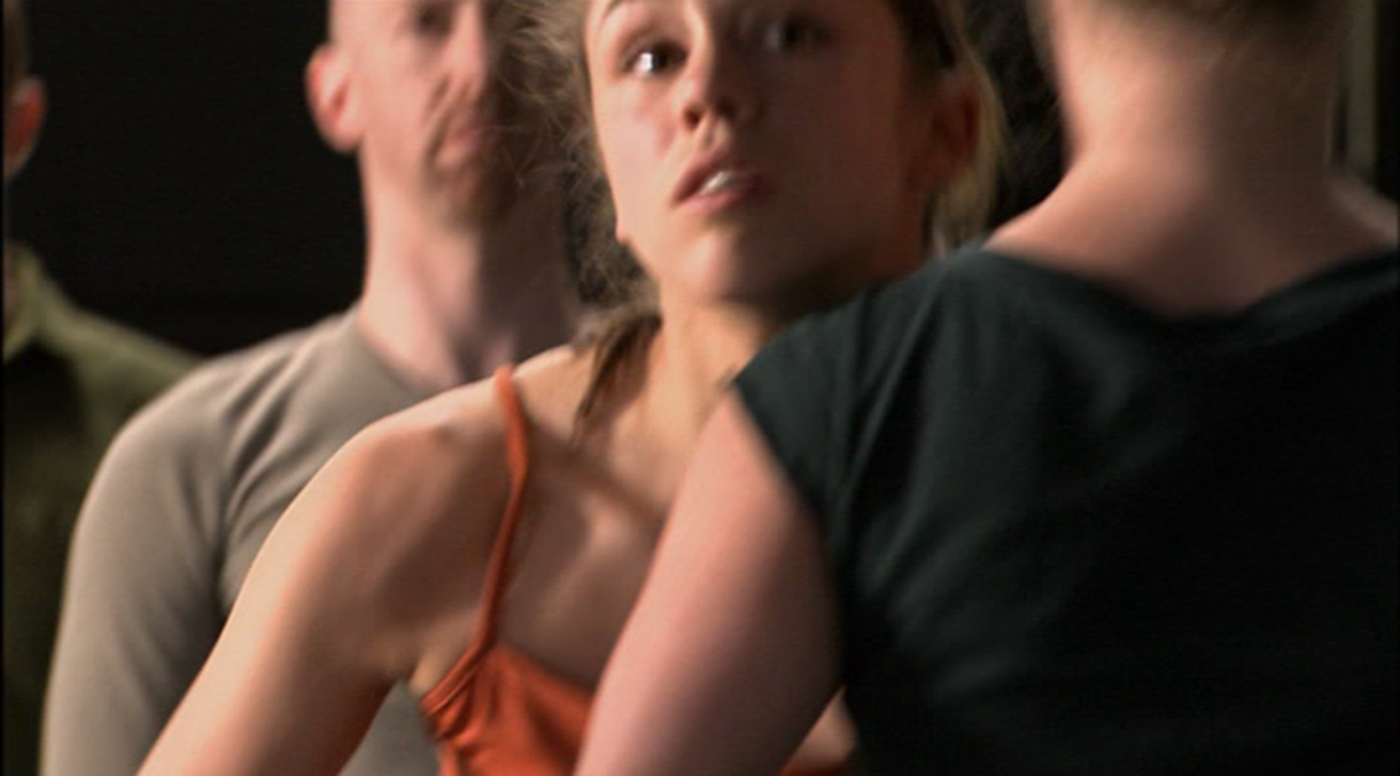
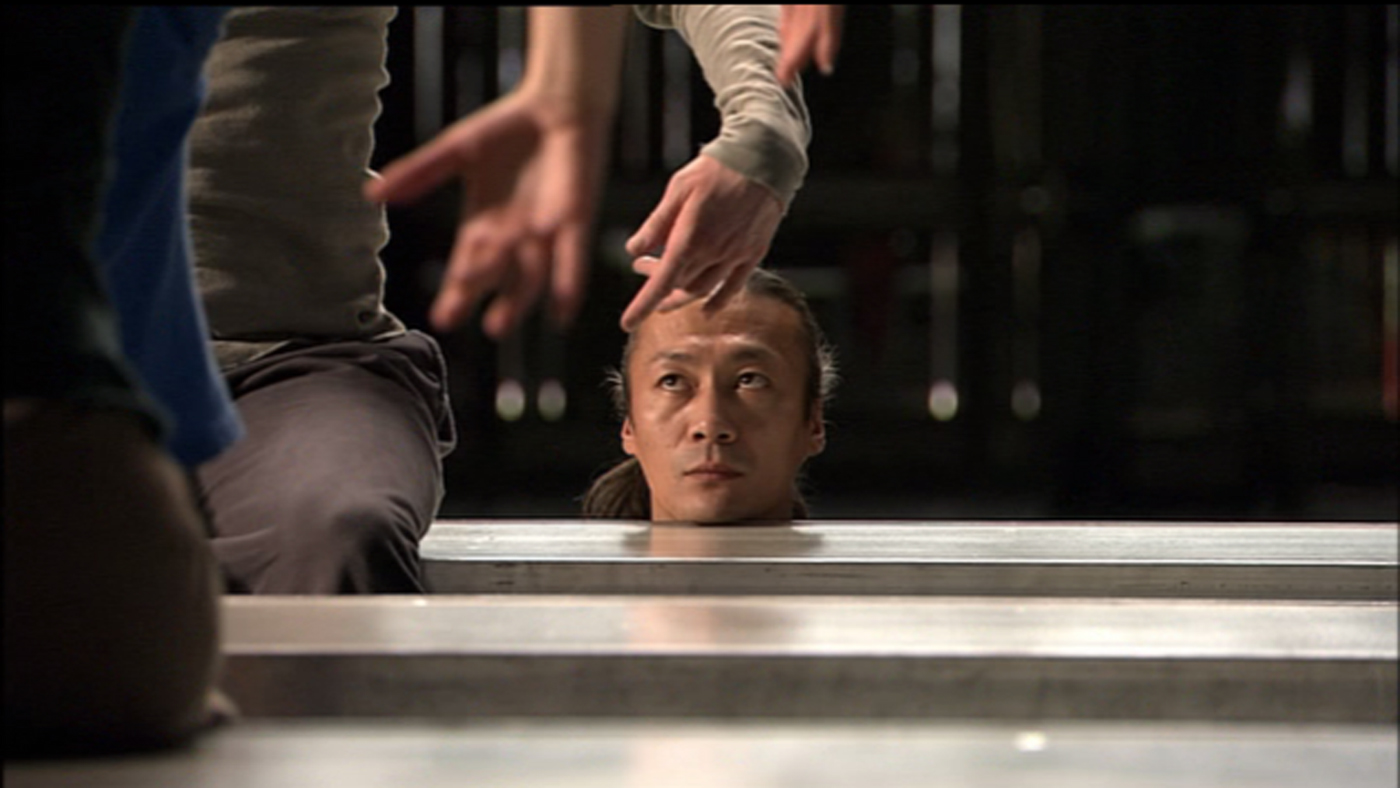
Using a medium shot, the camera tracks the movement of a female dancer in an orange camisole top. She appears to have lost control of her core: movements become initiated with other body parts such as head and shoulder. Meanwhile, some dancers sit on tables with their backs to the camera; this framing purposefully leaves out some of their heads. The solo dancer braces herself on the table and slides her head along the arms of a sitting dancer (Photo 1). Given the framing and close-up of just the backs and arms of the resting dancers, they seem to lose their humanness by turning into a movement terrain for the female mover to explore: no longer are they easily recognizable as dancers, but their bodies transform into a dynamic topography. Not only do her disarticulated movements communicate that she could be in a trance or powered by a different being, but the camera's framing has alienated the dancers' bodies to create another world. Adding to this otherworldly feeling, a male dancer sets his chin on the edge of a table, which appears to disembody his head. This short scene from Thierry De Mey's screendance One Flat Thing, reproduced (2006) was based on William Forsythe's dance of the same name.
Dancer Marthe Krummenacher (center) traverses alien terrain. Film still from One Flat Thing, reproduced (2006). Directed by Thierry De Mey, choreographed by William Forsythe. Courtesy Thierry De Mey.

Many scholars have noted how Forsythe defigures the ballet vocabulary, a technique called disfocus, which reconstructs that vocabulary and creates disarticulated movement (Brandstetter and Ulvaeu Reference Brandstetter and Ulvaeu1998, 46; Mattingly Reference Mattingly1999, 21; Nugent Reference Nugent2007, 41). For example, beginning with a balletic movement, Forsythe dissolves the conventional paradigm of coordination by instead initiating movement with other body parts like the elbow or head; this method results aesthetically in a decentered, meandering contortion. Along similar lines, Gerald Siegmund characterizes Forsythe's dancers as “monsters” whose bodies have been artificially assembled through the rationality of ballet (Reference Siegmund and Spier2011a, 25–26). He maintains that their bodies are “carving out spaces and undergoing experiences that cannot be accommodated into any functioning symbolic system of representation. They create atmospheres of nervous disquiet and the unknown” (Reference Siegmund and Spier2011a, 36). Taking his observation into account, this article will explore how the filming of One Flat Thing, reproduced features the preoccupation with an otherworldly aesthetic for both Forsythe and De Mey throughout their oeuvre. First, this article establishes Forsythe's movement aesthetics. Second, it explores the ideas of romanticism in the oeuvre of the choreographer's work particularly in terms of otherworldliness, alienation, and the use of disfocus. Third, this article examines De Mey's filmic techniques throughout his oeuvre and their aesthetic effects. Lastly, it provides a reading of the screendance One Flat Thing, reproduced.
A live performance of Forsythe's One Flat Thing, reproduced can easily overwhelm the senses since it appears to lack focus with individual dancers each completing different movements. However, moments of alignment do occur: groups of dancers move in the same direction simultaneously or perform similar gestures at the same time. De Mey can, in ways, maintain some of Forsythe's aesthetic aurally: the choreographer has worked with the composer Thom Willem whose electronic musical score “blurs sound and music” (Salter Reference Salter and Spier2011, 56), creating a subtle soundscape. Similarly, some of the alignments in the screendance are also visually maintained. The filmmaker, however, capitalizes on the possibilities of screendance by using more intimate shots and going inside the dance. He focuses on facial expressions, individual gesture, closer interaction and thus forms a loose narrative between interconnected worlds.
I argue that De Mey puts his artistic mark on One Flat Thing, reproduced by creating a heightened atmosphere of otherworldliness even more so than attained in a live version of Forsythe's dance piece. The filmmaker picks up on the choreographer's conceptions of otherworldliness derived from romantic ballet and the technique of disfocus. In addition to filming Forsythe's main dance,Footnote 1 the screendance includes five movement sequences—dancers moving around a single table or a long row of tables—that do not appear in the original choreography but had been filmed separately at the time of shooting. The integration of these five scenes interspersed into the filming of the main dance allows the following elements to contribute strikingly to the alien landscape: (1) the architectural composition of the tables; (2) the dancers' exaggerated, disjointed movements; (3) the filmic editing through juxtaposing cuts; and (4) the close-ups for intimacy and deterritorialization (Brannigan Reference Brannigan2011, 44).Footnote 2 By more prominently integrating Forsythe's deconstructive aesthetic, De Mey creates an enhanced otherworld through the medium of screendance that live dance cannot achieve.
In her book Otherworlds: Fantasy and History in Medieval Literature, Aisling Byrne recalls the various connotations of the word “otherworld”: the next world or afterlife, the fantastical realm of fairy tales, and the orientalized East. Despite these disparate evocations, she notes their commonality: “What would be considered supernatural in the actual world is entirely natural in these locations” (Reference Byrne2016, 5). Thus, these other self-sustaining worlds retain a self-understanding about themselves and their communities. Writing from a literary perspective, Byrne states: “The audience's expectations of the rules by which the narrative should operate are fundamentally altered through the cue given by the boundary between realms” (Reference Byrne2016, 22). While lacking a traditional literary narrative, Forsythe's dances and De Mey's screendances arguably tread these liminal spaces with their own otherworld through subversion of their expected, conventional aesthetics. For example, Forsythe juxtaposes a neoclassical ballet, The Second Detail (1991), with The Loss of Small Detail (1987/1991/1992)—a piece saturated with the disfocus method; a single, female dancer seems to bridge these two dances. And in One Flat Thing, reproduced the choreographer uses the same disarticulation as counterpoint to other sitting dancers; De Mey perceives these marked worlds and translates their boundaries through filmic editing and framing in his screendance. Another way to perhaps transpose Byrne's literary view into a dance idiom is through Jonathan Culler's lens of differentiating between story, “a sequence of actions or events, conceived as independent of their manifestation in discourse,” and discourse, “the discursive presentation or narration of events” (Reference Culler2002, 169–70). His generalized definition could help one recognize Forsythe's live or main dance One Flat Thing, reproduced as the story, while De Mey's screendance establishes a discourse with a particular point of view through the camera's eye and through editing. The choreographer's live version functions as the main story or narrative that the filmmaker freely alters to highlight his own perspective.
Forsythe's Movement Aesthetics and Film Experience
US-born William Forsythe began dancing professionally with the Stuttgart Ballet. In 1984 he became the artistic director of Ballett Frankfurt and later formed the Forsythe Company in 2005. He is credited for rejuvenating the ossified traditions of ballet by developing new movement vocabulary and creating dances that are informed by historical and intellectual research (Spier Reference Siegmund and Spier2011b, 2). In regard to his movement aesthetic, according to Gabriele Brandstetter and Marta Ulvaeu:
He starts with a classical pose, a ballet step or an enchaînement, disarticulates this figure, distances or shifts the hinges by setting each line in relation to each angle, and so arrives at a movement series that is defigured through multiple joint locations, which “does not look like ballet at all.” (Reference Brandstetter and Ulvaeu1998, 46)
Trained in classical ballet as well as other forms, the dancers, however, learn to reformulate, reconsider, and subvert conventional code into an improvised experimentation; thus, the dancers develop their own vocabulary based on the original balletic form through a transcriptive process (Brandstetter and Ulvaeu Reference Brandstetter and Ulvaeu1998, 47). By making these adjustments, the dancers' bodies can appear “tilted” or “distorted,” and as a result, Forsythe has been dubbed “postmodern” and “deconstructivist” (Mattingly Reference Mattingly1999, 21). Forsythe's dances often appear chaotic because of varying counterpoint techniques relying on many focal centers covering a wide stage; this choreographic technique implicitly demands that the viewer look for structure and patterns. According to Forsythe's former dramaturg Freya Vass-Rhee, the massive number of stimuli on stage forces viewers to realize the limits of their perceptual capacities, to prioritize movement, and to seek a structure in the material (Reference Vass-Rhee and Spier2011, 76). Related to the extent of stimuli available to his audiences, Forsythe also integrates other media into his dances such as: film, video, speech, props, and music; consequently, for some his work resists categorization (Spier Reference Siegmund and Spier2011b, 1; Sulcas Reference Sulcas and Spier2011, 4), while others might consider it contemporary dance.
In addition to using other media in his dances, Forsythe collaborated with another company member, Dana Caspersen, in the screendance From a Classical Position (1997). He also worked with visual artist Peter Welz on a “video sculpture” called whenever on on on nohow on / airdrawing (2004) in which Forsythe improvised while being recorded from many angles—above, side, and front (Huschka, Allison, and Franko Reference Huschka, Allison and Franko2010, 68). Similar camera perspectives are also explored in his analytical tool Synchronous Objects (2009). And his piece Kammer/Kammer (2000) utilized live video. According to Steven Spier, “It can be convincingly argued that Forsythe has been drawn to film and its techniques more consistently than other cultural stimuli” (Reference Spier and Spier2011a, 108). Concerning the media of film, Forsythe comments that it is a dance which no one sees in its entirety, but rather only as snippets edited together to create the feeling of motion (Reference Spier and Spier2011a, 109).Footnote 3 His conceptualization relates to how Douglas Rosenberg has theorized the collaborative process between choreographer and filmmaker: as being less a performance and more “an elaborately constructed photo session, unfolding temporally, frame by frame. The collaborators experiment with choreographic form as well as the formal structure of filmmaking itself, altering camera placement, shot composition, and visual space to find the most efficient aesthetic methods of framing movement” (Rosenberg Reference Rosenberg2012, 1). By the time Forsythe began working with De Mey in 2006, he had familiarized himself with these practices and the aesthetic possibilities of filming dance.
Developing Ideas of Otherworldliness and Alienation from Romanticism
Roslyn Sulcas observes that Forsythe's work has the “ability to create a unified theatrical universe, expressed in part by his choreography” (Reference Sulcas and Spier2011, 6). In addition to his choreography and the stage setting, Forsythe's attention to historical dance aesthetics, particularly romanticism, also helps to create a cohesive, otherworldly environment. European Romanticism was a literary, artistic, musical, philosophical, intellectual, and dance movement originating in the late eighteenth century. While romantic sensibilities emerged in Germany and Britain in the 1790s, manifestations of similar feelings started in France around 1800 and later flourished in the 1820s. By the 1820s and 1830s, these expressions had spread throughout the rest of Europe while they began fading in the Germanic and British areas of their origins (Breckman Reference Breckman2008, 1).
With an unrestrained subjectivism the romantic poets, particularly in a German and British context, were preoccupied with a boundless desire for the infinite, death, and otherworldly. Their constant striving to go beyond what is already known demonstrated a saturation with everyday life experiences; the poets sought an exploration of the mystical, the chaotic, and the abnormal by taking “us to imaginary lands, often unfamiliar, vague, or murky”; they reveled in contradiction, the multiplicity of meaning, and ambiguity “to emphasize the spiritual through contrast with the material” (Stein and Spillman Reference Stein and Spillman1996, 5). They viewed the artist as a genius who maintained a heightened sensibility, highly active imagination, and boundless creativity to create his or her own rules (Breckman Reference Breckman2008, 12). The romantics generally thought that the Enlightenment had falsely raised the importance of reason over other human faculties; as a result, they brought forth complexity and thoroughly investigated feeling, imagination, and the unconscious (8). The paradoxical notion of unleashing the liberated psyche of the creative Romantic and the equally vigorous desire to connect with a higher being or community (4) resulted in an unending process of perpetually becoming, developing, and striving (19–20). While these ideas pervade early romanticism (Frühromantik), high romanticism (Hochromantik) professed a return to the Church, tradition, and the nation (23). However, the tenor of early German and British romanticism most strongly permeated literature, art, music, and dance throughout the rest of Europe from 1815 until 1840 (29).
These ideas, in many respects, represent the ethos of Forsythe's choreographic conceptualization, working process, and his disfocus movement technique; these elements, as a result, contribute to his otherworldly aesthetic by creating the rules of his universe. I am not suggesting that his entire ethos revolves around romantic thought; however, there is a significant echo to investigate. While his disfocus technique derives from classical ballet, it also seems to depart aesthetically from this style by displaying boneless, directionless bodily movements. He maintains a romantic sensibility by working with classical ballet to create new aesthetic terrain. By engaging with disfocus, Forsythe seems to be more concerned with developing and experimenting with avant-garde movement than with movement's aesthetic resemblance to ballet. By using contrapuntal movement and “impossible choreographies”—a choreographic technique that demands that dancers attempt ultimately unattainable tasks and risk injury by pushing their bodiesFootnote 4—he embraces the chaotic and the paradoxical. Forsythe's pieces invite a multitude of interpretations and produce disparate affects, both of which resist categorization and fixed meaning. His penchant for these methods and aesthetics leads him to become interested in the beyond and the otherworldly from a stage viewpoint by investigating how they do (or do not) fit into dance history. Sulcas maintains that Forsythe was “intensely aware of … [ballet technique's] history as an art form and its potential to go beyond that history” (Reference Sulcas and Spier2011, 7). Just as Forsythe takes classical ballet technique and applies defigurative practices, he arguably also borrows from the history of dance and stage aesthetics.
Forsythe's creation of otherworldliness could be said to derive from the romantic ballet tradition in which the representation of ethereal characters took to the stage. The ballet La Sylphide, premiering in 1832 in Paris with choreography by Filippo Taglioni, featured his daughter Marie Taglioni as a female sylph, an imaginary spirit of the air, who was being pursued by an earthly Scotsman.Footnote 5 In order to embody “the beyond,” the romantic ballerina wore pointe shoes to appear more ethereal and convey the illusion of weightlessness and belie the pull of gravity as she danced. Donning wings, the ballerina maintained both human and animal characteristics. Lithographs of ballerinas such as Marie Taglioni depicted the dancer in an arabesque as if she were floating. In this position, she was lifted up to a tree on stage by a machine, thus using technology to create the illusion of flight (Lee Reference Lee2016, 39). The female dancers wore white tutus out of multiple layers of tulle, which represented chastity and innocence as well as the immaterial and the ideal. Because of this association with white, they became dehumanized by their sickly and fragile appearance; white, therefore, symbolized not only chastity but also death (Kolb Reference Kolb2009, 59–61).
The romantic ballerina inhabited the lonely forests and misty ponds isolated from humankind and at the periphery of European civilization. Gas lighting contributed to the mysteriousness of these settings by giving off a soft, dim glow. The opening scene from La Sylphide, for example, depicts the melding of different worlds. The Scotsman first encounters the sylph after he awakens: as if to suggest, first, that he was dreaming of her, and second, that the fluid realm of a dream can connect the two, and third, that upon his awakening, she becomes a part of his world even if only at its fringes. These aesthetics have penetrated Forsythe's imaginary allowing him to actively engage with the balletic lineage by developing these otherworldly ideas.
The qualities of the romantic ballerina seem to manifest themselves and further evolve in his piece The Second Detail (1991), which served later as an introduction to The Loss of Small Detail (1987/1991/1992). The first work includes tuned percussive music by Thom Willems that Forsythe calls “fun,” “dancey,” and having “swing” (quoted in Sulcas Reference Sulcas2014). The musical influence situates thirteen dancers contrapuntally performing neoclassical ballet vocabulary in solos, duets, trios, and quartets. While women dance in pointe shoes and men in flats, they both are wearing identical whitish-grey unitards in front of a grey minimalist background with stools lined downstage, perhaps an avant-garde manifestation of the romantic ballet blanc; the women dancers have lost their romantic tutus. At the end of the piece, a female dancer bursts onto the stage in a one-shouldered Issey Miyake dress. Standing out from the other dancers in terms of attire and performing a solo, she serves as a bridging figure into the otherworldly second part of the dance.
In stark contrast to the direct, strong, and assured movement of the balletic first piece, the movement in The Loss of Small Detail loses its teleological direction with dancers caving in and appearing to lose their core strength. Forsythe certainly plays with the expectation of the audience who is likely comfortable and familiar with the aesthetic of the opening. The sharp contrast between these two movement techniques serves to clearly delineate the boundaries of both worlds since the second piece may alienate the viewer by depicting an otherworldly landscape. The work premiered in 1987 in Frankfurt, but then it was largely forgotten and scrapped; in 1991, the piece was drastically altered and subsequently revamped again in 1992 (Siegmund Reference Siegmund and Spier2011b, 132). Sulcas describes how an endless reservoir of continual “boneless, dissolving movement” is maintained throughout the whole piece; the playful atmosphere of The Second Detail “makes way for a blanched universe of myth and symbol, poem and nightmare” (Reference Sulcas and Spier2011, 10). This “blanched universe” seems to further expand the creaturely population of a romantic ballet world, yet partially negates its traditional movement vocabulary and storyline. Forsythe creates numerous animalesque characters such as a faun whose painted white body with black dots reminds one of Vaslav Nijinsky in L'apres mini d'une faune; first performed in 1912, that work still evokes mythic imagery and vehemently resists a realistic personality. Sulcas brings together ideas such as “myth,” “symbol,” “nightmare,” and the tribal to suggest a general otherworldliness precisely because Forsythe's iconography does not allow for narrative coherence or immediate recognition. Forsythe further experiments with romantic otherworldliness by utilizing a white stage with falling white particles that could be interpreted as snow. On the one hand, the stage evokes the purity of a natural scene, and on the other hand, it also suggests death as the precipitation accumulates on the bodies and forms a blanket that obscures sight and suffocates life. Similarly, one might question how the snow might function in this other universe and who or what controls it. As the title of the piece suggests, according to Siegmund, the missing detail loses its origins and therefore lacks stability for an interpretation (Reference Siegmund and Spier2011b, 134). Perhaps it is the detail from The Second Detail that holds the key to coherence.
Company member Dana Caspersen (Reference Caspersen2007) recalls that this was the first time the dancers fully engaged with this “trance-like” way of moving. Brandstetter and Ulvaeu note: on the one hand, through an anthropological lens on orgiastic, tribal dance forms, individual dancers expressed a paradoxical trance of the whole group; on the other hand, through a medical-psychological perspective, the trance induces a dancing of unconscious desires (Reference Brandstetter, Ulvaeu, Polzer and Franko2015, 204–05). Both of these perspectives, however, attempt to reach into the “beyond” and the unknown allowing the expression to happen. In a sense, Caspersen suggests a kind of otherworldly aesthetic related to transcendence. The dissolving, disfocus technique perhaps spawned the idea of inventing creatures precisely because they evoked an otherworldly aesthetic when combined with the white stage setting.
Forsythe's subsequent work has departed slightly from creating otherworlds by developing variations on the idea of alienation. His piece Alien/a(c)tion (1992) emerged from the political context of East and West Germany and their issues of integration and immigration during and after unification (Siegmund Reference Siegmund, Manning and Ruprecht2012, 206). Using choreographic methods, Forsythe experimented with representative ways of alienation by creating a content-rich map with material that would be translated into movement. Compiling this document required multiple iterations of essentially “alienating” the source text Impressions of Africa by Raymond Roussel—already a work featuring the author's encounter with the unfamiliar. First, the dancers selected words or phrases from the text, free-associated with them, and created a short movement sequence. Then through an intricate process of drawing shapes on paper and cutting them out, the dancers folded them to create 3-D designs.Footnote 6 This page was photocopied, and the process repeated to create a compact, choreographic map that happened to alienate the dancers from each other. The film Aliens was also played on stage and created improvisatory movement tasks for the dancers. Through use of long benches, “impossible choreographies”Footnote 7 were established so that dancers obstructed each other and were unable to complete their movement, thus forcing them to abandon the sequence or seek assistance from others.
The title Alien/a(c)tion also invites multiple interpretations: alien action, alien nation, alienation. These terms could refer to nonearthly alien beings as demonstrated in the use of screening Aliens, the legal term referring to noncitizen status as well as physical spatial distancing. Viewed topographically and typographically, the slash and the parenthesis act as textual markers that literally alienate letters from each other but at the same time encourage the reader to see variations of coherent meaning. Furthermore, the long benches physically resemble the slash as if the single letters represent a dancer. Thus, this piece enacts a generalized and open understanding of the title and operates slightly differently than the romantic understanding of an otherworldliness through disfocus: Alien/a(c)tion uses more of a distancing technique through physical barriers (benches, impossible choreographies) and transformation (the translation of words and phrases into movement). While the iterations of composing a physical map might seem classical in structure, the positioning of impossible choreographies and the alienating process relate to the romantic paradox of perpetual becoming. Breckman views this reconciliation between individual creativity and a greater whole as an ongoing process (2008, 18). Forsythe's choreographic method of constantly transposing the multiplicities of the term Alien/a(c)tion enacts an aesthetic of continual becoming; one loses track of the number of times the source material has been iterated. While the title explodes with meaning, the core idea of “alien” still remains and unifies the disparate parts. As the otherworldly aesthetic and mercurial world arising from the disfocus technique warranted the creation of new kinds of creatures in The Loss of Small Detail and drew from the romantic ballet tradition, Forsythe engages with various forms of distancing and separation in Alien/a(c)tion.
Background on Forsythe's One Flat Thing, reproduced
To gain a deeper understanding of One Flat Thing, reproduced, De Mey filmed an interview with Forsythe in 2006. Organizing the interview into various themes concerning the dance, De Mey positions the camera on a tripod to focus on Forsythe. At the left edge of the frame is the blurry presence of De Mey who remains quiet for most of the interview while intertitles introduce each theme before Forsythe speaks. The choreographer reveals that this piece was part of, but later became independent of, Die Befragung des Robert Scott (2000), which dealt with the British naval officer Robert Scott who had led a failed expedition to the South Pole in 1912. In addition to having read Ernest Shackleton's South ([Reference Shackleton1914] Reference Shackleton2001) and Mary Shelley's Frankenstein ([Reference Shelley1818] Reference Shelley2018), Forsythe also drew inspiration from Francis Spufford's cultural history of polar exploration, I May Be Some Time: Ice and the English Imagination (Reference Spufford1996), and particularly from the author's term “baroque machinery” (Forsythe Reference Forsythe2006). Forsythe connects this term with the musical technique of counterpoint, which he highlights throughout the dance. In the interview, Forsythe refers to the “translucent-like-ice,” and “dangerous” tables because they are “slippery” and “unforgiving” (2006). In maintaining the Antarctic theme, others have interpreted the tables as ice floes or sheets of ice (Siegmund Reference Siegmund and Spier2011a, 21; Sulcas Reference Sulcas and Spier2011, 15). Forsythe imagined these glacial constructs as amassing layers of ice and snow. He describes the first two dancers who begin the piece as representing a “little storm,” and then the accumulation of all the dancers as symbolizing a “blizzard.” The analogy of accumulating snow has already been seen in The Loss of Small Detail.
Forsythe maintains the classical organization in One Flat Thing, reproduced even though the movement style does not appear balletic; he believes that the idea of classicism can evolve and thrive in a different time period through a process of translation (Sulcas Reference Sulcas and Spier2011, 15). Here is another example of defiguration or disfocus, which, then, relates not only to the balletic vocabulary he purposefully deconstructs and alters, but also to his structuring of the dance and his use of counterpoint. Interestingly, the level of disfocus in this piece as compared to The Loss of Small Detail and additional sequences in De Mey's screendance version of One Flat Thing, reproduced do not nearly compare.
Despite these classical structuring techniques, Forsythe's inspiration does arise from more romantic ideas from the exploration books and Frankenstein. Significantly echoing some of the characteristics of romantic thought even though it was written in the modernist period, Shackleton's and Spufford's works address the desire to go to the edges of the world—the South Pole—to experience the unknown of extreme nature: brutal cold, sublimity of barren landscapes with little human contact, and high risk of death. For the explorers, these regions remained alien and, through a colonialist view, needed to be explored to fulfill a particularly British fascination with the extreme cold.Footnote 8 While traveling to the other pole plays a role in Frankenstein (1818), the romantic novel deals mostly with a scientist who can imbue nonliving objects with life and create an eight-foot monster. The creature, however, is ostracized and othered by society because of his grotesque appearance. The common thread of these three works is the romantic desire to move out of the mundane world into the beyond—even if it is still terrestrial—and the fascination or rejection of the other. These ideas have seen earlier manifestations in The Loss of Small Detail and Alien/a(c)tion. While Forsythe's One Flat Thing reproduced seems to pick up mostly on a baroque structure and alignments to thematically guide the audience, the desire for the romantic beyond and otherworldly should also be included into its reading. After all, romantics reveled in the extraordinary power and freedom of their imagination and the ability to break conventional aesthetic rules by creating new ones (Breckman Reference Breckman2008, 12). De Mey arguably perceives these romantic ideas in Forsythe's source material and further instantiates them by adding the five disfocused scenes and creating an otherworldly aesthetic.
De Mey's Screendance Aesthetics
The Belgian musician and experimental filmmaker Thierry De Mey demonstrates a distinct penchant for situating and filming the malleable, dancing body in a poetic space. He has continually worked with contemporary choreographers, such as Anne Teresa De Keersmaeker, in creating dancefilms based on their work. In regard to his aesthetic, Sophie Walon maintains:
[The] relocating [of] the dance to original and cinegenic spaces enables the director and the choreographers he works with to restage the dance specifically for the screendance medium, to replace it in a new context, which, by generating new atmospheres, kinesthetic qualities, and bodily states, ultimately gives birth to a new creative work. The settings of De Mey's films are thus often chosen for their visually striking and poetic scenery, that is for their capacity to dramatically decontextualize theatrical choreographies and thereby distinguish his films. (Reference Walon2014, 30)
While relocating the dance remains one of De Mey's methods, he interestingly chooses to stay with the Frankfurt Bockenheimer Depot, a former rail yard, in order to generate the film version of One Flat Thing, reproduced; Forsythe had originally premiered the dance there in 2000. The filmmaker must have seen the poetic possibilities of working in the space as he created a deterritorialized landscape using the tables and natural lighting, taking everyday objects and alienating them from how they would normally be perceived. Indeed, another of his striking aesthetics is to film closer to the ground. Walon conducted an interview with De Mey in which he describes how positioning the camera lower captures “physical and terrestrial qualities” (2014, 34):
The position of the camera, especially the height from which you film, is crucial. I don't want to film from an overhanging eye perspective, which overlooks the carnality of the bodies, and intellectualises and rationalises what is shown. I want a bodily perspective that respects the centre of gravity of the dancers: that is why I usually shoot from a belly level. (Walon Reference Walon2014, 34)Footnote 9
Although the filmmaker tends to film lower, he does include a bird's-eye view and dynamic shots using a crane to highlight the logic and order of Forsythe's dance in space.
While attending a workshop by De Mey concerning the artistic filming of dance, Allen Kaeja describes the course's objective: “[to] act as a spy, to find strategies to organize, compose and create an aesthetic design and to deepen one's understanding of what filming technique enhance, capture, elevate and reveal the dance” (2007). Indeed, De Mey espouses creating a new perspective on dance that is not possible in the main dance. Before conceptualizing the screendance, he familiarizes himself intimately with the choreography and movement vocabulary, then he selects groups and individuals on which he will focus to maintain the dynamic and intensity throughout the film (2007). The director believes that the “‘eye of the camera’ becomes the choreographer re-interpreting the dance and re-investigating the movement. The responsibility becomes immense for the director to honour the work and maintain the essence and integrity of the dance” (Kaeja Reference Kaeja2007). Therefore, he does not believe in altering the dance so much that the screendance does not resemble the original; yet, it is important for him to leave his own directorial stamp.
De Mey also engages with a filmic technique called deterritorialization as interpreted by Erin Brannigan (Reference Brannigan2011). Engaging with the theories of the cinematic close-up of Béla Balázs (Reference Balázs and Bone1972, 40) and Gilles Deleuze (Reference Deleuze, Tomlinson and Habberjam1986, 87–88) both of whom believed in the primacy of the face over the rest of the body for conveying expression, Brannigan proposes a dehierarchialization of privileging the face and acknowledges the affective propensities of the whole body. She closely investigates how the close-up in screendance can draw attention to the body's micromovements; furthermore, deterritorializing the corporeal through this filmic technique draws attention to the dancerly quality of the entire bodily realm permeating it with aesthetic meaning (Brannigan Reference Brannigan2011, 43–44).
According to Walon, contemporary screendance filmmakers like De Mey tend to film bodies that move animalistically by using highly mobile cameras (Reference Walon and Rosenberg2016, 322). She perceives these qualities in five of his films: Prélude à la Mer (2009), with choreography by De Keersmaeker and the music L'Après-midi d'un faune by Claude Debussy, features animalistic mannerisms of a dancer walking on all fours and unfolding her arms in a catlike fashion. In La Valse (2010), music by Maurice Ravel and choreography by Thomas Hauert, dancing bodies resemble birds in flight both on top of a Brussels rooftop and inside a train station. And in Rémanences (2010) dancers evoke images of a chrysalis in a cocoon performing slow, snail-like, invertebrate movements. His Ma Mère l'Oye (2004), inspired by Charles Perrault's Mother Goose Tales, features moving bodies that seem to meld into the natural forest setting. This last example relates well to the romantic practice of writing fairy tales. First transmitted orally, this popular short prose form often described fantastical elements, such as talking animals and supernatural forces that transcended the experience of everyday life by creatively fusing the rational with the irrational (Scheck Reference Scheck and Mahoney2004, 101). With its frequent representation of animals, this genre combined the experience of the human with the animalistic and thus aligns with De Mey's aesthetic and oeuvre. His penchant similarly manifests itself in the screendance One Flat Thing, reproduced.
Enhancing Otherworldliness Through Five Additional Scenes
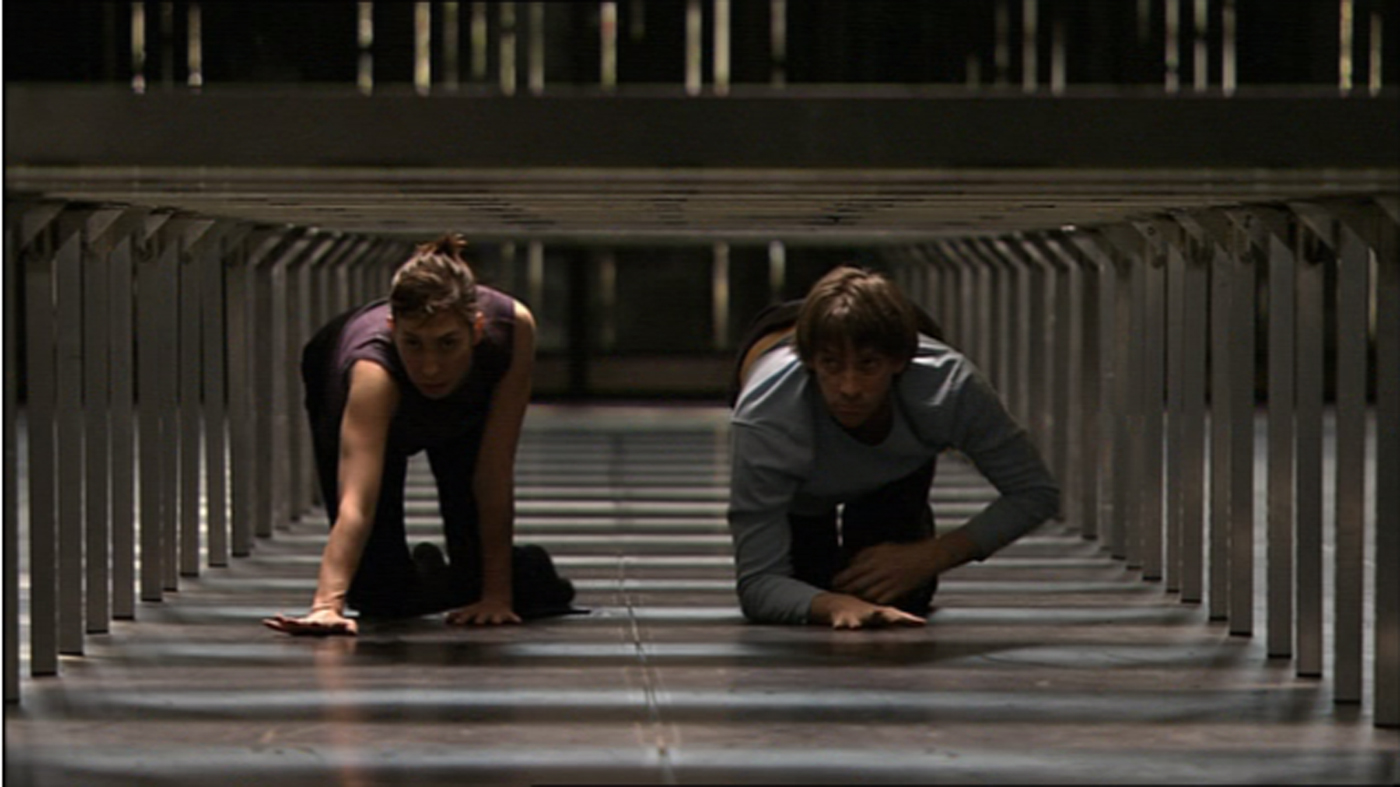
In trying to remain faithful to the choreography and intent of Forsythe's dance, De Mey does present most of the main dance linearly except for the five added scenes, which arguably enhance the aesthetic of otherworldliness due to Forsythe's disfocus method and De Mey's framing of the sequences. Three of these scenes from the screendance utilize a long row of single-file tables; the other two use only one table. While both artists have a similar sensibility of otherworldliness, I believe De Mey reworlds Forsythe's dance to reflect the filmmaker's aesthetic. By moving the iconic opening scene—with the running dancers—to a later position, De Mey begins his screendance by introducing the viewer to his otherworld: focusing on two dancers who cautiously crawl under a long row of tables (Photo 2). Shooting this scene head-on and using a long shot makes the image appear “flat” given the two-dimensionality of the screen. At the same time, the framing of this sequence establishes the illusion of three dimensions given the positioning of the tables: they create a highly architectural construction of symmetrical elongation and accumulation. In light of the background concerning One Flat Thing, reproduced, the mass of table legs suggests layers of ice and snow that have become compacted to create an ice floe or glacier. Thus, De Mey is experimenting with methods of representations that translate Forsythe's ideas. The great length of the tables visually also alludes to the beyond: the camera maintains focus on the two dancers while the table legs in the background lose their clarity thus evoking immeasurable endlessness. Furthermore, through this image, De Mey establishes an enhanced otherworldliness by decontextualizing the use of the tables and repurposing them into a low, crawling, tunnel space. Clarence Tsui remarks that this scene reminds one of “soldiers pulling themselves forward in a trench—an image of dance as warfare” (Reference Tsui2012). The two dancers crawl forward in a curious, exploratory, yet tentative manner as they survey their surroundings. In line with Walon's reading of De Mey's oeuvre, the dancers' creeping forward also evokes an animalistic tendency as they walk on all fours thus occupying a realm between animal and human. As they come to a standing position, the camera follows them, and their movements change after passing the table tops: their gazes hint that they are no longer interested in scanning their environs. Rather, the dancers begin creating boneless and twisted upper-body movements, which they hold as they pause before continuing—Forsythe's disfocus method. Besides the disjointed movements, their gazes also meander in various directions. De Mey stays at “belly level” with the dancers to highlight their carnality and groundedness as if they are creatures from a different world. This realm is in direct contrast to Forsythe's main dance, which features stronger, more direct and controlled movement reminiscent of both ballet and contemporary dance.
Opening scene with (l –r) Jone San Martín and David Kern crawling forward. Film still from One Flat Thing, reproduced (2006). Directed by Thierry De Mey, choreographed by William Forsythe. Courtesy Thierry De Mey.
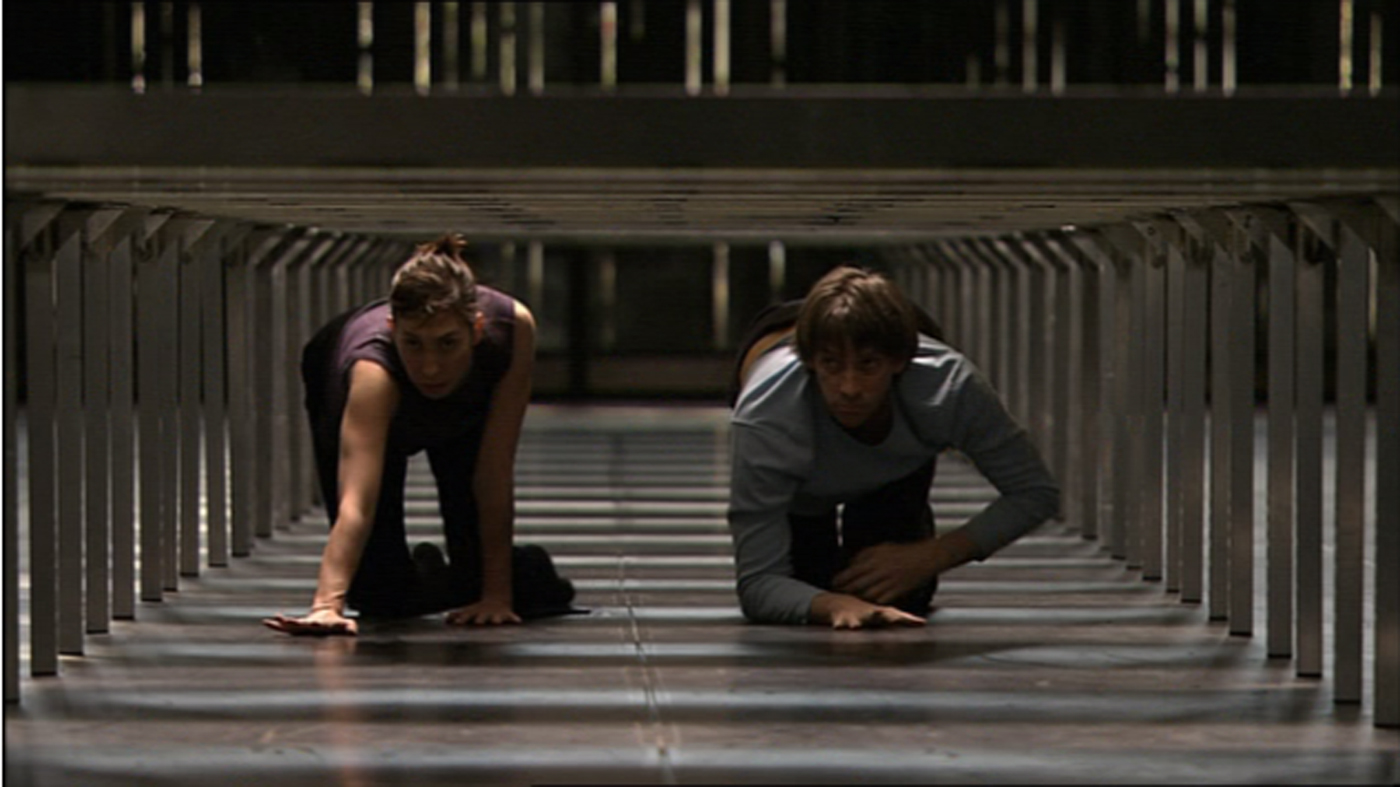
Interestingly, while the dancers are crawling, the credits introduce the screendance stating: the project as a collaboration, choreography by Forsythe, music by Willems, and filming by De Mey. As soon as the dancers rise from the trenches, the credits are finished. This technique draws the audience's attention back to the movement qualities of the dancers and implicitly announces a changing from one world to the next: one of recognizable animalistic crawling and curiosity under the tables (most likely through the influence of De Mey) to the Forsythian disarticulated, spineless body as the dancers rise. This shift in choreography and deterritorialized space seems to interweave the movement penchants of both artists in their aesthetic of otherworldliness. The filmmaker's close-up shot and upward panning focuses explicitly on the changing of worlds, which might be more difficult for an audience to see live on stage. Similarly, this movement phrase was not part of the main dance but improvised and recorded later during the film shooting. De Mey, as we will see, begins imprinting his authorial agenda and privileging the filmic media by constantly and clearly alternating between worlds, more so than can be easily perceived in Forsythe's stage version.
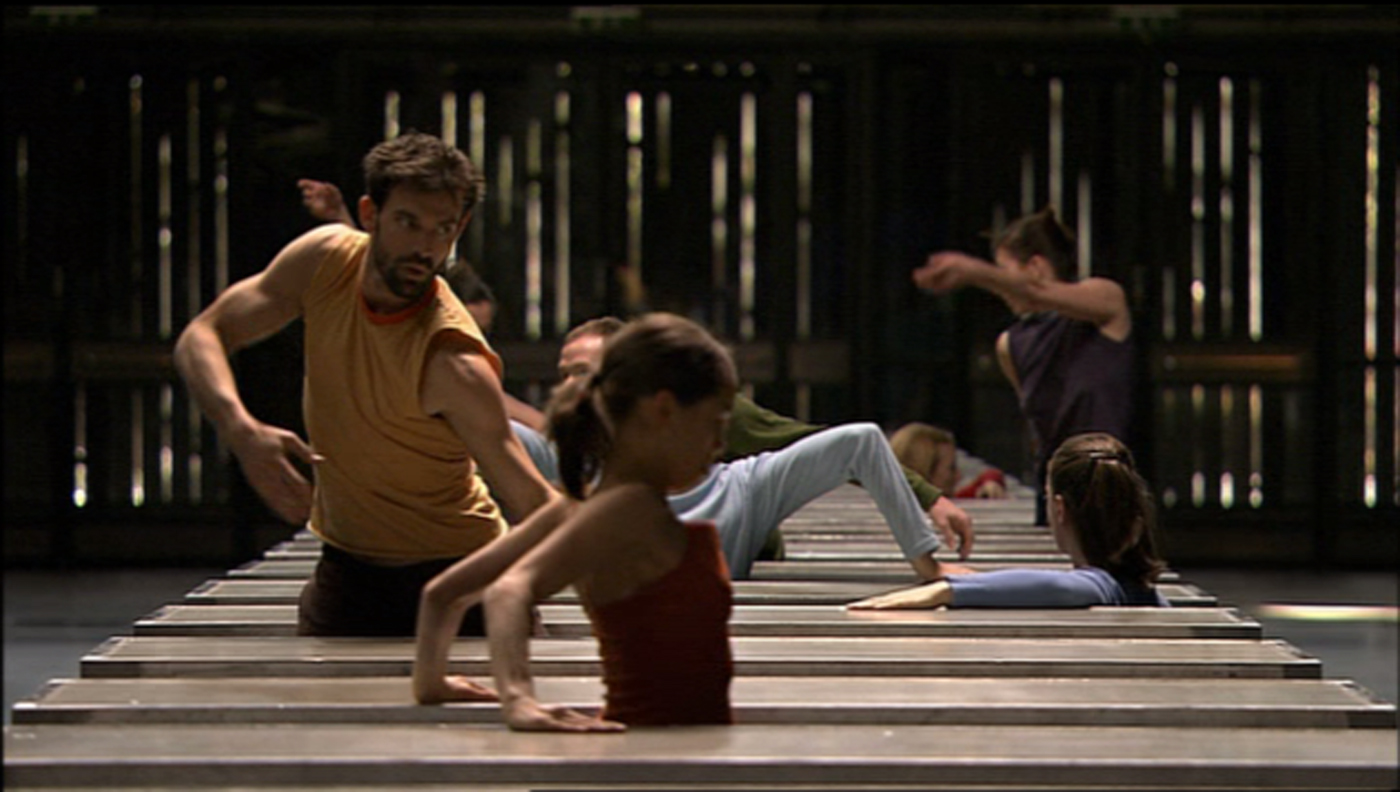
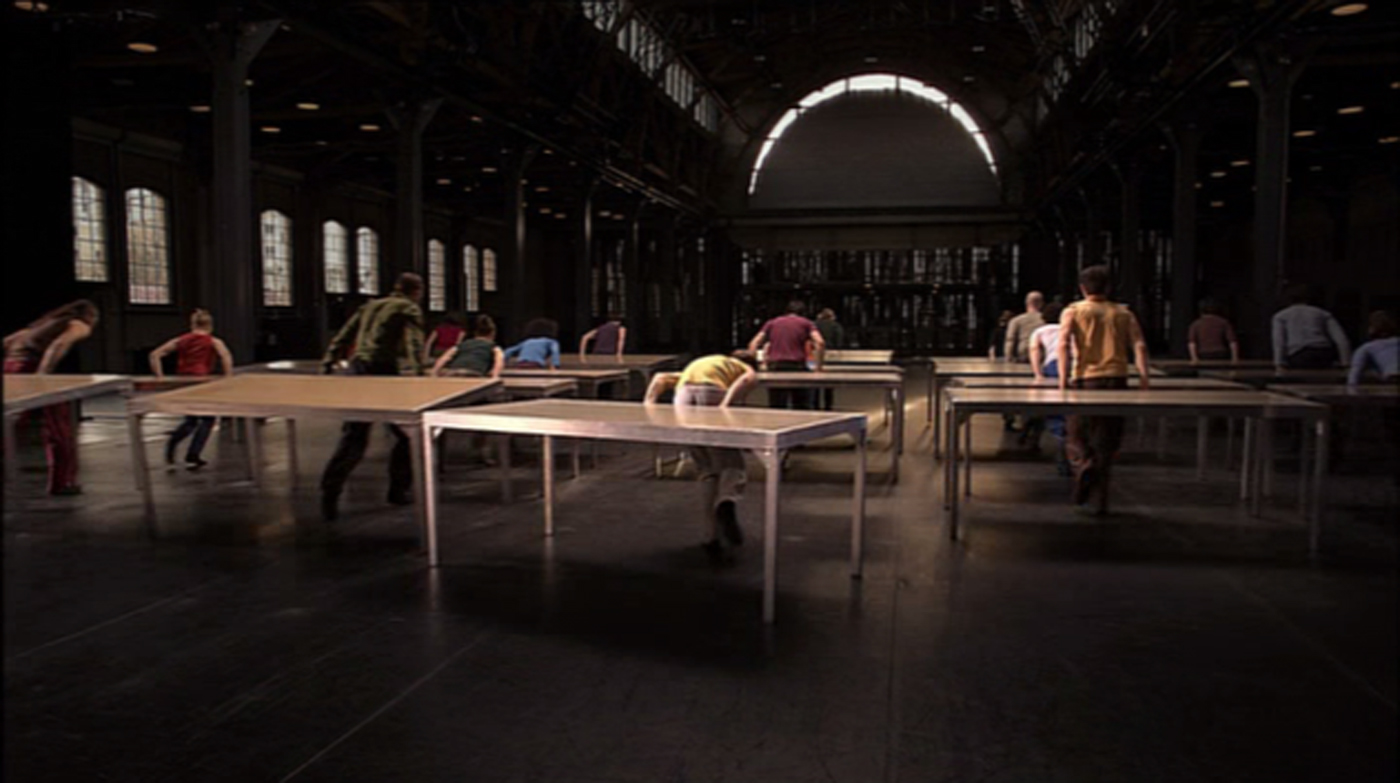
In another scene, “De Mey experiments again with a long shot of the extended line of tables but this time includes more dancers in his new universe. He maintains a similar camera angle as in the opening scene with two dancers, but now as many as eight movers populate the screen performing disjointed movements with intermittent pauses (Photo 3). Whereas before the two dancers were neatly centered in the camera's view and clearly focused, now the larger group comes in and out of the frame at various depths: the long shot of the camera focuses on the middle row while dancers in the very front and the back appear out of focus. While the choreographer cannot cause the audience's perception of his dancers to go out of focus per se, De Mey's camera, imitating the focus of the eye, can easily create and relay this fuzzy aesthetic to the viewer: essentially, his camera becomes the eye of the audience. Additionally, it often seems that the tables “cut off” or isolate single body parts (arms, torsos, legs) of the movers. Since De Mey has positioned the camera so that it captures only movement from the table top and above, dancers suddenly appear from below after springing up as if these creaturely beings were emerging from below the ice floes. While highlighting Forsythe's counterpoint technique, De Mey further suggests an alien terrain of disembodiment. His use of the tables as a partitioning device denies a view of the rest of the dancers' bodies, thus further alienating the observer from the mysterious worlds of the screendance. Consistent with his aesthetic of creating an otherworld, De Mey builds on his own work by exploring the animalistic movement of the Forsythe dancers and experimenting with framing the choreographer's disarticulated technique. In a way, he has translated Forsythe's distorted and disfocused movement into film by creating an enhanced imaginative world using the tables and out-of-focus, disembodied, body parts. By using a long shot, which highlights depth of field, and multiple layers of tables and dancers, this scene could recall a vast landscape of ice floes. Here, De Mey seems to evoke the German Enlightenment thinker Immanuel Kant's concept of the sublime—the inability to measure the powerful magnitude of nature and to be in awe of its infiniteness (Breckman Reference Breckman2008, 10). This idea became a central part of the romantic aesthetic.
A long shot of “disembodied” dancers creating an alien landscape. Film still from One Flat Thing, reproduced (2006). Directed by Thierry De Mey, choreographed by William Forsythe, danced by the Forsythe Company. Courtesy Thierry De Mey.

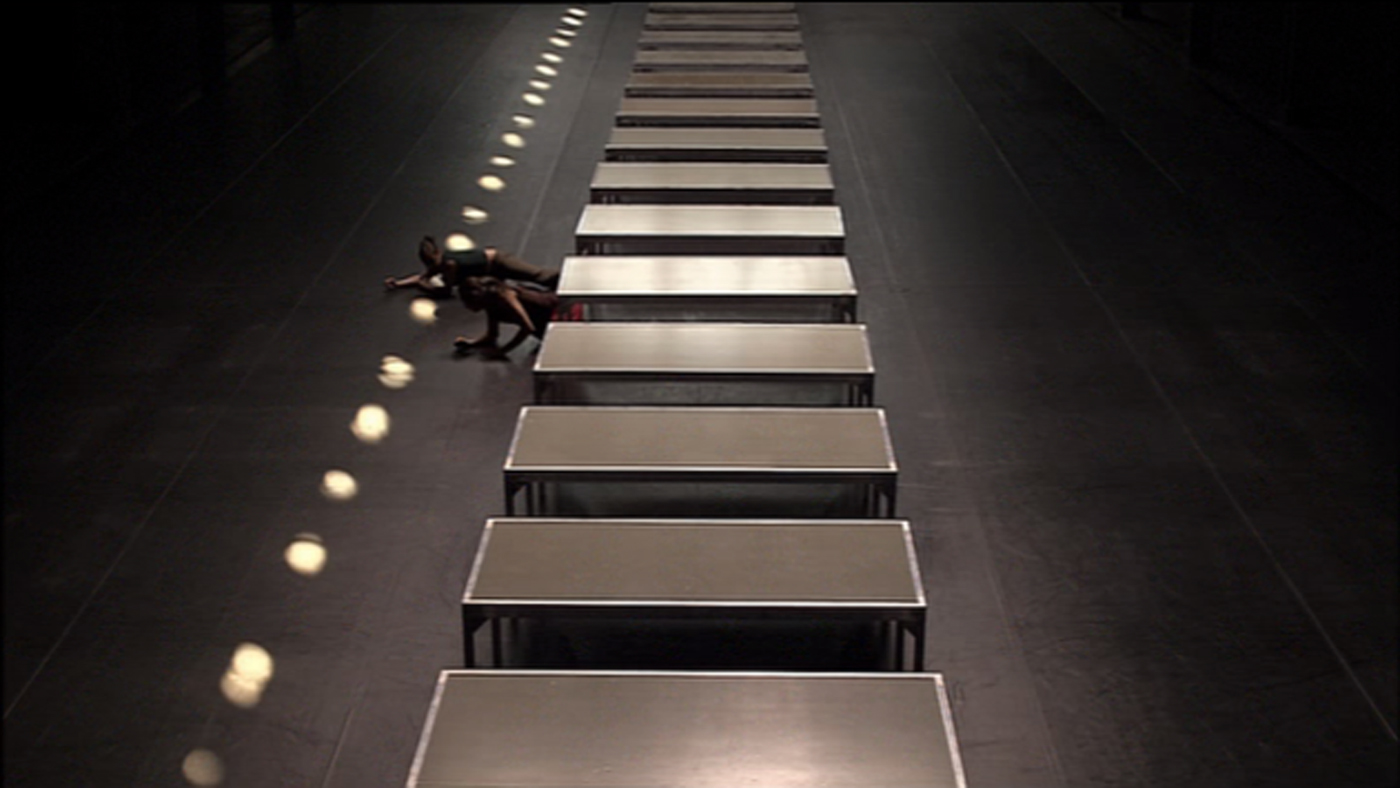
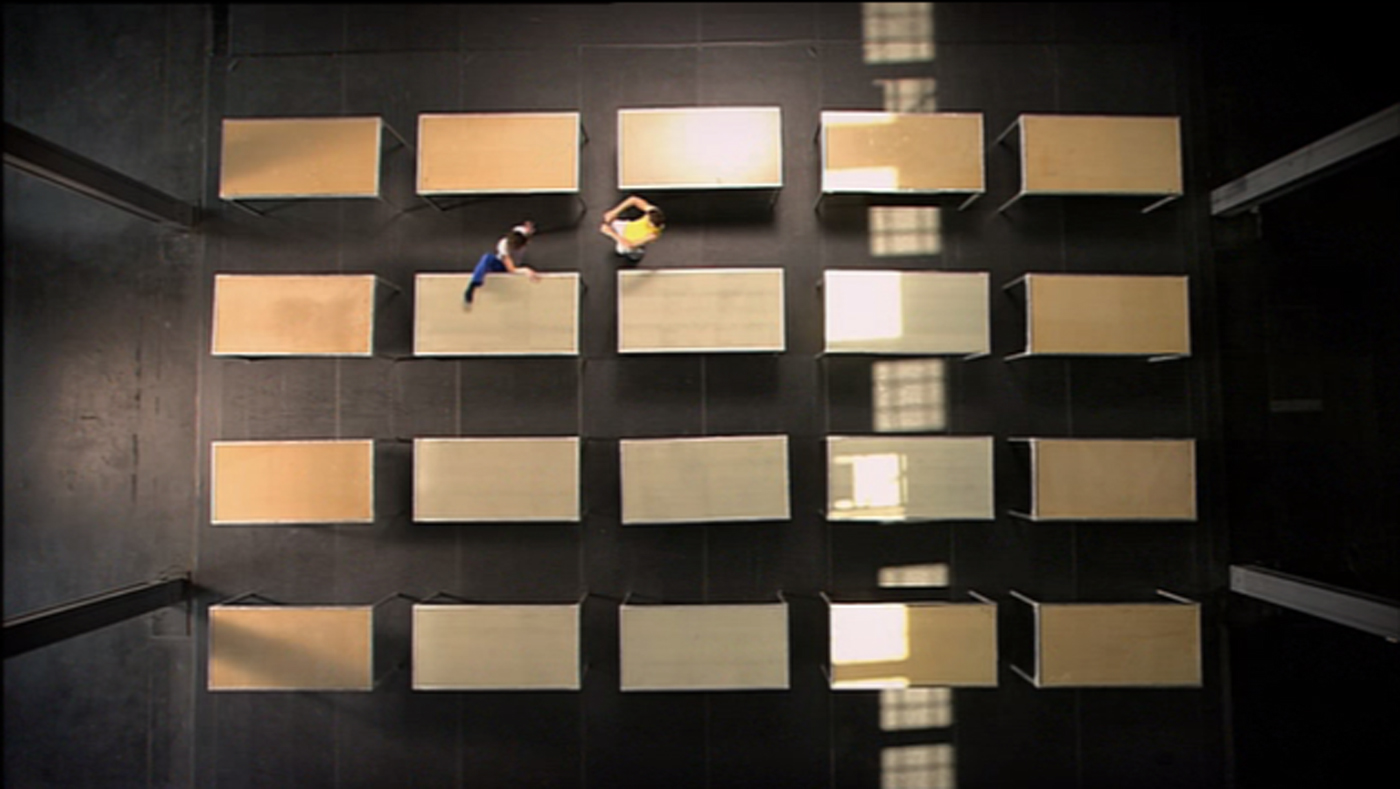
While the main dance One Flat Thing, reproduced ends with the dancers running back while dragging their tables, De Mey ends his screendance with shooting the long row of tables again, but this time from a higher, more diagonal view (Photo 4). Again, centered in the frame, two dancers move between, over, and under a single table. They then crouch under it and resume the same crawling gesture as performed in the first scene in the trenches; upon exiting the dancers cross a long row of sunlight shining in through the windows of the Bockheimer Depot. De Mey uses similar natural light patterns in La Valse, in which the windows of a train station allow light to filter in while creating a linear pattern on the floor, and in Rosas danst Rosas (1997) light shines through school windows forming a straight row of circles on the ground. The filmmaker, however, repurposes the glow here to create an otherworldly portal through which the dancers can enter or exit. Indeed, while it seems that De Mey could have selected another venue to shoot Forsythe's dance, as he has done with numerous other dances, the filmmaker was able to create a poetic space where the dance had originally been performed. Presumably, Forsythe and De Mey had arranged the tables in the single-file line that contributes further to the imaginative and repurposed architecture in the space. Walon observes this phenomenon as De Mey's searching for “aesthetic” areas “that echo, or more often further or even renew, those of the dance by giving the movements a new universe and hence new qualities, significance, and connotations” (2014, 28). By juxtaposing the industrial train lot with the incoming sun, De Mey preserves his aesthetic practice while maintaining and translating Forsythe's. By bookending the main choreography with two scenes of the same otherworld—the two dancers crawling toward the camera in the opening credits and then the two leaving through the light portal could be argued to be in the same realm because of the spatial construction and movement style—De Mey tries to create a circular narrative cohesiveness as a guide for the viewer.
Final scene as (l – r) Francesca Caroti and Sang Jijia crawl in/out the “portal.” Film still from One Flat Thing, reproduced (2006). Directed by Thierry De Mey, choreographed by William Forsythe. Courtesy Thierry De Mey.

Besides the scenes with the long row of uniform tables, there are some including a single table with one or more dancers. Unlike the “trench” and the overtly distorted choreography in the single-file tables scene, the movement sequences with the lone table are more characteristic of Forsythe's main dance One Flat Thing, reproduced. A sense of otherworldliness is again invoked by the filmic technique that De Mey uses leading up to the sole table dance. During a scene from the main choreography, a female dancer sweeps the head and torso of a male dancer who is lying flat (belly down) on the table top. As the camera moves closer to their movement, it cuts to a close-up of her turning his head so that his face looks directly into the camera: suggesting that a facial close-up can lead to another mental space. The next scene shows the single table as the same male dancer springs up from a kneeling position. In contrast to live dance, film is able, through use of cuts, to either smoothly transition between or juxtapose two scenes. Changing the space through editing, therefore, draws attention to these contrasting worlds. Since the director decides to maintain the linearity of Forsythe's main dance and then equally intersperses the scene of the single table and the long line of tables, this scene may indicate another point in time or a mental realm in the otherworld. In total, I would argue that De Mey depicts three realms: the familiar main dance that audiences may have already seen live, the single table realm in which movement stylistically reminds one of the original choreography, and finally the realm of lined-up tables where movement engages almost exclusively with the disfocus technique and animalistic crawling. Therefore, while the connection between these three different levels of otherworldliness remains unclear—that is, how dancer's progress from one to the next and why they exist—De Mey purposely leaves their relationship open as Forsythe does in his dances such as The Loss of Small Detail. The filmmaker's focus remains on experimenting with and deterritorializing the movement space to create multiple alien environments. Much like Forsythe's working process and dancers embody ideas from European Romanticism, De Mey perceives these themes that perpetually and clearly alternate between multivalent worlds.
De Mey's Deterritorialized Aesthetic
The five additional scenes De Mey included are equally dispersed in the screendance “to help balance the film and give new insight into the work” (Kaeja Reference Kaeja2007). By balancing the film, the director alludes to how Forsythe's counterpoint can be overwhelming, an aspect to which other scholars and viewers have already attested.Footnote 10 Given the complex cues and twenty-five movement sequences, watching the dance as a whole up close can overwhelm the senses. However, De Mey decided to “focus on certain individuals and their journeys through the piece” (Kaeja Reference Kaeja2007). Thus, he brings a loose “narrative” to his otherworld: a narrative that can still relate to Byrnes literary distinction of the term otherworld. Culler would call De Mey's film “discourse” that deviates from the “story”—Forsythe's main or live dance—and retells it with a distinct authorial perspective. While Forsythe used alignments to demonstrate moments of order and structure, De Mey seems to translate the choreographer's organizational efforts by using camera techniques that enhance the interactions and the “rules” of these otherworlds. In addition to the five scenes, De Mey uses his own filming of the main dance from One Flat Thing, reproduced to create his own universe. The filmmaker focuses on the following camera techniques to create his new world: deterritorialized close-ups and a circling method.
I believe De Mey wants to highlight the enhanced viewing possibilities and nonlinear editing of screendance over live dance as he introduces the viewer to the otherwordly landscapes. It is precisely these angles and juxtaposing or parallel cuts that cause a break in linearity. These temporal fissures can disorient the viewers who are actively looking for an overarching structure, especially if they have seen Forsythe's main dance live. Because of these sudden caesuras, the audience could perceive these changes in spaces and movement technique as otherworldly even more so than in a live performance. While all live dances create their own environments, De Mey's primary use of cuts serves to more strongly demarcate not only temporal shifts but also changes in space and movement quality.
Throughout the filming, De Mey generally retains Forsythe's metaphor of glacial accumulation starting from “little storm[s]” and building to a full on “blizzard” (Forsythe Reference Forsythe2006). His method of shooting maintains the central framing of the two men's “little storm,” begins the loose narrative, and follows them as they move laterally across adjacent tables. And toward the end of the screendance, De Mey uses edits together with numerous crane shots that descend upon the entire group to further enhance the activity and the viewer's perspective of the “blizzard.” In one frame at the beginning as one man performs a penché in attitude derrière, he kicks the other dancer whose cambré reactions is shown in the following frame, and the camera quickly cuts to the bird's-eye view (Photo 5). Through quick editing, De Mey tries to aesthetically recreate the feeling of the dancers as they react to each other's cues. In the same vein, it is as if the filmmaker himself takes a cue from the dancers in creating his screendance by alternating viewpoints. Even in this scene, one can sense the interaction between the dancers, however, the “little storms” start to build as more dancers begin performing their movement material. De Mey alternates between wider shots that try to capture all the counterpoint and close-ups that focus on a single dancer or group. De Mey has stated that he tends to film from the “belly level” to maintain physical and terrestrial qualitiesFootnote 11 and this relays his desire to assume the position of a viewer at an equal level. On the one hand, “physical” implies that a spectator could kinesthetically empathizeFootnote 12 with the dancers; physicality seems to suggest closer proximity. On the other hand, “terrestrial” indicates earthly. To even use such a term also suggests that De Mey conceives of the creative world as possibly not being from planet Earth. Because this perspective puts the viewer at the same level of the dancer, the filmmaker maintains Forsythe's aesthetic of wider shots to maintain intellect and rationality as well as to preserve alignments; higher views and wide-angle shots allow the observer to sustain a more “divine” perspective to see the world and its inner workings. While it seems as if De Mey mimics the perspective of a viewer who might switch between watching the aggregate dance and focusing on certain groups, his camera also moves dynamically into spaces impossible for audience members to travel and lets them see the intimate perspective of the camera.
Bird's-eye view after (l – r) Cyril Baldy flicks Ioannis Mandafounis. Film still from One Flat Thing, reproduced (2006). Directed by Thierry De Mey, choreographed by William Forsythe. Courtesy Thierry De Mey.

About halfway through the screendance, De Mey focuses on a male dancer who squats so that his chin sits on the table. By pulling the camera back to reveal what was covered before by the frame—widening its camera-looking (Rosenberg Reference Rosenberg2012, 69)Footnote 13—which now not only makes the nonessential again essential and the absent present, we discover more and more dancers moving around, who are juxtaposed by the squatting dancer. De Mey's framing disembodies the dancer's head whose eyes cast a glance left but then focus head on. For a moment as the camera pulls back, the dancers' bodies appear just as detached parts, such as the one dancer's isolated head, and contribute to the otherworldly landscape. In another shot with the disembodied head, three rows of bodies sit with their arms slowly reaching down to grasp the table (Photo 6). As the head watches the arms coming down, the isolated head becomes blurry as the camera focuses on the limbs. In this framing, the arms become objectified appendages without a body, and the head turns into a mere trace of a human. Connected directly to this scene as the three arms come down is another female solo dancer in an orange camisole, who puts her hand down near the first dancer in the row. From then on, De Mey focuses on her journey between the tables and the rest of the dancers, who, for the most part, remain still—sitting or standing. Her movement is marked with the disfocus technique as she seems to slither like a snake on the other dancers sitting down. De Mey's interest in her disarticulated movement lies in its animalistic charge and also corresponds to Forsythe's defiguration method. Furthermore, the inactivity of the resting dancers deterritorializes their bodies so they transform into an alien landscape while the single dancer moves around her new space. Because of the close-up on the sitting dancers, they no longer resemble human bodies but rather present a traversable, otherworldly terrain. Walon has observed this phenomenon in De Mey's other screendances: “This [aesthetic] erases, or at least renders porous, the boundaries between the dancers and their environments: again, spaces and bodies seem caught in the same ‘fabric’ of the world” (2014, 37). Performing disjointed movements, the dancer not only uses the tables to brace herself, but also employs the sitting dancers. This deterritorialization creates a new environment for her to momentarily explore before she slaps her hand on a table: a cue for other dancers to resume larger movements of the main dance. Interestingly, this scene is part of Forsythe's main choreography and was not part of the five additional ones: thus, De Mey has mined the dance for its moments of disfocus so he can further frame them with his perspective.
Dancer Sang Jijia's ‘disembodied’ head with three arms. Film still from One Flat Thing, reproduced (2006). Directed by Thierry De Mey, choreographed by William Forsythe. Courtesy Thierry De Mey.

One of the most striking camera techniques that De Mey uses to highlight Forsythe's otherworld can be seen when the filmmaker shoots in a circular pattern that covers the periphery of the four-by-five table grid. Whereas before he had shot entire scenes by quickly cutting to certain groups, this continuous tracking shot around the perimeter focuses on the dancers for a full two and a half minutes without editing. This grounded shot helps immensely recognize the regular flatness and continuity of the tables as ice sheets, as a possible living space for this community. Remaining essentially at the level of someone walking around the group and maintaining a critical distance, this uninterrupted tracking shot takes on the view of a voyeuristic individual: one interested in attempting to observe a dynamic society. The “belly level,”Footnote 14 circular shooting, therefore, enhances this view by giving the audience an opportunity to examine this otherworld from a dynamic perspective, which is not possible nor intended in the live dance. A similar circular shot is also used in Rosas danst Rosas in which De Mey films four female dancers performing gestural movements in chairs. Interestingly, for this continuous, long shot “Forsythe walked beside the dolly giving directions to the dancers, altering the timing of the dance and adapting the timing to the rotation of the camera” (Kaeja Reference Kaeja2007). Instead of simply relying on the planned movement material and improvisations, Forsythe strategically repositioned sequences. Indeed, Forsythe and De Mey collaborated in creating the aesthetic for this screendance. By filming an interview with Forsythe concerning the origins of the dance and closely studying performances and filmic renderings of One Flat Thing, reproduced, De Mey perceived and thematicized the romantic origins of the textual work and engaged with Forsythe's disfocus technique: a movement form creating an invertebrate and disarticulated aesthetic that reminds one of De Mey's animalistic dancing body. This kind of body then integrates itself and fully interacts with its surroundings; although De Mey has worked with other dancers and choreographers, he must always get to know the “lay of the land” so he can understand his role and autonomy in the collaborative process and create his otherworlds.
Rosenberg believes that “cameras, as an integral component of media space, are both telescopic and microscopic in their ability to extend vision and facilitate a kind of seeing that is a manifestation of our desire to draw phenomenal close to us” (Reference Rosenberg2012, 29). His characterization not only demonstrates a need to bring stimuli closer to the viewer, but the use of the adjectives “telescopic” and “microscopic,” drawn from a scientific realm, also evoke connotations of studying, observing, and objectifying. Rosenberg characterizes the director as an archaeologist who would be involved in: “unearthing, revealing, and ultimately reconnecting the disparate parts collected at the site of the excavation” (Reference Rosenberg2012, 160). De Mey creates an atmosphere of investigation and examination: for him as a creative endeavor in filming a screendance and for the viewer to gain insight into the interaction of an imaginary community through the filmmaker's perspective.
Besides the dancing and arrangement of tables contributing to the otherworldliness of the Bockenheimer Depot through the filming, De Mey engages with a large, glass, half-circular window with a shade that at times either completely or partially covers the window. The filmmaker, however, repurposes the spherical shape to resemble the sun or at least a representation of an otherworldly light source. In addition to the three otherworlds, which I have argued for in this article, the window is sometimes filmed but not necessarily intentionally, but simply because it happens to be in the frame when De Mey focuses on the dancers and the tables. However, at the end of the piece, when the dancers run back with the tables, the viewer can now read meaning into the window. Juxtaposing the industrial building with the natural light coming through the window, De Mey creates a more repurposed environment by deterritorializing the window. As the dance begins, the shade is partially lowered to reveal more light; eventually the shade completely reveals the light source at the height of the movement counterpoint; at the conclusion, as the dancers run back dragging their tables, one can see the shade being raised to completely block out the light (Photo 7). In De Mey's world this light source corresponds to the activity of the dancer's movement and enlivens the space with radiance.
Running back just as the ‘sun’ is eclipsed. Film still from One Flat Thing, reproduced (2006). Directed by Thierry De Mey, choreographed by William Forsythe, danced by the Forsythe Company. Courtesy Thierry De Mey.

In the last portion of De Mey's interview with Forsythe, the choreographer states his interpretation of the filmmaker's work:
What I like about film is the fact that you can become sort of intimate in the performance. In this case you took the camera and went right inside the tables. And … I like that fact that you can feel inside the dance as opposed to always being outside the dance. The work is designed to be seen from a distance actually. If you sit up too close you can't see it well. … The farther away you are, the more you lose certain kinds of intensity in the performance. So we can recuperate a lot of that intensity. And because of the way you're composing it, you can go back and revisit things. You don't have to lose the form; you just happen to focus in, then go back out, and revive that same theme. … You are doing those things you can't do on stage. … I'm not so crazy about the side view. I think the top view is fantastic. Front view that's what it's designed for. … From underneath [it] is a world unto itself. … If you give these moments of unity to an audience … where it's obvious that there's an organization as opposed to some sort of chaotic structure. They will follow it. It becomes a kind of narrative. (2006)
Forsythe mentions a variety of the filmic characteristics that have been discussed in this article and also belong to the aesthetic possibilities of screendance. He notices intimacy concerning the camera's positioning and alignments due to changes in perspective without sacrificing form. During the interview when Forsythe describes the under-table scenes as a “world unto itself,” his gaze focuses downward and away from the eyes of De Mey as if the choreographer is thinking about what he wants to say: it is difficult to note something substantive about this mysterious aesthetic. While both Forsythe and De Mey can create an alien landscape, trying to analyze it to only leads to reticence. This “world unto itself,” which for Forsythe leads to silence, seems to point to a romantic fascination with the beyond: the creation of new, incomprehensible otherworlds that confound the intellect and elicit abundant meaning and feeling. Arguably, this world is not simply relegated to the underside of the tables, but rather enhanced through De Mey's deterritorialization of the dancing body through camera positioning and framing. The worlds change based on the movement style (balletic/contemporary to animalistic to disarticulated), the space (main dance, single tables, line of table), and De Mey's camera work and editing.
By tracing the genealogy of Forsythe's aesthetic lineage—from romantic ballet to experimental methods of alienation—and further through De Mey's animalistic body in a deterritolialized setting, both choreographer and filmmaker maintain malleable representations of their own otherworlds. While De Mey honors the intensity of the main dance and Forsythe's representations of otherworldliness, the filmmaker also leaves his own artistic mark. Through intense study of One Flat Thing, reproduced, recognizing Forsythe's textual inspirations and disfocus technique, and the collaboration with Forsythe and his company, De Mey sensed the choreographer's imaginative landscape and chose to highlight and experiment with differing and ambiguous levels of otherworldliness by taking the viewer inside the dance. Since Forsythe's disfocus method evokes a disarticulated, invertebrate-like aesthetic, it could have arguably reminded De Mey of his own penchant for the animalistic dancing body: thus, the filmmaker prominently features these particular movement sequences at the beginning and end of his screendance. Clearly, the five additional movement sequences—featuring a single table or a long row of single-filed tables—further enhance Forsythe's already alien landscape by employing varying architectural compositions of the tables and highlighting the dancers' disjointed movements through close-ups and deterritorializing the corporeal. Furthermore, De Mey establishes three distinct worlds through which his screendance progresses and alternates: unlike Forsythe's live dance, De Mey's screendance maintains a unique position as a filmic medium because of its capacity to more easily delineate and travel between different worlds by employing cuts that juxtapose or parallel both the movement qualities and space.