Recently, one of the most vibrant lines of international law, comparative politics, and international relations research has been the quantitative study of government repression. This literature typically models the determinants of states’ rights performance, exploring how institutions like economic and military foreign policy, international conventions,Footnote 1 civil society, and domestic-government structure, among other factors, impact negative rights outcomes (Hill and Jones Reference Hill and Jones2014). These studies have resulted in the creation of the “standard model”: a common model specification that regresses state respect for human rights on a series of variables capturing differences in “domestic and external threats (civil and/or international war), regime type (democracy, military, and leftist), and socioeconomic conditions (economic development, population size, and colonial legacy)” as well as international legal commitments (Keith Reference Keith2012, 79).
The outcome measure in most of these models is some index or indicator that measures state respect for physical integrity rightsFootnote 2 or empowerment rights.Footnote 3 Among the most commonly used outcomes are the Political Terror Scale (PTS), the CIRI Physical Integrity Rights Index (Cingranelli, Richards and Clay Reference Cingranelli, Richards and Clay2015), the CIRI Empowerment Rights Index, the latent Human Rights Protection Scores (Fariss Reference Fariss2014), and the DO-IRT Empowerment Rights Index (Schnakenberg and Fariss Reference Schnakenberg and Fariss2014).Footnote 4 Each measure assesses states based on their aggregate level of performance on physical integrity rights, empowerment rights, or both. In other words, they measure how well states perform across a bundle of rights.
In many cases, however, researchers are interested in testing theories that relate to specific negative rights, such as extrajudicial killing. Until recently, researchers who wanted to examine the determinants of state respect for most individual rights needed to rely on CIRI’s data.Footnote 5 In 2016, the Varieties of Democracy Project (V-Dem) dataset was fully released, offering researchers an alternative. V-Dem offers researchers a rich new dataset, covering 173 countries and colonies from 1900 to 2015.Footnote 6 It contains 350 unique indicators related to democracy, including several measures of negative rights. These include, among others, freedom from torture and political killings, and freedom of speech and religion. Researchers are increasingly likely to use these V-Dem scores as an alternative or complement to their CIRI counterparts; the project has already been cited over 300 times since 2013.Footnote 7
Though the CIRI and V-Dem measures ostensibly capture similar underlying constructs, we show that the CIRI–V-Dem measurement pairs diverge significantly across time periods. Moreover, the measures are negatively correlated for a large set of countries. These findings stand in contrast to the relatively high correlations between other sets of popular negative rights measures and suggest that researchers should use caution before using the two measures as substitutes for one other. They also raise important broader questions about how rights measures are designed.
The CIRI and V-Dem rights measures
Cingranelli and Richards’ CIRI measures have been used more than any other disaggregated human rights data, appearing in at least 1136 studies published in comparative politics, political economy, international relations, international law, and other law and social science journals. The dataset quantifies information contained in the U.S. State Department’s Country Reports on Human Rights Practices. For physical integrity rights, it also considers AI’s World’s Human Rights Reports.Footnote 8 From these reports, CIRI coders produce ordinal-level country ratings on 15 state negative human rights practices. The dataset currently covers 202 countries from 1981 to 2011.
Released nearly two decades later, V-Dem is an international data collaboration project that currently covers 173 countries and colonies, spanning the period 1900–2015 (Coppedge et al. Reference Coppedge, Gerring, Altman, Bernhard, Fish, Hicken, Kroenig, Lindberg, McMann, Paxton and Semetko2011, Reference Coppedge, Gerring, Altman, Bernhard, Fish, Hicken, Kroenig, Lindberg, McMann, Paxton, Semetko, Skaaning, Staton and Teorell2015; Pemstein et al. Reference Pemstein, Marquardt, Tzelgov, Wang and Miri2015). Of the more than 350 unique indicators related to democracy, about half of them are based on “factual information obtainable from official documents such as constitutions and government records.”Footnote 9 The others are based on subjective decisions by approximately 2500 country experts around the world, many of whom have lived or worked in the countries they are rating (Pemstein et al. Reference Pemstein, Marquardt, Tzelgov, Wang and Miri2015). In most cases, the expert coders rely on their own impressions of countries or refer to secondary sources about country conditions.Footnote 10 The project uses multiple coders per country-year unit in a process that was coordinated by over 50 academics across multiple universities and institutes. From these data, V-Dem generates latent scores based on categorical questions answered by each coder for each country-year item.Footnote 11 The model accounts for disagreement between coders and it generates measurements of uncertainty conditional on the number of and agreement between coders, as well as coder reliability over time (Coppedge et al. Reference Coppedge, Gerring, Altman, Bernhard, Fish, Hicken, Kroenig, Lindberg, McMann, Paxton, Semetko, Skaaning, Staton and Teorell2015). The V-Dem data are increasingly used in comparative politics, political economy, international relations, and sociology.Footnote 12
Both datasets include a range of measures that capture how well states respect negative human rights. Specifically, they provide measures of the extent to which states respect individual physical integrity rights, empowerment rights, or bundles of these rights. Our focus here is on the disaggregated measures that capture state performance in relation to a particular right. CIRI provides 15 such measures. Depending on how negative human rights are defined, V-Dem provides somewhere between two and several dozen of these measures. Many of them examine specific subcomponents of disaggregated rights. For instance, V-Dem does not provide a measure of free speech generally; it disaggregates free speech into several measures that capture specific aspects of free speech, such as freedom of discussion and freedom of discussion for women.
The codebooks for each data project conceptualize these six measures in ways that share many similarities but also include key differences. For example, both sets measure torture, but they define it differently. The CIRI standard defines torture in part as, “the purposeful inflicting of extreme pain, whether mental or physical, by government officials or by private individuals at the instigation of government officials.” The V-Dem torture indicator defines torture more narrowly, as “the purposeful inflicting of extreme pain, whether mental or physical, with an aim to extract information or intimidate victims, who are in a state of incarceration.” It therefore requires that victims be incarcerated, and it limits the torturer’s motive to “extract[ing] information or intimidat[ing] victims,” thus excluding, among other things, the motive of “punishment” and “discrimination.” Torture as defined by various international law sources often occurs outside of the context of incarceration. So even without observing the data, we would expect the CIRI measure to count many more torture incidents than its V-Dem counterpart.
Just as the CIRI and V-Dem measures capture related but not identical underlying constructs, CIRI and V-Dem measure the six variables listed in Table 2 below in ways that are similar in some respects but different in others. Methods for measuring repression levels can be divided into three broad approaches based on how the source material is quantified: (1) events-based; (2) standards-based, and (3) survey-based (Landman Reference Landman2004).Footnote 13 CIRI claims to use a “standards-based” approach, meaning that it attempts to assess the frequency and level of violations in some time and place without documenting or counting specific instances. It claims to do this by comparing actual human rights practices in any given year to contemporary international law standards (Cingranelli and Richards Reference Cingranelli and Richards2010, 405–06). Yet some commentators argue that CIRI’s method is actually events-based. For instance, Wood and Gibney (Reference Wood and Gibney2010) remind us that the original CIRI approach was based on events-based thresholds such that the categories 2, 1, and 0 correspond to zero violations (“full respect”), 1-to-49 violations (“moderate respect”), and 50-or-more violations (“no respect”), respectively, and therefore describe a count of discrete rights violations. Though this was originally one of the coding guidelines developed by the CIRI team, they discovered it was not practical for most of the country-year reports that they coded.
V-Dem also claims to use a standards-based approach. Unlike other standards-based indicators, the V-Dem project controls the standards used to assess each of its variables (i.e., the questions’ wording and format, which is displayed in Online Appendix A). Moreover, because the coders complete the questions over the relatively short time span of four years, it is unlikely that the V-Dem human rights scores are temporally biased in the same way that standards-based human rights data might be (Fariss Reference Fariss2014). That is, unlike the human rights reports, the V-Dem data are based on question responses that are produced consistently with respect to time. However, like events-based data, the V-Dem expert coders rely on their knowledge of evidence from the historical record, and the historical record provides different levels of information for certain cases.
Table 1 summarizes the several characteristics of the CIRI and V-Dem measures.
Overview of Datasets

Note: Table 1 describes the source material for each dataset, its empirical coverage, scale, and measurement approach.
Given their nominally similar concerns, researchers might assume that the two measures correlate strongly, even if they note that descriptions in the respective indicators’ codebooks differ. This intuition is understandable given that previous comparisons of leading aggregated measures have found fairly high correlations between the measures. For instance, the Kendall’s τ-b coefficient for CIRI and the PTS is approximately 0.73 (for those PTS scores derived from State Department reports) and 0.65 (for those derived from AI reports) (Wood and Gibney Reference Wood and Gibney2010, 375).
So it would be reasonable to assume that CIRI and V-Dem are good substitutes. That assumption might lead researchers to choose one over the other based on traits like past or recent popularity, scope of time, or countries covered. It could also lead researchers to replace one measure for another as a robustness check. In fact, our conversations with researchers suggest that this is already widely done, even if not always reported in papers.
But treating two measures as interchangeable could be a pitfall for researchers, particularly if the measures are in fact concerned with different constructs. For instance, an indicator can be institution-oriented or individual-oriented. Institution-oriented indicators are concerned with compliance, that is, how well government institutions perform concerning individual rights or bundles of rights. In contrast, individual-oriented indicators are concerned with enjoyment—to what extent the country’s rights performance affects a typical national resident. Using an individual-based measure for a question relating to government rulemaking (or an institution-based measure for a question related to how citizens respond to repression) would answer a question different from the researcher’s question of interest, producing misleading results.
One way to shed light on different constructs is to study the respective databases’ codebooks, examining the assumptions underlying the measurement approaches. Another option is to do what we do here: empirically compare pairs of theoretically similar rights. This method may not tell the whole story, because significant divergence may stem from measurement error. But where empirical correlation is low, it constitutes strong evidence that the two scores are not in fact measuring the same phenomenon.
An empirical comparison of the disaggregated measures
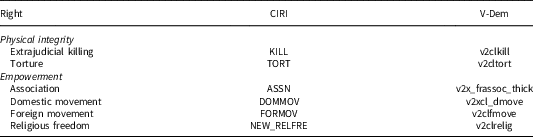
To begin, we selected a set of six broadly comparable rights that often interest empirical researchers. They include the physical integrity rights of (1) protection from extrajudicial killing and (2) protection from torture, and the empowerment rights of (3) freedom of domestic movement, (4) freedom of foreign movement, (5) freedom of religion, and (6) freedom of association. For each of those rights, we reviewed the codebooks for each dataset and identified one measure from CIRI and one from V-Dem that appeared to most closely capture that right. We took a conservative approach to identifying comparable indicators in CIRI and V-Dem, requiring high congruence between indicator definitions. Table 2 lists these CIRI–V-Dem measurement pairs. The first column provides a general description of the broadly conceived underlying construct they purport to capture.
Comparable Disaggregated Human Rights Measures

Note: The columns contain the underlying construct they are trying to capture, the CIRI variable name, and the V-Dem variable name.
We examine the extent to which these measures agree by constructing a panel dataset that contains the six CIRI and V-Dem variables listed in Table 2 for all 5647 country-year observations shared across both datasets. We then evaluate the degree to which the measures agree (Lee Rodgers and Nicewander Reference Lee Rodgers and Nicewander1988) by calculating the Spearman’s rank correlation coefficient, or Spearman’s ρ, for each of the six CIRI–V-Dem measurement pairs.Footnote 14 The correlation coefficient is calculated using the CIRI value and the mean V-Dem posterior value for each observation.Footnote 15 The statistic indicates the extent to which the measures agree with each other, with values closer to 1 representing increased agreement and values closer to −1 representing increased disagreement.
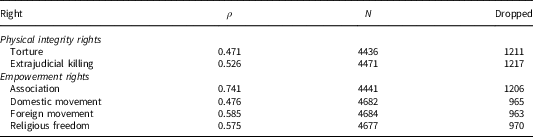
We first calculate ρ for each measure-measurement pair using all available country-year observations. Since we want to compare the coded values for country-years, we drop all observations that are not coded by both data projects.Footnote 16 Table 3 summarizes these calculations. The first column contains the name of the right measured by the CIRI–V-Dem pair, the second contains ρ for that pair, the third contains the number of observations coded by both measures, and the fourth column contains the number of country years dropped because of missingness in CIRI or V-Dem measures.
Correlations Between CIRI–V-Dem Measurement Pairs

Note: Table 3 shows the correlation coefficient for each CIRI–V-Dem measurement pair. The first column contains the name of the right measured by the CIRI–V-Dem pair, the second contains the calculated ρ for that pair, the third contains the number of observations coded by both measures, and the fourth contains the number of country years dropped because of missingness in CIRI or V-Dem measurements or in any country-year information.
This analysis reveals two important patterns. One is that the correlations for empowerment rights measures are higher than the correlations for physical integrity rights. An explanation for this could be that it is easier to observe violations of empowerment rights, since they often occur in more public settings than violations of physical integrity rights. In addition, governments rarely take the same measures to conceal violations of civil rights. The other pattern that we observe is a moderate relationship between nearly all of the measurement pairs. The range of correlation coefficients is 0.471–0.741, and the average is 0.562. In comparison, most measures of democracy correlate with each other at 0.8 or higher (Pemstein et al. Reference Pemstein, Meserve and Melton2010). We might expect that some human rights measures would correlate at even higher levels than democracy measures do. Though concepts like “torture” and “extrajudicial killing” are disputed in the rights, psychology, and medical literatures (e.g., McDonnell et al. Reference McDonnell, Nordgren and Loewenstein2011), and in law (e.g., Waldron Reference Waldron2005), they are still perhaps clearer than the long-contested concept of democracy. And as mentioned above, the Kendall’s τ-b coefficient for CIRI and the PTS is approximately 0.73 (State Department-derived PTS reports) and 0.65 (AI-derived reports) (Wood and Gibney Reference Wood and Gibney2010, 375). Our initial comparison of the CIRI and V-Dem indicators suggests that the measures disagree far more than most probably would have expected.
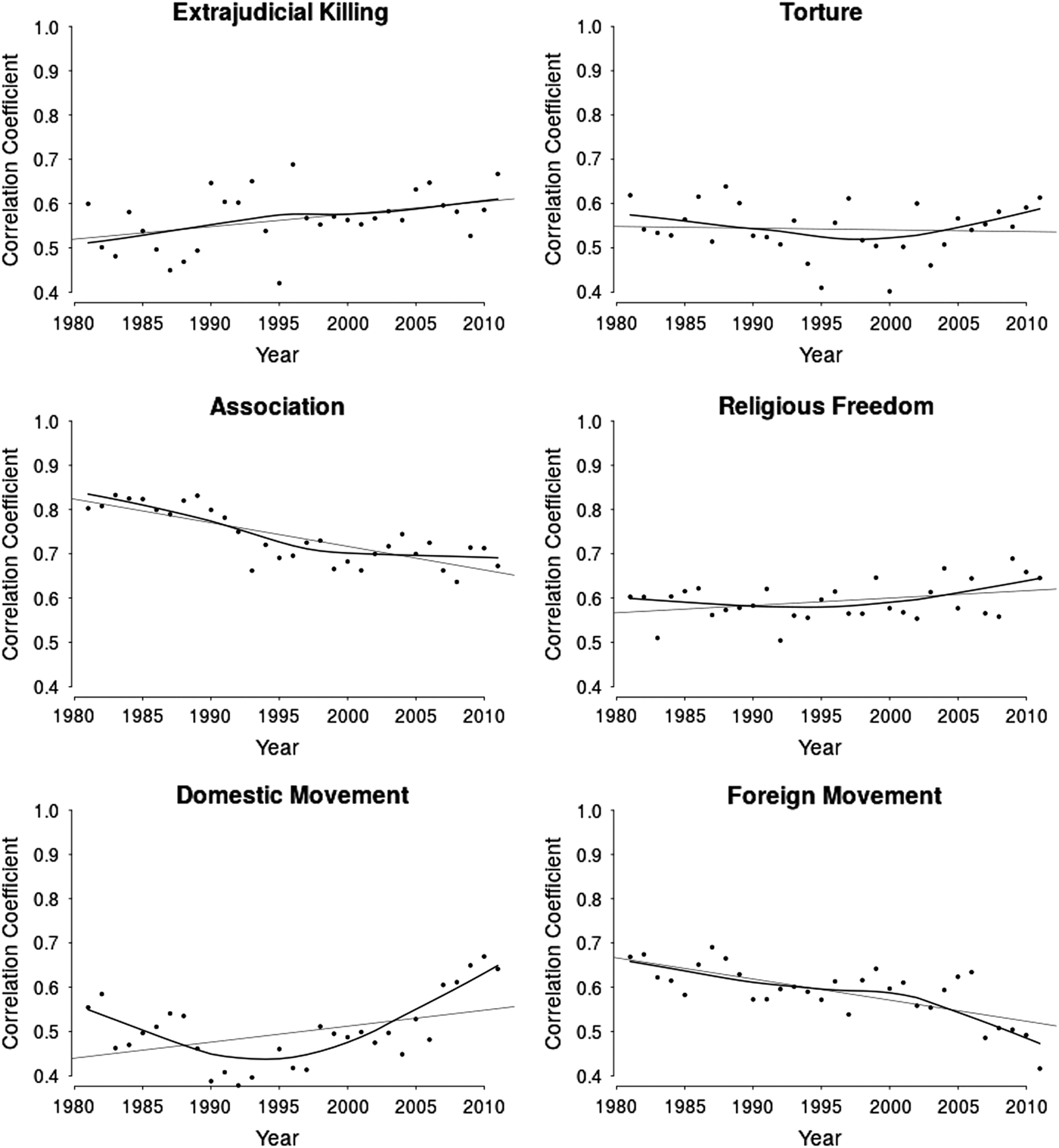
By looking only at the correlation coefficients for the entire sample, we might miss important divergences within subsets of the sample. For instance, it might be that these measures converge more for some years. If so, we would probably expect more agreement for more recent years; recent years’ records are better, and the V-Dem coders’ memories about them are fresher. We calculate the pairwise correlations for individual years. Figure 1 plots ρ for each measurement pair across time. Larger values indicate increased agreement over human rights practices within years. Between the CIRI and V-Dem data projects on extrajudicial killing and religious freedom, the plots are consistent with our expectations: agreement is higher for more recent years. The ρs for both sets of measurement pairs increase by about 50 percent from the first year in our data to the last year. But surprisingly, as to association and foreign movement rights, agreement declines as time progresses. The correlation between both sets of measures decreases by approximately 30 percent from 1981 to 2011. Curiously, agreement initially decreases over time for the domestic movement and torture measurement pairs and then increases.
Within-year correlations between CIRI–V-Dem measurement pairs Note: Figure 1 plots the correlation coefficient for each measurement pair across time.

These plots present several new puzzles for human rights researchers. Future work should examine why different sources agree more in some years than others. Scholars might also investigate why agreement about rights practices in recent years varies across datasets.
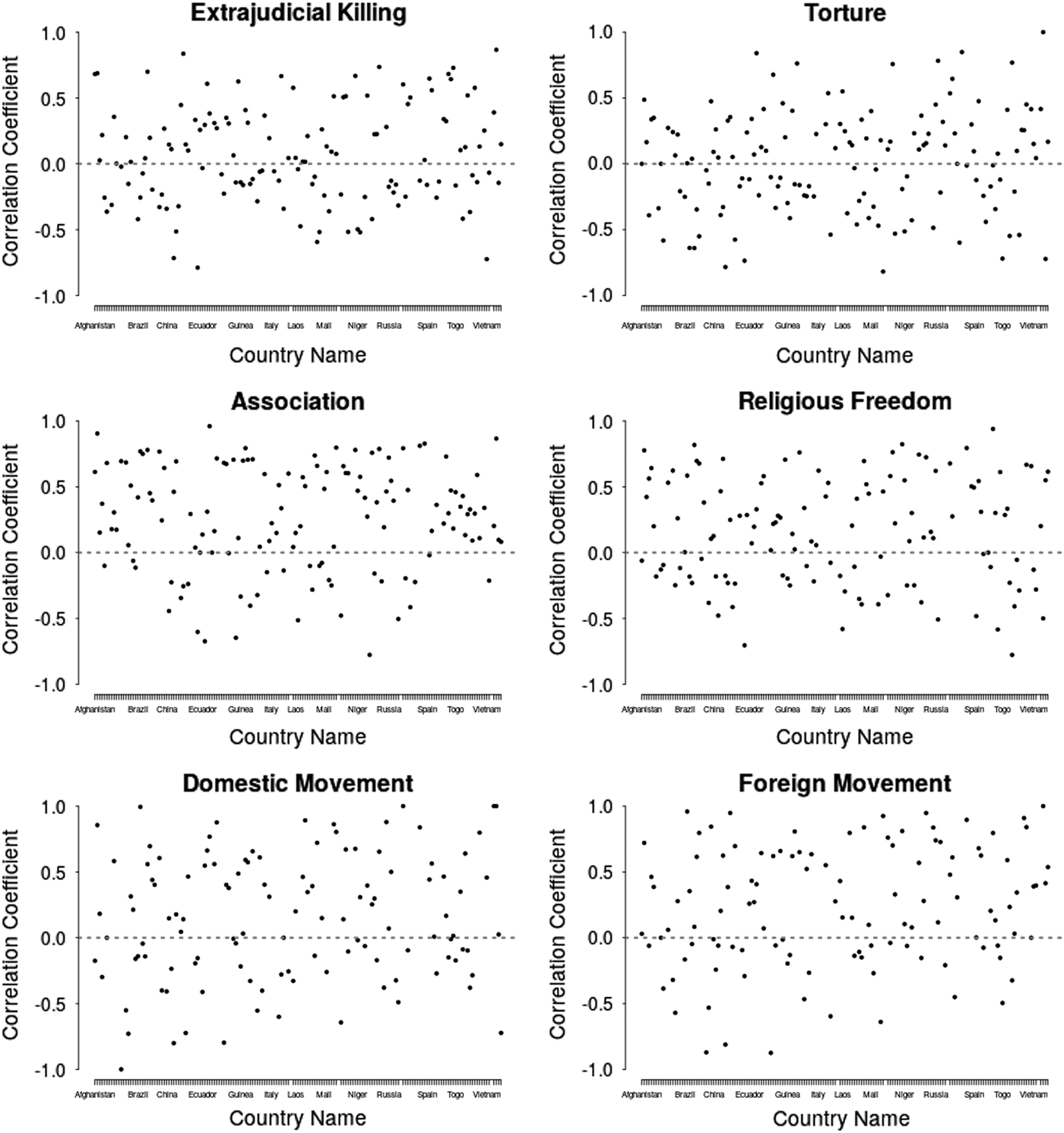
Next, we investigate whether the measures correlate better within some places than others. To do this, we calculate ρ for all countries in our sample.Footnote 17 The panels in Figure 2 plot the correlation coefficients for each pairwise measurement comparison by country name.Footnote 18 Larger values indicate increased agreement about human rights practices within countries. The horizontal gray line denotes ρ=0.
Within-country correlations between CIRI–V-Dem measurement pairs Note: Figure 2 plots the correlation coefficients from countries for each pairwise measurement comparison.

In this case, there are no clear patterns. Rather, the plotted correlation coefficients for each human right appear as if they were randomly drawn from a uniform distribution bound between [−1, 1]. For each right, the range of correlation coefficients covers nearly this entire interval. The correlation coefficients for extrajudicial killing cover the smallest range (−0.789 to 0.866) while the correlation coefficients for domestic movement cover the largest range (−1.000 to 1.000). This means that the measures substantially diverge when it comes to measuring trends within countries over time.
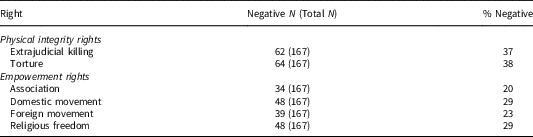
Surprisingly, the measures negatively correlate for approximately half the countries in the sample. In other words, while one measure records relatively higher respect for human rights, the other records relatively lower respect for human rights. Table 4 shows the number and percentage of countries in which rights measures are negatively correlated. The first column contains the name of the right measured by the CIRI–V-Dem pair. The second column contains the number of countries for which the relationship between the paired measures is negative along with the total number of countries included in the measurement comparison. The third column presents the percentage of countries for which the relationship between the CIRI and V-Dem measures is negative. In line with the patterns we observe in Table 3, the data projects disagree more about state respect for physical integrity rights within countries than state respect for empowerment rights. The CIRI and V-Dem physical integrity rights measures are, on average, negatively correlated for about 37 percent of the countries in our data. In contrast, the CIRI and V-Dem empowerment rights measures are negatively correlated for around 25 percent of countries on average.
Negative Within-Country Correlations Between CIRI–V-Dem Measurement Pairs

Note: Table 4 shows the percentage of countries in which rights measures are negatively correlated. The first column contains the name of the right measured by the CIRI–V-Dem pair, and the second contains the number of countries for which the relationship is negative.
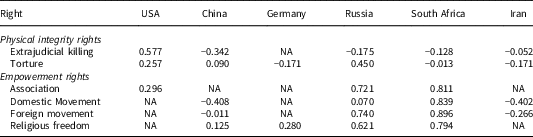
Finally, we examine the extent to which the measures agree within cases. The idea here is to see if some measures are consistently positively or negatively correlated for a set of countries that often interest both scholars and the public: China, Germany, Iran, Russia, South Africa, and the USA.Footnote 19 As we show in Table 5, the measures do not exhibit stability across these countries. The first column contains the name of the right measured by the CIRI–V-Dem pair, and the remaining columns contain the correlation coefficient for individual countries. We see that agreement varies considerably across measures within countries. In China, for example, the CIRI–V-Dem torture measures correlate at 0.090, while the extrajudicial killing measures correlate at −0.342. That the CIRI and V-Dem data projects disagree about the over-time human rights trends within countries, and even within similar types of rights, raises significant questions about how they code state practices. Future work might examine this puzzle.
Within-Country Correlations Between CIRI–V-Dem Measurement Pairs for Important Cases

Note: Table 5 shows the correlation coefficient between CIRI–V-Dem measurement pairs across several cases. The first column contains the name of the right measured by the CIRI–V-Dem pair and the remaining columns contain the ρ for individual countries.
Taken together, the results of our empirical comparison of the CIRI–V-Dem measurement pairs suggest that researchers should be careful when considering them as substitutes. Indeed, the data projects disagree about human rights performance over time and within countries. Scholars might theorize about the causes of measurement disagreement in future work.
Conclusion
The CIRI and V-Dem data projects largely disagree about the extent of rights practices within years and within countries. Although the two measures appear on their face to measure the same underlying concept, looking below the surface reveals important potential conceptual differences. Indeed, they correlate only moderately within years. Even more surprisingly, the variables are only weakly or moderately correlated within countries, and, for a non-trivial number of countries, the measures are negatively correlated. In sum, the CIRI and V-Dem indicators disagree far more than most researchers would probably expect.
The source of the observed divergence probably stems from some combination of two distinct phenomena: (1) different conceptualizations and (2) different measurement strategies. When we observe empirical divergence between CIRI and V-Dem scores, we cannot know the exact cause of the divergence, though patterns of correlation may point us in the direction of certain explanations.
These findings indicate that researchers should think carefully about using the measures as substitutes. These findings also suggest several important directions for future work, such as how conceptual approaches (e.g., based in international law versus elsewhere, or institution- versus individual-oriented) and measurement strategies (e.g., based on independent research versus government/NGO documents, or interval versus ordinal scoring) affect rights scores. For the time being, researchers considering whether to use one of these measures might consider first studying closely the assumptions and measurement techniques that underlie them.
The next step is to determine whether certain types of variables, periods, regions, or states differ more than others. If so, what explains this cross-measure variation? And perhaps most important, how do studies’ choice of measures affect their findings? If findings are robust across different measures, it would of course boost our confidence in the results. If not, we would need to probe the possible determinants of measurement disagreement. If certain factors are systematically related to measurement agreement, then scholars should take these factors into account while conducting statistical work.
Supplementary material
To view supplementary material for this article, please visit https://doi.org/10.1017/psrm.2018.62
Acknowledgments
We thank Holger L. Kern, Ronald F. Inglehart, Matt Golder, Sona Golder, Jule Krüger, Dom Nardi, Kathryn Sikkink, and Yuri Zhukov for their comments. We also thank attendees of the 2017 American Political Science Association annual meeting. All data and code necessary to replicate the analysis presented in the article will be publicly available upon publication at dataverse repositories maintained by the authors. This work is dedicated to the memory of Will Moore.