

Why do we easily assume that banks, financiers and the financial system as a whole command unprecedented power over our lives and choices? What is it about the nature of money, the financial industry and business practice that enables finance to discipline and control decisions, outcomes and political agenda? What are the ultimate sources of power of finance today? Too often, answers to these questions are founded on the underlying assumptions of unity and/or cohesion of, in and by finance. Standard economic theory assumes that financial entities are homogeneous rational agents performing their core function of optimizing the allocation of capital. In political economy, the power of the financial industry is often gauged by the apparent gulf, or disjuncture, between finance as a distinct bloc of capital and interests on the one hand, and the so-called real economy on the other. In political science, preconceived notions of power are tested in various contexts of the banking industry or securities markets. Underlying these apparently contrasting perspectives is a vision of finance as a cohesive, integrated and relatively harmonious realm.
However, a financial system that thrives on risk and innovation is necessarily complex and nebulous in nature and organization. While it is common to see today’s finance, money, credit or capital among the most footloose and globally integrated realms of economic activity, under closer examination the numerous inhabitants of the global financial system are different in size, scope, mission and the nature of their integration into the wider economy. Crucially, their interactions as elements in the credit-creation process form webs of relationships that are highly adaptive and drive the evolution of finance. The complexity inherent in modern financial practice has important implications for our analyses of financial politics and power relations.
How would a process-centred understanding of power be different to more traditional actor-centric theories of power? This article attempts to answer this question. In order to do this, I build a synthesis based on two complementary traditions of scholarship on finance and financial change: complex network theory and the field of evolutionary finance. While neither of these traditions explicitly targets questions of power or even politics, the synergies between them yield a conception of finance as a complex economic habitat, the power of which is necessarily a twofold phenomenon. On the one hand, the dynamic interaction between financial entities endows this complex habitat with a tangible degree of autonomy (inside power) vis-à-vis politics, society and economy. On the other hand, the evolutionary process guiding this financial ecology is necessarily built on innovation and hence is fragile.
As this article illustrates below, most commonly manifest in crises and ruptures, financial fragility itself is an important source of outside power for the financial industry. My analysis illustrates that, today, the structural power of finance originally identified by Susan Strange (Reference Strange1985) is necessarily two-sided: it manifests the effects of the endeavours (intentional and not) of financial agents; and, importantly, it rests on the seemingly boundless ability of the financial system to adapt, change and evolve.
The Global Financial System And The Power Of Cohesion
Discussions of power are often held back because of the challenge of defining the subject matter itself (Woll Reference Woll2014). Broadly, literature in the social sciences has identified three types of power. First, there is the relational approach, also known as a Weberian concept of power, which views power as the ability of A to make B do something B would not do otherwise. The second type of power is known as agenda-setting or agenda control: in any political discourse, the entity that is able to shape the agenda has power over outcomes. The third type of power, while often employed or implied in scholarly analyses, remains the most elusive. It is invariably described as structural power (Strange Reference Strange1985). The meaning of this particular facet of power remains debated and contested; it is most commonly suggested that it is the sheer size or presence of an entity that endows it with power to effect outcomes. For example, irrespective of China’s policies (relational power), or its ability to control the agenda, it is widely acknowledged that China is a powerful state due to its sheer size and involvement (or otherwise) in global and regional affairs (for example, Beeson Reference Beeson2010).
Where do studies of financial power stand in these debates? In a historical context, traditional accounts of power do explain the rise of individual financers, financial institutions and the financial industry as a whole to privileged positions in today’s society. Finance, broadly conceived, appears to have the unique ability to exert power in its Weberian sense and to effect outcomes by controlling the political agenda, nationally as well as internationally. The evolution of the state system in Europe and the US, for instance, was tightly intertwined with the history of large banking families such as the Rothschilds and the Rockefellers (see, for example, Ferguson Reference Ferguson1999; Josephson Reference Josephson1962; Parmar Reference Parmar2012). Today, large banking conglomerates and occasionally small but successful financial institutions (funds owned by George Soros or Warren Buffet, for example) are seeking to play a role, either directly in individual countries by shaping the political and social agenda, or indirectly by influencing the states’ economic performance.
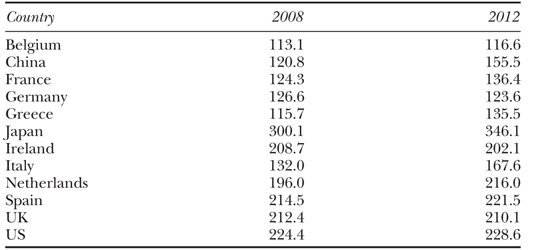
Various types of data illustrate the significance and, according to many observers, the domination of the financial industry over the rest of the economy. In most advanced and many emerging economies, the share of domestic credit provided by the banking system tends to be larger than the size of the country’s GDP. Notably, this ratio has increased in most crisis-stricken states following the 2007–9 crisis (Table 1). Across the world, the value of assets held by a country’s largest banks often exceeds the size of the country’s GDP. The international banking system also appears to be highly concentrated. The 2013 list of top 10 banks in the world, according to Tier I capital,Footnote 1 includes four Chinese banks (ICBC, China Construction Bank Corporation, Bank of China and Agricultural Bank of China, with ICBC the top of the world ranking), four US banks (JP Morgan Chase, Bank of America, Citigroup and Wells Fargo), one Japanese (Mitsubishi Financial Group) and one UK bank (HSBC). Globally, the notional value of outstanding derivative contracts (US$640 trillion in 2012) is about 10 times larger than the value of the world’s GDP (about US$70 trillion).
Domestic Credit Provided by Banking Sector (% of GDP)

Note: Domestic credit: domestic credit provided by the banking sector includes all credit to various sectors on a gross basis, with the exception of credit to the central government. The banking sector includes monetary authorities and deposit money banks, as well as other banking institutions where data are available (including institutions that do not accept transferable deposits but do incur such liabilities as time and savings deposits).
Source: World Bank (2013).
These and other figures suggest that finance, broadly conceived, does have the ability, the motives and the means to generate political outcomes in different national contexts, and that a decision by an individual financial entity or a group of companies has the potential to influence millions of people, both directly and indirectly. On the other hand, the ascent of global finance to its current position of supremacy illustrates that the relationship between the public and the private, or between the state and the financial market is never unidirectional but symbiotic (Hardie et al. Reference Hardie, Howarth, Maxfield and Verdun2013; Helleiner Reference Helleiner1996; Polanyi Reference Polanyi1944; Schwartz Reference Schwartz2009).
Despite the efforts of the architects of Bretton Woods to control international flows of capital in the post-war economy, and their commitment to Keynesian principles of economic governance, finance quickly discovered ways to circumvent the regulatory hurdles and exploit niches, often accidental, in the regulatory net (Burn Reference Burn1999). Key innovations in the international financial markets during the late 1950s, such as the Eurodollar market, would trigger further changes in the structure of the UK and US banking models, eventually eroding the effect of official regulatory measures (Palan Reference Palan2004; Palan et al. Reference Palan, Murphy and Chavagneux2010). In turn, the facilities created by the Euromarket would preconfigure the entire international financial system. The network of legal and financial facilities provided by the Euromarket would facilitate the rise of the City of London as the global offshore hub, and a key node in the privately governed global financial order, the power of which seems ubiquitous today.
A major insight offered by relational analyses of financial power suggests, therefore, that the financial industry has attained its position of dominance in today’s capitalism, not only because of its direct capacity (capital) to effect or bargain for political outcomes and compromises, but also because it has been able to capture and change the policy agenda of major political entities, nationally and internationally. At the same time, however, relational accounts of financial power have limitations. Being actor-centred and examining the mechanisms of power, these accounts tend to be circular in their understanding of regulatory arbitrage and regulatory capture. As a result, the account of the causes and consequences of finance’s unique position in politics, economy and society becomes a chicken-and-egg dilemma, as evidenced, for instance, in relational accounts of the ascent of global financial markets, or the view of the role of banking standards in the recent global financial crisis.
It is common to attribute the spiral of financial innovation central to the 2002–7 credit boom to the financial sector’s drive to escape regulatory constraints imposed by Basel norms. Yet the requirements of Basel II were themselves a more nuanced version of the earlier incarnation of international banking norms (Basel I) introduced in 1988–92 in order to deal with the growing phenomenon of the Euromarket and solvency problems of Western banks (Palan Reference Palan2004). With the emergence of new financial market opportunities in the 1990s, Basel I became an inefficient tool of international banking regulation. Its successor, Basel II, made it unprofitable for banks to hold liquid assets on their balance sheets. The banks responded to this constraint by innovating securitization techniques through which a large number of risky but seemingly profitable products and activities were moved off the balance sheets into the shadow banking system. In the wake of the global crisis that ensued, Basel III, the post-crisis iteration of international banking standards, focused on tightening the banks’ liquidity and capital requirements and targeting the issue of systemic risks and transparency.
Although the above account is historically correct, it would be mistaken to present the financial industry as some cohesive or unified force that is able to control outcomes. There is little evidence that the financial industry desired Basel I (although there is more evidence that many large banking houses were lobbying for a modification of Basel I in the direction of Basel II). The industry’s power lay less in its ability to control the agenda and more in its ability to adapt and innovate in a way that it was not harmed by agendas set by others. A retrospective linear reading which suggests that, because regulatory efforts did not hamper the growth of the financial system, finance has managed somehow to control events may therefore be misleading. While broadly indicative of the dynamics in the balance of power between the public authorities and the financial industry, relational accounts of financial power remain circular and therefore limited when, for instance, questions about the role of financial functions, operations and interconnections, rather than banks and institutions themselves, arise.
The alternative, yet more ambiguous, vision of financial power relies on variants of Susan Strange’s concept of the structural power of finance. Having identified finance as one of the four main structural spheres of global capitalism, Strange explains the strategic position of finance by its two inseparable facets, the economic and the political. As she argues, while the amount or type of credit may be a financial matter, ‘the management of credit is necessarily highly political’ (Strange Reference Strange1985: 39). Finance, according to Strange, ‘comprises not just the structures of the political economy through which credit is created but also the monetary system or systems which determine the relative values of the different moneys in which credit is denominated’ (Strange Reference Strange1994: 90). A large number of scholars have since built upon Susan Strange’s analysis of the structural power of finance and her notion of the increasingly destructive speculative element of global financial capitalism (Strange 1986), wherein finance has assumed the role of ‘the infrastructure of the infrastructure’ (Cerny Reference Cerny1997).
Unlike conventional accounts based on regulatory arbitrage, structural theories of finance do address questions of causality; they also interrogate the nature of financial power. Academic scholarship in international political economy (IPE) and other social sciences offers original and insightful critiques of the structural position of financial actors, motives and institutions in national and international political economies, the role of financial capital in global capitalism (for example, Bryan and Rafferty Reference Bryan and Rafferty2006; Germain Reference Germain1997; Harmes 2011) and, importantly, the place of ideas and even symbols in solidifying the power of finance in the global age (Abdelal Reference Abdelal2009; Best Reference Best2005; Blyth Reference Blyth2002, Reference Blyth2013; de Goede Reference de Goede2005).
Although wide in their scope and focus, structural approaches to financial power rest on one fundamental assumption about the nature of finance and the financial process itself. This is the notion that finance is uniquely powerful because of its ability and capacity to subordinate and homogenize economic agents and assets, integrate and organize markets, discipline policymakers, and pull various aspects of societal and human life into the orbit of financial exchange. Academic interpretations of this power, in turn, vary: mainstream studies ultimately derive from emancipatory visions of finance, seeing financial integration, inclusion and innovation as progressive forces of capitalism, while critical approaches to finance emphasize the disciplining, subordinating and destructive dimensions of finance, focusing on the distributive politics of global financialized capitalism.
Here, in particular, international political economy scholarship has examined the power of finance mainly through a juxtaposition of ‘finance’ as a relatively monolithic bloc of interests and capital vis-à-vis the state. In political science and sociocultural studies of finance the focus has been on the integrative quality of finance: political alliances formed on various issues of financial regulation make regulatory arbitrage and regulatory competition a continuing feature of the global financial system (for example, Hay and Watson Reference Hay and Watson2003; Pagliari and Young Reference Pagliari and Young2013); while the unique capacity of financial markets to codify, price and liquefy economic and social assets is seen to have fuelled the process of financialization (for example, Epstein Reference Epstein2005; Froud et al. Reference Froud, Johal, Leaver and Williams2006). In more recent and subtle studies of finance as a system, the multiplicity of financial agents and processes is often hidden behind a primary focus on the overwhelming power of sophistication, precision and ‘complexity’ of contemporary finance (Datz Reference Datz2012; Hardie et al. Reference Hardie, Howarth, Maxfield and Verdun2013; Wigan Reference Wigan2009, 2010). Notwithstanding these qualifications, the idea of cohesion and unity in, and crucially by finance has informed the vision of structural power of finance, both in its disciplinary and emancipatory facets. Yet, observationally, it appears to anyone familiar with the contemporary financial system that the alleged unity, cohesion and homogenizing dynamics of the financial system are overestimated. Divisions, fractures and the sheer complexity of modern finance present important lessons for our analyses of the structural power both of and in finance.
Financial Innovation
There are two major characteristics of finance today that can make any generalized statements about financial conditions or behavioural patterns – and therefore the deemed sources of power – obsolete within a relatively short time. The first is the function and organization of today’s financial system. While orthodox theories of finance maintain that the core function of the financial sector is to mediate between savers and borrowers, in reality banks and other financial institutions, trading in risk and innovations evolving at the nexus of financial and legal techniques, play a vital role in the creation of private credit (Mehrling Reference Mehrling2010).
Second, and importantly, in today’s societies the financial system has become a self-referential space. The sources of this tangible autonomy lie in the central role that financial innovation plays in the contemporary credit system. Perhaps like no other realm of economic activity bar the information technology (IT) sector, finance is inherently prone to mutation and has thrived on it throughout history. Yet, until recently, the phenomenon of financial innovation has avoided critical attention from social scientists (Dew Reference Dew2007). The propensity of today’s financial entities to create credit and thus expand the frontier of private money leads us to consider the role of the process of financial innovation, rather than the positions of financial actors, in analysing the strategic position of finance as a globally powerful industry.
The complexity and diversity of finance has come about as a result of the sector’s apparently infinite ability to mutate and, through this mutation, transform other parts of the economy, politics and society. In the language of politics, this capacity can be seen as the ‘inside’ dimension of power, or autonomy, where an entity (typically, a state) ‘is powerful to the extent that it is insulated from outside influence or coercion in the formulation and implementation of policy’ (Cohen Reference Cohen2000: 97). In the language of political economy and economics, this phenomenon is known as the endogeneity of finance, defined as a change or variable (that is, condition or outcome) that arises out of the inner workings of the model, or the system itself, rather than being caused exogenously by outside factors.
Shadow banking is one of the most recent and challenging outcomes of the endogenous financial process. A narrow definition of this phenomenon describes shadow banking as constituting market-based (rather than bank-based) ways of funding financial transactions, or, in other words, ‘money market funding of capital market lending’ (Mehrling et al. 2013). More inclusive definitions suggest that shadow banking is simply ‘credit extension outside of the banking system’ (Financial Stability Board 2011). Recent estimates from the Financial Stability Board (FSB) suggest that the global size of the shadow banking system is $71 trillion, roughly a third of the world financial system. Shadow banking has played a major role in the recent crisis, although debates continue as to whether the shadow banking system has played a leading (McCulley Reference McCulley2009) or merely an amplifying role in the banking crisis (Lysandrou Reference Lysandrou2012; Lysandrou and Nesvetailova Reference Lysandrou and Nesvetailova2014).
Both sides of the debate do acknowledge, however, that the ability to create credit outside the regulated realm of banking has enlarged the de facto size of banks and financial institutions. There are three main ways in which this process, largely undetected until 2007–8, has affected the financial system. First, the shadow web of financial transactions that connects a regulated bank with a myriad of complex and opaque financial and legal structures widens the actual economic size of the bank. Access to market-based funding and alternative financial channels may help a single institution be more adept in a competitive environment, realize economies of scale and manage its risks more efficiently. In the context of the system, however, a complex web of undetected financial links through the shadow banking system has made individual institutions such as Lehman Brothers, Bear Sterns or Northern Rock illiquid and insolvent, putting the financial system as a whole on the brink of a collapse.
Second, shadow banking operations have the capacity to transform a group of non-bank financial entities, such as hedge funds, money market funds and special purpose vehicles, into a bank-like structure, the financial activity of which is unregulated. Both processes raise prudential and systemic risk concerns for the tasks of financial regulation and stability, a matter currently forming a central part of attempts to bring about international financial regulatory reform. Third, the size of banks and financial institutions is related to the problem of systemic risk and fragility and hence has political ramifications, both overtly and covertly. The funding models of banks and other financial institutions relied on complex schemes of financial ownership that produced or held financial products or operations that could only function as long as the market mechanisms for pricing these instruments functioned (Langley Reference Langley2013).
With the onset of the crisis in August 2007, this mechanism seized up, and it became impossible to price complex financial products or execute individual transactions to get access to funding in the wholesale financial market. As a result, the viability of major banking and financial institutions came into question. The exposed failures of individual institutions pointed to the fragility of the system, exacerbated by the micro-prudential approach to financial regulation that had been informing national and international financial policies up to 2007, most prominently in the Anglo-Saxon countries, but also in Europe. In a rather perverse outcome of the crisis, the exposed fragility has endowed the crisis-stricken financial sector with enormous power, albeit not influence, in the time of a severe economic recession caused by financial crisis (Bell and Hindmoor Reference Bell and Hindmoor2014).
In other words, it appears that finance, broadly conceived, leads a life of its own. The ‘inside’ power of the financial system thriving on innovation has endowed the sector with tangible autonomy vis-à-vis politics and society, facilitating, in turn, a massive investment in the welfare of finance and a collective fear of intervening in the highly complex and competitive system. Can it be, then, that the real power of finance today lies inside the financial process itself? Would a process-centred vision of power be different to actor-centric approaches to the relational power of financial actors and their interests and, if so, in what ways?
Finance as Complex Ecological Habitat
Traditional approaches to power developed in the social sciences are of limited use when we are attempting to address these questions. On the one hand, macro-theories of finance and financial capitalism, discussing the ubiquitous nature of money and finance, tend to aggregate finance into a bloc of interests or capital. In turn, references to the power of finance as that of a relatively monolithic and homogeneous alliance of capital or political interests tend to derive from the linear reasoning of mainstream economics and finance, focused on the operations and mechanisms of the financial market and offering as a result little insight into the systemic dynamics of the contemporary financial system (Chick and Dow Reference Chick and Dow2005; Dow Reference Dow2011; Lawson 2009). The major problem with these visions is that the nuances, diversity and inner mechanisms of the financial system itself are not fully accounted for in the analyses of power.
On the other hand, political science and related fields often approach finance on the basis of preconceived notions of power. They examine the agenda and behaviour of financial actors by analysing supposedly universal relations of power applied to the financial industry. Such models tend to analyse the financial sector’s influence and functions in the broader social and political environment and tend to gauge outcomes of their interaction using quantitative or qualitative approaches. As such, these approaches are of limited help when the workings of a complex, diversified and, most crucially, constantly evolving system of financial entities and operations are concerned.
In fact, seeing the financial system operating in a given ‘environment’, as is common in various fields, poses its own epistemological barriers. The notion of ‘environment’ implies interaction between entities (traditionally, human and other living organisms) with an outside, exterior context. Yet the financial system today, and its embeddedness in the wider political-economic context, is defined first and foremost by dynamic interaction between its different inhabitants, and the effects (intentional and unintentional) of such interactions on the entities themselves, the financial system as a whole, as well as on the ‘outside’ context (politics, society, economy, culture and so on).
The structural power of finance today is necessarily twofold: it manifests the effects of the endeavours (intentional and not) of financial agents; crucially, it rests on the seemingly boundless ability of the financial system to adapt, change and evolve. As such, the process of financial innovation and evolution itself contains both the ‘inside’ and ‘outside’ facets of power, yet existing theoretical frameworks appear unable to accommodate the two dimensions of this power, mainly because they rarely engage with the anatomy of financial innovation.
In this light, an attempt to inquire into the nature of financial power requires a new analytical approach. Such a framework should accommodate a focus on the nature of financial interactions, the various inhabitants of the financial system, as well as on the outcomes of their interactions. Two academic traditions help build such a synthesis. The first comes from the emergent field of evolutionary finance. This field recognizes the central role of the apparently limitless capacity for innovations in investment styles, products and the regulatory framework. Evolutionary finance assumes that the marketplaces for risk-based assets exhibit a great degree of dynamism and evolution in the behaviour and interaction of their participants. Drawing on several academic currents, evolutionary finance examines the causes and effects of the dynamic nature of financial markets through the application of Darwinian ideas. While acknowledging that such changes can be traced back to intended outcomes of human endeavour, evolutionary scholars recognize that they are caused by the adaptive, self-organizational and endogenous dynamics of the decisions and interaction of agents in the financial market (Evstigneev et al. Reference Evstigneev, Hens and Reiner Schenk-Hoppe2008: 2).
Within the field of evolutionary finance, agent-based modelling and dynamic models of financial markets offer important insights into the choices that financial actors make under conditions of uncertainty and non-linear rationality (for example, Keen Reference Keen1995; Raberto et al. Reference Raberto, Tegllio and Cincoti2012; Thurner Reference Thurner2011). In particular, heterogeneous agent modelling (HAM) is an approach developed from the 1980s onwards by economists who recognized the bounded (rather than the linear) rationality of economic agents and examined their behaviour under conditions of uncertainty. Although this perspective builds on the early heterodox economics and advances the insights of Keynes and Simon into the role of uncertainty in influencing economic agents, new developments in mathematics, physics and computer science in non-linear dynamics, chaos and complex systems motivated economists to develop new models and tools. Challenging the traditional representative rational agent framework, heterogeneous agent modelling presents finance as a highly non-linear, adaptive system (Hommes Reference Hommes2006: 1114).
The second foundation of the emergent synthesis focuses more closely on the complexity of organization and adaptation, and derives from network theory. Applied to finance, the basic premise of this perspective is that today’s credit systems are not only composed of a variety of actors (various banks, money market mutual funds, investment conduits, structured-investment vehicles, hedge funds, broker-dealers, finance companies, and so on), but also of a range of credit instruments (wholesale money-market instruments, repos, asset-backed securities, and so forth) and therefore credit transactions (Guttmann Reference Guttmann2003; Guttmann and Philon Reference Guttmann and Plihon2010). These transactions necessarily take place in two realms simultaneously – legal and financial – and, together, form intricate webs of funding affiliations, intermediation and ownership chains. Finance and the credit system, therefore, are webbed as complex networks and need to be understood as such.
In the wake of the global financial crisis, applications of network theory have become common in the discussion of sources of financial instability and, more specifically, in the work on systemic risks in finance (Allen et al. Reference Allen, Babus and Carletti2010; Goldin and Vogel Reference Goldin and Vogel2010; Haldane Reference Haldane2009; Thurner Reference Thurner2011). A major conceptual insight here concerns the paradox of integration and complexity. Hyman Minsky (Reference Minsky1986) famously argued that, in finance, stability breeds instability. Network theory complements his insight by describing how too much complexity breeds instability and fragility. According to Simon (Reference Simon1962), most complex systems exhibit high levels of self-similarity and thus can be simplified for purposes of modelling. Yet, as Goldin and Vogel (Reference Goldin and Vogel2010) argue, the very process of simplification is inevitably reductionist and therefore can increase system fragility: homogeneity is one of the destabilizing characteristics of complex networks and, in financial markets, has been shown to contribute to liquidity crises (Persaud Reference Persaud2008).
The spread of financial innovations such as credit derivatives and securitization (the process of taking an illiquid asset, or group of assets, and through financial engineering transforming them into a financial security) has increased the level of complexity and integration in finance. At the same time, however, these innovations have also rendered the system exposed to targeted attacks on what Goldin and Vogel (Reference Goldin and Vogel2010) call ‘hub nodes’, with the potential for risk amplification and contagion. Indeed, securitization both enhances and relies on liquidity. On the one hand, it enhances the liquidity of underlying receivables by transforming them into tradable securities, contributing to the perception that, individually, financial entities are liquid and financially robust. Yet, on the other hand, the funding of a large number of market participants involved in the securitization process critically depends on market liquidity being permanently sustained (Bank of France 2008: 2). The homogeneity of financial actions of various entities, as well as the very nature of financial liquidity, implies that, at the aggregate level, the financial system driven by innovations is becoming progressively illiquid (Nesvetailova Reference Nesvetailova2010). In this reading, while it was the sub-prime crisis that triggered the financial crisis, it was the underlying innovation, integration and interdependency of the global financial network that created the fragility of the system (Goldin and Vogel Reference Goldin and Vogel2010).
Continuing the analysis of complex networks and drawing especially on the similarities with the 1970s scholarship on ecology, Haldane and May (Reference Haldane and May2011) have developed the concept of financial ecosystems as a tool to examine the consequences of financial interactions and the distribution of risks in the financial system. The authors acknowledge major differences between ecosystems that have long existed in the natural world and financial ecosystems that are embedded in political and social realms. Today’s ecosystems, they argue, are the survivors of long-lasting evolutionary processes, whereas the evolution of the financial system is a relatively recent phenomenon. Moreover, in finance, selection is not natural but political: ‘in financial ecosystems, evolutionary forces have often been survival of the fattest rather than the fittest’ (Haldane and May Reference Haldane and May2011: 351).
Yet, notwithstanding these qualifications, the concept of finance as ecology is uniquely suited for analysing the dynamics of the complex financial habitat which, embedded in the complex network of shadow banking entities and functions, thrives on and transforms through innovation. Indeed, etymologically, ‘ecology’ implies no distinction between human and non-human, living and non-living nodes within complex networks. As opposed to the notion of environment (which living species interact with), ‘ecology’ accommodates the connections between entities and their endeavours with non-human ecosystems, as well as within the socio-technical networks which underpin social organizations and the financial industry more specifically.Footnote 2 Therefore, while neither evolutionary finance nor network theory explicitly target questions of power or even politics, when blended together, these two perspectives build into a synthesis that analyses finance as a complex ecological habitat and helps us develop a framework for understanding the power of the financial process itself.
Financial Innovation And The Power Of Autonomy
In reading finance as a complex ecological habitat, well-rehearsed notions of ‘globalizing capital’ or even a global financial system appear somewhat over-stretched. In the financial ecosystem, complex structures such as banks, non-bank financial institutions, states and other entities coexist and co-evolve, forming webs of relationships and adapting their behaviour. Furthermore, under closer examination, key nodes of this financial ecology, such as banks themselves, appear to be ecological habitats, consisting of several rival departments and desks that often compete with each other and operate with different incentive structures (Ho 2009; Lewis Reference Lewis2011; Tett Reference Tett2009). Indeed, despite the integrative role of financial circulation, the global financial system is highly fragmented, individualistic and lacking an esprit du corps. Notwithstanding the references to the interests of ‘the financial sector’ or ‘the City of London’ and even the phenomenon of herd behaviour, most financial actors are in fact highly egotistic and do not act in the same way as traditional ‘political’ actors. The behaviours and trends interpreted in conventional linear analyses of finance as examples of individual human failure have to be acknowledged as much more systemic and as the deep-seated principles of operation of a distinct ecosystem, or an industry that is immune to outside influences.
Even the social class of the innovators themselves includes a different ethos, motivations and mentalities. Polillo (Reference Polillo2011: 364–5), for instance, has identified two main subgroups: market utopians (innovators who tend to work within existing power structures and financial elites, driven by concern with prestige and accountable to the market and the very idea of innovation) and ‘populist innovators’, or a class of financial entrepreneurs interested in their own quest for dominance and often mounting attacks on the existing citadels of financial power.
It was Thorstein Veblen (Reference Veblen1904, Reference Veblen1923) who first suggested that sabotage, or ‘conscientious withdrawal of efficiency’, is the main principle of business tactics in modern capitalism. While Veblen himself did not distinguish between financial and industrial entities, the concept of sabotage, or deliberate action aimed at weakening and disorienting another entity for gain – be they the consumer, the competitor or the government – through subversion, obstruction, disruption or destruction, is applicable in the financial sphere (Admati and Hellwig Reference Admati and Hellwig2013; Nesvetailova and Palan Reference Nesvetailova and Palan2013).
In a Veblenian perspective, the reliance on opaque products, complex techniques and language at the level of individual financial institutions can be interpreted as sabotage that was aimed to ensure that clients, the regulators and even the management of the firm itself, had difficulties grasping what was really created, valued or traded. In political-economic terms, the complexity that is inherent in the financial system that thrives on innovation is also a powerful agent by itself. The issue of complexity in contemporary finance has been a subject of much academic research and theorizing, from the now-classic distinction between risk and uncertainty (Keynes Reference Keynes1936; Knight Reference Knight1921) to the more recent sociological and anthropological theories of finance as a highly professional business thriving on a high degree of specialization (Ho Reference Ho2009; Tett Reference Tett2009).
Emerging literature on shadow banking also problematizes the opacity and complexity associated with the phenomenon of shadow banking. The techniques, tools and language of complexity, precision and sophistication that have come to be intimately associated with the idea of global finance have obscured the underlying developments within finance itself. On the one hand, the process of financial innovation during the past few decades has transformed finance into a highly differentiated realm, marked by increased specialization, sophistication and fragmentation. On the other hand, the inherent fragility of this system has been concealed under the sheer complexity of the financial innovation that appeared to create apparently plentiful liquidity and credit in the global economy.
The sources of the fragility of contemporary financial structures, and more generally of capitalism driven by financial innovation, have been addressed most comprehensively by Hyman Minsky (Reference Minsky1982, Reference Minsky1986) and his followers. A central pillar of Minsky’s vision of capitalism and its crises is the process of financial innovation in a system with open access to credit channels. The ability to ‘invent money’ (even temporarily) by relying on debt triggers a chain of transformations in the way economic entities finance themselves, shifting from being conservative to becoming more and more dependent on debt. This chain of debt-driven developments makes the financial system increasingly fragile, prompting the monetary authorities to intervene in order to prevent a structural economic collapse. As the process of private financial expansion continues, he forewarned, ‘innovations, particularly in finance, assure that problems of instability will continue to crop up; the result will be equivalent but not identical bouts of instability to those that are so evident in history’ (Minsky Reference Minsky1986: 287).
There are three main types of these financial innovations that constitute major sources of fragility in contemporary finance: structural, institutional and market (or product) innovations. Structural innovations in finance are best understood in a Schumpeterian way: as a revolutionary or fundamental change in the organization of a financial entity that facilitates a new frontier of business or financial practice (Awrey Reference Awrey2013). Examples of such structural changes in finance include not only the emergence of universal banks, but also more recent and complex techniques necessarily evolving at the nexus of finance and the legal sphere, such as the use of special funds and off-balance sheet vehicles and conduits by regulated financial institutions, or the principle of ‘true sale’ widely used in the process of securitization.
Product or market types of financial innovation involve the invention of new products and techniques of financial trade. These are driven by firms’ search for better funding sources, desire to optimize portfolio holdings, capture new client bases or create new markets. The invention of a sub-prime mortgage and financial products derived from it is now a notorious example of this type of innovation.
Finally, institutional financial innovation can be best defined as a process by which a practice or a series of new financial practices enable the creation and establishment of a new type of a financial operation, a market or even industry as a whole. The emergence of new types of financial actors, such as hedge funds, money market funds or asset management firms, or the recent invention of algorithmic trade, provide some examples of institutional innovation. The shift from the ‘originate to hold’ to ‘originate to distribute’ models of banking, although not driven by a single type of transaction, remains the most vivid illustration of the long-term consequences of institutional financial innovation.
A longer discussion of the form and functions of financial innovations is beyond the scope of this article, but it is important to note that all three types of financial innovation – structural, institutional and product – in reality co-evolve, feeding into each other. The invention of a new product may often facilitate the emergence (or disappearance) of a business sector, as has been the case with the junk bonds of Mike Milken, the mortgage securitization of Lewie Ranieri of Salomon Brothers, or the sub-prime market in the 2000s. Conceptually, as each of these examples would confirm, the chain of financial innovation, whether structural, institutional or market level, creates serious systemic consequences for the economy and policymakers. While integration and new networks greatly increased the robustness of the financial system, interdependence, complexity and the gulf between regulatory oversight and market innovators made global finance more brittle and fragile (Goldin and Vogel Reference Goldin and Vogel2010).
All three types of financial innovation constitute important forms and channels of private creation of credit, enabled by the very mission of finance as a risk-mining and risk-trading industry. In conventional analyses of relational power, this process is usually interpreted as a result of the increase of the (private) power of the financial sector vis-à-vis the decreased power of public authorities – that is, central banks. For instance, the apparent decline of the power of central banks, both functionally and ideationally, is one effect that the financial industry, thriving by and on innovation, has had on the public domain. Dealing with the ongoing crisis,
central banks responded with unprecedented force and were able, for a time, to restore stability to financial markets. But as the crisis has dragged on, they have had to expand their tool kit and extend their support from single institutions to more general market support. Recently, some central banks have moved further into the uncharted territory of quantitative easing. (Moe Reference Moe2012: 3)
As Moe continues, unconventional tools such as the function of market-makers of last resort, and controversial principles used by monetary authorities aiming to restore financial stability (elastic provision of public liquidity in response to the needs of the private market) meant that central banks now stand accused of being non-transparent in operations and for having bailed out de facto bankrupt banks (Moe Reference Moe2012). Yet, perhaps more importantly, the crisis and the bankrolling of private financial innovation with public liquidity have posed serious questions about the limits to this balance sheet expansion by central banks and the guiding principles for central bank liquidity support in the future. Both questions remain unanswered.
Paradoxically, therefore, the fragility, fragmentation and complexity inherent in the system of risk-based finance are not necessarily points of weakness. Under closer examination, they can be important elements in explaining the ‘structural’ power of finance.
From ‘Inside’ Power To The Structural Power of Financial Innovation
Finance is powerful not only because it can create wealth and precipitate certain shifts or political actions, but also because it can destroy things. Recurring crises, financial crashes and contagion can serve as prime case studies in the disciplining and destructive power of financial fragility. Institutionally, however, finance has risen to its strategic position in the global economy due to the mobilizing and creative power of fragility and crisis. Indeed, while costly and destructive in their impact on livelihoods and financial values, crises themselves are transformative, often precipitating political, economic and social reorganizations in the crisis-stricken countries.
In the aftermath of the 2007–9 crisis, problems of financial fragility and complexity inform the content of the regulatory debate and policy action at the international level. A full review of the regulatory developments is beyond the scope of this article, but three important nodes of debate are worth pointing out. Two interesting traits mark the post-crisis critical regulatory perspective on finance and financial innovation. On the one hand, the global approach to financial supervision and regulation has remained functional in its nature: legal and political form follows the function of a financial transaction. On the other hand, an important mission of the regulatory effort in the post-crisis reality has been to resolve complex conceptual challenges posed by financial innovation (Tietje and Lehmann Reference Tietje and Lehmann2010: 668–9).
Intellectually, the new regulatory perspective and ongoing regulatory initiatives tend to rely on heterodox approaches to finance, financial innovation and stability. Here the scholarship of Hyman Minsky, Irvin Fisher and J.M. Keynes, as well as insights from other academic fields such as biology or ecology, inform the analysis and invite an explicit doubt about the universal benefits of financial innovation. Three specific areas of this emergent conceptual debate reflect major shifts in thinking about the role and place of finance in politics and society. They include new thinking about the very mission of central banking and financial regulation in the age of private credit, shadow banking and complex financial realities.
An important area of tangible transformation is the nature and mission of monetary authorities, or central banking. Against the background of the global crisis, few can credibly argue that the golden rules of central banking laid out by Walter Bagehot apply today. Instead, when confronted with the crisis in 2007–9, the world’s central banks innovated in their own techniques of intervention, arranging international currency swaps and new ways of injecting liquidity into the financial system. Instead of serving as a lender of last resort, the US Federal Reserve has been acting as the dealer, or market-maker of last resort, effectively standing by the demands of the private financial markets for dollars (Mehrling Reference Mehrling2010).
Even though classical doctrines of central banking will take a long time to disappear completely, in the words of Claudio Borio (Reference Borio2011), central bankers of the twenty-first century will need to find a new compass for their vision and daily practice. He detailed three specific challenges with which monetary authorities will need to cope. First, central banks will have to operate in a hostile economic environment of recession or very slow growth. Second, central banks will have to take decisions fully aware that their benchmark macroeconomic paradigms have failed them: the crisis, in Borio’s words (2011: 1), has ‘exposed a chasm between the theory and practice of policy’. Third, central banks will have to adjust their policy frameworks while preserving their reputation and independence in an environment in which that independence is likely to come under increasing threat. As they cope with the legacy of the crisis and take on broader tasks, governance arrangements are likely to experience considerable strains (Borio Reference Borio2011: 1).
Another area of ideational tension currently, and of potential change in the future, is the interface between fiscal and monetary policies. Post-crisis economic intervention has involved a uniquely peculiar combination of elastic supply of state liquidity to the financial system, and a very orthodox idea of fiscal consolidation, particularly in the UK and other crisis-affected European countries. In this context, as McCulley and Pozsar (Reference McCulley and Pozsar2013: 5) warn, it appears that, as monetary orthodoxies are being gradually overruled, fiscal orthodoxies of austerity and balanced budgets remain entrenched, which risks driving the advanced world into ‘a state of large output gap torpor or worse’. Adair Turner (Reference Turner2013) reflects on this problem with his own notion of ‘helicopter money’ or overt monetary stimulus, which ‘distinct from quantitative easing [which uses new money to buy government debt only] is at the extreme end of finance but . . . should be taken out of the taboo box’ in situations where lack of growth and deep recession threaten economic future. Mark Carney, the new governor of the Bank of England, is not far behind with his idea of including GDP growth as a new target within the remit of the central bank’s targets.
A change of tone is also detectable in the international sphere. The pre-crisis international financial architecture was persistently based on the principles of harmonization and globalization of financial practice. Although compromises were common in the actual implementation of most regulations and standards, the idea of global financial regulation was indeed global: a new regulatory measure was only considered feasible in the global context if it was implemented synchronously by all participating members. (For a long time, the need for synchronicity constituted the main argument against the introduction of a financial transaction tax.)
In the post-crisis environment, principles of homogenization and synchronicity seem to be giving way to ideas of regulatory differentiation and regulatory competition. This trend is enhanced further by a segregated institutional realm of international financial regulation. Despite more than a decade of work on rethinking the global financial architecture, there is no coherent relationship between the various international financial institutions (IFIs). While influential, the International Monetary Fund (IMF) is arguably not the most significant body of financial governance, even though it remains the fire brigade for most countries. The intellectual capital, or ‘public brains’ of the global financial system, are located within the Bank for International Settlements (BIS), the related Financial Stability Board (FSB) and various elements of the Bank for International Settlements system, as well as some national central banks. In the post-2007 era, it is this intellectual capital, and its capacity to deal with issues of financial complexity, endogeneity and innovation, that is likely to shape the content of financial regulations, rather than more archaic bodies such as the International Monetary Fund, the G20 or the Organization for Economic Cooperation and Development (OECD).
In parallel, post-crisis international financial law sees its task as providing the meta norms necessary to enable regulatory competition among domestic jurisdictions that produce financial market products (Tietje and Lehmann Reference Tietje and Lehmann2010: 670). The focal point of the discussion on a meta norm for international finance therefore must be ‘to find the right balance between global harmonization and the possibility for states to create new regulatory and supervisory techniques, so that possible welfare gains are not lost and competition between different systems is not stalled’ (Tietje and Lehmann Reference Tietje and Lehmann2010: 680). Therefore, as Helleiner and Pagliari (Reference Helleiner and Pagliari2011: 195–6) write, students of global finance need to be alert to: ‘the possibility that policymakers may increasingly embrace an international regulatory order centered upon cooperative decentralization as a means of reconciling these competing incentives for greater national or regional autonomy within the context of still-integrated global markets’. In parallel, they argue, future theorizing would need to focus on the ‘different international regulatory outcomes of informal convergence, fragmentation, and cooperative decentralization’.
The major change prompted by the recent crisis has, therefore, been in the intellectual realm of global finance. Conceptually, monetary and financial authorities governing the global financial system in the post-crisis era, as well as academic studies of finance, now take serious recognition of the diversity, complexity and fragile nature of banking and finance where private financial innovation generates endogenous outcomes. It appears that it is not the robustness or the cohesive function of the financial system, but rather the underlying fragility, opacity and complexity of the global financial habitat that has endowed finance with the structural power originally identified by Susan Strange.
Conclusion
The aim of this article has been to inquire into the origins of financial power today by examining the very nature of financial functions and processes. Addressing this question, I have reviewed major approaches to the power of financial industry. My analysis suggests that, in most existing accounts, finance is considered inherently powerful and systemically important economically, politically and even culturally because of the unique capacity of finance and its agents to integrate, codify and thus homogenize various elements of human activity as they enter into the sphere of financial exchange. As a reflection of this assumption, conventional accounts of financial power are built upon the notion of cohesion and unity in, and by, finance.
This article has challenged this notion, suggesting that, rather than being a cohesive realm populated by a homogeneous set of actors and entities, the financial industry is a highly complex habitat populated by different actors, activities and business practices. The major artery of this ecology is the process of financial innovation, the theory and practice of which have shrouded the financial system in layers of complexity and opacity. Crucially, however, the process, techniques and perceptions of financial innovation have concealed the fragile foundations of a system driven by private financial innovation.
One important outcome of the recent global financial crisis and its aftermath has been the recognition of the important roles that the fragility and complexity of modern finance have for existing regulatory approaches and theories of global finance. In this article I have identified several major shifts that illustrate the direction of this ongoing conceptual change.
Acknowledgements
I am deeply grateful to Anthony Payne, Michael Moran, Giselle Datz and Ronen Palan for their detailed comments and suggestions on the earlier draft of this article. None of them is responsible for any remaining errors.