


The ‘brain drain’, resulting from the recruitment by the UK of highly qualified mental health professionals from middle- and low-income countries, has been described as a serious problem effecting the service provision, training and research capacity of these countries (Reference Doku and MallettDoku & Mallett, 2003; Reference Thara, Padmavati and SrinivasanThara et al, 2004). Although this issue is important, the benefits of such migration are seldom highlighted. Professionals who migrate often invest in families and businesses in their home country and are a source of valuable foreign income. Many professionals undergo specialised training and gain experience not available in their home countries and then return to provide an enhanced level of service (Reference TareenTareen, 2000). Such movement may also serve a catalytic purpose. An example of a sector that has gained enormously from the so-called brain drain is information technology in India, which is built largely around expatriates in the USA and their networks back home. The high profile of Indian information technology experts has encouraged a whole new generation to pursue excellence in this field.
At a conservative estimate, 20% of psychiatrists in the UK National Health Services originate from south Asian countries, mainly India and Pakistan. They can be a valuable teaching and training resource for their home countries. They are well aware of the cultural and clinical manifestations of illnesses, as well as the training milieu. They are usually well connected to their home institutions, and advances in telecommunication and information technology in south Asia provide new opportunities for collaboration. The application of telemedicine in psychiatry provides one such opportunity.
E-Mental health, or telepsychiatry, is generally defined as the use of communications technology to provide psychiatric services across distances. Such services are usually for diagnostic, management or educational purposes and could be provided through any form of electronic medium, but most commonly via the internet or telephony. E-Mental health may be ‘real-time’, where primarily, video-conferencing or telephony are used for real-time clinical interactions, or ‘store and forward’, where pre-recorded information is transferred in a fashion that allows it to be dealt with at a convenient time. Such technologies have been used successfully to provide mental healthcare to rural areas in the USA and Australia (Reference BrownBrown, 1998; Reference Monnier, Knapp and FruehMonnier et al, 2003). There are relatively few reports of their use in child and adolescent psychiatry. Elford et al (Reference Elford, White and Stjohn2001) in Newfoundland, Canada, compared child psychiatric assessment via a computer-based video-conferencing system with routine face-to-face assessment by a psychiatrist, and found that there were no significant differences in diagnosis, treatment recommendations and user satisfaction, and the costs were less than patients’ travel costs to routine clinics. For a detailed review of e-mental health and telepsychiatry, see Wootton et al (Reference Wootton, Yellowlees and McLaren2003).
We describe a pilot study to test the feasibility of providing training and supervision in child psychiatry, a neglected specialty, to a centre in Pakistan using the internet.
Method
In collaboration with the University of Manchester Department of Child and Adolescent Psychiatry, an e-mental health clinic was established at the Institute of Psychiatry, Rawalpindi, Pakistan to train and supervise staff in the diagnosis and management of children and adolescents aged 16 years or less. We employed the simpler and more flexible technique of ‘store and forward’, which requires personal computers with internet connections at both centres and a dedicated e-mail address. These requirements were met without any extra funding.
The collaborators
The Institute of Psychiatry is a teaching hospital affiliated to Rawalpindi Medical College and is the tertiary referral facility for Rawalpindi Division, with a population of about 8 million. It has the capacity for 50 in-patients, and an out-patient department treating over 4000 new patients per year. The institute employs four general adult consultants, eight medical officers, two psychologists and a variable number of junior trainees. It has well-established departments of general adult sub-specialties but child psychiatry has been identified as a neglected area.
A.R. worked at the institute for 5 years as a medical officer. He subsequently trained in child and adolescent psychiatry at Manchester and works as a clinical academic consultant. He negotiated one special interest session per week to collaborate with Rawalpindi in the development of the e-mental health clinic. In consultation with the director of the Institute (F.M.), a Child and Adolescent Psychiatry Special Interest Group (CAPSIG) consisting of a consultant, two medical officers and a clinical psychologist was formed in Rawalpindi.
Needs assessment
Data were collected from the case register on patients aged 16 years or under presenting in one calendar year (January to December 2003). A total of 821 new patients had been assessed. The gender distribution was equal and the age distribution was: 0-6 years (10%); 7-12 years (30%); and13-16 years (60%). Over a quarter of the patients received no diagnosis. Depressive disorder and neuropsychiatric problems made up 44% of the cases, whereas attention-deficit disorder and autism accounted for less than 3%. Focus group discussions with CAPSIG revealed that the level of confidence in making a diagnosis in younger children was low. Data in case registers on management were incomplete but indicated an overemphasis on psychopharmacology. The data indicated a need for training of mental health staff in the assessment and management of this sizeable case-load of children and adolescents.
Short introductory course
A.R. visited Rawalpindi to conduct a 5-day course for CAPSIG members at the Institute of Psychiatry. The objective was to enable trainees to gain familiarity in areas of child psychopathology where they felt deficient. The emphasis was on assessment procedures. Goodman & Scott (Reference Goodman and Scott1997) provided useful background reading but the trainees were encouraged to think about culturally appropriate management strategies and optimal utilisation of existing resources such as family and community support. A directory of local resources, such as charities and non-government organisations, working in the field was compiled. The introductory course was by no means comprehensive but served to set the tone for the e-mental health supervision process.
The e-mental health clinic
The CAPSIG members formed two pairs to run a special weekly clinic for children. Each pair ran the clinic on alternate weeks, thus not increasing their existing workload substantially. Complex cases were referred from routine out-patient clinics and represented a range of diagnostic or management problems seen. Every week one case was assessed in detail and a case history and list of specific questions prepared. This was e-mailed to A.R., who responded in 4 days with his feedback and other resource material relevant to the case. If necessary, A.R. consulted with other expert colleagues in learning disability or neuropsychiatry.
The feedback was discussed by CAPSIG members and referrer, and a management strategy formulated. Each case was then presented at a case conference attended by all trainees. Thus the model had a cascade effect, with CAPSIG members becoming increasingly more confident trainers.
Each case summary, feedback and management plan were filed to become part of an evolving practical handbook of child psychiatry. As the handbook was based on actual problems and updated regularly, it was pragmatic rather than theoretical, and dynamic rather than static. Its contents, such as management guidelines and information for carers, were carefully indexed for easy reference by staff members.
Results
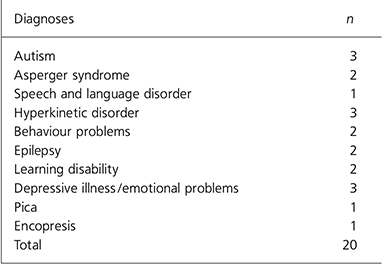
A range of disorders were seen in the 6-month pilot phase; these are summarised in Table 1. Developmental and hyperkinetic disorders represented about half the cases for which consultation was sought. Encouraging the trainees to ask specific questions helped focus their minds and enabled the trainer to provide a problem-orientated rather than academic feedback. The following vignettes (abridged for brevity) describe a typical consultation.
Diagnostic breakdown of cases referred to the e-clinic
| Diagnoses | n |
|---|---|
| Autism | 3 |
| Asperger syndrome | 2 |
| Speech and language disorder | 1 |
| Hyperkinetic disorder | 3 |
| Behaviour problems | 2 |
| Epilepsy | 2 |
| Learning disability | 2 |
| Depressive illness/emotional problems | 3 |
| Pica | 1 |
| Encopresis | 1 |
| Total | 20 |
Case 1
A 9-year-old male had a 3-month history of aggression with older siblings and schoolmates. He was average in studies, good at memorising facts, but was now refusing to go to school because he‘does not like one of the teachers’. His family has recently moved to Rawalpindi from a small town and his parents feel he is not adjusting well. He achieved the normal milestones of development but was clumsy as a child. He was always very shy of strangers and would hide if guests were in the house. He liked to collect stamps and would spend hours looking at his collection. His speech is normal but pedantic. He was wary of the interviewer and avoided eye contact. The parents are of the opinion that something has happened in school to upset him as generally he is well-behaved.
Questions: Could this be a normal reaction to moving to a big city and a new school? Could he have a mild learning disability and is not coping with schoolwork? How should his behaviour, especially aggression, be managed?
Excerpts from feedback: Often, it is not possible to make a clinical diagnosis in one session. It could be a reaction to the stress of change, or some other problem. Lack of social reciprocation, ritualistic behaviour and difficulty with change could be features of Asperger syndrome (literature attached). Mild learning disability can coexist with these problems (guidelines for clinical assessment attached). Teachers’ viewpoint could assist. Need to analyse his behaviour (Antecedent-Behaviour-Consequence chart and instructions attached). May need graded return to school. Explore possibility of smaller school with fewer pupils and an understanding teacher. Will need further assessment to clarify diagnosis.
Outcome: Diagnosis of Asperger syndrome was confirmed. Parents were educated about the condition and given material in Urdu. He was moved to a smaller school and responded well to a structured environment. His aggressive behaviour stopped in 2 weeks.
Case 2
A 5-year-old boy had a 2-year history of soiling. This had started after father married for the second time (polygamy acceptable in this culture). There is tension between the two wives who live in the same house, over how he should be managed. He has had to change school twice because of the problem. He does not have any friends, and older siblings make fun of him. He has had a complete physical evaluation by a number of doctors and has also been taken to traditional healers. He is currently on imipramine, 75 mg daily, prescribed by an adult general psychiatrist.
Questions: Should he continue with imipramine? If not, what other medication might help? What should be the psychological management?
Excerpts from feedback: Review his physical evaluation to ensure nothing has been missed. Imipramine is used for enuresis but has no role in encopresis and should be stopped. If diagnosis of encopresis is confirmed, educate parents (literature attached). Warn against unnecessary drugs and advise against doctor-shopping. Engage with the child (age-appropriate techniques of communicating explained). Use simple behavioural techniques (use of star charts, praise, etc., explained). Have a consultation with the whole family if possible (principles of such a consultation outlined). A combination of educational, psychological and behavioural methods is more likely to succeed than one approach alone.
Outcome: The family engaged in treatment and was able to think of the problem in psychological terms rather than seeking pharmacological treatment. Behavioural treatment is ongoing.
Discussion
The objective of the e-clinic was to train and empower existing staff, rather than provide a satellite service. Feedback from both sides was obtained after 12 weeks. The CAPSIG members stated that their diagnostic and management skills had begun to improve. They felt well supported and, in turn, felt they could support other trainees. The activity generated new interest in collaborating with existing child welfare organisations and schools. Feedback from patients indicated that they valued expert opinion from abroad, and that the overall profile of the service had been raised as a result of the activity.
A.R. felt this was a feasible and sustainable activity that contributed to his continuing professional development. Supervising from a distance offered some advantages. Focusing on training rather than service did not lead to a big increase in clinical work. He did not feel isolated academically as he had access to resource material at the UK centre that he could provide to CAPSIG. There was no issue of territoriality or conflict of interest with other consultant colleagues at the institute.
Most of the feedback obtained was anecdotal and more formal feedback is planned. Quantitative evaluation will be carried out after 1 year when clinical data will be compared with the previous year to see if there have been changes in diagnostic and management practices. Enough case material will also have been collected to edit and publish as a practical handbook. As broadband technology becomes widely available, video-conferencing will also be used in diagnosis and management.
This pilot study demonstrates a practical method for training and supervising colleagues in Pakistan from a distance. Other immigrant specialists can adapt it to assist colleagues in their home countries. Short time-limited projects in their fields of expertise (e.g. providing one-off cognitive-behavioural therapy supervision to a colleague or providing guidance for managing treatment-resistant cases) can be taken up without major changes to everyday routine. As this study shows, such activity can have very satisfying paybacks.
E-Mental health in low- and middle-income countries could also learn from the activities of the Swinfen Charitable Trust, established in 1998 with the aim of providing telemedicine links between hospitals in the developing world and specialists who give free advice by e-mail. A prospective 6-month evaluation of their service showed that 125 consultations from a range of specialties took place. The referring doctors found the service useful and half said it improved their management of patients (Reference Wootton, Youngberry and SwinfenWootton et al, 2004).
Institutions such as the Royal Colleges and Department of Health should support and facilitate such activities. Similarly, mental health leaders in low- and middle-income countries, specifically south Asia, should encourage their expatriate colleagues to contribute meaningfully to their training programmes, thereby converting part of their loss into an opportunity.
Declaration of interest
None.
Acknowledgements
We thank Professor Murad Khan and Dr Hashim Reza for their comments on the manuscript.


 Open access


eLetters
No eLetters have been published for this article.