INTRODUCTION
People undergoing hematopoietic stem cell transplantation must cope with numerous physical, social, emotional, and practical challenges due to this cancer treatment's toxicity and risk, as well as the lengthy hospitalization and recovery period it entails (McQuellon & Andrykowski, Reference McQuellon, Andrykowski and Appelbaum2009). These factors make transplant recipients highly dependent on their main caregiver (usually a partner or family member), who plays a central role in addressing their emotional, informational, and practical needs throughout the transplant process. Although caregiver support is highly valued by transplant recipients, many report problems with caregiver support, including communication problems (21–27%), feeling overprotected (18–31%), or feeling that their needs are not well understood by caregivers (18–33%) (Andrykowski et al., Reference Andrykowski, Cordova and Hann1999). These kinds of problems are consistent with social support research showing that even well-intended support attempts can have unintended negative effects on recipients or fail to provide them with the emotional and/or practical resources they need (see, e.g., Barrera, Reference Barrera1986; Bolger et al., Reference Bolger, Zuckerman and Kessler2000; Fisher et al., Reference Fisher, Nadler and Whitcher-Alagna1982; Gleason et al., Reference Gleason, Iida and Bolger2003; Newsom et al., Reference Newsom, Rook and Nishishiba2005).
Thus, caregiver support varies in the extent to which it serves its intended purpose of helping transplant recipients manage treatment-related emotional and practical challenges. The social support effectiveness (SSE) framework (Rini & Dunkel Schetter, Reference Rini, Dunkel Schetter, Sullivan and Davila2010) adds a new perspective to research on enacted support (also called “received support”) by facilitating investigation of this variation. Research on enacted support has traditionally emphasized investigation of the quantity of support received by using measures that assess how much support of a particular type a person has received within a given time period. In contrast, research guided by the SSE framework assesses the extent to which enacted support has met the support recipient's needs in terms of empirically based aspects of its quality and quantity. The goal is to examine how effectively the support provided the needed emotional and practical resources, as appraised by the recipient.
Research has demonstrated associations between receiving more effective support and reductions in distress (e.g., Rini et al., Reference Rini, Redd and Austin2011; Reference Rini, Schetter and Hobel2006) and physiological stress responses (Giesbrecht et al., Reference Giesbrecht, Wolse and Crooks2013). One relevant study of transplant survivors (Rini et al., Reference Rini, Redd and Austin2011) found that the benefits of receiving a greater quantity of support from a partner depended on the effectiveness of the support. When partner support was more effective, its quantity was not associated with the recipient's distress; however, when partner support was less effective, receiving a greater quantity of partner support was associated with higher distress. Related research suggests that ineffective support could hinder cognitive processing of stressful events (Lepore, Reference Lepore, Baum and Andersen2001).
Given the foregoing, we reasoned that variation in the effectiveness of caregiver support provided to transplant recipients throughout the transplant process could profoundly affect their day-to-day treatment experiences. The present study was a first step in investigating this research question; it examined the association between the effectiveness of caregiver support and transplant survivors' recollections of their treatment experiences, as reflected by narratives they wrote describing their experiences before, during, and after the transplant. These recollections provide insight into the lived experiences of people who have survived transplantation, in addition to revealing meanings and interpretations that can affect their current and future psychosocial functioning (Bluck et al., Reference Bluck, Alea and Habermas2005; Conway, Reference Conway2005).
There are several important ways by which caregiver support could influence transplant experiences and, in turn, survivors' recollections of those experiences. First, it may be a coping resource (Thoits, Reference Thoits1986). Effective support from a caregiver could help ease the emotional and practical burdens created by transplant-related stressors throughout treatment. According to the concept of optimal matching (Cutrona, Reference Cutrona1990), these benefits should be greatest when the functional type of support matches the needs of the recipient (Cutrona, Reference Cutrona1990; Cutrona et al., Reference Cutrona, Shaffer and Wesner2007; Rini & Dunkel Schetter, Reference Rini, Dunkel Schetter, Sullivan and Davila2010; Thoits, Reference Thoits1986). For instance, specific resources offered by a caregiver's effective emotional support (e.g., listening to and understanding concerns, providing encouragement, and showing affection) should help transplant recipients manage distress or avoid feeling emotionally isolated; effective caregiver informational support (e.g., providing information, guidance, and help in understanding information) should facilitate transplant recipients' ability to reappraise their experience and find meaning in it; and effective caregiver instrumental support (e.g., helping with tasks and addressing material needs) should help transplant recipients avoid or manage the adverse effects of practical problems.
Conversely, ineffective caregiver support may adversely affect the transplant experience. For instance, caregivers may fail to understand recipients' needs, can be ambivalent about providing support, or might lack the skill or motivation to provide it sensitively. Ineffective emotional support may be experienced by recipients as smothering rather than comforting, informational support may be experienced as controlling and not useful, and instrumental support may make recipients feel guilty or indebted while failing to address practical needs. When ineffective support occurs often enough, it can be expected to adversely affect transplant recipients' ability to meet psychosocial challenges of transplant, shaping their recalled experiences in ways that can be detected in their transplant narratives.
Second, caregiver support may affect transplant survivors' recollections of their treatment by affecting their cognitive processing of the event. Cognitive processing is the psychological process through which people make sense of a severely stressful event and integrate it into their self-concept and worldview in order to facilitate psychological recovery (Lepore, Reference Lepore, Baum and Andersen2001; Pennebaker & Chung, Reference Pennebaker, Chung and Friedman2011). Caregivers' responses to transplant recipients' attempts to express their thoughts and feelings about their treatment (e.g., being receptive, offering new interpretations, or suggesting ways to cope) can facilitate cognitive processing, influencing whether and how events are recalled (e.g., by influencing their integration with other enduring representations in an autobiographical knowledge base; Conway, Reference Conway2005). For instance, one study of transplant survivors (Mosher et al., Reference Mosher, Lepore and Wu2012) showed that survivors who perceived that they could talk about their cancer-related thoughts and feelings with others (i.e., their caregiver was more emotionally supportive and offered useful informational support; Lepore, Reference Lepore, Baum and Andersen2001) were better able to cognitively process their experience; they had fewer intrusive thoughts about their experience and fewer active attempts to avoid such thoughts.
OVERVIEW OF THE PRESENT STUDY
The present study investigated whether transplant survivors' recall of the experience of their transplant—as indicated by patterns of natural language use in the narratives they wrote to describe their experience—varied according to the effectiveness of their primary caregiver's social support. Consistent with the SSE framework, effectiveness was conceptualized as a stable feature of caregiver support (see Rini & Dunkel Schetter, Reference Rini, Dunkel Schetter, Sullivan and Davila2010). Patterns of natural language use were analyzed using the Linguistic Inquiry and Word Count (LIWC) software program (Pennebaker et al., Reference Pennebaker, Chung and Ireland2007), which includes a dictionary organized into various linguistic categories to measure the frequency with which words or word stems in these categories appear within a narrative (e.g., Pennebaker et al., Reference Pennebaker, Mehl and Niederhoffer2003). Our study focused on four categories that: (1) reflected life domains affected by stem cell transplant; (2) had the potential to be influenced by caregiver social support (e.g., we did not investigate pronoun use but rather categories reflecting emotional and practical stressors); and (3) corresponded to preexisting dictionaries available in the LIWC program. The following hypotheses, guided by social support theory (e.g., Cutrona, Reference Cutrona1990; Thoits, Reference Thoits1986) and the SSE framework (Rini & Dunkel Schetter, Reference Rini, Dunkel Schetter, Sullivan and Davila2010), reflected the overarching proposition that the effectiveness of a given functional type of caregiver support (emotional, informational, or instrumental) should have its strongest associations with transplant-related stressors that would be mitigated by the particular resources which that type of support provides:
H1: More effective caregiver emotional support (e.g., showing affection, caring, encouragement, sympathy, and “being there”) should be uniquely related to lower use of negative emotion words (e.g., “alone,” “cried,” or “anxiety”) because these actions help mitigate negative emotional responses to stress.
H2: More effective caregiver informational support (e.g., providing useful advice or information and helping to understand and interpret events) should be uniquely associated with greater use of words indicating insight (H2A) and lower use of words indicating causation (H2B) (e.g., “because,” “effect,” and “reason”) because more successful cognitive processing should increase the chance that recipients have gained insight into their experience and its cause, reducing their need to search for a causal explanation for their diagnosis.
H3: More effective caregiver instrumental support (e.g., help getting needed resources and getting tasks done) should be uniquely associated with lower use of words associated with money and insurance (e.g., “borrow,” “insurance,” and “debt”) because the support should either moderate or help transplant recipients avoid common practical problems related to finances and insurance.
METHODS
Participants and Procedure
The participants included 182 men and women enrolled in a trial evaluating a psychosocial intervention for transplant survivors. They were identified through patient databases at two medical centers and through announcements at outlets serving this patient population. A phone interview was completed to determine their eligibility for the trial. They had to be survivors of a successful transplant in the prior 9 months to 3 years, at least 18 years old, English speaking, and experiencing at least mild survivorship difficulties in one or more of these domains: cancer-specific distress (Horowitz et al., Reference Horowitz, Wilner and Alvarez1979); generalized distress (Derogatis, Reference Derogatis1993); poor health-related quality of life (McQuellon et al., Reference McQuellon and Russell1997), and low sense of purpose in life (Scheier et al., Reference Scheier, Wrosch and Baum2006). The details of screening and study procedures are described in a report of the trial (Rini et al., Reference Rini, Austin and Wu2014). The relevant study procedures are summarized here.
Eligible participants were randomized to one of four writing groups. After randomization, they wrote their narratives in three 20-minute home-based structured writing sessions spaced a week apart. They were instructed to write about the time before, during, and after transplant, respectively. One of the four writing groups was a control group that wrote down the factual details of their transplant (i.e., with no thoughts or feelings). That group's narratives were excluded from analyses because their instructions limited their ability to write about the affective and cognitive aspects of their experience. The three writing groups included in the present study were not constrained in this manner. Two of the three groups (groups 1 and 2) were given standard expressive writing instructions (i.e., to write their deepest thoughts and feelings about their transplant) (Pennebaker & Beall, Reference Pennebaker and Beall1986) on all writing days. Group 2 received additional directions prior to the first writing session, indicating that, though they would be writing for themselves on the first three writing days, on the fourth (not included in the present study) they would be asked to write a narrative that would be shared with people preparing for transplantation (as if speaking to someone preparing for a transplant). Group 3 wrote this way (for sharing) across all writing days. Because the groups received somewhat different writing instructions, all analyses controlled for writing group. The study procedures were approved by the institutional review boards at both study sites.
Measures
Caregiver SSE was measured at baseline (prior to randomization) with three subscales from the 25-item SSE Questionnaire (Rini et al., Reference Rini, Redd and Austin2011), which assesses the effectiveness of emotional, informational, and instrumental support from a specific provider (their partner or, for unpartnered participants, their primary transplant caregiver). For each functional type of support, a brief definition is then provided so that respondents can report: (1) how well the quantity of that type of support matched the amount needed (0=very poor to 4=excellent); (2) the extent to which they wished it had been somehow different (0=not at all to 4=extremely); (3) the extent to which it was perceived to have been provided skillfully (0=not at all to 4=extremely); (4) how difficult it was to get (0=never to 4=always); and (5) whether the provider ever offered the support without being asked (0=never to 4=always). Responses focus on support during the prior three months to capture characteristic levels of SSE. Four-month test–retest correlations ranging from 0.64 to 0.69 suggest that SSE is relatively stable, consistent with the view that it reflects stable features of the support provider, recipient, and their relationship (e.g., Rini et al., Reference Rini, Schetter and Hobel2006). This measure therefore provides a good indication of the effectiveness of caregiver support during treatment and recovery. Subscale scores, created by summing relevant items, can range from 0 to 20, with higher scores indicating more effective support (Cronbach's α=0.84–0.93).
Sociodemographic characteristics were self-reported and included age, sex, marital/relationship status, annual household income, highest level of education completed, work status, and race/ethnicity.
Medical characteristics were abstracted from data from medical charts and self-reported. They included diagnosis, weeks since transplant, type of transplant (allogeneic or autologous), and number of serious transplant complications (e.g., infections, mucositis, graft-versus-host disease).
Statistical Analyses
Descriptive statistics were first computed. Participants' narratives were then collapsed across their three writing sessions so that analyzed narratives described transplant experiences before, during, and after hospitalization for the transplant. Next, we used the LIWC program (Pennebaker et al., Reference Pennebaker, Chung and Ireland2007) to code their linguistic content. LIWC scores represent the percentage of words corresponding to each of its linguistic categories (e.g., a “2.6” for “negative emotion” means that 2.6% of the words in a text were in that category). The outcomes were four categories in the 2007 LIWC dictionary: (1) negative emotion words, (2) cognitive mechanism words related to insight, (3) cognitive mechanism words related to causation, and (4) words related to money and insurance (LIWC's “money” category).
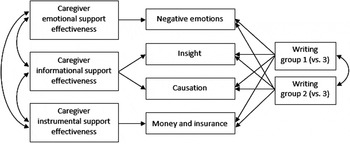
We next tested hypotheses using path analysis, implemented in EQS 6.2 with maximum-likelihood estimation (Bentler, Reference Bentler2008). The hypothesized model is shown in Figure 1. It controlled for randomly assigned writing group (two dummy-coded variables, with group 3 as the comparison group). As widely recommended, model fit was evaluated with multiple indicators. Good fit was indicated by a nonsignificant χ2, a comparative fit index (CFI) >0.95, and a root-mean-square error of approximation (RMSEA) below 0.06 (Hu & Bentler, Reference Hu and Bentler1999). Modification indices (Wald and Lagrange multiplier tests) were consulted for suggested model modifications.
Hypothesized model of relations between caregiver social support effectiveness and categories of natural word use from linguistic analyses. Error terms are omitted for clarity.

RESULTS
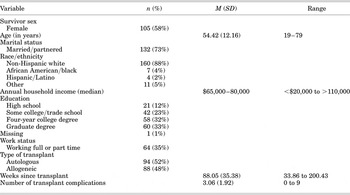
Descriptive statistics are presented in Table 1. The sample included 105 women and 77 men who were, on average, 54 years old. Reflecting characteristics of people who undergo transplant nationally (Joshua et al., Reference Joshua, Rizzo and Zhang2010), most were non-Hispanic white. Furthermore, most were married or had a partner (73%) and were college educated (65%). Correlations and descriptive statistics are shown in Table 2.
Descriptive statistics (N=182)

Correlations among study variables (N= 182)

a Statistics for word use variables represent percentages of total word use in analyzed narratives.
b Coded so that higher scores indicated fewer negative effects (i.e., more effective support).
Hypothesis Testing
Model Specification and Fit
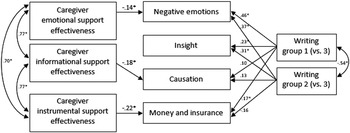
The χ2 test for the hypothesized model indicated room for improvement: χ2(20)=33.88, p=0.03, CFI=0.97, RMSEA=0.06, 90% CI=0.00–0.10. Modification indices suggested several substantive changes, including dropping the path from caregiver informational support effectiveness to insight words (which was not significant; p=0.70), and adding a correlation between the error terms for insight and causation word use (a reasonable addition for these conceptually related categories). There was no indication of a need for paths beyond those specified in the hypothesized model. Making these changes yielded a more parsimonious model with good fit: χ2(20)=29.51, p=0.08, CFI=0.98, RMSEA=0.05, 90% CI=0.00–0.09. The findings from this final model (see Figure 2) are described next.
Final model of relations between caregiver social support effectiveness and categories of natural word use from linguistic analyses. Standardized estimates are shown. Error terms are omitted for clarity. Paths identified with an asterisk are significant at the p<0.05 level.

Negative Emotion Words
Transplant survivors whose caregiver generally provided more effective emotional support used a lower proportion of negative emotion words in their narratives than those who received less effective caregiver emotional support (t=–2.08). This finding supported hypothesis H1, as did the fact that the effectiveness of caregiver informational and instrumental support was unrelated to negative emotion word use. Exploratory analyses replacing the negative emotions word use variable with variables representing use of sadness, anxiety, and anger words (subcategories of negative emotion words) indicated that this effect could be traced to words indicating sadness (β=–0.17, t=–2.28, p<0.05) rather than anxiety (β=0.01, t=–1.10, p>0.05) or anger (β=–0.003, t=–0.04, p>0.05). Moreover, significant associations between effective caregiver emotional support and use of sadness words were observed for narratives describing experiences during (β=–0.19, t=–2.56, p<0.05) and after transplantation (β=–0.18, t=–2.46, p<0.05), but not before (β=–0.02, t=0.01, p > –0.05).
Use of Words Indicating Cognitive Processing (Insight and Causation)
Caregiver informational support effectiveness was not associated with use of insight words, contrary to hypothesis H2A. However, transplant survivors whose caregiver generally provided more effective informational support used a lower proportion of words indicating causation than those who received less effective caregiver emotional support (t=–2.50, p<0.05). This finding supported hypothesis H2B, as did the fact that neither effectiveness of caregiver emotional support nor effectiveness of caregiver instrumental support was related to use of causation words. Exploratory analyses indicated that this effect was primarily due to use of causality words in narratives describing experiences before (β=–0.14, t=–1.98, p<0.05) and transplantation (β=–.16, t=–2.14, p<0.05), but not during transplantation (β=–0.08, t=–1.06, p>0.05).
Use of Money and Insurance Words
Transplant survivors whose caregiver generally provided more effective instrumental support used a lower proportion of words related to money and insurance in their narratives than those who reported receiving less effective caregiver instrumental support (t=–3.09). This finding supported hypothesis H3, as did the fact that the effectiveness of caregiver emotional and informational support were unrelated to use of these words. Exploratory analyses indicated that this effect was primarily due to use of money and insurance words in narratives describing experiences before (β=–0.17, t=–2.40, p<0.05) and (marginally) after (β=–.14, t=–1.88, p=0.06), but not during transplantation (β=–0.10, t=–01.33, p>0.10).
CONCLUSIONS
Our study investigated how variation in the effectiveness of caregiver support is associated with stem cell transplantation survivors' recalled experiences of their treatment, as indicated by linguistic features of the narratives they wrote to describe it. We investigated recalled treatment experiences because these recollections reveal lingering cognitive and emotional effects of treatment that have implications for current and future psychosocial functioning (Bluck et al., Reference Bluck, Alea and Habermas2005; Conway, Reference Conway2005). The study extended prior research on the consequences of variation in the effectiveness of social support by examining the unique effects of different functional types of effective support, and because of the rich context offered by survivors' treatment narratives. Our findings suggest ways that support given by a skilled caregiver may affect how transplant recipients experience this psychologically and physically arduous treatment. Although causal relations will need to be established with further research, the potential usefulness of our findings is underscored by the fact that they are consistent with well-established social support theory and the empirically based SSE framework. Namely, the effectiveness of each functional type of caregiver support (emotional, informational, and instrumental) was associated with a category of word use reflecting an outcome that theoretically should be most affected by it (e.g., Cutrona, Reference Cutrona1990; Thoits, Reference Thoits, Sarason and Sarason1985).
The findings largely supported our hypotheses. First, survivors who received more effective emotional support from their caregiver used fewer negative emotion words in their narratives—especially fewer sadness words during and after transplant. These findings are consistent with evidence that enacted emotional support can be an important resource among people diagnosed with cancer (Arora et al., Reference Arora, Finney Rutten and Gustafson2007). Depressive symptoms are a recognized problem after stem cell transplantation (Fife et al., Reference Fife, Huster and Cornetta2000; Syrjala et al., Reference Syrjala, Langer and Abrams2004). If prospective research confirms that distress is exacerbated by receiving ineffective caregiver support, then pretransplant screening may be used to identify patients in need of intervention (e.g., supplementary emotional support resources or training to help caregivers provide more effective emotional support), guided by the empirically based SSE framework (Rini & Dunkel Schetter, Reference Rini, Dunkel Schetter, Sullivan and Davila2010).
Furthermore, transplant survivors who received more effective informational support from their caregiver were less likely to use such causation words as “because,” “effect,” and “reason,” especially when describing the periods before and after transplant. This LIWC category was designed to detect language use indicating cognitive processing. It may be that getting good advice, feedback, and guidance from a caregiver reduced transplant survivors' need to search for a causal explanation for their diagnosis and treatment. In the face of a serious health-related stressor, it may be most adaptive to find an acceptable causal explanation relatively quickly to begin the process of rebuilding meaning systems challenged by the event (Park et al., Reference Park, Edmondson and Fenster2008). For instance, a study of narratives produced by parents of children with developmental disabilities found that parents of children whose diagnosis was uncertain (vs. certain) used more causation words (Carroll, Reference Carroll2009)—possibly indicating greater cognitive effort devoted to understanding their child's disability—as well as more words indicating sadness. The fact that in our study effective caregiver informational support was associated with lower use of causation words after hospital discharge may indicate that for this type of resolution either transplant survivors did not feel the need to find a causal explanation or they found one relatively quickly. Conversely, ineffective caregiver informational support may hinder survivors' ability to reach this type of resolution. This explanation is consistent with sociocognitive processing models that highlight how interactions with others (e.g., in which they suggest new ways of thinking about an event) can help people cognitively process the event and put it behind them (Lepore, Reference Lepore, Baum and Andersen2001)
Finally, transplant survivors who received effective instrumental support from their caregiver (e.g., useful help with tasks that need to get done, material resources) used fewer words related to money and insurance (e.g., “debt,” “owe,” “expense”) in their narratives, especially when describing the time before and, marginally, after transplant. Transplantation is associated with substantial expense caused by disrupted work, medical expenses, travel, and other costs (Hamilton et al., Reference Hamilton, Wu and Austin2013; McQuellon & Andrykowski, Reference McQuellon, Andrykowski and Appelbaum2009). Patients begin learning about these expenses prior to hospitalization and probably are affected by them to some extent throughout treatment, although their impact could become relatively less important during active treatment, as fears about risk to life become more prominent. It may also be that financial and insurance strains become increasingly problematic after hospital discharge when treatment bills arrive. Lower use of money- and insurance-related words may indicate that caregivers who provide more effective instrumental support help insulate transplant survivors from these types of concerns, either through their own actions or through resources they can access. Clearly, there are other kinds of practical problems that may also be mitigated by effective caregiver instrumental support (e.g., childcare, work problems). We focused on words related to money and insurance because they represent widespread problems within this population (Hamilton et al., Reference Hamilton, Wu and Austin2013) and because the LIWC program included a category with words and word stems that were a good representation of the kinds of problems faced by people undergoing transplant.
The foregoing discussion assumes a specific causal pathway—that the effectiveness of daily acts of caregiver support provided throughout the transplantation process influence survivors' transplant experience and their ability to cognitively process it. It is also possible that transplant survivors with a greater tendency to appraise themselves, their world, and other people in a positive light are more likely to report more effective caregiver support, to recall the most positive aspects of transplant, or to forget its most negative aspects. These causal assumptions will need to be examined in future research to guide interventions. A useful extension of this work would use a prospective, longitudinal design beginning prior to transplant to document potential confounds (e.g., survivors' dispositional characteristics), life stressors, caregiver support transactions as they occur, and survivors' responses to those transactions.
A strength of our study is that some shared methods biases were minimized by the research design; survivors' reports of the effectiveness of their caregiver's support and their narratives describing their transplant experiences were collected at separate times and provided in response to distinct sets of instructions. This design minimized biases involving situational or intrapersonal factors that may influence responses at a particular assessment timepoint, or those involving similarity in responses across measures administered in close proximity. Other sources of methods bias (e.g., dispositional characteristics that can influence responses across measures) could have influenced the findings.
One limitation of our study was that the sample was predominantly non-Hispanic white, although the sample's demographics were similar to those found in the larger population of people undergoing stem cell transplantation (Joshua et al., Reference Joshua, Rizzo and Zhang2010). Moreover, linguistic analyses cannot take into account the context of a word's use and therefore may miss or misrepresent some words. However, it is also the case that linguistic analyses can be a valuable supplement to self-reports collected with questionnaires. Studies using this analytic technique have provided useful insights to guide additional research, and evidence supports the validity of the LIWC method (e.g., Bantum & Owen, Reference Bantum and Owen2009).
Moreover, several novel features of the study—its consideration of variation in the effectiveness of different functional types of caregiver support and its use of linguistic analyses to investigate transplant survivors' recalled treatment experiences—are significant strengths. Our findings show that caregiver support effectiveness warrants further research. We believe that it was likely to have affected recalled transplant experiences by influencing the emotional and practical burdens of the transplant process as it occurred and/or by affecting cognitive processes that influence which aspects of the experience remain salient over time versus being psychologically resolved. Our findings are consistent with these pathways, although others may exist. Given transplant survivors' reliance on caregivers during their lengthy and arduous treatment, these findings provide a first step to developing new interventional approaches for a population with demonstrated need.
ACKNOWLEDGMENTS
This research was supported by the American Cancer Society (Grant #RSGPB-07-285-01-CPPB; PI: Rini). We thank Katie Basmajian, Anna-Marie Vu, and Jennifer Chee-Chait for their assistance in data collection. We also thank all the transplant recipients who participated in this study for their time and dedication