Introduction
Approximately 16 severe earthquakes occur yearly, resulting in fatalities, injuries, and material losses. Reference Rostami-Moez, Rabiee-Yeganeh, Shokouhi, Dosti-Irani and Rezapur-Shahkolai1 Consequently, large earthquakes are often associated with destructive natural disasters. A large earthquake usually results in many casualties, thus having a high mortality rate. Reference Gul and Andsoy2 The unexpected nature of earthquakes complicates mitigation efforts and evacuation plans. Several factors can influence an earthquake’s severity, including the day of the week, time of day, population density, location, and local geological conditions. Therefore, having a disaster preparedness plan in place for the community is just as crucial as building safety. Reference Lindell, Arlikatti and Prater3
A comprehensive analysis of past disasters is essential to developing disaster preparedness. Preparation and planning are important for minimizing the effects of earthquakes, disasters, and other seismic events. Essential components of disaster planning include: (1) protocols that outline how prehospital and hospital medical care will change during the initial response; (2) maximizing community resources; (3) understanding common clinical conditions following earthquakes and how to treat them; and (4) understanding that outside assistance will not arrive immediately and may take more than 48 hours to arrive. Reference Sheikhi, Seyedin, Qanizadeh and Jahangiri4
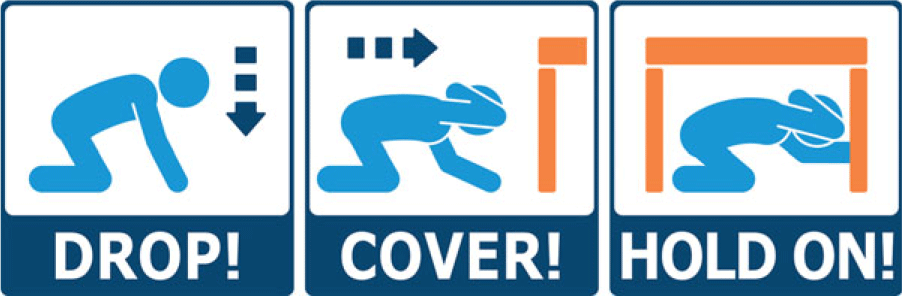
Disaster preparedness relies on a high level of “disaster awareness” and the dissemination of scientific knowledge because the foundation of preparedness is society. Hence, earthquake drills are conducted in various societies to prepare for devastating disasters, such as earthquakes. Among the procedures recommended for these drills, the “Drop, Cover, and Hold On” position is recommended to protect oneself when shaking occurs. 5
The literature, however, needs more studies comparing Drop, Cover, and Hold On with other positions and protection methods. Nevertheless, many organizations, including the Occupational Safety and Health Administration (OSHA; Washington, DC USA), American Red Cross (ARC; Washington, DC USA), and Federal Emergency Management Agency (FEMA; Washington, DC USA), have long recommended Drop, Cover, and Hold On during a shaking (Figure 1). 6–8

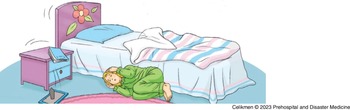
The Drop, Cover, and Hold On approach has been widely accepted in disaster-response communities as one of the safest protection positions. People would take shelter under a heavy table to prevent injury from falling objects in the event of a disaster. There is a newer and less-researched method called “Fetal Position in the Triangle of Life” (Figure 2). According to this method, it is preferable to lay in the fetal position next to furniture rather than under it since roofs and walls create buffer zones adjacent to non-crushable objects that protect people from being crushed. There is, however, a lack of studies comparing these two positions.
Fetal Position in the Triangle of Life.

This study aims to determine and compare the effectiveness of Drop, Cover, and Hold On versus Fetal Position in the Triangle of Life in reducing casualties during earthquakes and to establish a consensus among experts in medical search and rescue.
Methods
In this study, the data collected from experienced medical search and rescue professionals were analyzed using a three-stage Delphi technique to compare Drop, Cover, and Hold On versus Fetal Position in the Triangle of Life.
Insights into the Delphi Technique
While the Delphi technique has evolved since it was first described, its basic approach remains unchanged. Reference Nasa, Jain and Juneja9 A Delphi-based approach consists of a series of “rounds” in which several experts are asked to respond to a particular topic. Every round builds on the previous one’s findings. In this way, the study can evolve based on earlier findings to yield the final results. By viewing previous rounds’ responses, including their own, participants can reflect on the views of others and reposition their ideas accordingly. Anonymity is consistently maintained throughout each round. Participants’ own opinions will not be viewed as negative or influenced by personal factors, thereby avoiding any bias. Expert opinion rounds, each building on previous findings and allowing participants to reassess responses, are designed to develop a consensus view that answers the research question. It is possible to vary the Delphi approach regarding the number of rounds, how questions are communicated, responses are collected, and how consensus is determined. The study used a three-round Delphi methodology. A one-month interval separated each round of data collection in October and December of 2022.
Round 1—In an open-ended survey, ten medical search and rescue experts were asked what factors affect a person’s mortality after being extricated from the rubble. Depending on the answers provided, their answers were categorized and coded (similar statements made by each expert represented one code). Using this questionnaire, the researchers sought opinions on the topic.
Round 2—An analysis of simulations was conducted in the second round. During the demolition of two separate five-story buildings in Istanbul that were identified as illegal, low-quality construction and were decided to be demolished by the Istanbul Metropolitan Municipality at two different times, earthquake simulations were performed. Several parts of the buildings were furnished to replicate classrooms, bedrooms, study rooms, and human living areas, and dummy subjects were placed at each location. To maintain the home or school setting of the buildings, household items that could not be crushed and would leave “living spaces” at least 50-60cm high, which is close to the thickness of column beams, were placed. These included box spring beds and desks with metal cages. Ten semi-torso mannequins were constructed from plaster and hard, brittle plastic materials attached with tape to tables, chairs, and desks (to simulate squatting). A further ten were placed near household items such as chests with tightly stacked books, beds with books under them, and bed linens. “Pancake” demolition was used in buildings that weakened load-bearing systems by simulating earthquake waves in different directions, pulling and impacting, and putting the building into resonance to mimic earthquake waves.
Several damages were incurred to the mannequins in the buildings measured by the Seismology Institute of Istanbul Technical University (ITU; Istanbul, Turkey), whose structural systems were weakened and turned into pancakes in the worst-case scenario due to shaking similar to the resonance effect caused by the continuity of earthquake waves.
The same medical search and rescue team independently assessed the damaged mannequins after the collapse. After combining the simulation observations and the inferences made in the first round, a second survey was conducted.
Round 3—Following the second round of ratings, a third round of questionnaires was administered. As part of this questionnaire, participants were asked to give a score from one to ten based on their level of agreement. Whether they agreed or disagreed with Fetal Position in the Triangle of Life and Drop, Cover, and Hold On using a ten-point Likert scale, the agreement rates were measured and compared.
Participants
A Delphi study’s design is largely dependent on selecting the right panelists. In Delphi studies, participants are selected according to their expertise in a particular field. An expert group with a good composition is crucial for the success of these studies. Reference Linstone and Turoff10 Delphi refers to participants as “experts”: individuals who are knowledgeable about a topic and offer valuable ideas and opinions. In summary, the four items that make up the criteria for selecting experts for the study are as follows. Among them are experience and cognitive awareness of the topic, willingness to participate, sufficient time, and effective communication. Reference Skulmoski, Hartman and Krahn11 Delphi studies are most effective when the participants’ expertise is homogeneous based on the study’s objectives. The number of experts should be capped at a manageable number. Reference Delbecq, Van de Ven and Glenview12,Reference Okoli and Pawlowski13
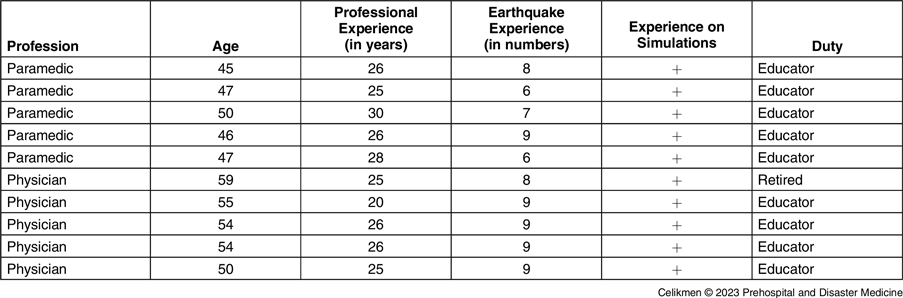
Medical search and rescue specialists (emergency medicine specialists and paramedics) from various Turkish public and nongovernmental organizations who volunteered after national and international earthquakes participated in this study. The participants actively participated in search and rescue activities following at least six earthquakes listed below. Table 1 provides detailed information about the experts. Along with being actively involved in the field, the experts continue to provide training based on their experience.
Detailed Information about the Participating Experts

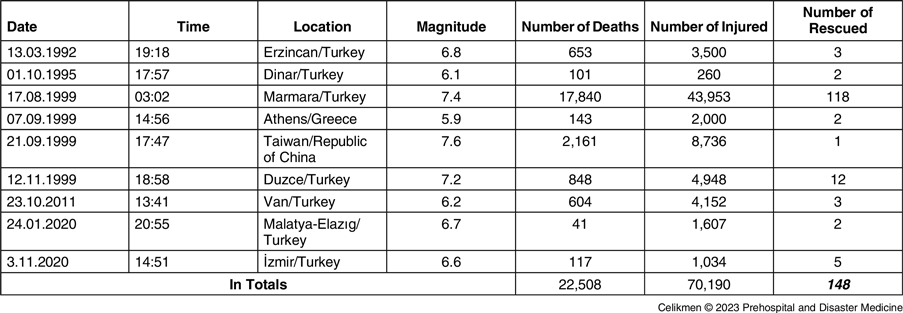
List of Earthquakes and Activities Involving Medical Search and Rescue Experts
Earthquake 1—At 19:18 on March 13, 1992, an earthquake with a magnitude of 6.8 struck Erzincan, Turkey. It resulted in 3,500 injuries and 653 deaths. Three injured people were rescued alive from rubble by the search and rescue team involved in the investigation. All three rescued victims suffered only superficial abrasions and lower extremity injuries. Three of the victims did not exhibit post-earthquake crush syndrome. In these three injured individuals, one-year mortality was not observed. The three individuals received psychosocial support, and one required additional physical therapy.
Earthquake 2—An earthquake with a magnitude of 6.1 struck Dinar/Afyonkarahisar/Türkiye at 17:57 on October 1, 1995. In this earthquake, 260 people were injured and 101 people died. Two injured people were recovered from rubble by search and rescue personnel. In the two injured people, there was no mortality after one year. One of the two injured suffered injuries to his upper and lower extremities, as well as tenderness in his head and neck (as a result, he did not require surgery or bleeding). A superficial abrasion was all that was present on the second casualty.
Earthquake 3—At 03:02 on August 17, 1999, a 7.4 magnitude earthquake struck Marmara/Türkiye. This earthquake injured 43,953 people and killed 17,840. One hundred eighteen (118) people were rescued from under the rubble during this earthquake. The latest was on the fifth day following the earthquake. A total of 34 of these earthquake victims suffered injuries to lower extremities, two suffered crush injuries from arm compression, and one required amputation under the rubble. The other earthquake victims suffered superficial abrasions.
Earthquake 4—A 5.9 magnitude earthquake hit Athens/Greece on September 07, 1999 at 14:56, causing 2,000 injuries and the death of 143 people. Two injured people were rescued from rubble by the search and rescue team. The injured people had crush injuries to both upper and lower extremities, but no crush syndrome was observed in the follow-up. Both underwent orthopedic surgery and needed psychological and physical therapy. Both victims did not die within one year.
Earthquake 5—At 17:47 on September 21, 1999, an earthquake with a magnitude of 7.6 struck Taiwan/Republic of China, injuring 8,736 people and killing 2,161. An injured person was rescued from the rubble by the search and rescue team. In the rescued victim, laceration and abrasions were found in the head region, tenderness along the spine, and multiple abrasion areas in the lower and upper extremities. One-year mortality was not observed. Follow-up required psychological support and physical therapy.
Earthquake 6—An earthquake with a magnitude of 7.2 struck Duzce, Turkey at 18:58 on November 12, 1999, injuring 4,948 people and killing 848 others. Twelve (12) injured people were rescued from rubble by search and rescue crews.
Earthquake 7—At 13:41 on October 23, 2011, an earthquake with a magnitude of 6.2 struck Van/Turkey; 4,152 people were injured and 604 people died. Three injured people were rescued from the rubble by search and rescue teams.
Earthquake 8—Maltya-Elazıg, Turkey was struck by an earthquake on January 24, 2020, which injured 1,607 people and killed 41. There were two injured people pulled out of rubble by search and rescue workers.
Earthquake 9—On November 3, 2020 at 14:51, an earthquake with a magnitude of 6.6 struck Izmir/Turkey; 1,034 people were injured and 117 people died. Five injured people were rescued from under the rubble by a search and rescue team (Table 2).
Overview of the Earthquakes in which the Search and Rescue Team Took Part

Note: Including location, intensity, number of injured, number of dead, and number of injured that were rescued from rubble.
Statistical Analyses
Statistical analyses were performed using Statistics for Social Sciences (SPSS v28; Armonk, New York USA). Descriptive data were presented as numbers for categorical variables and medians and interquartile ranges (IQR) for ordinal variables.
Ethical Authorization
Ethical approval was obtained from University of Health Sciences, Kartal Dr. Lutfi Kirdar City Hospital (Kartal, Istanbul, Turkey) Ethics Committee (2022/514/242/10-25.01.2023).
Results
First Round of Delphi
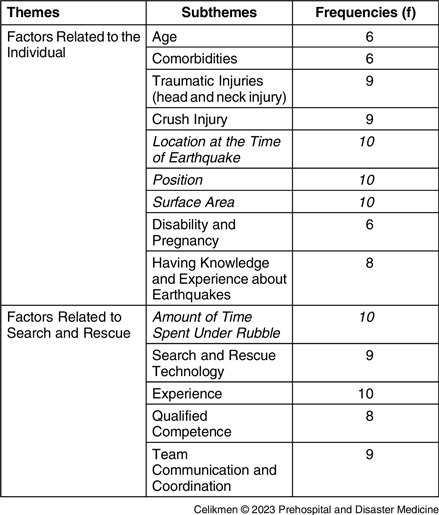
Researchers asked ten medical search and rescue experts open-ended questions about the factors that affect the mortality of a person rescued from the rubble, and their answers are presented in Table 3. In the answers given, all experts mentioned the following factors: age, position, and surface area of the injured person. A victim’s time under rubble and the experience of search and rescue teams were two prominent factors related to search and rescue. During this round, the researchers coded open-ended responses independently, with 90% inter-rater reliability. Reference Miles and Huberman14
Factors that Affect Mortality Under Rubble

Second Round of Delphi
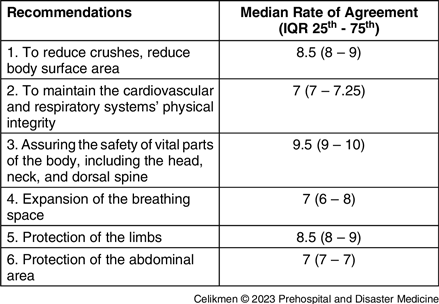
After the simulation in the second round, mannequin damage rates were examined by opening rubble pavement and tunnels. Mannequins placed under objects such as tables and desks, lying down and crouching (torso), were crushed in both buildings. In contrast, only a few mannequins with their legs and arms folded, reduced in size, and placed on their sides in the Fetal Position in the Triangle of Life suffered crushed leg parts after being thrown. By lying on its side next to household items that did not get destroyed even in the worst pancake demolitions and utilizing the gaps in between the horizontal floors of the buildings as structural elements, the Fetal Position in the Triangle of Life has been observed in many earthquake survivors and rescued victims. Mannequins compacted in these positions suffered the least damage. In comparisons between the Drop, Cover, and Hold On position and the Fetal Position in the Triangle of Life mannequins, collapsing structural elements caused less head and neck damage in the fetal position. For the height of the gap that increased survival chances in the fetal position lying on the side, a distance of 40-50cm, roughly equal to the height of the hip, may be sufficient. Drop, Cover, and Hold On requires a wider distance than this. Close to one meter, such a distance exceeds the thickness of many pancake debris columns and beam structures. These vertical and horizontal load-bearing elements provide horizontal inter-layer survival spaces. Using a ten-point Likert scale, the experts created items related to survival, and their agreement with each item was measured after the independent simulation observation (Table 4).
Analysis of Experts’ Recommendations on Earthquake Survival Factors based on a 10-Point Likert Scale

Third Round of Delphi
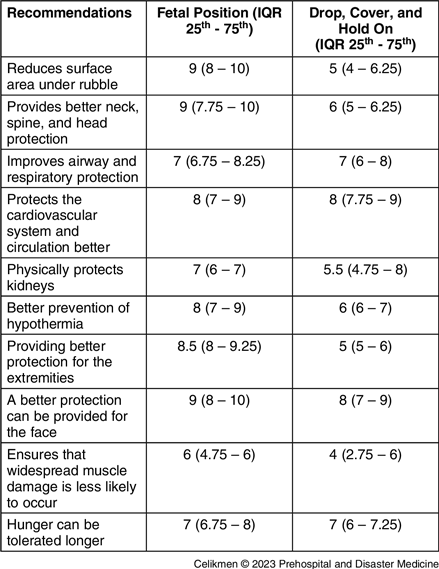
A comparison of the positions proposed in the first and second rounds, using a ten-point Likert scale, Table 5 shows the average expert rating for the comparison of the two positions in the first and second rounds. Cronbach Alpha for the scale is 0.96, indicating a high degree of reliability.
Experts’ Evaluation of Survival Chances in Different Positions of the Recommendations in the First Two Rounds, Using a 10-Point Likert Scale

Discussion
Taking immediate action can help reduce the deaths and morbidities caused by earthquakes, wars, landslides caused by deforestation, mine collapses, and avalanches. Reference de Bruycker, Greco and Annino15 Experts identified three major determinants of mortality among those trapped under rubble in this study: the individual’s location at the time of the earthquake, their position at the time of the earthquake, and their body surface area. When the literature is examined in terms of these three factors, studies are limited, and Drop, Cover, and Hold On is more prominent. 16
The United States, Japan, Chile, Turkey, India, Indonesia, Guatemala, Papua New Guinea, Guatemala, and China agree that Drop, Cover, and Hold On should be the standard response during an earthquake. 17 Research findings suggested that the life triangle approach was inaccurate and was especially influenced by social media. Reference Arlikatti, Huang, Yu and Hua18 It has been shown that earthquakes in rural areas of cities cause greater damage and higher mortality rates than earthquakes in urban areas. Reference Zhao, Zhou and Zhong19 It is evident that rural areas, despite being geographically similar, suffer from declining building quality and fatal consequences as a result. Reference Ellidokuz, Ucku, Aydin and Ellidokuz20 This is because a quality-built environment is vital to the safety and resilience of a settlement. Rural areas in developed countries experience this problem as well as in developing countries. Reference Kenny21
Different living conditions and building quality should raise the same question: Does the difference in building quality affect personal protection methods during earthquakes? A limited amount of research has been conducted on this topic. Observations after simulation studies and the experiences of medical search and rescue teams in Turkey and other countries after earthquakes indicate that pancake collapses are likely to occur, especially in countries with inadequate building stock. In the worst-case scenario, horizontal concrete slabs coincide with the head-neck-spine axis, which is the leading cause of death in earthquakes. Reference Liu and He22,Reference Igarashi, Matsumoto and Kubo23 The expert consensus in this study suggested that the Fetal Position in the Triangle of Life may be more protective against head and neck spine crushes and solid organ injuries than Drop, Cover, and Hold On, considering the post-earthquake rubble.
Another common cause of earthquake-related deaths is crush injuries. Reference Cabral, Edding, Portocarrero and Lerma24 Traffic accidents, earthquakes, landslides, mine collapses, avalanches, avalanche accidents, and virtually any situation where pressure is applied to part or all of the human body/extremities can cause crush injuries. Reference Anderson, Cole and Pannell25 In severe crush injuries, acute renal failure (AKF) can cause massive rhabdomyolysis, which can be fatal if medical attention isn’t provided immediately. Reference Lameire, Sever, Van Biesen and Vanholder26,Reference Porter and Greaves27
By minimizing the target, the most critical goal in preventing crush injuries is to increase the chance of survival and decrease the chance of injury. There is no doubt that being in a solid building on solid ground at the time of a major disaster such as an earthquake reduces mortality and morbidity. The expert experiences and simulations in this study suggested that the Fetal Position in the Triangle of Life next to an object that won’t be crushed is protective against crush injuries. Based on simulations and experiences, it is believed that injured patients will be able to protect their anatomical parts (extremities, abdominals, head, neck, abdomen, and thorax) in the Fetal Position in the Triangle of Life while maintaining their physiological functions and preventing them from being crushed.
In countries with high-quality and durable housing stock, earthquake protection measures focus on protecting people from damage due to falling objects during the shaking rather than from structural damage caused by collapsed buildings. In developing countries, on the other hand, earthquakes of the same severity and duration still cause death and disability because of crush injuries.
It is the intention of the relevant institutions in countries with solid building stocks, such as the United States and Japan, to create an action plan for earthquake-like disasters that includes measures like getting under a table so that objects may fall during a shaking event without injury, rather than protecting against crush injuries. 5–7
Human settlements with adequate security, high standards in terms of ground structure and building construction, in short, buildings that are “un-collapsible,” may employ this approach. A combination of simulation and search and rescue studies, however, have found that weak protective items, such as desks and tables, do not increase chances of survival against crush injuries or reduce injuries if the building collapses in multi-story buildings bearing tons of weight. On August 17, 1999, thousands of buildings were razed to the ground in Turkey, and nearly 20,000 people lost their lives as a result. Reference Işık, Büyüksaraç, Ekinci, Aydın and Harirchian28
Simulations of collapsed buildings show that Drop, Cover, and Hold On positions are unlikely to protect people in these buildings. When buildings with unstable construction stock collapse, they can only provide small survival spaces. Consequently, geological and structural differences between countries make similar protection methods in one country ineffective in another. Reference Guha-Sapir and Carballo29
During earthquakes and building collapses, the sudden causes of death occur directly from the compression of body parts between two hard surfaces, while the less-sudden causes of death result from the indirect effects of this compression on the organs. Utilizing the surviving space in the building correctly is the best way to avoid being crushed. When buildings collapse, cavities large enough to accommodate an intact human body form near large, bulky, and strong objects. In another collapsed building simulation conducted in Turkey, the mannequins between the beds were unharmed, while the mannequins under the beds were crushed. The mannequins above the beds could not be seen from inside the collapsed building. Reference Mahdavifar, Izadkhah and Heshmati30 Countries with weaker building stocks adopt the action plans of developed countries, which are based on the concept of “the building that won’t collapse” in earthquakes, without even discussing against what and why they should be implemented.
Nevertheless, when the history of the Drop, Cover, and Hold On proposal is examined, it becomes apparent that it was created by modifying the “Duck and Cover” proposal. As ionizing radiation, especially the highly penetrating gamma rays, can easily pass through glass, Duck and Cover is proposed to prevent people from being exposed to the radiation below the window height of 90cm to one meter in the building regulations. The Drop, Cover, and Hold On method has been proposed in response to many devastating disasters, particularly earthquakes, despite the limited number of studies in the literature. Reference Karam and Karam31–Reference Davis33
Few studies have compared Drop, Cover, and Hold On to Fetal Position in the Triangle of Life, but they are controversial and lack scientific evidence. Reference Akgüngör34 According to the study conducted in Iran to examine the benefits and limitations of Drop, Cover, and Hold On and the Triangle of Life recommendations, Iran and Turkey are similar when it comes to the size of the area affected by the risk and the socioeconomic situation. Depending on the distance from the epicenter of an earthquake, the study suggests that the population exposed to an earthquake can be divided into three groups, and recommendations vary based on the intensity of the earthquake and the structural characteristics of the earthquake. According to them, earthquake protection measures should be determined by knowing how many people are likely to be in which group during earthquakes. The authors conclude that Drop, Cover, and Hold On is the best self-protection strategy during earthquakes due to the large number of people in buildings that have been damaged but have not collapsed. Reference Mahdavifar, Izadkhah and Heshmati30 As people may not know about the epicenter during a disaster and may not be sure about the quality of their buildings, this approach can easily be viewed as incorrect. Furthermore, during the reporting period of this paper, the 7.7 and 7.6 magnitude earthquakes that occurred in Turkey on February 6, 2023, with the epicenter in Kahramanmaraş, affected ten provinces and had very destructive consequences. There are approximately 7,500 collapsed buildings across the country. It was reported that most of the buildings collapsed in a city located approximately 170 kilometers from the epicenter. As survival after an earthquake is a priority, preparing for the worst-case scenario is essential. Therefore, Fetal Position in the Triangle of Life would be more appropriate for a low-quality building.
It is impossible to predict when and in which season an earthquake will occur. People trapped under the rubble must, however, combat seasonal conditions in order to survive. Consequently, this study found that Fetal Position in the Triangle of Life is more beneficial than Drop, Cover, and Hold On since it is thought to reduce hypothermia and maintain body temperature better, especially during cold weather.
Limitations
This study’s data are based on a three-round Delphi technique and are limited to medical rescue experts who have worked in the earthquakes mentioned in the text. Their experience consists primarily of earthquakes in Turkey, although some of them have also worked voluntarily in international earthquakes.
Conclusion
According to this expert consensus, the Fetal Position in the Triangle of Life has the following advantages over Drop, Cover, and Hold On: reduced surface area, less crush injuries, protection of a larger body part from injury, better protection from hypothermia, and better maintenance of basal metabolism.
Conflicts of interest/disclaimer
The authors declare that there is no conflict of interest regarding the publication of this article. The views expressed in the submitted manuscript are those of the authors and not necessarily those of the institution or funder.
Author Contributions
MFC, SY, ACT, and FUC conceived the study and designed the trial. MFC and SY supervised the conduct of the trial and data collection. MFC, ACT, and SY undertook recruitment of participating centers and patients and managed the data, including quality control. MFC, FUC, ACT, and SY provided statistical advice on study design and analyzed the data; FUC and SY chaired the data oversight committee. MFC, FUC, SY, and ACT drafted the manuscript, and all authors contributed substantially to its revision. MFC, SY, ACT, and FUC take responsibility for the paper as a whole.