I. INTRODUCTION
In recent years, there has been a lot of interest in transition metal (TM)-silicides and - germanides due to their interesting electrical and magnetic properties and their potential applications in solid state electronic devices.Reference Chi, Lee, Chua, Lee, Ashok and Kwong1–Reference Zaima, Nakatsuka, Kondo, Sakashita, Sakai and Ogawa5 Even though the most Ge-rich phase in majority of the TM–Ge systems is TMGe2, the Ni–Ge system does not exhibit this phase under equilibrium conditions; the most Ge-rich phase is only NiGe.Reference Massalski, Okamoto, Subramanian and Kacprzak6 The Ni–Ge system contains β-Ni3Ge, Ni2Ge, ε′-Ni5Ge3, and NiGe phases under equilibrium conditions at room temperature. Three intermediate phases (δ-Ni5Ge2, ε-Ni5Ge3, and Ni3Ge2) also exist at elevated temperatures.Reference Massalski, Okamoto, Subramanian and Kacprzak6 These high-temperature nickel germanides could be synthesized at low temperatures using multilayer reactions.Reference Jensen, Ly and Johnson7
Some attempts have been made in the past to synthesize NiGe2 in a metastable condition at room temperature, but these efforts have not been completely successful. Starting from a stoichiometric mixture of Ni and Ge, Takizawa et al.Reference Takizawa, Uheda and Endo8 synthesized the NiGe2 phase by reacting the Ni and Ge powders at a high pressure of 5.5 GPa and a high temperature of 700 °C and quenching the sample to room temperature before releasing the applied pressure. Lim et al.Reference Lim, Chi, Lim, Wang, Chan, Osipowicz and Yeo9 sputtered 15 nm Ni layers on a Ge-on-Si substrate and subjected them to laser annealing and rapid thermal annealing. Using different characterization techniques, they observed Ge-rich NiGe2 phase coexisting with NiGe or Ge phases. By depositing alternate layers of Ni and Ge and allowing the reaction to take place between them, Ly et al.Reference Ly, Miller and Johnson10 reported the possible formation of a metastable cubic NiGe2 phase. But there have been no reports on the formation of homogeneous NiGe2 phase at low temperatures and under atmospheric pressure. We have been successful in the synthesis of NiGe2 at room temperature and at atmospheric pressure using the technique of mechanical alloying (MA). During these investigations, we have also observed a reversible transformation from NiGe (formed from blended elemental Ni and Ge powders by MA) to NiGe2 and then it reverts back to NiGe on continued milling, the subject matter of this study.
MA is a powder processing technique that involves repeated cold welding, fracturing, and rewelding of powder particles in a high-energy ball mill. Both stable and metastable phases have been produced by MA including supersaturated solid solutions, crystalline and quasicrystalline intermediate phases, amorphous alloys, and nanocomposites.Reference Suryanarayana11–Reference Suryanarayana and Al-Aqeeli13
II. EXPERIMENTAL PROCEDURE
Pure elemental powders of Ni and Ge (both of higher than 99.9% purity) were blended together corresponding to the nominal composition of Ni–66.7 at.% (71.26 wt%) Ge. 10 g of this powder blend, along with 100 g of hardened steel balls, were loaded into a stainless steel container, maintaining a ball-to-powder weight ratio of 10:1. About 2 wt% of stearic acid was added as a process control agent to minimize the agglomeration of powder particles between themselves and to the walls of the container. The weighing, blending, loading, and unloading of powders were conducted in an argon-filled glove box so as to minimize powder contamination. Milling was carried out in a high energy SPEX CertiPrep 8000D mixer mill (Metuchen, NJ) for a total of 75 h. The mill was stopped after every 2 h of milling to open the vials inside the glove box to scrape the accumulated powder from the vial walls and mix this with the remaining powder, and milling was resumed. This helped in minimizing the amount of the unmilled powder after completing the milling process.
The milled powders were collected periodically. The results obtained after milling the powder for 1, 5, 10, 60, 65, and 75 h are reported in this investigation when there were important changes in the structure, even though x-ray diffraction (XRD) patterns were recorded at several other times to follow the structural evolution in the milled powder. The milled powders were characterized for determining the nature of the phases produced by XRD using a Rigaku-DXR 3000 diffractometer (The Woodlands, TX) with Cu Kα radiation (λ = 0.15406 nm) at 40 kV and 35 mA settings. The XRD patterns were recorded in the 2θ range of 20° to 90°. The phases present were identified and their lattice parameters calculated using standard XRD procedures.Reference Cullity and Stock14,Reference Suryanarayana and Norton15 Identification of the phases was done by comparing the diffraction angles and intensities of the different diffraction peaks with the standard XRD patterns reported in the literature. Scanning electron microscopy (SEM) was conducted in a Zeiss Ultra 55 microscope (Thornwood, NY) to observe the microstructural changes using both secondary-electron and backscattered imaging modes. Energy dispersive x-ray spectroscopy (EDS) was used to evaluate the chemical compositions of the milled powders and correlate them with the XRD results. The average particle sizes in the SEM micrographs were determined using quantitative metallography methods. In this method, the linear dimensions of a large number of particles in different directions were measured and the average particle size was calculated by averaging out the total length over the number of particles.Reference Brandon and Kaplan16
III. RESULTS
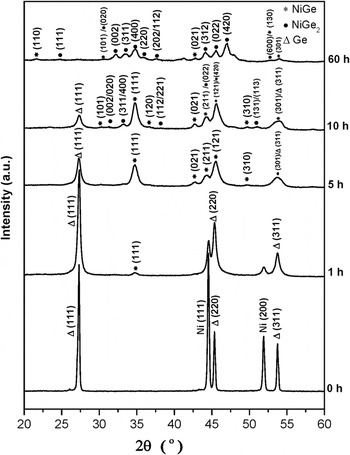
Figure 1 shows the XRD patterns of the Ni–Ge powder blend as a function of the milling time up to 60 h. The XRD pattern of the unmilled powder (0 h) shows the presence of both elemental Ni (ICDD-PDF # 4-0850) and Ge (ICDD-PDF #65-0333). On milling the powder blend for 1 h, diffraction peaks of both the elements showed broadening and a decrease in their intensities, a result of the reduced crystallite size and increased lattice strain introduced into the powder during milling. Simultaneously, the appearance of a new phase is suspected as evidenced by the presence of a low intensity peak at a 2θ value of about 34.8°. On milling the powder for 5 h, several additional peaks started appearing in the XRD pattern. By comparing the diffraction peak positions and their intensities, these new peaks have been identified as belonging to the NiGe (ICDD-PDF # 65-6716) phase with an orthorhombic crystal structure with the lattice parameters a = 0.5811 nm, b = 0.5381 nm, and c = 0.3428 nm and belonging to the space group Pbnm (No. 62). A number of the expected high intensity peaks from this phase have been found to be present in the XRD pattern of the powder milled for 5 h. For example, the most intense peak with a relative intensity of 100 has the Miller indices (111) and occurs at an angle of 2θ = 34.625° in the standard XRD pattern, whereas it is present at an angle of 2θ = 34.75° in the experimental XRD pattern. Other high intensity peaks such as from (121), (211), (021), and (301) were also detected at this stage of milling. However, it should be noted that since the amount of the NiGe phase is present only in small quantities, the absolute peak intensities are not very high. It is also to be noted that some amount of free Ge is present at this time of milling. The amount of the NiGe phase increased with increasing milling time as indicated by the increase in the number and intensity of the diffraction peaks, noting that the amount of elemental Ge decreased.
XRD patterns of the Ni–66.7 at.% Ge powder blend milled for different times. While the unmilled (0 h) powder blend shows only Ni and Ge, the powder milled for 1 h shows the initial stages of formation of the NiGe phase. The amount of the NiGe phase increased on continued milling up to 5 h, and at 10 h of milling, beginning of the formation of the metastable NiGe2 phase was noted. An almost homogeneous NiGe2 phase was noted on milling the powder blend for 60 h.

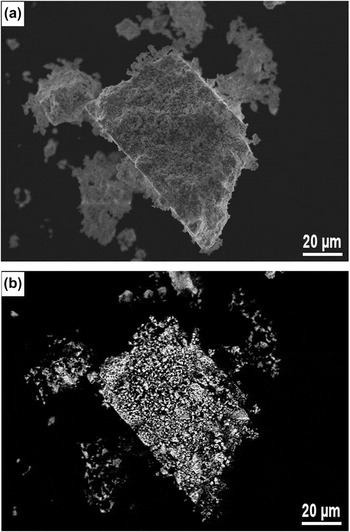
The fact that structural changes are occurring in the milled powder was also confirmed through SEM studies. Figure 2 shows the backscattered and secondary-electron images of the Ni–66.7 at.% Ge powder milled for 5 h. The secondary-electron micrograph [Fig. 2(a)] shows the general morphology of one large powder particle and it may be noted that there appears to be some internal structure. However, on observing the backscattered micrograph [Fig. 2(b)], which shows the atomic number contrast, it becomes clear that interdiffusion between Ni and Ge has taken place and that structural changes have occurred, resulting in the formation of the NiGe intermetallic. In the backscattered images, the phase with a high average atomic number appears brighter and the one with a lower atomic number appears darker. Accordingly, the heavier phase Ge appears brighter and the lighter phase NiGe appears darker as shown in Fig. 2(b).
Secondary-electron and backscattered images of the Ni–66.7 at.% Ge powder blend milled for 5 h. While the secondary-electron image (a) shows the general morphology of the large powder particle, the backscattered image (b) shows the atomic number contrast where the heavier phase (Ge) appears brighter and the lighter phase (NiGe) appears dark.

This situation continued up to 10 h, when new diffraction peaks started appearing; i.e., NiGe, Ge, and a new phase are present in the powder milled for 10 h. Reasonably intense peaks have been noted to be present at 2θ values of 33.1° and 50.8°. By comparison with the literature, it was noted that these additional diffraction peaks could be interpreted as belonging to the metastable NiGe2 phase (ICDD-PDF # 70-3928). These peak positions correspond to the (400/311) and (113/131) peaks of the NiGe2 phase, reported by Takizawa et al.Reference Takizawa, Uheda and Endo8 The most intense peak present in this phase has been reported to be (402/420) at an angle of 2θ = 45.96°. This peak, however, overlaps with the (121) peak of the NiGe phase which occurs at 2θ = 45.58°. Therefore, it is very reasonable to assume that the metastable NiGe2 phase is starting to form at this stage of milling. This metastable high-temperature and high-pressure phase exhibits an orthorhombic structure with the lattice parameters a = 1.0830 nm, b = 0.5763 nm, and c = 0.5762 nm and belonging to the space group Cmca (No. 64). The lattice parameters calculated from our patterns are the same as those reported by Takizawa et al.Reference Takizawa, Uheda and Endo8 A small quantity of the Ge phase is still present at this time. The amount of the NiGe2 phase formed in the powder increased with increasing milling time at the expense of the NiGe phase.
On milling the powder for 60 h, most of the diffraction peaks belonged to the NiGe2 phase. That is, an almost homogeneous phase had formed on milling the powder for 60 h. There is an important difference, however, in the structure of the NiGe2 phase formed at shorter milling times and at longer milling times. While the lattice parameters of the NiGe2 phase at shorter milling times are almost the same as those reported by Takizawa et al.,Reference Takizawa, Uheda and Endo8 those at longer milling times appear to be slightly different. By careful analysis of the diffraction patterns using analytical methods,Reference Suryanarayana and Norton15 the lattice parameters of the NiGe2 phase formed at 60 h have been calculated to be a = 1.0303 nm, b = 0.5829 nm, and c = 0.5402 nm. Although the real reasons for this are not clear, this could be due to the significant departure from equilibrium of the mechanically alloyed powders, caused by heavy deformation.
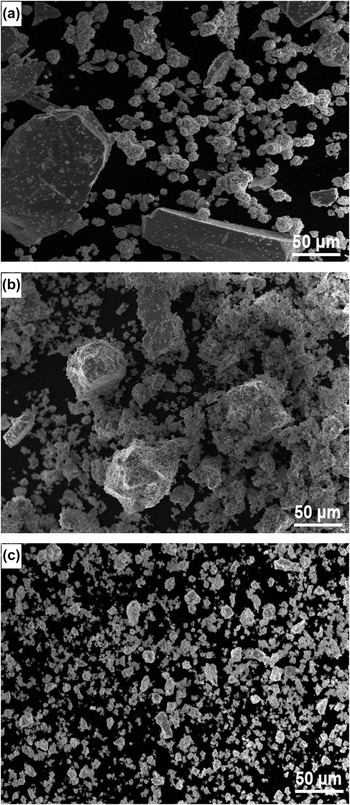
Figure 3 shows the SEM micrographs of the powder blend on milling for different times. Figure 3(a) shows the SEM micrograph of the unmilled powder wherein the Ni and Ge powder particles could be identified unambiguously. EDS analysis confirmed that the angular and bulky (about 80 μm in size) powder particles are Ge, whereas the relatively fine (about 6 μm) particles represent Ni. Interdiffusion between the powder particles and homogenization occurs during milling and Fig. 3(b) represents an SEM micrograph of the powder milled for 5 h, showing the presence of both NiGe and Ge phases. The sizes of the powder particles are about 50 μm for the NiGe phase and about 2 μm for the Ge particles. EDS analysis confirmed that the average chemical composition of the NiGe phase is 49 at.% (54.3 wt%) Ge. On further milling the powder to 60 h, the powder particles are of intermediate size, about 5–6 μm [Fig. 3(c)] and the chemical composition of these powder particles was determined by EDS to be very close to that of NiGe2, viz., 71.2 at.% Ge (75.5 wt% Ge), suggesting that the NiGe2 phase formed is perhaps slightly richer in Ge.
Scanning electron micrographs of the powder blend in the (a) as-blended (unmilled) condition showing elemental Ni and Ge powder particles, (b) formation of the NiGe phase at 5 h, and (c) after milling for 60 h, when an almost homogeneous NiGe2 phase had formed. Chemical analysis of the particles through EDS confirms these observations.

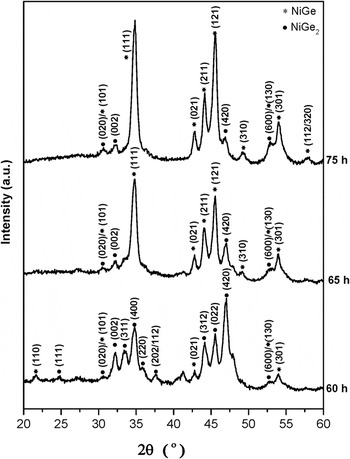
An interesting observation that was made during milling of the powder blend was the reversibility of the NiGe phase formation. Figure 4 shows the XRD patterns of the powders milled for 60, 65, and 75 h. While the powder milled for 60 h contained essentially the NiGe2 phase (even though a small amount of the NiGe phase is still present), the powder milled for 65 h and beyond contained both the NiGe2 and NiGe phases. That is, the amount of the NiGe phase started increasing with a concomitant decrease in the amount of the NiGe2 phase. This trend continued on milling the powder up to 75 h, when the amount of the NiGe phase is substantially higher than at 65 h of milling and this occurred at the expense of the NiGe2 phase. Thus, it appears that there is a reversal in the formation of the NiGe phase suggesting that NiGe starts to transform to the NiGe2 phase and then reverts back to the NiGe phase.
XRD patterns showing the reversibility of the formation of NiGe on milling the powders. Whereas an almost homogeneous NiGe2 phase was found to form on milling the powder blend for 60 h, continued milling to 65 h showed the re-formation of the NiGe phase. The amount of the NiGe phase continued to increase on milling to 75 h at the expense of the metastable NiGe2 phase.

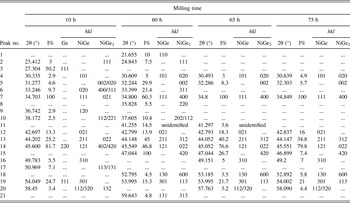
The reversibility of the transformation becomes clear from Table I where the diffraction peak positions and their intensities from the XRD patterns of powders milled for 10, 60, 65, and 75 h are presented. The intensities have been calculated using the JADE-7 software available with the XRD machine. For example, it may be noted that the intensities of some of the diffraction peaks from the NiGe phase are reasonably strong at 10 h of milling. These intensities then decrease up to 60 h of milling, and on subsequent milling their intensities again increase. This trend may be particularly noted for (111), (021), (310), (301), and (112) peaks. Similarly, the intensities of the diffraction peaks from the NiGe2 phase are noted to continuously decrease from 60 to 75 h of milling. For example, the (420) peak which has a relative intensity of 100 at 60 h, has only 26.7 at 65 h, and 7.4 at 75 h of milling. Similarly, the (002) peak which has a relative intensity of 29.9 at 60 h became weak with a relative intensity of 8.3 at 65 h and 5.7 at 75 h of milling. Further, the relatively weak reflections such as (112) and (313) observed at 60 h have completely disappeared at 75 h of milling. These trends clearly show that reversibility of the phase transformations is actually occurring.
Peak positions and their intensities of milled Ni–66.7 at.% Ge powder blends at milling times of 10, 60, 65, and 75 h.

IV. DISCUSSION
A. Changes in diffraction peak profiles
The technique of MA involves severe plastic deformation of the powder particles. This introduces a variety of crystalline defects including grain boundaries, dislocations, stacking faults, vacancies, and others. These defects lead to changes in the diffraction peak profiles resulting in decreased peak intensities and broadening of the diffraction peaks. Two major factors that contribute to these changes are the small crystallite sizes and lattice strain introduced into the powder due to the presence and accumulation of these defects. A consequence of these effects (peak broadening and decrease of peak intensities) is that relatively low intensity peaks may not be clearly seen. Additionally, if diffraction peaks from two different phases are very close to each other, it may not be possible to differentiate between them and identify the phases unambiguously, due to peak broadening and consequent overlapping of the peaks. This has been the bane of structure identification of milled powders through XRD methods.Reference Suryanarayana11,Reference Suryanarayana12 This difficulty is overcome when one attempts to identify the structure by noting the presence of the expected high intensity peaks in any phase. And, we have adopted this process in structure identification in this investigation.
B. Microstructural changes
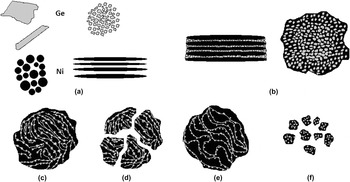
Figure 5 represents a schematic of the microstructural changes that take place during MA. During milling, the repeated collisions that occur between the powder particles and the grinding balls and the grinding vial result in severe plastic deformation of the powder particles. If the metal powders involved are soft, they get elongated and, due to convolution effects, lamellar structures consisting of alternate layers of the constituent metals are formed. On the other hand, brittle and hard particles get fragmented into smaller particles [Fig. 5(a)]. In the present case, however, Ge is relatively harder (and brittle), and therefore, it will not be possible to have a lamellar structure with the alternate layers of Ni and Ge. Instead, the hard Ge particles get dispersed along the lamellar boundaries of the soft Ni phase and/or get impregnated into the softer powder particles [Fig. 5(b)]. With continued milling, these lamellar structures of the softer metal with the hard metal particles along the interfaces get convoluted and the hard particles get slowly distributed uniformly [Fig. 5(c)]. Due to the continued milling beyond this stage, work hardening of the powder particles takes place and these get fragmented again into smaller particle sizes [Fig. 5(d)]. Since fresh surfaces are created at this stage due to fragmentation, these are very reactive and therefore agglomeration of powder particles takes place leading to the formation of larger particles [Fig. 5(e)]. These repeated fracturing and cold welding events during milling result in a particle size distribution such that there is a peak at an intermediate stage and in the final stages of milling, when steady-state conditions are obtained, very fine particles result [Fig. 5(f)]. The SEM micrographs presented in Fig. 3 confirm that the powder particle sizes follow the above trend.
Schematic showing the structural evolution in the Ni–Ge powder blend on MA. (a) The soft Ni particles get plastically deformed and form lamellar structures, while the brittle Ge particles get fragmented on milling. (b) The brittle Ge particles get impregnated into the soft particle surfaces or along lamellar boundaries. The images (c)–(e) show that agglomeration, fracturing, and rewelding of powder particles occur as milling continues. (f) The final stage of milling when fine alloy particles form with the same composition as the starting composition of the powder blend.

During milling, the powder particles get refined, a high density of crystalline defects such as dislocations, vacancies, and grain boundaries are introduced, and simultaneously, there is also a slight increase in powder temperature. All these effects lead to increased diffusivity and consequently alloying occurs.Reference Suryanarayana11,Reference Suryanarayana12 Therefore, it is not surprising that intermediate phases have formed during MA from blended elemental Ni and Ge powders.
C. Formation and stability of intermediate phases
The technique of MA is known to produce both stable and metastable intermediate phases in a number of alloy systems starting from blended elemental powder mixtures.Reference Suryanarayana11,Reference Suryanarayana12 Their formation can be easily rationalized in terms of the thermodynamic stabilities of the different possible phases. Therefore, it is not surprising that the equilibrium NiGe phase has formed during MA from blended elemental Ni and Ge powders. This NiGe phase reacts with the excess Ge that remained in the powder blend resulting in the formation of the metastable NiGe2 phase, according to the reaction:
 $${\rm{NiGe}} + {\rm{Ge}} \to {\rm{NiG}}{{\rm{e}}_2}\quad .$$
Some of the metastable phases that occur in mechanically alloyed powder mixtures are those that exist either at high temperatures in the corresponding phase diagrams or those that are stable at high pressures.Reference Suryanarayana11,Reference Suryanarayana12 The occurrence of these high-temperature and/or high-pressure phases in mechanically alloyed powders at near-room temperature and under atmospheric pressure is related to the increased diffusivity at relatively lower temperatures and surface energy effects. This occurs because the crystallite sizes are very small reaching nanometer dimensions, and it is known that diffusion occurs much faster in nanocrystalline materials.Reference Suryanarayana17 Additionally, the presence of short circuit diffusion paths such as grain boundaries and interfaces also contributes to enhanced diffusivity. Further, it has been suggested that, due to the intense pressures exerted on the powder particles by the grinding balls, very high pressures of the order of 6 GPa are generated during milling.Reference Maurice and Courtney18,Reference Davis, McDermott and Koch19
The powder particle sizes and the grain (crystallite) sizes of MA powders are very fine. Even though the particles are relatively coarse, with micrometer dimensions, each powder particle contains a number of crystallites, the size of which is typically of nanometer dimensions. Since the crystallite size is very small this leads to vastly increased surface (crystallite boundary) area. Consequently, the surface free energy of the powder particles is very high. Since the total free energy of the system ΔG is made up of two terms, ΔG v and ΔG s, where ΔG v is the volume free energy and ΔG s is the surface energy, and the surface free energy is significantly higher for the fine particles, the total free energy of the system under mechanically alloyed conditions gets significantly raised. This additional free energy raises the free energy of the equilibrium phase to a level higher than that of the metastable phase, and consequently the metastable phase gets preferentially stabilized. Further, it is easier to raise the internal energy of the intermediate phases through nonstoichiometry and possibility of disordering in these intermediate phases.Reference Sharma, Vaidyanathan and Suryanarayana20 Thus, the total free energy of the MA powders is made up of several factors and can be represented as:
 $$\Delta {G_{{\rm{Milled}}}} = \Delta {G_{\rm{v}}} + \Delta {G_{\rm{s}}} + \Delta {G_{{\rm{Defects}}}} + \Delta {G_{{\rm{Disorder}}}} + \Delta {G_{{\rm{Nonstoichiometry}}}}\quad .$$
The additional energy input into the system allows the metastable phases, which are otherwise unstable, to be stabilized at room temperature and at atmospheric pressure. It is also possible that the enthalpy of formation for the NiGe2 phase is not high and that is why under the nonequilibrium conditions of MA, this phase had formed.
The formation of a very large number of metastable phases has been reported in the literature on MA, including amorphous alloys.Reference Suryanarayana12,Reference Sharma, Vaidyanathan and Suryanarayana20,Reference Wang, Suryanarayana and An21 It is also repeatedly noted that even if the final phase obtained is a solid solution, the system forms intermediate phases in the early stages of milling.Reference Sharma, Vaidyanathan and Suryanarayana20,Reference Grigor’eva, Korchagin, Barinova, Ivanov and Boldyrev22 The reason for the formation of the intermediate phases is their lower energy (higher thermodynamic stability) in relation to the solid solution phases.
D. Reversible transformation
It may appear a little strange that a stable equilibrium phase transforms to a metastable phase on milling the powders further. But, it should be remembered that under the severe plastic deformation conditions experienced by the powders during MA, formation of, or transformation from equilibrium to, metastable phases is of common occurrence. Now let us understand why the equilibrium NiGe phase transformed to the metastable NiGe2 phase and then reverted back to the stable NiGe phase.
As explained above, the introduction of a variety of crystalline defects (plus disorder and nonstoichiometry) raises the free energy of the system above that of the equilibrium phase and so the metastable phase gets stabilized. A metastable phase can transform to the equilibrium phase by releasing the additional energy that is stored in it. This is possible, for example, by increasing the temperature, which provides the needed thermal activation energy for the transformation.
There have been some examples in the MA literature where a metastable phase transformed to the equilibrium phase on continued milling. For example, amorphous phases formed either by rapid solidification processingReference Trudeau, Schulz, Dussault and Van Neste23 or by MAReference Patil, Hong and Suryanarayana24,Reference Sharma and Suryanarayana25 have been shown to crystallize on milling the powder mixture, a phenomenon referred to as “mechanical crystallization”. This has been reported mostly in Fe-based alloys. Reversible amorphous–crystalline–amorphous transformations have also been reported in some Co–Ti alloy compositions.Reference Sherif El-Eskandarany, Aoki, Sumiyama and Suzuki26–Reference Sherif El-Eskandarany, Aoki, Sumiyama and Suzuki28 Even though the observation in the present investigation is not about crystallization of an amorphous alloy, but transformation from a metastable to a stable state, the transformation is similar because a metastable crystalline phase is transforming to the equilibrium crystalline phase just like a glass (metastable) is transforming into a crystalline (equilibrium) phase.
Transformation of a metastable crystalline phase to an equilibrium phase can involve transformation from (a) a high-temperature phase to a low-temperature phase or (b) a high-pressure phase to a low-pressure phase. The literature has many such examples. But, in the present case, we are dealing with a situation when a high-pressure and high-temperature phase is transforming to a stable phase, just by mechanical milling. A transformation of the above type requires that the pressure is released from the high-pressure phase and that the necessary thermal energy is provided to transform the high-temperature phase to the low-temperature phase.
Several reasons are possible for the transformation of a metastable phase to an equilibrium phase. Firstly, the equilibrium phase has a lower free energy than the metastable phase and therefore, the equilibrium phase is more stable. However, this transformation requires activation energy to be supplied, and consequently, the transformations take place only at elevated temperatures. But, in the present case, the transformation is taking place at near-room temperature.
During MA, the powder particles get fragmented and become smaller and smaller until the steady state condition is reached when the particle size remains virtually constant. Because fresh surfaces are constantly created during milling, the pressure experienced by the powder during milling could be released, resulting in the formation of the equilibrium phase.
But, a more interesting observation made in this investigation is the reversibility of the NiGe phase. As shown in Fig. 4, milling up to 60 h resulted in the formation of the metastable NiGe2 phase, and on further milling, the NiGe2 phase transformed back to the NiGe phase. Such a transformation is possible when we realize that NiGe2 is a metastable phase. Since this is a high-temperature high-pressure phase, it is also possible that the “stability” of this metastable phase at room temperature and at atmospheric pressure is not very high. Therefore, the phase transforms to the more stable equilibrium NiGe phase. A transformation from the metastable to stable phase requires provision of sufficient activation energy in terms of either pressure or temperature.
However, another and more plausible explanation is that the powder experiences high temperatures during milling because of the severity of deformation. But, in the present investigation, MA was conducted at room temperature and therefore it is not possible that the powder has experienced a high temperature. In fact, it has been clearly shown that the maximum temperature experienced by powders during MA is not more than about 200 °C,Reference Suryanarayana11,Reference Suryanarayana12 a temperature too low for the transformation to occur in the present investigation. It has been suggested earlierReference Suryanarayana11 that the energy supplied during MA can be considered as equivalent to an increase in temperature. Consequently, continued milling of the powder may be considered as subjecting it to high temperatures and this could be the reason why the metastable NiGe2 phase transformed to the NiGe phase. It is also possible that the activation energy for the transformation from NiGe2 to NiGe is not very high and therefore it has been relatively easy to go from the metastable to the equilibrium state.
As a final note, it should be realized that, under equilibrium conditions, the constitution of the Ni–66.7 at.% Ge powder should be a mixture of the NiGe and Ge phases. However, on milling the powder for 75 h, we have observed a mixture of the NiGe2 and NiGe phases and the presence of Ge was not noted. This suggests that the transformation from the metastable NiGe2 phase to stable phases has just started, but not completed. Accordingly, we observe only the NiGe phase but not Ge. Longer milling and/or high-temperature annealing of the milled powder will lead to complete equilibration.
V. CONCLUSIONS
MA of blended elemental powders of Ni and Ge in the ratio of 1:2 was carried out. In the early stages of milling (after 1 h of milling), the equilibrium NiGe phase had started to form with some Ge remaining without alloying. Subsequent milling led to the initial formation of the NiGe2 phase at 10 h and its amount increased with increasing milling time. This NiGe2 phase is metastable and the maximum amount of this phase had formed on milling the powder for 60 h. Most surprisingly, just by milling for a longer period of time, this metastable phase started to decompose to form the equilibrium NiGe phase, thus moving toward equilibrium. The possible reasons for the formation of the stable and metastable phases during milling, the process of equilibration, and the reversibility of the NiGe → NiGe2 → NiGe transformations have been explained on the basis of the thermodynamic stabilities of the different phases and the microstructural features of the milled powders.