I. INTRODUCTION
A tin whisker is a unidimensional material; a single-crystal wire of β-Sn. Typical whiskers are about 1–5 micrometers in diameter, and tens of micrometers to several millimeters in length. These whiskers were first observed to grow spontaneously from tin plating. As a scientific phenomenon, tin whiskers were first observed about 60 years ago.Reference Compton, Mendizza and Arnold1 Due to their high conductivity, tin whiskers can easily cause a short circuit in an electronic device, and so far there have been several catastrophic accidents due to whiskers.Reference Brusse, Ewell and Siplon2 Therefore, both scientists and engineers in industry have been greatly interested in the phenomenon of tin whisker growth. During the past 60 years, many growth mechanisms, such as the dislocation model,Reference Eshelby3 the recrystallization modelReference Ellis, Gibbons and Treuting4 and an oxide-crack modelReference Tu5 have been proposed to explain the growth of whiskers from tin plating. However, until now, none of the explanations have been universally accepted. In particular, the mechanism of tin whisker growth, as a solid-solid whisker growth phenomenon, has been a topic of considerable interest ever since the phenomenon was first found in 1951.
In the past, the tin whisker phenomenon was mainly reported to occur in tin plating.Reference Compton, Mendizza and Arnold1–Reference Tu5 But recently, whiskers were also observed on the surface of bulk tin-based solders doped with rare-earth elements (RE).Reference Jiang and Xian6, Reference Chuang, Lin and Chi7 It is interesting that, Jiang and Xian,Reference Jiang and Xian6 and Chuang et al.,Reference Chuang, Lin and Chi7 reported that whiskers only grew from Sn-RE intermetallic compounds (IMCs) in the solder, whereas no whiskers were found on the Sn matrix. To explain the phenomenon of spontaneous whisker growth from a bulk Sn-based solder, an oxidation reaction between Sn-RE IMC and oxygen in air was hypothesized.Reference Jiang and Xian6, Reference Chuang, Lin and Chi7 According to this explanation, the decomposition of the Sn-RE IMC by oxidation is the crucial step, by which nascent Sn atoms are released for the whisker growth.Reference Jiang and Xian6 However, in recent research, it was observed that the whisker growth rate from a Sn-RE IMC was sometimes so widely variable that it appeared to be dependent upon the weather on the day when the experiments were carried out. This implies that traces of water vapor in the air could have a significant part in the process of whisker growth. On the other hand, the effect of the humidity on tin whisker growth from the tin plating was reported by Oberndorff et al.,Reference Oberndoff, Ditte, Crema, Su and Yu8 Reynolds et al.Reference Reynolds, Osenbach, Henshall, Parker and Su9 and Osenbach et al.,Reference Osenbach, Reynolds, Henshall, Parker and Su10 who all showed that whisker growth on Sn plating can be accelerated by high humidity (HH). Based on this background, it is reasonable to consider the influence of the environment on the whisker growth on Sn-RE IMC.
II. EXPERIMENTAL METHOD
Solid samples of Sn3Nd IMC were prepared by tungsten inert gas (TIG) melting, in which the raw materials were pure tin (99.9% purity) and Nd of industrial purity. To prevent heavy oxidation of the rare-earth element in air, it was wrapped in a Sn sheet before melting. To obtain chemical uniformity, the samples were TIG-melted three times and then quenched on a copper block.
The as-cast alloy ingots were carefully mechanically polished with 600 and 3000 grit silicon carbide (SiC) papers. During this polishing, water contact was carefully avoided. Then the samples were stored in five different environments for comparing the whisker growth among them. The five environments were dry oxygen (DO), dry argon gas (DA), Silica-gel dry condition (SD), room ambient (RA; 30–56% RH), and high temperature (55 °C) high humidity (80% RH) condition (HH), respectively.
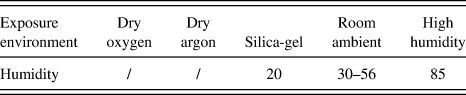
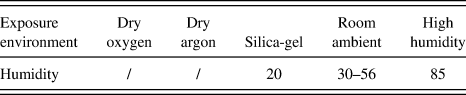
For the DO environment, the sample was put in a silica tube which was first pumped to 1 × 10⁻⁴ Pa vacuum, and then backfilled with dry pure oxygen at 0.21 atm. The silica tube was then sealed. For the DA environment, the schedule was the same except that the tube was backfilled with dry argon. A constant temperature water bath was used for the HH environment. And a sealed chamber containing silica gel was used for the SD environment. The humidity of each storage environment is listed in Table I. The weight changes of the samples were measured periodically after sample exposure to RA and HH, and the weight of the sample stored in SD was only measured twice. In the case of DA and DO, there was little weight change of the samples.
Humidity of the storage conditions (RH).
An optical microscope (OM) with a magnification of 400X was used to observe the incubation time for whisker growth for the different storage conditions. In situ observation of whisker growth was carried out under an OM and the growth progress was photographically recorded at a magnification of 1000X. The morphology of tin whisker growth on these specimens was also observed in a scanning electron microscopy (SEM) operating at a voltage of 20 keV.
Samples of the whiskers for TEM observation were obtained by vibrating the bulk sample. After the whiskers on the surface fell into a beaker with ethyl alcohol, they were collected for observation from the ethyl alcohol surface with a TEM copper grid. A TEM (Jeol-JEM-2010, Tokyo, Japan) wasused to observe the microstructure of the whiskers. X-ray diffraction (XRD) was used to determine the phase structure of the surface before and after whisker growth.
III. RESULTS
A. Effect of humidity
1. Surface color and weight change
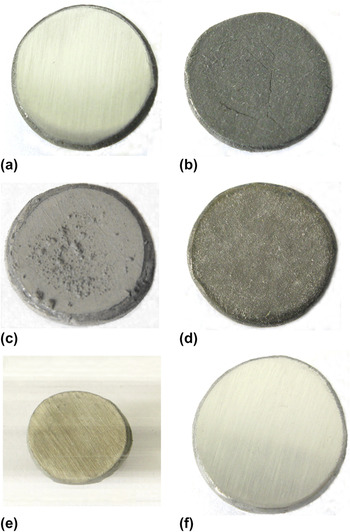
Figure 1 is a series of photographs showing the morphology change of the samples after exposure to the different environments. It is obvious that the color of the sample exposed to the high RH environments changed more quickly than the others. In particular, there is an obvious color change after the sample was stored in HH condition (55°C/85% RH) for only 3 h [Fig. 1(c)], which indicated that the reaction between the sample and some component of the air is intensive. There are several bulk cracks in the sample stored in RA condition for 7 days [Fig. 1(b)], which shows that there was high bulk expansion during exposure to this environment. As a comparison, there was only a slight color change of the sample stored in DA for 33 days [Fig. 1(e)]. It is interesting that the color of the sample stored in DO condition did not change at all, which disclosed that the reaction of the Sn3Nd sample with oxygen in the air was much weaker than that with water in the air. This is not consistent with the previous assumption of oxygen reaction.Reference Jiang and Xian6, Reference Chuang, Lin and Chi7 Moreover, after exposure to RA for several hours following SEM observation, DA and DO samples displayed a rapid color change, and whiskers grew on the surfaces, showing that water rather than oxygen in the RA environment is the significant component that reacts with Sn3Nd.
Color change of the Sn3Nd samples exposed in different environments (a) as friction; (b) in room ambience (30–52% RH) for 7 days; (c) 55 °C/85%RH for 3 h; (d) Silica-gel drying condition (20% RH) for 7 days; (e) dry argon environment for 33 days; (f) DO environment for 7 days.

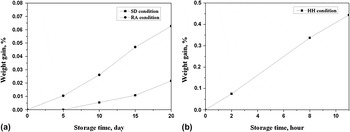
The weight gains of the samples during time exposed in different environments are shown in Fig. 2. After exposure to RA, SD and HH environments, the increase in weight of the samples was in linear proportion with the exposure time. It is obvious that the higher the RH, the greater the weight gain. This shows that the reaction rate between Sn3Nd and water in the exposure environment is dependent on the RH, whereas the reaction products between the Sn3Nd sample and water molecules in the air cannot be protective against further reaction.
Weight gain of the Sn3Nd samples exposed in different environment (a) SD condition and RA condition; (b) HH condition.

2. Incubation time
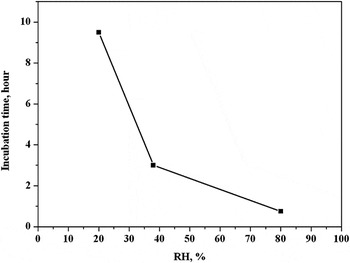
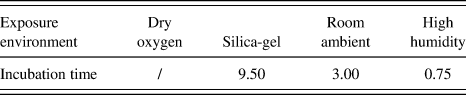
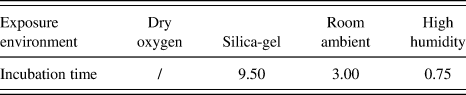
The whiskers grew out of the surface of the Sn3Nd IMC after the samples were stored in each environment. The incubation time was defined as the time when the first whisker was observed at a magnification of 400X. The practical incubation time was dependent on the observation method; therefore, the data under the same OM are comparable with each other. Table II shows the incubation times for the samples stored in the different environments, and these times reflect the trend of the whisker growth to some extent. The data in Table II disclose clearly that the incubation time increases with decreasing RH. As shown in Fig. 3, there was approximately a reciprocal relationship between the incubation time and the RH of the storage environment. It is obvious that there is a significant relationship between whisker incubation time and the humidity of the stored environment. In fact, whiskers were not observed, even in the SEM, on the sample that had been stored in DO condition, as shown in Sec. III A 3.
Relationship between the RH in exposure environment and the incubation time for whisker growth.

Incubation time of whisker growth from Sn3Nd IMCs in different storage conditions (h).
3. Influence of the exposure environment
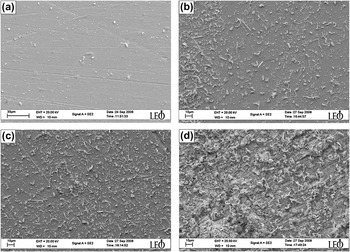
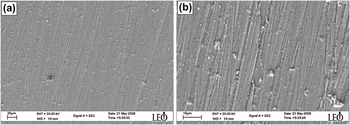
Figure 4 shows the SEM images of the whiskers on the Sn3Nd surface after storage in the different environments for one day. It is obvious that the whisker density increases with the RH. As shown in Fig. 4(a), there are only some small hillocks but no whiskers on the surface of the sample stored in DO condition. As a comparison, it was observed that the whiskers were dense, and there were many protrusions [as shown in Fig. 4(d)] on the surface of the sample stored in HH condition for only 11 h, which reflects a very active reaction in the HH environment.
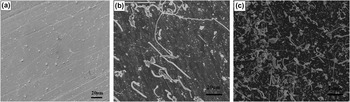
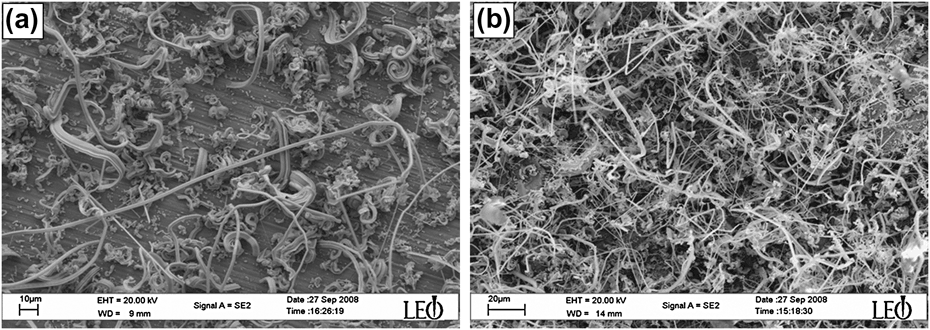
Figure 5 shows SEM images of the whiskers grown on the Sn3Nd surfaces after storage in the different environments for 7 days. As shown in Fig. 5, the whisker density of the sample exposed in RA condition [Fig. 5(c)] is much higher than that exposed in SD condition [Fig. 5(b)]. Interestingly, although the density of the whiskers on the sample exposed to the SD condition was far less than that for the RA condition, the whiskers of the SD sample were much longer than those on the RA sample. By way of comparison, except for some hillocks, whiskers were still not observed on the sample stored in DO conditions, even after 7 days [Fig. 5(a)].
SEM images of the whiskers on NdSn3 IMC surface exposed in different environments for one day (a) DO condition; (b) SD condition; (c) RA condition; (d) HH condition (only for 11 h).

SEM images of whiskers on NdSn3 IMC after exposed in different environment for 7 days (a) DO condition; (b) SD condition; (c) RA condition.

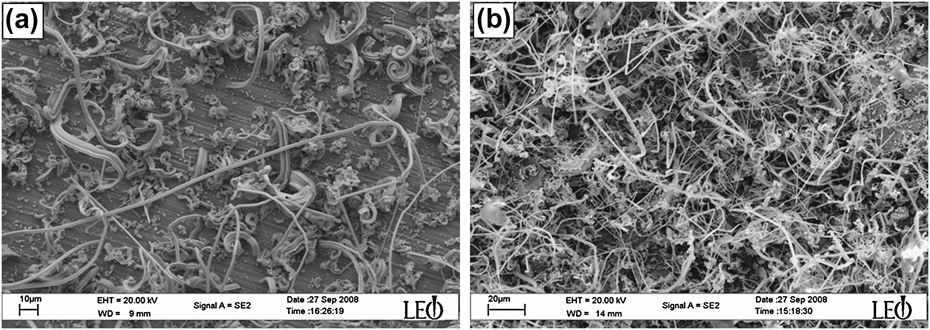
Figure 6 shows SEM images of whisker growth on the Sn3Nd surface after storage in the different environments for 22 days. It was observed again that the whiskers on the sample stored in SD condition were bigger but less numerous than those in RA condition. It is clear that whiskers had covered the entire surface of the sample stored under RA conditions for 22 days; there were many long, thin whiskers. On the other hand, as shown in Fig. 7, not one whisker was observed yet on the sample stored in DA conditions for 33 days.
SEM images of whiskers on NdSn3 IMC after exposed in different environment for 22 days (a) SD condition; (b) RA condition.
SEM images of surface of NdSn3 IMC sample after exposed in DA for 33 days.

As shown in Fig. 4(a), Fig. 5(a), and Fig. 7, some hillocks were observed on the surfaces of the samples stored in both the DO and DA condition, but none developed into a whisker after further storage in the environment. This shows again that the existence of water molecules in the storage environment is the most important factor controlling whisker growth.
4. Whisker growth on an as-cast surface
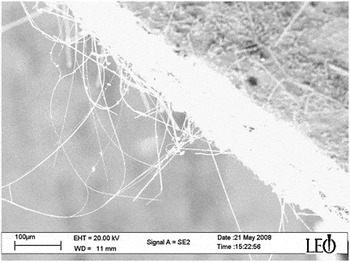
Figure 8 shows whiskers growth from the lateral surface of the sample stored in the SD condition for 22 days, this was an as-cast surface, not mechanically polished. Since the mechanical polishing could induce surface residual stresses, the relationship between whisker growth and mechanical polishing can sometimes be a controversial issue. However, the result shown in Fig. 8 clearly shows that whiskers can grow spontaneously on an as-cast surface, indicating that mechanical stress is not a necessary condition for whisker growth. Also, the thick oxide film on the as-cast surface did not prevent whisker growth. The whisker phenomenon on both polished and as-cast surfaces of Sn-RE IMC shows that spontaneous tin whisker growth is inevitable when Sn-RE IMCs are exposed in an environment containing water vapor.
SEM images of whiskers growing from lateral surface, which was in as-cast condition (not mechanically polished) after exposed in SD condition for 22 days.

B. Whisker morphology
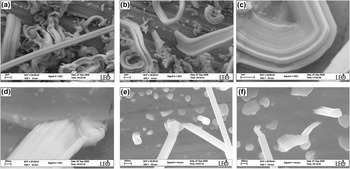
As shown in Figs. 4–6, there are mainly two kinds of whisker morphologies; one is thick, short and curved, the other is thin, long and straight. Figure 9 is a series of SEM images, which reveal the details of the whisker morphology. As seen in Fig. 9(a), when whiskers grew gradually from the Sn3Nd IMC, to start with, some hillocks formed, and then some of those developed into the whiskers. The whiskers looked like they had been squeezed out of the substrate, and clear longitudinal striations could often be observed on the surface of a whisker. When the whisker is curved, the longitudinal striations are also curved, as shown in Fig. 9(c), which implies that the longitudinal striations had developed during the whisker growth process. After exposure to the SD environment for 22 days, the diameter of the thin, long whiskers was about 2 micrometer, whereas that of the thick, short ones was about 6 micrometer. As shown in Fig. 9(d), there were also many thin, short whiskers on the surface of the sample. There were some cracks near the root of the whiskers, as shown in Fig. 9(b), and one of the whisker looked like it had been extruded from a crack. The crack phenomenon shows that a bulk expansion accompanied the whisker growth when the sample was exposed to the SD environment.
The whisker morphology after exposure to different environments (a) SD condition for 22 days; (b) SD condition for 22 days; (c) SD condition for 1 day; (d) SD condition for 1 day; (e) RA condition for 1 day; (f) RA condition for 1 day.

C. In situ observation of whisker growth
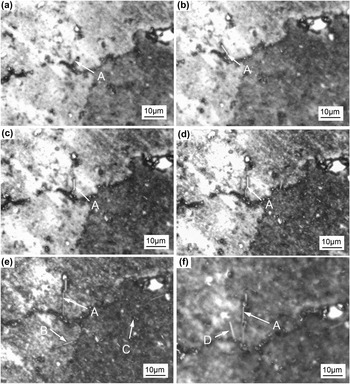
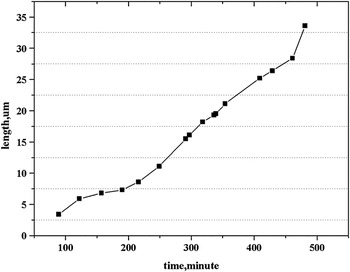
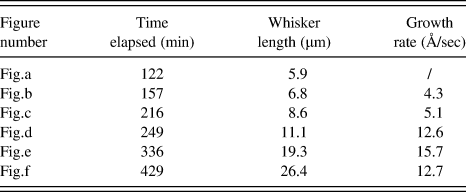
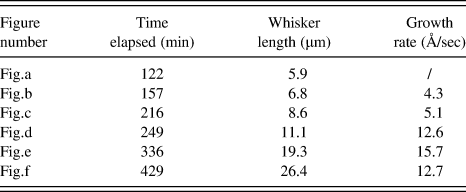
Figure 10 is a series of images showing the continuous growth of a whisker selected from the hundreds of whiskers (marked A) during in situ optical microscopy (OM) observation. Whisker A was first observed after exposure to RA (24 °C, 47% RH) conditions for only 122 min [Fig. 10(a)]. The growth rate of the whisker was not constant; i.e., the whisker grew at different speeds during different periods. The measured results from the in situ observations including the whisker length and elapsed time are listed in Table III. Figure 11 shows the practical growth rate of the whisker in different phases, by which it was calculated that the lowest growth rate of the whisker was 4.3 Å/s, and the highest one was 15.7 Å/s, respectively. The average growth rate of the whisker was 11 Å/s. This growth rate is about 2–3 orders of magnitude higher than typical growth rate of whiskers reported previously (0.01–0.1 Å/s). It is worth noting that each whisker nucleated and grew at a different time (marked B, C, D in Fig. 10), and the growth rate of each whisker was also different from the others.
In situ observation of a tin whisker by OM under RA condition (24 °C/47% RH) (a) 122 min; (b) 157 min; (c) 216 min; (d) 249 min; (e) 336 min; (f) 429 min.

The growth rate of a tin whisker by OM in situ observation in RA condition.

In situ observation of a whisker growth (as shown in Fig. 10).
D. TEM observation
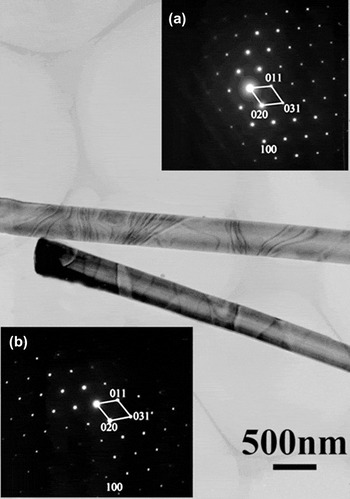
Figure 12 is a bright-field (BF) image, and the inset is the corresponding selected-area electron diffraction (SAED) pattern of the whiskers grown on the Sn3Nd IMC under RA conditions. The zonal axis of the two SAED was [100]. The SAED pattern shows that the whisker was a single crystal, and the crystal structure was β-Sn, which has a body-center tetragonal structure. There are many interference stripes in the BF image, presumably due to microstrains during whisker growth.Reference Liu and Xian11
TEM image of the whiskers grown on NdSn3 IMC.

E. XRD analysis
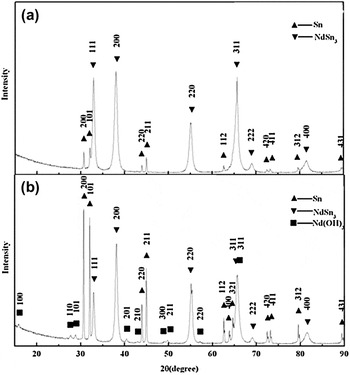
Figure 13 shows XRD patterns for the surface of the Sn3Nd IMC alloy before and after exposure to the whisker growth environment. From the XRD results, it is interesting to note that, after whiskers had grown out of the surface, a new phase, Nd(OH)3 formed from exposure to the environment. This phenomenon implies that there is an important relationship between the whisker growth and the chemical reaction between the Sn3Nd and water in the environment. This reaction product, Nd(OH)3 is not consistent with previous results, in which the reaction product was reported as the RE oxide.Reference Jiang and Xian6, Reference Chuang, Lin and Chi7 It should be noted that these earlier results were mainly from energy-dispersive spectroscopy (EDS) or electron probe micro analyzer (EPMA) analyses, using which light elements such as hydrogen cannot be detected. As will be discussed in Sec. IV, the presence of this Nd(OH)3 confirms that water vapor is the most significant factor in the mechanism of whisker growth from the Sn3Nd IMC.
XRD result of the surface of the NdSn3 IMC samples before and after exposure to RA (a) as-polished, (b) 1 day after exposed in RA.

IV. DISCUSSION
A. Chemical reaction
The phenomenon of whisker growth on the surface of solders doped with RE has been widely researched.Reference Jain, Chen and Lai12–Reference Chuang, Lin and Chi19 In most of these studies, tin whiskers grew on the Sn-RE IMC in the solders. And in previous studiesReference Xian and Liu20, Reference Jiang and Xian21 it was reported that whiskers could grow on bulk Sn3Nd IMC when exposed to the RA environment. Dudek and ChawlaReference Dudek and Chawla16 proposed that the phenomenon of whisker growth is caused by the following two oxidation processes:


They assumed that a large volume expansion takes place with the formation of the RE oxide. Because of the restraint by the solder substrate, a high local compressive stress resulting from the volume expansion arises in the Sn-RE IMC phase. It is this local compressive stress that could be the driving force for whisker growth. This process, then, is the oxidation mechanism for the whisker phenomenon on Sn-RE IMCs.
However, the present results shown above make it clear that, when the bulk Sn3Nd was exposed to DO for a long time, whiskers did not form (Figs. 4 and 5), implying that the oxidation mechanism was not operative. On the other hand, when the Sn3Nd sample was exposed to a humid environment for even a short time, whiskers formed quickly, showing that the humidity of the storage environment is the key factor influencing whisker growth from the Sn3Nd IMC. The reaction between Sn3Nd IMC and water molecules in air can be expressed as follows:

As Fig. 13 shows, Nd(OH)3, was an easily detected reaction product, that does form after whisker growth from Sn3Nd, proving the existence of reaction (3).
It is an interesting question then: why is the presence of water necessary for whisker growth from the Sn3Nd IMC? In other words, why does whisker growth proceed according to Reaction (3) rather than Reactions (1) or (2)? There are two important differences between Reaction (3) and the Reaction (1) or (2).
First, the RE reaction products are different. In reaction (3), the RE reaction product is a RE hydroxide, Nd(OH)3; whereas in reaction (1) and (2), they are RE oxides; RE2O3 or REO2. As shown in Fig. 2, the weight gain of the Sn3Nd increased linearly with the exposure time in both the RA and HH environments, which implies that the reaction product, Nd(OH)3 is not a protective film for the succeeding reaction. In other words, the water molecules can easily diffuse through the Nd(OH)3. In fact, it is well known that some of the hydroxides of strong alkali metals, such as NaOH, can absorb moisture under ambient conditions, which means that the hydroxides can capture the water molecules in that case. Therefore, as a result, Reaction (3) will be reaction-controlled rather than the diffusion-controlled, and Reaction (3) will proceed linearly and rapidly. Interestingly, Liszkowski et al.,Reference Liszkowski, Turek, Figiel and Gajerski22 reported recently that Nd oxide could absorb water molecules in ambient air to form Nd(OH)3, while Nd(OH)3 has a large number of structural defects, explaining why Reaction (3) is rapid. As the reaction is rapid, it will release a large amount of Sn andhydrogen atoms, leaving the Sn atoms free to form the whiskers. On the other hand, the RE oxides, RE2O3 or REO2, are assumed to be protective and stable films in DO at room temperature. Once an oxide film forms, oxygen molecules in the environment must diffuse and pass through the oxide film to react with the Sn-RE IMC under the oxide film. In this case, the reaction will be diffusion-controlled, making the reaction rate (oxide film growth rate) decrease with the thickness of the oxide film. As a result, the rate of Reaction (1) or (2) would be slow, and not supply an abundant resource of released Sn atoms, as a result, whiskers could hardly form at all.
Second,hydrogen atoms are a reaction product of Reaction (3), but no hydrogen is generated by Reaction (1) or (2). It is not yet clear how the hydrogen atoms would be involved in whisker formation and growth. It may be assumed, however, that thehydrogen atoms can be temporarily adsorbed on the nascently generated Sn atoms, thus preventing the oxidation of the Sn by the oxygen in the ambient air, and keeping the released Sn atoms nascent and active. This latter effect is important in the mechanism of whisker growth. On the other hand, if the oxygen atoms were first absorbed by the released Sn atoms, because of the strong interaction between oxygen and metals, these atoms would be devitalized by the chemical adsorption. As a result, the driving force for whisker growth will be lost. Based on the above reasoning, it can be understood why corrosion in a HH environment, which also releases hydrogen, can enhance the whisker growth on Sn plating.Reference Osenbach, Reynolds, Henshall, Parker and Su10
B. Driving force of whisker growth
What is the driving force for whisker growth? It has been an interesting question for a long time. Although the whisker phenomenon has been studied for more than half a century, the true identity of the driving force for whisker growth is still unclear. In the case of tin plating, most of the viewpointsReference Tu5, Reference Fisher, Darken and Carroll23–Reference Xu, Zhang, Fan, Abys, Hopkins and Stevie26 state that the local compressive stress in the tin plating is the driving force for whisker growth. In the case of solders doped with rare earth metals, the reason for whisker growth was still assumed to be the compressive stress. The stress was hypothesized to have been generated by the volume expansion resulting from the oxidation of the Sn-RE IMC, which was estimated as about 15% by Dudek and Chawla.Reference Dudek and Chawla16 However, rapid tin whiskers growth was recently observed on an Sn3Nd powder after exposure to ambient conditions, and this observation implies that whisker could also form without compressive stress.Reference Shi and Xian27
Considering Reaction (3), when 1 mol of Sn3Nd is decomposed, the reaction products will be 1 mol of Nd(OH)3 and 3 mol of Sn. When the Sn atoms are released from the Sn3Nd IMC, they are nascent and individual. According to thermodynamics, individual atoms (without assemblage) have a high chemical potential (energy), and so are unstable. They will tend to be attracted to any nearby atoms or to crystallize to decrease their chemical potential and to reach a stable state. As a result, the mechanism of whisker formation can be understood to be a process of energy decrease. In this case, the driving force for whisker growth should come from the chemical potential difference between the released nascent Sn atoms (with a high energy state) and the Sn crystal (with a low energy state).
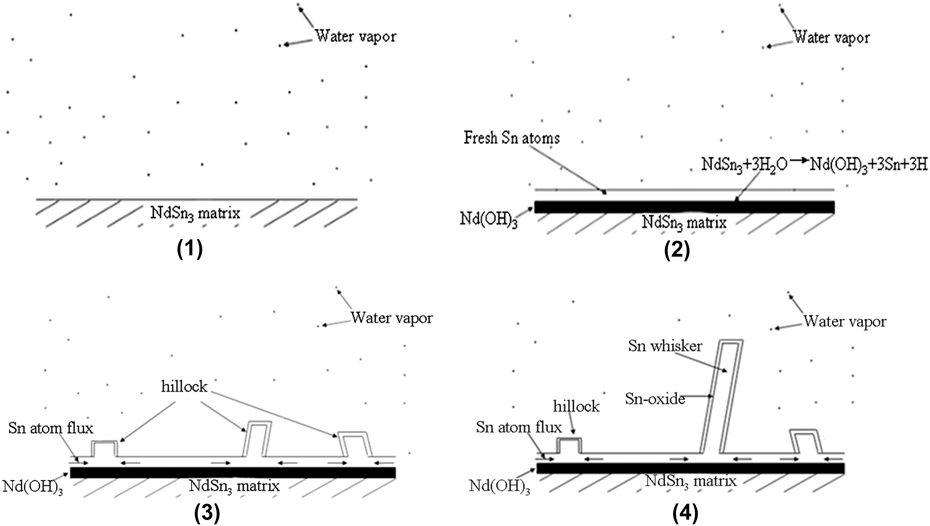
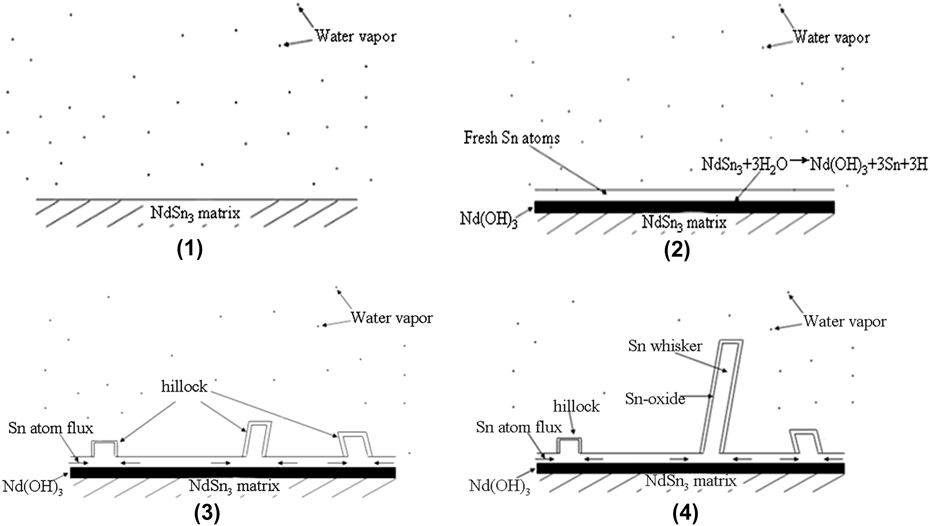
The process of whisker growth from the Sn3Nd IMC is shown in the Fig. 14. When the Sn3Nd IMC is exposed to humid air, the water molecules in the environment are adsorbed by the Sn3Nd IMC, then Reaction (3) takes place, the products being Nd hydroxide, Nd(OH)3, and Sn atoms. The Nd(OH)3 adsorbs and stores water molecules to react continuously with the Sn3Nd IMC, bringing more nascent and free Sn atoms which gradually accumulate on the surface of the Nd(OH)3. Because of the high chemical potential of the nascent and free Sn atoms, the nucleation of the β-Sn crystal will take place to decrease the energy of the individual Sn atoms, then, first, hillocks (small surface eruptions), as the precursor for whiskers, arise on the surface. When a hillock forms, the crystal surface of the hillocks can supply a position with a low energy to other individual Sn atoms, which would attract more Sn around it to crystallize; looking like an attractive force applied to the nascent tin atoms and directing them toward to the whisker. A concentration gradient of the free Sn atoms between the whisker (as a sink) and the released Sn atoms (as a resource) could be set up, which supply further Sn atoms migrations to the low energy site. The crucial reason for the transition from the hillocks to wire-like whiskers is still unclear. Perhaps the anisotropy of the crystal lattice of β-Sn (a body-center tetragonal structure) could be the causative factor of the wire-like growth.Reference Shi and Xian27
A schematic of tin whisker growth from NdSn3 IMC exposure to the environment with trace water (1) water molecules in the environment are absorbed by Sn3Nd IMCs; (2) reaction between Sn3Nd and H2O, the products include Nd(OH)3, nascent Sn atoms and hydrogen atoms; (3) Because of the high chemical potential of the nascent Sn atoms, the hillocks form to decrease the energy of the individual Sn atoms; (4) Because of the anisotropy of the crystal growth for the β-Sn, whiskers continuously grow as following the reaction.
The driving force to move a Sn atom to the whisker can be estimated as follows:

Here F in Eq. (4) is the apparent force on the diffusive Sn atom, whose direction toward the whisker; Δμ is the chemical potential difference between the individual released Sn atoms and the Sn crystal: The crystalline reaction is


where μcrystal and μfree are the chemical potential of the Sn crystal (i.e., whisker) and the individual, free Sn atoms, respectively. In Eq. (4), Δx is the distance between the individual Sn atom and the whisker.
The values of the parameters in Eq. (4) are estimated as follows. If the crystal growth process by the solid atoms can be analogized as solidification, a process to transform the random atoms into the ordered arrangement also, the chemical potential difference Δμ can be approximately estimated as the heat of fusion for tin, Δμ = 7.03 kJ/molReference Iida and Guthrie28; and Δx is estimated as a reasonable distance between the Sn atom and the whisker, Δx =1*10−6 m.Reference Tu5 Substituting the data in Eq. (4), the apparent force on the diffusable Sn atom is estimated at about F = 1.2*10−14 N, that is 0.012 pN (pico-Newton).
Under the driving force, the average velocity, V, of the Sn atom toward to the whisker root can be expressed as:

Where B is the mobility, in the case of self-diffusion, there is a simple relationship between the mobility B and the diffusivity:

where k is the Boltzmann constant, k = 1.38 × 10⁻²³ Nm/K, T is the Kelvin (absolute) temperature at diffusion (T = 300K); and D is the self-diffusivity of Sn, which can be estimated as 1 × 10⁻¹² m2/s at room temperature.Reference Tu5 Substituting the data, the average rate of motion of the Sn atom will be V = 2.9*10−6 m/s; that is 2.9 μm/s. This is a relatively high rate of motion for the diffusing Sn atoms. Based on this calculation, the growth rate of the whiskers should be primarily dependent upon the rate of generation of nascent tin atoms in the vicinity of a whisker. The higher the RH in the exposed environment is, the faster the hydroxide reaction is, the more the nascent Sn atoms form, and, as a result, the stronger the trend of the whisker growth. Therefore, in the case of a relatively humid environment such as RH, it can be readily understood why whiskers were easy to initiate and grow at a high rate, as shown in Fig. 11.
V. CONCLUSIONS
Tin whisker growth from the Sn3Nd IMC was studied by exposing it to a series of environments with different relative humidities. The results show that the tendency for whisker growth is very strong only in relatively humid environments, for which short incubation times and a rapid growth rates were observed. The shortest incubation time for whisker growth was only 0.75 h after exposure to the HH condition (80% RH); and the average growth rate was up to 11 Å/s after exposure to the RA condition (30–56% RH). By way of comparison, no tin whiskers at all formed on the surface of the Sn3Nd IMC after exposure to the dry argon-protective atmosphere (DA) for 33 days, and no whiskers formed in the DO in 7 days, either. Therefore, the existence of water in the exposure environment is the necessary condition for the phenomenon of the whisker growth from Sn3Nd IMC. The higher the relative humidity (RH) in the environment is, the stronger the tendency for whisker formation and growth will be.
The continuous growth behavior of the whisker was in situ observed by OM. The results showed that the growth rate of a whisker was not constant. In the beginning, the growth rate is relatively low, about 4.3 Å/s for the initial 3–4 h, followed by a higher growth rate of more than 12 Å/s. TEM observation showed that the whisker was β–Sn single-crystal, in which there are the interference bands in the bright field image of the whisker, and they could be caused by the growth stress. The XRD analysis before and after whisker growth showed that a new reaction product, Neodymium hydroxide, Nd(OH)3, formed after exposure of the Sn3Nd IMC to the RA condition for one day.
It is suggested that the chemical potential difference between the nascent, free Sn atoms and the whisker Sn crystal is the driving force for whisker growth. By a qualitative estimate, the Sn atoms under the action of the driving force can rapidly move to the whisker; therefore, the growth rate of the whiskers should be mainly dependent upon the rate of production of nascent tin atoms around a whisker by the reaction between Sn3Nd and the water in the environment. The higher the humidity in the exposure environment is, the faster the hydroxide reaction is, the more nascent Sn atoms form, as a result, the stronger the trend to the whisker growth will be.
ACKNOWLEDGMENTS
This work was supported by the National Nature Science Foundation of China (Grant Nos. 50871119). The authors would like to thank Mr. Z. T. Mao for the preparation of Sn3Nd IMC alloy; and Mr. Chen C. for his help in SEM observation; and Dr. W. Warke for the English improvement of the paper.