Practical application: The results of this study recommend that the proposed antenna-based sensor with novel configuration can be used for industrial purposes as it is having a relatively less complex procedure for determining the extent of adulteration in solid food materials with high accuracy.
Introduction
One of the basic needs for every living being is food which is composed of carbohydrates, water, fats, and proteins; which are consumed by humans for nutritional purpose. In this present era, food adulteration has become a serious threat for the society especially in developing countries as people are opting unfair means to earn profit [Reference Bansal, Singh, Mangal, Mangal and Kumar1, Reference Awasthi, Jain, Das and Alam2]. Food adulteration is defined as the process in which the quality of food material is degraded either by adding material with inferior quality, by extracting valuable ingredient, or by adding low-cost materials [Reference Mohammad, Chowdhury, Biswas, Absar, Grumezescu and Holban3, Reference Choudhary, Gupta, Hameed and Choton4]. In addition to this, various products are naturally contaminated due to aging, industrial inventions, and during natural calamities, which not only degrade the quality of food materials but have dangerous effects on different living beings and natural vegetation [Reference Ades, Henry and Feldstein5].
Since birth every citizen is entitled to consume wholesome food, so it is requisite to track adulterated food products before consuming it. However, it is impossible to check the quality of food materials to ensure its nutritive value only on the basis of visual inspection, especially when adulterant resembles the base product [Reference Ayza and Belete6, Reference Alauddin7]. There are certain properties of the material that are associated with each raw material, especially electric properties like dielectric permittivity that could be examined to check the adulteration in food samples to assure its quality [Reference Alahnomi, Hamid, Zakaria, Sutikno, Azuan and Bahar8, Reference Weng, Chen, Cheng and Chen9]. When two materials possessing different values of permittivity are mixed together then it results into third effective permittivity whose value lies in between the two parental values, from which some sight of adulteration can be traced [Reference Zajicek and Vrba10]. The microwave sensors have the ability to sense the permittivity variations which results in the change of electromagnetic field distribution upon interaction with materials having different dielectric properties [Reference Javed, Arif and Zubair11]. In addition, microwave technology provides non-destructive and non-invasive environment for material testing [Reference Posudin, Peiris and Kays12, Reference Ansari, Jha and Akhtar13]. Hence, microwave characterization techniques have found a wide range of applications in the field of health, agriculture, and food industries [Reference Jain, Mishra, Thakare and Mishra14–Reference Rajendran, Menon and Donelli16].
There are a number of microwave techniques, among which the resonant methods are considered to be more reliable and accurate, since these methods involve the testing of a material at single or discrete frequencies [Reference Kunte and Gaikwad17, Reference Tiwari, Singh, Mondal and Akhtar18]. The devices engaged for the characterization purpose of the materials are referred as sensors, as they have the ability to sense the change in material properties on the bases of variation in sensor response such as resonant frequency, reflection coefficient, quality factor, etc. [Reference Nitika, Jaswinder and Khanna19]. There are a number of resonant sensors that are available in the literature; the planar technology is more attractive in the current scenario because of its compact size, low cost, and less performance time with easy data interpretation [Reference Alahnomi, Zakaria, Yussof, Althuwayb, Alhegazi, Alsariera and Rahman20]. The propagation of electromagnetic field determines the dielectric properties to reveal the parameters of food object using microwave sensor are mainly through three measurement modes: reflection, transmission, and resonation [Reference Romera, Herraiz-Martínez, Martinez-Martinez and Gil21, Reference Muhammed Shafi KT22].
Nowadays, various microwave sensor technologies are merchandized for detecting sugar, salinity, moisture content, humidity, etc. For instance, a microstrip patch antenna proposed for measuring salt and salinity in water has been reported in literature review [Reference Rahman, Islam and Samsuzzaman23]. A waveguide probe and reflection method was introduced to measure complex permittivity of a phantom of biological muscle tissue [Reference Zajıcek, Smejkal, Oppl and Vrba24]. Further for determining the moisture in oil palm fruits, a waveguide technique has been proposed [Reference Abbas, Hashim, Mokhtar and Aziz25]. For humidity sensing, a polymer-loaded ultrawide band RF identification sensor has been introduced [Reference Manzari, Occhiuzzi, Nawale and Catini26]. Apart from these, many antenna sensors have been designed for air quality monitoring, medical checkup, food analysis, etc. [Reference Hichmen, Ghodbane, Amir, Zidane, Hamouda and Rouane27–Reference Kumari, Patel and Yadav29]. However, all these methods are considered to be time-consuming with some complex procedure and complicated data interpretation, which require skilled operators to handle and use these microstrip-based antenna sensors. Therefore, for food evaluation, novel, miniaturized, and cost-effective planar resonant RF sensor with improved sensitivity and considerable quality factor (Q-factor) is required for adulteration detection which can potentially be used as a substitute against existing fiber optic and chemical-based methods [Reference Meng, Wu and Gray30, Reference Kulkarni and Joshi31].
In this article, a miniaturized slot-loaded microstrip line-fed antenna-based sensor is deployed for detecting adulteration in some common spices such as red chilli powder adulterated with brick powder, black pepper powder adulterated with papaya seeds, and turmeric powder adulterated with artificial yellow color. The detection of adulteration is observed against the variation in reflection coefficient magnitude and shift in resonant frequency depending upon the amount of adulterant that is mixed with the pure sample which is further represented in graphical form to show the linear variation. At last, to focus on associated merits of the chosen sensor, the performance parameters of proposed antenna sensor are compared with the earlier work presented in the literature. It is recognized that the proposed microstrip antenna sensor has high sensitivity with good quality factor compared to other available sensors. Further, a small value of standard deviation gives resolution high enough to distinguish adulteration with an acceptable statistical accuracy.
Materials and methods
Design and characterization of proposed antenna-based sensor
Step-by-step evolution of proposed design
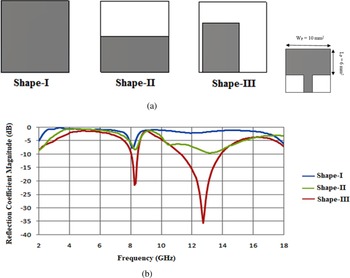
The step-by-step evolution of the layout of antenna sensor design to achieve desired result is represented in this section. The simulation and parametric optimization of the proposed antenna sensor is carried out using time domain solver in three-dimensional simulation software i.e. Computer Simulation Technology Microwave Studio (CST MWS). Three shapes of ground plane are taken into account, shape-1 is the full ground plane structure considered as an initial shape, and then for obtaining the desired results, the shape of the ground plane structure is optimized as presented in shape-II and shape-III. The plot for reflection coefficient magnitude versus resonant frequency is represented in Fig. 1(b) considering the radiating patch having dimensions 6 × 10 mm2.
(a) Geometrical layout for different ground plane structures. (b) Reflection coefficient magnitude corresponding to different ground plane structures.

Shape-I has an overall dimension of 10 × 10 mm2, shape-II represents a partial ground plane having size 5 × 10 mm2, and shape-III shows an asymmetric ground plane with size 7 × 5.5 mm2. These structures show different values of reflection coefficients as illustrated in Fig. 1 out of which shape-III shows the most considerable value of reflection coefficient magnitude; therefore, it is chosen for designing the proposed antenna.
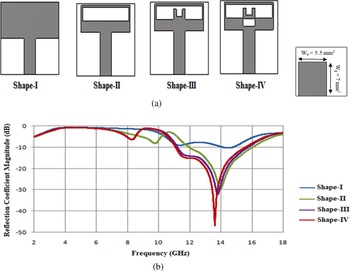
Similarly, in Figs 2(a) and 2(b) four different shapes for the radiating patch are considered to optimize patch structure for obtaining desired results. The plot for reflection coefficient magnitude versus resonant frequency is represented in Fig. 2(b) considering the final optimized ground plane structure having dimensions 7 × 5.5 mm2.
(a) Geometrical layout for different radiating patch structures. (b) Reflection coefficient magnitude corresponding to different radiating patch structures.

Shape-I represents the full radiating patch having an overall size 5 × 10 mm2, shape-II to shape-IV represent the different shapes of modified radiating patch with various slots etched into the patch. The reflection coefficient magnitude graph for each shape is shown in Fig. 2(b). The reflection coefficient magnitude graph for shape-IV shows the maximum negative value for reflection coefficient magnitude among all other shapes, thus shape-IV is considered as the final shape of radiating patch for the proposed antenna prototype.
Fabrication of proposed antenna sensor
The top and bottom views of the proposed antenna sensor are shown in Fig. 3. The proposed antenna is designed for 50 Ω matching employing FR-4 substrate with thickness = 1.56 mm, relative permittivity (ε r) = 4.4, and loss tangent (δ) = 0.0025 with an overall size of 10 × 10 mm2. The position and size of the feedline are optimized to obtain considerably better frequency shift to measure the sensitivity, Q-factor, and accuracy of the antenna. The overall dimensions of substrate, ground plane, radiating patch, and feedline are indicated as Ls × Ws, Lg × Wg, Lp × Wp, and Lf × Wf respectively. The various slots in the radiating patch are symbolized as S 1, S 2, and S 3. Table 1 represents the values for various geometrical parameters of proposed microstripline-fed antenna sensor.
Geometrical layout of slot-loaded proposed antenna sensor in CST Microwave Studio. (a) Top view. (b) Bottom view.

Geometrical parameters of the proposed microstripline-fed antenna sensor

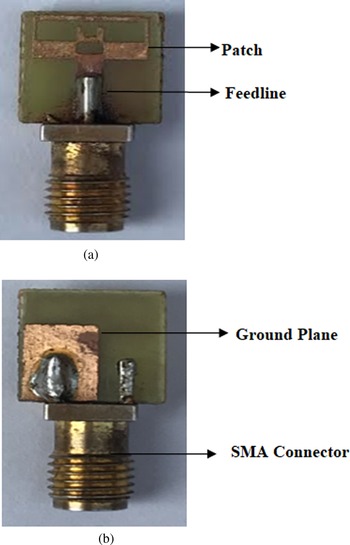
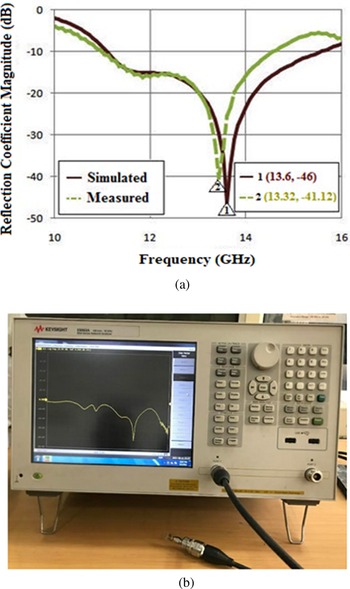
For the fabrication of proposed antenna sensor, photolithography technique is used, which is based on wet etching method. Wet etching is used to remove unwanted region by immersing the substrate in liquid solution. The top and bottom views of the fabricated sensor with three-hole SMA connector are shown in Fig. 4. The simulated results cover the frequency band from 11.07 to 15.55 GHz with resonant frequency at 13.6 GHz and reflection coefficient magnitude at −46 dB. Further, the measured results show the bandwidth from 11.04 to 14.56 GHz having resonant frequency at 13.32 GHz and reflection coefficient magnitude at −41.12 dB. The experimental results are measured using an Agilent E5071C Vector Network Analyzer (VNA) which shows good agreement with the simulated results indicating good wideband impedance matching with reflection coefficient magnitude under −10 dB. The slightest variation in measured response is due to minor fabrication errors and variation in permittivity of the substrate with frequency. Figure 5 shows the comparison graph of simulated and measured response for reflection coefficient magnitude and photograph of measurement procedure for reflection coefficient magnitude using Agilent E5071C VNA.
Photograph of fabricated slot-loaded microstrip line-fed antenna sensor with three-hole SMA connector. (a) Top view. (b) Bottom view.

(a) Simulated and measured response of reflection coefficient magnitude. (b) Reflection coefficient magnitude measurement using Agilent E5071C VNA.

The measurement procedure was carried out at Antenna Research Laboratory in Electronics and Communication Engineering Department, Thapar Institute of Engineering and Technology, Patiala, Punjab, India. Further the comparison graphs were plotted using Microsoft Excel 2007.
Gain, efficiency, and current density of proposed antenna sensor
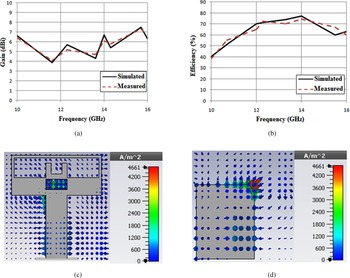
The measured gain and efficiency of the proposed antenna-based sensor given by VNA are compared with the simulated gain and efficiency given by CST software as illustrated in Figs 6(a) and 6(b). The measured results show a peak gain of 7.58 dBi and an efficiency of 77%, whereas the simulated results show a peak gain of 7.49 dBi and an efficiency of 74%. A close agreement between simulated and measured results is obtained w.r.t. gain and efficiency which proves that the proposed antenna-based senor is performing accurately. Further, to determine the electromagnetic radiation pattern, current density distribution for the top and bottom view of the proposed antenna-based sensor at 13.32 GHz is analyzed as shown in Figs 6(c) and 6(d). These results show that the slots in the patch and other parameters of the ground plane and feedline are solely liable for bandwidth enhancement and overall appreciable performance of radiation characteristics of the proposed antenna-based sensor.
(a) Comparison graph for simulated and measured gain. (b) Comparison graph for simulated and measured efficiency. (c) Simulated current density on radiating patch. (d) Simulated current density on ground plane of the proposed antenna-based sensor.

Sensitivity, Q-factor, and accuracy of proposed antenna sensor
The proposed sensor significantly shows the high sensitivity of 280 MHz as a frequency function. In order to compute the sensitivity of the proposed antenna sensor as a function of frequency, shift in resonant frequency (Δf) of the input reflection coefficient magnitude is measured w.r.t. the simulated and measured results of the proposed antenna sensor. Here the simulated and measured results are considered under unloaded conditions i.e. when we are not testing any samples.
The quality factor for the proposed antenna-based sensor is calculated as 409. Based on the resonant frequency and bandwidth of the resonator the Q-factor of the antenna can be calculated as: [Reference Azaryan, Batouritski, Budagov, Demyanov, Karpovich, Liubetski, Maximov, Rodionova and Shirkov32]

where fr is the resonant frequency and BW is the bandwidth of the resonator.
Further, higher sensitivity gives greater accuracy in measurement as a small change in real part of the permittivity can be measured easily. The proposed antenna-based sensor shows 98% accuracy, which proves that the proposed sensor could be utilized for food adulteration-detecting application.
The proposed antenna-based sensor for solid food evaluation
In this section, the capability of the proposed antenna-based sensor is checked for solid food evaluation. Firstly raw spices, i.e. red chilli powder, black pepper powder, and turmeric powder, were considered as pure sample. Two grams (0.002 kg) each of pure sample were measured with weighing machine and are kept on top of the antenna-based sensor for about 2 min. It is found that the process becomes stable at approximately 2 min after keeping the sample on the radiating patch. The reflection coefficient magnitude for pure samples of spices is measured using VNA; the average of five readings is taken from the large set of experiments that were observed for about 20 times. This same procedure is opted for each pure sample of spices after a gap of 10 min. After this, a binary mixture is prepared by adding different adulterants with pure samples for analyzing different cases: (i) red chilli powder adulterated with brick powder; (ii) black pepper powder adulterated with papaya seeds powder; and (iii) turmeric powder with artificial yellow color. The mixture is prepared by weight which is measured using a weighing machine; all samples of equal weight are then separately tested and reflection coefficient magnitude response with respect to frequency shift for each case is measured using VNA and represented in graphical form. The average of five values for each adulterated spice sample was taken that was observed up to 20 times. All the measurements were taken at room temperature (25°C), and after each measurement, the sensor was washed with water and wiped with tissue paper. Finally, a comparison graph was plotted from the results obtained for unadulterated sample and adulterated sample mixture at different adulteration levels. The phenomenon associated with resonant frequency shift is dielectric perturbation and change in reflection coefficient magnitude is due to the solid's response to electromagnetic radiation, which depends upon the properties of material, temperature, and chemical composition.
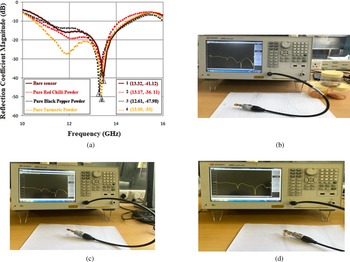
The measured reflection coefficient magnitude graph with respect to resonant frequency for all pure spice samples is plotted in Fig. 7(a) and photographs depicting the measurements with samples loaded on the surface of the proposed antenna sensor are shown in Figs 7(b) and 7(c). Figure 7(a) represents that the proposed sensor loaded with a pure sample of red chilli powder, black pepper powder, and turmeric powder resonates at 13.17, 12.61, and 13.09 GHz with reflection coefficient magnitude at −36.11, −47.98, and −50 dB respectively, whereas the unloaded sensor resonates at 13.32 GHz with −41.12 reflection coefficient.
(a) Measured reflection coefficient magnitude response for the proposed sensor loaded with all pure samples of red chilli, black pepper, and turmeric powder. (b, c) Experimental setup during measurement with samples loaded on the surface of the proposed antenna sensor.

Sensitivity and dielectric permittivity analysis
The experimental results of the proposed antenna-based sensor w.r.t. pure spice samples (red chilli, black pepper, and turmeric powder) show considerably good sensitivity and measured dielectric permittivity values are illustrated in Table 2. As the proposed antenna sensor has good accuracy, it can detect even a small change in the dielectric permittivity of different materials. As shown in Fig. 8, the antenna sensor is examined for different permittivity values w.r.t. resonant frequency, the relationship between the resonant frequency and different values of dielectric permittivity illustrates that as the value of dielectric permittivity increases, resonant frequency decreases and vice versa. Thus this proves that the proposed antenna sensor is a valid tool for detecting adulteration in food materials having different dielectric permittivity values. The mathematical expression for measured dielectric permittivity of tested samples is obtained as: [Reference Alhegazi, Zakaria, Shairi, Sutikno, Alahnomi and Abu-Khadrah33]

Relationship between resonant frequency and dielectric permittivity.

Measured values of sensitivity and dielectric permittivity for the proposed antenna-based sensor w.r.t. resonant frequency and reflection coefficient

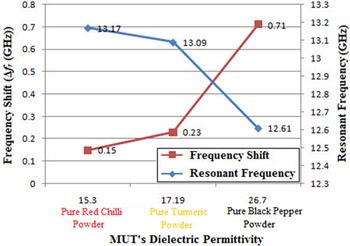
Figure 9 shows the relationship between the resonant frequency and measured dielectric permittivity. This graph depicts that as the resonant frequency increases, the dielectric permittivity of the pure spice samples decreases depending upon material properties.
Relationship between frequency shift, resonant frequency, and measured dielectric permittivity of pure spice samples (red chilli, black pepper, and turmeric powder).

Estimation of adulteration
For estimating the adulteration, testing on pure samples is carried out to check the accuracy and sensitivity of the proposed antenna sensor.
Therefore, various adulterants such as brick powder, papaya seeds powder, and artificial yellow color are mixed with a pure sample of red chilli, black pepper, and turmeric powder separately. The change in reflection coefficient magnitude and resonant frequency is observed on mixing the adulterant into the pure sample and this change occurs according to the level of adulterant added to the pure samples [Reference Chakraborty and Biswas34]. Further, the sensitivity performance of the proposed antenna sensor as a function of frequency is measured w.r.t. shift in resonant frequency (Δf (MHz)) of the input reflection coefficient magnitude as 150, 710, and 230 MHz for red chilli, black pepper, and turmeric powder respectively using the formula:

where fru is the resonant frequency of the proposed antenna sensor for unloaded condition and frl is the resonant frequency of the proposed antenna sensor for loaded condition.
In this section, the limit of detection (LOD) was estimated for various adulterants added to pure spice's samples as illustrated in Table 3. For this study, three different binary mixtures were prepared with different quantities of adulterants to check adulteration at various levels. Pure spices were considered as reference sample to analyze the adulteration procedure.
LOD in different spice samples

Case (i): red chilli powder adulterated with brick powder
Red chilli powder is one of the most common spices used in Indian kitchen for enhancing the color of the dish and also used as a tempering spice. However, red chilli is usually adulterated with brick powder to add weight and bright red color to it; hence, it is very dangerous to health if consumed on regular basis. For this case study, four different samples were prepared by mixing brick powder with red chilli powder in different concentrations of adulterant. Keeping the total weight 0.2 g, binary mixtures were prepared, starting with 0.2 g considered as a pure red chilli sample and 0 g brick powder (adulterant), then gradually adding 0.05 g brick powder to 0.15 g pure red chilli powder, so that the total weight remains 0.2 g. At last 0.2 g of brick powder is considered as a pure adulterated sample with 0 g red chilli powder (unadulterated) mixed in it. Table 4 represents the experimental data of red chilli powder adulterated with brick powder.
Experimental data of MUT

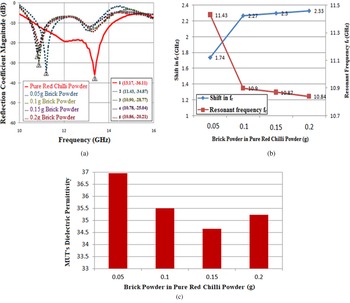
Figure 10(a) shows the reflection coefficient magnitude with respect to resonant frequency for pure red chilli powder when mixed with brick powder at different levels of adulteration. The reflection coefficient magnitude for pure red chilli which is considered as a reference sample is −36.11 dB at 13.17 GHz resonant frequency, whereas the reflection coefficient magnitude for brick powder when 0.05, 0.1, 0.15, and 0.2 g mixed with pure sample is −34.87, −28.77, −25.04, and −20.21 dB resonating at 11.43, 10.90, 10.78, and 10.86 GHz respectively. This graph illustrates that as the level of adulteration increases the corresponding reflection coefficient magnitude decreases due to change in dielectric properties of the material which further results in shift of resonant frequencies. Figure 10(b) shows the relationship between shift in frequency and resonant frequency (fr) at different levels of adulteration in pure red chilli powder. Further, Fig. 10(c) represents the measured dielectric permittivity of the MUT i.e. brick powder in pure red chilli powder corresponding to the amount of adulterant in pure sample.
(a) Measured reflection coefficient magnitude with respect to resonant frequency for pure red chilli powder adulterated with brick powder at different levels of adulteration. (b) Relationship between shift in frequency and resonant frequency (fr) at different levels of adulteration in pure red chilli powder. (c) Measured dielectric permittivity of the MUT corresponding to the amount of the adulterant in pure sample.

Case (ii): black pepper powder adulterated with papaya seeds powder
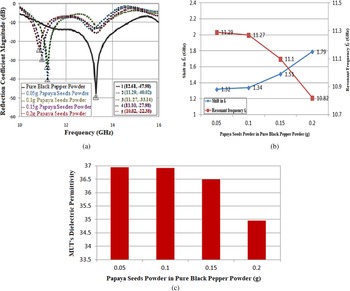
Black pepper powder is usually adulterated with papaya seeds powder to add bulk to the material. In this section, four different adulteration levels were prepared from 0.05 to −0.2 g by mixing papaya seeds powder in pure black pepper powder, considering 0.2 g of papaya seeds as a pure adulterated sample with 0 g black paper powder. As the concentration of adulterant increases the dielectric permittivity of the MUT changes, which results in change of reflection coefficient magnitude and resonant frequency. Table 5 represents the experimental data of black pepper powder adulterated with papaya seeds powder.
Experimental data of MUT

These changes are illustrated in Fig. 11(a) w.r.t. pure black pepper powder which is considered as a reference sample. The reflection coefficient magnitude for pure black pepper powder is −47.98 dB with resonant frequency at 12.61, whereas the reflection coefficient magnitude for papaya seeds powder mixed with pure black pepper powder is −40.02, −33.14, −27.98, and −22.38 dB for 0.05, 0.1, 0.15, and 0.2 g quality of adulterant having a resonant frequency at 11.29, 11.27, 11.10, and 10.82 GHz respectively. As the level of adulteration increases in the pure sample, reflection coefficient magnitude decreases with shift in resonant frequency owing to change in dielectric permittivity of the mixture. Further, Fig. 11(b) shows the relationship between shift in frequency and resonant frequency (fr) when pure sample is adulterated with different levels of adulteration. Further, Fig. 11(c) represents the measured dielectric permittivity of the MUT, i.e. black pepper powder adulterated with papaya seeds powder corresponding to the amount of adulterant in pure sample.
(a) Measured reflection coefficient magnitude with respect to resonant frequency for pure black pepper powder adulterated with papaya seeds powder at different levels of adulteration. (b) Relationship between shift in resonant frequency and resonant frequency (fr) at different levels of adulteration in pure black pepper powder. (c) Measured dielectric permittivity of the MUT corresponding to the amount of the adulterant in pure sample.

Case (iii): turmeric powder adulterated with artificial yellow color
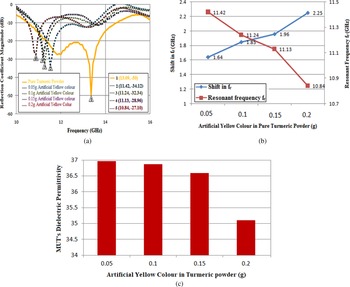
Turmeric is a yellow-colored spice with many health benefits; however, it is adulterated with artificial yellow color to increase the amount of turmeric powder. Similar procedure is chosen here to study the adulteration in turmeric powder, with different volumes of artificial yellow color mixed with pure sample. Figure 12(a) shows the variation in reflection coefficient magnitude and shift in resonant frequency w.r.t. different adulteration levels in pure sample where 0.2 g is considered as an adulterated sample with no amount of pure turmeric powder added to it. Pure turmeric powder is considered as a reference sample, having reflection coefficient magnitude −50 dB and resonant frequency 13.09 GHz. Table 6 represents the experimental data of black pepper powder adulterated with papaya seeds powder.
(a) Measured reflection coefficient magnitude with respect to resonant frequency for pure turmeric powder adulterated with artificial yellow powder at different levels of adulteration. (b) Relationship between shift in frequency and resonant frequency (fr) at different levels of adulteration in pure turmeric powder. (c) Measured dielectric permittivity of the MUT corresponding to the amount of the adulterant in pure sample.

Experimental data of MUT

The reflection coefficient magnitude for adulterated sample at 0.05, 0.1, 0.15, and 0.2 g is −34.12, −32.34, −28.96, and −27.10 dB having resonant frequency at 11.42, 11.24, 11.13, and 10.84 GHz respectively. Figure 12(b) shows the relationship between shift in frequency and resonant frequency (fr) when pure sample is adulterated with different levels of adulteration. These results illustrate that as the concentration of adulterant increases in the pure sample, reflection coefficient magnitude decreases with shift in resonant frequency which is due to the change in dielectric properties of the MUT. Further, Fig. 12(c) represents the measured dielectric permittivity of the MUT, i.e. turmeric powder adulterated with artificial yellow color corresponding to the amount of adulterant in pure sample.
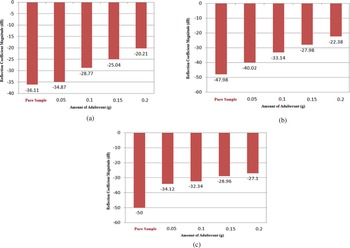
Figure 13 depicts the variation in reflection coefficient magnitude for various pure spice samples with different adulterants at different adulteration levels.
Variation in reflection coefficient magnitude at 0.05, 0.1, 0.15, and 0.2 g amount of adulterant for (a) red chilli powder adulterated with brick powder, (b) black pepper powder adulterated with papaya seeds powder, (c) turmeric powder adulterated with artificial yellow color.

Results and discussion
The methodology instigated for this work is based on the interaction of electromagnetic field owing to shift in resonant frequency and change in reflection coefficient magnitude as a function of dielectric permittivity of the sample which supports the detection of adulteration in food materials. All the above experimental results illustrate that the composition of the solution changes as well as the degree of saturation, when the level of adulteration increases which results in change of dielectric properties of the binary mixture, whose effect can be observed in the variation of reflection coefficient magnitude and in resonant frequency shift. The variability of the reflection coefficient magnitude at different levels of adulteration depends upon the dielectric permittivity of the material, which increases or decreases depending upon the type of adulterant and its concentration level in the mixture. For instance, the dielectric permittivity of the mixture decreases with an increase in the percentage of adulteration in the pure sample; as a result, reflection coefficient magnitude also decreases and vice versa. Figure 13 depicts the variation in reflection coefficient magnitude for all pure samples that are adulterated with different adulterants at 0.05, 0.1, 0.15, and 0.2 g amount of adulteration.
It is observed from the aforementioned results that as the level of adulteration increases the dielectric permittivity of the material decreases which results in a decrease of reflection coefficient magnitude w.r.t. shift in resonant frequency.
The validation data of reproducibility for some common spice's adulteration are illustrated in Table 7. Other figures of merits for the proposed slot-loaded microstrip line-fed antenna-based sensor, such as LOD, sensitivity, accuracy, and Q-factor, prove it to be a valid tool for detecting adulteration in solid food without deteriorating the quality of the food. Further, it gives high coefficient of determination (R 2 > 0.343) which is used to predict dielectric permittivity of the MUT and has standard deviation less than the difference between unadulterated and adulterated values, giving resolution high enough to distinguish adulteration with an acceptable statistical accuracy. Moreover, it does not require any harmful chemicals or expensive equipment, thus reducing its complexity and making it a cost-effective device for monitoring food quality. A single sensor is used for performing experiments from January 2022 to February 2021. All the experimental results obtained after a number of trails were plotted in graphs herein. The results start to degrade as the number of trails increases; this may be due to some material sticking to the radiating patch. However, if we calibrate the sensor carefully, wash and wipe it properly after each experiment, this will not affect the measurement. Further, it is observed that this sensor is sustainable for about 1000 trails, after that the pattern on the substrate starts to peel off and become faded that degrades the performance of the sensor. The shelf life of this antenna-based sensor is approximately more than 1 year.
Reproducibility data for some common adulterants in spices

Few things that are appreciable about the proposed sensor owing to its high sensitivity and Q-factor are:
1. This sensor is capable of detecting very small amount of adulterant since its LOD is 0.05 g.The proposed sensor is capable of detecting each constituent separately providing sufficient range between their frequency shift and reflection coefficient magnitude that helps in analyzing adulteration for different levels of adulterants.
2. It helps to detect the adulteration for unknown permittivity materials as well as for materials having high permittivity.
However, it is observed from the measurement procedure that though the proposed slot-loaded microstrip line-fed antenna-based sensor is capable of detecting different levels of adulteration, it is incapable to identify the kind of adulterant present in the sample, reporting it as a drawback of this sensor. A detailed comparison with earlier reported work in terms of the analytical performance is depicted in Table 8.
A detailed comparison with earlier reported work in terms of the analytical performance

Conclusions
In this work, a miniature slot-loaded microstripline-fed antenna-based sensor is investigated for detecting adulteration in red chilli powder adulterated with brick powder, black pepper powder adulterated with papaya seeds powder, and turmeric powder with artificial yellow color. The protocol was designed and fabricated on an inexpensive FR-4 substrate with thickness = 1.56 mm and permittivity (εr) = 4.4 having reflection coefficient magnitude −41.21 dB at 13.32 GHz resonant frequency. The simulated and measured results considerably show good agreement, which validates the proposed antenna sensor for detecting adulteration in spices with high sensitivity. The proposed sensor has a Q-factor of 409, showing significantly high sensitivity of 280 MHz with 98% accuracy. Further, the proposed antenna sensor has high repeatability due to small value of standard deviation for measured results. The experimental procedure of this proposed sensor is based upon the interaction of the sample food materials with the electromagnetic field owing to shift in resonant frequency as a function of dielectric permittivity of the samples. This sensor has certain LOD; however, it could detect low permittivity materials also. The proposed sensor does not need any harmful chemicals or expensive equipment and it has less performance time with easy data interpretation. The results of this study recommend that the proposed antenna-based sensor with novel configuration can be used for industrial purposes as it is having a relatively less complex procedure for determining the extent of adulteration in solid food materials with high accuracy.
For future examination, more variety of materials like fuel, oil, etc., can be investigated for detecting adulteration using such antenna-based sensors with more compact size.
Acknowledgements
The authors are highly grateful to TIET-VT Centre of Excellence for Emerging Materials (CEEMS) for their support in funding this project. We would also like to thank Hitendra, Ph.D. Scholar, Antenna Research Lab, ECEDat TIET and Amanpreet Singh, Lab Technician, Capstone Lab, ECED at TIET for their assistance in antenna measurements. We also thank Arianz India Pvt. Ltd. Mohali, Punjab, India for the smooth and timely fabrication of our proposed antenna.
Conflict of interest
None.
Ethical standards
On behalf of all co-authors, I, Nitika, declare that this article has not been published in or is not under consideration for publication elsewhere. All authors were actively involved in the work leading to the manuscript and will hold themselves jointly and individually responsible for its content. Also, there is no conflict of interest in this paper.
 Nitika received her Bachelor of Technology in Electronics and Communication Engineering from Chandigarh Group of Colleges, Mohali, India in 2015 and Masters of Engineering in Wireless Communication from T.I.E.T., Patiala, Punjab, India in 2017. Presently, she is pursuing Ph.D. from T.I.E.T., Patiala. Her research interests emphasize on design and optimization of microstrip patch antennas using optimization algorithms such as differential evolution (DE) algorithm, genetic algorithm (GA), and particle swarm optimization (PSO) algorithm. Her research interest also includes detecting adulteration in food materials.
 Jaswinder Kaur received her Bachelor of Technology and Master of Technology in Electronics and Communication Engineering from Punjab Technical University, Jalandhar, Punjab, India in 2005 and 2009, respectively. She received her Ph.D. degree from Thapar University, Patiala, Punjab, India in 2014. Presently, she is working as an Assistant Professor in the Department of Electronics and Communication Engineering, Thapar Institute of Engineering and Technology (T.I.E.T.), Patiala, Punjab, India. She has published several papers in various peer-reviewed journals/conferences of national and international repute. Her research interests include the analysis and design of microstrip patch antennas for wireless communication, 5G MIMO antenna, CSRRs, flexible antennas, and antennas for biomedical applications.
 Rajesh Khanna received his B.Sc. (Engg.) degree in Electronics and Communication in 1988 from Regional Engineering College, Kurukshetra, Haryana, India, and M.E. degree in 1998 from Indian Institute of Sciences, Bangalore, India. Presently, he is working as a Professor and Head of the Department of Electronics and Communication, Thapar University, Patiala, Punjab, India. He has published 80 papers in national and international journals/conferences. He has research projects worth Rs 1.5 crores to his credit. His research interests include the analysis and design of antennas, wireless communication, multiple input multiple output (MIMO), and fractional Fourier transform-based wireless.