Introduction
Fever and infection during pregnancy have been associated with a range of psychiatric conditions in the offspring, such as schizophrenia, depression and autism (Bale et al. Reference Bale, Baram, Brown, Goldstein, Insel, Mccarthy, Nemeroff, Reyes, Simerly, Susser and Nestler2010; Kim et al. Reference Kim, Bale and Epperson2015). These associations are evident for conditions in which it is unlikely that the fetus was directly infected. This raises the possibility that fetal brain development may be disrupted when the mother (but not the fetus) is exposed to an infectious agent, and that this disruption may ultimately contribute to psychiatric disorder in the child. Although the underlying mechanisms for such effects are poorly understood, some animal models and other lines of evidence have generated a plausible theory, that is, the maternal responses common for various infections in pregnancy, such as maternal inflammation or fever, may impact fetal neurodevelopment (Zhou, Reference Zhou2012; Flinkkila et al. Reference Flinkkila, Keski-Rahkonen, Marttunen and Raevuori2016). Around 25% of pregnant women experience at least one episode of fever during pregnancy, and approximately 60% are exposed to infections (Collier et al. Reference Collier, Rasmussen, Feldkamp and Honein2009; Werenberg Dreier et al. Reference Werenberg Dreier, Nybo Andersen, Hvolby, Garne, Kragh Andersen and Berg-Beckhoff2016). Given that these exposures are highly common in pregnancy, it is of interest to consider whether the reported associations with offspring psychiatric diagnoses are evident for other measures of psychiatric morbidity as well.
Psychosis-like experiences (PLEs), such as brief hallucinations, delusional ideas and unusual thought content are considered as early markers or sub-clinical expressions of psychosis (van Os et al. Reference van Os, Linscott, Myin-Germeys, Delespaul and Krabbendam2009). In comparison with clinical psychotic disorders, PLEs are expressed in a much larger part of the population. A meta-analysis of studies in non-clinical samples showed that the median prevalence of such symptoms among 9–12-year-old children was 17% (Kelleher et al. Reference Kelleher, Connor, Clarke, Devlin, Harley and Cannon2012a ). Although the prognostic value of PLEs is still to be fully understood, children exhibiting these symptoms are believed to be at increased vulnerability for psychiatric morbidity in later life (Kaymaz et al. Reference Kaymaz, Drukker, Lieb, Wittchen, Werbeloff, Weiser, Lataster and Van Os2012; Linscott & van Os, Reference Linscott and Van Os2012; van Os & Linscott, Reference van Os and Linscott2012). Also, even in the absence of progression to clinical psychopathology, PLEs are strongly linked to poor psychosocial outcomes and self-harming behavior (Nishida et al. Reference Nishida, Sasaki, Nishimura, Tanii, Hara, Inoue, Yamada, Takami, Shimodera, Itokawa, Asukai and Okazaki2010; Kelleher et al. Reference Kelleher, Lynch, Harley, Molloy, Roddy, Fitzpatrick and Cannon2012b ; Fonville et al. Reference Fonville, Cohen Kadosh, Drakesmith, Dutt, Zammit, Mollon, Reichenberg, Lewis, Jones and David2015).
One previous study in children from the Avon Longitudinal Study of Parents and their Children (ALSPAC) study showed an approximately 40% increased risk of PLEs at age 12 following exposure to any maternal infection in pregnancy (Zammit et al. Reference Zammit, Odd, Horwood, Thompson, Thomas, Menezes, Gunnell, Hollis, Wolke, Lewis and Harrison2009). The aim of this study was to add to this sparse literature by examining whether fever and common infections during pregnancy increases the risk of PLEs at age 11 in the children from the Danish National Birth Cohort (DNBC). We focused on fever per se, and on genitourinary infections, respiratory infections, and influenza-like illness.
Methods
Study population
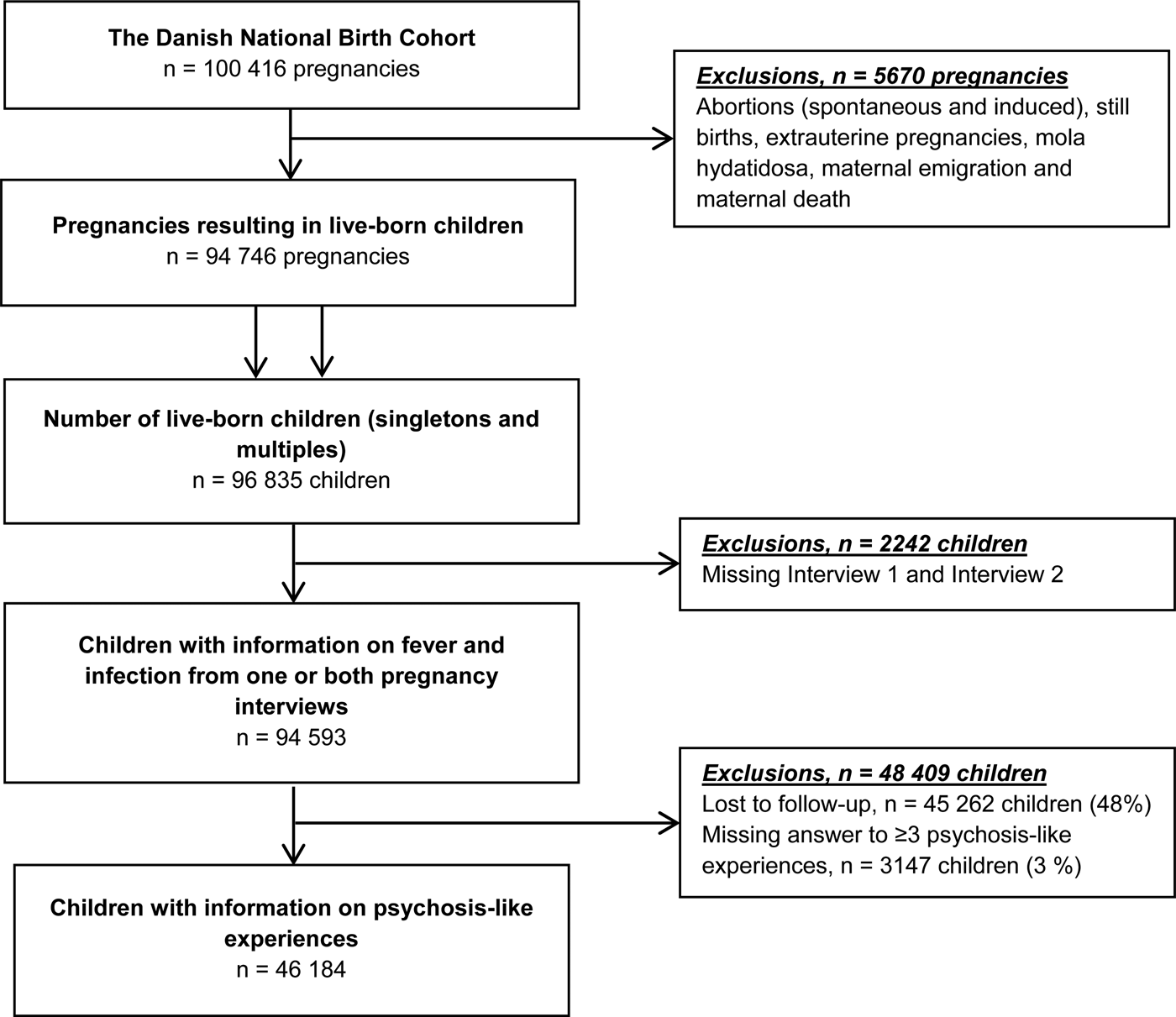
The DNBC is a nation-wide cohort of mother–child dyads (Olsen et al. Reference Olsen, Melbye, Olsen, Sorensen, Aaby, Andersen, Taxbol, Hansen, Juhl, Schow, Sorensen, Andresen, Mortensen, Olesen and Sondergaard2001). Pregnant women were enrolled during 1996–2002 by their general practitioners at their first antenatal visit, which is scheduled to take place around gestational weeks 6–10. Inclusion criteria for enrollment into the DNBC were intention to carry the pregnancy to term, residency in Denmark, and sufficient Danish proficiency to participate in telephone-interviews. The women were interviewed twice during pregnancy (approximately at gestational weeks 16 and 30), and provided information about their health and lifestyle. Continuous follow-up of their children is still ongoing (Danish National Birth Cohort – Statens Serum Institut, 2016). A total of 94 593 live-born children were eligible for inclusion in this study. The analyses are based on 46 184 children participating in the 11-year follow-up and not missing ⩾three PLE questions; see Fig. 1. Written informed consent was obtained from all mothers at time of enrollment and this study has been approved by the Danish Data Protection Agency (Journal number: 2013-41-1431).
Flowchart of the study population.

Psychosis-like experiences
Psychosis-like symptoms were assessed in a web-based questionnaire completed by the children themselves at age 11. A seven-item Adolescent Psychotic-Like Symptom Screener (Kelleher et al. Reference Kelleher, Harley, Murtagh and Cannon2011), partly based on the Diagnostic Interview Schedule for Children (Shaffer et al. Reference Shaffer, Fisher, Lucas, Dulcan and Schwab-Stone2000) was devised to address experiences of visual and auditory hallucinations, thought interference, receiving messages from the radio or television, being spied on, being controlled and grandiosity. The questions were generally phrased as ‘Have you ever heard voices or sounds that no one else can hear?’ and they were able to answer ‘yes, definitely’, ‘yes, I think so’ and ‘no’. PLEs were analyzed as a summarized variable according to the presence or absence of any definite symptoms. Children were subsequently grouped as having reported none, one or ⩾two definite symptoms. If one or two responses were missing for the seven items (n = 861), these missing were coded as the most common response to that particular item (‘no’, for all items).
Maternal fever and infections
Maternal episodes of fever and infections during pregnancy were reported in the two pregnancy interviews. The questions for fever, for instance, were formulated as ‘In this pregnancy, have you had any episodes of fever?’ A fetus was considered as exposed if the mother in any of the two interviews answered yes to that question. Exposure to genitourinary infections was defined by maternal report of cystitis, pyelonephritis or vaginal infections and respiratory tract infection was defined by prolonged cough. The woman could report multiple exposure episodes of fever and each infection and timing of each episode was reported in gestational weeks. For fever episodes, the maximum recorded temperature (in °C) was reported as well. Given that an influenza diagnosis is rarely confirmed and self-diagnosis has poor predictive value (Jutel et al. Reference Jutel, Baker, Stanley, Huang and Bandaranayake2011), women were not asked directly about their exposure to influenza. Instead, we a priori decided to define a fever-episode accompanied by headache and muscle or joint pain as a case of influenza-like illness. While exposure to influenza-like illness was considered as a sub-group of women experiencing fevers, the other infections were defined independently of fever exposure.
Covariates
Inclusion of covariates was informed by existing literature and based on several sources of information. Maternal age at birth was extracted from the Danish Medical Birth Registry (Knudsen & Olsen, Reference Knudsen and Olsen1998), through linkage using the mother's civil registration number. Maternal educational status was based on the highest level of completed education listed in the Population's Education Register (Jensen & Rasmussen, Reference Jensen and Rasmussen2011). If the mother was enrolled at an educational institution at the time of giving birth, the highest ongoing education was used. We extracted the household income in the year prior to the year of birth from the Income Statistics Register (Baadsgaard & Quitzau, Reference Baadsgaard and Quitzau2011) and parental secondary mental health care was based on registered contacts to psychiatric departments between 1977 until 2010, extracted from the Danish Psychiatric Central Research Register (Mors et al. Reference Mors, Perto and Mortensen2011). Maternal report of smoking during pregnancy and number of children in the household was assessed in the first pregnancy interview. If smoking status was missing (~4% of pregnancies) we used information from the Medical Birth Registry. In the Medical Birth Registry, smoking habits in early pregnancy is recorded, based on the first consultation with a midwife, which usually takes place around gestational weeks 16–17. Finally, place of birth as listed in the Medical Birth Registry was divided into five levels of urbanization (capital, capital suburb, provincial city with more than 100 000 inhabitants, provincial towns with more than 10 000 inhabitants, and rural areas), as described elsewhere (Pedersen & Mortensen, Reference Pedersen and Mortensen2001).
Other variables
In order to compare general rates of psychiatric morbidity among children who participated in the 11-year follow-up with children lost to follow-up, we additionally used the Danish Psychiatric Central Research Register to extract all contacts with the psychiatric system for all live-born children in the DNBC.
Statistical analyses
Multinomial logistic regression models were used to calculate adjusted relative risk ratios (RRR) and corresponding 95% confidence intervals (CIs) for the associations between exposures to fevers and infections in pregnancy and PLEs in the child at age 11. The children with no definite PLEs were considered the reference group in all models.
Initially, exposures to fever, genitourinary infections, respiratory infections, and influenza-like illness at any time during pregnancy were analyzed. Fever episodes were additionally analyzed according to the reported maximum temperature of the fever (<39 °C, ⩾39 °C, or unknown) in order to examine potential dose-response effects. Next, we considered the timing of exposures, according to trimester (1st trimester: gestational weeks 1–12 and second trimester: gestational weeks 13–28). A woman was only included in the trimester-specific analyses if exposure information on the entire trimester of interest was available (i.e. the timing of her last interview exceeded the last gestational week in the trimester). Because the last interview was scheduled to take place at approximately gestational week 30, we did not estimate effects of third trimester exposure. To determine whether potential effects were similar across the different types of psychosis-like symptoms, we then examined how the prenatal exposures were associated with each specific PLE, for probable and definite symptoms, respectively. Finally, as a sensitivity analysis we furthermore examined alternative case-definitions of influenza-like illness.
In this study, nearly half of the 94 593 eligible children did not participate in the 11-year follow-up. We expected that loss to follow-up was differential on several important characteristics. To evaluate to what extent such selection biased our results we compared the original analyses with analyses using weights to correct for loss to follow-up (Seaman & White, Reference Seaman and White2013). In essence, we estimated a weight for each child, proportional to the inverse probability that he or she participated in the follow-up, given the specified covariates. The rationale was that children remaining in the study, but with a low chance according to the model of doing so (for instance because they had a mental illness), were given a higher weight, so that they were not only representing themselves, but also children like them, that did not participate in the 11-year follow-up. The weights were estimated using a logistic regression model (n = 94 593) and aimed to include all relevant variables that predicted follow-up status. The model was based on information on maternal age, maternal education, household income, parental and child secondary mental health care, maternal smoking in pregnancy, and urbanization.
All analyses were performed with Stata (StataCorp, College Station, Texas) and using robust standard errors to correct for the dependency between siblings in the sample.
Results
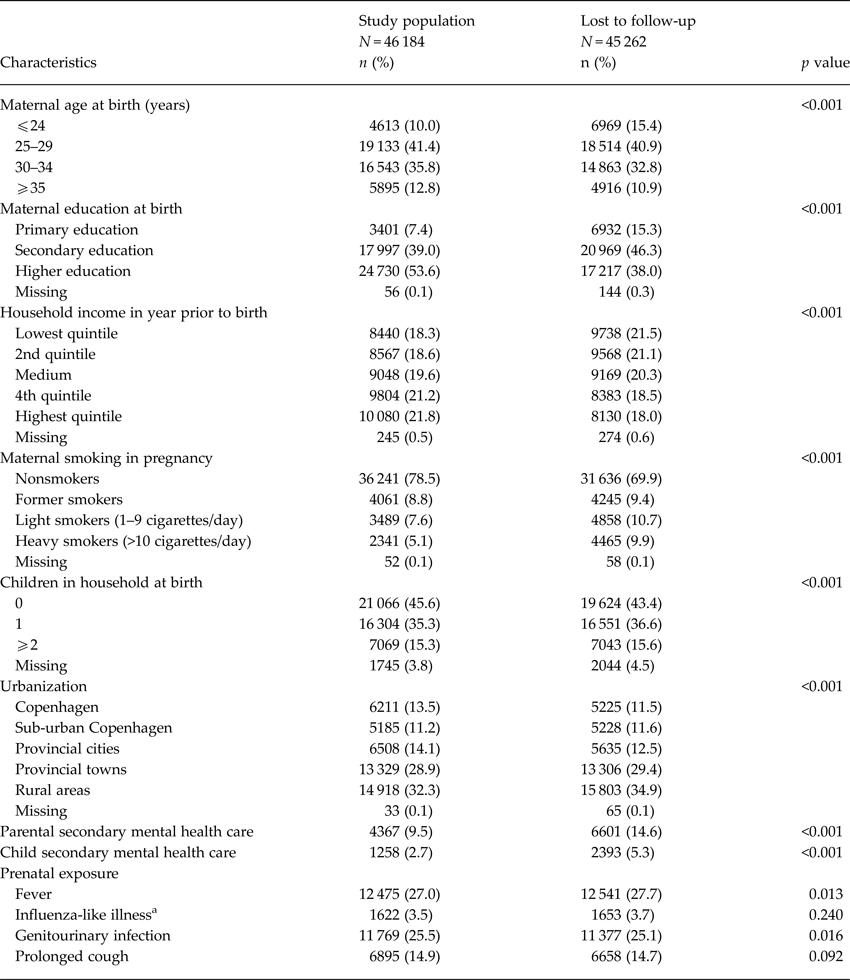
Prenatal exposures to episodes of fever and infections were relatively common among children participating in the 11-year follow-up of the DNBC. Twenty-seven percent of the children were prenatally exposed to fever, while influenza-like illness, genitourinary infections and prolonged cough occurred in 3.5%, 25.5%, and 14.9% of the pregnancies, respectively (see Table 1). The frequency of these prenatal exposures did not differ substantially between children who participated in the 11-year follow-up and those who did not. Being lost to follow-up was however associated with young maternal age at birth, lower maternal education and income, higher maternal smoking, and whether parents or the child itself had any registered contacts to a psychiatric department.
Characteristics of DNBC participants according to follow-up status at age 11

a Influenza-like illness was defined a priori as episodes of fever with headache and muscle or joint pain.
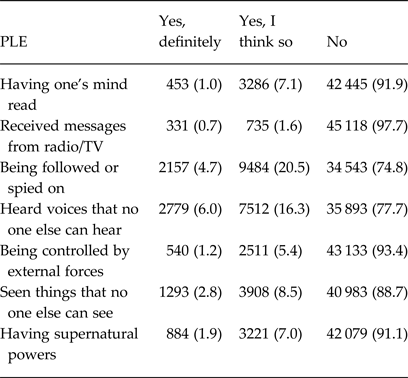
Prevalence of specific psychotic experiences among the children varied substantially; see Table 2. Auditory hallucinations and the feeling of being spied on were the two most common PLEs with around one in four children reporting that they definitely or probably had experienced such symptoms. Contrarily <3% reported having definitively or probably received messages from the television or radio and <7% reported that they were controlled by external forces. Generally, reporting of definite symptoms was much less frequent, than probable symptoms, and 89% of the children did not report any definite symptoms at all, while 7% reported one and 4% reported ⩾two definite symptoms.
Prevalence of psychosis-like experiences (PLEs) in 46 101 children in the 11-year follow-up of the DNBC

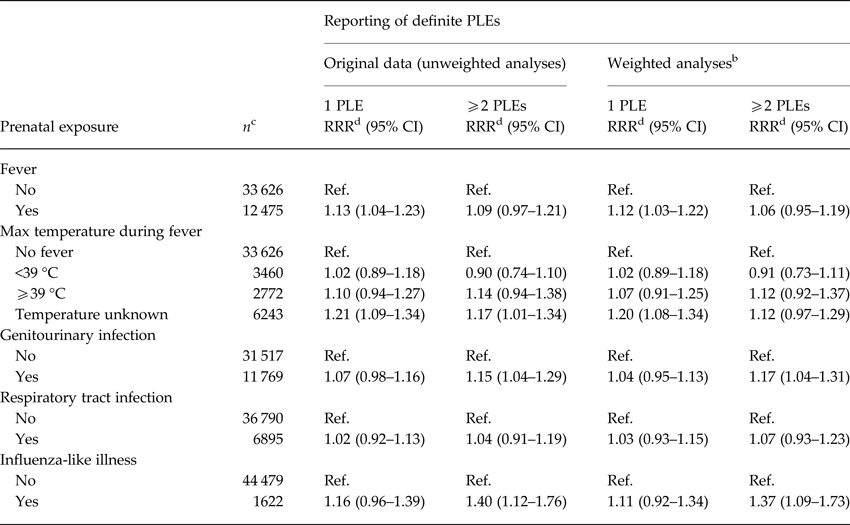
The multinomial logistic models showed that prenatal fevers and infections were generally associated with a low to moderate excess risk of PLEs in the children at age 11 (Table 3). Maternal fever was associated with a slightly elevated risk of PLEs in the child for one definite PLE (RRR: 1.13, 95% CI 1.04–1.23), but not to a larger extent for ⩾two (RRR: 1.09, 95% CI 0.97–1.21). High fevers showed a slightly stronger association with PLEs than low fevers, but the number of women with high fevers was small and neither of these associations were statistically significant. The association was strongest for unknown fever temperatures, but all associations were somewhat attenuated in the weighted analyses, suggesting that attrition may have biased these estimates somewhat upwards. Genitourinary infections were likewise marginally associated with the child's report of PLEs, with the association being slightly stronger for ⩾two definite PLEs (RRR: 1.15, 95% CI 1.04–1.29), than for one (RRR: 1.07, 95% CI 0.98–1.16). No association was observed for respiratory tract infections, but influenza-like illness in pregnancy was associated with an approximately 40% increased risk of the child having experienced two or more PLEs at age 11. In the sensitivity analyses, where we examined the same association, but where influenza-like illness was defined using other combinations of fever and influenza symptoms, this associations was however reduced or entirely removed (e-Table 1).
Multinomial logistic regression of prenatal fever and infection exposures and reporting of definite PLEs at age 11. a

Analyses of original and weighted data. DNBC, n = 46 184
a Reference category: Not having reported any definite PLEs.
b Inverse probability weights were based on a logistic regression model (n = 94 593) and included maternal age, maternal education, household income, parental and child secondary mental health care, maternal smoking in pregnancy, and urbanization. The number of children in the household at birth was not included in the construction of weights, due to the large proportion of missings.
c Refers to numbers in crude analyses.
d Analyses are adjusted for maternal age, maternal education, household income, parental secondary mental health care, maternal smoking in pregnancy, children in the household at birth, and urbanization. Analyses of fever episodes are additionally adjusted for genitourinary and respiratory infection exposure and vice versa.
Further analyses revealed that the observed associations between PLEs following prenatal exposures to fever and the various infections did not seem to be strongly dependent on the trimester of exposure (e-Table 2). The point estimates did vary somewhat and tended to be highest for first-trimester exposure. However, none of these associations reached statistical significance.
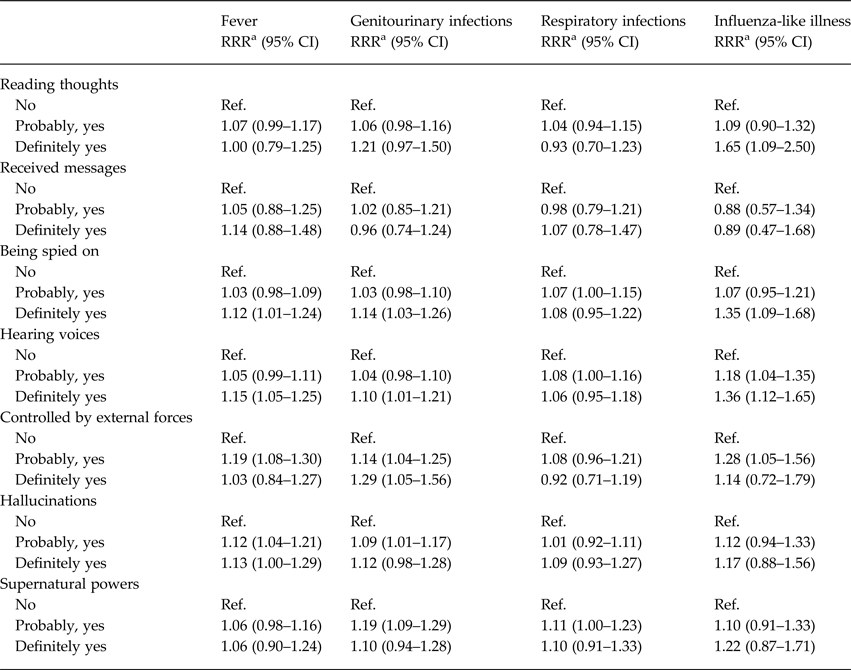
When we considered each PLE independently, we observed that the associations found in the overall analyses were not limited to any particular symptom(s) (Table 4). Some PLEs (e.g. involving auditory hallucinations and feelings of paranoia) were, however, more consistently associated with the prenatal exposures of interest, than others (e.g. receiving messages from the radio/television and having their thoughts read). The strongest associations were generally found for prenatal exposure to influenza-like illness, but also exposure to fever, genitourinary infections and respiratory infections showed associations with several of the individual PLEs. Across most symptoms there was a tendency that associations were stronger for definite symptoms compared with probable symptoms, although this was not entirely consistent.
Multinomial logistic regressions of prenatal exposures and separate psychosis-like experiences

Probable and definite symptoms.
a Analyses are adjusted for maternal age, maternal education, household income, parental secondary mental health care, maternal smoking in pregnancy, children in the household at birth, and urbanization. Analyses of fever episodes are additionally adjusted for genitourinary and respiratory infection exposure and vice versa.
Discussion
In this large prospective study among children at age 11, we found some evidence of a modest association between prenatal exposures to fever and common infections and the occurrence of PLEs during childhood. We found that maternal fever and genitourinary infections at any point in pregnancy were associated with a slightly increased risk of PLEs at age 11 (about 10–15%). Respiratory tract infections were not associated with PLEs in general, but was weakly associated with specific symptoms. Finally, our results suggested that under an a priori definition of influenza-like illness, there were a more substantial association with offspring PLEs, but these results were very sensitive, to how influenza-like illness was defined.
Our findings are somewhat, but not entirely in line with those reported from the ALSPAC study (Zammit et al. Reference Zammit, Odd, Horwood, Thompson, Thomas, Menezes, Gunnell, Hollis, Wolke, Lewis and Harrison2009). The authors found that a range of maternal infections were associated with PLEs (odds ratio [OR] 1.44, 95% CI 1.14–1.86), but found that influenza during any time of pregnancy was not associated more, or less, strongly with PLEs in the child, than having other non-influenza infections. These findings were consistent with the theory that adverse effects of prenatal maternal infections may not be pathogen-specific, but rather, related to a maternal response that is seen in multiple infections. In our study, however, we found some indication that influenza during pregnancy, more so than other infections, was associated with the risk of sub-clinical psychotic symptoms during childhood, at least when our a priori definition of influenza-like illness was used. While the strength of the association with influenza-like illness was comparable with that found in the ALSPAC study, those found for fever and genitourinary infections were more modest. The different findings might be attributed to methodological differences, such as differences in sample size (n = 5379 v. 46 184 in our study), different means of data collection for maternal exposures (postal questionnaire v. telephone interview in our study), or differences in measurement of PLEs (the PLIKSi semi-structured interview v. the web-based Adolescent Psychotic-Like Symptom Screener in ours).
To our knowledge, this is the first study that specifically addresses maternal fever in pregnancy in relation to childhood PLEs. While there is some evidence to suggest that elevated maternal body temperature during pregnancy may indeed cause neurodevelopmental impairment in the offspring (Dreier et al. Reference Dreier, Andersen and Berg-Beckhoff2014) and even psychosis (Jones et al. Reference Jones, Rantakallio, Hartikainen, Isohanni and Sipila1998; Torrey et al. Reference Torrey, Rawlings and Yolken2000), our findings did not suggest that prenatal fever exposure constitute a substantial risk factor for childhood PLEs. In fact, given that we did not observe a clear dose–response relationship with fever temperature, might indicate that the underlying infection rather than the fever itself was responsible for the small excess risks that we did observe. Another potential explanation for the weak, but positive findings for fever and also genitourinary infections in this study is that PLEs act as proxies for more severe mental illness. Under this scenario, effects would be expected to be small, because children exhibiting PLEs consists of a mix of children that will go on to develop an actual clinical psychiatric disorder and children that will not. It is consequently possible that the associations may not represent actual causal effects for PLEs, but rather reflect stronger underlying associations with specific clinical disorders, associated with PLEs (for instance schizophrenia or depression). As the children in the DNBC reaches young adulthood in the years to come, this could be a priority for further studies.
In contrasts to what we expected, we did not find that the associations between prenatal infections and PLEs were dependent on the timing of exposure. Much of the literature linking prenatal infections to psychiatric morbidity have suggested that these effects were often trimester-specific, although both early and mid-pregnancy has been proposed as the most critical period (Brown et al. Reference Brown, Begg, Gravenstein, Schaefer, Wyatt, Bresnahan, Babulas and Susser2004; Meyer et al. Reference Meyer, Yee and Feldon2007; Martin & Dombrowski, Reference Martin, Dombrowski, Martin and Dombrowski2008; Brown & Derkits, Reference Brown and Derkits2010). It is however, possible that we were not able to detect any variation in effect across pregnancy, given that the effects that we observed were relatively small and the statistical power in these analyses was limited.
In this study, we examined seven different symptoms of sub-clinical psychosis that were part of the Adolescent Psychotic-Like Symptom Screener. We found that a total of 11% of the children in the DNBC follow-up reported at least one definite PLE. Compared with population-based estimates, this is probably somewhat lower, given that children with mental health problems were less likely to participate in the 11-year follow-up. The prevalence of the seven different PLEs varied substantially, with auditory hallucinations being the most common phenomenon reported by the children with definite psychosis-like symptoms. These findings are similar to that reported in other studies (Polanczyk et al. Reference Polanczyk, Moffitt, Arseneault, Cannon, Ambler, Keefe, Houts, Odgers and Caspi2010; Kelleher et al. Reference Kelleher, Harley, Murtagh and Cannon2011). No clear pattern was however found in how the prenatal exposures were associated with the specific symptoms of psychosis, although the more prevalent symptoms also showed more consistency in the link to the prenatal exposures.
The clinical relevance of PLEs in childhood has been widely debated and several issues have been raised. First of all, although the presence of PLEs may predict onset of psychiatric illness, in most children the symptoms will resolve, rather than evolve (Nelson et al. Reference Nelson, Fusar-Poli and Yung2012). This suggests that PLEs do not generally constitute a persisting problem for a majority of the children affected. However, increasing frequency and pervasiveness of the symptoms have been shown to be more strongly associated with progression to clinical psychopathology (Yung et al. Reference Yung, Nelson, Baker, Buckby, Baksheev and Cosgrave2009; Nelson et al. Reference Nelson, Fusar-Poli and Yung2012). In this study we did, however, not have any information regarding the frequency of the symptoms or whether the child was distressed by the occurrences. A second issue is the specificity of PLEs as markers of psychiatric disorders. Evidence suggests that although PLEs are measures of mild or brief psychotic symptoms, they do not seem to be more strongly associated with subsequent development of psychotic disorders than with other psychiatric conditions (Hanssen et al. Reference Hanssen, Peeters, Krabbendam, Radstake, Verdoux and Van Os2003; Kelleher et al. Reference Kelleher, Connor, Clarke, Devlin, Harley and Cannon2012a ). Instead, they have been suggested to constitute a measure of general psychopathology (Nelson et al. Reference Nelson, Fusar-Poli and Yung2012). Finally, some studies have questioned whether endorsement in screening instruments, such as the one used in this study, accurately predict actual psychosis-like symptoms, when not followed up by probing questions, for instance in a clinical interview (Laurens et al. Reference Laurens, Hodgins, Maughan, Murray, Rutter and Taylor2007; Horwood et al. Reference Horwood, Salvi, Thomas, Duffy, Gunnell, Hollis, Lewis, Menezes, Thompson, Wolke, Zammit and Harrison2008). To overcome this issue, at least in part, we focused primarily on the children reporting definite symptoms (rather than probable), and also distinguished between children with one or multiple PLEs, as any issues with misclassification is likely to be lower among these children. A recent validation study using clinical interviews did additionally conclude that the Adolescent Psychotic-like Symptom Screener did in fact provide good sensitivity and specificity in identifying young adolescents in the general population with PLEs (Kelleher et al. Reference Kelleher, Harley, Murtagh and Cannon2011).
Several important strengths of this study are worth noting. Given the comprehensiveness of the information that were available on fever and common infections in pregnancy, we were able to conduct detailed sub-analyses examining, for instance, the effects of exposure timing and temperature of fevers. Furthermore, as all information on maternal exposures were collected during pregnancy, any missing information or flawed recall was most likely independent of the future outcome in the child. A further strength of this study was the ability to adjust all analyses for a host of potential confounders, including maternal sociodemographic characteristics, health-related conditions, as well as lifestyle during pregnancy.
Attrition was, however, relatively high. To correct for selective attrition, we conducted a range of weighted sensitivity analyses, which allowed us to assess the extent of any potential bias. One major advantage in the specification of these weights was the inclusion of an indicator for childhood secondary mental health care. This auxiliary variable was strongly associated with follow-up status as well as PLEs, which increase the accuracy of the corrected estimates in weighted models and make the missing at random assumption more plausible (National Research Council (US) Panel on Handling Missing Data in Clinical Trials, 2010). The measures of association were generally only slightly attenuated in the weighted analyses, suggesting that loss to follow-up did not bias our results in any substantial manner. This was most likely due to the fact that attrition seemed to be largely independent of prenatal exposure status.
Another important limitation was that all measures of exposures were based on maternal self-report. However, given that the assessments were carried out during pregnancy, the women only had to recall exposures that were 2–4 months back in time, which heightens the accuracy of recall. Use of serologic data on maternal levels of immunoglobulin M and G could nevertheless potentially improve exposure classification in future research. Using hospital records to examine the influence of more severe infections during pregnancy could similarly improve our understanding of the possible link between these infections and PLEs in childhood. Finally, we examined the associations between many different exposures, and with PLEs individually and combined, resulting in large number of statistical tests. Thus, we cannot exclude that some of our positive findings are simply due to multiple testing.
In conclusion, in this large prospective study, fever and a range of common infections in pregnancy generally showed weak but positive associations with sub-clinical psychotic symptoms in the offspring. Our findings regarding influenza-like illness furthermore suggested that it may be especially relevant to further consider the role of prenatal influenza in future research on PLEs.
Supplementary Material
The supplementary material for this article can be found at https://doi.org/10.1017/S0033291717001805
Acknowledgements
The Danish National Birth Cohort was established with a significant grant from the Danish National Research Foundation. Additional support was obtained from the Danish Regional Committees, the Pharmacy Foundation, the Egmont Foundation, the March of Dimes Birth Defects Foundation, the Health Foundation, and other minor grants. The DNBC Biobank has been supported by the Novo Nordisk Foundation and the Lundbeck Foundation. Follow-up of mothers and children have been supported by the Danish Medical Research Council (grant numbers SSVF 0646, 271-08-0839/06-066023, O602-01042B, 0602-02738B), the Lundbeck Foundation (grant numbers 195/04, R100-A9193), The Innovation Fund Denmark 0603-00294B (grant number 09-067124), the Nordea Foundation (grant number 02-2013-2014), Aarhus Ideas (grant number AU R9-A959-13-S804), University of Copenhagen Strategic Grant (no. IFSV 2012), and the Danish Council for Independent Research (grant numbers DFF – 4183-00594 and DFF – 4183-00152).
This research received no specific grant from any funding agency, commercial or not-for-profit sectors.
Declaration of Interest
None.