Externalizing behavior is the most prevalent and persistent form of maladjustment in both childhood and adolescence (Dishion & Patterson, Reference Dishion, Patterson, Cohen and Cicchetti2006), and is an important predictor of psychopathology in adulthood (Moffitt, Caspi, Harrington, & Milne, Reference Moffitt, Caspi, Harrington and Milne2002). Research has identified two general types of externalizing behavior problems: aggression and rule breaking (Burt, Reference Burt2012; Dishion & Patterson, Reference Dishion, Patterson, Cohen and Cicchetti2006). Aggression consists of overt behaviors such as bullying and fighting, whereas rule breaking consists mainly of covert behaviors such as stealing and truancy. This conceptual distinction is supported by studies showing differential developmental trajectories (De Haan, Prinzie, & Deković, Reference De Haan, Prinzie and Deković2010) and risk factors for aggression and rule breaking (Prinzie, Onghena, & Hellinckx, Reference Prinzie, Onghena and Hellinckx2006). Children show individual differences in their developmental trajectories of aggression and rule breaking during the transition from childhood to adolescence (Bongers, Koot, van der Ende, & Verhulst, Reference Bongers, Koot, van der Ende and Verhulst2004; Broidy et al., Reference Broidy, Nagin, Tremblay, Bates, Brame and Dodge2003), which might be explained by individual and contextual risk factors (Jennings & Reingle, Reference Jennings and Reingle2012).
Previous research has revealed different developmental trajectories for aggressive and rule-breaking behavior, reporting on average three to four developmental trajectories for aggressive and rule-breaking behavior in childhood and adolescence (Jennings & Reingle, Reference Jennings and Reingle2012). Regarding aggressive behavior, studies found, in general, a class of children showing chronically high or escalating aggressive behavior from childhood into adolescence (5%); a class showing high initial levels and subsequently a strong decrease in aggression (15%); a class showing moderate, but decreasing levels of aggression (20%); and a class of children showing no or low decreasing levels of aggression (>60%, e.g., Bongers et al., Reference Bongers, Koot, van der Ende and Verhulst2004; Brame, Nagin, & Tremblay, Reference Brame, Nagin and Tremblay2001; Broidy et al., Reference Broidy, Nagin, Tremblay, Bates, Brame and Dodge2003). For trajectories of rule breaking, three to four groups likewise have been reported most often (Jennings & Reingle, Reference Jennings and Reingle2012): a class showing chronically high levels of rule breaking in childhood and adolescence (5%), a class showing a steep increase in rule breaking during adolescence (10%), a class displaying a medium increase in rule breaking during adolescence (25%), and a class displaying nearly no rule breaking (>60%, e.g., Bongers et al., Reference Bongers, Koot, van der Ende and Verhulst2004). In sum, previous research identified three to four subgroups of children that differ in their developmental trajectories of aggression and rule-breaking behavior from childhood into adolescence.
An important individual-level set of risk factors for children's behavior problems is their personality traits (Caspi & Shiner, Reference Caspi, Shiner, Damon, Lerner and Eisenberg2006; Tackett, Martel, & Kushner, Reference Tackett, Martel, Kushner, Zentner and Shiner2012), meaning their consistent patterns of behaving, thinking, and feeling. For example, low benevolence predicts both aggression and rule breaking, longitudinally. Low conscientiousness and high extraversion predict the development of children's rule breaking but not aggression over time (De Haan et al., Reference De Haan, Prinzie and Deković2010); impulsivity likewise is strongly related to rule-breaking behavior (Burt & Donnellan, Reference Burt and Donnellan2008; Jones, Miller, & Lynam, Reference Jones, Miller and Lynam2011). In addition, agreeableness is more related with aggression than with rule-breaking behavior (Jones et al., Reference Jones, Miller and Lynam2011). These existing findings suggest that there are likely to be differential associations between personality traits and specific types of externalizing behaviors (Lynam et al., Reference Lynam, Caspi, Moffit, Raine, Loeber and Stouthoemer-Loeber2005).
Personality researchers have shown, however, that more narrowly defined, lower order personality facets are often better predictors of several behaviors (e.g., substance use and peer-rated popularity) than broader personality factors (Paunonen & Ashton, Reference Paunonen and Ashton2001); thus, children's personality facets may be even better predictors of specific types of externalizing behavior than the youth's higher order personality traits.
In addition to children's personality traits, a contextual risk factor for aggression and rule-breaking behavior is dysfunctional parenting (Dishion & Patterson, Reference Dishion, Patterson, Cohen and Cicchetti2006). Overreactive parenting (yelling and criticism), for example, predicts higher levels of aggression and rule breaking over time (Prinzie et al., Reference Prinzie, Onghena and Hellinckx2006). In addition, interactive effects between the parenting context and children's lower order personality facets may have the potential to explain developmental trajectories of aggression and rule-breaking behavior (Prinzie et al., Reference Prinzie, Onghena, Hellinckx, Grietens, Ghesquiere and Colpin2003). For example, existing work shows that overreactivity is only related to the development of externalizing behaviors for less benevolent and conscientious children (Prinzie et al., Reference Prinzie, Onghena, Hellinckx, Grietens, Ghesquiere and Colpin2003).
In an attempt to extend previous research on the trajectories of aggression and rule-breaking behavior, we examined whether children's lower order personality facets, the hostile or overreactive parenting they experience, and the interactions between the two predict particular trajectories of aggression and rule breaking during the transition into adolescence. Considering subgroups of children, with different trajectories of aggression and rule-breaking behavior, has the potential to reveal different risk factors across trajectories of aggression and rule breaking. The transition to adolescence is a period characterized by an increase in problem behaviors such as rule breaking (Bongers et al., Reference Bongers, Koot, van der Ende and Verhulst2004). In addition, children develop increasing autonomy (Galambos & Costigan, Reference Galambos, Costigan, Weiner, Lerner, Easterbrooks and Mistry2003), while parents need to facilitate this increasing autonomy by learning to relax some control while remaining supportive. Given that the transition to adolescence brings challenges to children and parents, it is especially important to study this period in relation to problem behaviors, children's personality traits, and parenting risk factors.
The Links Between Child Personality Traits and Aggression and Rule Breaking
According to the vulnerability model, children's personality traits are important factors in explaining differences in trajectories of aggression and rule breaking (Shiner & Caspi, Reference Shiner and Caspi2003). There is growing consensus that individual differences in children's and adolescent's personality traits can be captured by the Big Five personality factors, typically labeled as (a) extraversion, (b) agreeableness (or benevolence in youth), (c) conscientiousness, (d) emotional stability, and (e) openness/imagination (Caspi & Shiner, Reference Caspi, Shiner, Damon, Lerner and Eisenberg2006; Shiner & DeYoung, Reference Shiner, DeYoung and Zelazo2013). The Big Five is structured hierarchically, with the five broad factors each subsuming a number of lower order, more narrowly defined facets. In line with the vulnerability model, previous research focusing on the Big Five has consistently found that high extraversion, low benevolence, and low conscientiousness are associated with the development of aggression and rule breaking (De Haan et al., Reference De Haan, Prinzie and Deković2010; Lynam et al., Reference Lynam, Caspi, Moffit, Raine, Loeber and Stouthoemer-Loeber2005; Ozer & Benet-Martinez, Reference Ozer and Benet-Martínez2006; Prinzie et al., Reference Prinzie, Onghena, Hellinckx, Grietens, Ghesquiere and Colpin2003, Reference Prinzie, Onghena, Hellinckx, Grietens, Ghesquiere and Colpin2004). Therefore, the lower order personality facets of these three Big Five factors are the focus of this study.
The Big Five lower order personality facets have been found to have unique predictive power for social behaviors, beyond the variance accounted for by Big Five factors (Paunonen & Ashton, Reference Paunonen and Ashton2001). This finding suggests that narrow traits may have higher predictive validity compared with broader traits. For example, specific personality facets of the extraversion, benevolence, and emotional stability domains are found to differentiate developmental trajectories of anxious and depressive symptoms during the transition from childhood into adolescence. Specifically, higher shyness, irritability, and altruism predicted membership in more problematic anxious and depressive groups. The personality facets energy, optimism, compliance, and anxiety were unique predictors for class membership for anxious symptoms (Prinzie, van Harten, Deković, van den Akker, & Shiner, Reference Prinzie, van Harten, Deković, van den Akker and Shiner2014).
Moreover, the higher order domains may obscure effects at the facet level (Klein, Dyson, Kujawa, & Kotov, Reference Klein, Dyson, Kujawa, Kotov, Zentner and Shiner2012). In line with this finding, different facets within the same Big Five factor can predict different outcomes or relate differently to the same outcome (Shiner & Caspi, Reference Shiner and Caspi2003). For example, some facets of extraversion may positively correlate with externalizing behavior (e.g., activity level), whereas other facets of extraversion may correlate negatively (e.g., optimism or positive affect). The investigation of lower order facets in relation to externalizing behaviors may provide a clearer picture of the etiological risk factors that differentiate children following distinct trajectories of aggressive and rule-breaking behavior (Jennings & Reingle, Reference Jennings and Reingle2012). Moreover, information on lower order facets may further increase the effectiveness of interventions for externalizing behaviors, because interventions can be tailored to specific facets rather that broad domains. To the best of our knowledge, no studies have yet focused on the relation between lower order personality facets and trajectories of aggression and rule-breaking behavior.
The present study used a well-validated parent-report measure to assess the Big Five traits in youth: the Hierarchical Personality Inventory for Children (Mervielde & De Fruyt, Reference Mervielde, De Fruyt, Mervielde, Deary, De Fruyt and Ostendorf1999). In this measure, the three Big Five factors that are the focus of this study subsume 13 facets. Extraversion includes four facets: shyness, expressivity, optimism, and energy. Benevolence includes five facets: egocentrism, irritability, compliance, dominance, and altruism. Conscientiousness includes four facets: achievement motivation, orderliness, concentration, and perseverance (Mervielde & De Fruyt, Reference Mervielde, De Fruyt, Mervielde, Deary, De Fruyt and Ostendorf1999). Because the literature linking youth's personality traits with aggression and rule breaking has not yet addressed trait facets, we based our hypotheses on temperament research that has examined temperament traits that are associated with Big Five lower order facets.
Concerning the extraversion factor, the facet labeled energy includes children's adventure seeking and can be related to the activity level described in temperament models (Mervielde, De Clercq, De Fruyt, & Van Leeuwen, Reference Mervielde, De Clercq, De Fruyt and Van Leeuwen2005; Rothbart, Ahadi, & Evans, Reference Rothbart, Ahadi and Evans2000; Shiner & DeYoung, Reference Shiner, DeYoung and Zelazo2013). Previous research suggests that children who display higher activity levels and sensation seeking are at a higher risk for developing externalizing behavior (De Pauw & Mervielde, Reference De Pauw and Mervielde2010). In addition, the facet expressiveness can be related to the temperament factor surgency (e.g., Rothbart et al., Reference Rothbart, Ahadi and Evans2000). Surgency involves the eager approach of potentially rewarding situations; high levels of surgency may result in externalizing behavior when a highly assertive goal is blocked (Oldehinkel, Hartman, De Winter, Veenstra, & Ormel, Reference Oldehinkel, Hartman, De Winter, Veenstra and Ormel2004; Rothbart & Putnam, Reference Rothbart, Putnam, Pulkkinen and Caspi2002). Similarly, expressiveness may relate to externalizing behaviors because it taps into children's tendency to easily argue with other people and express their feelings, for example, if goals are blocked (Rothbart & Putnman, Reference Rothbart, Putnam, Pulkkinen and Caspi2002). Optimism involves children's positive emotionality and their coping strategies; this facet is not included in most temperament models, but optimism is an aspect of extraversion in children (Mervielde & De Fruyt, Reference Mervielde, De Fruyt, Mervielde, Deary, De Fruyt and Ostendorf1999). Lower optimism has been found to predict higher levels of externalizing behaviors over time (Pulkkinen, Lyyra, & Kokko, Reference Pulkkinen, Lyyra and Kokko2009), perhaps because youth with lower optimism may respond to stressors less adaptively.
Regarding facets of benevolence, irritability includes children's tendencies toward anger and frustration and is consistently found to be positively associated with externalizing behavior (Caspi & Shiner, Reference Caspi, Shiner, Rutter, Bishop, Pine, Scott, Stevenson and Taylor2008; Frick & Morris, Reference Frick and Morris2004; Rothbart, Reference Rothbart2007; Shiner & DeYoung, Reference Shiner, DeYoung and Zelazo2013). Compliance is closely related to temperamental unmanageability and includes children's tendencies to be noncompliant with parental attempts to stop or redirect the behavior of the child. Compliance is likely to be negatively related to externalizing behaviors (Bates, Pettit, Dodge, & Ridge, Reference Bates, Pettit, Dodge and Ridge1998; Rothbart & Bates, Reference Rothbart, Bates, Damon, Lerner and Eisenberg2006).
Two facets of conscientiousness seem likely to be related to the broader temperamental trait of effortful control (EC): concentration and perseverance. EC includes the dimension attentional control, defined as the capacity to focus and shift attention when desired, which seems highly similar to the concentration facet within the conscientiousness factor. Similar to attentional control, we predict that concentration will be negatively related to externalizing behaviors (Rothbart, Reference Rothbart2007). EC also includes perseverance, which taps into persistence during boring and difficult tasks. Children who are able to persevere during uninterested and complex tasks are better at regulating their own behavior. Low perseverance has been identified as a precursor for externalizing behavior (Sargeant, Bornovalova, Trotman, Fishman, & Lejuez, Reference Sargeant, Bornovalova, Trotman, Fishman and Lejuez2012), as has low EC (Oldehinkel et al., Reference Oldehinkel, Hartman, De Winter, Veenstra and Ormel2004). Thus, we expected perseverance to predict lower externalizing behavior.
We had no specific hypotheses for the remaining facets of extraversion (i.e., shyness), benevolence (i.e., egocentrism, dominance, and altruism), and conscientiousness (i.e., achievement motivation and orderliness), due to the lack of previous research on traits related to these facets.
Parenting and Aggression and Rule Breaking: Associations and Interactions
Research suggests that dysfunctional parenting is an important contextual risk factor for the development of aggression and rule-breaking behavior (Dishion & Patterson, Reference Dishion, Patterson, Cohen and Cicchetti2006). Overreactive parenting, which is defined as parents' tendencies to respond with anger, frustration, and meanness to problem behavior of the child (Arnold, O'Leary, Wolff, & Acker, Reference Arnold, O'Leary, Wolff and Acker1993; Prinzie, Onghena, & Hellinckx, Reference Prinzie, Onghena and Hellinckx2007), is an important target of parenting interventions and is conceptually similar to coercive parenting (Patterson, Reference Patterson1982). Overreactivity is an important aspect of parenting to examine during the transition from childhood to adolescence because, during this phase of life, youth need support from their parents while they strive for autonomy (Allen et al., Reference Allen, Insabella, Porter, Smith, Land and Phillips2006). Because overreactive parents display power-assertive behavior, it is likely that such parenting would undermine children's development of autonomy and would result in a misfit between youth's developmental needs and the parenting context. Parental overreactivity has been related to higher levels of both aggression and rule breaking over time (Prinzie et al., Reference Prinzie, Onghena and Hellinckx2006).
Although overreactivity has been directly related to aggressive and rule-breaking behavior during childhood, a goodness of fit model emphasizes that children's adjustment depends on the fit between the environment and their personality characteristics (Thomas & Chess, Reference Thomas and Chess1977). Parenting should be tailored to a child's personality characteristics in order to promote adjustment, and externalizing problems may develop as a result of mismatch between child characteristics and the parenting they experience (Bates, Schermerhorn, & Peterson, Reference Bates, Schermerhorn, Petersen, Zentner and Shiner2012; Shiner, Reference Shiner, Mikulincer, Shaver, Cooper and Larsen2014). In line with this model, existing work shows that overreactivity is related to more aggressive and rule-breaking behavior especially for children with lower scores on extraversion, benevolence, and conscientiousness (De Haan et al., Reference De Haan, Prinzie and Deković2010; Prinzie et al., Reference Prinzie, Onghena, Hellinckx, Grietens, Ghesquiere and Colpin2003; Van den Akker, Deković, & Prinzie, Reference Van den Akker, Deković and Prinzie2010; Van Leeuwen, Mervielde, Braet, & Bosmans, Reference Van Leeuwen, Mervielde, Braet and Bosmans2004), suggesting that some children are more vulnerable to developing adjustment problems in the context of overreactive parenting. In this study, we will explore how specific personality facets interact with overreactive parenting in the development of aggression and rule-breaking behavior. To our knowledge, no studies have yet considered lower order facets of personality when investigating the prediction of aggressive and rule-breaking outcomes from Personality × Context interactions.
Another distinctive aspect of the present study is its focus on the transition from childhood to adolescence; most previous work in this area has focused on childhood. For example, previous research on elementary school aged children suggests that highly irritable and easily frustrated children may be at greatest risk for elevated levels of aggressive and rule-breaking behavior in the presence of overreactivity (Prinzie et al., Reference Prinzie, Onghena, Hellinckx, Grietens, Ghesquiere and Colpin2003). However, when children transition to adolescence, the interplay between parent and child characteristics may become less influential. For example, children become less dependent upon their parents in order to regulate their emotions when they transition into adolescence (Galambos & Costigan, Reference Galambos, Costigan, Weiner, Lerner, Easterbrooks and Mistry2003). Irritable children may be more vulnerable to the effects of overreactivity because they have difficulties in regulating their own emotions and behaviors. Similarly, overreactivity might predict group membership in trajectories with higher levels of aggression and rule breaking for children with high energy levels (Prinzie et al., Reference Prinzie, Onghena, Hellinckx, Grietens, Ghesquiere and Colpin2003). Until now, these hypotheses have not been empirically tested.
The Present Study
The current study contributes to the literature on personality and externalizing behaviors by considering lower order personality facets and parenting variables in relation to developmental trajectories of externalizing behaviors. Thereby, this study has the potential to gain a more detailed perspective on how individual differences in personality at the facet level are related to the development of different trajectories and types of externalizing behavior. Four research questions were addressed to explore these issues. First, we examined the number and shape of the developmental trajectories of aggression and rule-breaking behavior that could be distinguished from age 9 to 15. We hypothesized that we would find three or four trajectories for both aggression and rule breaking, which may differ in both levels and direction of change over time (Jennings & Reingle, Reference Jennings and Reingle2012). Second, for personality, we focused on the facets of the Big Five factors that have been most consistently associated with the development of externalizing behaviors: extraversion, benevolence, and conscientiousness (De Haan et al., Reference De Haan, Prinzie and Deković2010; Lynam et al., Reference Lynam, Caspi, Moffit, Raine, Loeber and Stouthoemer-Loeber2005; Ozer & Benet-Martinez, Reference Ozer and Benet-Martínez2006; Tackett et al., Reference Tackett, Martel, Kushner, Zentner and Shiner2012). Based on the literature, we expected that higher expressiveness, lower optimism, higher energy, higher irritability, lower compliance, lower concentration, and lower perseverance would predict membership in classes with higher levels of aggression and rule-breaking behavior. To explore their predictive power, all other facets of the extraversion, benevolence, and conscientiousness factors were investigated as well. Third, we analyzed whether parental overreactivity could predict trajectory membership. We expected that higher overreactivity would predict membership in trajectories with higher levels of aggression and rule breaking. Fourth, we examined whether lower order personality facets moderated the relationship between parental overreactivity and trajectories of aggression and rule breaking. We expected to find that overreactivity predicts group membership in trajectories with more aggressive and rule-breaking behavior, especially for children with higher expressiveness, lower optimism, higher energy, higher irritability, lower compliance, lower concentration, and lower perseverance.
Although gender differences were not the major focus of this study, we analyzed whether boys and girls showed differences in trajectory membership for trajectories of aggression and rule breaking. Based on previous research, we expected that more boys than girls would follow trajectories with higher levels of aggression and rule breaking (Bongers et al., Reference Bongers, Koot, van der Ende and Verhulst2004).
Method
Participants
This study is part of the Flemish Study on Parenting, Personality, and Development, which started in 1999. For detailed information on the sample see Prinzie et al. (Reference Prinzie, Onghena, Hellinckx, Grietens, Ghesquiere and Colpin2003). The current study used data from the third (Time 1 [T1]; 2001), fourth (Time 2 [T2]; 2004), and fifth (Time 3 [T3]; 2007) measurement waves, because these waves contained the measures of interest. To obtain a sample of children who transitioned from childhood into adolescence, we selected data for children who were aged 8 or 9 at T1. This resulted in a sample of 290 children (141 boys, 48.6%). The mean age of the children at T1 was 8.80 years (SD = 0.53 year, range = 8–9.92 years). There were no gender differences for age, t (288) = 0.65, p = .517, d = 0.08. For these 290 children, 290 mothers and 277 fathers participated at T1, 245 mothers and 231 fathers participated at T2, and 235 mothers and 221 fathers participated at T3. The mean age of mothers and fathers at T1 was 37.17 (SD = 3.51 years, range = 27–52 years) and 38.83 years (SD = 3.89, range = 30–54), respectively. Parental educational levels for mothers and fathers were 1.0% and 3.0% elementary school, 40.5% and 42.2% secondary school, 37.0% and 23.3% nonuniversity higher education, and 21.4% and 31.5% university or higher, respectively. These percentages are representative for the Belgian population. All parents were of Belgian nationality.
Missing data points across the study occurred for 4.9% for the mother data and for 9.2% of the father data. The Little missing completely at random test on all variables used in this study revealed that the pattern of missing data values was completely at random, χ2 (71) = 84.75, p = .127. Therefore, we included respondents with missing values in our analyses using a full-information maximum likelihood procedure for the estimation of the models in Mplus 6.11 (Muthén & Muthén, Reference Muthén and Muthén1998–2011).
Measures
Aggression and rule breaking
Mothers and fathers reported on children's externalizing problem behaviors using the Dutch translation of the Child Behavior Checklist (CBCL) at T1, T2, and T3 (Achenbach, Reference Achenbach1991; Verhulst, Van der Ende, & Koot, Reference Verhulst, Van der Ende and Koot1996). Thirty-three items of the CBCL account for the broadband externalizing syndrome, scored on a 3-point scale (0 = not true, 1 = somewhat/sometimes true, 2 = very true or often true). This scale consists of two subscales: aggression and rule-breaking behavior. The aggression scale contains 20 questions about overt aggressive behaviors such as arguing a lot, fighting with other children, and destroying one's own and others' belongings. The rule-breaking subscale is composed of 13 items, including more covert behaviors such as lying, cheating, having no guilt, and stealing at home and elsewhere. Many studies have shown that the CBCL, including the Dutch translation, is a reliable and valid instrument (Bongers et al., Reference Bongers, Koot, van der Ende and Verhulst2004). Summed scores were created for aggression and rule-breaking behavior. The correlations between father and mother reports for aggression and rule breaking ranged from 0.52 to 0.74 across waves. Composite scores were created by averaging the scores between mothers and fathers for each time point. These scores were used throughout the analyses. Internal consistencies for the composite scores of aggression at T1, T2, and T3 were 0.92, 0.92, and 0.93, respectively, and for rule breaking were 0.71, 0.67, and 0.81, respectively.
Child personality
Mothers and fathers reported on their child's personality at T1, by means of the Hierarchical Personality Inventory for Children (Mervielde & De Fruyt, Reference Mervielde, De Fruyt, Mervielde, Deary, De Fruyt and Ostendorf1999). This comprehensive Big Five measure assesses individual differences among children and includes 144 items, on a 5-point Likert scale (1 = barely characteristic, 5 = highly characteristic). For this study, we used the facets of the extraversion, benevolence, and conscientiousness dimensions that were previously linked with externalizing behavior (e.g., De Pauw & Mervielde, Reference De Pauw and Mervielde2010; Prinzie et al., Reference Prinzie, Onghena, Hellinckx, Grietens, Ghesquiere and Colpin2003). Extraversion (32 items) measures expressiveness and assertiveness, including four lower order facets: shyness, expressiveness, optimism, and energy. Benevolence (40 items), which is a broader measure of the dimension termed agreeableness in adults, measures the child's prosocial versus antisocial tendencies and includes five facets: egocentrism, irritability, compliance, dominance, and altruism. Conscientiousness (32 items) measures conscientiousness in school or worklike situations, such as cleaning at home, and consists of four facets specified as achievement motivation, orderliness, concentration, and perseverance. The facets shyness, egocentrism, irritability, and dominance are reverse coded for the domains but not at the facet level. Internal consistencies for the facets ranged from 0.78 to 0.88, and correlations between mother and father reports ranged from 0.53 for altruism to 0.73 for orderliness. For the analyses, the average scores between fathers and mothers were used.
Overreactive parenting
Mothers and fathers reported on their overreactivity using the Dutch translation of the overreactivity subscale of the Parenting Scale (Arnold et al., Reference Arnold, O'Leary, Wolff and Acker1993) at T1. Overreactivity relates to parenting behaviors of irritability, anger, and frustration and is related to harsh or coercive parenting (Patterson, Reference Patterson1982) and includes behaviors such as insulting and hitting the child. The nine items of the overreactivity factor present discipline encounters (e.g., “When my child misbehaves …”) followed by two options that represent opposite anchor points for the 7-point Likert scale (e.g., “I speak to my child calmly” vs. “I raise my voice or yell”). The Parenting Scale has been found to be a valid measure for inadequate discipline practices of parents (Arnold et al., Reference Arnold, O'Leary, Wolff and Acker1993; Prinzie et al., Reference Prinzie, Onghena and Hellinckx2007). The Cronbach α values for the scale were 0.79 for mothers and 0.74 for fathers. The correlation between mother and father reports was .25.Footnote 1 Mother and father scores were averaged.
Statistical analyses
Descriptive statistics and intercorrelations among variables were examined. Further statistical analyses consisted of two steps. In the first step, to determine how many subgroups with distinct longitudinal trajectories of aggression and rule-breaking behavior could be distinguished, we conducted separate growth mixture modeling (GMM) analyses for aggression and rule breaking over the three waves, using Mplus 6.11 (Muthén & Muthén, Reference Muthén and Muthén1998–2011). GMM can test whether subgroups with noticeable distinct developmental trajectories exist within one sample. Previous research on externalizing trajectories (e.g., Bongers et al., Reference Bongers, Koot, van der Ende and Verhulst2004; Broidy et al., Reference Broidy, Nagin, Tremblay, Bates, Brame and Dodge2003) mostly used semiparametric group-based trajectory models for modeling individual trajectories, thereby assuming homogeneous groups with no within-group variance. On the contrary, GMM can distinguish different groups while allowing within-group heterogeneity in the level and change of aggression and rule breaking, which facilitates a more realistic representation of complex data (Muthén, Reference Muthén2006). To account for the nonnormal distribution of the aggression and rule-breaking variables, we used the robust MLR estimator (Muthén & Muthén, Reference Muthén and Muthén1998–2011). To decide upon the optimal solution of latent classes we used the Bayesian information criterion (BIC; Schwartz, Reference Schwartz1978) and the Lo–Mendell–Rubin adjusted likelihood ratio test (aLRT; Lo, Mendell, & Rubin, Reference Lo, Mendell and Rubin2001). For the BIC, a lower value represents a better fitting model, taking into account increased model complexity. A significant aLRT test result indicates that a model with k classes is better than a model with k – 1 classes. Despite the use of these fit indices as a guide to identify the number of classes, the substantive meaning of the classes was deemed most important. For example, a model with one extra class may provide significant incremental model fit, but it may be too small to be meaningful or difficult to replicate (Muthén & Muthén, Reference Muthén and Muthén2000). Every group had to cover at least 5% of the sample for meaningful interpretation and use in further analyses. In addition, we computed the entropy value, which quantifies the uncertainty of classification of subjects into latent classes. Entropy values range between 0 and 1, with 0 corresponding to randomness and 1 to a perfect classification (Celeux & Soromenho, Reference Celeux and Soromenho1996).
In the second step, we performed separate multinomial logistic regression analyses for aggression and rule breaking per personality factor to investigate whether personality facets, overreactivity, and the interactions between personality facets and overreactivity could predict to which class a child belonged. To avoid problems with multicollinearity, the personality and parenting variables were centered (see Aiken & West, Reference Aiken and West1991).
Results
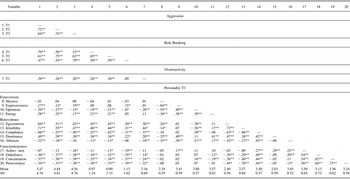
The means, standard deviations, and intercorrelations between aggression, rule breaking, overreactivity, and personality facets are presented in Table 1.
Means, standard deviations, and correlations among aggression, rule breaking, overreactivity, and personality facets

Note: T1–3, Times 1–3; Achiev. mot., achievement motivation.
*p < .05. **p < .01.
Trajectories of aggression and rule breaking
In order to answer our first research question concerning the number of distinct developmental trajectories of aggressive and rule-breaking behavior from age 9 to 15, we modeled separate latent classes of aggressive and rule-breaking behavior over three measurement waves using GMM.
Aggression
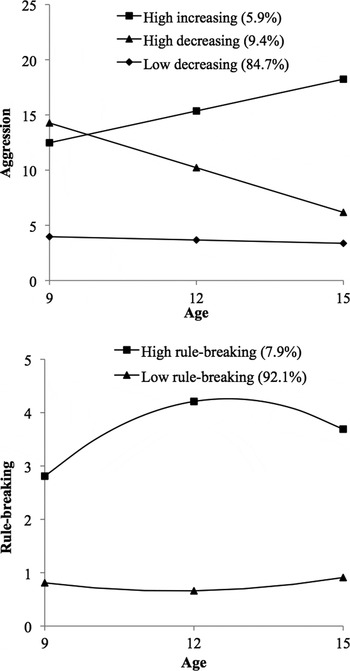
For aggressive behavior, results indicated that a three-class solution fitted best to the data (log likelihood = –2,039.25, BIC = 4,146.53, LRT = 64.28, p < .05), as the BIC for this solution was smaller than that of the two-class solution (log likelihood = –2,073.27, BIC = 4,197.58, LRT = 84.30, p < .01) and the four-class solution (log likelihood = –2,031.81, BIC = 4,148.66, LRT = 14.06, p = .59). In addition, the aLRT indicated that adding a third class significantly improved model fit over the two-class model, but adding a fourth class did not result in an improvement of the model. Moreover, the four-class solution contained a class with only 3% of the sample (n = 9), and added a class that was highly comparable to one of the three classes of the three-class solution. The final three-class solution included a significant linear slope for all three classes, but no quadratic slope because the means of a quadratic slope were not significant in any of the three classes. Entropy for this solution was high (0.91). The graphical presentation of the aggression trajectories is shown in Figure 1. The first trajectory class (85%, n = 249) consisted of participants with low and decreasing levels of aggressive behavior throughout the transition from childhood to adolescence. Hence, this class was labeled the low decreasing class (intercept: M = 3.97, SE = 0.25, p < .001; linear slope: M = –0.30, SE = 0.11, p = .005). The second trajectory class (9%, n = 25) showed relatively high initial levels of aggression and a steady decrease of aggression, and was labeled the high decreasing group (intercept: M = 14.27, SE = 1.23, p < .001; linear slope: M = –4.05, SE = 0.75, p < .001). The third trajectory class (6%, n = 16) showed relatively high initial levels of aggression and a steady increase of aggression and was labeled the high increasing class (intercept: M = 12.48, SE = 1.26, p < .001; linear slope: M = 2.88, SE = 0.91, p = .002).
Graphical presentations of the estimated trajectories of (top) aggression and (bottom) rule breaking.

Rule breaking
With regard to rule breaking, a two-class solution was preferred (log likelihood = –1,132.42, BIC = 2,327.22, LRT = 119.51, p < . 01). Although the BIC values for a three-class solution (log likelihood = –1,082.48, BIC = 2,249.00, LRT = 95.68, p = .35) and a four-class solution (log likelihood = –1,042.14, BIC = 2,192.00, LRT = 77.27, p = .16) were lower than the BIC value of the two-class solution, the aLRT showed a nonsignificant improvement for a three-class solution. In addition, the three-class solution contained a class with only 2.8% of the sample (n = 8), and included a class that was comparable to one of the classes indicated in the two-class solution. The final two-class solution included a combination of a linear slope and a quadratic slope, both having significant means in the two classes. Entropy for this solution was high (0.95). The rule-breaking trajectories are presented in Figure 1. The first trajectory class (92%, n = 269) consisted of children with low levels of rule breaking throughout the transition from childhood to adolescence; hence, this trajectory was labeled the low rule-breaking class (intercept: M = 0.81, SE = 0.07, p < .001; linear slope: M = –0.35, SE = 0.10, p < .001; quadratic slope: M = 0.20, SE = 0.05, p < .001). The second trajectory class (8%, n = 21) displayed moderate rule breaking in childhood, a subsequent increase following a curved shape, and was labeled the high rule-breaking class (intercept: M = 2.81, SE = 0.39, p < .001; linear slope: M = 2.36, SE = 0.67, p < .001; quadratic slope: M = –0.96, SE = 0.38, p = .012). Eight out of 25 children in the high decreasing aggression class were also in the high rule-breaking class. Nine out of 16 children in the high increasing aggression class were also in the high rule-breaking class. Cross-tab analyses further confirmed that participants in these classes were significantly nonoverlapping, χ2 (2) = 91.80, p < .001.
Predicting class membership with personality facets, overreactivity, and their interactions
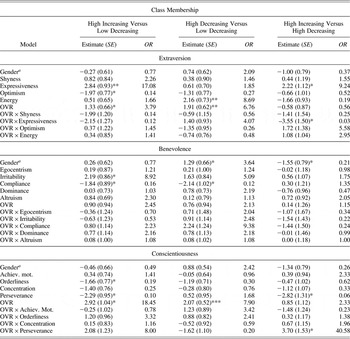
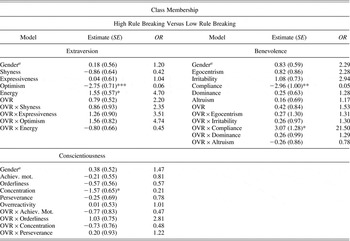
To examine whether personality facets, overreactivity, and their interactions could predict class membership, we conducted separate multinomial logistic regression analyses for each of the three Big Five factors for both aggression and rule breaking. Thus, all facets of one personality factor (e.g., extraversion), overreactivity, their interactions, and gender were entered in one model at the same time. Tables 2 and 3 show the regression coefficients and odds ratios for aggression and rule breaking, respectively.
Parameter estimates and odds ratios for predictors of class membership for aggression

Note: N = 290. OVR, Overreactivity; Achiev. mot., achievement motivation.
a Gender was coded as girls = 0 and boys = 1.
*p < .05. **p < .01. ***p < .001.
Parameter estimates and odds ratios for predictors of class membership for rule breaking
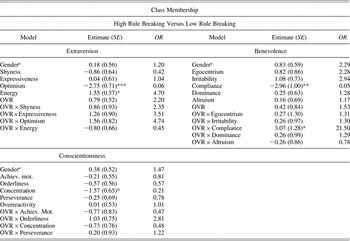
Note: N = 290. OVR, Overreactivity; Achiev. mot., achievement motivation.
a Gender was coded as girls = 0 and boys = 1.
*p < .05. **p < .01. ***p < .001.
Predicting class membership for aggression
For aggression, the low class was chosen as the reference class, to determine how children following the high increasing or decreasing class differed from those following a low trajectory. In line with our hypotheses, boys were more likely to follow the high decreasing trajectory than were girls. We subsequently examined the predictive value of personality facetsFootnote 2 and found that children in the high increasing trajectory were more expressive and less optimistic (extraversion facets); more irritable and less compliant (benevolence); and less persevering and less orderly (conscientiousness) at T1. Children in the high decreasing trajectory class showed significantly higher energy scores (extraversion) and less compliance (benevolence). In addition, we contrasted the high increasing versus high decreasing trajectories of aggression, which revealed that children in the high increasing trajectory class were more expressive (extraversion), but had less perseverance (conscientiousness). While the current study focused explicitly on facets of the extraversion, benevolence, and conscientiousness personality domains, we also explored whether facets of the emotional stability and imagination personality domains predicted class membership of aggression. These results revealed that children in the high increasing aggression trajectory class showed significantly lower scores on intellect (a facet of imagination) compared to the low decreasing aggression class (odds = 0.30, p = .036). This result is consistent with literature showing that aggression is linked to lower cognitive ability (Loeber & Hay, Reference Loeber and Hay1997). No other facets of the emotional stability and imagination domains were related to the odds of following the high increasing or high decreasing trajectories of aggression. Means, standard deviations, and intercorrelations between aggression, rule breaking, overreactivity, and personality facets of all Big Five domains are presented in online-only Supplementary Table S.1.
We then examined the predictive value of parental overreactivity. Children in the high increasing and high decreasing trajectory classes of aggression had parents reporting higher overreactivity at T1 compared with the low class. Overreactivity did not predict the high increasing aggression trajectory compared with the high decreasing aggression trajectory. When looking at the interactions between overreactivity and personality facets, we found two significant interactions when we compared the high increasing trajectory with the high decreasing trajectory. Contrary to our expectations, results showed that children's expressiveness (extraversion) moderated the relation between overreactivity and the odds of following the high increasing trajectory. Higher T1 overreactivity decreased the odds of following the high increasing trajectory but only when children had high scores (1 SD above the mean) on expressiveness (odds = 0.07, p = .006). Overreactivity was not related to the odds of following the high increasing trajectory when children showed average (odds = 0.56, p = .508) or low (1 SD below the mean; odds = 4.56, p = .301) levels of expressiveness. In addition, Overreactivity × Perseverance was significant when comparing the high increasing versus high decreasing trajectories, but subsequent analyses at different levels of perseverance revealed nonsignificant results. No significant interactions were found when comparing the high increasing and high decreasing aggression trajectories with the reference class. The proportion of explained variance ranged from 40% to 53% (Nagelkerke R 2).
Predicting class membership for rule breaking
With respect to rule breaking, the low rule-breaking class served as the reference class to determine how children following the high rule-breaking trajectory differed from those following the low rule-breaking trajectory. In contrast with our hypotheses, no gender differences were found for class membership. In examining the personality facets, the results indicated that children following the high rule-breaking trajectory were less optimistic and more energetic (extraversion facets), less compliant (benevolence), and less able to concentrate (conscientiousness). In addition, exploratory analyses revealed that facets of the emotional stability and imagination personality domains did not predict class membership for rule-breaking behavior.
Parental overreactivity was not predictive of class membership in the high rule-breaking class. However, regarding the interaction between overreactivity and personality facets, we found one significant interaction in which children's compliance moderated the predictive value of overreactivity. For this analysis with a binary outcome (i.e., high rule breaking vs. low rule breaking), we were able to use the SPSS macro from Hayes and Matthes (Reference Hayes and Matthes2009) to test the predictive value of overreactivity at different values of children's compliance. In contrast to our expectations, overreactivity at T1 increased the odds of following the high rule-breaking trajectory for highly compliant children (at and greater than 1.17 SD above the mean; odds = 55.59, p = .046), but not for children with average compliance scores (odds = 1.70, p = .541). Contrary to our expectations, overreactivity decreased the odds of following the high rule-breaking trajectory class for children with low compliance scores (at and lower than 0.78 SD below the mean; odds = 0.14, p = .047). The proportion of explained variance ranged from 24% to 43% (Nagelkerke R 2).
Because the low trajectory groups for aggression and rule breaking included such a large proportion of the sample (N = 249 and 269 for the low aggression and rule-breaking classes, respectively), we also investigated whether personality facets predicted variance within these groups. For these analyses, we conducted 18 multiple regression analyses predicting the continuous aggression and rule-breaking scores at T1, T2, and T3 from the personality facets. In order to examine the developmental trajectories of aggression and rule-breaking behavior over time, as modeled with our GMM analyses, we controlled for previous aggression and rule-breaking scores in the regression analyses.Footnote 3
With respect to aggression, results showed that at T1, variance within the low trajectory class could be predicted with personality facets (expressiveness, optimism, energy, egocentrism, irritability, compliance, dominance, achievement motivation, and orderliness). However, there were only two predictors for change in aggression (shyness from T1 to T2, and energy from T2 to T3). Concerning variance at T1 within the low rule-breaking behavior class, optimism, energy, compliance, dominance, achievement motivation, and orderliness predicted variance in rule-breaking behavior at T1. However, only shyness, egocentrism, and perseverance from T1 to T2 were significant predictors for change in rule breaking, and gender predicted change in rule breaking from T2 to T3. In summary, shyness and energy were found to predict variance in the development of aggression within the low trajectory class. Moreover, shyness, egocentrism, and perseverance predicted significant variance in the development of rule-breaking behavior.
Discussion
In this study, we examined child personality facets, overreactive parenting, and their interaction as predictors of aggression and rule-breaking trajectories during the transition from childhood to adolescence (ages 9–15 years) in a large community sample. We found three and two trajectories for aggression and rule breaking, respectively. Moreover, we identified unique relationships between lower order personality facets, overreactive parenting, and the interaction between these two as antecedents of developmental trajectories of aggression and rule-breaking behavior.
Developmental trajectories of aggression and rule breaking
Consistent with our predictions based on the Jennings and Reingle (Reference Jennings and Reingle2012) review, we identified three trajectory classes for aggression showing different developmental patterns: a low decreasing trajectory, a high decreasing trajectory, and a high increasing trajectory. Previous research found that aggression typically shows a decline across the childhood and adolescent years, with most children displaying low and decreasing levels of aggression (Broidy et al., Reference Broidy, Nagin, Tremblay, Bates, Brame and Dodge2003), and our results replicate this finding. In line with previous research (Broidy et al., Reference Broidy, Nagin, Tremblay, Bates, Brame and Dodge2003), we identified an increasing trajectory of aggression, reflecting a group of escalators during the transition from childhood into adolescence (Jennings & Reingle, Reference Jennings and Reingle2012): these children already showed relatively high levels of aggression in childhood, which further increased into adolescence. Our data help identify and describe that group of youth.
With respect to rule breaking, we found two trajectory classes, revealing different developmental patterns: a low trajectory and a high rule-breaking trajectory, the latter following a curved developmental trajectory with highest rule-breaking behavior at age 12. These trajectories were partially consistent with previous research that found that most children show no or low rule breaking throughout childhood and adolescence, and a small group of children display moderate childhood rule-breaking levels that increase into adolescence (Jennings & Reingle, Reference Jennings and Reingle2012). The high rule-breaking trajectory supports Loeber et al.'s (Reference Loeber, Wung, Keenan, Giroux, Stouthamer-Loeber and Welmoet1993) perspective on the development of delinquent careers because these children displayed a sharp increase in rule-breaking behavior during the transition into adolescence. However, we expected to find one or two moderate rule-breaking classes as well (cf. Bongers et al., Reference Bongers, Koot, van der Ende and Verhulst2004). One possibility that might explain the discrepancy in the number of classes concerns a lack of power to identify more classes in the current study. Previous studies generally included over 1,000 participants, increasing the power to identify additional classes (Jennings & Reingle, Reference Jennings and Reingle2012). Alternatively, the lower number of rule-breaking trajectories identified in our study might have been the result of our statistical approach. While previous research mainly used latent class growth curve analyses to identify subgroups of children, our GMM is considered to facilitate a more realistic representation of complex data because it allows for within-class variation (Muthén, Reference Muthén2006). Because latent class growth curve analysis does not allow for within-class variance in intercept and slope, this method often results in more classes compared with GMM (Jung & Wickrama, Reference Jung and Wickrama2008). However, even with only the low and high rule-breaking trajectory groups, it was possible to examine important personality facets and parenting predictors to clarify the nature of these groups.
Predicting aggression and rule breaking from youth's personality facets, parental overreactivity, and the interactions between the two
Child personality facets: Main effects
An important contribution of this study is that several childhood personality facets were found to predict different trajectories of aggression and rule breaking during the transition into adolescence. Consistent with our hypotheses, the children following different trajectories for aggression and rule-breaking behavior differed in their average levels of specific personality trait facets, supporting the validity of the groups.
Three personality facets were found to be risk factors for different trajectories of aggression as well as for high rule breaking. First, children, in the high increasing aggression class and children in the high rule-breaking class were less optimistic in childhood. The optimism personality facet involves whether children see the sunny side of things and whether they evoke sympathy of their peers. Less optimistic children, who may evoke less sympathy from their peers, may have inadequate coping skills necessary to successfully make the transition to secondary school (Ozer & Benet-Martínez, Reference Ozer and Benet-Martínez2006). Consistent with this interpretation, children with less optimism are found to display more hostility when entering secondary school (Boman & Yates, Reference Boman and Yates2001), which might lead to increasing levels of aggression and rule breaking. It may be that these children's lower optimism is a social adaptation to previous negative peer and or parenting experiences, resulting in more hostility and less optimism (MacKinnon-Lewis, Lindsey, Frabutt, & Chambers, Reference MacKinnon-Lewis, Lindsey, Frabutt and Chambers2014). Second, consistent with our predictions, children in the high decreasing aggression class and children in the high rule-breaking class were more energetic at age 9. Although children in the high decreasing aggression class were acting out and showed difficulties in regulating their behavior in childhood, they may have learned to better regulate their own behaviors because of the normative increase in self-regulation skills that occurs in adolescence (King, Lengua, & Monahan, Reference King, Lengua and Monahan2013). However, more energy was also a risk factor for the high rule-breaking class; youth with higher energy may also be higher in novelty seeking and sensation seeking, traits that are associated with higher rates of rule breaking (Muris, Meesters, de Kanter, & Timmerman, Reference Muris, Meesters, de Kanter and Timmerman2005). It may be that, although most children desist from overt aggressive behaviors in childhood, some begin to display covert rule breaking in adolescence, reflecting a pattern of heterotypic continuity from aggression to rule breaking (Broidy et al., Reference Broidy, Nagin, Tremblay, Bates, Brame and Dodge2003). Third, our study further confirmed that low compliance in childhood was a risk factor for all trajectories with elevated levels of aggression and rule-breaking behavior. Such children are characterized by unmanageability and are resistant to control, which challenges parental attempts to stop or redirect the behavior of the child (Rothbart & Bates, Reference Rothbart, Bates, Damon, Lerner and Eisenberg2006).
We also identified personality facets that uniquely predicted trajectories of aggression or rule breaking. First, our results indicate that expressiveness in childhood was a unique risk factor for increasing aggression in adolescence. It may be that highly expressive children feel less inhibited about showing aggressive behavior when transitioning to adolescence. Moreover, expressive children may want to explore social boundaries and may have, for example, more arguments with their parents than less expressive children. Second, more irritability in childhood was a unique risk factor for increasing aggression but not for covert behaviors such as rule breaking (Burt, Reference Burt2012). Irritable children may show tendencies toward anger and frustration and deficits in their emotion regulation, which put them at risk for increasing levels of aggressive behavior (Frick & Morris, Reference Frick and Morris2004). Third, lower orderliness and perseverance were also unique risk factors for the development of high increasing aggression. Previous studies showed that a lack of orderliness and perseverance relate to lower school performance (Smith et al., Reference Smith, Fischer, Cyders, Annus, Spillane and McCarthy2007), which may lead to frustration and a subsequent increase of aggressive behavior. Fourth, low concentration was a unique risk factor for the development of rule breaking. Low concentration may represent a tendency for low constraint, making these children vulnerable to develop rule-breaking behavior into adolescence (Burt, Reference Burt2012). This finding is consistent with research showing that children diagnosed with attention-deficit/hyperactivity disorder, which is marked by poor concentration, are at risk for the development of rule-breaking behaviors in adolescence (American Psychiatric Association, 2013). In sum, our results support the vulnerability model for personality trait–psychopathology links (Shiner & Caspi, Reference Shiner and Caspi2003) by showing that children's personality facets are important risk factors for particular trajectories for both aggression and rule breaking. We also found that personality facets could differentiate between children at risk for aggression or rule-breaking behavior.
Overreactive parenting: Main effects and moderation by personality
Parental overreactivity uniquely predicted membership in the high increasing and high decreasing aggression groups, relative to the low aggression group, but not group membership for rule breaking. This connection between overreactivity and aggression is consistent with Patterson's (Reference Patterson1982) coercion model. Overreactivity may lead to an unpredictable and inconsistent environment for the child. Consistent with coercion theory, overreactive parents may negatively reinforce their children's aggressive tendencies by taking away their demands when children respond to them with hostility. This in turn may predispose children to follow trajectories with higher levels of aggressive behavior. Contrary to our expectations, overreactivity did not predict high rule breaking. Further research will be needed to clarify this null result.
In addition, we found some support for the goodness-of-fit model (Thomas & Chess, Reference Thomas and Chess1977) by showing that the effect of overreactivity on aggression and rule breaking was dependent in some cases upon the fit between the parenting environment and the child's personality traits. Specifically, we found that parental overreactivity decreased the likelihood of following the high increasing aggression trajectory compared to the high decreasing aggression trajectory, but only for highly expressive children. This seems counterintuitive. However, for highly expressive children, reactive parenting may actually be effective to control their aggressive behavior. Comparable results have been found for dysregulated children, who were less likely to develop externalizing problems if mothers were high in reactive control compared to low levels of reactive control (Bates et al., Reference Bates, Pettit, Dodge and Ridge1998). Furthermore, we found that overreactivity predicted the high rule-breaking trajectory but only for highly compliant children. It might be that hostility and excessive control impair social development in basically cooperative children (Bates et al., Reference Bates, Pettit, Dodge and Ridge1998). In contrast, low overreactivity was predictive of the high rule-breaking class but only for less compliant children. More research is needed to explain this finding. Our results show that personality facets are linked in meaningful ways to aggression and rule-breaking trajectories and point to the interplay between child and parenting characteristics in predicting the development of aggression and rule breaking.
It is important to note that we tested a total of 39 interactions, and only 2 were significant. Further research will be necessary to assess the replicability of these significant findings because they may have been due to chance. However, consistent with previous research on children's traits and various outcomes (Rothbart & Bates, Reference Rothbart, Bates, Damon, Lerner and Eisenberg2006), this study obtained more widespread evidence for main effects of traits on trajectory membership than interaction effects during the transition into adolescence. Our relatively limited findings of interaction effects may in part have to do with our focus on the transition to adolescence. Although overreactive parenting has been previously linked to childhood externalizing behaviors, especially for children with a difficult temperament (e.g., Prinzie et al., Reference Prinzie, Onghena, Hellinckx, Grietens, Ghesquiere and Colpin2003), this interplay between parent and child characteristics may become less salient when children transition into adolescence because of the relatively greater influence of peers on youth's behavior during adolescence (Brown & Larson, Reference Brown and Larson2009). Children become less dependent upon their parents for help with self-regulation when they transition into adolescence (Galambos & Costigan, Reference Galambos, Costigan, Weiner, Lerner, Easterbrooks and Mistry2003). In addition, the amount of time spent with and influence of peers increases during adolescence, which may also affect the interplay between parent and child characteristics (Brown & Larson, Reference Brown and Larson2009). Despite our finding of only two interaction effects, these should be considered as important because previous studies report that interaction effects are difficult to detect due to measurement error (Aiken & West, Reference Aiken and West1991). Even if two variables are reliable, measurement error is amplified when considering interaction terms, compared with first-order predictors. Therefore, the magnitude of the interaction effect is expected to be an underestimate of the true effect size, which results in an overestimation of direct effects and an underestimation of interaction effects (Aiken & West, Reference Aiken and West1991).
Gender
In line with our expectations and with previous research, boys were more likely to follow trajectories with higher levels of aggression than were girls (e.g., Bongers et al., Reference Bongers, Koot, van der Ende and Verhulst2004). In contrast to our predictions, gender was not a significant predictor of high rule-breaking behavior. However, previous research on rule-breaking behavior reported similar shapes of trajectories of rule-breaking behaviors for boys and girls (e.g., Bongers et al., Reference Bongers, Koot, van der Ende and Verhulst2004). Moreover, gender differences are more consistently found with regard to trajectories of aggression, in which boys are often overrepresented. In contrast, gender differences with regard to trajectories of more covert rule-breaking behaviors may be less likely (e.g., Loeber, Capaldi, & Costello, Reference Loeber, Capaldi and Costello2013). For example, according to Moffitt's (Reference Moffitt1993) dual taxonomy model, boys are more likely to follow the life course persistent trajectory. However, regarding the adolescence-limited trajectory, which includes rule-breaking behaviors, there are fewer differences between boys and girls. Thus, our failure to find gender differences in rule-breaking trajectories may be consistent with some previous research.
Strengths and limitations of the present study
Some limitations of this study need to be recognized. First, we used only parent reports and questionnaires. Correlations between parent reports and child reports are known to be low to moderate, especially for adolescents (Barker, Bornstein, Putnick, Hendricks, & Suwalsky, Reference Barker, Bornstein, Putnick, Hendricks and Suwalsky2007). Therefore, including child reports may more accurately assess child personality, overreactivity, aggression, and rule breaking, and may minimize the potential threat of common-method variance. Second, due to our focus on the transition from childhood to adolescence, we were able to only use three measurement waves with 2-year intervals. The inclusion of more waves, using smaller time intervals, may provide more reliable estimations of the developmental trajectories (Muthén, Reference Muthen and Kaplan2004). Third, future research should assess indirect/relational aggression, because these covert types of aggression are more often displayed when children enter adolescence (Brame et al., Reference Brame, Nagin and Tremblay2001).
Fourth, research on the relations between personality and problem behavior has been criticized by stating that these associations result primarily from item overlap. However, Prinzie et al. (Reference Prinzie, Onghena, Hellinckx, Grietens, Ghesquiere and Colpin2003) found that the Big Five personality traits and adjustment problems are conceptually and empirically distinct. Specifically, Prinzie et al. showed that removal of possibly confounded items did not affect the pattern of relations between personality factors and adjustment, thereby demonstrating that item contamination of Big Five traits with adjustment behavior measures is rather limited.
Fifth, some additional personality facets may be meaningful predictors of aggression and rule breaking but did not reach significance in this study. Therefore, future replication of our findings is necessary. Even though this study provides a unique longitudinal perspective on the development of externalizing behaviors across the transition from childhood into adolescence in an adolescent sample from the general community, this study was conducted on a relatively small sample (N = 290) with even smaller subgroups. Therefore, future research with a larger sample is suggested. In addition, further research is needed to investigate whether our findings can be generalized to samples that can be considered more at risk for the development of externalizing behaviors.
We found relatively small groups of children following higher levels of aggression and rule-breaking trajectories. Because our sample is a community sample, one would not expect to find a large proportion of children following high trajectories of aggression and rule-breaking behaviors. In addition, the identification of small groups of children that are at risk of developing externalizing behaviors can be very important for clinical interventions, not only in terms of personal consequences for the individual child and his or her family, but also in terms of societal costs. Externalizing behaviors are costly for society due to the costs generated by school failure, delinquency, and involvement in the juvenile justice system (Foster, Reference Foster2010), so research pinpointing more specific predictors of externalizing trajectories has potential applied importance.
Sixth, we cannot rule out the influence of unobserved variables, which makes it impossible to make any causal inferences in the present study. Related to these problems of making causal inferences, future studies should investigate the direction of effects between child personality facets and overreactive parenting versus adjustment problems. Considering the direction of effects, it may be possible that child personality facets and overreactive parenting drive changes in the development of externalizing behavior and that changes in externalizing behavior relate to changes in personality and parenting. Future research may benefit from using latent difference score modeling or cross-lagged panel models in order to investigate shaping and elicitation effects during the transition from childhood into adolescence (e.g., Keijsers, Loeber, Branje, & Meeus, Reference Keijsers, Loeber, Branje and Meeus2011; Van den Akker, Deković, Asscher, & Prinzie, Reference Van den Akker, Deković, Asscher and Prinzie2014) including lower order personality facets.
Conclusion
The present study showed that childhood lower order personality facets could predict different trajectories of aggression and rule breaking. Our results reflect the importance of differentiating between different forms and trajectories of externalizing behavior for the investigation of risk factors (Burt, Reference Burt2012), because trajectories of aggression and rule breaking showed some unique relationships with lower order personality facets. In addition, we demonstrated that trajectories of aggression and rule breaking depend on both individual and contextual factors and their interactions. These findings could have practical implications for prevention and intervention programs for children at risk for elevated levels of aggression and rule breaking. For clinicians, information on lower order facets, as compared to broad personality factors, may help to tailor an intervention to specific dispositional traits in order to increase the effectiveness of interventions that help children at risk for the development of aggression and rule breaking (Stoltz et al., Reference Stoltz, Prinzie, De Haan, Londen, De Castro and Deković2013).
Supplementary Material
To view the supplementary material for this article, please visit http://dx.doi.org/10.1017/S0954579415000577.