CHD is one of the important aetiologies of pulmonary arterial hypertension. In a Dutch national registry, 6% of CHD patients had pulmonary arterial hypertension or Eisenmenger syndrome. Reference van der Velde, Vriend, Mannens, Uiterwaal, Brand and Mulder1 In particular, children with complex lesions such as atrioventricular septal defects often develop pulmonary arterial hypertension early in life. Reference Pascall and Tulloh2 Further, trisomy 21 patients may experience rapid progression of pulmonary arterial hypertension regardless of CHD. Reference Yamaki, Horiuchi and Takahashi3 However, the impact of treatment of CHD-pulmonary arterial hypertension in paediatric patients is not certain due to the paucity of evidence and the heterogeneity of the underlying CHD lesions. Reference Galie, Humbert and Vachiery4
Prostacyclin is a highly effective treatment for severe pulmonary arterial hypertension, Reference Barst, Rubin and Long5 and indications for prostacyclin in paediatric pulmonary arterial hypertension are similar to those for adults. Reference Galie, Humbert and Vachiery4 Moreover, in paediatric pulmonary arterial hypertension, including CHD-pulmonary arterial hypertension subcutaneous administration of treprostinil has been found to be safe and effective. Reference Levy, Del Cerro and Nadaud6 Herein, we report the safe introduction and efficacy of subcutaneous treprostinil in a case of CHD-pulmonary arterial hypertension with trisomy 21.
Case presentation
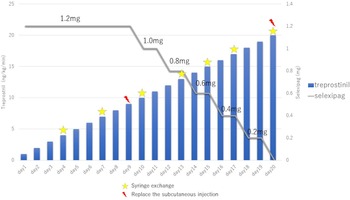
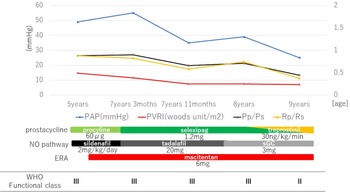
A 2380-g boy delivered at 39 weeks gestation was diagnosed as trisomy 21 by post-natal chromosome analysis. He presented with cyanosis and was referred to our hospital 11 days after birth. Echocardiogram showed complete atrioventricular defects. At 59 days old, he underwent pulmonary artery banding to reduce pulmonary blood flow. Five months after surgery, cardiac catheterisation revealed a high pulmonary artery pressure 43/17 (30) mmHg. Combination therapy with sildenafil and beraprost was initiated, followed by intracardiac repair at 1-year-old. At the age of 5 years, pulmonary arterial hypertension had progressed, he also received an endothelin receptor antagonist and was switched from sildenafil to tadalafil 20 mg dose per day to improve adherence. Furthermore, we also switched an oral prostacyclin analogue from beraprost to selexipag at 7 years old and finally reached 1.2 mg per day for 8 months. The cardiac catheter showed an improvement of pulmonary hypertension (pulmonary artery pressure improved from 71/39 (55) to 43/20 (35) mmHg, pulmonary resistance/systemic resistance improved from 0.82 to 0.58). However, the patient developed intolerable nausea and vomiting was unable to continue taking the selexipag. He then experienced dyspnoea on exertion (WHO functional class III) even though we switched from tadalafil to riociguat 3 mg per day in expectation of positive effect for the patient with pulmonary vessel endothelium lesion. On the other hand, riociguat acts by directly stimulating soluble guanylate cyclase, independent of endogenous nitric oxide, to enhance the production of cGMP. To further improve pulmonary arterial hypertension, we decided to switch from selexipag to subcutaneous treprostinil, which has a longer half-life and is more stable at room temperature than IV prostacyclin. First, the subcutaneous injection site was chosen to be the abdomen, where the pain was most tolerable and did not interfere with daily life. The indwelling needle was changed every 3 days, and the subcutaneous injection site was changed once every 1–3 weeks. The subcutaneous dose of treprostinil was started at 1 ng/kg/minute and increased by 1 ng/kg/minute every 24 hours, and the oral dose of selexipag was reduced by 0.2 mg every 2 days starting on day 10. The goal was to increase the dose of treprostinil to 20 ng/kg/minute and discontinue oral selexipag (Fig 1). No adverse effects were observed during the transition. Under the guidance of the palliative care team, acetaminophen and ibuprofen were administered using a facial pain metre to control pain. As a result of the change, nausea and vomiting have resolved. He was able to climb stairs without shortness of breath and improved from WHO functional III to II. Two months after titration of subcutaneous treprostinil to 30 ng/kg/minute, cardiac catheterisation showed marked improvement in pulmonary arterial hypertension (pulmonary artery pressure 39/12 (25) mmHg; pulmonary resistance/systemic resistance 0.37; Fig 2).
Switching therapy from oral selexipag to subcutaneous treprostinil. The syringe was replaced every 3 days, while the subcutaneous injection site was replaced every 1–3 weeks. Titration of subcutaneous treprostinil was performed over 20 days (1 ng/kg/minute increase every 24 hour). The dose of selexipag was decreased (0.2 mg per 2 days) from 10 days of initiation of subcutaneous treprostinil.

Haemodynamic cardiac catheter data with exercise capacity according to the World Health Organization Functional Class during the transition of specific pulmonary arterial hypertension therapy. Cardiac catheterisation data showed a surprising improvement in haemodynamics and exercise capacity.

Discussion and conclusions
Post-operative pulmonary artery hypertension associated with CHD is defined as persisting immediately after CHD surgery or recurring and developing months to years after surgery despite the absence of significant post-operative haemodynamic lesions. Reference Zuckerman, Leaderer, Rowan, Mituniewicz and Rosenzweig7 In particular, patients with complex lesions such as atrioventricular septal defects or truncus arteriosus often develop pulmonary artery hypertension early in life. Reference Pascall and Tulloh2 Similarly, newborn infants with trisomy 21 have a high risk of developing severe persistent pulmonary hypertension at birth, and often exhibit a more aggressive pulmonary vascular disease secondary to CHD or airway obstruction than for patients without trisomy 21. Reference Rosenzweig, Abman and Adatia8 The specific CHD-pulmonary artery hypertension treatment strategy is largely based on the clinician’s experience rather than evidence-based data. There are only a few randomised trials in paediatric CHD-pulmonary artery hypertension patients. In this case, the patient received a limited effect with specific triple oral combination therapy and significant adverse effect occurred with selexipag. Therefore, he required alternative therapy such as an IV prostacyclin, which has the potential to improve pulmonary haemodynamics and exercise capacity in CHD-pulmonary artery hypertension patients. However, IV prostacyclin has short half-life and requires permanent central venous access, which increases the risk of systemic embolism in patients with an obligatory right-to-left shunt, and of catheter-related bloodstream infections. Reference Rosenzweig, Kerstein and Barst9 We felt that this therapy was also unsuitable for this young patient due to the high risk for self-removal of the indwelling central venous catheter due to his intellectual disability. Treprostinil is a tricyclic benzidine analogue with a longer half-life and increased stability at room temperature. It was recently shown to be safe and effective in paediatric PAH. Reference Levy, Del Cerro and Nadaud6 However, the effectiveness in 21 trisomy patients remains unknown. Of interest, treprostinil was found to be safe and effective in adult CHD-pulmonary artery hypertension patients. Reference Skoro-Sajer, Gerges and Balint10 Thus, we elected to use treprostinil instead of IV prostacyclin in this case. The introduction and titration of subcutaneous treprostinil was successful and associated with positive clinical and haemodynamic effects.
In conclusion, this is the first report on improving haemodynamics and exercise capacity by a transition from oral selexipag to subcutaneous treprostinil in a trisomy 21 patient with CHD-PAH in addition to oral macitentan and riociguat. Subcutaneous treprostinil may be an effective alternative to intravenous prostaglandin I2 products. It should be noted that in order to successfully administer subcutaneous treprostinil to trisomy 21 patients with intellectual disability, it is important to carefully manage pain and collaborate with multi-disciplinary team.
Acknowledgements
We thank Edanz Group (https://en-author-services.edanzgroup.com/) for editing a draft of this manuscript.
Financial support
The authors have no funding concerning this case report.
Conflicts of interest
The authors have no financial conflicts of interest to disclose concerning this case report.
Ethics standards
We obtained domestic ethical committee approval from Nagano Children’s Hospital (Approval No. K-02-18).