Phosphorus (P) ranks just behind hydrogen, oxygen, carbon and nitrogen (H, O, C and N) in a quantitative list of the most important elements in biology (Voet & Voet Reference Voet and Voet1990). However, P is usually less available to life than these other elements, particularly in the oceans. H and O are available in any aqueous solution, while C and N can be found in gaseous compounds that are readily distributed through the atmosphere and that can be converted into highly soluble chemical forms. Although there is some speculation about extraterrestrial input of P to Earth, early life may have been mainly dependent on crustal elemental sources (Pasek Reference Pasek2008). In contrast, while P is a relatively common element in the Earth's crust (0.1% by weight) (Winter Reference Winter2007), there is no gas phase P compound analogous to CO2, CH4, N2 or NH3, and common phosphate minerals such as apatite (Ca5(PO4)3(OH, F, Cl)) are only sparingly soluble (Stumm & Morgan Reference Stumm and Morgan1996). The distribution of bioavailable P at the Earth's surface is therefore extremely heterogeneous. Although there is some speculation about extraterrestrial input of P to Earth, early life may have been mainly dependent on crustal elemental sources (Pasek Reference Pasek2008). In this way, P is similar to many of the so-called ‘micronutrient’ elements that are required in biology in trace amounts (e.g. Fe, Cu, Mn and Zn). As a result, the distribution of life at the Earth's surface is often determined by the distribution of P, which is why phosphate (PO43−) fertilizers are commonly used to compensate for low P concentrations.
Twenty years ago, Westheimer explained why life as we know it is based on P (Westheimer Reference Westheimer1987). A critical feature is the acid–base chemistry of P in the 5+ oxidation state (P(V)) in the form of phosphoric acid (H3PO4), which dictates that the dominant soluble forms of P at biological pH ( 7–8) are the charged species H2PO4−, HPO42− and PO43− (collectively, these species and H3PO4 are referred to as ‘inorganic phosphorus’ or Pi). Charged molecules are more easily contained within lipid membranes than are uncharged molecules, and hence evolution selected for biomolecules that include functional groups derived from Pi and other weak acids such as carboxylic acids and amino acids (Davis Reference Davis1958). However, Pi is unique even among these weak acids because it can maintain a negative charge at physiological pH even when bonded to two other molecular units. Hence, as the building block for adenosine triphosphate (ATP) and adenosine diphosphate (ADP), Pi prevents chemically stored energy from escaping the cell. Similarly, the repeating phosphodiester linkages in deoxyribonucleic acid (DNA) effectively make DNA a polyanion, so that Pi helps cells retain the genetic material. The negative repeating charge of DNA is also a key factor in its physical stability in the way it prevents folding of the linear strand, thereby protecting template-like behaviour (Benner & Hutter Reference Benner and Hutter2002). Hence, Pi is well suited as a component of both metabolic and genetic molecules.
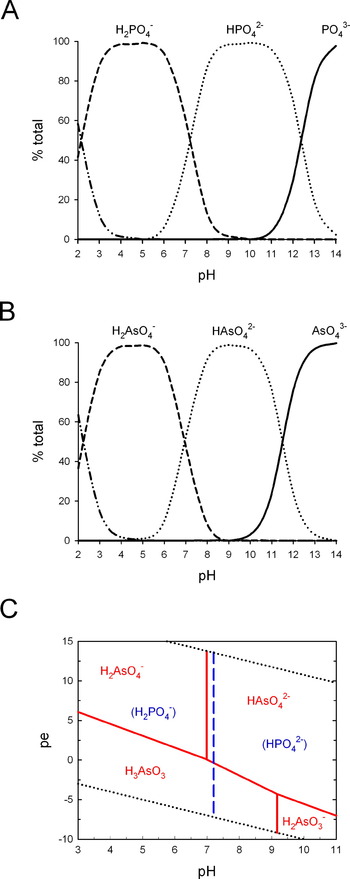
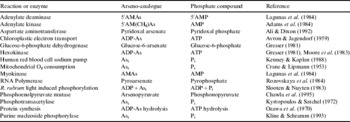
However, other elements share key chemical properties with P. Of these arsenic (As) in the (V) oxidation state warrants closer inspection. Inorganic As(V), like P(V), is negatively charged over a range of physiological pH conditions, as H2AsO4−, HAsO42−, or AsO43− (i.e. arsenate or Asi). In fact, the dissociation constants for H3AsO4 are so similar to those of H3PO4 that Asi and Pi follow strikingly similar speciation patterns (Figure 1A and B). Also, like Pi, Asi is capable of retaining a negative charge even when it bonds to two other molecules. Owing to these similarities, known life cannot easily distinguish between Asi and Pi. Thus, arsenate is taken up by cells via phosphate transporters and can substitute for Pi in the early steps of many Pi-based metabolic pathways (Braunstein Reference Braunstein1931; see Table 1). For example, As is generally thought to decouple oxidative phosphorylation, the production of ATP using energy released by oxygen-consuming redox reactions, because no ATP is produced in phosphate-depleted, arsenate-rich mitochondrial particles even though oxygen uptake continues. This observation suggests that arsenate substitutes for phosphate in the early steps of this process (Crane & Lipmann Reference Crane and Lipmann1953). These similarities account in large measure for the biological toxicity of Asi.
pH and redox potential (pe) are the most important factors controlling arsenic speciation. Phosphate (A) and arsenate (B) speciation are shown as a function of pH for the (V) oxidation states. H3PO4 or H3AsO4 (dashed and dotted line), H2PO4− or H2AsO4− (dashed line), HPO42− or HAsO42− (dotted line) and PO43− or AsO43− (solid line) are all indicated as a percentage of total Pi or Asi. The distribution curves in (A) and (B) show that Asi and Pi have similar charge and speciation under biologically relevant pH (Westall et al. Reference Westall, Zachary and Morel1976; Allison et al. Reference Allison, Brown and Novo-Gradac1991; Serkiz et al. Reference Serkiz, Allison, Perdue, Allen and Brown1996). Redox speciation is shown on a pe-pH diagram for aqueous arsenic species (C) in the systems P–O2–H2O and As–O2–H2O at 25°C and 1 bar total pressure. Arsenic (solid lines) and phosphorus (dashed line) species have been overlaid within the bounds of the O2–H2O redox couple (dotted lines). On such a diagram, phase boundaries represent the conditions at which the activities of the species on each side of the boundary are equal (Morel & Hering Reference Morel and Hering1993; Smedley & Kinniburgh Reference Smedley and Kinniburgh2002). Under dysoxic conditions (pe≈0) and at neutral to mildly alkaline pH, the dominant As species is HAsO42− suggesting that it would be present under conditions possibly relevant to the early evolution of life on Earth.

Evidence of arsenate substitution for phosphate by modern, extant biochemical processes

Why, despite these similarities, has the possibility of As-based life been discounted? The primary chemical objection is that Asi-based compounds hydrolyse much more rapidly than their Pi counterparts (Westheimer Reference Westheimer1987). In particular, polyarsenates hydrolyse orders of magnitude faster than do polyphosphates. However, this objection is not decisive. For example, the same type of problem exists for nucleic acids. As we shall argue, chemically exceptional aquatic environments and natural selection both offer solutions, particularly when considered in the context of prebiotic chemistry and the evolution of early life (Levy & Miller Reference Levy and Miller1998). Similar logic could apply here.
The relative instability of polyarsenates does not rule out a role for Asi in environments in which it is present at much higher concentrations than Pi. Such settings could sustain elevated steady-state concentrations of polyarsenates and other As-based biomolecules versus P-based analogues despite the faster reaction rates of the former. Intriguingly, such environments include both terrestrial and deep-sea hydrothermal systems (Von Damm Reference Von Damm1990; Wilkie & Hering Reference Wilkie and Hering1998; Langner et al. Reference Langner, Jackson, McDermott and Inskeep2001) where life is conjectured to have originated (Corliss et al. Reference Corliss, Dymond, Gordon, Edmond, von Herzen, Ballard, Green, Williams, Bainbridge and Crane1979; Martin & Russell Reference Martin and Russell2003) and where the last common ancestor may have avoided surface-sterilizing meteor impacts of the Late Heavy Bombardment (Maher & Stevenson Reference Maher and Stevenson1988; Miller & Bada Reference Miller and Bada1988; Sleep & Zahnle Reference Sleep and Zahnle1998). In these systems, As and many other elements react with hydrogen sulphide to precipitate as sulphide minerals, forming the famous ‘chimneys’ of undersea ‘black smoker’ volcanoes. The surfaces of these minerals, rich in bioessential trace metals and S, and bathed in fluids containing dissolved volatiles such as CO2 and N2 (Forrest et al. Reference Forrest, Ledesma-Vázquez, Ussler, Kulongoski, Hilton and Greene2005), are widely recognized as a promising environment for prebiotic catalytic chemistry and early life (Schoonen & Xu Reference Schoonen and Xu2001; Brandes & Devol Reference Brandes and Devol2002). Importantly, As, unlike P, forms sulphide minerals, rendering it far more accessible than P for (bio)chemical reactions occurring on hydrothermal sulphide mineral surfaces. Although present in these minerals in a highly reduced form, arsenite (AsO33−) and arsenate are thermodynamically and kinetically stable even in anoxic waters at pH>7, as long as the concentration of sulphide is low (Berner Reference Berner1981; Smedley & Kinniburgh Reference Smedley and Kinniburgh2002; Oremland et al. Reference Oremland, Stolz and Hollibaugh2004). Such chemical conditions probably typified the Archean oceans (Canfield Reference Canfield2005), so that Asi could have been available near the surfaces of As-rich sulphide minerals where As sulphides dissolved in seawater.
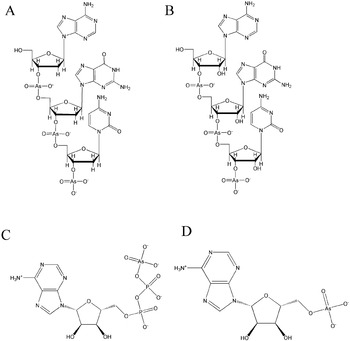
If arsenate is present then, in striking contrast to their Pi analogues, Asi biomolecules indeed form spontaneously. For example, in vitro mixtures of adenosine (or a deoxy analogue) and Asi readily form As-nucleosides and As-nucleotides (Lagunas et al. Reference Lagunas, Pestana and Diez-Masa1984) (Figure 2). Furthermore, these synthetic 5′AMAs can substitute for 5′AMP in reactions catalysed by the enzymes myokinase and adenylate deaminase (Lagunas et al. Reference Lagunas, Pestana and Diez-Masa1984). Thus, rapid hydrolysis per se may be unproblematic in environments rich in As, as key molecules can be quickly replenished.
Examples of both described and yet undetected arsenate containing biological molecules (at pH 7): (A) As-deoxyribonucleic acid (As-DNA); (B) As-ribonucleic acid (As-RNA); (C) adenosine diphosphate arsenate (ADP-As); and (D) adenosine monoarsenate (AMAs).

It is interesting to speculate that the reactivity of polyarsenates versus polyphosphates might have actually been a virtue in prebiotic chemical systems or ancestral organisms. Owing to the stability of Pi compounds, all known organisms require sophisticated enzymes to catalyse the removal or addition of Pi (phosphatases and kinases, respectively). Asi compounds might have needed less sophisticated molecular machinery to fulfil their biochemical roles in ancient systems, facilitating the development of Pi-like metabolism. It is perhaps no coincidence that it is relatively simple, through site-directed mutagenesis, to change an arsenate reductase to a phosphatase (Rosen Reference Rosen2002). One interpretation of this similarity is that reductases derive from phosphatases. However, an equally plausible interpretation is that the fundamental biochemistry of Pi-based life emerged in an As-rich environment.
Natural selection could have stabilized Asi biomolecules, analogous to the ways that Pi-bearing biomolecules have evolved stability against hydrolysis. The phosphodiester bonds of ribonucleic acid (RNA), for example, are stabilized in vivo by 5′ and 3′ end modifications as well as by numerous protein interactions (Deana & Belasco Reference Deana and Belasco2005; Slomovic et al. Reference Slomovic, Laufer, Geiger and Schuster2005; Petrillo et al. Reference Petrillo, Silvestro, Nocera, Boccia and Paolella2006). Without these mechanisms, the phosphodiester linkages to ribose hydrolyse within seconds under biological conditions (Lindahl Reference Lindahl1993; Selinger et al. Reference Selinger, Saxena, Cheung, Church and Rosenow2003). Moreover, in vitro studies replicating thermophilic environments where early life may have resided show the rate of RNA hydrolysis steadily increases as temperature rises from 65 to 100°C (Eigner et al. Reference Eigner, Boedtker and Michaels1961), approaching reaction rates which are comparable to those for short strands of polyarsenates (Kawamura Reference Kawamura1999, Reference Kawamura2001a,Reference Kawamurab; Nagahama & Kawamura Reference Nagahama and Kawamura2002; Kawamura et al. Reference Kawamura, Nagahama and Kuranoue2005). It is therefore plausible that As-based life emerged in As-rich environments and, once established, evolved strategies that would enable it to persist.
A second objection to As raised by Westheimer is that it is easily reduced from As(V) to As(III), whereas P is rarely reduced from P(V) at the Earth's surface (Westheimer Reference Westheimer1987). Although this difference poses some challenges to As-based metabolism, it also implies some benefits because the redox properties of As provide possible bioenergetic pathways. Indeed, some extant microorganisms exploit this metabolic opportunity (Stolz & Oremland Reference Stolz and Oremland1999; Rosen Reference Rosen2002; Bhattacharjee & Rosen Reference Bhattacharjee, Rosen, Nies and Silver2007). Asi can serve as an electron acceptor by anaerobic heterotrophic bacteria that oxidize reduced carbon and produce arsenite (Dowdle et al. Reference Dowdle, Laverman and Oremland1996; Stolz & Oremland Reference Stolz and Oremland1999; Oremland et al. Reference Oremland, Newman, Kail, Stolz and Frankenberger2002; Oremland & Stolz Reference Oremland and Stolz2003), in chemolithoautotrophic arsenite oxidizers that fix inorganic carbon and produce arsenate (Ehrlich Reference Ehrlich2002) or in cyanobacteria and purple bacteria that use arsenite as an electron donor in anaerobic photosynthesis (Kulp et al. Reference Kulp, Hoeft, Asao, Madigan, Hollibaugh, Fisher, Stolz, Culbertson, Miller and Oremland2008). Therefore, far from being a liability, the redox character of As potentially makes it more biochemically versatile than P.
Once life ventured forth from its As-rich primordial home, the balance of advantage probably tipped in favour of P because P is typically 10 000 times more abundant than As at the Earth's surface. However, As-based life could even survive today in restricted pockets where As is present in abundance, such as shallow and deep-sea hydrothermal systems or at Mono Lake (Von Damm Reference Von Damm1990; Pilcher et al. Reference Pilcher, Veizer and Hall1999; Oremland et al. Reference Oremland, Newman, Kail, Stolz and Frankenberger2002, Reference Oremland, Stolz and Hollibaugh2004; Roesler et al. Reference Roesler, Culbertson, Etheridge, Goericke, Kiene, Miller and Oremland2002).
In conclusion, there seems to be no knockout argument against As-based life, and considerable circumstantial evidence to suggest its plausibility. In recent years, astrobiologists have devoted considerable attention to exploring the possibility of alternative forms of extraterrestrial life (dubbed ‘weird life’) (Baross Reference Baross2007). Curiously, little thought has been devoted to the possibility that the Earth may have once also harboured weird life. It is a tantalizing prospect that an ancestral, alternative form of life might even continue to lurk in modern As-rich Earth habitats forming an extant ‘shadow biosphere’ (Cleland & Copley Reference Cleland and Copley2006; Davies et al. Reference Davies, Benner, Cleland, Lineweaver, McKay and Wolfe-Simon2009). A search of such environments would seem to be a promising initial step to test this hypothesis. In view of the extensive consideration given to the possibility of emergent life on other planets, it would be ironic if we overlooked a candidate right here on Earth.
Acknowledgments
The authors are especially indebted to Ron Oremland and Barry Rosen for inspirational, thoughtful and supportive discussions. We should also like to thank John Reinfelder for assistance with thermodynamic calculations and discussion, and John Baross, Steve Benner, John Chalmers, Hilairy Hartnett, Andy Knoll, Ann Pearson and Everett Shock for useful discussions and comments. This paper stems from extensive discussions at the workshop Tree or Forest? Searching for an Alternative Form of Life on Earth held at The Beyond Center, Arizona State University, in December 2006. FWS was supported during the genesis of these ideas by a National Science Foundation Minority Postdoctoral Fellowship (DBI-0511972).