Stress regulatory processes in young adults may provide a window into the hypothesized biobehavioral pathways that link stressful experiences with poor health. Maintaining some degree of physiological stability is a healthy adaptive process that allows an individual to respond to both typical and extraordinary demands (McEwen, Reference McEwen2003). Allostasis presupposes that stress-responsive physiological systems are intended to change over time and adjust to meet the demands of a constantly changing environment. Even when the environment is extremely challenging or stressors are persistent or recurrent, allostatic physiological changes will help the individual to meet the demands of their environment, despite potential costs exerted by such alterations. Stress exposure is not equally distributed across a large population of individuals. Within the United States, Blacks reliably experience greater exposure to a variety of stressors, including poverty, poor schools, unsafe neighborhoods, racial discrimination, and concomitant strains on family interactions compared to Whites (Williams & Jackson, Reference Williams and Jackson2005). Examining race differences in hypothalamic–pituitary–adrenal (HPA) functioning may capture different parts of the normal distribution of stressor exposure, providing a window into the impact of the cumulative burden of stress.
Persistent stressor exposure and the subsequent allostatic physiological adjustments may, over time, canalize the individual along a deleterious pathway, which may result in physiological hyper- or hyporesponsivity. Chronic activation of stress responsive systems can cause wear and tear on regulatory systems (e.g., allostatic load; McEwen, Reference McEwen1998). This concept has helped to explain risk for metabolic syndrome (Carroll et al., Reference Carroll, Chiapa, Rodriquez, Phelps, Cardarelli and Vishwanatha2008; Keyes, Reference Keyes2009) and stress-related diseases (Karlamangla, Merkin, Crimmins, & Seeman, Reference Karlamangla, Merkin, Crimmins and Seeman2010; Taylor, Repetti, & Seeman, Reference Taylor, Repetti and Seeman1997), including mental health symptoms (Evans, Reference Evans2003; McEwen, Reference McEwen2000c; Schulkin, McEwen, & Gold, Reference Schulkin, McEwen and Gold1994). It is not surprising that Blacks demonstrate consistent evidence of higher allostatic load by adulthood and have a high incidence of stress-related morbidity and mortality (Green & Darity, Reference Green and Darity2010; Szanton, Gill, & Allen, Reference Szanton, Gill and Allen2005). Evidence for allostatic load may be present in relatively young populations (Evans & English, Reference Evans and English2002; Johnston-Brooks, Lewis, Evans, & Whalen, Reference Johnston-Brooks, Lewis, Evans and Whalen1998). Geronimus, Hicken, Keene, and Bound (Reference Geronimus, Hicken, Keene and Bound2006) found that Blacks had greater probability of allostatic load as young adults compared to Whites and that health disparity increased proportionally across adult development (Huffman, Reference Huffman2009). Health disparities in life expectancy and death rates due to all causes and a wide range of specific causes are well established (Heron, Reference Heron2007). We need to better understand the biopsychosocial processes underlying the development of stress-related diseases, with a particular focus on the factors underlying individual differences within both races.
Our goal is to use the allostasis model to describe when and how race differences can be ascribed to social and environmental forces. Identifying and understanding early signs of the biological impact of social and environmental forces is imperative for prevention efforts, as it may be possible to diminish the impact of race-related differences through targeted psychosocial prevention efforts. The present study targets young adults aged 19 to 22 years because exposure to social stressors is likely to have accumulated enough to influence stress-related physiology. In contrast, it is early enough in adulthood that the wear and tear on physiology may not yet be permanent, and intervention efforts may still be fruitful before the individual fully attains adult roles and responsibilities. This age range marks an important developmental transition (Schulenberg, Sameroff, & Cicchetti, Reference Schulenberg, Sameroff and Cicchetti2004), known as emerging adulthood (Arnett, Reference Arnett2007).
HPA Functioning as a Primary Allostatic Mediator
Many empirical examples of allostatic load are less applicable to young populations because they rely on outcome measures that emerge or become exacerbated much later in development. Lupien and colleagues (Reference Lupien, Ouellet-Morin, Hupbach, Tu, Buss, Walker, Cicchetti and Cohen2006) describe the first physiological indicators of stressor exposure as primary allostatic mediators. These include physiological systems that are both stress responsive and that have diverse target organs, thereby helping the individual calibrate to their environment (e.g., autonomic, HPA, immune; McEwen, Reference McEwen2000c). Each primary allostatic mediator is theorized to have different thresholds for responding to environmental stimuli (Del Guidice, Ellis, & Shirtcliff, Reference Del Guidice, Ellis and Shirtcliff2011; Hastings et al., Reference Hastings, Shirtcliff, Klimes-Dougan, Allison, DeRose and Usher2011). The present investigation targets HPA axis functioning because it (a) is known to be responsive to social contextual factors of both short- and long-term duration (Miller, Chen, & Zhou, Reference Miller, Chen and Zhou2007; Weems & Carrion, Reference Weems and Carrion2009; Yehuda, Reference Yehuda2001); (b) has a relatively high threshold for activation, so likely reflects only the most salient stressors (Hastings et al., Reference Hastings, Shirtcliff, Klimes-Dougan, Allison, DeRose and Usher2011; Sapolsky, Romero, & Munck, Reference Sapolsky, Romero and Munck2000); (c) is capable of changing gene expression and protein transcription for a substantial period of time (De Kloet, Reference De Kloet2004); and (d) has been implicated as a risk factor for mental and physical health problems (Lupien et al., Reference Lupien, Ouellet-Morin, Hupbach, Tu, Buss, Walker, Cicchetti and Cohen2006; Lupien, King, Meaney, & McEwen, Reference Lupien, King, Meaney and McEwen2001).
Defining risk or pathology for allostatic mediators is challenging because it is difficult to disentangle when physiological adjustments are adaptive or maladaptive (Del Guidice et al., Reference Del Guidice, Ellis and Shirtcliff2011), and both higher or lower activity may be advantageous depending on the context (Cicchetti & Rogosch, Reference Cicchetti and Rogosch2001; Ruttle et al., Reference Ruttle, Shirtcliff, Serbin, Ben-Dat Fisher, Stack and Schwartzman2011; Shirtcliff & Essex, Reference Shirtcliff and Essex2008). Stress regulation provides a useful rubric for understanding adaptation (Siever & Davis, Reference Siever and Davis1985). Regulation can be summarized through two large components: flexibility and regularity (or rhythmicity). The purpose of flexibility is to enhance the individual's ability to respond to the environment to maintain stability; because environments frequently change, often the most efficient way of maintaining stability is to promote flexibility within physiological systems. At the same time, regularity encourages these changes to be predictable and consistent. Rhythmic changes can encourage physiological flexibility because these physiological systems fluctuate substantially on a daily basis. By examining cortisol's diurnal (or daytime) rhythm across several days, we were able to examine rhythmicity as well as flexibility.
We consider cortisol's diurnal rhythm to reflect an allostatic process because it can capture consistent (or longitudinal) modulation of the HPA axis often observed as a consequence of chronically stressful experiences (Evans, Lercher, Meis, Ising, & Kofler, Reference Evans, Lercher, Meis, Ising and Kofler2001; Gunnar & Vazquez, Reference Gunnar and Vazquez2001; Ockenfels et al., Reference Ockenfels, Porter, Smyth, Kirschbaum, Hellhammer and Stone1995). The daytime component of the circadian rhythm, diurnal cortisol, is highly stable across days and years (Rosmalen et al., Reference Rosmalen, Oldehinkel, Ormel, de Winter, Buitelaar and Verhulst2005; Ruttle et al., Reference Ruttle, Shirtcliff, Serbin, Ben-Dat Fisher, Stack and Schwartzman2011; Shirtcliff et al., Reference Shirtcliff, Allison, Armstrong, Slattery, Kalin and Essex2011; Shirtcliff & Essex, Reference Shirtcliff and Essex2008). It is typically characterized by a sharp increase within 30 min of waking, followed by a steep decline by midmorning and then more gradual decline over the course of the day, with the lowest values at bedtime (Stone et al., Reference Stone, Schwartz, Smyth, Kirschbaum, Cohen and Hellhammer2001). Morning cortisol levels reflect strong genetic influences and are largely under the control of hypothalamic and pituitary hormone regulation (Van Hulle, Shirtcliff, Lemery-Chalfant, & Goldsmith, Reference Van Hulle, Shirtcliff, Lemery-Chalfant and Goldsmith2011), but afternoon/evening levels can be more influenced by contextual and environmental events (Bartels, de Geus, Kirschbaum, Sluyter, & Boomsma, Reference Bartels, de Geus, Kirschbaum, Sluyter and Boomsma2003; Schreiber et al., Reference Schreiber, Shirtcliff, Van Hulle, Lemery-Chalfant, Klein and Kalin2006). Consequently, the diurnal rhythm may indicate the confluence of intrinsic, biological forces with extrinsic, environmental forces working together within an individual on a daily cycle. The regularity of this rhythm is also important because high morning levels help individuals prepare for the events of the day, whereas the lower evening levels permit critical immune and tissue repair (Dallman et al., Reference Dallman, Viau, Bhatnagar, Gomez, Laugero, Bell and Pfaff2002). In the present investigation, we captured cortisol levels and diurnal rhythm using saliva samples taken four times per day across 3 separate days.
Two recent cross-sectional studies have linked diurnal cortisol measures with race. DeSantis and colleagues (Reference DeSantis, Adam, Doane, Mineka, Zinbarg and Craske2007) found that Black adolescents had flatter diurnal cortisol slopes than White adolescents, derived from both lower waking and higher bedtime cortisol in Black youth. The Coronary Artery Risk Development in Young Adults study (Cohen et al., Reference Cohen, Schwartz, Epel, Kirschbaum, Sidney and Seeman2006) measured cortisol over the course of 1 day from 781 adults and found flatter diurnal slopes attributed to both lower morning and higher evening cortisol in Black adults. In addition, a small convenience sample found Black adults had lower morning cortisol than White adults, but Bennett, Merritt, and Wolin (Reference Bennett, Merritt and Wolin2004) did not assess the diurnal rhythm or stressor exposure and racial discrimination. For the other two studies, socioenvironmental factors did not explain race differences (Cohen et al., Reference Cohen, Schwartz, Epel, Kirschbaum, Sidney and Seeman2006; DeSantis et al., Reference DeSantis, Adam, Doane, Mineka, Zinbarg and Craske2007), but rather, stressor exposure and race had independent and additive effects on the diurnal rhythm. Race had the strongest effect size (Cohen et al., Reference Cohen, Schwartz, Epel, Kirschbaum, Sidney and Seeman2006). These additive effects could reflect differences in the underlying distribution of stressor exposure for Blacks and Whites and that individual differences in stressor exposure are also salient.
Race Differences in Stressor Exposure and Physiological Impact of Stressors
Psychological mechanisms have been posited for how differential exposure to stress may explain race disparities in health and well-being (Szalacha et al., Reference Szalacha, Erkut, Garcia Coll, Fields, Alarcon, Ceder and Luthar2003), but the allostasis framework emphasizes that explanations may be psychobiological as well. Higher rates of exposure to a wide range of stressors due to low income, poorer neighborhoods, and lower education among Blacks compared to Whites have been born out in a number of studies, particularly on health outcomes where stressor exposure reliably predicts morbidity and mortality (Lantz, House, Mero, & Williams, Reference Lantz, House, Mero and Williams2005; Prelow, Danoff-Burg, Swenson, & Pulgiano, Reference Prelow, Danoff-Burg, Swenson and Pulgiano2004; Turner & Avison, Reference Turner and Avison2003). To some extent, race differences have been attributed to differences in poverty and financial stress (Krieger, Reference Krieger2005). Young adults are particularly susceptible to financial strains such as difficulties paying rent, not having money left after paying bills, and unpaid bills (Conger et al., Reference Conger, Conger, Elder, Lorenz, Simons and Whitbeck1992; Duncan & Brooks-Gunn, Reference Duncan and Brooks-Gunn1997; Wilkinson & Pickett, Reference Wilkinson and Pickett2009). Much of the effects of poverty are transmitted through residential segregation and the increased likelihood that a Black family will live in a distressed neighborhood (Krieger, Reference Krieger2005; Massey, Reference Massey2004; Williams & Jackson, Reference Williams and Jackson2005). A number of studies have linked race, poverty, and distressed neighborhoods (Lantz et al., Reference Lantz, House, Mero and Williams2005; Prelow et al., Reference Prelow, Danoff-Burg, Swenson and Pulgiano2004; Turner & Avison, Reference Turner and Avison2003) to a variety of outcomes, including mental health (Caughy, O'Campo, & Muntaner, Reference Caughy, O'Campo and Muntaner2003), violent behavior (Paschall, Flewelling, & Ennett, Reference Paschall, Flewelling and Ennett1998), and drug problems (Duncan, Duncan, & Strycker, Reference Duncan, Duncan and Strycker2002). The association between neighborhood quality and violence provides evidence that living in a poor neighborhood contributes to violence within the family (Cunradi, Caetano, Clark, & Schafer, Reference Cunradi, Caetano, Clark and Schafer2000), and further helps to account for the known relationship between criminal victimization and depression (Simons et al., Reference Simons, Murry, McLoyd, Lin, Cutrona and Conger2002). Recent stressful life events as well as total lifetime major events are more prevalent among Blacks than Whites even when compared within low socioeconomic status young adults (Turner & Avison, Reference Turner and Avison2003).
Blacks are also exposed more frequently to race-related stressors, which Peters and Massey (Reference Peters and Massey1983) describe as “mundane extreme environmental stress.” This describes a special form of daily hassles in which Blacks are subjected to more scrutiny, treated as suspicious or potentially threatening in everyday situations, often ignored, or assumed to be an employee or server. These stressors are particular to race rather than class or income status (Bulatao & Anderson, Reference Bulatao and Anderson2004). Similarly, racial discrimination is a distinct stressor from other sociodemographic disadvantages (Landrine & Klonoff, Reference Landrine and Klonoff1996; Turner & Avison, Reference Turner and Avison2003) and exerts unique wear and tear on the individual (Luthar, Reference Luthar, Cicchetti and Cohen2006).
We examined multiple types of stressors (Cicchetti & Curtis, Reference Cicchetti and Curtis2007; Cicchetti & Toth, Reference Cicchetti and Toth2009) because different types of stressors may exert differential impact on HPA functioning (Boyce & Ellis, Reference Boyce and Ellis2005; Essex et al., Reference Essex, Armstrong, Burk, Goldsmith and Boyce2011). We do not know whether or how race differences in these domains operate. Concurrent stressors provide information about the coregulation of stressor exposure and stress responsivity. These particular measures of stressors were selected because they tap into life history-relevant processes (Del Guidice et al., Reference Del Guidice, Ellis and Shirtcliff2011) and have previously been associated with HPA functioning (Evans et al., Reference Evans, Lercher, Meis, Ising and Kofler2001; Lupien et al., Reference Lupien, King, Meaney and McEwen2001; Lupien, King, Meaney, & McEwen, Reference Lupien, King, Meaney and McEwen2000). Three measures of stressors intentionally captured experiences with racism, discrimination, and daily racial hassles. Race-related stressors have been associated with HPA functioning (DeSantis et al., Reference DeSantis, Adam, Doane, Mineka, Zinbarg and Craske2007; Kaholokula et al., Reference Kaholokula, Grandinetti, Keller, Nacapoy, Kingi and Mau2011; Richman & Jonassaint, Reference Richman and Jonassaint2008).
Association With Mental Health Outcomes
Allostatic load implies that understanding allostatic processes will inform us about stress-related health outcomes. This dovetails nicely with a developmental psychopathology perspective, which seeks to identify multiple pathways from risk exposure to mental health disorders (Cicchetti & Cohen, Reference Cicchetti and Cohen1995), or with symptomatology within the normal range (Cicchetti & Lynch, Reference Cicchetti and Lynch1995; Cicchetti & Toth, Reference Cicchetti and Toth2009). Allostatic load is linked with physical health problems (McEwen, Reference McEwen2000c), yet it is also implicated in the development of mental health problems (Koob & Le Moal, Reference Koob and Le Moal2001; McEwen, Reference McEwen2000a; Piazza & Le Moal, Reference Piazza and Le Moal1996). We targeted three broad mental health symptom clusters that are prevalent in young adults.
First, antisocial behavior has been previously linked with blunted HPA activity (Alink et al., Reference Alink, van Ijzendoorn, Bakermans-Kranenburg, Mesman, Juffer and Koot2008; Hawes, Brennan, & Dadds, Reference Hawes, Brennan and Dadds2009; Loney, Butler, Lima, Counts, & Eckel, Reference Loney, Butler, Lima, Counts and Eckel2006; McBurnett et al., Reference McBurnett, Raine, Stouthamer-Loeber, Loeber, Kumar and Kumar2005; O'Leary, Loney, & Eckel, Reference O'Leary, Loney and Eckel2007; Popma et al., Reference Popma, Doreleijers, Jansen, Van Goozen, Van Engeland and Vermeiren2007; Shirtcliff et al., Reference Shirtcliff, Vitacco, Graf, Gostisha, Merz and Zahn-Waxler2009; Susman, Reference Susman2006; van Goozen et al., Reference van Goozen, Matthys, Cohen-Kettenis, Gispen-de Wied, Wiegant and van Engeland1998). Briefly, the HPA axis has strong reciprocal connections with social- and emotion-related neurocircuitry (Phan, Wager, Taylor, & Liberzon, Reference Phan, Wager, Taylor and Liberzon2002; Pruessner et al., Reference Pruessner, Dedovic, Pruessner, Lord, Buss and Collins2010). High cortisol allows the individual to be open or attentive to relevant emotional and social information in the individual's environment (Shirtcliff et al., Reference Shirtcliff, Vitacco, Graf, Gostisha, Merz and Zahn-Waxler2009), yet may also leave the individual sensitive to experience the pain and distress of another with nearly as much activation in pain neurocircuitry as if they experienced the pain themselves (Decety & Lamm, Reference Decety and Lamm2006; Singer et al., Reference Singer, Seymour, O'Doherty, Kaube, Dolan and Frith2004). Hypoarousal of the HPA axis attenuates the openness of the individual to such distress cues, potentially buffering the individual from being open to stress or distress. Antisocial behavior may result, however, as the individual becomes more unemotional and callous to others’ distress cues, with hypoarousal augmenting relative insensitivity to punishment or distress (van Honk, Schutter, Hermans, & Putman, Reference van Honk, Schutter, Hermans and Putman2003).
Second, Koob and Le Moal (Reference Koob and Le Moal2001) posit an allostatic model for substance use risk (see also Piazza & Le Moal, Reference Piazza and Le Moal1996). Similar to the model for antisocial behavior, low cortisol shifts the balance toward insensitivity to punishment cues. It may also enhance reward sensitivity and heightened dependence on activation in reward neurocircuitry (van Honk et al., Reference van Honk, Schutter, Hermans and Putman2003). Low cortisol may put individuals at risk for seeking such activation, in part to bring cortisol up to more optimal levels (Raine, Reference Raine2002). Consistently, studies find that individuals at risk for drug abuse initiation or relapse have lower morning cortisol (Moss, Vanyukov, Yao, & Kirillova, Reference Moss, Vanyukov, Yao and Kirillova1999) and potentially blunted diurnal rhythms (Adinoff et al., Reference Adinoff, Risher-Flowers, De Jong, Ravitz, Bone and Nutt1991). Thereafter, acute intake of nearly all drugs of abuse stimulates cortisol reactivity (Lovallo, Reference Lovallo2006). Initial cortisol reactivity to substance use helps return the HPA axis to basal levels through negative feedback, but also induces an acute allostatic state (Koob & Le Moal, Reference Koob and Le Moal2008a, Reference Koob and Le Moal2008b). Persistent use may lead to HPA dysregulation, with basal cortisol becoming chronically low, despite continued use.
Third, the present study targets internalizing symptoms of depression, anxiety, and somatization, which have been theorized to operate in an allostatic framework (Korte, Koolhaas, Wingfield, & McEwen, Reference Korte, Koolhaas, Wingfield and McEwen2005; McEwen, Reference McEwen2000a, Reference McEwen2000b). A meta-analysis by Burke, Davis, Otte, and Mohr (Reference Burke, Davis, Otte and Mohr2005) suggests the diurnal rhythm may be especially calibrated to internalizing symptoms. Heightened HPA functioning renders an individual more open to their environment. This allows the individual to benefit from warmth, support, and structure (Ellis & Boyce, Reference Ellis and Boyce2011; Roy, Steptoe, & Kirschbaum, Reference Roy, Steptoe and Kirschbaum1998). In negative social contexts, however, this may leave the individual more vulnerable to a stressor's full impact (Ellis & Boyce, Reference Ellis and Boyce2011), leading to vigilance, anxiety, and depressive symptoms (Del Guidice et al., Reference Del Guidice, Ellis and Shirtcliff2011).
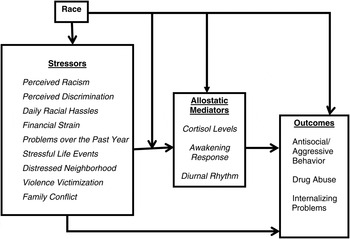
Figure 1 posits a heuristic model based on a developmental allostasis framework that acknowledges the link between race and measures of stressors, including the unique stressors of racism and discrimination. Chronic stressors are anticipated to lead to allostatic changes, as reflected by shifting set points for the primary allostatic mediators of cortisol level and its diurnal rhythm. In turn, altered HPA functioning is hypothesized to be associated with poor mental health outcomes, an early indicator of an adverse trajectory with more likely adverse outcomes in a still relatively young and healthy age group.
The heuristic model linking stress and allostatic mediators to outcomes.

Methods
Sample
Participants were recruited from a longitudinal study that examined effectiveness of the Parents Who Care substance abuse prevention intervention for families (Haggerty, MacKenzie, Skinner, Harachi, & Catalano, Reference Haggerty, MacKenzie, Skinner, Harachi and Catalano2006; Haggerty, Skinner, MacKenzie, & Catalano, Reference Haggerty, Skinner, MacKenzie and Catalano2007). Parents of eighth-grade students in the Seattle school district received a letter describing the study, and parents were contacted by phone. Families were included if the teen and one or both parents consented to participate. Eligibility included that the parent identified the teen as Black (or African American) or White (or European American), spoke English as their primary language, and planned to live in the area for at least 6 months. Forty-six percent of families who received letters consented (55% of Blacks and 40% of Whites). Parents who refused were more likely to be White, married, and had a higher education on average than those who consented. Other ethnic groups were not recruited.
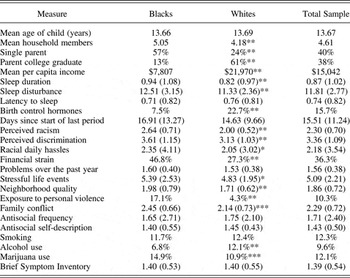
The sample was balanced by teen race and gender. Racial differences were evident for several demographic measures. Whites reported higher per capita income and parental education; Blacks reported higher prevalence of single parenthood (Table 1). Most primary caregivers were female (>80%), with 71.6% being the adolescent's biological mother. Caregiver gender and relationship were similar across race with one exception: more Black youth had another female primary caregiver (e.g., grandmother, aunt) than did White youth, χ2 (1) = 13.95, p < .001.
Descriptive data on demographics, control, stressor, and mental health measures by race

*p < .05. **p < .01. ***p < .001.
At the follow-up (5 to 6 years after the intervention), we attempted to contact all 331 young adults who now ranged in age from 19 to 22 (mean = 19.7 years). Of the original participants, 301 (90.1%) completed the surveys and were asked to participate in the saliva collection phase of the study. Of these, 67 were Black males, 73 Black females, 82 White males, and 79 White females. Two participants were not eligible for saliva collection due to incarceration. Most participants were currently enrolled in school (57.8%), while 45.6% were employed and 18% were currently neither employed nor attending school regularly.
Collection procedure
Participants completed a 50-min survey on a laptop computer and were given instructions for collecting saliva and a collection kit filled with 12 vials, daily diaries, a card with saliva collection instructions, and freezer packs to ensure samples remained chilled until frozen. At least 1.5 ml of saliva was collected by passive drool. Saliva samples were collected four times each day over 3 days: (a) when the participant woke up, before they were out of bed; (b) 30 min after the initial sample before the participants had brushed their teeth or eaten any food; (c) at least 1 hr after lunch; and (d) at bedtime, before brushing their teeth. Participants were urged to not eat, drink, exercise, or brush their teeth for 30 min before collection to avoid contaminating the sample. Like other steroid hormones (O'Connor et al., Reference O'Connor, Brindle, Holman, Klein, Soules and Campbell2003), cortisol is stable when stored frozen, and is robust to freeze–thaw cycles (Barrett, Akinsanya, Chang, & Vesterqvis, Reference Barrett, Akinsanya, Chang and Vesterqvis2005). Nevertheless, freeze–thaw cycles were strictly avoided. The saliva samples were refrigerated or frozen until picked up by study staff, then frozen at −80°C until assayed. Participants were asked to complete diary entries immediately after each collection in order to record the date and time of each sample and answer questions evaluating demographic, social, emotional, and physiological factors. The participant was given $50 for completing the survey and compensated $5 in cash for each filled saliva vial, for a maximum of $60 for 12 vials.
Six data collectors trained participants on the research protocols and facilitated compliance (e.g., coordinating participants’ reminder schedules; Fernades, Skinner, Woelfel, Carpenter, & Haggerty, in press). Type and timing of reminders were specific to each participant, depending on work/school commitments and reminder preferences. Participants were contacted via phone call, direct text (between the data collector and participants), or autotexts (textmelater.com). All participants were contacted on their personal cell phone. If the participant did not have a cell phone, they were provided with a prepaid cell phone.
Measures
Cortisol
An enzymatic immunoassay was used to measure cortisol using 80 µl of saliva. The assay uses a purified polyclonal anticortisol antibody, R4866, provided by C. Munro (University of California, Davis), and reference calibrators (Steraloids, cat. no. Q3880). This assay has been validated for use in serum (Munro & Stabenfeldt, Reference Munro and Stabenfeldt1985) and saliva specimens (Tomblingson, Reference Tomblingson2005). Intra- and interassay coefficients of variation were 2.4% and 13.3%, respectively. Results were further validated by comparison with a commercial kit (Assay Designs, cat. no. 900-071), r (55) = .71, p < .0001. Cortisol was measured in micrograms per deciliter, with a lower detection limit of .03 µg/dl. Natural log transformation was used to reduce skew to a normal distribution.
Stressor exposure
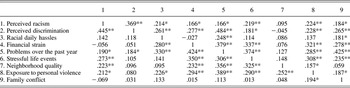
Correlations between measures of stressors (see Table 2) are frequently significant, yet the magnitude of the correlations indicates that these stressors capture distinct constructs. Racism and Life Experiences Scales developed by Harrel et al. (Harrel, Reference Harrell2000; Harrell, Merchant, & Young, Reference Harrell, Merchant and Young1997) assessed racism, discrimination across domains, and racial daily hassles. The author has provided extensive documentation of the scale's development, reliability, and psychometric properties. Perceived racism is the mean of nine survey items (Cronbach α = 0.83) from the Harrell Racism Scale. Items include “Overall, during your lifetime, how much have you personally experienced racism, racial discrimination or racial prejudice?” and “In general, how much stress has racism caused you during your lifetime?” Response options ranged from 1 to 5; higher scores indicate more experience with racism.
Correlations for associations between measures of stressors by race

Note: Whites are above the diagonal, and Blacks are below the diagonal.
*p < .05. **p < .01.
Perceived discrimination includes 10 survey items from the Harrell Discrimination Scale. The root for all items was “During your lifetime, how much have you experienced prejudice or discrimination based on each of these characteristics?” Characteristics included gender, race, ethnicity, social class, talents (skills, intelligence), religion, physical appearance, sexual orientation, personality, and physical disability. Responses ranged from 1 (extremely) to 5 (not at all) so that higher scores indicated greater extent of perceived discrimination. Scores reflected the maximum level reported regardless of the source identified.
The Harrell daily hassles scale was collected at the end of each saliva sampling day to capture mundane extreme environmental stress. The scale consists of 20 items assessing microaggressions, including “being ignored, overlooked, or not given service,” and “others reacting to you as if they are afraid or intimidated.” Participants report how often these occurred in their daily lives because of their race (0 = never, 5 = once a week or more), and how much these events bothered them (0 = never happened, 1 = doesn't bother me at all, 5 = bothers me extremely). The sum of hassles was calculated for each of 3 days, then averaged across days.
Financial strain was measured with four survey items “Was there a time in the past 12 months when you did any of the following because you did not have enough money?” Items included “Did not pay the full amount of the rent or mortgage on time,” “Needed to see a doctor or go to the hospital but did not go,” “Needed to see a dentist but did not go,” and “Did not pay the full amount of the gas, oil, or electric bills.” Scores were assigned 0 (did not endorse any of these) and 1 (endorsed one or more items) to form a dichotomous variable.
Problems in the past 12 months was the mean of 11 survey items (Cronbach α = 0.81) where respondents rated problems in the past 12 months as 1 (not at all), 2 (a little), and 3 (a lot). Problems included concerns about health, problems with friends, romantic partners, school, legal, family relationships, work or people at work, teams or organizations, moving house, loss of income, and big disappointments or failure.
Number of stressful events was based on the items endorsed from a list of 14 potentially stressful events (Gray, Litz, Hsu, & Lombardo, Reference Gray, Litz, Hsu and Lombardo2004), such as death of a parent or a close friend, serious illness, failing a grade, breaking up with a boy/girlfriend, natural disaster, and combat.
Neighborhood quality was based on five survey items: “How much do these things describe the neighborhood you live in now?” Items included crime or drug selling, fights, undesirable neighbors, people moving in and out, not safe. Responses range from 1 (a lot) to 4 (not at all). Items were reversed then averaged (Cronbach α = 0.87). High scores indicated more distressed neighborhoods.
Violence victimization was based on six survey items to assess past-year violence exposure. Items included “In the past year have you been attacked?” and “In the past year has there been any violence in your home?” Scores were assigned from 0 (none of the items were endorsed) to 3 (3 or more items endorsed).
Family conflict was computed as the number of positive endorsements of four items taken from the Conflict Tactics Scale (Straus, Reference Straus, Straus and Gelles1990). The family behaviors included fighting a lot, criticizing each other, losing their temper, and being openly angry. Endorsements were made on a 4-point scale: YES, yes, no, NO. Higher scores indicated greater conflict levels.
Mental health outcomes
Frequency of antisocial behavior was computed as the sum of 12 items. Each item was scored for frequency of the behavior in the past year, with scores ranging from 0 (none) through 2 (4 or more times). Items included starting fights, using a weapon or force to get something you want, driving recklessly, destroying others’ property on purpose, and so forth. The item “Purposely setting fire to a building or car” was dichotomously scored 0 (none) or 2 (at all in the past year). Antisocial self-description was computed as the mean of 5 items. The statements included “I ignore rules that get in my way,” and “I tell a lot of lies.” Responses for whether the statement described them were coded on a 4-point scale of YES, yes, no, NO. Higher scores indicated more antisocial attribute endorsement.
Substance use was recorded on all 3 days for the daily diary at the time of each saliva sample. Scores for smoking, alcohol use, and marijuana use were set to 0 if none reported and 1 if any reported.
Measures of mental health included the 18-item Brief Symptom Inventory (BSI-18). The BSI is a global severity measure of depression, anxiety, and somatization on a scale from 1 (not at all distressed) to 5 (extremely distressed; Derogatis, Reference Derogatis1993).
Control variables
Control variables included gender, family income during adolescence, and sleep quality. Income of the family at baseline (eighth grade) was used as an indicator of resource availability while growing up. This prospective measure of income may be a more stable indicator of lifetime socioeconomic status than concurrent income, which transiently and precipitously declines in emerging adults. Moreover, controlling for income partially rules out influence of stressor exposure stemming from earlier poverty or resource availability. Household per capita income was calculated from parent's endorsement of 1 of 11 categories for annual household income (before taxes). We assigned the midpoint of the range and then divided by the number of people in the household as reported by parents on the survey.
The Pittsburgh Sleep Quality Index (Buysse, Reynolds, Monk, Berman, & Kupfer, Reference Buysse, Reynolds, Monk, Berman and Kupfer1989) was collected on each saliva day and used to create three scales. Sleep duration scores are based on answers to “During the past week, how many hours of actual sleep did you get each night?” Scores range from 0 (7 or more hours) to 3 (less than 5 hours). High scores indicate short sleep duration. Disturbance is the sum of nine items, such as “Had bad dreams,” and “Coughed or snored loudly,” with response options 1 (not during the past week), 2 (once or twice a week), and 3 (three or more times a week). The sum ranges from 6 to 22 (M = 11.8, SD = 2.77). High scores indicate frequently disturbed sleep. Latency is the sum of two items, “Couldn't get to sleep within 30 minutes” and “During the past week, how long in minutes has it usually taken you to fall asleep each night?” The sum was then recoded into three categories. High scores indicate taking longer to get to sleep.
Analyses
Descriptive data are presented on demographics, sleep quality, and exposure to stressors by race in Table 1. Hierarchical linear models (HLMs) estimated the trajectory of cortisol across the day using SAS PROC MIXED (Singer, Reference Singer1998). Repeated cortisol measures (max = 12) are nested within day. The two levels of the model were estimated using a random effect for intercept (to capture cortisol upon awakening) and time since waking (TSW; to capture the linear diurnal slope). The cortisol awakening response (CAR) was modeled using a fixed effect for a dummy variable coded 0/1 for samples collected between 25 and 55 min after waking. Cross-tabulation with tube number verified that 94.3% of these observations were the designated second tube of the day. Similarly, over 90% of the first tubes of the day were collected prior to 25 min of waking. We also tested for a within-person random effect of day and Day × TSW, meaning intercepts and slopes were estimated separately for each day. The day variables were dropped after no effects for day were found, consistent with Shirtcliff and Essex (Reference Shirtcliff and Essex2008).
Race was entered as a main effect on cortisol level, an interaction with CAR, and an interaction with TSW. Post hoc analyses included single degree of freedom significance tests of race differences in point estimates at waking, 30 min, 8 hr, and 16 hr after waking. Models were estimated for women separately and indicated neither use of a hormone-based birth control method (pill, nuvo ring, etc.) nor menstrual cycle phase influenced cortisol level or slope. These potential control measures were nonsignificant and were dropped from further models.
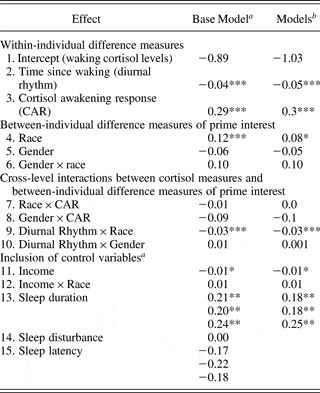
A base model was estimated including intercept, race, gender, CAR, TSW, income, and sleep duration, disturbance, and latency, and the two-way interactions of race with gender, CAR, and TSW (see Table 3). This model indicated no significant effects for sleep disturbance or latency so they were dropped from further analyses. Separate HLMs then added a main effect for each of the nine measures of stressors, which indicated the impact of that stressor on waking levels (on the intercept). Successive analyses then examined the effect of each stressor on the waking response (Stressor × CAR) and on linear decline (Stressor × TSW). Next, forward selection procedures tested for the interaction of race with each stressor to determine whether the stressor was associated with waking levels differently for Whites than Blacks. To assess possibly nonlinear associations between stressor exposure and waking cortisol, a stressor-squared term was added. Nonlinear race moderation was assessed by adding the interaction between race and stressor-squared. Finally, models were estimated including the three-way interactions (CAR × Race × Stressor and TSW × Race × Stressor) to assess whether stressors were associated with the CAR or linear decline over the day differently for Whites and Blacks. A parallel strategy was employed for mental health outcomes.
Parameter estimates and significance levels for models predicting cortisol.

Note: Sleep disturbance and latency were entered a priori into the model but were removed as they were not significant and were not of primary interest.
aIncluding control variables.
bIncluding measures of stressors.
*p < .05. **p < .01. ***p < .001.
Results
Were there race differences in stressor exposure?
Race differences were significant for demographic variables and most control variables and stressors, consistent with typical race differences in the United States (see Table 1). A higher rate of poverty among Blacks was indicated by large family size, more single-parent households, and lower parent education and per capita income compared to Whites. Blacks reported sleeping longer, but having more disturbed sleep. There was no a race difference in sleep latency.
Blacks reported significantly more racism, discrimination, and racial daily hassles. Blacks reported significantly more stressful life events, greater financial strain, higher family conflict, and poorer quality neighborhoods. Race differences in exposure to violence were especially notable in the top and bottom categories, indicating that Blacks typically report high exposure to violence, whereas Whites typically report no exposure. There was no race difference in reports of problems in the past 12 months. Blacks reported lower alcohol use, and higher marijuana use than Whites.
Capturing cortisol's diurnal rhythm with the hierarchical model
TSW represents a significant linear slope from waking until bedtime (β = −0.06, t = −16.38, p < .001), indicating that cortisol levels dropped across the day (see Table 3). The dummy variable for CAR was also significant and positive (β = 0.25, t = 7.09, p < .001), indicating cortisol rose significantly during the period from 25 to 55 min after waking. A fixed effect for TSW squared was tested but not significant and was thereafter dropped.
Race and gender differences in cortisol level and rhythm
Waking cortisol levels
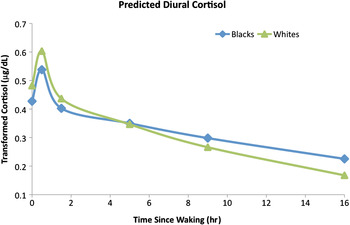
Figure 2 presents the predicted diurnal patterns for Blacks and Whites. There were significant race differences (β = 0.09, t = 2.55, p = .01), indicating higher cortisol levels at waking for Whites compared to Blacks. There were no gender effects or Race × Gender interactions predicting waking cortisol levels.
Race differences in diurnal cortisol rhythm indicate lower waking and higher evening levels for Blacks compared to Whites. [A color version of this figure can be viewed online at journals.cambridge.org/dpp]

CAR
We then determined if the rise in CAR showed race or gender differences by examining interactions with the CAR dummy variable. These effects were not significant.
Diurnal rhythm
We examined race and gender differences in cortisol's rate of decline over the day by examining interactions with TSW. Cortisol's diurnal decline was slower (flatter slope) for Blacks than Whites (β = 0.03, t = 3.97, p < .001). Post hoc tests of race differences at 0, 30 min, 8 hr, and 16 hr after waking indicated that, compared to Whites, Blacks had lower cortisol at waking (Δ = 0.12, df = 1, 471, t = 3.09, p = .002), were not different by the midafternoon (Δ = −0.08, df = 1, 471, t = −1.32, p = .19), but then emerged with significantly higher cortisol at bedtime (Δ = −0.29, df = 1, 471, t = −2.56, p = .01).
Income, gender, and sleep quality effects on cortisol
The predictors included the main effects and interactions in the base model identified above (see also Table 3). There was a significant effect of family income (when participants were eighth graders): individuals with less money as adolescents had higher cortisol by young adulthood. The effect of income on cortisol did not interact with race; nevertheless, both income and Income × Race were included in subsequent analyses because the interaction controls for possible nonlinear income effects (increases in income are more meaningful when income is low and less meaningful when income is high). The effects of gender or Race × Gender on the linear slope were not significant; Black males and females both appeared to have flatter diurnal slopes than White males and females. Nevertheless, gender effects were controlled in all analyses. Short sleep duration was associated with higher waking cortisol, so it was controlled in all analyses.
Effects of stressor exposure on cortisol level and possible race moderation
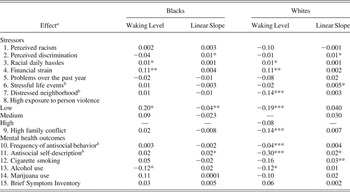
Of the nine measures of stressor exposure, five were significantly associated with waking cortisol levels directly or moderated by race: daily racial hassles, high family conflict, financial strain, distressed neighborhood, and exposure to personal violence (see Table 4). Main effects were found for racial daily hassles and financial strain, indicating higher waking cortisol associated with both stressors for Blacks and Whites.
Relationships of stressors and mental health outcomes to cortisol waking levels and change over the day (linear slope) by race

aEach stressor measure and its interactions and mental health outcome were added to the base model in separate analyses. They are shown in single columns for brevity. Parameters for predictors in the base model vary only slightly, depending on which stressor is included.
bOnly linear effects are illustrated. Quadratic effects or quadratic interactions with race were later found.
*p < .05. **p < .01. ***p < .001.
The interaction of each stressor with race then determined if stressors influence waking cortisol more for Blacks or Whites. Three race interactions were significant. The relationship between family conflict and waking cortisol was moderated by race, F (1, 1621) = 9.38, p = .002. In separate follow-up models for Blacks and Whites, we found no significant relationship for Blacks, but lower waking levels were significantly associated with higher conflict for Whites.
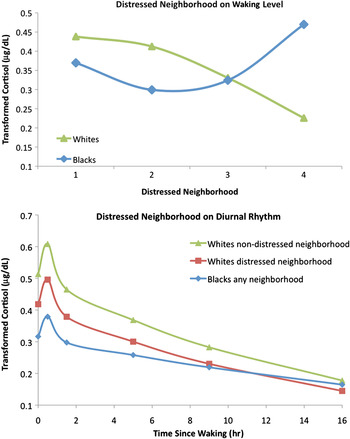
The relationship between distressed neighborhood and waking cortisol was significantly different for Blacks and Whites, F (1, 1740) = 7.93, p = .005. Distressed neighborhood was associated significantly with lower waking cortisol for Whites (β = −0.14, p = .0003), but was not associated significantly for Blacks (β = 0.01, p = .75). Exposure to distressed neighborhoods resulted in diurnal cortisol for Whites that more closely resembled Blacks (Figure 3).
(Top) The effect of distressed neighborhood on cortisol levels indicated more distressed neighborhood was associated with lower cortisol within Whites but had a nonlinear curve within Blacks, so that the highest cortisol was observed in Blacks from distressed neighborhoods. (Bottom) Distressed neighborhood further impacted the diurnal rhythm but only in Whites. [A color version of this figure can be viewed online at journals.cambridge.org/dpp]

There was also a significant interaction between race and violence victimization on waking cortisol levels, F (2, 1651) = 10.89, p < .0001. Separate models were run for Blacks and Whites. Compared to Whites exposed to no violence, there was a statistical trend that waking cortisol was lower for Whites exposed to high violence (β = −0.19, p = .09). For Blacks, the association was quite different. Compared to Blacks with no exposure, Blacks with high exposure to personal violence had higher waking cortisol levels (β = 0.20, p = .03).
Given our overarching model and preliminary findings (Del Guidice et al., Reference Del Guidice, Ellis and Shirtcliff2011), we tested for nonlinear relationships between stressor exposure and waking cortisol levels by adding an effect for each stressor-squared in addition to linear stressor effects. We added the interaction between stressor-squared and race because nonlinear relationships might be moderated by race. These tests are only appropriate for continuously measured variables so no such tests were conducted for financial strain or exposure to personal violence. There was no evidence for curvilinear effects for racism, discrimination, racial hassles, problems in the past year, or family conflict. Significant curvilinear effects were found for stressful life events, F (1, 1809) = 8.96, p = .003, and the interaction between distressed neighborhood and race, F (1, 1599) = 12.65, p = .0004. Compared to individuals with no stressful life events, cortisol levels were lower as individuals experienced a greater number of events; as the number of events increased beyond moderate stressor exposure; however, individuals with the greatest number of events had higher cortisol levels. This pattern was comparable for Blacks and Whites. In the case of distressed neighborhood, the patterns differed by race, such that the neighborhood-squared effect was significant only for Blacks, F (1, 596) = 13.82, p = .0002. For Whites, the linear effect persisted such that lower waking cortisol was associated with increasingly distressed neighborhoods. For Blacks, waking cortisol was somewhat lower in slightly distressed neighborhoods compared to nondistressed neighborhoods; yet in more and more distressed neighborhoods, waking levels were higher.
Effects of stressor exposure on CAR
No significant effects or interactions with race were found for any of the stressors on CAR.
Effects of stressor exposure on cortisol's diurnal rhythm
Models then determined which of the measures of stressors were associated with the rate of decline in cortisol over the day. Each model included the main effect of the stressor on cortisol levels in addition to the interaction between that stressor and TSW; all other control measures identified in Table 3 were likewise included.
Regardless of race, higher levels of discrimination were associated with flatter diurnal patterns (β = 0.01, p = .02; see Table 4). There was also a significant three-way interaction between stressful life events, race, and TSW, F (1, 225) = 5.57, p = 0.02, indicating that the impact of stressful life events on cortisol's diurnal rhythm was different for Whites than Blacks. Subsequent analyses examined the interaction by estimating separate models for Blacks and Whites. Greater lifetime exposure to stressful life events flattened cortisol's diurnal rhythm for Whites (β = 0.005, p = .047), in addition to the quadratic effects of stressful life events on cortisol's waking level. For Blacks, the impact of stressor exposure on cortisol's diurnal rhythm was not significant (β = −0.003, p = .19), although the quadratic-stressor effects on cortisol waking level (described above) persisted.
Finally, a significant three-way interaction was detected for exposure to personal violence, F (2, 258) = 5.45, p = 0.005. Follow-up models for each race separately indicated that the effects of personal violence for Whites were specific to waking levels (described above), but for Blacks, the effects of personal violence were associated with the cortisol slope, F (2, 176) = 4.33, p = 0.01. Although the effects of personal violence on White young adults made them appear indistinguishable from Black young adults in the morning, by the afternoon, Blacks nevertheless still had higher cortisol levels as a function of their flatter diurnal rhythms. For Blacks exposed to high levels of personal violence, the impact of race was exacerbated by exposure to personal violence. Not only did they have higher morning cortisol levels than any other group, but their diurnal rhythm was even flatter, so that they ended the day with the highest cortisol levels.
Three-way interactions for the other measures of stressor were not detected.
Relationship between HPA functioning and mental health outcomes
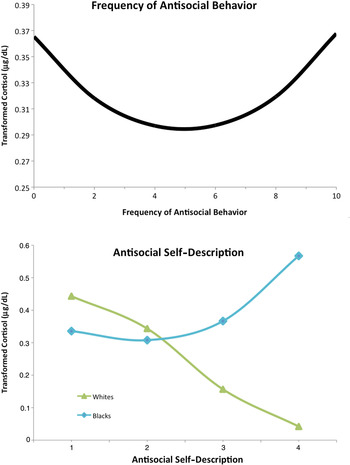
Similar analyses were conducted to assess the relationships between mental health outcomes and cortisol diurnal rhythm (Table 4). We found significant race moderation in the relationship between waking levels and reports of antisocial behavior frequency, F (1, 1589) = 7.57, p = .006, and self-description, F (1, 1710) = 18.14, p < .0001. In both cases, the relationship was not significant for Blacks, but greater antisocial behavior was associated with lower waking cortisol for Whites (Figure 4). In addition, antisocial self-description was significantly associated with blunted cortisol decline over the day for both Blacks and Whites. Similarly, race moderation was indicated for antisocial behavior frequency, but subsequent analyses for each race group detected no significant relationships.
(Top) The nonlinear association of frequency of antisocial behavior on waking cortisol levels. (Bottom) The interaction between race and antisocial self-description showed lower cortisol was associated with antisocial behavior within Whites. The association was nonlinear for Blacks, with the most antisocial Blacks having the highest cortisol levels. [A color version of this figure can be viewed online at journals.cambridge.org/dpp]

A significant main effect was found for alcohol use such that use was associated with lower waking cortisol for Blacks and Whites. The relationship between cortisol and smoking was moderated by race, F (1, 1692) = 9.27, p = .002, such that smoking was associated with blunted cortisol decline over the day for Whites, but was not significant for Blacks. No relationships were evident between BSI and cortisol waking level, CAR, or rate of decline over the day.
Discussion
The present study used the conceptual framework of allostasis to examine whether stressor exposure can “get under the skin” and impact functioning of one of the primary neuroendocrine pathways, the HPA axis. Following the view that allostatic load has behavioral and physiological consequences, we then determined the implications of HPA dysregulation for mental health outcomes evident in young adults. Four findings were notable. First, consistent with previous research (Cohen et al., Reference Cohen, Schwartz, Epel, Kirschbaum, Sidney and Seeman2006; DeSantis et al., Reference DeSantis, Adam, Doane, Mineka, Zinbarg and Craske2007), we found Blacks had lower morning cortisol and flatter diurnal rhythms, ending the day with higher cortisol than Whites. Second, associations between stressor exposure and HPA functioning were complex, but followed a pattern proposed in recent developmental models (Boyce & Ellis, Reference Boyce and Ellis2005; Del Guidice et al., Reference Del Guidice, Ellis and Shirtcliff2011). Stressor effects on HPA functioning were typically weaker for Blacks than Whites. Despite strong measures of stressors, the effect of race on HPA functioning persisted. Third, there was some evidence for interactions with race, perhaps suggesting that the underlying allostatic mechanism of how stress can “get under the skin” may operate differently in Blacks than Whites. Fourth, consistent with our prior research (Essex et al., Reference Essex, Shirtcliff, Burk, Ruttle, Klein and Slattery2011; Ruttle et al., Reference Ruttle, Shirtcliff, Serbin, Ben-Dat Fisher, Stack and Schwartzman2011; Shirtcliff & Essex, Reference Shirtcliff and Essex2008; Shirtcliff, Granger, Booth, & Johnson, Reference Shirtcliff, Granger, Booth and Johnson2005) and our heuristic model, blunted HPA functioning was associated with poorer mental health outcomes relevant to this particular age group (antisocial behavior, substance use; Schulenberg et al., Reference Schulenberg, Sameroff and Cicchetti2004). These findings could lead us to conclude that Black young adults exhibited less HPA flexibility than their White counterparts, which may contribute, over time, to greater risk for allostatic load as the persistent weathering of HPA dysregulation takes its toll (Borrell & Crawford, Reference Borrell and Crawford2011; Geronimus et al., Reference Geronimus, Hicken, Keene and Bound2006; Szanton et al., Reference Szanton, Gill and Allen2005; Taylor et al., Reference Taylor, Repetti and Seeman1997). That race differences were already observed within a relatively healthy age range is, unfortunately, consistent with prior literature (Evans & English, Reference Evans and English2002; Johnston-Brooks et al., Reference Johnston-Brooks, Lewis, Evans and Whalen1998).
Did stressor exposure explain race-related differences in HPA functioning?
In a simplistic manner, stressor exposure did not account for race differences in waking cortisol or diurnal rhythm. Findings appear consistent with studies where race differences are persistent (Cohen et al., Reference Cohen, Schwartz, Epel, Kirschbaum, Sidney and Seeman2006). Within White young adults, greater stressor exposure typically blunted HPA functioning to the extent that Whites with substantial exposure to stressors appeared similar to typical Black young adults. Traditionally, greater stressor exposure has been linked with higher cortisol (Sapolsky, Reference Sapolsky1998; Selye, Reference Selye1950), yet several theories have begun to recognize the paradoxical finding that low cortisol (especially low morning cortisol) may be a common outcome of chronic stressor exposure (Cicchetti & Rogosch, Reference Cicchetti and Rogosch2001; Gunnar & Vazquez, Reference Gunnar and Vazquez2001; Yehuda et al., Reference Yehuda, Bierer, Schmeidler, Aferiat, Breslau and Dolan2000). The acute rise in stress-related HPA activity, over time, diminishes until basal functioning falls below earlier set points and flexibility is compromised (Miller et al., Reference Miller, Chen and Zhou2007; Weems & Carrion, Reference Weems and Carrion2009). Although this may appear as stress dysregulation, an allostatic view emphasizes that such alterations may be adaptations to the individual's environment. Low cortisol may help the individual to be buffered or shielded from the impact of chronic stressors.
Del Giudice and colleagues (Reference Del Guidice, Ellis and Shirtcliff2011) build upon the foundation of differential susceptibility (Belsky & Pluess, Reference Belsky and Pluess2009) and biological sensitivity to context (Boyce & Ellis, Reference Boyce and Ellis2005; Ellis & Boyce, Reference Ellis and Boyce2011; Ellis, Essex, & Boyce, Reference Ellis, Essex and Boyce2005). Such adaptive calibration models may be necessary to account for complex and potentially nonlinear stressor–HPA associations (Cicchetti & Rogosch, Reference Cicchetti and Rogosch2007). There are wide differences in an individual's biological sensitivity to context (BSC) in addition to individual differences in stressor exposure. Biological systems that change across time and development are proposed to filter, encode, and amplify salient information about the individual's environment, thereby coordinating or calibrating stress-responsive systems to the demands of the environment and moderating the individual's openness to environmental inputs. Notably, Del Guidice and colleagues (Reference Del Guidice, Ellis and Shirtcliff2011) point to allostatic mediators as being the primary systems implicated. It may be adaptive for individuals with a high BSC to be open to the benefits of a warm, supportive, and protected environment. Likewise, it may be adaptive for individuals with a high BSC to be open to harsh, dangerous, or unpredictable environments, allowing them to attend to the environment closely to anticipate and respond early to challenges. Individuals with a low BSC, on the other hand, do not experience extant physiological arousal. Rather, they appear buffered or protected from repeatedly responding to moderate stressors and maintain enough sensitivity to remain responsive to salient social information (Lyons & Parker, Reference Lyons and Parker2007; Parker, Buckmaster, Schatzberg, & Lyons, Reference Parker, Buckmaster, Schatzberg and Lyons2004). Some environments are even more toxic (Cicchetti & Lynch, Reference Cicchetti and Lynch1995). Such extremely challenging conditions may be powerful enough to shut down physiological responsiveness in order to shield the individual from their stressful lives. In such extreme instances, the individual may become unemotional, callous, or nonresponsive to social cues (Hawes et al., Reference Hawes, Brennan and Dadds2009; Shirtcliff et al., Reference Shirtcliff, Vitacco, Graf, Gostisha, Merz and Zahn-Waxler2009).
Applying this perspective, we observed considerable within-race variability in exposure to stressors, yet Blacks on average reported more short-term and chronic exposure to a variety of stressors. This is consistent with prior literature showing Blacks typically experience greater “mundane environmental stress” (Peters & Massey, Reference Peters and Massey1983). Within our study, it appears as though the stress response systems for Whites was typically calibrated by milder environmental stressors so that their cortisol levels largely ranged from “sensitive” to “buffered,” as observed in other largely White samples (Ellis et al., Reference Ellis, Essex and Boyce2005). In contrast, it appears as though the stress-response system for Blacks was typically calibrated to a higher stressor burden such that cortisol levels largely ranged from “buffered” to “vigilant.” Del Guidice and colleagues (Reference Del Guidice, Ellis and Shirtcliff2011) postulate that most individuals are buffered or exposed to moderate stressors. The greater frequency of null findings in Blacks may reflect that, typically, Black young adults experience the concomitant calibration of HPA functioning of being buffered.
Our interpretation of race interactions, therefore, is not that underlying psychobiology is disparate in Blacks and Whites. Rather, we contend there is an overlapping yet different range of stressors typically experienced by Blacks and Whites, but the underlying psychobiology is similar. Exposure to dangerous, unpredictable environments contributes to allostatic load regardless of race (Geronimus et al., Reference Geronimus, Hicken, Keene and Bound2006). Understanding the full continuum of environmental experiences, from normal to abnormal, is an important tenet of developmental psychopathology (Cicchetti & Toth, Reference Cicchetti and Toth2009), as well as allostasis, which emphasizes how regulatory processes are often nonlinear. Such developmental views may be more fruitful than merely illustrating race differences.
Depending on the range of stressors and the BSC profiles of the population, stress–HPA associations are expected to be threefold (i.e., linear decline; flat; and linear inclines; Obradovic, Bush, & Boyce, Reference Obradovic, Bush and Boyce2011; Obradovic, Bush, Stamperdahl, Adler, & Boyce, Reference Obradovic, Bush, Stamperdahl, Adler and Boyce2010). If the measure of stressor is broad, it may be possible to detect more than one section of this curve, thereby strengthening evidence for adaptive calibration (Ellis et al., Reference Ellis, Essex and Boyce2005). Although not apparent for each stressor (Obradovic & Boyce, Reference Obradovic and Boyce2009), two measures of stressors revealed the anticipated curvilinear association. First, individuals who had low and extremely high numbers of stressful life events by young adulthood had the highest cortisol levels, whereas individuals with a more moderate number of stressful events had lower cortisol. This U-shaped curve was apparent for both Whites and Blacks. Second, cortisol levels were lower as White young adults were exposed to more distressed neighborhoods; for Black young adults, however, there was a J-shaped curve such that individuals with moderately distressed neighborhoods showed lower cortisol but individuals from the most distressed neighborhoods had the highest cortisol levels. These associations were admittedly complex, but followed the predicted pattern of individual differences in both biological sensitivity and stressor exposure.
One concern with this application of the model is that allostasis may be more relevant for stress reactivity as observed in acute laboratory challenges instead of the diurnal rhythm (Dickerson & Kemeny, Reference Dickerson and Kemeny2004; Het, Rohleder, Schoofs, Kirschbaum, & Wolf, Reference Het, Rohleder, Schoofs, Kirschbaum and Wolf2009; Lam, Dickerson, Zoccola, & Zaldivar, Reference Lam, Dickerson, Zoccola and Zaldivar2009). Nevertheless, responsivity is best interpreted with reference to that specific context (Gunnar, Talge, & Herrera, Reference Gunnar, Talge and Herrera2009). We do not know how relevant or ecologically valid such contexts are with reference to more persistent or chronic stressors (van Eck, Nicolson, Berkhof, & Sulon, Reference van Eck, Nicolson, Berkhof and Sulon1996), nor whether such contexts are similarly salient for Whites and Blacks (Richman & Jonassaint, Reference Richman and Jonassaint2008). Cortisol's diurnal rhythm is not a typical stress reactivity measure. Yet, because momentary stress responsivity quickly habituates and the diurnal rhythm is highly stable, it may shed light on the long-term physiological resources during persistent, ecological stressors. The rhythm partially reflects the accumulation of environmental stressors, with afternoon and evening levels being highly influenced by the social environment (Bartels et al., Reference Bartels, de Geus, Kirschbaum, Sluyter and Boomsma2003; Schreiber et al., Reference Schreiber, Shirtcliff, Van Hulle, Lemery-Chalfant, Klein and Kalin2006; Van Hulle et al., Reference Van Hulle, Shirtcliff, Lemery-Chalfant and Goldsmith2011), including naturally occurring hassles (Adam, Hawkley, Kudielka, & Cacioppo, Reference Adam, Hawkley, Kudielka and Cacioppo2006; Almeida, McGonagle, & King, Reference Almeida, McGonagle and King2009; Peeters, Nicholson, & Berkhof, Reference Peeters, Nicholson and Berkhof2003). Cortisol's diurnal rhythm may therefore instantiate long-term alterations in stress responsivity. Flatter diurnal rhythms may indicate stress dysregulation, as the individual struggles to match their physiological set points with the demands of the environment, resulting in a less flexible diurnal rhythm. Yet, flatter diurnal rhythms may also reflect adaptive calibration of the individual's physiology to the level of challenge in their environment, suggestive of a buffering effect in which a flattened rhythm nonetheless maintains some physiological rhythmicity. This buffering may come at a cost, with the trade-off of maintaining rhythmicity being a less flexible or malleable HPA axis.
Does HPA functioning have implications for relevant mental health outcomes in young adults?
We anticipated race-related differences in allostatic load, but were agnostic as to whether Blacks would be more likely to show associations of HPA functioning with mental health outcomes. On the one hand, once stress physiology moves toward allostatic load, vulnerabilities to stress-related pathology, including psychopathology, should be anticipated regardless of race. On the other hand, the extant literature finds greater allostatic load within Black adults (Green & Darity, Reference Green and Darity2010; Szanton et al., Reference Szanton, Gill and Allen2005), hinting that these processes may be stronger in Blacks than Whites. For the present study of young adults, we did not observe greater mental health problems in Blacks. Yet, we did replicate that Blacks experienced greater stress exposure, consistent with other investigations in which Blacks report equal or lesser levels of psychological distress or psychiatric disorders than Whites (Kessler, Berglund, Demler, Jin, & Walters, Reference Kessler, Berglund, Demler, Jin and Walters2005). This may fit with a process called equifinality (Cicchetti & Lynch, Reference Cicchetti and Lynch1995; Cicchetti & Rogosch, Reference Cicchetti and Rogosch1999), in which there are multiple pathways to the same outcomes.
Associations of HPA functioning with mental health outcomes were typically stronger for Whites than Blacks. This may suggest that the process of stressor exposure “getting under the skin” shows race-related differences. Alternatively, it may indicate that the shift of BSC between “sensitive” to “buffered” is highly calibrated to mental health outcomes, whereas that calibration is not tight within the wide range of buffered individuals. Individuals with a high BSC with very little stressor exposure are theorized to have better than average mental health (i.e., for better and for worse; Ellis, Boyce, Belsky, Bakermans-Kranenburg, & van IJzendoorn, Reference Ellis, Boyce, Belsky, Bakermans-Kranenburg and van IJzendoorn2011; Knafo, Israel, & Ebstein, Reference Knafo, Israel and Ebstein2011). There is some empirical support that high cortisol can culminate in better outcomes than expected (Cicchetti & Rogosch, Reference Cicchetti and Rogosch2007; Essex, Armstrong, Burk, Goldsmith, & Boyce, Reference Essex, Armstrong, Burk, Goldsmith and Boyce2011; Gunnar, Tout, de Haan, Pierce, & Stansbury, Reference Gunnar, Tout, de Haan, Pierce and Stansbury1997; Obradovic et al., Reference Obradovic, Bush and Boyce2011; Sethre-Hofstad, Stansbury, & Rice, Reference Sethre-Hofstad, Stansbury and Rice2002). These protective benefits may deteriorate quickly toward more typical levels as individuals become more hardy. Hardiness may be more typical within Blacks (Williams & Lawler, Reference Williams and Lawler2001). This emphasizes that higher or lower responsivity of allostatic mediators is not inherently good, but rather indicates a process of adaptive physiological calibration so that the individual can best meet the demands of their environment. A wide variety of physiological profiles can thus be viewed as “best” or “best for the situation.”
As expected, we found that lower cortisol was associated with antisocial behavior, at least within Whites. This fits with a broad literature (Alink et al., Reference Alink, van Ijzendoorn, Bakermans-Kranenburg, Mesman, Juffer and Koot2008; Loney et al., Reference Loney, Butler, Lima, Counts and Eckel2006; O'Leary et al., Reference O'Leary, Loney and Eckel2007; Oosterlaan, Geurts, Knol, & Sergeant, Reference Oosterlaan, Geurts, Knol and Sergeant2005; Shirtcliff & Essex, Reference Shirtcliff and Essex2008; Shirtcliff et al., Reference Shirtcliff, Granger, Booth and Johnson2005; van Goozen et al., Reference van Goozen, Matthys, Cohen-Kettenis, Gispen-de Wied, Wiegant and van Engeland1998) and our neurobiological model (Shirtcliff et al., Reference Shirtcliff, Vitacco, Graf, Gostisha, Merz and Zahn-Waxler2009). Moreover, for both White and Black young adults, flatter diurnal rhythms were associated with antisocial behavior, such that low morning cortisol was most clearly linked with antisocial behavior (Popma et al., Reference Popma, Doreleijers, Jansen, Van Goozen, Van Engeland and Vermeiren2007; Ruttle et al., Reference Ruttle, Shirtcliff, Serbin, Ben-Dat Fisher, Stack and Schwartzman2011). Prior trade-offs of flexibility for buffering, as indicated by flattened diurnal rhythms, may render individuals more susceptible to stress-related outcomes. This allostatic process may become deleterious when the physiological adjustments themselves exert problems (Merritt, McCallum, & Fritsch, Reference Merritt, McCallum and Fritsch2011), or when the environment shifts and the individual's set points appear mismatched for their present context. Low cortisol, for example, may shift the balance toward punishment insensitivity and reward dependency (van Honk et al., Reference van Honk, Schutter, Hermans and Putman2003), buffering the individual from learning from correction or discipline.
We found some evidence for effects of HPA functioning on substance use. Within Whites, blunted diurnal rhythms were associated with smoking; for both Blacks and Whites, lower morning cortisol was associated with alcohol use. Lower cortisol and flatter diurnal rhythms were expected to indicate greater allostatic burden and, in turn, be associated with greater substance use (Koob & Le Moal, Reference Koob and Le Moal2001, Reference Koob and Le Moal2008a, Reference Koob and Le Moal2008b). Koob's allostasis model is not specific to substances (Lovallo, Reference Lovallo2006), nor is it clear why diurnal dysregulation would be specific to smoking whereas alcohol would impact morning cortisol. Prior studies have found that higher cortisol is associated with nicotine withdrawal (Granger et al., Reference Granger, Blair, Willoughby, Kivlighan, Hibel and Fortunato2007; Hogle & Curtin, Reference Hogle and Curtin2006; Ussher et al., Reference Ussher, West, Evans, Steptoe, McEwen and Clow2006); the blunted diurnal rhythm may indicate a growing accumulation of withdrawal or number of use/withdrawal cycles in cigarette smokers by the afternoon/evening hours. Morning cortisol levels, in contrast, do not likely reflect acute alcohol intake. Instead, low cortisol may indicate a general risk for initiation of alcohol use (Adinoff, Iranmanesh, Veldhuis, & Fisher, Reference Adinoff, Iranmanesh, Veldhuis and Fisher1998; Adinoff, Junghanns, Kiefer, & Krishnan-Sarin, Reference Adinoff, Junghanns, Kiefer and Krishnan-Sarin2005; Croissant & Olbrich, Reference Croissant and Olbrich2004; Moss, Vanyukov, & Martin, Reference Moss, Vanyukov and Martin1995). Finally, we found no evidence for HPA functioning in relation to internalizing as measured by the BSI, which is inconsistent with the allostasis theory (McEwen, Reference McEwen2000a, Reference McEwen2000b). We remain cautious about interpretation as a different range of internalizing symptoms may be necessary to observe effects.
Implications for intervention and prevention efforts
Little research has been conducted on the impact of psychosocial intervention on HPA regulation (Dozier et al., Reference Dozier, Manni, Gordon, Peloso, Gunnar and Stovall-McClough2006; Fisher, Gunnar, Chamberlain, & Reid, Reference Fisher, Gunnar, Chamberlain and Reid2000; Fisher, Stoolmiller, Gunnar, & Burraston, Reference Fisher, Stoolmiller, Gunnar and Burraston2007; Fisher, Van Ryzin, & Gunnar, Reference Fisher, Van Ryzin and Gunnar2011; Luecken et al., Reference Luecken, Hagan, Sandler, Tien, Ayers and Wolchik2009). The extant studies are promising as they make the implications for preventive efforts tangible. Based in part on our own interventions, we know that family-focused preventive interventions that promote the buffering effects of positive parent/child bonding, anger management, and predictability and safety within the home reduce future mental health problems (e.g., drug use and antisocial behavior; Brody, Kogan, Chen, & Murry, Reference Brody, Kogan, Chen and Murry2008; Haggerty et al., Reference Haggerty, Skinner, MacKenzie and Catalano2007; Hawkins, Kosterman, Catalano, Hill, & Abbott, Reference Hawkins, Kosterman, Catalano, Hill and Abbott2005). The targeted family practices should impact life-history relevant experiences that are salient for establishing set points for allostatic mediators (Del Guidice et al., Reference Del Guidice, Ellis and Shirtcliff2011). These successful interventions thus may work in part because they facilitate HPA regulation through three underlying mechanisms. First, interventions may reduce stressor exposure within the family, thereby reducing chronic wear and tear. Such intervention outcomes are frequently small in magnitude, yet their slow and consistent accumulation over time may result in the largest impact on allostatic load (Fisher et al., Reference Fisher, Van Ryzin and Gunnar2011; Luecken et al, Reference Luecken, Hagan, Sandler, Tien, Ayers and Wolchik2009); large intervention effects may, unfortunately, induce an allostatic state that the individual's physiology then works against to reestablish homeostasis. Small, consistent HPA alterations may be more permanent. Second, prevention and intervention efforts may provide the individual with useful skills for navigating an inherently stressful world (Cicchetti & Rogosch, Reference Cicchetti and Toth2009; Taylor et al., Reference Taylor, Burklund, Eisenberger, Lehman, Hilmert and Lieberman2008). In turn, these skills could serve to reduce the further impact of stressful experiences. Communication skills and anger management may be particularly useful in reducing the physiological impact of stressor exposure (Antoni et al., Reference Antoni, Cruess, Cruess, Kumar, Lutgendorf and Ironson2000; Moons, Eisenberger, & Taylor, Reference Moons, Eisenberger and Taylor2009). Finally, interventions may change the individual's social support or openness to receiving social support (Heinrichs, Baumgartner, Kirschbaum, & Ehlert, Reference Heinrichs, Baumgartner, Kirschbaum and Ehlert2003; Kirschbaum, Klauer, Filipp, & Hellhammer, Reference Kirschbaum, Klauer, Filipp and Hellhammer1995; Roy et al., Reference Roy, Steptoe and Kirschbaum1998).
Regarding the present study, we illustrate that the HPA axis is calibrated by some stressors more than others, and that the direction of calibration may be nonlinear. Rather than attempt to “reduce cortisol,” intervention studies should consider using an allostatic framework to interpret potentially paradoxical findings; high cortisol may indicate that an individual is open to prevention efforts (Cicchetti & Rogosch, Reference Cicchetti and Toth2009; Luecken et al, Reference Luecken, Hagan, Sandler, Tien, Ayers and Wolchik2009). The present study does not suggest that White or Black young adults should be more targeted for intervention efforts. Rather, prevention efforts should primarily consider the individual's underlying level of stressor exposure. At one end of the stressor continuum, encouraging youth to be open, empathic, attentive, and emotionally expressive may be beneficial, whereas those same outcomes may not be as beneficial in persistently stressful environments.
Limitations
Several limitations must be acknowledged. First, we did not have earlier measures of HPA functioning or parallel measures of stressors that would permit examination of developmental allostatic processes (Cicchetti & Toth, Reference Cicchetti and Toth2009). Controlling prospectively for income (as a proxy for socioeconomic status) points toward findings being specific to the emergence of allostatic load beyond earlier adversity. Second, this study focused on stressors without examining protective or positive life events that could shield the individual (Heinrichs et al., Reference Heinrichs, Baumgartner, Kirschbaum and Ehlert2003; Kirschbaum et al., Reference Kirschbaum, Klauer, Filipp and Hellhammer1995; Roy et al., Reference Roy, Steptoe and Kirschbaum1998; Taylor et al., Reference Taylor, Repetti and Seeman1997). Preliminary glances showed that Whites exposed to the most positive parenting had the highest cortisol; for Blacks, observed positive parenting was linked with low cortisol levels, whereas the absence of positive parenting was associated with higher cortisol; such nonlinear associations hint toward Whites and Blacks occupying different parts of a continuum of environmental influences. Future investigations should test whether positive environments mitigate the development of allostatic load. Third, this study focused on HPA functioning as a primary allostatic mediator, but allostatic load is defined by alterations across multiple physiological systems that interact with each other (Hastings et al., Reference Hastings, Shirtcliff, Klimes-Dougan, Allison, DeRose and Usher2011). Despite these limitations, however, the present investigation sheds light on allostatic processes in young adults, moving beyond simple demonstration of health disparities between Blacks and Whites.
Conclusions
Findings support an allostatic model in which stressors, including experiences with racism and discrimination, influence primary allostatic mediators, even as early as age 20. At first glance, observing significant interactions with race lends to the argument that allostatic processes operate differently in Whites than Blacks. Our view is that race differences in HPA functioning reflect that stressors exposure is not equally distributed across the population, with Blacks and Whites representing different parts of the distribution of stressors. Examining race differences has provided an important glance into the impact of the cumulative burden of stress. Higher stress exposure, nevertheless, did not fully account for observed race differences, suggesting that more work needs to be done to understand the nature of health disparities. Better understanding of which stressors influence HPA regulation most for Blacks requires more attention to the full range of experiences and environments, and how HPA regulation develops over time in response to those experiences. Regardless of race, HPA functioning had implications for mental health outcomes. Lower cortisol and flattened diurnal rhythms were associated with poorer mental health outcomes. Although blunted physiological activity may buffer the individual from the stressors in their environment, the trade-off is that some individuals with blunted HPA functioning may be at risk for poor mental health outcomes, especially problems that reflect a propensity toward punishment insensitivity and reward dependency.