INTRODUCTION
There is some evidence that use of diets with a high concentrate proportion may be associated with metabolic disorders characterized by low pH, high concentrations of volatile fatty acids (VFA) and high osmolality (DeVries et al. Reference DeVries, Schwaiger, Beauchemin and Penner2014), reducing the activity of fibrolytic microorganisms and intake, which can lead to a decrease in the animal's performance. Higher proportions of non-fibrous carbohydrates (NFC) in the feeding practice predisposes cattle to ruminal acidosis and has been shown to result in the accumulation of VFA and lactate due to decreasing absorption, which is associated with exposure of the ruminal epithelium to low pH < 5·5 (DeVries et al. Reference DeVries, Schwaiger, Beauchemin and Penner2014) and changes in rumen microflora (Petri et al. Reference Petri, Forster, Yang, McKinnon and McAllister2012). As a consequence, nutrient intake and digestibility are both reduced. DeVries et al. (Reference DeVries, Dohme and Beauchemin2008) demonstrated that the intensity of ruminal acidosis was affected by energy required for yield and maintenance and dietary forage levels. Improved understanding of the physiological mechanisms in cattle that prevent ruminal acidosis and how these mechanisms respond under high-grain feeding systems may enhance the capacity to reach rapid rates of growth while reducing potential detrimental effects caused by ruminal acidosis (Schwaiger et al. Reference Schwaiger, Beauchemin and Penner2013).
On the other hand, animals fed with higher proportions of fibre may have lower energy efficiency and feed intake, hence reduced synthesis of microbial protein (Yang & Beauchemin Reference Yang and Beauchemin2006). These processes depend, however, on the chemical and physical qualities of roughage, such as the density and concentrations of neutral detergent fibre (NDF) and other nutrients that affect ruminal fermentation and, therefore, the composition of rumen microbiota (Zhu et al. Reference Zhu, Fu, Wang, Wang, Ye, Wu and Liu2013). Nevertheless, because physical fibre intake is critical to maintain proper rumen functions (Zebeli et al. Reference Zebeli, Mansmann, Steingass and Ametaj2010), determining optimal forage and roughage : concentrate ratios that minimize the risk of ruminal disorders, without impairing growth performance, is of paramount importance.
Tifton 85 hay is among the predominant forage sources for ruminants due to its higher dry matter yield by area, although it is typically considered low quality forage (high fibre and low protein) (Hill et al. Reference Hill, Gates and Burton1993). However, previous studies have not reported on the effect of increasing concentrate to Tifton 85 hay ratios on ruminal microbial populations, and its relation to ruminal fermentation parameters in Nellore steers. Thus, it was hypothesized that higher proportions of concentrate in the diet of these Nellore steers may affect ruminal fermentation and microbiota as a consequence of a ruminal pH reduction. The present study was conducted to evaluate the effect of diets with four different roughage (hay Tifton 85) : concentrate ratios on intake, digestibility, rumen fermentation and rumen microbiota of Nellore feedlot steers.
MATERIALS AND METHODS
The protocol used in the present study was in accordance with the Brazilian College of Animal Experimentation (COBEA – Colégio Brasileiro de Experimentação Animal) guidelines and was approved by the Ethics, Bioethics and Animal Welfare Committee (CEBEA – Comissão de Ética e Bem Estar Animal) of the FCAV–UNESP–Jaboticabal campus, Brazil (017621/11).
Animals and experimental feeds
Eight Nellore steers fitted with 10 cm (internal diameter) silicone-type ruminal cannulas and duodenal T-type cannulas were used in a double 4 × 4 Latin square design experiment. The steers were fitted with the cannulas at about 8 months of age and had at least 8 weeks of recovery before the start of the study. The mean bodyweight (BW) of steers was 344 ± 42·8 kg at the beginning of the study and 373 ± 32·4 kg at the end. The experimental diets were formulated to provide a dry matter (DM) intake of 19·0 g/kg of BW (6·8 kg per animal/day), which were calculated using AFRC (1993).
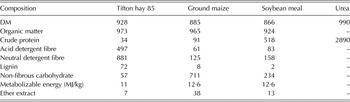
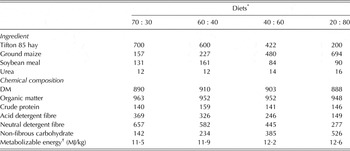
The roughage was Tifton 85 hay and the experimental concentrate was composed of maize, soybean meal and urea (Table 1). The dietary treatments were as follows: 70 : 30 = containing 700 g of roughage and 300 g of concentrate per kg DM; 60 : 40 = containing 600 g of roughage and 400 g of concentrate per kg DM; 40 : 60 = containing 400 g of roughage and 600 g of concentrate per kg DM; and 20 : 80 = containing 200 g of roughage and 800 g of concentrate per kg DM (Table 2). The Tifton 85 hay was chopped into lengths of about 2–3 cm. The ingredients for the concentrate were ground in a hammer mill fitted with strainers and 2 mm sieves. Continuous homogenization of the diets was performed in a horizontal mixer for 15 min. The animals were fed with Tifton 85 hay, experimental concentrates and 100 g/animal mineral supplement BELLNUTRI® (calcium: 146 g/kg; phosphorus: 40 g/kg; sulphur: 40 g/kg, sodium: 130 g/kg; copper: 1350 mg/kg, manganese: 1040 mg/kg, zinc: 5000 mg/kg, iodine: 100 mg/kg; cobalt 80 mg/kg, selenium: 26 mg/kg; fluorine (Max): 800 mg/kg) once a day at 06.00 h as a total mixed ration. Feed available in the trough was mixed at 16.00 h, as a strategy for encouraging animals to return to the trough and stimulate intake. Throughout the entire experimental period, the allowance was adjusted to allow refusals of approximately 100 g/kg in relation to the total amount consumed on the previous day. Feed refusals were collected and weighed before feeding and sub-samples were obtained and frozen at −20 °C.
Chemical composition of dietary ingredients (g/kg on a dry matter (DM) basis)

Composition of the experimental diets (g/kg on a dry matter (DM) basis)

* Diets: 70 : 30 containing 700 g of Tifton 85 hay and 300 g of concentrate per kg DM; 60 : 40 containing 600 g of Tifton 85 hay and 400 g of concentrate per kg DM; 40 : 60 containing 400 g of Tifton 85 hay and 600 g of concentrate per kg DM; and 20 : 80 containing 200 g of Tifton 85 hay and 800 g of concentrate per kg DM; concentrate containing ground maize, soybean meal and urea.
† Metabolizable energy = total apparent digestibility of gross energy × 0·82.
Four consecutive 21 day periods were used. Each study period consisted of 14 days for adaptation, 6 days for faeces and urine collection, and 1 day for sampling ruminal fluid. The latter was collected for measurement of ruminal pH, ammonia N (NH3-N), and VFA as well as bacteria and protozoa quantification.
Data collection and sampling procedures
Faeces were collected for 5 days to estimate the digestibility of dietary constituents. At the end of each collection day, faeces were weighed and homogenized. At the end of each 21 day study period, a composite sample was made for each animal based on the fresh weight of each sampling day. Total urine was collected for 5 days using funnel collectors attached to the animals. The funnel collector was connected to a polyethylene flexible tube, which directed the urine to containers containing 500 ml sulphuric acid (H2SO4, 200 ml/l; v/v) to avoid loss of nitrogenous compounds. After each 24 h collection period, the total weight and volume of urine excreted were determined. A composite sample was made from the 5 sampling days. The composite sample was homogenized and a 10 ml sub-sample was diluted with 40 ml of 0·018 mm H2SO4.
Duodenal samples were collected over 2 days (fourth and fifth data collection days during the study period) at 6 h intervals. Sample collection during the second day was delayed to ensure that every 3 h in a 24 h period was properly represented (Oliveira et al. Reference Oliveira, Berchielli, Pedreira, Primavesi, Frighetto and Lima2007). Samples were kept at −10 °C and at the end of the period one sample was made by pooling the samples for each animal in each period. Indigestible neutral detergent fibre (iNDF) was used as an indicator of daily DM flows in the duodenum (Harvatine & Allen Reference Harvatine and Allen2006), obtained via an in situ methodology after 240 h (Casali et al. Reference Casali, Detmann, Valadares Filho, Pereira, Henriques, de Freitas and Paulino2008) with incubated samples of feed offered, feed refusals, faeces and ground duodenal digesta (Wiley mill, 2 mm screen). The iNDF was analysed using an Ankom 200 Fibre Analyser (Ankom Technology Fairport, NY, USA).
Ruminal contents were sampled on the fifth day of each sampling period to determine pH and the concentrations of VFA and ammonia (NH3-N). Samples were taken at 0, 2, 4, 6, 8, 10, 12 and 14 h after feeding, and pH was measured after the contents were filtered. Two 20 ml aliquots were stored at −10 °C and later used to determine NH3-N according to the methodology of Fenner (Reference Fenner1965), adapted for use in Kjeldahl distillation. The VFA concentration was determined according to the methodology described by Palmquist & Conrad (Reference Palmquist and Conrad1971).
Microbial protein synthesis was calculated via urinary total excretion of purine derivatives (allantoin + uric acid) according to the technique of Fujihara et al. (Reference Fujihara, Ørskov, Reeds and Kyle1987), as described by Chen & Gomes (Reference Chen and Gomes1992) and calculated according to Pina et al. (Reference Pina, Valadares Filho, Tedeschi, Barbosa and Valadares2009).
Feed offered, feed refusals and faeces samples were dried at 55 °C for 72 h and ground in a Wiley mill (Thomas Scientific, Swedesboro, NJ) to pass through a 1 mm screen. Samples of Tifton 85 hay, concentrates and feed refusals were analysed for DM (934·01), mineral matter (MM; 942·05) and ether extract (EE; 920·39) according to AOAC (1990). The EE contents in faeces were determined by extraction in ether (EE; 920·39). Nitrogen was determined using a LECO FP-528 nitrogen analyser (LECO Corp., St. Joseph, MI, USA).
Neutral detergent fibre was determined using α-amylase and without the addition of sodium sulphite, following Van Soest et al. (Reference Van Soest, Robertson and Lewis1991) and adapted for the Ankom200 Fibre Analyser (Ankom Technology, Fairport, NY, USA). Acid detergent fibre was determined using the method described by Goering & Van Soest (Reference Goering and Van Soest1970) and adapted for the Ankom200 Fibre Analyser (Ankom Technology, Fairport, NY, USA). Acid detergent lignin was determined by solubilization of cellulose with sulphuric acid, according to Van Soest & Robertson (Reference Van Soest and Robertson1985). Non-fibrous carbohydrates were estimated as recommended by Hall (Reference Hall2000), as follows: NFC = 100 − [(% CP − %CP urea + %Urea) + %EE + %MM + %NDF]; however NFC data were converted to g/kg. Gross energy was obtained by the combustion of samples in an adiabatic bomb calorimeter IKA® modelo 2000 Basic.
Microbial population
Samples of ruminal contents were collected on day 16 of the trial period, via the cannulas, before the morning feeding of the animals. Fifty grams of the rumen contents were weighed and immediately added to 50 ml of phosphate saline buffer (pH 7·4), stirred vigorously for 3 min, and then the contents were filtered with a mesh fabric (100 μm). The filtrate was subjected to centrifugation at 16 000 g for 10 min at 4 °C. The supernatant was discarded and the remaining precipitate was re-suspended in 4 ml of Tris – EDTA buffer (10X, pH 8·0). The re-suspended content was centrifuged at 16 000 g for 10 min at 4 °C, the supernatant was discarded, and the precipitate immediately frozen (−20 °C) and stored for a period of 3 months.
Extraction of DNA was conducted in 250 mg of sample using the extraction kit AxyPrep ™ Bacterial Genomic DNA Miniprep (Axygen-Biosciences). The integrity and quantity of DNA was checked by electrophoresis on agarose gel (0·8%), and complementary DNA was assessed by spectrophotometry (Thermo Scientific NanoDrop ™ 1000) for evaluation of its quality and quantity.
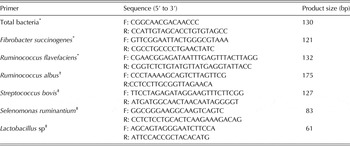
Quantitative real-time polymerase chain reaction (qPCR) was used for absolute quantification of total bacteria and relative quantification of cellulolytic bacteria (Ruminococcus albus, Fibrobacter succinogenes and Ruminococus flavefaciens). The primers used in the present study are shown in Table 3.
Primers used in the present study

F = forward; R = reverse.
* Denman & McSweeney (Reference Denman and McSweeney2006).
† Mosoni et al. (Reference Mosoni, Chaucheyras-Durand, Béra-Maillet and Forano2007).
‡ Khafipour et al. (Reference Khafipour, Li, Plaizier and Krause2009).
The amplifications were performed in triplicate and negative controls were run in the assay, omitting the total DNA. The reactions were conducted in the 7900 Real Time PCR System. The qPCR reaction was carried out using 25 ng of total DNA in a reaction containing: 7·5 μl of SYBR® Green PCR Master Mix (Bio-Rad, Hercules, CA, USA), 10 pmol of primer pair, and H2O to a final volume of 25 μl. Cycling conditions were 50 °C for 2 min, 95 °C for 10 min, and 40 cycles of 95 °C for 15 s, 60 °C for 1 min and 78 °C for 30 s. After one cycle of amplification, a step was added to increase the temperature from 60 to 95 °C to obtain dissociation curve of the reaction products, used for analysing the specificity of amplification.
Direct counts of protozoa were performed in a Sedgewick-Rafter counting chamber (Dehority et al. Reference Dehority, Tirabasso and Grifo1989). The samples were diluted with 200 ml/l glycerol and stained using Lugol's solution before counting the cells (D'Agosto & Carneiro Reference D'Agosto and Carneiro1999). Cell counts were obtained from rumen content aliquots that were preserved in formalin (a solution of equal parts water and 370 ml/l formaldehyde) (D'Agosto & Carneiro Reference D'Agosto and Carneiro1999).
Statistical analyses
The intake, digestibility, microbial protein synthesis and protozoa quantification data were analysed as a double 4 × 4 Latin square using the PROC MIXED procedure of Statistical Analysis System (SAS, version 9.2). The general mathematical model was represented as follows:
 $$Yijk = \mu + \alpha i + \beta j + sk + \alpha \beta ij + eijk$$
in which Yijk represents the observation on steers k given diet i at period j; αi represents the fixed effect of the ith diet, i = 1, 2,…, nt; βj represents the fixed effect of the jth period, j = 1, 2,…, np; and sk represents the random effect of the kth steers, k = 1, 2,…, nc, with variance component σ2c (Tempelman Reference Tempelman2004). Ruminal pH, NH3-N and VFA data were analysed as double 4 × 4 Latin square data with repeated measures over time. The model included fixed effects of diet, time and the interaction between these. Random effects consisted of steers and periods. In the analyses of feed intake, digestibility, nitrogen balance, protozoa population, pH, NH3-N and VFA, the means were compared using the contrast option of the PROC MIXED of SAS and declared significant at P < 0·05 for linear or quadratic effects.
A randomized block design was used for quantification of rumen bacteria, with fixed effects of treatments (1 degree of freedom (d.f.)) and blocks (7 d.f.) and random effects of period (7 d.f.), animal (7 d.f.) and error. In the analysis of the population of rumen bacteria, the means were compared using the DIFF option of the PROC MIXED's t test and significance was declared at P < 0·05.
RESULTS
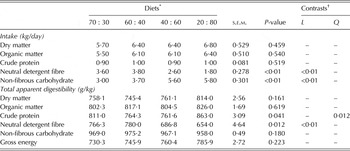
Higher proportions of concentrate in the diet did not affect intake and digestibility of dry and organic matter (Table 4). Crude protein intake was similar for all diets, but digestibility showed a quadratic association with concentrate proportion (P = 0·01), with the lowest values observed for the 60 : 40 and 40 : 60 roughage : concentrate ratios (Table 4). There was a linear reduction in intake and digestibility of NDF (P < 0·01, Table 4) with increasing proportions of concentrate in the diets.
Effect of four roughage : concentrate ratios on intake and content of digestible component in Nellore steers

* Diets: 70 : 30 containing 700 g of Tifton 85 hay and 300 g of concentrate per kg DM; 60 : 40 containing 600 g of Tifton 85 hay and 400 g of concentrate per kg DM; 40 : 60 containing 400 g of Tifton 85 hay and 600 g of concentrate per kg DM; and 20 : 80 containing 200 g of Tifton 85 hay and 800 g of concentrate per kg DM; concentrate containing ground maize, soybean meal and urea.
† Significant contrasts: L = linear, Q = quadratic; P-values for non-significant (P > 0·05) contrasts are not reported.
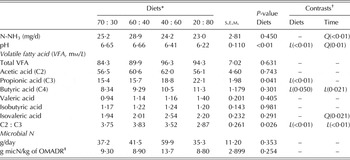
There was no interaction between diet and time for any of the ruminal parameters evaluated (Table 5). The concentration of N-NH3, total rumen VFA, acetic (C2), butyric (C4), isobutyric, valeric and isovaleric acids, and microbial nitrogen did not differ among diets. However, increasing proportions of concentrate in the diet resulted in a linear reduction in average rumen pH and increased butyric acid and propionic acid (C3) concentration, resulting in lower relative C2 : C3.
Effect of dietary roughage : concentrate ratio on rumen parameters in Nellore steers

* Diets: 70 : 30 containing 700 g of Tifton 85 hay and 300 g of concentrate per kg DM; 60 : 40 containing 600 g of Tifton 85 hay and 400 g of concentrate per kg DM; 40 : 60 containing 400 g of Tifton 85 hay and 600 g of concentrate per kg DM; and 20 : 80 containing 200 g of Tifton 85 hay and 800 g of concentrate per kg DM; concentrate containing ground maize, soybean meal and urea
† Significant contrasts: L = linear, Q = quadratic; P-values for non-significant (P > 0·05) contrasts are not reported
‡ g of microbial N/kg of organic matter apparently digested in the rumen.
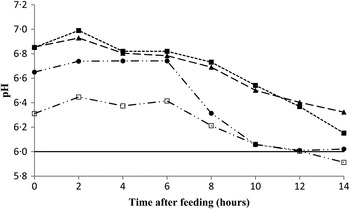
All ruminal parameters except concentrations of acetic and valeric acids varied with time. For all diets, ruminal pH values remained above 6·0 up to 12 h after feeding. Ruminal pH fell below 6·0 for animals fed with a higher proportion of concentrate in the diet (20 : 80) only 14 h after feeding (Fig. 1).
Rumen pH in steers fed diets 70 : 30 containing 700 g of Tifton 85 hay and 300 g of concentrate per kg DM (▲); 60 : 40 containing 600 g of Tifton 85 hay and 400 g of concentrate per kg DM (■); 40 : 60 containing 400 g/kg of Tifton 85 hay and 600 g/kg of concentrate (•); 20 : 80 containing 200 g/kg of Tifton 85 hay and 800 g/kg of concentrate (□); standard error of means (s.e.m. = 0·056); diets × time interaction (P < 0·05).

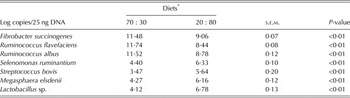
The population of fibrolytic bacteria changed with increasing proportions of concentrate in the diet. The qPCR analysis showed that high levels of concentrate decreased F. succinogenes, R. flavefaciens and R. albus population numbers (P < 0·05, Table 6) in the rumen. However, consumers of lactic acid (Selenomonas ruminantium and Megasphaera elsdenii) and producers of lactic acid (Lactobacillus sp. and Streptococcus bovis) increased when animals were fed with high-concentrate diets (P < 0·05, Table 6).
Effect of dietary roughage : concentrate ratio on the proportion of ruminal bacterial

* Diets: 70 : 30 containing 700 g of Tifton 85 hay and 300 g of concentrate per kg DM; and 20 : 80 containing 200 g of Tifton 85 hay and 800 g of concentrate per kg DM; concentrate containing ground maize, soybean meal and urea
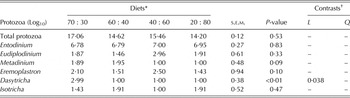
The total number of protozoa was similar for the different roughage : concentrate ratios (Table 7). The genus Entodinium was more representative in all diets, representing 0·99 of all protozoa. Protozoan counts were only influenced by diet for the genus Dasytricha (P < 0·01), being higher in the roughage : concentrate ratio 70 : 30.
Effect of dietary roughage : concentrate ratio on rumen protozoa of Nellore steers

* Diets: 70 : 30 containing 700 g of Tifton 85 hay and 300 g of concentrate per kg DM; 60 : 40 containing 600 g of Tifton 85 hay and 400 g of concentrate per kg DM; 40 : 60 containing 400 g of Tifton 85 hay and 600 g of concentrate per kg DM; and 20 : 80 containing 200 g of Tifton 85 hay and 800 g of concentrate per kg DM; concentrate containing ground maize, soybean meal and urea.
† Significant contrasts: L = linear, Q = quadratic; P-values for non-significant (P > 0·05) contrasts are not reported.
DISCUSSION
The present study evaluated the effect of diets with four different roughage (hay Tifton 85) : concentrate ratios on intake, digestibility, rumen fermentation and rumen microbiota of Nellore feedlot steers. It was found that although increased proportions of concentrate in the diet changed the ruminal bacterial population, there was no reduction of pH below 6·0 for a long period.
Thus, the hypothesis that higher proportions of concentrate in the diet of these Nellore steers may affect ruminal fermentation as a consequence of a ruminal pH reduction was not supported due to the effect of NDF present in all diets (more than 400 g per 100 kg BW, reported as a minimum according to Piatkowski et al. Reference Piatkowski, Gürtler and Voigt1990 and Hoffmann Reference Hoffmann1990) and DM intake level of the animals (Tafaj et al. Reference Tafaj, Zebeli, Maulbetsch, Steingaß and Drochner2006). Considerable research (Yang et al. Reference Yang, Beauchemin and Rode2001; Krause & Combs Reference Krause and Combs2003) demonstrates that fibre effectiveness of the ration, particularly starch fermentability in the rumen, depends on the concentrate as well as the roughage. Firkins et al. (Reference Firkins, Eastridge, St-Pierre and Noftsger2001) observed that an increase in dry matter intake (DMI) would still result in an increase in rumen-degradable starch, although the increased passage rate caused a reduction in the percentage of ruminally degraded starch. Thus, in the present study Nellore (beef cattle) steers, when compared with dairy cows, might have a decreased risk of ruminal acidosis simply due to lower DMI in the present study when compared with dairy cows (Tafaj et al. Reference Tafaj, Zebeli, Maulbetsch, Steingaß and Drochner2006).
It has been suggested that intake can be reduced in diets with increasing roughage : concentrate ratios due to the negative association between forage NDF and the bulk density of the diet (Allen Reference Allen2000; Kozloski et al. Reference Kozloski, Reffatti, Bonnecarrère Sanchez, Lima, Cadorin, Härter and Fiorentini2007). On the other hand, physical fill rarely limits intake of high-concentrate diets because when these diets are diluted by roughage, the animal typically increases intake to meet its energy requirements (Galyean & Defoor Reference Galyean and Defoor2003). However, the present results showed no effect of increasing proportions of concentrate in the diet on dry and organic matter intake. This is in line with previous research showing similar results for other cattle breeds (Hristov et al. Reference Hristov, Ropp, Grandeen, Abedi, Etter, Melgar and Foley2005; Owens et al. Reference Owens, McGee, Boland and O'Kiely2008; Aguerre et al. Reference Aguerre, Wattiaux, Powell, Broderick and Arndt2011). Although voluntary ingestion can be limited by rumen distension when maximum NDF intake capacity is reached (Mertens Reference Mertens, Forbes and France1993), the observed lack of differences in intake may be explained by the fact that in the diets with greater roughage (70 : 30 and 60 : 40), bulk fill was not a limiting factor. It is also possible that the observed increases in VFA concentration were not sufficient to activate the satiety centre of the hypothalamus (Allen Reference Allen2000).
Increasing levels of concentrate in the diet of ruminants have usually been associated with higher total tract DM and organic matter digestibility, even though fibre digestibility can be reduced, especially when grain-based concentrates are fed (Archimède et al. Reference Archimède, Sauvant and Schmidely1997). Accordingly, although increasing proportions of concentrate in the diet did not change the digestibility of organic matter, the present results showed that fibre digestibility was increasingly reduced, as reported elsewhere (Moorby et al. Reference Moorby, Dewhurst, Evans and Danelón2006; Agle et al. Reference Agle, Hristov, Zaman, Schneider, Ndegwa and Vaddella2010). Replacing roughage with concentrate reduced ruminal pH due to a lower NDF intake, as grains are generally more digestible than forage, resulting in the accumulation of VFA (Lechartier & Peyraud Reference Lechartier and Peyraud2010). The corresponding decrease of ruminal pH reduces the population of fibrolytic bacteria, among which F. succinogenes, R. albus and R. flavefaciens are known as the most important (Kobayashi et al. Reference Kobayashi, Shinkai and Koike2008). Therefore, fibre digestion may have been reduced owing to the reduction in ruminal pH derived from the greater NFC fermentation (Cerrato-Sánchez et al. Reference Cerrato-Sánchez, Calsamiglia and Ferret2007).
Even though pH was reduced for diets with higher proportions of concentrate, ruminal pH was kept within a normal physiological range (>6·0) for a long period (12 h; Fig. 1), even when the proportion of hay was only 200 g/kg DM (corresponding to 277 g NDF/kg DM). It is proposed that this was only possible due to the chemical composition and particle size (20 mm long, DeVries et al. Reference DeVries, Schwaiger, Beauchemin and Penner2014) of Tifton 85 hay. Dietary NDF concentration is, in turn, correlated with diet particle size and chewing time (Meissner & Paulsmeier Reference Meissner and Paulsmeier1995; Galyean & Defoor Reference Galyean and Defoor2003; Ellis et al. Reference Ellis, Mahlooji, Lascano and Matis2005), which affect the ruminal buffer capacity (Allen & Mertens Reference Allen and Mertens1988; Zebeli et al. Reference Zebeli, Aschenbach, Tafaj, Boguhn, Ametaj and Drochner2012). These findings point to the suitability of this low quality roughage (higher fibre and low protein) as a source of fibre, which has an important role in modulating rumen fermentation in Nellore steers fed with a diet of 80% grain.
Another factor that may have contributed to the fact that animals did not show pH < 6·0 for a long period was the slow rate of degradation of concentrate in the rumen (low DM intake level, degradation rate 2%/h – AFRC 1993). Tafaj et al. (Reference Tafaj, Zebeli, Maulbetsch, Steingaß and Drochner2006) observed that the very low degradation rate of concentrate (5·5%/h) and its allocation in portions lower than 2·8 kg in a time interval of 3–4 h during the day could help to reduce the negative effects of increasing the proportion of concentrate on rumen fermentation.
Volatile fatty acid concentration is mainly affected by dietary composition, and manipulation of the diet by increasing the proportion of concentrate is a strategy to optimize ruminal fermentation by increasing propionogenesis (Doreau et al. Reference Doreau, van der Werf, Micol, Dubroeucq, Agabriel, Rochette and Martin2011). In the present study, such typical propionic acid fermentation response was observed and consequently the C2 : C3 ratio dropped, in line with previous findings (Bauman et al. Reference Bauman, Davis and Bucholtz1971; Sutton et al. Reference Sutton, Dhanoa, Morant, France, Napper and Schuller2003). This increase in ruminal propionic acid concentration can be explained by the greater consumption of NFC. Accordingly, there was also an increase in the relative proportion of S. ruminantium, an important species that produces propionic acid by decarboxylation of succinate (Wolin et al. Reference Wolin, Miller, Stewart, Hobson and Stewart1997) and relies on starch and sugars for growth. The greater rumen concentrations of butyrate in response to feeding large amounts of grain found in the present study were expected and also agree with previous studies (Stone Reference Stone2004; Saleem et al. Reference Saleem, Ametaj, Bouatra, Mandal, Zebeli, Dunn and Wishart2012). These results have been correlated with an increased population of S. bovis and Lactobacillus spp, which are more tolerant to acidic (low pH) conditions, and produce lactate. In addition, the catabolism of lactate produces butyrate in the rumen fluid of cattle fed grain-rich diets in response to a decrease in ruminal pH (Saleem et al. Reference Saleem, Ametaj, Bouatra, Mandal, Zebeli, Dunn and Wishart2012). Consequently, these microbes gradually replace other normal rumen microorganisms and tend to become the major components of the rumen microbial population by using glucose as their main substrate (Dawson et al. Reference Dawson, Rasmussen, Allison, Hobson and Stewart1997).
The concentration of N-NH3 in the rumen results from the balance between production, absorption and incorporation of amino N into microbial protein (Russell et al. Reference Russell, Sniffen and Van Soest1983). Here, N-NH3 concentration remained above 5 mg/dl in all diets tested, a threshold suggested to have no effect on microbial protein production (Satter & Roffler Reference Satter and Roffler1975). Consistent with this result, it was also observed that microbial synthesis and its corresponding efficiency did not differ among diets. Energy is the main dietary factor determining the intensity and efficiency of microbial protein synthesis in the rumen (Agle et al. Reference Agle, Hristov, Zaman, Schneider, Ndegwa and Vaddella2010), and all diets were isoenergetic.
Animals fed high-grain diets are expected to undergo substantial changes in the ruminal environment and microbial populations (Goad et al. Reference Goad, Goad and Nagaraja1998; Tajima et al. Reference Tajima, Arai, Ogata, Nagamine, Matsui, Nakamura, Aminov and Benno2000). In the present study, qPCR absolute analysis was used to determine how increasing proportions of concentrate to Tifton 85 hay ratios in the diet of Nellore steers changed microbial populations. The results show that fibrolytic bacteria populations (F. succinogenes, R. flavefaciens and R. albus) decreased with increasing proportions of concentrate. This reduction could be in part explained by the lower rumen pH in cattle fed a high-grain diet (Khafipour et al. Reference Khafipour, Li, Plaizier and Krause2009; Mao et al. Reference Mao, Zhang, Wang and Zhu2013). The results of the present study are consistent with those of previous studies (Tajima et al. Reference Tajima, Aminov, Nagamine, Matsui, Nakamura and Benno2001; Klieve et al. Reference Klieve, Hennessy, Ouwerkerk, Forster, Mackie and Attwood2003), which reported that the proliferation of fermenting bacteria of fibrous carbohydrates is directly correlated with the amount of fibre in the diet, and that the replacement of fibre by rapidly fermentable carbohydrates can influence the dynamics of the ruminal ecosystem.
For bacteria consumers (S. ruminantium and M. elsdenii) and producers of lactic acid (Lactobacillus sp. and S. bovis) there was, in turn, an increase in population numbers when animals were fed with high-concentrate diets. This latter change may be due to the increased fermentable substrate present in the diet favouring amylolytic bacteria growth (Fernando et al. Reference Fernando, Purvis Ii, Najar, Sukharnikov, Krehbiel, Nagaraja, Roe and de Silva2010).
Total concentration of protozoa in ruminal fluid generally increases with the addition of concentrate in the diet (Franzolin & Dehority Reference Franzolin and Dehority1996; Brossard et al. Reference Brossard, Martin and Michalet-Doreau2003), although high-grain diets can result in reduced protozoa numbers or even defaunation due to a decrease in ruminal pH < 5·6 (Hristov et al. Reference Hristov, Ivan, Rode and McAllister2001; Dehority Reference Dehority2005). However, in the present study, total protozoa population remained constant, consistent with the fact that ruminal pH remained > 5·8. Similarly, the composition of protozoa in the rumen remained nearly unchanged except for one genus (Dasytricha). While Entodinium was responsible for maintaining the stable population of total protozoa, as it represents 0·98 of protozoa in the rumen, diets with a higher roughage proportion (70 : 30) benefited the population of Dasytricha, possibly due to its capacity to use cellulose (Hungate Reference Hungate1996).
In summary, the present study suggests that, for diets based on hay from the tropical grass Tifton 85, increasing concentrate proportions do not affect intake and digestibility of dry and organic matter. This roughage enabled average ruminal pH to be > 6·0 for up to 12 h after feeding, possibly making Tifton 85 hay an appropriate source of fibre that may modulate rumen fermentation in Nellore feedlot steers.
In conclusion, diets with increasing concentrate to Tifton 85 hay (source fibre low quality) ratios inhibit the growth of some cellulolytic bacteria, reducing fibre digestibility without impairing the intake and digestibility of dry and organic matter. The findings also point to Tifton 85 hay as a possible source of fibre that could modulate rumen fermentation in the Nellore steer feedlot.
The authors would like to thank the São Paulo Research Foundation (FAPESP) for providing financial support through grant # 2010/02036-4 and grant # 2011/20617-7, and the National Council for Scientific and Technological Development (CNPq – Conselho Nacional de Desenvolvimento Científico e Tecnológico).