Introduction
Selection pressure caused by frequent use of the same herbicide or mechanism of action naturally causes the selection of resistant weeds. More than a third of the 54 cases of resistance of weeds to herbicides in Brazil are related to species of the family Poaceae (Heap Reference Heap2022). Goosegrass [Eleusine indica (L.) Gaertn.] is one of the grass species with resistance to important herbicides used for its management in Brazil, presenting populations resistant to herbicides that inhibit the enzymes acetyl-coenzyme A carboxylase (ACCase, HRAC Group 1) and 5-enolpyruvylshikimate-3-phosphate synthase (EPSPS, HRAC Group 9) (Osuna et al. Reference Osuna, Goulart, Vidal, Kalsing, Ruiz Santaella and De Prado2012; Takano et al. Reference Takano, Oliveira, Constantin, Braz and Gheno2017).
Eleusine indica is a cosmopolitan species; thus, it has developed resistance all around the world. There are 37 reports of resistance in other countries, connected to eight different sites of action (Heap Reference Heap2022). The most common cases refer to glyphosate resistance, with 11 reports; in addition, there are 20 cases showing resistance to a single herbicide mode of action and six cases of multiple resistance, including one case of simultaneous resistance to four sites of action (Jalaludin et al. Reference Jalaludin, Yu and Powles2014).
A weed population with resistance to ACCase inhibitors in Brazil was found in soybean [Glycine max (L.) Merr.] fields in the state of Mato Grosso, presenting cross-resistance to the aryloxyphenoxypropionate (APP) and cyclohexanedione (CDH) chemical groups (Osuna et al. Reference Osuna, Goulart, Vidal, Kalsing, Ruiz Santaella and De Prado2012; Vidal et al. Reference Vidal, Portes, Lamego and Trezzi2006). Eleusine indica populations resistant to ACCase inhibitors were also found in Malaysia and the United States, with the same cross-resistance to APPs and CDHs (Jalaludin et al. Reference Jalaludin, Yu and Powles2014; Leach et al. Reference Leach, Devine, Kirkwood and Marshall1995; Marshall et al. Reference Marshall, Kirkwood and Leach1994; McCullough et al. Reference McCullough, Yu, Raymer and Chen2016). The recurrent cases of resistance to ACCase-inhibiting herbicides are usually connected to target-site resistance (Takano et al. Reference Takano, Melo, Ovejero, Westra, Gaines and Dayan2020). Asp-2078-Gly and Trp-2027-Cys mutations in the ACCase enzyme are important mechanisms of resistance to ACCase-inhibiting herbicides in E. indica (Cha et al. Reference Cha, Najihah, Sahid and Chuah2014; Jalaludin et al. Reference Jalaludin, Yu and Powles2014; McCullough et al. Reference McCullough, Yu, Raymer and Chen2016; Osuna et al. Reference Osuna, Goulart, Vidal, Kalsing, Ruiz Santaella and De Prado2012). In addition, the metabolization of herbicides can also contribute to resistance to ACCase inhibitors (McCullough et al. Reference McCullough, Yu, Raymer and Chen2016; Powles and Yu Reference Powles and Yu2010; Wang et al. Reference Wang, Lin, Chiang and Ching-Yuh Wang2017).
Glyphosate resulted in adequate control of E. indica for several years, but the frequent use of this herbicide also caused the selection of resistant biotypes (Takano et al. Reference Takano, Oliveira, Constantin, Braz and Gheno2017). The main mechanisms of resistance of E. indica to glyphosate are connected to changes in the herbicide site of action by mutation or overexpression of EPSPS (Baerson et al. Reference Baerson, Rodriguez, Tran, Feng, Biest and Dill2002; Chen et al. Reference Chen, Huang, Zhang, Wei, Huang and Chen2015; Gherekhloo et al. Reference Gherekhloo, Fernández-Moreno, Alcántara-de la Cruz, Sánchez-González, Cruz-Hipolito, Domínguez-Valenzuela and De Prado2017; Kaundun et al. Reference Kaundun, Zelaya, Dale, Lycett, Carter, Sharples and McIndoe2008; Molin et al. Reference Molin, Wright and Nandula2013; Takano et al. Reference Takano, Mendes, Scoz, Lopez Ovejero, Constantin, Gaines, Westra and Dayan2018; Yu et al. Reference Yu, Jalaludin, Han, Chen, Sammons and Powles2015). Moreover, amplification of the EPSPS gene was observed in Palmer amaranth (Amaranthus palmeri S. Watson) populations resistant to glyphosate (Gaines et al. Reference Gaines, Zhang, Wang, Bukun, Chisholm, Shaner, Nissen, Patzoldt, Tranel, Culpepper, Grey, Webster, Vencill, Sammons and Jiang2009).
The present study was developed based on a E. indica population with resistance to multiple herbicide modes of action (EPSPS inhibition: glyphosate; ACCase inhibition: aryloxyphenoxypropionate chemical group) from Primavera do Leste, MT, Brazil. The objective was to identify possible mechanisms of resistance associated or not with the herbicide sites of action.
Material and Methods
Acquisition of Seeds and Growth of Plants
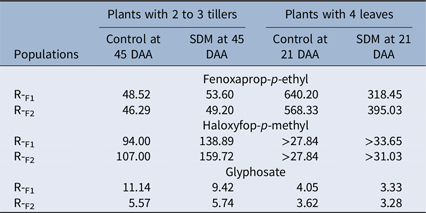
Eleusine indica resistance to glyphosate and ACCase-inhibiting (fenoxaprop-p-ethyl and haloxyfop-p-methyl) herbicides was confirmed through dose–response curve studies carried out at the Brazilian Agricultural Research Corporation (EMBRAPA) in Brasilia, DF, Brazil, and in the Luiz de Queiroz College of Agriculture, University of São Paulo (ESALQ/USP), Piracicaba, SP, Brazil; the data are shown in Correia et al. (Reference Correia, Araújo and Bueno Júnior2022). The resistance factor ranged from 3.3 to 11 for glyphosate and presented values greater than 27.8 for fenoxaprop-p-ethyl and haloxyfop-p-methyl (Table 1).
Resistance factors a from dose–response experiments for the resistant (R-F1 and R-F2) Eleusine indica populations for fenoxaprop-p-ethyl, haloxyfop-p-methyl, and glyphosate herbicides, for control and shoot dry matter (SDM) at 45 d after application (DAA) in plants with 2 to 3 tillers (experiments in Brasília, DF, Brazil), and for control and SDM at 21 DAA in plants with 4 leaves (experiments in Piracicaba, SP, Brazil).

a Detailed results are presented in Correia et al. (Reference Correia, Araújo and Bueno Júnior2022).
The resistant E. indica seeds were the same used in the dose–response curve experiments, which were obtained from an agricultural production area in the municipality of Primavera do Leste, MT, Brazil (15.376ºS, 54.434ºW, 631-m altitude). Resistant plants of generation 1 (R-F1) were propagated to obtain generation 2 seeds (R-F2). Seeds of a population susceptible to the herbicides were used as a control population; they were acquired from a commercial company specializing in weed seed production (Agrocosmos, Engenheiro Coelho, São Paulo, Brazil).
Eleusine indica seeds from susceptible (S) and resistant (R-F1 and R-F2) populations used to determine target and non-target mechanisms of resistance were sown in pots (0.25 dm3) containing a clayey soil previously fertilized with N (0.575 mg dm−3), P2O5 (500 mg dm−3), and K2O (500 mg dm−3). The plants were maintained in a greenhouse at ESALQ/USP, in Piracicaba, SP, Brazil. The plants were thinned to 1 plant per pot after emergence. For watering, each pot (experimental unit) was nested in a container with a wider diameter and no holes; soil moisture was monitored periodically, and water in the containers was replenished when necessary. The temperature varied from 20.4 C to 33.4 C, the mean relative air humidity was 79.2%, and only natural light was provided.
Target Mechanisms of Resistance
Sequencing of ACCase and EPSPS Genes through PCR
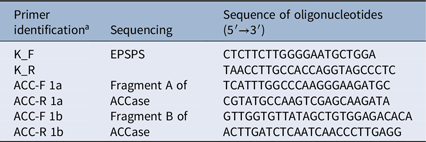
Sequencing of ACCase and EPSPS genes was carried out at the Max Feffer Laboratory of Plant Genetics of the ESALQ/USP, in Piracicaba, SP, Brazil. When the E. indica plants had four fully expanded leaves, DNA from five plants of each population (S, R-F1, and R-F2) was extracted using the CTAB (hexadecyltrimethylammonium bromide) method described by Doyle (Reference Doyle1987). DNA concentration and quality were evaluated in agarose gel (1% v/v). A 300-bp EPSPS fragment was amplified using the primers used by Kaundun et al. (Reference Kaundun, Zelaya, Dale, Lycett, Carter, Sharples and McIndoe2008) to assess the mutations at the positions 102 and 106; and two fragments of ACCase (440 bp and 436 bp) were assessed using two sets of primers, according to Cha et al. (Reference Cha, Najihah, Sahid and Chuah2014), the first containing the codon for the Ile-1781 replacement, and the second for the other six codons: Trp-1999, Trp-2027, Ile-2041, Asp-2078, Cys-2088, and Gly-2096 (Table 2).
Primers used for polymerase chain reaction (PCR) of Eleusine indica populations susceptible and resistant (R-F1 and R-F2) to acetyl-coenzyme A carboxylase (ACCase)- and 5-enolpyruvylshikimate-3-phosphate synthase (EPSPS)-inhibiting herbicides.

a F, forward; R, reverse.
PCR was carried out under the following characteristics: 1 µl of each DNA (10 ng µl−1), 2.5 µl of buffer 10X HiFiTaq® (Thermo Fisher Scientific Inc., Waltham, MA, USA), 2.0 µl dNTP Mix 2.5 mM; 0.5 µl of each primer (10 µM), 17.30 µl of Milli-Q water, 1.0 µl MgCl2 50 mM, and 0.2 µl of HiFiTaq® DNA Polymerase (5U µl−1), making a total volume of 24.5 µl. The PCR cycling configuration was: 1 cycle of 94 C for 3 min, 40 cycles of 94 C for 30 s, 52 C (EPSPS) or 56 C (ACCa and ACCb) for 30 s, 72 C for 1 min (ACCa and ACCb) or 1 min, 30 s (EPSPS), and a final extension at 72 C for 5 min.
Before the sequencing, the PCR products were purified using a PCR purification kit, according to the manufacturer (QiaGen, Hilden, Germany). Once purified, the integrity of PCR products was confirmed by capillary electrophoresis. The PCR products of 5 plants of each population (S, R-F1, and R-F2) were sequenced. The sequencing reaction was carried out using 2 μl of BigDye® Terminator v3.1 Cycle Sequencing Kit (Applied Biosystems, Waltham, MA, USA); 200 ng of DNA; 3 μl of Save Money Buffer (200 mM of Tris pH 9 and 0.5 mM MgCl2); and 0.5 μl of forward and reverse primers (10 µM μl−1) of the region to be analyzed. The program used for the sequencing reaction consisted of the following phases: denaturation at 95 C for 20 s, annealing at 60 C for 15 s, and extension at 57 C for 1 min, for a total of 25 cycles.
The purification of the sequencing reaction was carried out by adding 2 μl of sodium acetate/EDTA (1.5 M NaAc and 259 mM EDTA), which was well homogenized; then, 60 μl of absolute ethanol was added and the reaction was again homogenized. The reaction was then centrifuged for 45 min at 4,000 rpm and 4 C. The supernatant was removed by inversion, and 150 μl of 70% ethanol was added, followed by another centrifugation for 15 min at 4,000 rpm and 4 C. The supernatant was discarded, and the pellet was dried at room temperature, protected from light, and then suspended in 10 μl of deionized formamide (Hi-DiTM formamide, Applied Biosystems). The samples were denatured at 95 C for 5 min, refrigerated in ice for 5 min, and subjected to an automatic sequencer (ABI 3130 DNA Analyzer, Applied Biosystems). The sequences were determined using Sequencing Analysis v. 5.3.1 software.
Analysis of Number of Copies and Expression of ACCase and EPSPS Genes through qPCR
The experiment to assess the expression of ACCase and EPSPS enzymes was carried out at the Cell and Molecular Biology Laboratory of the CENA/USP, in Piracicaba, SP, Brazil. Leaf tissue from 10 plants of each E. indica population (S, R-F1, and R-F2) was collected, ground in liquid nitrogen, and stored at −80 C before RNA extraction. The RNA extraction was carried out following the Trizol kit manufacturer’s instructions (Invitrogen, Thermo Fisher), using 50 mg of frozen ground tissues. The total RNA extract was diluted in 20 ml of 0.1% DEPC solution. The RNA samples were quantified by spectrophotometry at 260- and 280-nm wavelengths, using the NanoDropTM 2000c (Thermo Fisher Scientific Inc.). The RNA samples were treated with DNase I (Thermo Fisher Scientific Inc.) free from RNase and the cDNA of the first ribbon was synthetized from 1,000 ng of total RNA, using the iScript cDNA Synthesis Kit (Biohad, Hercules, CA, USA). Total genomic DNA was also extracted with a DNA extractor (Maxwell-RSC48, model AS8500, Promega, Madison, WI, USA).
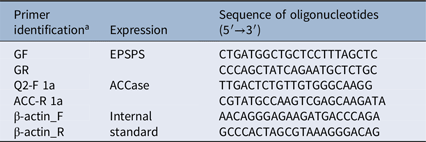
Regarding the genomic cDNA and genomic DNA, the EPSPS and ACCase primers were based on Chen et al. (Reference Chen, Huang, Zhang, Wei, Huang and Chen2015) and Cha et al. (Reference Cha, Najihah, Sahid and Chuah2014), respectively, in addition to the internal standard using β-actin (Table 3). The reactions were carried out in a real-time PCR system StepOnePlusTM (Thermo Fisher Scientific Inc.) by using the PowerUp SYBR Green Master Mix (Thermo Fisher Scientific Inc.), following the manufacturer’s instructions. Genomic DNA and cDNA (100 ng each) were amplified by using quantitative data in real-time PCR, with a total volume of 20 μl under the following conditions: 10 min at 42 C; 10 min at 95 C; 40 cDNA amplification cycles for 15 s at 95 C, 20 s at 59 C, and 30 s at 72 C, with the fluorescence signal recorded. A final step of 15 s at 95 C, 1 min at 60 C was carried out, and the fluorescence was measured at each 0.7 C increment from 60 to 95 C.
Primers used for quantitative PCR (qPCR) of Eleusine indica populations susceptible and resistant (R-F1 and R-F2) to acetyl-coenzyme A carboxylase (ACCase)- and 5-enolpyruvylshikimate-3-phosphate synthase (EPSPS)-inhibiting herbicides.

a F, forward; R, reverse.
The quantification of EPSPS and ACCase was calculated as ΔCt = (Ct of EPSPS or ACCase − Ct of β-actin), and the relative increases in number of EPSPS or ACCase copies were expressed as 2−ΔΔCt (Livak and Schmittgen Reference Livak and Schmittgen2001). Each sample was processed with three replications to calculate the mean and the standard deviation. The results were expressed as fold increases in number of ACCase and EPSPS copies in relation to β-actin. The means were compared using Tukey’s test (P < 0.05) for the number of genomic copies and levels of expression of enzymes.
Non-target Mechanisms of Resistance
Absorption and Translocation of [14C]glyphosate and [14C]fenoxaprop-p-ethyl
Two experiments were developed at the Laboratory of Ecotoxicology of the CENA/USP, in Piracicaba, SP, Brazil: one for glyphosate and other for fenoxaprop. Plants of populations S, R-F1, and R-F2 were treated with the herbicides when they had four fully expanded leaves. The second-oldest leaf was marked and covered with aluminum foil before the remaining leaves were subjected to application of 1,000 g ae ha−1 of glyphosate in the first experiment and 110 g ai ha−1 of fenoxaprop in the second. Both applications were carried out using a CO2-pressurized backpack sprayer equipped with a spray boom with four flat-fan nozzles (Magno AD11002, Magnojet, Ibaiti, Brazil) at a constant pressure of 2 kPa and application volume equivalent to 200 L ha−1.
Under laboratory conditions, the aluminum foil was removed from the marked leaf, and a solution containing a mixture of [14C]glyphosate with cold glyphosate and [14C]fenoxaprop with cold fenoxaprop was prepared and applied, using five 1-μl droplets. The total radioactivity applied per plant, using [14C]glyphosate and [14C]fenoxaprop, was 175.605.0 and 204.972.0 dpm, respectively.
The absorption and translocation were measured at 24, 48, and 72 h after treatment (HAT). Three replications (plants) were used simultaneously for each evaluation time. The treated leaves were washed with 3 ml of a methanol and deionized water solution (1:1 v/v). Two 500 μl aliquots of the liquid from the washing were collected, and 10 ml of a scintillation solution (Instagel Plus, Perkinelmer Inc., Waltham, MA, USA) was added to each; the solution was analyzed through liquid scintillation spectrometry. The results for each aliquot were extrapolated to the total volume of the solution.
Parts separated from the dried plant (treated leaf, other leaves, and roots) were oxidated in a biological oxidizer, followed by measurement of radioactivity in the samples through liquid scintillation spectrometry. The absorption values were calculated using the following equation:
 $$\% {\rm{Habs}} = \left[ {to/\left( {to + fl} \right) \times 100} \right]$$
where %Habs is the proportion of the herbicide absorbed; to is the quantity of 14C, measured after the oxidation of all tissues; and fl is the quantity of 14C detected in the washing of treated leaves.
The following equation was used for the translocation of herbicides:
 $$\% {\rm{Htr}} = 100 - \left[ {ft/\left( {ft + of} \right) \times 100} \right]$$
where %Htr is the proportion of the herbicide translocated; ft is the quantity of 14C measured in the treated leaf; and of is the quantity of 14C detected in the other leaves. The translocation was also measured for the roots. The mean [14C]glyphosate and [14C]fenoxaprop recovered was 88% and 83%, respectively. The absorption and translocation were analyzed using Tukey’s test (P < 0.05), applied for each evaluation time.
Metabolic Profile of Eleusine indica Susceptible and Resistant to Glyphosate
Analyses were carried out at the Weed Science Research Center of the FCA/UNESP, in Botucatu, SP, Brazil. The E. indica plants (populations S, R-F1, and R-F2) were grown until they reached the 4-leaf stage and then treated with 1,000 g ae ha−1 of glyphosate. The application was carried out using a pressurized backpack sprayer equipped with a spray boom with four flat-fan nozzles (Magno AD11002) at a constant pressure of 2 kPa and application volume equivalent to 200 L ha−1.
The concentrations of glyphosate, acid aminomethylphosphonic (AMPA), and shikimate were quantified at 0 (time of application), 24, 48, 72, 96, and 168 HAT. The entire aerial part of each plant was collected at each time, placed in 50-ml plastic centrifuge tubes, and stored in an ultrafreezer at −80 C. Leaf tissue samples were macerated in a porcelain mortar containing liquid nitrogen; the ground tissue was placed in 15-ml plastic centrifuge tubes and again stored in an ultrafreezer at −80 C. The samples were then lyophilized (removal of water) at −50 C, standardized in a 15-ml Falcon tube with 100 mg of leaf tissue (ground and lyophilized), and again stored in an ultrafreezer at −80 C until the extraction procedure.
Acidified water (pH 2.5) was added to each 15-ml tube for the extraction of compounds. The tubes were slightly shaken and then subjected to an ultrasonic bath at 37 kHz for 30 min at 55 C (Gomes et al. Reference Gomes, Carbonari, Velini, Trindade and Silva2015).
After the extraction, all samples were centrifuged at 4,000 rpm for 10 min at 20 C (38R routine) for separation of the stages. The supernatants were collected and filtered in a Millipore filter (Millex HV, Merck Millipore Ltd., Tullagreen, Ireland) with a pore size of 0.45 μm equipped with a Durapore membrane with a pore size of 13 mm, and packaged in an amber bottle with a 9-mm diameter opening (flow supplying) with capacity of 2 ml. The compounds were quantified using a liquid chromatography–tandem mass spectrometry system composed of a high-performance liquid chromatograph (Prominence UFLC, Shimadzu, Kyoto, Japan) coupled to a hybrid triple-quadrupole mass spectrometer (Triple Quad 4500, Applied Biosystems, Foster City, CA, USA).
Direct injections with an analytical standard solution of 1 mg L−1 of each compound were carried out individually to optimize the mass spectrometer conditions. The infusions of test substances were used to choose the ionization mode [electrospray ionization (ESI)], which produces analyte ions at the liquid stage before entering the mass spectrometer. The negative ionization mode was used for glyphosate, AMPA, and shikimic acid.
The compounds were separated with a Gemini 5 μ C18 analytical column (, Phenomenex, Torrance, CA, USA; 150 mm by 4.6 mm, 110 Å) at a flow rate of 0.6 ml min−1, using two mobile stages: stage A (PA) consisted of 5 mM of ammonium acetate in water, and stage B (PB) consisted of 5 mM of ammonium acetate in methanol. The chromatographic conditions used to quantify the compounds were: 0 to 1 min, 10% PB, and 90% PA; 1 to 4 min, 95% PB, and 5% PA; 4 to 8 min, 95% PB, and 5% PA; 8 to 10 min, 10% PB, and 90% PA; and 10 to 12 min, 10% PB, and 90% PA (Gomes et al. Reference Gomes, Carbonari, Velini, Trindade and Silva2015).
The total running time was 18 min, regardless of the compound, and the retention time for each compound in the chromatographic column was 3.86 min for glyphosate and shikimic acid and 3.69 min for AMPA. The calibration curve was determined for each compound, with standard concentrations covering the range of levels of the compounds found in the plant tissues. The means were compared using Tukey’s test (P < 0.05), applied for each time of evaluation.
Results and Discussion
Target Mechanisms of Resistance
Sequencing and Expression of the ACCase Gene in Susceptible and Resistant Eleusine indica Populations
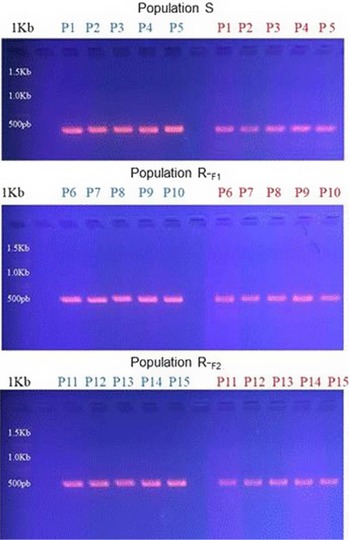
Two regions of the carboxyl-transferase (CT) domain of plastidic ACCase (fragments A and B), containing all known mutation locations (Délye et al. Reference Délye, Zhang, Michel, Matéjicek and Powles2005; Liu et al. Reference Liu, Harrison, Chalupska, Gornicki, O’Donnell, Adkins, Haselkorn and Williams2007), were amplified by standard PCR; the fragments were approximately 500 bp in length (Figure 1), which is consistent with the work carried out by Cha et al. (Reference Cha, Najihah, Sahid and Chuah2014).
PCR analysis of five individuals from three Eleusine indica populations, one susceptible (S) and two resistant (R-F1 and R-F2), to acetyl-coenzyme A carboxylase (ACCase)-inhibiting herbicides. Two fragments of approximately 500 bp were generated by amplification of the primer designed by Cha et al. (Reference Cha, Najihah, Sahid and Chuah2014).

The sequencing of fragment A of the ACCase gene excluded the possibility that the Ile-1781-Leu mutation is responsible for E. indica resistance to ACCase inhibitors. In addition, five known target points in fragment B (Trp-1999, Trp-2027, Ile-2041, Cys-2088, and Gly-2096) also did not explain the evolution of resistance to ACCase-inhibiting herbicides. However, a nonsynonymous single-nucleotide polymorphism (SNP) mutation in the second nucleotide of the amino acid codon (A to G) at position 2078 resulted in an exchange of an asparagine for a glycine (Asp-2078-Gly), conferring resistance to APPs, which was not found for the susceptible population (Figure 2). Asparagine is a polar hydrophilic amino acid, whereas glycine is a nonpolar hydrophobic amino acid. This change at position 2078 caused the total removal of the carboxyl group that was strongly projected into the cavity of the active site of the ACCase CT domain (Délye et al. Reference Délye, Zhang, Michel, Matéjicek and Powles2005). Therefore, it was proposed that the specific mutation Asp-2078-Gly affected the connection site, hindering the interaction of some herbicides with the ACCase enzyme, as in the cases of fenoxaprop-p-ethyl and haloxyfop-p-methyl, but responded differently to clethodim and quizalofop-p-tefuryl, which are still efficient to control resistant populations (R-F1 and R-F2) (Correia et al. Reference Correia, Araújo and Bueno Júnior2022).
Alignment of the ACCase fragment of a susceptible Eleusine indica population from Malaysia (JQ684524.1) with susceptible (S) and resistant (R-F1 and R-F2) populations from Brazil. The boxed nitrogenous bases at position 2078 represent the replacement of the codon GAT by GGT within positions 2064–2083 in the resistant populations, which results in the Asp-2078-Gly mutation responsible for the mechanism of resistance to acetyl-coenzyme A carboxylase (ACCase)-inhibiting herbicides.

The Asp-2078-Gly mutation caused cross-resistance to the APP and CDH chemical groups in other E. indica populations in Brazil and in the United States (Osuna et al. Reference Osuna, Goulart, Vidal, Kalsing, Ruiz Santaella and De Prado2012; McCullough et al. Reference McCullough, Yu, Raymer and Chen2016). In other cases of multiple resistance in E. indica in Brazil, the resistant population also presented the Asp-2078-Gly mutation with resistance to the APP and CDH chemical groups, in addition to the phenylpyrazole chemical group, which encompasses the herbicide pinoxaden, even before its marketing in the country (Vázquez-García et al. Reference Vázquez-García, Alcántara-de la Cruz, Rojano-Delgado, Palma-Bautista, Vasconcelos and De Prado2021). Therefore, the possibility that the resistant populations (R-F1 and R-F2) in the present study are also resistant to pinoxaden is not discarded.
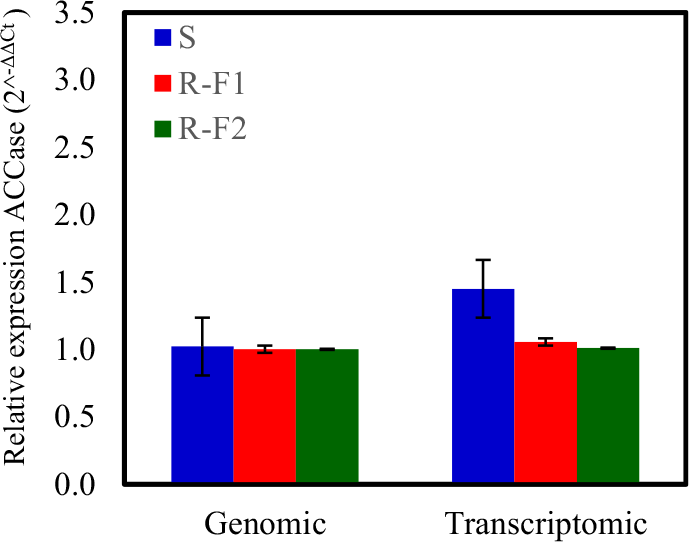
The amplification of the ACCase gene does not participate in the resistance to ACCase inhibitors in E. indica (Figure 3); all populations (S, R-F1, and R-F2) had only one copy of ACCase and similar levels of ACCase transcription. Contrastingly, resistant plants of johnsongrass [Sorghum halepense (L.) Pers.] and Chinese sprangletop [Leptochloa chinensis (L.) Nees] (Bradley et al. Reference Bradley, Wu, Hatzios and Hagood2001; Pornprom et al. Reference Pornprom, Mahatamnuchoke and Usui2006) and, later, large crabgrass [Digitaria sanguinalis (L.) Scop.] presented an increased expression of ACCase of approximately 5- to 7-fold more copies, confirming it as an important mechanism of resistance for these species (Laforest et al. Reference Laforest, Soufiane, Simard, Obeid, Page and Nurse2017).
Relative quantification of number of genomic and transcriptomic copies of ACCase in susceptible (S) and resistant (R-F1 and R-F2) Eleusine indica plants from Brazil, using β-actin as the reference gene. The data were gathered from two experiments with three replications per treatment and biotype. The means were not different (Tukey’s test, P < 0.05).

Sequencing and Expression of the EPSPS Gene in Susceptible and Resistant Eleusine indica Populations
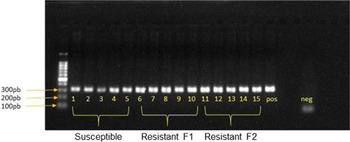
The region that encompasses positions 102 and 106 of the EPSPS gene, which are connected to cases of E. indica resistance to glyphosate, was amplified through PCR reaction, and the fragment size was approximately 300 bp (Figure 4), according to Kaundun et al. (Reference Kaundun, Zelaya, Dale, Lycett, Carter, Sharples and McIndoe2008).
PCR analysis for five individuals of three Eleusine indica populations, one susceptible (S) and two resistant (R-F1 and R-F2), to 5-enolpyruvylshikimate-3-phosphate synthase (EPSPS)-inhibiting herbicide. A 330-bp fragment was generated by amplification of the primer designed by Kaundun et al. (Reference Kaundun, Zelaya, Dale, Lycett, Carter, Sharples and McIndoe2008).

The sequencing of the 300-bp fragment of the EPSPS gene showed that the R-F1 and R-F2 populations did not have the known mutation at position 106, which is occupied by proline (codon CCA) according to the nucleotide sequence of the population S (Figure 5). Moreover, additional mutations in this sequence were not found, with position 102 occupied by threonine (codon ACT), which also makes weeds resistant to glyphosate. It confirms that the mechanism of resistance of this population from Primavera do Leste, MT, Brazil, does not involve changes in the 300-bp EPSPS fragment, which encompasses the positions 102 and 106, in contrast to the other two E. indica populations in Brazil that had a SNP mutation at position 106 (Pro-106-Ser) conferring resistance to glyphosate (Takano et al. Reference Takano, Mendes, Scoz, Lopez Ovejero, Constantin, Gaines, Westra and Dayan2018; Vázquez-García et al. Reference Vázquez-García, Alcántara-de la Cruz, Rojano-Delgado, Palma-Bautista, Vasconcelos and De Prado2021).
Alignment of the EPSPS fragment of susceptible and resistant Eleusine indica populations from Malaysia (AY157642 MS and AY157643 MR) with susceptible (S) and resistant (R-F1 and R-F2) populations from Brazil. The boxed bases at positions 102 and 106 show the absence of mutation within positions 96–115 in populations resistant to the 5-enolpyruvylshikimate-3-phosphate synthase (EPSPS)-inhibiting herbicide.

In other countries, several works reported that E. indica evolved mutations against the herbicide at the glyphosate site of action. The first case of the Pro-106-Ser mutation was reported in a resistant E. indica population in Malaysia (Baerson et al. Reference Baerson, Rodriguez, Tran, Feng, Biest and Dill2002). In the United States, the Pro-106-Ser mutation is widespread in several populations in different regions of the country (Kaundun et al. Reference Kaundun, Zelaya, Dale, Lycett, Carter, Sharples and McIndoe2008; Molin et al. Reference Molin, Wright and Nandula2013; Mueller et al. Reference Mueller, Barnett, Brosnan and Steckel2011). Rarer cases of TIPS double mutation (Tre-102-Ile and Pro-106-Ser) were found in Malaysia and China, resulting in populations highly resistant to glyphosate (Chen et al. Reference Chen, Huang, Zhang, Wei, Huang and Chen2015; Yu et al. Reference Yu, Jalaludin, Han, Chen, Sammons and Powles2015). In Mexico, this species evolved two mechanisms of resistance simultaneously: a Pro-106-Ser mutation and overexpression of EPSPS (Gherekhloo et al. Reference Gherekhloo, Fernández-Moreno, Alcántara-de la Cruz, Sánchez-González, Cruz-Hipolito, Domínguez-Valenzuela and De Prado2017).
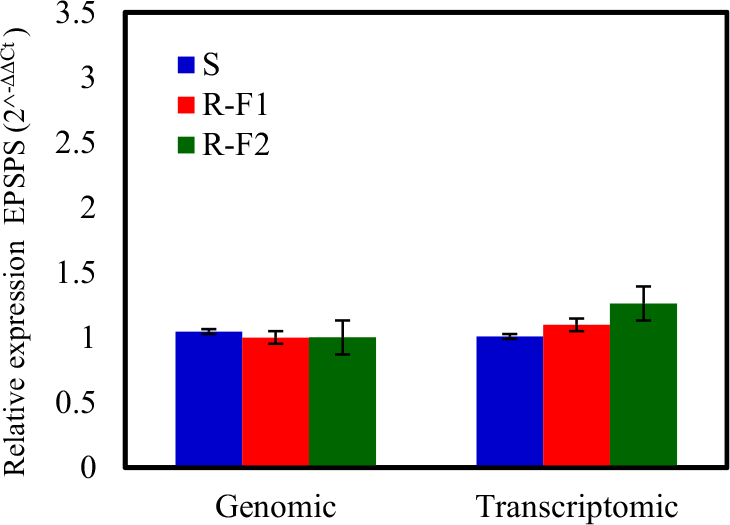
Regarding the mechanism of amplification of the EPSPS gene, the resistant populations (R-F1 and R-F2) had only one copy of EPSPS and did not differ in levels of expression of the enzyme from the S population (Figure 6). Eleusine indica resistance to glyphosate due to amplification of the EPSPS gene is reported in the literature, with 17-fold increases in the number of EPSPS copies (Chen et al. Reference Chen, Jiang, Huang, Wei, Huang, Wang, Zhao and Zhang2017). Deng et al. (Reference Deng, Yang, Chen, Yang, Xia, Zhu, Chen, Cai and Yuan2020) also reported increases of 6- to 10-fold in the number of EPSPS copies in a glyphosate-resistant population. The results obtained in the present study denoted that the mechanism of resistance to glyphosate in this E. indica population is not connected to the site of action of the herbicide, but to a non–target site resistance (NTSR) mechanism.
Relative quantification of number of genomic and transcriptomic copies of EPSPS in susceptible (S) and resistant (R-F1 and R-F2) Eleusine indica plants from Brazil, using β-actin as the reference gene. The data were gathered from two experiments with three replications per treatment and biotype. The means were not different (Tukey’s test, P < 0.05).

Non-target Resistance Mechanisms
Absorption and Translocation of [14C]glyphosate and [14C]fenoxaprop-p-ethyl
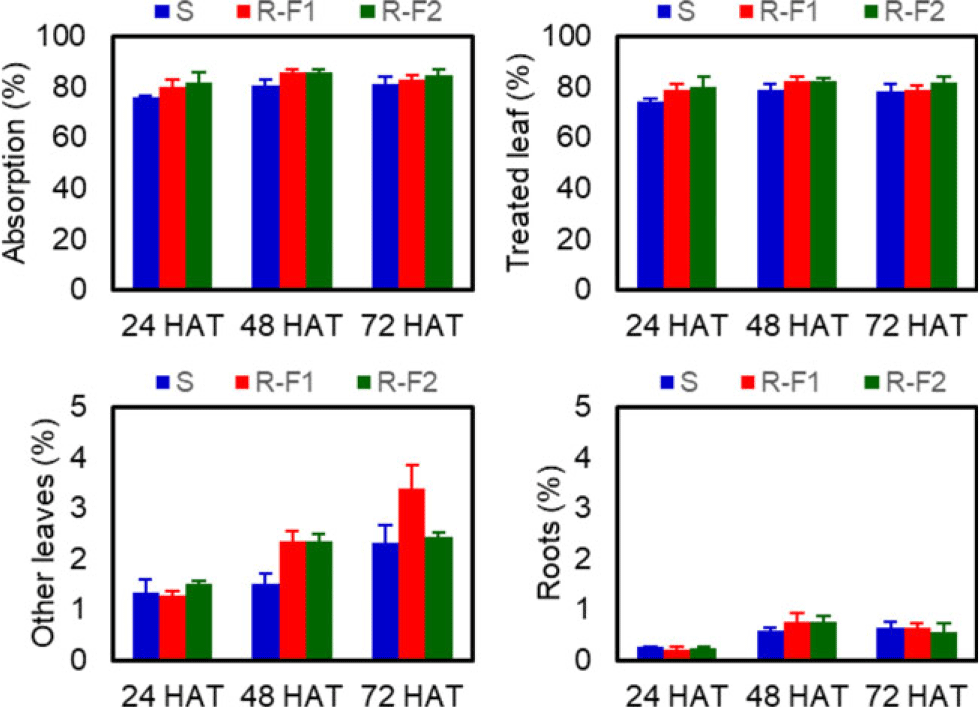
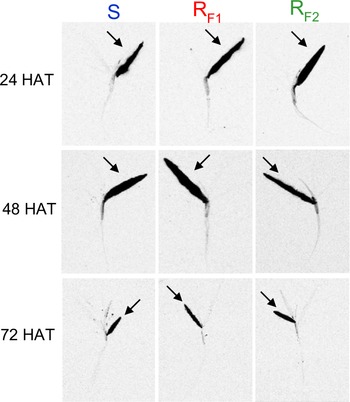
Almost 90% of [14C]fenoxaprop had been absorbed by the susceptible and resistant populations at 24 HAT (Figures 7 and 8). The largest part of the herbicide remained in the treated leaf in all populations, with less than 2% translocated to other leaves and an insignificant quantity to the roots. Therefore, there is no evidence of difference in absorption and translocation between susceptible and resistant populations (R-F1 and R-F2). These results corroborate those from previous studies, which found no differences in absorption and translocation rates for [14C]fluazifop and [14C]diclofop in susceptible and resistant E. indica populations (Leach et al. Reference Leach, Devine, Kirkwood and Marshall1995; McCullough et al. Reference McCullough, Yu, Raymer and Chen2016).
Absorption and translocation of [14C]fenoxaprop-p-ethyl at 24, 48, and 72 h after treatment (HAT) in susceptible (S) and resistant (R-F1 and R-F2) Eleusine indica plants: overall absorption and translocation of fenoxaprop to the treated leaf, fenoxaprop to other leaves, and fenoxaprop to the roots. The means were not different (Tukey’s test, P < 0.05). Bars represent the mean ± SE (n = 3).

Autoradiograph of [14C]fenoxaprop-p-ethyl in susceptible (S) and resistant (R-F1 and R-F2) Eleusine indica populations at 24, 48, and 72 h after treatment (HAT).

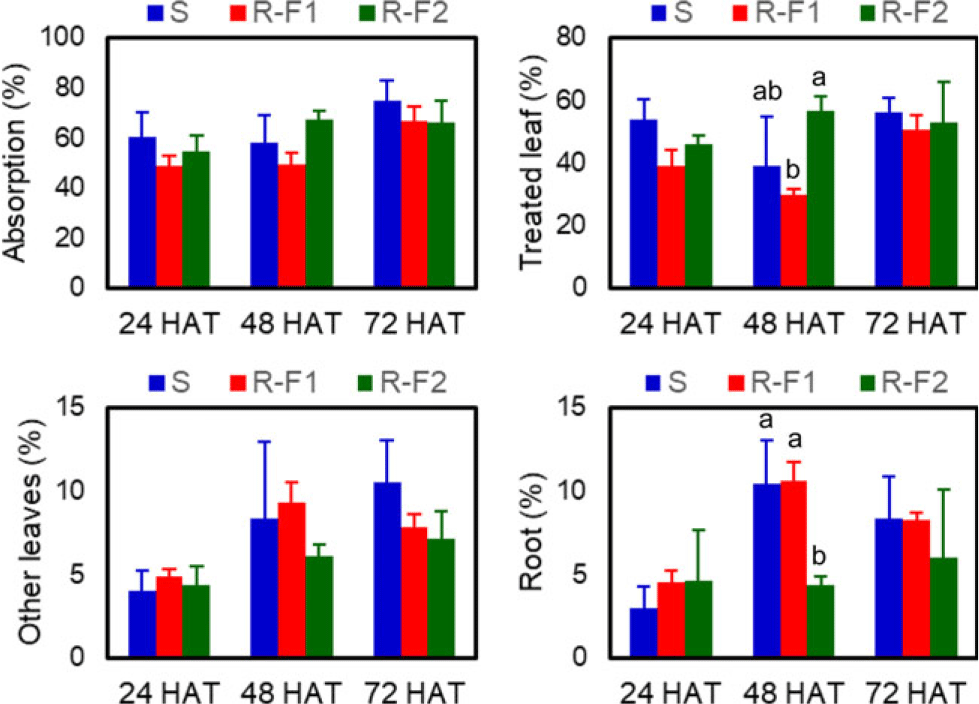
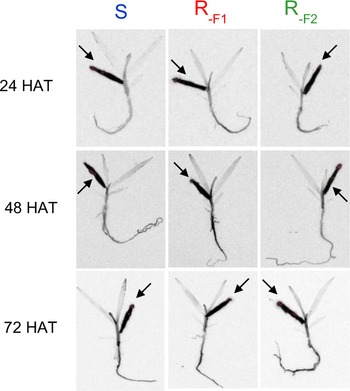
Approximately 75% of [14C]glyphosate was absorbed by susceptible E. indica plants, with no significant differences between the populations (S, R-F1, and R-F2) and no evidence of differential absorption between populations (Figures 9 and 10). In addition, the translocation to other leaves did not differ among the populations (S, R-F1, and R-F2) at all times evaluated, except at 48 HAT, when the translocation to roots was 6.1% lower for the resistant population R-F2, but this dynamic did not repeat for population R-F1. Similarly, the treated leaves of population R-F1 had 15% less [14C]glyphosate than the treated leaves of population S, but this also did not occur for population R-F2. Resistant populations of S. halepense and perennial ryegrass (Lolium perenne L.) showed decreases in [14C]glyphosate absorption and translocation (Ghanizadeh et al. Reference Ghanizadeh, Harrington, James, Woolley and Ellison2016; Vila-Aiub et al. Reference Vila-Aiub, Balbi, Distéfano, Fernández, Hopp, Yu and Powles2012). However, these mechanisms have not yet been reported for glyphosate-resistant E. indica populations (Kaundun et al. Reference Kaundun, Zelaya, Dale, Lycett, Carter, Sharples and McIndoe2008; Takano et al. Reference Takano, Mendes, Scoz, Lopez Ovejero, Constantin, Gaines, Westra and Dayan2018).
Absorption and translocation of [14C]glyphosate at 24, 48, and 72 h after treatment (HAT) in susceptible (S) and resistant (R-F1 and R-F2) Eleusine indica plants: overall absorption and translocation of glyphosate to the treated leaf, glyphosate to other leaves, and glyphosate to the roots. The means found at 48 HAT for the treated leaf and for roots differed from each other (Tukey’s test, P < 0.05). Bars represent the mean ± SE (n = 3).

Autoradiograph of [14C]glyphosate in susceptible (S) and resistant (R-F1 and R-F2) Eleusine indica populations at 24, 48, and 72 h after treatment (HAT).

Based on these data, absorption and translocation did not contribute to resistance to ACCase- and EPSPS-inhibiting herbicides in the resistant E. indica population from Primavera do Leste, MT, Brazil.
Although the Asp-2078-Gly mutation in the ACCase gene was detected in the resistant (R-F1 and R-F2) E. indica populations, this result does not rule out the possibility of the occurrence of other resistance mechanisms in these plants, such as the enhanced metabolization of the herbicides fenoxaprop-p-ethyl and haloxyfop-p-methyl, which were not evaluated in the present study.
Metabolic Profile of Eleusine indica Susceptible and Resistant to Glyphosate
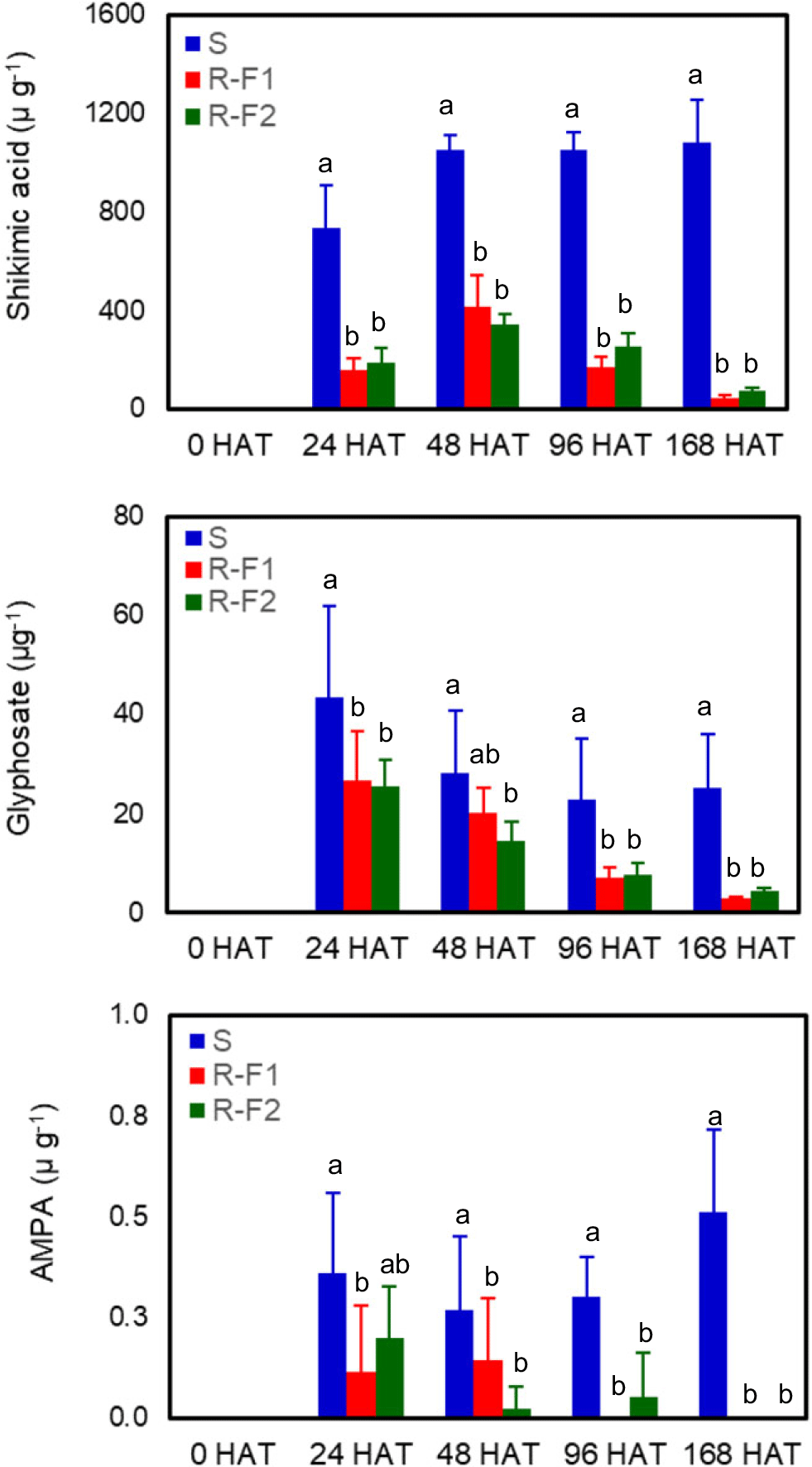
The susceptible and resistant populations (R-F1 and R-F2) responded differently to concentrations of glyphosate, shikimic acid, and AMPA, at 0 (time of application), 24, 48, 72, 96, and 168 HAT (Figure 11). Shikimic acid concentrations in the aerial part of resistant plants were lower than those in susceptible plants at all points over time. After 168 HAT, the susceptible population presented 26.4- and 14.6-fold greater shikimic acid accumulation than the R-F1 and R-F2 populations. Both results can be interpreted as indicators of resistance to glyphosate in weeds, due to the inhibition of the EPSPS pathway (Gazola et al. Reference Gazola, Bianchi, Dias, Carbonari and Velini2020; Powles and Preston Reference Powles and Preston2006).
Concentrations of shikimic acid, glyphosate, and aminomethylphosphonic acid (AMPA) in susceptible and resistant (R-F1 and R-F2) Eleusine indica populations at 0, 24, 48, 96, and 168 h after treatment (HAT). The means for the susceptible population differed significantly from the means of both resistant populations (Tukey’s test, P < 0.05). Bars represent the mean ± SE (n = 3).

Lower shikimic acid levels in resistant plants compared with susceptible plants indicate that the enzyme EPSPS is less affected by glyphosate in the R-F1 and R-F2 populations. A lower quantity of glyphosate is probably reaching the enzyme in resistant plants due to some NTSR mechanism. This hypothesis is supported by the lower glyphosate levels found in resistant populations at all points over time, mainly at 96 and 168 HAT. However, the low levels of glyphosate were not connected to increases in levels of AMPA in the plants, which is the main metabolite of glyphosate (Duke Reference Duke2011). The destination of the glyphosate molecule in the R-F1 and R-F2 populations was not elucidated; its concentration decreased by 89% and 83% after 168 HAT, respectively, when compared with the susceptible population.
These results are different from those obtained for other glyphosate-resistant E. indica populations in Brazil, whose plants accumulated less shikimic acid and presented similar glyphosate and AMPA concentrations between resistant and susceptible populations at all points over time, discarding any effect of metabolism on the plant resistance mechanism, which was attributed to a Pro-106-Ser mutation (Takano et al. Reference Takano, Mendes, Scoz, Lopez Ovejero, Constantin, Gaines, Westra and Dayan2018).
The metabolization of glyphosate into less toxic compounds does not occur frequently in weeds, and the correlation between glyphosate and concentrations of metabolites is often not clear (Sammons and Gaines Reference Sammons and Gaines2014). However, the action of aldo-keto reductase enzymes on metabolic degradation of glyphosate to increase AMPA and glyoxalate levels was reported for a resistant population of junglerice [Echinochloa colona (L.) Link] (Pan et al. Reference Pan, Yu, Han, Mao, Nyporko, Fan, Bai and Powles2019). Another important NTSR mechanism is the presence of ABC transporting enzymes (ATP-binding cassette), which direct glyphosate to the vacuole or to the cell apoplast space, blocking it from reaching the site of action, and have been associated with glyphosate resistance in some weeds (Pan et al. Reference Pan, Yu, Wang, Han, Mao, Nyporko, Maguza, Fan, Bai and Powles2020; Tani et al. Reference Tani, Chachalis and Travlos2015; Yuan et al. Reference Yuan, Tranel and Stewart2007, Reference Yuan, Abercrombie, Cao, Halfhill, Zhou, Peng, Hu, Rao, Heck, Larosa, Sammons, Wang, Ranjan, Johnson and Wadl2010).
According to Gaines et al. (Reference Gaines, Duke, Morran, Tranel, Küpper and Dayan2020), the metabolism of herbicides is divided into three stages. Stage I involves the addition of a functional group to the herbicide by oxidation, reduction, or hydrolysis carried out mainly by monooxygenases of cytochrome P450. Stage II involves more complex changes in the herbicide, including conjugation with glutathione (GSH), carried out by GSH S-transferases, or with glucose, carried out by glycosyltransferases. Stage III involves the transport of conjugated metabolites to a vacuole or incorporation into the cell wall for compartmentalization or additional degradation. Most degradation products are nontoxic to the plant or have very low toxicity when compared with the active ingredient.
The results obtained in the present study indicate that the E. indica population from Primavera do Leste, MT, Brazil, presented an NTSR mechanism that confers resistance to glyphosate. However, further studies are needed to identify the mechanism involved, which may be the sequestration of herbicide to cell vacuoles in resistant plant populations or the degradation of the molecule, with transport of conjugated metabolites for incorporation into the cell wall or accumulation in vacuoles. In addition, the possibility of mutation in another fragment of the EPSPS gene not yet detected through research should also not be ruled out.
The results obtained allowed us to conclude that: (1) the Asp-2078-Gly mutation conferred resistance to ACCase inhibitors, with no overexpression of ACCase or changes in herbicide absorption and translocation; (2) overexpression of the EPSPS, Thr-102 and Pro-106 mutations, and changes in absorption and translocation are not involved in E. indica resistance to glyphosate; and (3) the metabolism of glyphosate in resistant E. indica plants requires further studies to elucidate the final destination of this herbicide in these plants.
Acknowledgments
The authors thank postdoctoral student Danielle Gregorio Gomes Caldas for contributions to the analyses at the Cell and Molecular Biology Laboratory of the CENA/USP, Piracicaba, SP, Brazil; and the Herbicide Resistance Action Committee Brazil (HRAC-BR) for the financial support for development of this research. No conflicts of interest have been declared.