1. Introduction
A number of countries in sub-Saharan Africa (SSA) are faced with an increasing rate of undernourishment and malnourishment due to the aftermath of climate change. Promoting agricultural productivity in order to improve the welfare of the most vulnerable group has been a major public policy issue in these countries in recent years. As evidenced in a recent Food and Agriculture Organisation report (FAO, 2017), the prevalence of chronically undernourished people in SSA rose from 20.8 per cent in 2015 to 22.7 per cent in 2016, amounting to 224 million people compared to 200 million in the previous years, which accounts for 25 per cent of the global number of undernourished people. These statistics are predicted to rise with the increase of extreme-weather-related events and rainfall variability.
Many rural dwellers in SSA are smallholder farmers who depend on rainfed agriculture and are mainly at the lower income quantile (Livingston et al., Reference Livingston, Schonberger and Delaney2011). They are likely to be vulnerable to adverse effects of weather-related shocks, and this can lead to poor household welfare. Hence, a growing number of studies show that the poorest agrarian households are the worst hit by weather shocks (Asfaw and von Braun, Reference Asfaw and von Braun2004; Fussel, Reference Fussel2010; Ericksen et al., Reference Ericksen, Thornton, Notenbaert, Cramer, Jones and Herrero2011; Skoufias et al., Reference Skoufias, Rabassa and Olivieri2011; Levine and Yang, Reference Levine and Yang2014; Asfaw and Maggio, Reference Asfaw and Maggio2018).Footnote 1
In addition, these farmers are likely to have limited productivity-enhancing technologies, particularly because they are unaffordable due to cost, while the relatively high transaction costs (such as distance to input market) to even acquire farm inputs could be an additional impediment. Therefore, sustainable agricultural policy for the welfare of smallholders in rural regions of SSA countries should be such that it considers both efficient agricultural input supply and the rising weather variability.
Economic theory provides explanations for the potential role of agricultural programmes in moderating the relationship between weather variability and household's outcomes. First, the farm input subsidy programme (FISP) may increase the efficiency of agricultural inputs for farmers who may have been affected by weather variability in previous seasons (Lunduka et al., Reference Lunduka, Ricker-Gilbert and Fisher2013; Ricker-Gilbert and Jayne, Reference Ricker-Gilbert and Jayne2017).
Second, considering that the outcome of the FISP is to improve food and cash crop production of vulnerable smallholders in Malawi (Dorward et al., Reference Dorward, Chirwa, Jayne, Chunan-Pole and Angwafo2011), the income from the sale of such production could cushion the negative effect that could stem from weather vulnerability, and the household's overall welfare will be improved.
Third, the FISP may increase the strength of social networks in isolated communities through the community of agricultural input retail stores across districts (Kaiyatsa et al., Reference Kaiyatsa, Ricker-Gilbert and Jumbe2018, Reference Kaiyatsa, Ricker-Gilbert and Jumbe2019), which could be helpful for risk-sharing among farmers within such districts through mechanisms such as knowledge sharing (among others) to cushion the weather shocks (Maertens and Barrett, Reference Maertens and Barrett2012; Mbugua et al., Reference Mbugua, Nzuma and Muange2019).
The focus of this research on Malawi is motivated by its historical records of weather variability and its being among the 12th most exposed country to the effects of climate change (World Bank, 2010; Chinsinga, Reference Chinsinga2013). For instance, the ‘El Niño’Footnote 2 event resulted in severe drought in Malawi and led to failed crops for many subsistence farmers (USAID, 2016), which further shows the country's susceptibility to weather shocks.
Moreover, the structural economic conditions of Malawi further exacerbate the vulnerability of smallholders to weather shocks. For example, its economy is characterised by high dependence on agriculture, which accounts for about 36–39 per cent of the total economic income, employs about 80 per cent of the total workforce, and contributes about 75 per cent to foreign exchange earnings (FAO, 2014). In addition, about 80 per cent of the exported products are from the country's agricultural sector which also serves as the backbone for national and household food security (Ministry of Agriculture and Food Security, 2010).
However, the country is still lagging in food security and consumption. According to the Global Food Security Index (GFSI, 2016), Malawi currently ranks 105th out of 113 countries in the overall food security index with a respective ranking of 111, 99 and 92 in the affordability, availability and quality/safety of food categories. These conditions typically explain why food security indices in Malawi may be highly elastic to rainfall shocks.
Against this background, this study uses household panel date from Malawi's 2010/11 and 2012/13 Integrated Household Panel Survey to investigate the mitigating role of Malawi's FISP in the nexus between climate variability and household welfare. Specifically, the objective of this paper is twofold: to examine the impact of rainfall shocks on household welfare; and to investigate the mitigating role of the farm input subsidy scheme in the relationship between weather variability and household welfare outcomes in rural Malawi.Footnote 3
This study is related to a growing literature on the moderating role of agricultural interventions on the effects of weather variability on smallholder households. A few studies such as Kaiyatsa et al. (Reference Kaiyatsa, Ricker-Gilbert and Jumbe2019), Harou (Reference Harou2018), and Karamba and Winters (Reference Karamba and Winters2015) have examined the effects of the FISP on households' outcomes. However, our study differs from the existing literature as it focuses on the mitigating role of agricultural policy such as the FISP on weather shocks and households' outcomes. Our results show that negative rainfall shocks lead to a significant decline in households' welfare. However, households with access to FISP vouchers experience improve welfare compared to households without FISP vouchers.
The remainder of this paper is structured as follows: the context of the study is in section 2, while section 3 discusses the empirical literature. Section 4 considers the data sources and the empirical strategy. The results and discussion are included in section 5 while the paper concludes in section 6.
2. Farm input subsidy in Malawi
Malawi is a landlocked southeastern African country with a population of over 19 million people (World Population Review, 2018). It has two main seasons: the cold-dry and hot-wet seasons, and temperatures ranging from 14–32°C (United Nations, 2014). The country is ranked as one of the world's poorest, 170th out of 187, it suffers from low levels of nutrition, and it is vulnerable to weather shocks (United Nations, 2014; World Bank, 2018).
From the time of Malawi's independence in 1964 up to the mid-1980s when the structural adjustment programme was introduced, the food security policy was the main guide for agricultural plans and strategies in the country. Following this, a number of policies have evolved over the years, such as the Agriculture and Livestock Development Strategy and Action Plan established in 1995; the Malawi Agricultural Sector Investment Programme of 1999; the Agricultural Development Programme of 2006; and the Agricultural Sector Wide Approach of 2007–2009 and 2010–2015 (Ministry of Agriculture and Food Security, 2010; FAO, 2014).
In 2010, the government decided to establish a policy with the responsibility for harmonising the various agricultural development strategies. This was named the National Agricultural Policy Framework, and it was tasked with the responsibility for promoting agricultural productivity and realising national food security, amongst others (FAO, 2014).
Malawi's FISP is an offshoot of the Agricultural Input Subsidy Programme, a small-scale targeted input subsidy programme popularly referred to as the Starter Pack Scheme which was initiated in 1998. The FISP became popular in 2005 after a severe drought in the country that led to the programme being augmented from only a few farmers to about 50 per cent of the country's farmers, and to over 70 per cent of farmers in recent years (Harou, Reference Harou2018).
The objective of the programme is to give farmers access to improved agricultural inputs which can bring about food self-sufficiency and enhance rural income via higher levels of food and cash crop production (Dorward and Chirwa, Reference Dorward and Chirwa2011; Lunduka et al., Reference Lunduka, Ricker-Gilbert and Fisher2013), by handing out vouchers and coupons to smallholder farmers who own their farmlands and reside legitimately in their own villages, for the purchase of farm inputsFootnote 4 at subsidised rates (Chibwana and Fisher, Reference Chibwana and Fisher2011; Dorward and Chirwa, Reference Dorward and Chirwa2011; Dorward et al., Reference Dorward, Chirwa, Jayne, Chunan-Pole and Angwafo2011; Harou, Reference Harou2018).
The distributions of the vouchers are carried out at two levels (Ricker-Gilbert and Jayne, Reference Ricker-Gilbert and Jayne2017). First, the fertiliser and seeds are officially allocated to regions and districts based on agricultural cultivation area and the number of smallholders in such locations. Second, at the community-level, the community and the village heads are then involved in determining the eligible smallholders. The original allocation strategy for the vouchers targeted smallholders who are full-time farmers, and who are unable to purchase at most two bags of fertilisers at the prevailing commercial price in the community as determined by local leaders (Dorward et al., Reference Dorward, Chirwa, Matita, Mhango, Mvula, Taylor and Thome2013). From 2008 onward, the target group was defined as the ‘vulnerable’ group, including resource-poor households, disabled, elderly, female and child-headed households (see Ricker-Gilbert and Jayne, Reference Ricker-Gilbert and Jayne2017).
The voucher can be used to purchase agricultural inputs at a subsidised price from participating private retail stores, and such retailers then submit the voucher and receipt to the government for payment. Each smallholder who participates in the FISP is eligible to receive two vouchers, used for one 50-kg bag of fertiliser at a discounted price and for between 5 and 10 kg of improved maize seed (see Ricker-Gilbert and Jayne, Reference Ricker-Gilbert and Jayne2017).
Existing studies show that since the implementation of the FISP, there has been improvement in agricultural output among smallholder farmers, such that maize increased from a 43 per cent deficit in 2005 to a 53 per cent surplus by 2007 (Chibwana and Fisher, Reference Chibwana and Fisher2011; Harou, Reference Harou2018). However, due to the declining food insecurity levels in Malawi, from about 57 per cent in 2004/05 to 42 per cent in 2010/11 (Government of Malawi, 2005, 2012; Sibande et al., Reference Sibande, Bailey and Davidova2015), and the enormity of the FISP,Footnote 5 there has been criticism with regard to beneficiaries of the FISP adopting poor climate-resilient farming systems such as unsustainable land management practices and poor crop diversification strategies (see Zulu, Reference Zulu2017).
Another criticism of the FISP is the cultural sentiment associated with the distribution of the agricultural input, such that non-beneficiary neighbours could still benefit from the programme (Holden and Lunduka, Reference Holden and Lunduka2013).
There are some issues about the effectiveness of the targeting system of the FISP, including the frequent exclusion of poor households (Holden and Lunduka, Reference Holden and Lunduka2013), high administration costs (Lunduka et al., Reference Lunduka, Ricker-Gilbert and Fisher2013), tacit exclusion of female farmers from the programme (Ricker-Gilbert et al., Reference Ricker-Gilbert, Jayne and Chirwa2011; Chibwana et al., Reference Chibwana, Fisher and Shively2012), and consideration of households' wealth and agricultural land holding (Kilic et al., Reference Kilic, Whitney and Winters2013; Fisher and Kandiwa, Reference Fisher and Kandiwa2014). In some other cases, there are instances of elite capture, village leaders reducing the number of coupons per beneficiary household and some villages that are excluded based on egalitarian bias (Holden and Lunduka, Reference Holden and Lunduka2013). In light of these issues, there is a need for better targeting of the FISP based on a random and universal framework for the distribution of coupons. Such efforts will be necessary to ensure that the programme is actually targeting the intended group, which are the rural poor.
3. Empirical literature
This study is related to two strands of literature which are discussed in this section. First, we consider studies that focus on agricultural policies and food security, paying attention to smallholders in Africa. Second, we focus on weather shocks and their impact on smallholders' outcomes.
Considering the first strand, some studies such as Daidone et al. (Reference Daidone, Davis, Knowles, Pickmans, Pace and Handa2017) highlight the need for agricultural programmes to consider both cash transfers and input programmes for efficient improvement of the outcome of beneficiary farmers. Although the authors focus on welfare outcomes like poverty and hunger, they conclude that the efficiency of such programmes will largely depend on other factors, including the prevailing climatic conditions.
Further, Sibande et al. (Reference Sibande, Bailey and Davidova2015) also consider a similar agricultural policy in Malawi on both the broad measure of food security, and per capita consumption of smallholder farmers. The authors find a significant improvement in these two outcome variables for smallholders who are beneficiaries of the agricultural input programme. Similar findings are echoed in Chirwa and Dorward (Reference Chirwa and Dorward2013), Dorward et al. (Reference Dorward, Chirwa, Matita, Mhango, Mvula, Taylor and Thome2013) Asfaw et al. (Reference Asfaw, Cattaneo and Pallante2016) and Ricker-Gilbert and Jayne (Reference Ricker-Gilbert and Jayne2017). Malhotra (Reference Malhotra2015) accounts for the impact of a different programme – the National Agriculture Input Voucher Scheme – on smallholders' food security in Tanzania. She notes that this programme increases farmers' level of food security. However, this impact was noted to be through some important individual characteristics of the smallholders such as educational attainment, among others. For Nigeria, Ayoade et al. (Reference Ayoade, Ogunwale and Adewale2011) find the National Special Programme for Food Security to be highly effective for poverty reduction, while taking into account the gender dimension of their study.
Finding a positive and significant impact of agricultural-related programmes that target farm production efficiency is only logical considering that such programmes facilitate farm productivity by improving planting, reducing farm-related cost in farm input acquisition, or even by improving farm processes. However, this is not always the case, as studies which are beginning to advocate for the consideration of other non-controllable factors that affect the efficiency of agricultural programmes (see Giller et al., Reference Giller, Tittonell, Rufino, van-Wijk, Zingore, Mapfumo, Adjei-Nsiahe, Herrero, Chikowo, Corbeels, Rowe, Baijukya, Mwijage, Smith, Yeboah, van der Burg, Sanogo, Misiko and Vanlauwe2011; Daidone et al., Reference Daidone, Davis, Knowles, Pickmans, Pace and Handa2017) note that agricultural programmes in Africa have had mixed results due to ecological variability within farming systems in this region. Hence, the need to consider the impact of weather shocks on smallholders' agricultural outcomes.
Weather shocks include those unpredicted natural and environmental occurrences that directly affect farm yield, such as floods, droughts, frost and hailstorms, and can also have significant and severe consequences on agricultural productivity and general household welfare. The literature on this linkage abounds with important evidence from developing countries (Jayachandran, Reference Jayachandran2006; Yang and Choi, Reference Yang and Choi2007; Dell et al., Reference Dell, Jones and Olken2009; Schlenker and Lobell, Reference Schlenker and Lobell2010; Björkman-Nyqvist, Reference Björkman-Nyqvist2013). For instance, Badolo and Kinda (Reference Badolo and Kinda2012) and Benton and Bailey (Reference Benton and Bailey2015) note that weather variability increases the frequency and severity of devastating impacts on the sufficiency of food production in developing countries.
However, when smallholder farmers become vulnerable to certain weather shocks, studies have noted that having access to some agricultural inputs that can help reduce the impact of such shocks will have beneficial effects on farm performance. With the perceived adverse effect from weather shocks, and the need for farmers' access to some agricultural input, this study is set up to investigate the shock-cushioning capacity of specific agricultural policy in Malawi – the Farm Input Subsidy Programme – on food security outcomes of smallholder farming households.
4. Data sources and empirical methodology
4.1. Data sources
This study uses panel data for households provided by Malawi's Integrated Household Panel Surveys (IHPS) for 2010/11 and 2012/13.Footnote 6 The Government of Malawi, through the National Statistical Office, conducted these surveys with support from the World Bank Living Standards Measurement Study-Integrated Surveys on Agriculture (LSMS-ISA) programme.
The IHPS collects detailed demographic and household characteristics and provides information on rainfall and temperature measures in the geospatial data relating to seasonal variation of weather. Other plot-specific information relating to agricultural productivity includes the topographic and vegetation indicators of households' plot ownership and management.
The 2010/11 wave of the IHPS collected information on 3,426 households in the 2009/2010 agricultural years. The 2012/13 wave of the survey collected information on 4,000 households and attempted to track and resample all the households and individuals in the previous wave. For 4,000 households in the 2012/2013 wave, interviewers were able to track back for a second interview only 3,104 households from the original panel subsample (2010/11 wave).
Moreover, 76.8 per cent of the 3,104 households from the 2010/2011 wave did not split over time; 18.49 per cent split into two households; and 4.7 per cent split into three to six households. The data has an overall attrition rate of only 3.78 per cent at the household level. For our analysis, we dropped urban households from the sample of the first and second waves respectively. This is because agricultural activities (e.g., farming) in Malawi are carried out predominantly in the rural areas.
4.2 Other sources of information: rainfall data
For the rainfall data used in our analysis, we match the household survey data with rainfall data obtained from the National Oceanic and Atmospheric Administration Climate Prediction Centre's African Rainfall Estimation Algorithm version 2.0. Seasonal precipitation data gathered from the Malawian meteorological weather stations are used in the interpolation of the global positioning system of the surveyed households. These data include annual and wet season precipitation measures respectively, and spatial distribution of households included in the LSMS-ISA survey for Malawi enhances the credibility of the rainfall variation at the enumeration area (EA) level.
The measure of rainfall shocks we used for precipitation data was provided by the World Bank (along with the LSMS data). We follow Maccini and Yang (Reference Maccini and Yang2009), Björkman-Nyqvist (Reference Björkman-Nyqvist2013) and Rocha and Soares (Reference Rocha and Soares2015) in constructing rainfall shocks and creating measures of deviations in rainfall from the long-run mean rainfall for an area by constructing rainfall shock in the following way:

where $\; ln{R_{ht - 1}}$ indicates the yearly rainfall in household h for the preceding year's planting season and is the average historical yearly rainfall in household h. The average historical yearly rainfall was calculated from 2001 to 2013. Thus, ${\rm Rainshoc}{{\rm k}_{ht - 1}}$
 is the shock measure used for deviation of the natural logarithm of the total rainfall in the 12 months prior to the 2009/2010 and 2012/2013 periods and the natural logarithm of the average yearly historical rainfall in household h prior to the corresponding years.
The rainfall deviation basically implies a percentage deviation from mean rainfall. However, we use negative shock in the regressions, which is measured as the absolute value of the deviation if a negative deviation exists between rainfall deviation from the historical norm and 0 if otherwise. We use this rainfall shock definition for the following reasons: (1) to take care of the outlier issue, and (2) to easily interpret the result as a percentage deviation with reference to the historical rainfall information.
4.3 Summary statistics
For the household welfare measure, we use the following outcomes in our analysis: (i) log of per capita food expenditure, (ii) log of non-food consumption per capita, (iii) log of total consumption per capita, and (iv) Food Consumption Score (FCS). We compute an FCS following the World Food Programme guidelines that captures both dietary diversity and food frequency. It is the weighted sum of the number of days the household consumed foods from eight food categories in the last week. The score is calculated based on the sum of weighted number of days in the last week the household ate food from eight food groups: (2 × number of days of cereals, grains, maize grain/flour, millet, sorghum, flour, bread and pasta, roots, tubers and plantains) + (3 × number of days of nuts and pulses) + (number of days of vegetables) + (4 × number of days of meat, fish, other meat and eggs) + (number of days of fruits) + (4 × number of days of milk products) + (0.5 × number of days of fats and oils) + (0.5 × number of days of sugar, sugar products and honey). Spices and condiments are excluded. The maximum value of the FCS is 126.
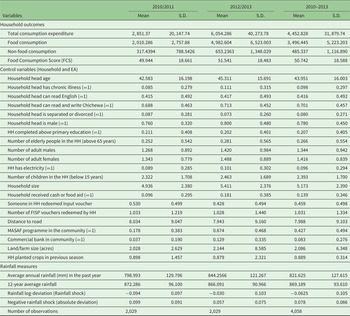
Table 1 presents the summary statistics for the dependent variables used in our analysis. For the two periods used (2010–2013) in the analysis, the average total expenditure, food expenditure and non-food are approximately 4,453, 3,496 and 485 Malawian Kwacha respectively.
Summary statistics

Notes: Authors' computation from the Malawi Integrated Household Panel Survey 2010–2013.
Also, the average FCS reported by the households is 51 out of a maximum score of 126. For the rainfall variable, the 3-year average rainfall across rural households for the periods of our data (2009/10 and 2012/2013) is 822 mm and the average historical rainfall (2001–2012) is 8,649 mm. The negative rainfall shock is 0.078 (in absolute deviation). Household size is 5 with an average household head age of 44 years.
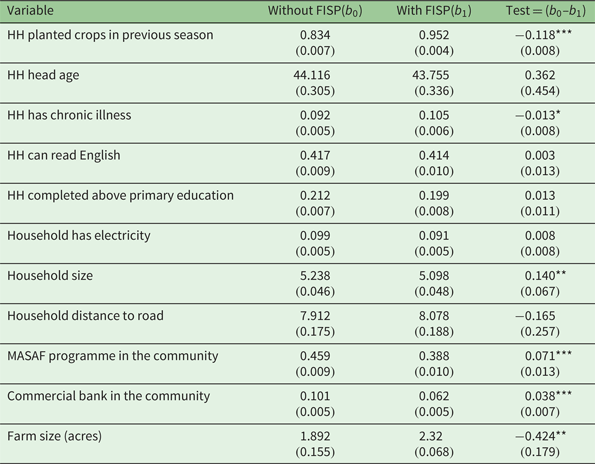
Table 2 shows mean characteristics by household's receipt of Farm Input Subsidy. The number of households that planted crops in the previous season and received FISP is larger than the number of households that did not receive FISP. In terms of the average age of household head, the mean difference shows no statistically significant difference between the recipients of FISP and the non-recipients of FISP. Moreover, households that received FISP reported larger farm size of 2.32 acres compared to households without FISP that reported 1.892 acres. Also, the mean difference shows that 39 per cent of households in communities with a public works programme such as the Malawi Social Action Fund (MASAF) received FISP compared to 46 per cent of households in communities without a public works programme.
Test of mean difference of household characteristics and receipt of FISP

***, ** and * represent significance levels at 1%, 5% and 10%, respectively.
4.4 Empirical methodology
We adopt an identification strategy similar to that of Björkman-Nyqvist (Reference Björkman-Nyqvist2013) and Yang and Choi (Reference Yang and Choi2007). We exploit the exogenous variations in seasonal precipitation patterns to investigate the mitigating role of the FISP due to negative rainfall shocks on rural households' welfare. We use data on the FISP provided by Malawi's Integrated Panel Survey to investigate whether Malawi's FISP mitigates the impact of negative rainfall shocks on household welfare in rural Malawi. The primary focus of the estimation is to model the interaction of the FISP on the relationship between negative rainfall shocks and households' welfare.
The paper analyses negative rainfall shocks, FISP and household welfare nexus by estimating the following equation:

where ${Y_{ht}}$ denotes household welfare measures for household h at time t, and ${\delta _t}$
 represents year fixed effects. Also, parameter $\emptyset$
 denotes the direct effect of negative rainfall shocks on household welfare, $\varphi$
 captures our parameter of interest – the interaction of rainfall shocks (NS) and dummy for receipt of farm input subsidy by the household (FISP) – a dummy variable equals one if a household redeemed at least one input subsidy in the previous planting season and zero if otherwise. Evaluating the relationship between the interactions of coefficient estimates from $\emptyset$
 and $\varphi \;$
 is the underlying basis for equation (2). Lastly, $X_{ht}^{\rm \prime }$
 denotes household and community covariates used in the estimation and ${\varepsilon_{ht}}$
 is the error term which is assumed to be normally distributed. The error term is assumed to be independent and identically distributed (iid) between villages, but correlated within EAs; hence, we clustered the standard errors at the EAs for all estimations.
4.4.1 Endogeneity of households' receipt of farm input subsidy programme voucher
The potential threat to the identification of the mitigating role of the FISP is non-random assignment of FISP recipients across the rural households. Hence, households that received the FISP voucher are likely to systematically differ from non-recipient households in some other ways. To allay this concern, we use an interaction instrumental variable by interacting the share of FISP vouchers distributed in a district with negative rainfall shock as an instrumental variable for the interaction of a dummy variable of receipt of FISP vouchers by each household with negative rainfall shock. The use of district shares of FISP vouchers received as an instrument for FISP vouchers received by a household is closely related to that which is used by Mason and Ricker-Gilbert (Reference Mason and Ricker-Gilbert2013), and Harou (Reference Harou2018).Footnote 7
The argument for the use of district shares of FISP vouchers receipt is that household receipt of FISP vouchers is likely to be positively correlated with the share of vouchers distributed to a district. But the district share of FISP vouchers is unlikely to affect households' welfare directly, except through households' receipt of FISP vouchers. Although we cannot empirically test whether there is correlation between the shares of FISP vouchers allocated to a district and unobserved factors that could potentially affect households' welfare, we are making the argument that any uncontrolled factors in our regressions that could affect the instrument are also likely to affect households' receipt of FISP vouchers.
Furthermore, in an instrumental variable analysis, two conditions should be fulfilled in order for the instrument to be relevant and valid. These conditions include the following: (i) the instrument must be relevant, i.e., ${\rm cov}({Z_i},\,{X_i}) \ne 0$ ; (ii) the instrument must fulfil the exclusion restriction condition such that ${\rm cov}({{Z_i},{\varepsilon_i}} )= 0$
 , that is, the instrument does not directly affect household welfare. The first-stage equations using district share of FISP received, and district share of FISP interacted with negative rainfall shock are shown below:


Table A1 in the online appendix shows the results of the first-stage regressions for the relationship between receipt of FISP vouchers redeemed by households and the district shares of FISP received. The first-stage results show a positive and strong correlation between the dummy variable for FISP voucher redeemed by households and the share of FISP received in a district.
The first condition for the relevance of the instrument is established in the first-stage estimations. The second requirement for an instrumental variable is the validity or exclusion restriction, which is that the instrument should have no effect on household welfare other than through the first-stage channel. Moreover, the F-statistics of the excluded instrument suggest that district shares of FISP received is not a weak instrument as the value ranges between 114.07 and 85.57 for the Cragg-Donald Wald F statistic and Kleibergen-Paap rk Wald F statistic. See table A1 in the online appendix for details. In addition, we present the results of the reduced form regression in table A2 in the online appendix. The results show a significant relationship between district level receipt of vouchers and household welfare.
5. Results and discussion
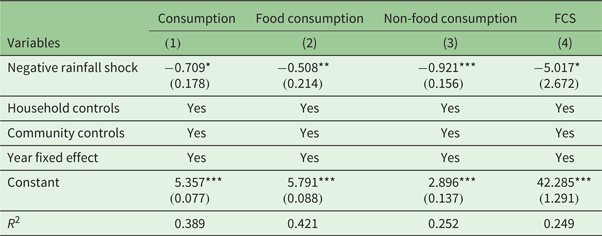
The discussion of the results begins by presenting the relationship between negative rainfall shocks and food security in table 3. Using different measures of welfare, we show that exposure to negative rainfall shocks reduce household welfare. Column (1) shows a 10 per cent increase in negative deviation of rainfall from the historical rainfall average which leads to an approximately 7 per cent reduction in per capita total consumption expenditure. Column (2) shows that a 10 per cent increase in negative deviation of rainfall from the historical rainfall average lowers the per capita food consumption expenditure by around 5 per cent.
Impact of rainfall shock on household welfare (OLS regressions)

Notes: The regressions comprise 4,058 observations. Robust standard errors (clustered at the household level) are reported in parentheses. ***, ** and * represent significance levels at 1%, 5% and 10%, respectively. Control variables used in the regression include: age of household head, household head has chronic illness, household head read English, household head read and write Chichewa, household head is a male, household head completed at least primary education, household head is divorced or separated, number of elderly above 65 years in the household, number of adult females in the household, number of children below 15 years in the household, household has access to electricity, household head is monogamous, household size, household received cash or food aid, farm size, household distance to road, MASAF programme in the community and commercial banks available in the community.
Also, from column (3), the result shows that a 10 per cent increase in negative deviation of rainfall from the historical rainfall average reduces per capita non-food consumption expenditure by 9 per cent. Also, the FCS decreases by 50 per cent for a 10 per cent increase in negative deviation of rainfall from the historical rainfall.
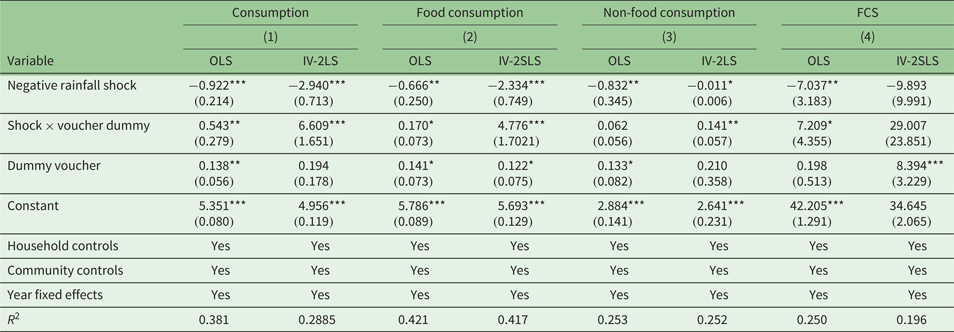
Table 4 presents OLS and IV-2LS results of the conditioning role of FISP vouchers on the relationship between negative rainfall shocks and the indicators of household welfare. The OLS results from column (1) show that a 10 per cent increase in negative deviation of rainfall from the historical rainfall average leads to about 9 per cent reduction in per capital total consumption expenditure for households without FISP vouchers, but a decline of about 4 per cent in consumption expenditure for households that received FISP vouchers. The IV-2SLS results in column (1) reveal that a 10 per cent increase in negative deviation of rainfall from the historical rainfall average leads to a 29 per cent reduction in per capita consumption expenditure for non-recipients of FISP vouchers, but an increase of about 36 per cent in per capita total consumption expenditure for households that are recipients of FISP vouchers.
Rainfall shock on household welfare and the role of Farm Input Subsidy – OLS and IV results

Notes: The regressions comprise 4,058 observations. Robust standard errors (clustered at the household level) are reported in parentheses. ***, ** and * represent significance levels at 1%, 5% and 10%, respectively. Control variables are the same as in table 3.
In column (2), the OLS results show that a 10 per cent increase in negative deviation of rainfall from the historical rainfall average leads to about 7 per cent reduction in per capita food consumption expenditure for non-recipients of FISP vouchers but leads to a decline of about 5 per cent in per capita food consumption expenditure for households that are recipients of FISP vouchers. The IV-2SLS results in column (2) show a 10 per cent increase in negative deviation of rainfall from the historical rainfall average leads to a 23 per cent decline per capita food consumption expenditure for non-recipients of FISP vouchers but a 24 per cent increase in per capita food consumption expenditure for recipients of FISP vouchers.
Furthermore, in column (3), the OLS results of the interaction between FISP vouchers and negative shocks have no statistically significant effect on non-food consumption expenditure. The IV-2SLS results from column (3) show that a 10 per cent increase in negative deviation of rainfall from the historical rainfall average leads to a 0.11 per cent decline in per capita non-food consumption expenditure for non-FISP recipient households, but an increase in non-food expenditure by 1.3 per cent for recipients of FISP vouchers.
Moreover, in column (4) of table 4, the OLS results show that households that are exposed to negative rainfall shocks and which received FISP vouchers report a 2 per cent increase in FCS relative to households without FISP vouchers. However, the IV-2SLS results in column (4) reveal no statistically significant effect of the interaction of FISP vouchers with negative rainfall shock on FCS.
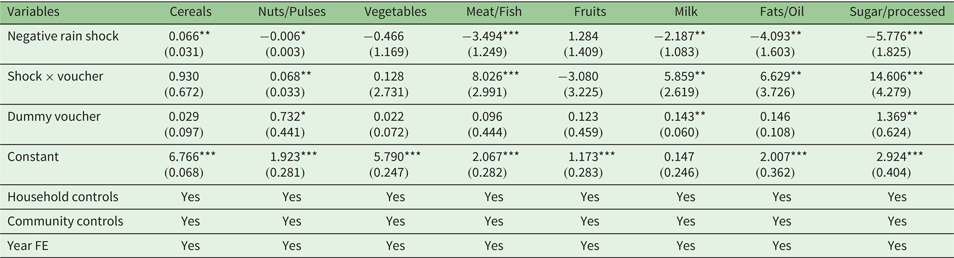
Table 5 presents the results from the instrumental variable analysis on disaggregated food categories or classes consumed over a number of days in a week. The results show that an increase in negative deviation of rainfall from the historical rainfall average leads to an increase in the number of days in a week that cereals are consumed but a decline in number of days in a week that nuts/pulses, milk, meat, fats and oil, and sugar/processed are consumed. However, households' receipt of FISP vouchers mitigates the adverse effects of negative rainfall shocks and increases the number of days the listed disaggregated food categories are consumed. We find a statistically significant effect of the interaction between FISP receipt and negative rainfall shocks on nuts/pulses, meat/fish, milk, fats/oil, and sugar/processed sugar.
The mitigating of FISP vouchers against rainfall shock on dietary diversity (IV results)

Notes: The regressions comprise 4,058 observations. Robust standard errors clustered at the household level are reported in parentheses. ***, ** and * represent significance levels at 1%, 5% and 10%, respectively. Control variables are the same as table 3.
The results from table 5 also reveal that, besides the mitigating role of FISP voucher receipts against negative rainfall shocks, we find that FISP receipts have a direct effect on disaggregated food categories such as nuts/pulses, milk, and sugar/processed sugar. The implication of this finding is that FISP can lead to an increase in household food security status.
5.1 Potential pathways
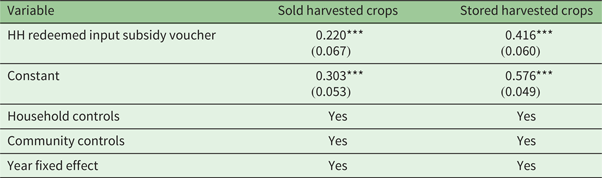
We identify potential pathways or mechanisms through which FISP mitigates the effects of negative rainfall shocks on household welfare. From table 6, the results show that households that redeemed farm input subsidy vouchers are more likely to have the following: (i) sold harvested crops, (ii) stored harvested crops. We estimate the relationship between receipt of FISP vouchers and the outcomes (sold harvested crops and stored harvested crops) using a linear probability model.
Potential mechanisms

Notes: The regressions comprise 4,058 observations. Robust standard errors (clustered at the household level) are reported in parentheses. *** represents significance level at 1%. Control variables are the same as table 3.
The outcomes are binary variables, and the estimated coefficients are interpreted in terms of likelihoods or probabilities. Specifically, the receipt of FISP vouchers is positively associated with the likelihood of having harvested crops for sale by 22 percentage points. Also, the receipt of FISP vouchers is positively associated with households having stored harvested crops by 42 percentage points.
5.2 Robustness check
We conduct a robustness check for the negative rainfall shock used in our analysis. The shock variable used in the previous analysis lumps together the positive rainfall deviation and zero deviation. The aim of the robustness check is to investigate whether the results are consistent with those obtained in table 4. Hence, we exclude the observations with positive deviation in the shock variable used in the robustness check. The results, shown in table A3 in the online appendix, are consistent with those obtained in table 4.
However, we find a negative effect of the dummy of FISP voucher on welfare outcomes for columns (2) and (3). Although these results from the FISP receipts dummy in columns (2) and (3) are counterintuitive, they are not the focus of our analysis in this study. The focus of our analysis is on the coefficient of negative rainfall shocks, and the interaction of FISP with negative rainfall shock. The negative coefficients of the FISP dummy in columns (2) and (3) may be driven by the reduced sample size used in the regressions after excluding observations with positive deviations. These findings are unlikely to detract from the policy implications of this study because the emphasis is on the mitigating impact of FISP receipts on households' welfare in Malawi.
5.3 Discussion
The decreasing effect on food consumption expenditure and non-food expenditure as a result of exposure to negative rainfall shocks is expected and aligns with the narrative of the devastating effect of weather shocks on Malawian households (Asfaw and Maggio, Reference Asfaw and Maggio2018).
The findings from the various estimations suggesting that the Malawian FISP has a cushioning role against the harsh consequences of rainfall shock on households – which is seen in their food consumption and in the overall food security – have important implications. Overall, these findings support the hypothesis that households require social protection policies to efficiently and effectively cope with weather-related shocks. This is especially true for most vulnerable households like those in the rural areas and even poor smallholder agricultural households.
Furthermore, we find from our result that, in terms of overall household consumption, food consumption and non-food consumption, beneficiaries of the FISP tend to be better off when confronted with weather shocks than non-beneficiaries of the programme. These results are in tandem with Asfaw and Carraro (Reference Asfaw and Carraro2016) and Daidone et al. (Reference Daidone, Davis, Knowles, Pickmans, Pace and Handa2017), who find a similar outcome: that the FISP tends to improve the welfare outcome of beneficiary households. This result is consistent with the foundational philosophy of the FISP, which is mainly to influence the production decisions of farmers through enhanced access to improved agricultural inputs (Dorward and Chirwa, Reference Dorward and Chirwa2011; Lunduka et al., Reference Lunduka, Ricker-Gilbert and Fisher2013) by the provision of vouchers and coupons for the purchase of agricultural inputs (Dorward and Chirwa, Reference Dorward and Chirwa2011; Harou, Reference Harou2018). It is logical to expect that in the provision of these inputs to farmers, those who are exposed to agricultural-related shocks are most likely to maintain improved crop production for both subsistence and market sale, for the reasons below.
First, weather shock experiences for households participating in the FISP could be less of a problem (as the data suggest) because there is an economic support for these farmers to maintain their production capacity, even if it might be slightly negative compared to instances where there are no weather shocks. However, the maintenance of the production capacity by these farmers may well affect food consumption of the household through subsistence means. Although these farmers may still face a slight decrease in their food consumption, the magnitude is better compared to those farmers who do not participate in the FISP. As a result, these farmers are able to have more food for subsistence purposes despite the weather shocks.
Second, noting that households who have received the FISP and are exposed to a shock may not be as affected as those who are non-beneficiaries of the FISP, meaning that their farm produce is not as severely affected as that of the comparison group, then such produce can still be sold to generate income for household consumption (both food and non-food). As highlighted in Herrmann et al. (Reference Herrmann, Jumbe, Bruentrup and Osabuohien2018), income from the sale of farm produce is a key determinant of food access and food security in Malawi. In addition, the beneficiary households, with a relatively stable production and income from the sale of their farm produce, have a tendency to experience better food consumption compared to the non-beneficiary households.
6. Conclusion
This study investigates the potential implications of an agricultural input subsidy programme on the effect of weather shocks on household welfare, which include food security indicators as used in the study. The potential implication of such agricultural policy for consumption, food consumption, non-food consumption, and FCSs for households that experience weather shocks is an important issue for agricultural and rural development, especially in Malawi, where the majority of rural dwellers are smallholder farmers. Our analysis builds on this by studying the potential household-level linkages between the FISP, rainfall shocks and welfare outcomes. We focused on both households that are beneficiaries of the programme and those that are not, while controlling for the year fixed-effects to improve the efficiency of the regression analysis.
We find that, on the average, households' welfare is negatively affected by rainfall shocks. More so, households that participate in the FISP experience significantly higher total consumption, food and non-food consumption, even when confronted with weather shocks. Moreover, for the FCS, we find a significant effect of the FISP when exposed to weather shocks. We consider disaggregated food diversity categories; we find that access to the FISP increases the likelihood of consumption of classes of foods such as meat/fish, milk, fats/oil and sugar. These results support the claim that agricultural programmes could have significant effects on households' mechanisms for coping with weather related shocks.
Supplementary material
The supplementary material for this article can be found at https://doi.org/10.1017/S1355770X20000285.