Implications
The Dahe pig is a Chinese indigenous pig breed and the Dawu pig is a crossbred using the Duroc × Dahe breeding scheme through five generations of selection. This is the first study to evaluate growth and carcass characteristics, organ weight, meat quality, and intramuscular fatty acid and amino acid composition of the two breeds. The results showed that the Dahe pigs retained good meat but poor growth and carcass composition, whereas the Dawu pigs not only retained good meat quality as did the Dahe pigs but also had good growth performance and carcass composition. These results indicated that the two breeds could be used in commercial pig production in China to provide high taste quality niche products.
Introduction
The Chinese swine industry is by far the largest of its kind in any country in the world. Jiang and Li (Reference Jiang and Li2010) reported the 2009 standing population to be 463 million heads and the slaughter at 668 million in China. There are about 100 local swine breeds in existence in China and the native pig breeds have high reproductive rates, good meat quality, good adaptability for extensive feeding and management and the ability for high utilization of green crude. However, owing to undesirable traits such as slow growth rate, low dress percentage and low lean meat percentage, few local breeds are utilized on large commercial farms in China (Jones, Reference Jones1998). One of the reasons for the increasing interest in local pig breeds is the better quality of their meat compared with modern breeds (Dunn, Reference Dunn1996; Labroue et al., Reference Labroue, Goumy, Gruand, Mourot, Neelz and Legault2000). According to the literature, pigs of Chinese local breeds present poorer growth performance; moreover, they are fatter and less conformed than pigs of modern breeds (Lan et al., Reference Lan, McKeith, Novakofski and Carr1993; Cesar et al., Reference Cesar, Silveira, Freitas, Guimarães, Batista, Torido, Meirelles and Antunes2010). As for the quality of meat or meat products, the abovementioned studies report an advantage of local pig breeds in relation to pigs of modern breeds.
The Dahe pig is a traditional commercial pig breed that is raised in southwest China in the Yunnan province. Owing to the poor growth performance and carcass composition, it is endangered by extinction. Nowdays, the Dahe pig is included in the national preservation program for autochthonous breeds. In order to utilize the precious genetic resource, we used the Duroc × Dahe breeding scheme and bred the crossbred Dawu pig through five generations of selection. The Dahe pig and the Dawu pig have good adaptability for extensive feeding and management and the ability for high utilization of green-crude feed. The meat of the two breeds is the excellent raw material of Xuanwei-Ham. Nowadays, there are few reports about the germplasm characteristics of the two breeds. Therefore, the objectives of the experiment were to evaluate the growth and carcass characteristics, organ weight, meat quality and intramuscular fatty acid (FA) and amino acid composition of the two breeds.
Material and methods
The experiment was conducted in compliance with the requirements of the Animal Ethics Committee of Sichuan Agricultural University.
Animals and management
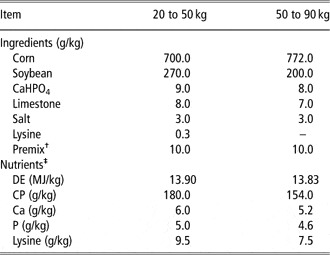
The experiment was organized by the Qujing Farming Bureau and Sichuan Agricultural University and conducted on the Dahe pig preservation farm in Qujing city. A total of 40 castrated male pigs (n = 20 per breed) were randomly selected at 60 days of age (with similar weight at about 20 kg). All pigs were housed in individual pens (2 m2) located in the same room. Owing to the Dahe and the Dawu pigs being usually slaughtered at about 80 kg in the production system, the feeding experiment lasted for 150 days for the Dawu pigs and 180 days for the Dahe pigs in order to gain similar slaughter weight after 7 days of the adaptation period. All pigs were fed twice a day with the same diet, and pigs had ad libitum access to diet and water (nipple drinkers). The experimental diets were based on corn and soybean meal, and were formulated with crude protein concentrations, trace minerals and vitamins to meet or exceed the National Research Council (NRC, 1998) recommendations for the different growth phases. Chemical analyses of the basal diet were carried out according to the methods of Association of Official Analytical Chemists (AOAC, 1990). During the experimental period, the corn–soybean meal diet was offered to pigs as shown in Table 1.
Ingredients and nutrients of the basal experiment diets

DE = digestible energy.
†Provided the following (unit/kg): 1600 mg of Cu, 10 000 mg of Fe, 3000 mg of Mn, 10 000 mg of Zn, 40 mg of I and 30 mg of Se, 6 05 000 IU of vitamin A, 1 55 000 IU of vitamin D3, 1800 IU of vitamin E, 200 mg of vitamin K3, 300 mg of vitamin B1, 400 mg of riboflavin, 200 mg of vitamin B6, 1.5 mg of vitamin B12, 1500 mg of pantothenic acid, 2800 mg of niacin and 12 500 mg of choline.
‡All data were analyzed values except DE, which was calculated using swine National Research Council (1998) values.
Growth and carcass measurements and organ weight
In the experimental period, the data of initial live weight, final live weight and feed consumption were recorded. At their predestinated slaughter age, all pigs were slaughtered to determine carcass composition according to the methods described by Xiao et al. (Reference Xiao, Xu and Chen1999). Briefly, all pigs were transported to an abattoir. The pigs received no feed on the day of slaughter, but were allowed to rest for 2 h after about 1 h of transportation (including loading and unloading), after which they were electrically stunned (90 V, 10 s and 50 Hz), exsanguinated, dehaired and eviscerated. The head was removed and the carcass was longitudinally split. The left carcass was physically dissected into bone, muscle and subcutaneous fat and skin, and each of the dissected tissue was weighed to the nearest gram. The organs were removed and weighed. The Longissimus dorsi area was determined by tracing its surface area at the 10th rib and by using a planimeter (Planix 5.6, Tamaya Digital Planimeter, Tamaya Tecnics Inc., Tokyo, Japan). The backfat thickness was taken in the midline with a sliding caliper on the 10th rib. Carcass dressing percentage was determined from the live weight (fasted overnight but given free drinking water and weighed at the farm) and the hot carcass weight.
Meat quality measurements
pH was measured using a pH star (Osaka, Japan) at 45 min and 24 h postmortem on the L. dorsi according to the procedure described by Verónica et al. (Reference Verónica, María del, Sonia, Pedro and José2009). Color parameters were determined using a Minolta CR-300 colorimeter (Minolta Camera, Osaka, Japan) with an illuminant D65, a 10° standard observer and a 2.5 cm port/viewing area according to the procedure described by Miao et al. (Reference Miao, Wang, Xu, Huang and Wang2009). Drip loss was defined as the weight loss of a meat sample (50 g), placed on a flat plastic grid and wrapped in foil, after a storage time of 24 h in a refrigerator (4°C; Miao et al., Reference Miao, Wang, Xu, Huang and Wang2009). Cooking loss was measured by a meat sample packaged under vacuum – in a circulating water bath at a temperature of 75°C. Subjective Marbling scores were evaluated approximately at 24 h postmortem according to the method of the National Pork Produces Council (NPPC, 2000). The analysis of intramuscular fat (IMF) content was measured according to the AOAC (1990) procedures. Muscle fiber area was determined using the procedure described by Gint and Vigilijus (Reference Gint and Vigilijus2008).
Analysis of FA and amino acid composition
FA composition was analyzed by gas chromatography (Agilent 6820, Agilent Technologies, USA) using a capillary column (HP-Innowax, Agilent, 30 m long, 0.32 mm internal diameter and 0.25 μm film thickness) according to the method described by Yang et al. (Reference Yang, Ma, Qiao, Song and Du2005). The temperature program was started at 200°C for 2 min, followed by ramping to 202°C at a rate of 0.4°C/min, and then followed by another ramping to 207°C at a rate of 0.7°C/min and holding for 14 min. The temperature of the injection port was 250°C and that of the flame ionization detector was 275°C. The velocity of the carrier gas (N2) was set at 2.8 ml/min and the head pressure of the carrier gas was 11.9 psi. FAs in three fractionations were quantified using C17:0 as an internal standard. All FAs in the samples were identified by the retention times according to the standard compounds of FAs (Sigma Chemical Co., St. Louis, MO, USA).
Amino acid composition was determined using the method described by Lu et al. (Reference Lu, Li, Yin, Zhang and Wang2008). The wet muscle samples were cut into slices and dried in a vacuum-freeze dryer, allowed to equilibrate with atmospheric moisture for 24 h, and then finely ground to pass a 60-mesh sieve. The amino acid composition of the muscle powder was analyzed using ion-exchange chromatography with an automatic amino acid analyzer (L-8800 Hitachi Automatic Amino Acid Analyzer, Tokyo, Japan) after hydrolyzing with 6 N HCl at 110°C for 24 h. Methionine, cystine and tryptophan were partly destroyed under acid hydrolysis. Tryptophan was determined after alkaline hydrolysis with 4 N NaOH for 22 h at 110°C. Methionine and cystine were analyzed after cold formic acid oxidation for 16 h before acid hydrolysis. Duplicate analyses were performed on all six samples in each breed.
Statistical analyses
Statistical analysis was performed using the ANOVA procedure of the SAS System for Windows Release 8.0 (SAS Institute Inc., Cary, NC 27513, USA). The model included breed as the main effect. Duncan test was applied to compare the mean values of the breed. Mean values and standard errors are reported in the tables. Differences were considered significant if P ⩽ 0.05.
Results and discussion
Growth and carcass traits
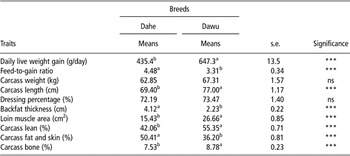
Growth performances in the two breeds are shown in Table 2. The average daily live weight gain of the Dahe pigs was lower than that of the Dawu pigs (P < 0.001); meanwhile, the Dahe pigs had a higher feed-to-gain ratio compared with the Dawu pigs (P < 0.001). The results were in accordance with previous reports (Young, Reference Young1992a, Reference Young1992b, Reference Young1995 and Reference Young1998), which showed that the Chinese native breeds (Meishan, Fengjing and Minzhu) had low daily live weight gain and high feed-to-gain ratio, but the growth performances of hybrid pigs from Yorkshire × Meishan, Yorkshire × Fengjing and Yorkshire × Minzhu were largely improved.
Means and s.e. of growth and carcass traits in the two breeds

a,bMeans within a row with different superscripts indicate significant differences; ns at P > 0.05; *** significant at the 0.1% level.
The carcass characteristics of the two breeds are shown in Table 2 and there are big differences between the two breeds. The carcasses of the Dahe pigs were shorter (P < 0.001); meanwhile, they contained less lean meat and carcass bone (P < 0.001) than did the carcasses of the Dawu pigs. By contrast, the Dahe pigs had more carcass subcutaneous fat and skin compared with the Dawu pigs (P < 0.001). In addition, the Dahe pigs had thicker backfat and smaller loin muscle area compared with the Dawu pigs (P < 0.001). No significant differences in dressing percentage and carcass weight were attributable to the two breeds. These above results indicate not only that the Dahe pig has a strong ability to deposit lipids showing high subcutaneous fat percentage and low lean meat percentage as well as another Chinese native breeds by contrast, the Dawu pig, which has a large proportion of Duroc, has high lean meat percentage as well as foreign breeds.
These results were in accordance with previous reports (Xu, Reference Xu1994; Miao et al., Reference Miao, Wang, Xu, Huang and Wang2009), which showed that the Jinhua pig was characterized by stronger fatty deposition, lower lean meat percentage and reduced growth performance compared with the Landrace pig. Gispert et al. (Reference Gispert, Fonti Furnols, Gil, Velarde, Diestre, Carrión, Sosnicki and Plastow2007) compared five different genetic types of pig (Landrace, Large White, Duroc, Pietrain and Meishan) and found that the Meishan pigs had lighter carcass weight, lower lean meat percentage and higher subcutaneous fat percentage compared with the pig breeds. Wanger et al. (Reference Wanger, Schinckel, Chen, Forrest and Coe1999) also found differences in the carcass composition from different genetic types of swine. The higher backfat thickness and lower carcass lean content in Chinese native pigs were related to their lower muscle growth potential. The greater ability of Chinese native pigs to deposit lipids is probably related to an indirect effect of concomitant breed difference in protein accretion and an increase in extra energy available for lipid synthesis (Renaudeau and Mourot, Reference Renaudeau and Mourot2007). Similar results were reported when Meishan (White et al., Reference White, Lan, McKeith, McLaren, Novakofski, Wheeler and Kasser1993; Litten et al., Reference Litten, Corson, Hall and Clarke2004), Iberian pigs (Morales et al., Reference Morales, Baucells, Pérez, Mourot and Gasa2003) or Creole pigs (Renaudeau and Mourot, Reference Renaudeau and Mourot2007) were compared with conventional lean pigs.
The crossbred Dawu pigs, crossing the modern Duroc breed and local Dahe breed, had better carcass characteristics than the Dahe pigs. The results were in accordance with previous reports (Lan et al., Reference Lan, McKeith, Novakofski and Carr1993), which showed that the crossbred pigs from Yorkshire × Meishan, Yorkshire × Fengjing and Yorkshire × Minzhu were characterized by lower fat deposition and higher lean meat percentage compared with the purebreds of Meishan, Fengjing and Minzhu.
Weight of organs
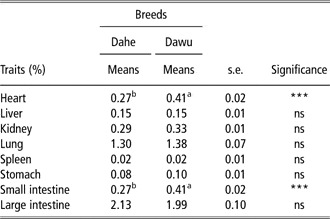
As shown in Table 3, the relative weight of organs showed differences in the two breeds. The Dahe pigs had lower relative weight of the heart and small intestine compared with the Dawu pigs (P < 0.001, respectively). Several factors, such as the diet protein level, slaughter weight and breed, have been reported to influence both the actual and relative organ weight of slaughter pigs (Chen et al., Reference Chen, Lewis, Miller and Yen1999; Miao et al., Reference Miao, Wang, Xu, Huang and Wang2009). In this study, the relative heart weight and the small intestine weight were lower in the Dahe pigs than in the Dawu pigs. The results are in accordance with previous findings reported by Cliplef and McKay (Reference Cliplef and McKay1993) and Yang and Lin (Reference Yang and Lin1997), which showed that pigs with leaner carcasses and faster growth rate had a larger heart and small intestine. However, Miao et al. (Reference Miao, Wang, Xu, Huang and Wang2009) found that the Jinhua pigs had a higher relative weight of heart compared with the Landrace pigs. No significant differences in other organ weight was found between the two breeds, and the results were in agreement with previous findings (Ruusunen et al., Reference Ruusunen, Partanen, Pösö and Puolanne2007), which showed that the relative weight of the liver and kidneys did not differ significantly between breeds of pigs at the age of 165 days. But many findings indicated that the organ weight was affected by breeds (Chen et al., Reference Chen, Lewis, Miller and Yen1999; Kouba et al., Reference Kouba, Bonneau and Noblet1999; Miao et al., Reference Miao, Wang, Xu, Huang and Wang2009; Barea et al., Reference Barea, Nieto, Vitari, Domeneghini and Aguilera2011).
Means and s.e. of relative organ weight in the two breeds

a,bMeans within a row with different superscripts indicate significant differences; ns at P > 0.05; ***significant at the 0.1% level.
Meat quality parameters
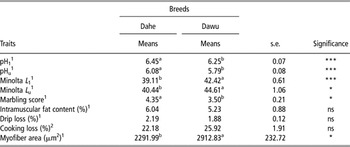
Meat quality in the two breeds is shown in Table 4. pH1 (at 45 min postmortem) and pHu (at 24 h postmortem) of the Dahe pigs were significantly higher compared with the Dawu pigs (P < 0.001, respectively). pH was a major parameter of meat quality which affected both the technological and eating qualities of pork (van Laack et al., Reference van Laack, Kauffman, Sybesma, Smulders, Eikelenboom and Pinheiro1994; van der Wal et al., Reference van der Wal, de Vries and Eikelenboom1995). Sellier (Reference Sellier1998) reported that reference was commonly made to three distinct pH-related abnormalities. These were specifically the PSE (pale, soft, exudative) meat condition (associated with pH1 values <5.9 to 6.1 depending on the muscle), the DFD (dark, firm, dry) meat condition (associated with pHu values >6.0 to 6.2) and the ‘acid meat’ condition (associated with pHu values <5.4 to 5.5). In this study, the two breeds showed high pH1 values. Warriss et al. (Reference Warriss, Kestin, Brown and Nute1996) and Yang and Liu (Reference Yang and Liu2009) also reported higher muscle pH1 for local breeds. By contrast, Labroue et al. (Reference Labroue, Goumy, Gruand, Mourot, Neelz and Legault2000) reported lower muscle pH1 (L. dorsi) and higher muscle pHu (Semimembranosus) for local breeds in comparison with Large White breed; however, no indication was given of the stress susceptibility gene status of their local breeds. In the two breeds, the pH values were within normal scopes and the meat showed no characteristics of PSE, DFD and ‘acid meat’.
Means and s.e. of meat quality in the two breeds

a,bMeans within a row with different superscripts indicate significant differences; ns at P > 0.05; *significant at the 5% level; ***significant at the 0.1% level.
1Longissimus dorsi at 10th rib.
2Greater psoas; pH1, Minolta L 1 (at 45 min postmortem); pHu, Minolta L u (at 24 h postmortem).
Lower Minolta L values (at 45 min and 24 h postmortem) in the L. dorsi were found for the Dahe pigs compared with the Dawu pigs (P < 0.001 and P < 0.05, respectively). Similar results were reported between the Iberian and Landrace pigs (Serra et al., Reference Serra, Gil, Pérez-Enciso, Oliver, Vázquez, Gispert, Díaz, Moreno, Latorre and Noguera1998) or between the Creole and Large White pigs (Renaudeau and Mourot, Reference Renaudeau and Mourot2007). Miao et al. (Reference Miao, Wang, Xu, Huang and Wang2009) found that the Jinhua pig meat had lower Minolta L value and tended to be darker than that of the Landrace pigs. Ramírez et al. (Reference Ramírez, Morcuende and Cava2007) also found that the Minolta L value was influenced by the genotype of pigs. However, these results conflict with those of earlier studies (Edwards et al., Reference Edwards, Bates and Osburn2003), which observed that objective Minolta L values were not different between breeds (Duroc- and Pietrain-sired pigs). According to the meat color standards of NPPC (2000), color score levels of 3 to 5 or Minolta L value levels of 37 to 49 are considered to be good. In this study, the Minolta L values were perfect in the breeds, which indicated that the two breeds had good meat color.
Regarding drip loss and cooking loss, no significant differences were found in the two breeds (P > 0.05, respectively). Water is the major meat constituent representing approximately 75% of the meat weight. It is an essential quality parameter, both for the industry and the final consumer. High water holding capacity (WHC) values might cause advantages both in processed meats for the industry and in the fresh meat appearance for the consumer (den Hertog-Meischke et al., Reference den Hertog-Meischke, van Laack and Smulders1997). The main factors that affected WHC and thus drip loss were: genotype (HAL and RN genes), pre-slaughter management and stunning methods (Claeys et al., Reference Claeys, De Sme, Demeyer, Geers and Buys2001; Schäfer et al., Reference Schäfer, Rosenvold, Purslow, Andersen and Henckel2002). According to den Hertog-Meischke et al. (Reference den Hertog-Meischke, van Laack and Smulders1997), another important feature that affected WHC was the predominant type of fiber in the muscle. Muscles with a major amount of glycolytic fibers, also called white muscle fibers (fast contraction, type II A, anaerobic), had a lower WHC and a high pH drop rate after death (Lawrie, Reference Lawrie2005), as well as a lower final pH. In this study, the two breeds had high WHC showing low drip loss and cooking loss. Very high pH levels in the two breeds probably result in high WHC.
Higher Marbling score was found in the Dahe pigs compared with the Dawu pigs (P < 0.05) and no significant difference was found in the IMF content in the two breeds, both of which interestingly had high IMF content. The high IMF content of the Dawu pigs probably results from the outstanding specificity of Duroc pigs with high IMF content. IMF content was related to the organoleptic characteristics of pig meat and influences meat and meat product quality (Wood et al., Reference Wood, Enser, Moncrieff and Kempster1988), and IMF depended on the genotype of pigs (Affentranger et al., Reference Affentranger, Gerwig, Seewer, Schwörer and Künzi1996). Generally, fat is an important holder of flavor. Consequently, IMF content seems to have a decisive influence on the tenderness, juiciness and flavor of pig meat. Meat with a low fat content is insipid, strawy and dry. In this study, the two breeds had high Marbling score and high IMF content, which indicated that the Dahe and the Dawu pigs had good quality characteristics in the meat. From these results, one can assume that the two breeds have a strong level of lipid synthesis activity. Similarly, an increase in lipogenic enzyme activities in adipose and muscle tissue was reported by Serra et al. (Reference Serra, Gil, Pérez-Enciso, Oliver, Vázquez, Gispert, Díaz, Moreno, Latorre and Noguera1998) and Morales et al. (Reference Morales, Baucells, Pérez, Mourot and Gasa2003) when Iberian pigs were compared with Landrace pigs. An IMF content of 2% to 3% was suggested to be optimal for eating quality (Bejerholm and Barton-Gade, Reference Bejerholm and Barton-Gade1986; DeVol et al., Reference DeVol, McKeith, Bechtel, Novakofski, Shanks and Carr1988). However, owing to the selection of high lean meat content, the average IMF content of pig meat has decreased below this optimum these days, especially in many commercial pig populations. Therefore, to improve the IMF content is the new objective for pig genetics and breeding. The high IMF content in the two breeds can meet the demand for high taste quality niche products.
The Dahe pigs had a lower fiber area than the Dawu pigs (P < 0.05). The result was in accordance with previous results (Lan et al., Reference Lan, McKeith, Novakofski and Carr1993), which reported that Yorkshire pigs had a larger fiber area than Meishan (4, 206 μm2v. 3, 213 μm2 at ∼100 kg live weight). The muscle fiber area is an important factor affecting numerous pre- and post-mortem biochemical processes and thus also meat quality (Klosowska and Fiedler, Reference Klosowska and Fiedler2003). The pork muscle fiber area had influence on meat quality and pork with high muscle fiber area had high shear force, drip loss and cooking loss (Gint and Vigilijus, Reference Gint and Vigilijus2008). These results may help explain why the two breeds had high WHC because of the small fiber area.
According to the meat quality characteristics of the two breeds, this study confirms that the two breeds have good meat quality. From our results, it can be suggested that the two breeds could be used in production systems to provide high taste quality niche products to the market.
FA and amino acid composition
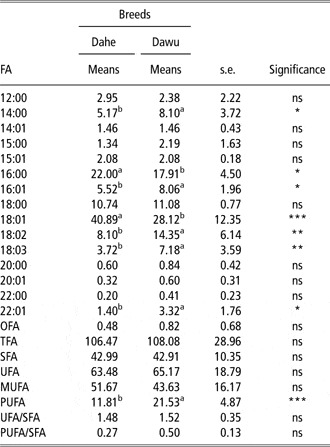
Table 5 shows the FA composition of the L. dorsi in the two breeds. In this study, C18:1, C16:0, C18:0 and C18:2 were the main FAs; meanwhile, monounsaturated fatty acid (MUFA) and saturated fatty acid (SFA) were by far the most abundant components (>87%) in the L. dorsi. These results were in good agreement with the results obtained from IMF (Muriel et al., Reference Muriel, Andres, Petron, Antequera and Ruiz2007; Martin et al., Reference Martin, Muriel, Antequera, Perez-Palacios and Ruiz2008 and Reference Martin, Muriel, Antequera, Andres and Ruiz2009; Yang et al., Reference Yang, Zhao, Xiao, Zhan, Du, Wu and Ma2010) in different pig breeds. Some other investigations showed that SFAs were much lower than MUFAs (Daza et al., Reference Daza, López-Bote, Olivares, Menoyo and Ruiz2007; Larrea et al., Reference Larrea, Pérez-Munuera, Hernando, Quiles and Lluch2007; Ramírez et al., Reference Ramírez, Morcuende and Cava2007; Tikk et al., Reference Tikk, Tikk, Aaslyng, Karlsson, Lindahl and Andersen2007), or that SFAs were a little higher than MUFAs (Martin et al., Reference Martin, Muriel, Antequera, Perez-Palacios and Ruiz2008) or that polyunsaturated fatty acids (PUFAs) were much higher than usually described by Bee et al. (Reference Bee, Gebert and Messikommer2002) and Daza et al. (Reference Daza, López-Bote, Olivares, Menoyo and Ruiz2007) in intramuscular neutral lipids. These differences could be related to the different breeds, experimental diets and feeding regimes in various studies.
FA composition of Longissimus dorsi Footnote 1 (mg/g)

FA = fatty acid; OFA = other FA; TFA = total FA; SFA = saturated FA; UFA = unsaturated FA; MUFA = monounsaturated FA; PUFA = polyunsaturated FA; UFA/SFA = the ratio of UFA to SFA; PUFA/SFA = the ratio of PUFA to SFA.
1 L. dorsi at 10th rib.
a,b Means within a row with different superscripts indicate significant differences; ns at P > 0.05; *significant at the 5% level; **significant at the 1% level; ***significant at the 0.1% level.
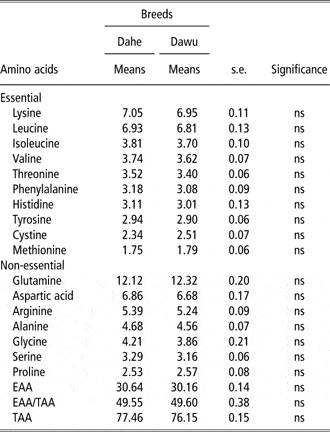
Table 6 shows the amino acid content of L. dorsi in the two breeds, and no significant differences were found in the two breeds. In this study, nine essential amino acids (EAAs) were found in the two breeds, which had higher EAA percentages (49.55% in the Dahe pigs and 49.60% in the Dawu pigs, respectively) compared with the total amino acid contents. The EAAs at the highest concentration in pig meat were lysine and leucine. Okrouhlá et al. (Reference Okrouhlá, Stupka, Čitek, Šprysl, Kluzáková, Trnka and ŠŠtolc2006) reported that the highest content of essential and semi-essential amino acids was determined in lysine (9.71% to 10.54%), leucine (8.18% to 9.21%) and arginine (7.28% to 7.88%). However, Belitz et al. (Reference Belitz, Grosch and Scieberle2001) reported values of 7.8% to 8.1% for lysine and 7.5% to 7.6% for leucine. In this study, the lowest content among the EAAs was measured in methionine, whereas Okrouhlá et al. (Reference Okrouhlá, Stupka, Čitek, Šprysl, Kluzáková, Trnka and ŠŠtolc2006) reported that phenylalanine showed the lowest content among the EAAs. Okrouhlá et al. (Reference Okrouhlá, Stupka, Čítek, Šprysl, Trnka and Kluzáková2008) indicated that the amino acids composition was affected by lean meat proportion. On the basis of the comparison of the total chemical composition in the dependence on the lean meat proportion in the carcass, the best appears to be the muscle with 54.9% to 60.0% lean meat proportion and more.
Amino acid composition of Longissimus dorsi Footnote 1 (g/100 g, dry meat)

EAA = essential amino acid; TAA = total amino acid; EAA/TAA = the ratio of EAA to TAA.
1 The percentage of amino acid to dry matter and L. dorsi at 10th rib.
ns (P > 0.05).
Conclusions
Above all, the Dahe pigs had good meat quality but poor growth performance and carcass composition. The Dawu pigs not only retained good meat quality characteristics of the Dahe pigs but also growth performance and carcass composition were greatly improved. C18:1, C16:0, C18:0 and C18:2 were the main FAs in the L. dorsi in the two breeds. Nine EAAs from the L. dorsi were found in the two breeds and they had higher EAAs percentages. These results indicated that the two breeds could be used in commercial pig production in China to provide high taste quality niche products.
Acknowledgments
We thank the teachers and graduate students at the Key Laboratory of Swine Genetics and Breeding and Qujing Farming Bureau for managing and slaughtering the research flocks. This study was supported financially by the Ministry of Science and Technology of People's Republic of China (2008BADB2B11-7).