The presence of architectural graffiti on the facades and walls of Maya temples and palaces was recognized by the first pioneers who explored the area at the end of the nineteenth century and during the first archaeological campaigns at the beginning of the twentieth century (Maler Reference Maler1911:56–63; Périgny Reference Périgny1908:81–82, Reference Périgny1911; Thompson Reference Thompson and George A.1898:226; Tozzer Reference Tozzer1913:160–163). After these initial efforts to record the information contained in these depictions and scribbles, archaeologists did not seem to consider graffiti as worthy of their attention. Some scholars even considered graffiti to be the “idle doodling of bored and inattentive novices” (Thompson Reference Thompson and Eric1954:10–11). It was only after the laudable work of the Tikal Project during its excavations from 1956 to 1970 (Trik and Kampen Reference Trik and Michael1983) that this type of information began to be considered important for scientific research and to be systematically recorded and analyzed (for a thorough study of the history of graffiti in the Maya area, see Źrałka Reference Źrałka2014:73–83).
As unofficial and probably spontaneous creations, graffiti constitute a very valuable source of information about the lives of the people who inhabited the places where they were found: they are personal acts of self-expression (Mayer Reference Mayer, Lorenzo and Cosme2009:27; Patrois and Nondédéo Reference Patrois, Nondédéo, Lorenzo and Cosme2009:44; Źrałka Reference Źrałka2014:205). Many researchers consider that graffiti in the Maya area were created by members of the elite, because the places where they were usually found were palatial complexes and temples; this may also explain the prevalence of images related to political and religious themes (Andrews Reference Andrews and Anderson1999:16; Helmke and Źrałka Reference Helmke and Źrałka2021:115; Michelet Reference Michelet, Lorenzo and Cosme2009:97; Patrois and Nondédéo Reference Patrois, Nondédéo, Lorenzo and Cosme2009:44; Źrałka Reference Źrałka2014:139). The number of graffiti present at any given Maya site varies widely, depending on the preservation of the stucco, the attention given by archaeologists to this kind of information while exploring the site, or emic considerations about this type of expression at different Maya cities and different historical periods (Andrews Reference Andrews and Anderson1999:3–5; Mayer Reference Mayer, Lorenzo and Cosme2009:17, 26; Michelet Reference Michelet, Lorenzo and Cosme2009:97; Źrałka Reference Źrałka2014:177–179).
Recent research has placed particular emphasis on the contextual analysis of graffiti, which takes into account where graffiti are located and what was the purpose or use of that location to infer what the intentions might have been of the people who left their impressions engraved or painted on the walls or floors of those structures (Baird and Taylor Reference Baird, Taylor, Jennifer and Taylor2019:6; Ragazzoli et al. Reference Ragazzoli, Harmanşah, Salvador, Ragazzoli, Harmanşah, Salvador and Frood2018:4; Smith Reference Smith1986). For example, Hutson (Reference Hutson2011) claims that some graffiti at Tikal were created by children, and Brown and colleagues (Reference Brown, McCurdy, Yeager, Freidel, Chase, Dowd and Murdock2024) have shown that some structures at Xunantunich were dedicated to the education of novices and that graffiti were used as an educational tool. Although global interpretations of the possible purpose of graffiti at a given site are important and interesting in and of themselves (Patrois and Nondédéo Reference Patrois, Nondédéo, Lorenzo and Cosme2009; Trik and Kampen Reference Trik and Michael1983; Źrałka and Hermes Reference Źrałka, Hermes, Lorenzo and Cosme2009), the only way to truly understand the possible meaning and function of graffiti is to take each building or room where it is found and analyze it in detail in light of that particular context.
This article presents the contextual analysis and interpretation of the graffiti found in Rooms 1 and 2 of Substructure II-B at the Maya site of Calakmul. I consider architectural graffiti as including both texts and images that are engraved or painted on the walls of buildings and that were not part of their original decoration (Andrews Reference Andrews and Anderson1999:2; Helmke and Źrałka Reference Helmke and Źrałka2021:99; Mayer Reference Mayer, Lorenzo and Cosme2009:27; Źrałka Reference Źrałka2014:36–37). Although some studies refer to painted graffiti as dipinti, I consider them to be graffiti because in one of the examples I discuss, engraving and painting were interrelated.
The Context
The city of Calakmul, located in southern Campeche, Mexico, was the seat of one of the most powerful Maya kingdoms of the Classic period, the Kanu’l dynasty. Along with Tikal, Calakmul was part of the group of political superpowers in the Maya world that vied for power and hegemony during the Late Classic period (AD 600–900; Martin and Grube Reference Martin and Grube2008:101).
The rooms under scrutiny are situated within Structure II, a building located at the southern end of the Great Plaza (Figure 1), the epicenter of the political activity at Calakmul throughout its entire history. This structure was built during the Late Preclassic period (300 BC–AD 250) and underwent multiple modifications during the centuries of its use. Measuring 120 m on each side and with a height of 45 m, it is one of the most impressive structures in the Maya area.
Map of the ceremonial center of Calakmul, with Structure II on its southern end (prepared by Alejandra Salinas, Calakmul Archaeological Project [PAC]).

Figure 1 Long description
The map depicts the ceremonial center of Calakmul, highlighting key areas such as the Great Acropolis, Great Plaza, Little Acropolis and structures I and II. The map is oriented with north indicated by an arrow. The Great Acropolis is located on the western side, while the Northeast Group is on the eastern side. The Great Plaza is centrally positioned, with Structure II to its south and Structure I further south. The Little Acropolis is situated to the east of the Great Plaza. A scale bar at the bottom indicates distances up to 800 meters.
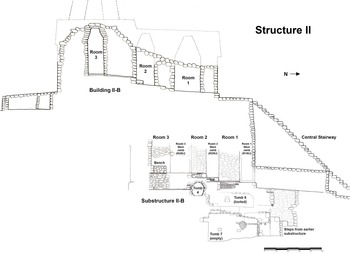
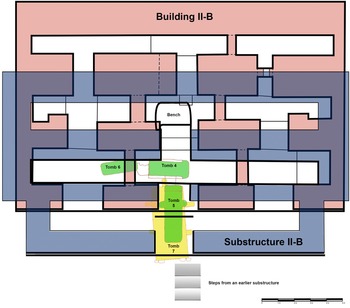
As part of the work conducted by the Calakmul Archaeological Project (PAC) during the 1997 archaeological season, a substructure consisting of a building with three vaulted rooms—referred to as Substructure II-B—was found under Building II-B (Figure 2), which is located at the front of Structure II (Carrasco Vargas et al. Reference Carrasco Vargas, Boucher, González, Blos, García Vierna, García Moreno and Vázquez Negrete1999:51). Substructure II-B was constructed during the Early Classic period (AD 250–600) and was used until it was enclosed and sealed by later architecture. Before being sealed, a tomb was excavated into the floor of its second room (Figures 2 and 3, Tomb 4): it was aligned with the east–west axis of Structure II. After it was filled and closed, a fire ritual was performed atop the tomb to sacralize it; no subsequent reentry was detected (Boucher and Palomo Reference Boucher and Palomo2000:50; Carrasco Vargas et al. Reference Carrasco Vargas, Boucher, González, Blos, García Vierna, García Moreno and Vázquez Negrete1999:52–53). It was previously assumed that the closure of Substructure II-B occurred around AD 725 (Carrasco Vargas et al. Reference Carrasco Vargas, Boucher, González, Blos, García Vierna, García Moreno and Vázquez Negrete1999:51), based on a Long Count date that was part of its graffiti, but the date was misinterpreted, as I show later.
Tombs distribution inside Substructure II-B (prepared by Eduardo Salvador, PAC).

Figure 2 Long description
The architectural plan depicts Structure II, focusing on Building II-B and Substructure II-B. Building II-B includes three rooms labeled Room 1, Room 2 and Room 3. Below, Substructure II-B also contains three rooms with the same labels. Tomb 4 is located in Room 2 of Substructure II-B, aligned with the east-west axis. A central stairway connects the structures, with north oriented to the right. A bench is present in Room 3 and a seep is noted from the stair entrance. The plan includes a scale bar for reference. The spatial arrangement highlights the relative positions of rooms, tombs, stairway, bench and seep within the structure.
Zenithal view of the tombs inside Substructure II-B (prepared by Eduardo Salvador, PAC). (Color online).

Figure 3 Long description
The diagram shows Building II-B and Substructure II-B. Building II-B is outlined in red, while Substructure II-B is in blue. Inside Substructure II-B, there are three labeled tombs: Tomb 4, Tomb 8 and Tomb 7, marked in green. A bench is located centrally. Steps from an earlier substructure are indicated in gray. A scale bar is present at the bottom right, providing a reference for size.
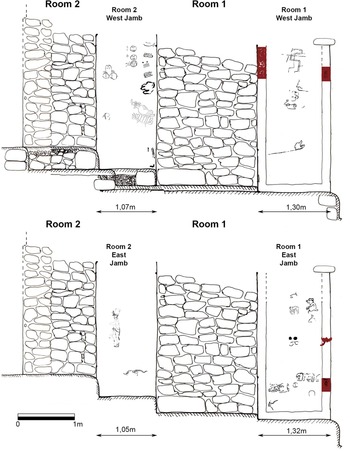
The graffiti that I analyzed are located on the doorjambs of the entrances to Rooms 1 and 2 of Substructure II-B. These two jambs show unmodified stucco for most of their surface, except for a red frame (about 5 cm thick) along the edges of the jamb of Room 1 (Figure 4). Behind these two rooms there is another room, Room 3, in which no graffiti were found.Footnote 1 Only the central corridor created by the junction of the rooms’ entrances has been excavated to date; the areas beyond the jambs, toward the interiors of the three rooms, have not, so it is possible that more graffiti could be found on their walls. The fact that no graffiti were found in Room 3 may indicate the special character of the graffiti in the other two rooms, given their direct connection to Tomb 4.
Graffiti location on the doorjambs of Room 1 and Room 2 of Substructure II-B; the graffiti are not to scale (prepared by Eduardo Salvador, PAC; graffiti drawings by the author). (Color online).

Figure 4 Long description
The diagram consists of two sub-images illustrating the graffiti locations on the doorjambs of Rooms 1 and 2 in Substructure II-B. The first image shows the west jambs of Room 2 and Room 1. Room 2's west jamb is depicted with various graffiti drawings, while Room 1's west jamb features a red frame along the edges, approximately 5 centimeters thick, with graffiti inside. The distance between the jambs is labeled as 1.07 meters for Room 2 and 1.30 meters for Room 1. The second image illustrates the east jambs of Room 2 and Room 1. Room 2's east jamb contains graffiti drawings and Room 1's east jamb also has a red frame with graffiti. The measurements are indicated as 1.05 meters for Room 2 and 1.32 meters for Room 1. Both images include a scale bar at the bottom left, showing a length of 1 meter. The diagrams highlight the specific locations and dimensions of the graffiti on the jambs, emphasizing the red frames on Room 1's jambs.
The Graffiti
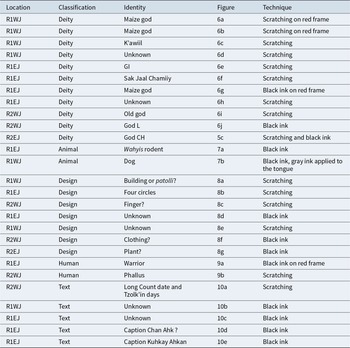
I identified 27 graffiti in Substructure II-B, which I grouped into the following categories: 11 deities, two zoomorphic figures, seven abstract designs, five hieroglyphic texts including an incomplete Long Count date with three associated Tzolk’in days, one anthropomorphic representation, and one phallus (Table 1). Of these, eight were found on the west jamb of Room 1 (R1WJ), 11 on the east jamb of Room 1 (R1EJ), six on the west jamb of Room 2 (R2WJ), and only two on the east jamb of Room 2 (R2EJ; Figure 4).
Graffiti Classifications and Their Elaboration Techniques.

Table 1 Long description
The table lists individual graffiti entries by location, classification type, identified subject, figure reference, and the technique used to create the mark. Deities are the most frequent classification, appearing across all four locations and including Maize god, K’awiil, GI, Sak Jaal Chamiiy, Old god, God L, and God CH, plus several unknown deities. Scratching is the most common technique overall, especially for deity images and several design motifs, while black ink is used for some deities, most animals, many designs, and all text entries. R1EJ contains the widest mix, with multiple deities, several designs, a warrior figure, and three text items including two named captions. R1WJ includes repeated Maize god entries and a dog rendered in black ink with gray ink added to the tongue, alongside scratched designs and one ink text of unknown content. R2WJ features a scratched Old god, an ink God L, several scratched designs, a scratched phallus, and a scratched Long Count date with Tzolk’in days. Identifications include question marks and “unknown,” so subject labels and some design interpretations are tentative and should be read as proposed rather than certain.
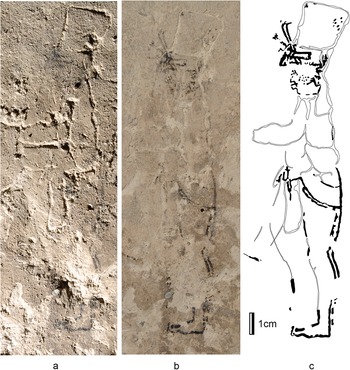
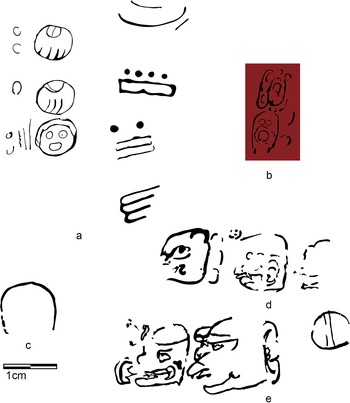
Three techniques were used to create the graffiti: scratching, painting, and a composite technique (Źrałka Reference Źrałka2014:93–94) that combined the first two methods (Figure 5). Eleven of the 27 graffiti were created using black paint over the plain stucco or over the red frame (Figures 6g, i; 7a, b; 8d, f, g; 9c–e; and 10a) The general quality of these representations indicates that whoever created them knew how to draw and write, which means that the artists were familiar with classical Maya graphic conventions.
Graffito of God CH (R2EJ) showing a mixed realization technique: (a) scratching; (b) painting; (c) both techniques forming a single image (photographs and drawings by the author). (Color online).

Figure 5 Long description
Three vertical sub-images are arranged left to right and labeled a, b and c. a shows a close view of a textured wall surface with incised lines forming a standing human-like figure. The figure has a head area, a torso and legs, with additional scratched marks around the body. b shows a close view of a textured wall surface with faint painted marks forming a human-like figure. The marks are lighter and less defined than in a. c shows a simplified line drawing of a standing human-like figure in side view. The figure has a hat, a face profile, a torso and legs with boots. A vertical scale bar labeled 1 centimeter is placed near the lower left of the drawing.
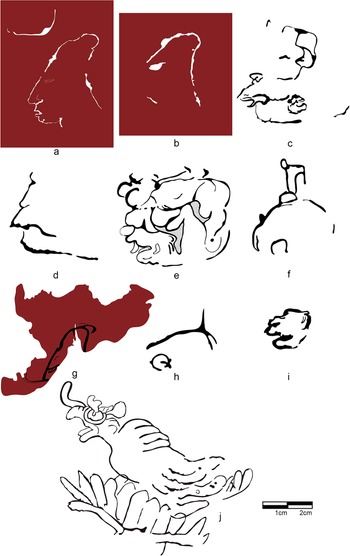
Graffiti showing deities: (a) Maize God (R1WJ); (b) Maize God (R1WJ); (c) K’awiil (R1WJ); (d) unknown (R1WJ); (e) GI (R1EJ); (f) Sak Jaal Chamiiy (R1EJ); (g) Maize God (R1EJ); (h) Death God? (R1EJ); (i) Old god (R2WJ); (j) God L (R2WJ; drawings by the author). (Color online).

Figure 6 Long description
The illustration shows graffiti depictions of various deities, arranged in panels labeled a to j. Each panel features simplified line drawings. Panels a and b depict the Maize God with white linework on dark red backgrounds, showing profile views with distinct facial features. Panel c illustrates K’awiil with detailed line art. Panel d is an abstract representation labeled unknown. Panel e shows GI with complex line elements. Panel f depicts Sak Jaal Chamiiy with unique line features. Panel g presents another Maize God profile on a red background. Panel h is labeled as Death God? with simple line art, indicating uncertain identification. Panel i shows an Old god with distinct characteristics. Panel j features God L, a large depiction with intricate line details, accompanied by a scale indicating 10 cm to 20 cm. The panels are arranged in rows and columns, with varying sizes and the style is minimalist line art, reflecting archaeological tracings of graffiti motifs.
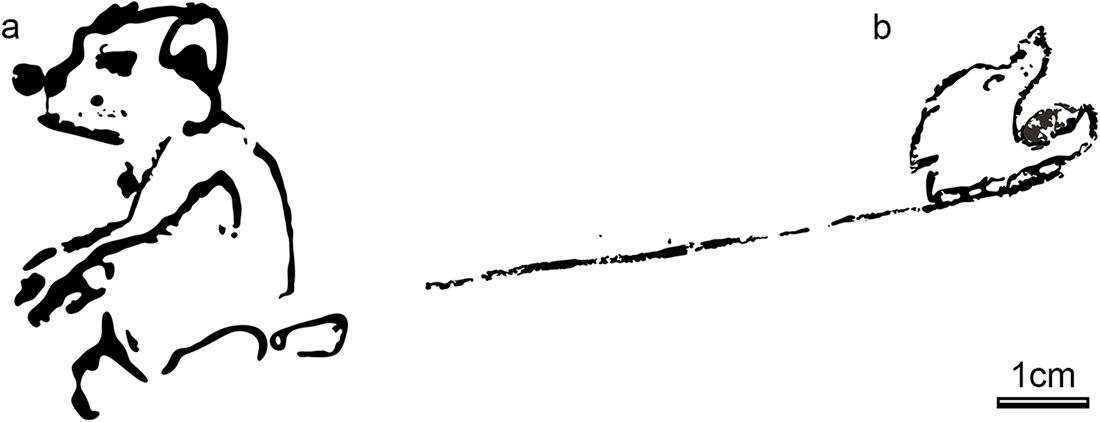
Graffiti showing animals: (a) image of the wahyis (co-essence) K’an Baah Ch’o’ (R1EJ); (b) dog wearing a collar and on a leash (R1WJ; drawings by the author).

Figure 7 Long description
N/A
Graffiti showing abstract designs: (a) patolli or building plan? (R1WJ); (b) four circles, two carved and two scratched (R1EJ); (c) unknown (R2WJ); (d) unknown (R1EJ); (e) unknown (R1WJ); (f) part of clothes? (R2WJ); (g) plant or deity’s headdress? (R2EJ; drawings by the author). (Color online).

Figure 8 Long description
The image A showing several thick black lines forming a large, angular, looping path with multiple right-angle turns, with a few thinner parallel lines overlapping parts of the path. The image B showing two solid black circles placed side by side above two short curved lines. The image C showing a single curved black outline forming an open arc shape. The image D showing a short, irregular black shape with a thicker cluster at one end and a thinner extension curving upward. The image E showing a red square containing thin white branching lines and small white marks, including a rectangular outline near the center. The image F showing a small cluster of short, vertical black strokes near the lower left. The image G showing a long, wavy black line running horizontally with several short downward and upward branches along the middle section. A scale bar at the lower right reads "1cm".
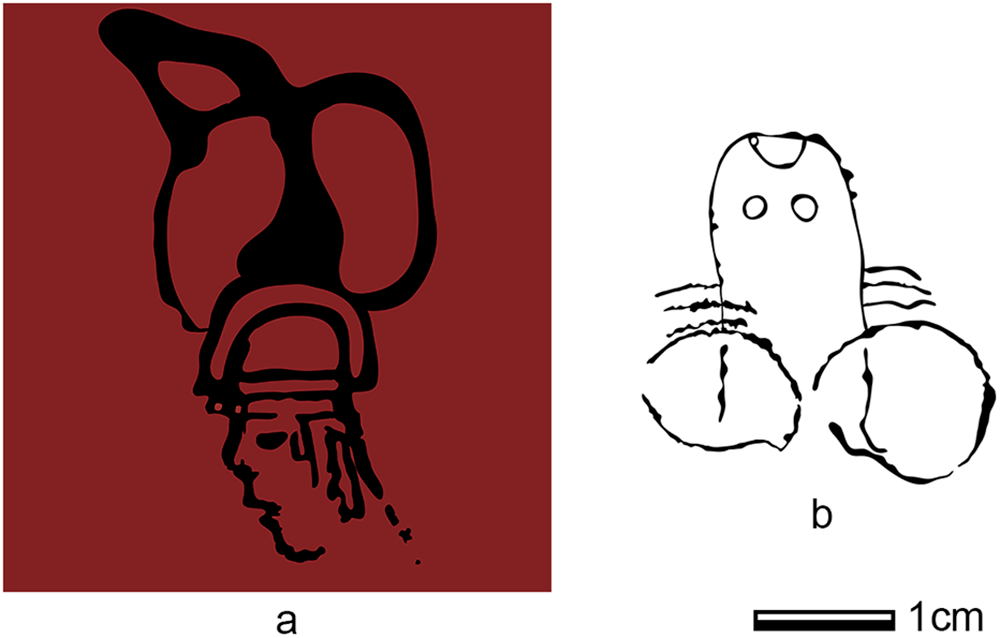
Human graffiti: (a) warrior (R1EJ); (b) phallus (R2WJ; drawings by the author). (Color online).

Figure 9 Long description
The image shows two drawings labeled a and b. Drawing a depicts a warrior with a detailed headdress and facial features. Drawing b illustrates a phallus with circular shapes and lines. Both drawings are simple in style, with drawing a having more intricate details compared to drawing b. A scale indicating 1 cm is present below drawing b.
Texts in the graffiti: (a) dates: 2 imix, 1 imix, 13 ajaw; Long Count Date 9.12.15 (R2WJ); (b) unreadable (R1WJ); (c) unreadable (R1EJ); (d) caption Chan Ahk ? (R1EJ); (e) caption Kuhkay Ahkan (R1EJ; drawings by the author). (Color online).

Figure 10 Long description
The image A showing several small line drawings arranged in a loose cluster. Near the upper left are three stacked circular forms with short curved marks inside. To the right are short groups of dots and short horizontal strokes. Below these are additional curved and zigzag-like strokes. The image B showing a small rectangular inset filled with glyph-like marks and curved lines. The image C showing a curved line above a horizontal scale bar labeled 1 centimeter. The image D showing a small face-like outline with an eye and mouth, with short marks near the top. The image E showing a larger cluster of graffiti-like line drawings. It includes a face-like form with an open mouth and teeth-like marks, several overlapping curved strokes and additional partial face-like outlines to the right.
Fifteen of the 27 graffiti were produced by scratching the surface of the stucco (Figures 6a–f, h, j; 8a, e; 9a, b; and 10b). The quality of the scratches and incisions varies greatly among the different graffiti. They range from very detailed and thorough renderings, as in the case of the depiction of God GI (Figure 6e) and God L’s headdress (Figure 6j), to very crude and schematic ones, as seen in some of the abstract designs (Figure 8a–c).
One graffito used a mixed technique (Figure 5), by which parts of the image were created by scratching the surface of the stucco (Figure 5a) and the rest was done using black paint (Figure 5b); this composite technique was also used at the site of Chilonche (Feliu Beltrán Reference Feliu Beltrán2019:294, 298). Figure 5c shows the use of both painting and scratching in Tomb 4’s graffiti, with a different type of line for each technique. The difference in quality between the two techniques is remarkable: the incised lines that form some parts of God CH’s body are very crude, whereas the lines drawn with the brush—which represent his face and part of his clothes and legs—are detailed, even artistic. What is truly remarkable about this graffiti is that both parts are completely integrated into a single image, suggesting that both were done by the same person; likely the creator was someone who could paint but whose etchings were not very good. This could mean that the creators of the graffiti were artisans or scribes who knew how to draw, paint, and write but were not very adept at the scratching technique. This would imply that the lack of quality of some graffiti did not indicate a lack of knowledge but rather a lack of technical skill in one of the techniques used. This may also contradict the importance of technique in the definition of graffiti (Helmke and Źrałka Reference Helmke and Źrałka2021:99), because it may be the medium and the tools used to render the images that influence the final result, rather than the knowledge of their creator.
Many of the graffiti are unfinished, so that only part of their original design is visible. In some cases, the designs are incomplete because the stucco surface on which they are located is now lost; for example, the representation of God L (Figure 6j). However, in some other examples, the carving or painting was left unfinished. This is the case with the depictions of some of the deities present on R1WJ and R1EJ (Figure 6d, f, h). The following subsections describe in detail the categories of the graffiti I analyzed.
Deities
Four deities are located on R1WJ (Figure 6a–d), two of which probably represent the Maize God (Figure 6a, b), because they show his characteristic oblong head, which is usually associated with the tonsured version of this supernatural being (Taube Reference Taube2018:78; Figure 5). Another representation of the same deity is on R1EJ (Figure 6g); however, it was not scratched but painted on the red edge of the jamb. Although this representation is incomplete, its features clearly correspond to those of the Maize God.
Two other deities can be seen on R1WJ (Figure 6c, d), one on top of the other. The lower one could be a representation of K’awiil (Figure 6c), because his features—the long frontal tooth and the curved tusk at the rear edge of his mouth—correspond to those of this deity. There are also traces of an element on the top of his head that appears to project forward, which would correspond to the axe head or celt that is typically embedded in his forehead (Valencia Rivera Reference Valencia Rivera2022:20). The image above this one depicts another entity (Figure 6d), but it is difficult to identify, because it is unfinished, and its remaining features could not be clearly associated with any known deity.
On R1EJ, in addition to the representation of the Tonsured Maize God, there are several incomplete representations of what appear to be the heads of deities (Figure 6f–h). Figure 6h does not show enough detail to be identifiable, but the second one (Figure 6f), although incomplete, appears to be a representation of Sak Jaal Chamiiy, the braided death deity: part of his skull could be discerned, with an ornate element protruding from the top. This god was a popular character in the representations of the Baby Jaguar myth that appear on Codex-style ceramics (Macleod Reference Macleod, Moyes, Christenson and Sachse2021; Martin Reference Martin, Blos, Cobos and Robertson2002; Robicsek and Hales Reference Robicsek and Hales1981:22–24, 1988; Valencia Rivera and García Capistrán Reference Valencia Rivera, García Capistrán, Nielsen and Helmke2013), some of which have been found at Calakmul (Boucher and Palomo Reference Boucher and Palomo2012).
The last deity depicted on R1EJ is GI (Figure 6e), a deity not usually present in the iconography of Calakmul but one that was very important at other Maya sites, such as Palenque and Tikal (Stuart Reference Stuart2005a:163). Although some of the details present in representations of this god are not visible in this example, others are, such as the fish fin or barbel usually depicted on his cheek, the shark tooth in the front of his mouth, the prominent round eye, and the curls of hair on his forehead (Stuart Reference Stuart2005a:164).
The next important depiction of a Maya god appears on the stucco of R2WJ, where the hat of God L is easily recognizable (Figure 6j). It shows the brim of his hat covered with feathers, and on top of it sits Uxlajuun Chanal Kuy, the predatory bird that is almost always present as part of his headdress (Bernatz Reference Bernatz2006:30–32).
Between the incomplete depiction of God L and the Long Count inscribed on the same jamb is another image of what seems to be another supernatural being (Figure 6i). Its features may belong to one of the Maya old deities and are similar to those present on the vase K530, with the upper lip drooping, the hooked nose, and the lack of abundant hair.
On the opposite jamb, the image of another deity with a high hat, squared eyes, and spots on his cheek can be seen (Figure 5c). It could be the representation of God CH, one of the supernatural cultural heroes present in the Maya religion, who is usually portrayed alongside God S. Although his hat does not correspond to the hat of a hunter that he usually wears, the supernatural shape of his eyes indicates that we are seeing the image of a god, not that of a human being. Another important detail that could help us identify this character are the spots on his cheek, which are similar to those of the jaguar skin that this deity always has on his face.
Animals
Only two animals are depicted as part of the graffiti present in Substructure II-B. The first is located on R1WJ and is a very naturalistic representation of a dog wearing a collar and attached to what seems to be a leash (Figure 7b). The dog appears to be barking, and its ears are set back in a threatening pose, so this may be the depiction of a guard dog. This graffito was done with black paint on top of the white stucco, with dark-gray paint used to color the animal’s tongue. This may be the only representation of a dog on a leash in Maya art.
The second animal is located on R1EJ: it represents an anthropomorphic rodent wearing a loincloth (Figure 7a). It is clearly the representation of a co-essence, or wahyis, as they were called by the ancient Maya; it is very similar to K’an Baah Ch’o’, a being portrayed on some Maya vases, such as K2023, and on the stucco frieze at Tonina (Grube and Nahm Reference Grube, Nahm and Kerr1994:699–700).
Geometric Designs
Some of the graffiti examined have no immediate reference and appear to be abstract or geometric designs (Figure 8a–g). A few are noteworthy, such as the one located on R1WJ (Figure 8a), which superficially resembles a building plan or a patolli game; a real patolli was found at the base of Structure VII in Calakmul (Gallegos Gómora Reference Gallegos Gómora1994:11). Another interesting design is located on R2EJ; it seems to represent a plant, because it has parts radiating from a stem (Figure 8g). Plants are not part of the themes commonly represented by graffiti, so this could instead be part of the foliations coming from the head of a deity, such as the Maize God, as in the examples found on the vases K1892 and K1258; another possibility is that it represents Ux Yop Huun, the Maya Jester God, whose image appears in a graffito on the floor of the Temple of the Inscriptions at Palenque (Stuart Reference Stuart, Golden, Houston and Skidmore2012:126). It is difficult to explain the presence of this type of graffiti in this assemblage, but some authors attribute these designs to altered states of consciousness that its creators may have attained during ritual ceremonies, such as the one probably performed during the entombment of the Kanu’l lord (Haviland and Haviland Reference Haviland and de Laguna Haviland1995).
Anthropomorphic Images
There is only one anthropomorphic image as part of the graffiti located in Substructure II-B: it represents the head of a male, who appears to be a warrior wearing a helmet (Figure 9a). The image was created using black ink over the red paint of the jamb’s frame. The quality of the image is exceptionally high, allowing the viewer to see a male face wearing a very complex headdress. The headdress has a lower part that is very similar to a Hellenic helmet, with a band on top where two large ear-shaped appendages are anchored, making it look like a huge crest.
Phallus
There is only one image in this group, the representation of a human phallus (Figure 9b). This is one of the very few examples of this type of image appearing as graffiti in the Maya area. Only three other phalli have been reported: one each at Tikal, Río Bec, and San Clemente (Źrałka Reference Źrałka2014:140–141).
Texts
Very few examples of written texts have been found in Maya graffiti when compared to other ancient cultures, such as the Roman, Greek, or Egyptian (Helmke and Źrałka Reference Helmke and Źrałka2021:99; Źrałka Reference Źrałka2014:131–139). This could imply that the knowledge of writing was less widespread among the Maya, even among members of the court. Substructure II-B contributes five new texts to this corpus, three of which are legible. The legible texts can be classified as captions, calendrical texts, and pseudoglyphs (Helmke and Źrałka Reference Helmke and Źrałka2021:100). I only discuss the graffiti belonging to the first two categories (Figure 10a, d, e), because the remaining texts (Figure 10b, c) are either incomplete or too damaged to be classified correctly.
There is another possible example of textual graffiti at Calakmul, which is located on scene SE-E1 in Structure I of the Chi’ik Nahb plaza (Helmke and Źrałka Reference Helmke and Źrałka2021:99; Martin Reference Martin, Golden, Houston and Skidmore2012:64–65; Źrałka Reference Źrałka2014). However, this example should be treated with caution: the text could be part of the original design of the mural paintings present there, if indeed the artist wanted to represent a vessel with an engraved inscription on it.
Captions. The two captions contained in the graffiti of this structure are located at the bottom of R1EJ (Figure 10d, e). They are situated very close to each another but are far enough apart to determine that they do not form a single caption. The first (Figure 10d) could be read as CHAN-na AK ?, chan ahk ?, “snake turtle” or “sky turtle,” where the last glyph is clearly a bird, but not enough of it remains to be able to determine a reading value. The second caption (Figure 10e) could be read as KUKAY AKAN-na, kuhkay ahkan, or “Ahkan firefly.”
These two texts are clearly the names of two different people, who may have been the creators of some, if not all, of the graffiti in this assemblage. The expression “Chan Ahk” is part of anthroponyms found at Hix Witz, Cancuen, Zapote Bobal, and El Perú-Waka. As for Kuhkay Ahkan, Ahkan is the name of a Maya deity associated with drunkenness, disease, and death (Grube Reference Grube, Graña-Beherens, Grube, Prager, Sachse, Teufel and Wagner2004), and the names of deities were usually part of anthroponyms (Valencia Rivera Reference Valencia Rivera, Kettunen, López, Kupprat, Lorenzo and Cosme2018). In this case, this aspect of Ahkan also includes the characteristics of a firefly, an insect associated with the night and darkness (Lopes Reference Lopes2004:4–5). Captions—in this case, personal names—are quite common in the graffiti of other ancient cultures (Ragazzoli Reference Ragazzoli, Ragazzoli, Harmanşah, Salvador and Frood2018:24–26; Stern Reference Stern, Ragazzoli, Harmanşah, Salvador and Frood2018:146) and were mainly used to express the presence of the signer at the place where the graffiti was found (Helmke and Źrałka Reference Helmke and Źrałka2021:101; Ragazzoli Reference Ragazzoli2013, Reference Ragazzoli, Ragazzoli, Harmanşah, Salvador and Frood2018:25–26).
Calendrical Texts. Among the textual graffiti found in Substructure II-B is a date located on R2WJ (Figure 10a). It consists of two parts: a list of three Tzolk’in days, rendered in descending order—2 Imix, 1 Imix, and 13 Ajaw (left part of Figure 10a)—and an incomplete Long Count date (the right portion of Figure 10a). This date was misinterpreted in a previous analysis as [9].14.16, with the baktun number missing because it supposedly was not included as part of the date (Carrasco Vargas et al. Reference Carrasco Vargas, Boucher, González, Blos, García Vierna, García Moreno and Vázquez Negrete1999:51). However, a careful inspection of the inscription, aided by the use of raking light, revealed a different date. There are still traces of the Long Count Date Introductory Glyph at the top, and the coefficient previously interpreted as 14 is actually a number 9, composed of four dots and a large bar underneath, instead of two separate lines. The second coefficient of the date is composed of two dots—one of which is almost completely eroded—above two bars, which are similar in size to the bar of the previous number, yielding the number 12. Above the top bar of this coefficient, there is a notch that appears to be another single dot, but it is simply part of the stucco that flaked off while the creator of the graffito was scratching the upper part of the top bar. The second number is then clearly 12, because some remains of the lateral lines connecting the three horizontal lines of the bars are still visible. A photograph taken by the PAC at the time of the discovery of the structure shows an additional number below the previous two, in this case composed of three bars, which adds the number 15 to the date. There are no traces of the remaining two numbers necessary to complete a Long Count date or even space under the previous coefficients to include them, so they were simply never there. Putting all this together, we obtain the date 9.12.15.?.?. If we assume that the last two coefficients are zero, we obtain the date 9.12.15.0.0, 2 Ajaw 13 Zip (April 12, AD 687). However, if we consider the Tzolk’in dates written to the left of the Long Count, we have the following sequence of days: 9.12.15.9.0 13 Ajaw 13 Keh (October 9, AD 687), 9.12.15.9.1 1 Imix 14 Keh (October 10, AD 687), with the third date only a month in the future, 9.12.15.11.1 2 Imix 14 Kankin (November 19, AD 687), suggesting that one of this threes dates would be the date the structure was closed. In the next section I analyze the possible implications of these dates for the final use of the structure.
The Burial
The presence of a Long Count date in R2WJ raises two possibilities for its potential significance. The first would be that the date is associated with the closure of the structure, meaning that whoever was buried there died before or on that date. This would imply that the occupant could only be Yukno’m Ch’e’n II, because he disappears from the written record around that time.Footnote 2 This important Kanu’l ruler was born on 9.8.7.2.17 8 Kaban 5 Yax (September 11, AD 600) and ascended to the throne on 9.10.3.5.10 8 Ok 18 Zip (April 29, AD 636; Martin and Grube Reference Martin and Grube2008:108). Unfortunately, we have no glyphic text that gives the exact date of his death, but his final passing may have occurred between October 9 and October 10, AD 687, as the dates in the graffito would suggest.
In the second scenario, the Long Count date is not associated with the closing of the structure but instead is related to some other, possibly significant, event in the life of the person buried there. All the proposed dates associated with the Long Count fall into the period around when Yukno’m Yich’aak K’ahk’ became the ruler of the Kanu’l dynasty, an event that took place on 9.12.13.17.7 6 Manik’ 5 Zip (April 3, AD 686; Martin and Grube Reference Martin and Grube2008:110). However, the written record contains no other dates in relation to this ruler, so it is impossible to know what the three possible dates might have referred to. This would also imply that the structure was closed later, after the death of its occupant, who would have to be Yukno’m Yich’aak K’ahk’, who was identified as the occupant of Tomb 4 by the researchers who exhumed it (Carrasco Vargas et al. Reference Carrasco Vargas, Boucher, González, Blos, García Vierna, García Moreno and Vázquez Negrete1999; Martin and Grube Reference Martin and Grube2008:111). As the recent discovery of the remains of La Corona Hieroglyphic Stairway 2 shows, the death of Yich’aak K’ahk’ occurred well after his defeat by Jasaw Chan K’awiil—Tikal’s ruler at that time—in AD 695 (Martin and Grube Reference Martin and Grube2008:110–111; Stuart et al. Reference Stuart, Canuto, Tomás Barrientos, Ponce and Baron2015:2–3) and not after the battle and away from Calakmul, as some scholars suggested (Delvendahl and Grube Reference Delvendahl and Grube2011:88; Martin and Grube Reference Martin and Grube1995:45). Furthermore, Block 4 of the same hieroglyphic stairway indicates that Yich’aak K’ahk’ died on December 14, AD 697, and Block 5 states that he died after visiting La Corona on January 31, AD 696 (Stuart et al. Reference Stuart, Canuto, Tomás Barrientos, Ponce and Baron2015:3).
There has been some controversy about the identity of the occupant of Tomb 4, as some of the contents of the tomb belonged to Yich’aak K’ahk’s predecessor, Yukno’m Ch’e’n II (Martin and Grube Reference Martin and Grube2008:109; Stuart et al. Reference Stuart, Canuto, Tomás Barrientos, Ponce and Baron2015:5). These are a Codex-style painted vase—whose owner, Yukno’m Ch’e’n II, is mentioned in the text located on the rim of the vase—and a stuccoed jadeite mosaic mask with a painted inscription on its base, indicating that it was a personal portrait of the ruler (Martin and Grube Reference Martin and Grube2008:109). If the tomb belongs to Yich’aak K’ahk’, he may have taken these objects as royal heirlooms from the individual who may have been his father. However, if the tomb does belong to Yukno’m Ch’e’n II, then the presence of the objects that belonged to Yich’aak K’ahk’, particularly an orange polychrome plate with an inscription indicating that it belonged to him, would have to be interpreted as an offering to venerate his father.
After the discovery of La Corona Hieroglyphic Stairway 2, it appeared that Tomb 4 might indeed contain the remains of Yukno’m Yich’aak K’ahk’ (Martin and Grube Reference Martin and Grube2008:111), but the presence of Yukno’m Ch’e’n II’s belongings in the tomb and the new analysis of the Long Count date found in the graffiti of Calakmul Substructure II-B may indicate otherwise (Stuart et al. Reference Stuart, Canuto, Tomás Barrientos, Ponce and Baron2015:5). Therefore, until a definitive date for the death of Yukno’m Ch’e’n II is found in the written record, the identification of the individual interred in Tomb 4 remains uncertain.
The Meaning
The remains of one of the most famous and important rulers of Calakmul were deposited beneath the floor of Room 2 of Substructure II-B (Figure 2, Tomb 4). Its floor was broken up, and a burial chamber was excavated and prepared to receive his body. Instead of the typical corbelled vault, this chamber had a curved vault, which was created using a wooden structure on which mud was applied by hand: fingerprints could still be distinguished on it. The shape of the vault is identical to that of the corridor inside Substructure II-C, which was built to resemble a cave (Carrasco Vargas Reference Carrasco Vargas and Vera2012:90). The wooden structure was carved with elaborate designs and hieroglyphic texts that were transferred to the mud that covered the vault and the walls of the chamber and then painted (Boucher and Palomo Reference Boucher and Palomo2000:50; Carrasco Vargas et al. Reference Carrasco Vargas, Boucher, González, Blos, García Vierna, García Moreno and Vázquez Negrete1999:52). All these elements were added to simulate an artificial cave in which the body would be deposited (Boucher and Palomo Reference Boucher and Palomo2000:51). Although the number of people buried in caves during ancient Maya times was small (Christophe Helmke, personal communication 2022), some were deposited in such places (Cucina and Tiesler Reference Cucina, Tiesler and Gabriel D.2014): the Maya saw caves as entrances to the underworld (Vogt and Stuart Reference Vogt, Stuart, James and Keith2005:157) and so designed their tombs to emulate such places (Ashmore and Geller Reference Ashmore, Geller, Rakita, Buikstra, Beck and Williams2005:84; Fitzsimmons Reference Fitzsimmons2009:71; Salazar Lama Reference Salazar Lama, Mazariegos, Doyle and Pillsbury2022:159).
Above the tomb, on the jambs of the adjacent rooms, a series of graffiti were created before the entire structure was closed. To determine the purpose of the graffiti in Substructure II-B and their relationship to the final use of the structure, I compared the frequency of occurrence of the different categories of graffiti with the frequency of use of the same categories for the Maya culture in general. It is important to note that the graffiti under study do not contain complex narrative scenes but all appear as isolated elements on the four jambs of the two rooms. The total number of graffiti present in Substructure II-B is 27, and their frequency distributions are 40.7% for deities, 7.4% for zoomorphic graffiti, 25.9% for geometric designs, 3.7% for anthropomorphic images, 3.7% for genital images, and 18.5% for texts. According to Źrałka (Reference Źrałka2014:105, Chart 1), the general distribution percentages—after counting all the graffiti reported in the Maya area at the time of his study for each of the categories present—are 4.9% for deities, 8.8% for zoomorphic images, 9.1% for geometric images, 47.2% for anthropomorphic images, 2.4% for genital images, and 2.4% for hieroglyphic inscriptions. Thus, the main differences between the assemblage of graffiti created in Substructure II-B and Maya graffiti in general are the higher percentages associated with deities and with human representations in the Calakmul graffiti. Clearly, the creators of the graffiti in the rooms of Substructure II-B had a very strong intention to create a supernatural setting for this environment.
An analysis of the nature of the deities depicted in the graffiti distinguishes four interrelated cosmological realms: rebirth, death, royalty, and material abundance. The first group of deities—represented by GI and the Maize God—is associated with the concept of rebirth. The many representations on ceramics of the Maize God’s journey through the underworld and his rebirth reflect the belief that the same fate was assured for the Maya lords after death (Quenon and Le Fort Reference Quenon, Le Fort, Kerr and Kerr1997; Salazar Lama Reference Salazar Lama, Mazariegos, Doyle and Pillsbury2022:138; Zrałka et al. Reference Zrałka, Koszkul, Martin and Hermes2011:902–906); this must be the same reason why there are three different representations of this deity in these graffiti. Furthermore, according to Stuart (Reference Stuart2005a:170), GI is a watery aspect of the sun before its emergence from the underworld. In Mayan cosmology, the sun is believed to die each day to be reborn the next. Its death is conceived as a journey through the waters of the underworld that occurs each night. Both the sun, which is reborn at each sunrise, and the maize plant, which is reborn after each dry season, are archetypes used by Maya rulers to represent their belief in their possible return after death or the existence of an afterlife.
The counterpart of this goal is the representation of the deities associated with death and the underworld: God CH, God L, and Sak Jaal Chamiiy. The presence of this group of deities is related to the use of this space as the final resting place of the deceased lord, a necessary step toward the presumed regeneration of life after his sojourn through the underworld. These deities may have been thought to receive the ruler on his entering a cave within the sacred mountain where these supernatural beings roamed.
Finally, K’awiil may simply signal the royal character of the deceased, as he was the tutelary deity of the defunct Maya rulers (Colas Reference Colas, Fort, Gardiol and Matteo2009:201–202). It is also important to keep in mind that K’awiil and God CH are two active participants in the events leading to the rebirth of the Maya Maize God (Chinchilla Mazariegos Reference Chinchilla Mazariegos, Moyes, Christenson and Sachse2021; Salazar Lama Reference Salazar Lama, Mazariegos, Doyle and Pillsbury2022:144–147; Valencia Rivera Reference Valencia Rivera2022:73–78; Valencia Rivera and García Capistrán Reference Valencia Rivera, García Capistrán, Nielsen and Helmke2013), a process associated with the resignification of the room used to place the tomb. In addition, K’awiil and God L are the two deities directly involved in the provision of abundance (Valencia Rivera Reference Valencia Rivera, Kováč, Kettunen and Krempel2019, Reference Valencia Rivera2022:92–108), a concept that may be connected to the presence of a phallus as part of the graffiti.
Digging deeper into the religious or ritual characterization of this space, it is interesting to note that one of the two animals depicted here is clearly a wahyis, a being associated with the underworld and with royalty; the other is a dog, an animal that was used as a companion (Houston and Scherer Reference Houston and Scherer2020; Stuart Reference Stuart2014), whose remains have been associated with ritual contexts (Cunningham-Smith et al. Reference Cunningham-Smith, Sharpe, Arianne, Thornton, Emery and Ardren2020:180), and which the Maya may have conceived as agents dedicated to aid the deceased in their journey to the underworld (Kerr Reference Kerr2001; Stuart Reference Stuart2014; Thompson Reference Thompson and Eric1970:300–301).
Among the cultures of Mesoamerica, there is a general belief in the existence of companion spirits, also called co-essences, with whom their possessor shares his or her consciousness, especially during sleep or in a trance (Houston and Stuart Reference Houston and Stuart1989:1). These beings usually had the form of an animal or were conceived as natural phenomena, such as lightning (Spero Reference Spero1987:5; Velásquez García Reference Velásquez García and Ruíz2010, Reference Velásquez García, de Velasco and Vega2011). A wahyis could be released during sleep or in a trance state brought about by the performance of ecstatic acrobatic arts by religious specialists (Velásquez García Reference Velásquez García, de Velasco and Vega2011). During this trance, the individual was transformed into his or her spirit companion. Transforming into their co-essence was specially used by sorcerers to attack their enemies (Stuart Reference Stuart and Stuart2005b; Velásquez García Reference Velásquez García and Ruíz2010, Reference Velásquez García, de Velasco and Vega2011). Interestingly enough, these beings were associated not only with individuals but also with Maya ruling dynasties; thus, we could infer that Maya rulers also possessed and used these powers to harm their adversaries (Calvin Reference Calvin, Kerr and Kerr1997; Grube and Nahm Reference Grube, Nahm and Kerr1994; Stuart Reference Stuart and Stuart2005b) and that the presence of a wahyis in graffiti could imply supernatural protection for the Maya lord in his passage to the underworld.
Considering that the meanings of the graphic designs are difficult to elucidate, even though their large number may suggest that they have a direct relationship to a sacred environment and ritual; that the legible texts are presumably associated with the names of those who created the graffiti; and that the Long Count date is associated with the person buried in this building, the only image that remains to be understood in this context is the representation of the human head wearing an elaborate headdress. It may represent the image of the deceased person or a guardian who would keep the individual buried safe in his resting place, similar to the representations of warriors carrying a K’awiil scepter in Pakal’s tomb at Palenque (Fitzsimmons Reference Fitzsimmons2009:55–56).
Conclusions
The contextual analysis of the graffiti on the doorjambs of Substructure II-B, which is associated with the burial of one of Calakmul’s most prominent rulers, suggests that it was used as a means of transforming an otherwise secular space into a ritualized one. This constitutes an excellent example of placemaking: graffiti are used to make a simple room into an appropriate location for the burial of the human remains of a sacred ruler, in the hope that he will be reborn in another cosmological realm.
According to Berleant (Reference Berleant and Menin2003:42), a place could be defined as the setting of the events of a human life: it is the locus of action and intention and is present in all consciousness and perceptual experience. He also suggests that the sacred space is entirely aesthetic (Berleant Reference Berleant and Menin2003:47), which means that, by changing the aesthetics of a particular place, its meaning could also shift. This was precisely the intention of the people who created the graffiti in the rooms of Substructure II-B. By including a plethora of deities—associated with rebirth, death, royalty, and abundance—and meaningful dates on its walls, these artists, probably courtiers, sought to redefine the nature of the place where the remains of their lord would be deposited. They transformed this space from a simple room into a sacred realm and turned this space into a symbolic cave, one of the most important ritual places in Maya religion: the cave was the place where their ancestors and deities roamed and where some kind of afterlife was desired for them.
Regarding the identity of the person buried in this space, the reinterpretation of the Long Count date in the graffiti casts doubt on whether the sacred Kanu’l lord Yukno’m Yich’aak K’ahk’ or his father Yukno’m Ch’e’n II is buried there. Although the evidence provided by the inscriptions on La Corona Hieroglyphic Stairway 2 may indicate otherwise, the personal belongings of this last lord, the date inscribed as part of the graffiti of Substructure II-B, and a strong tendency of the Maya to denote room-closing events (Helmke et al. Reference Helmke, Ball and Taschek2018:136–137) could support the interpretation that it is the tomb of Yukno’m Ch’e’n II. We will have to wait for the appearance of the burial date of this last lord, in an as yet-unknown Maya inscription, to be sure whether the date is associated with the father or his son. Perhaps using more advanced dating techniques on the bones will also help solve this problem.
The analysis of graffiti—taking into account their actual context of use, their content, the interrelationship of their subject matter, and their characteristics—provides the means to understand the selection of the images and texts used by the people who created them. It brings us closer to the way they perceived their sacred spaces and how they redefined them for a desired use.
Acknowledgments
I would like to thank Ramón Carrasco Vargas , director of the Calakmul Archaeological Project, for the enlightening discussions we had about the character of the graffiti found in Substructure II-B during the 2011 field season, when all the graffiti were registered. I would also like to thank Elena San Román, Octavio Esparza, Christophe Helmke, Daniel Salazar Lama, Felix A. Kupprat, and three anonymous reviewers for their valuable comments and suggestions on the first draft of this article.
Funding Statement
This research was supported by the Calakmul Archaeological Project (INAH) and by Project PAPIIT IN403823 (DGAPA-UNAM).
Data Availability Statement
The archaeological materials photographed and used in this work are in their original location. These rooms are closed, and permission to visit them is at the discretion of the Instituto Nacional de Antropología e Historia (INAH).
Competing Interests
The author declares none.