FOCUS POINTS
• Treatment resistance is a frequent condition in major depressive disorder and represents a challenging issue, particularly in older people.
• The elderly population has a greater likelihood of polipharmacy, age-related pharmacodynamic and pharmachokinetic changes, and physical and/or cognitive comorbidities that increase their susceptibility to antidepressants’ side effects.
• The use of rTMS could be of particular potential benefit in treatment-resistant elderly patients, who often cannot tolerate the higher doses of drugs needed or show phenomena of intolerance and interaction.
• Several studies assessing the efficacy of rTMS found smaller response rates in elderly patients when compared to younger samples.
• However, the correlation between age and response is still a controversial issue, and the aim of our work was to retest the effectiveness and safety of low-frequency rTMS in a 3 weeks active treatment in a group of resistant-depressed, and to compare the results in older vs. younger patients.
Introduction
Major depressive disorder (MDD) in the elderly population represents a challenging issue, affecting up to 4% of this population. In old age, depressive syndromes often affect people with chronic medical illnesses, cognitive impairment, and disability, which can worsen the outcomes of other medical disorders and promote disability.Reference Alexopoulus1 Furthermore, major depression in older patients showed distinct clinical features when compared to major depression in younger patients, as showed by the STAR*D study (Sequenced Treatment Alternatives to Relieve Depression).Reference Husain, Rush and Sackeim2 Several studies investigating this topic report similar rates of response to antidepressant and psychological therapies in older and young adults.Reference Alexopoulus1 However, the treatment of older patients presents more difficulties. Indeed, older patients usually have a greater likelihood of polipharmacy, age-related pharmacodynamic and pharmachokinetic changes, and physical and/or cognitive comorbidities that increase their susceptibility to antidepressants’ side effects (particularly to the adverse cognitive effects and sleep disturbances).Reference Cooper, Katona and Lyketsos3
A recent systematic review showed that only half of older patients with refractory depression responded to the available active treatments.Reference Cooper, Katona and Lyketsos3 Therefore it is a priority objective to establish effective treatment strategies for this population of patients.
Currently, brain stimulation techniques are the treatment of choice when pharmacological therapies fail.Reference Marangell, Martinez, Jurdi and Zboyan4 Among these, repetitive magnetic transcranial stimulation (rTMS) is one of the most studied and with more evidence available to date. Two recent meta-analyses of double blind sham-controlled studies indicate that both high-frequency (over the left dorso-lateral prefrontal cortex, DLPFC) and low-frequency (over the right DLPFC) TMS are equally effective and more effective than sham stimulation in ameliorating major depression disorder severity.Reference Schutter5, Reference Schutter6
In an article published in 2006, Fitzgerald et al. combined the two mentioned protocols as “bilateral sequential TMS” (high-frequency left plus low-frequency right), and reported its efficacy versus sham stimulation.Reference Fitzgerald, Benitez, De, Daskalakis, Brown and Kulkarni7 Therefore, in order to better understand a potential additive effect of this combined approach, we compared it with unilateral low-frequency stimulation. Our results showed higher antidepressant efficacy of low-frequency stimulation when compared both to sham stimulation and to bilateral sequential stimulation. Thus, in view of the better tolerability and the decreased probability of adverse events related to this stimulation protocol, we proposed low-frequency TMS as an alternative to high-frequency TMS.Reference Pallanti, Bernardi, Di Rollo, Antonini and Quercioli8
The use of rTMS could be of particular benefit in treatment-resistant elderly patients, who often cannot tolerate the higher doses of drugs needed or show phenomena of intolerance and interaction. Furthermore, with respect to antidepressant pharmacotherapy, rTMS may be able to improve cognition and sleep.Reference Miniussi and Rossini9, Reference Pallanti, Quercioli, Di Rollo, Antonini, Cauli and Hollander10
However, studies assessing the efficacy of rTMS found smaller response rates in elderly patients when compared to younger samplesReference Figiel, Epstein and McDonald11, Reference Padberg, Zwanzger and Thoma12: a number of other studies reported similar scarce results.Reference Manes, Jorge and Morcuende13, Reference Mosimann, Schmitt and Greenberg14 Instead, satisfying outcomes were indicated in a study concerning the effects of rTMS on vascular depression by Fabre et al.Reference Fabre, Galinowski and Oppenheim15 and in an open label trial conducted by Abraham et al.Reference Abraham, Milev, Lazowski, Jokic, du Toit and Lowe16
A recent study showed also that age was inversely correlated to low-frequency right-sided rTMS treatment response,Reference Aguirre, Carretero and Ibarra17 and the authors hypothesized that a greater prefrontal cortical atrophy in older patients could limit the efficacy of rTMS, due to a reduced magnetic field capability to reach the prefrontal cortex. This is an important finding that suggests how different subpopulations of treatment-resistant patients may respond in different ways to stimulation therapies.
The present study (part of a larger investigation on the effect of rTMS in resistant depressed subjects), on the basis of the previous literature indication, would therefore like to retest the following three hypotheses:
1. Low-frequency rTMS confirms its effectiveness in a group of resistant-depressed patients.
2. A better response in a “younger” subgroup after 3 weeks of active rTMS treatment is shown, compared to an “older” subgroup.
3. A direct relationship between age and reduced response to rTMS is shown.
Materials and Methods
Subjects
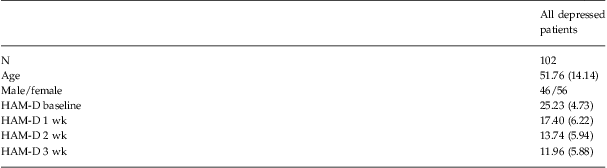
The sample included 142 consecutively enrolled, self-referred, right-handed, outpatients (mean age: 51.75, SD: 14.14, range 23–76), and we enrolled 102. The patients had all been diagnosed with nonpsychotic major depression, according to DSM-IV criteria and confirmed by the Structured Clinical Interview for Diagnosis (SCID).Reference First, Spitzer, Gibbon and Williams18 Inclusion criteria were as follows: (a) Hamilton Rating Scale for Depression (HAM-D)Reference Hamilton19 scores of ≥18, and (b) at least two previous failed antidepressant trials, each lasting at least 6 weeks (stage II of antidepressant resistance according to Thase and RushReference Thase and Rush20) (mean number of courses = 3.58, SD = 1.54). Previous failed trials for antidepressants were required to have used a standard minimum effective dose, for example, 40 mg/day of fluoxetine, paroxetine, or citalopram; 100 mg/day of sertraline; 150 mg/day of clomipramine; or 150 mg/day of venlafaxine, based on the Antidepressant Treatment History Form. Exclusion criteria were as follows: (a) actual risk of suicidality or psychiatric condition of such severity that it required psychiatric hospitalization; (b) rTMS contraindications, such as metallic implants, foreign bodies, or history of seizures; (c) substance abuse in the previous 6 months; (d) any major medical disease; and (e) inability or refusal to provide written informed consent. During the trial, all the patients continued their usual medical care and psychotropic medications to which they did not respond. All medications were required to be maintained at a stable dose for at least 4 weeks prior to the beginning of the treatment. Doses were also kept constant during the 3-week treatment period. All patients were on antidepressant medications, and to avoid confounds on motor cortex excitability measures, medications with a known inhibitory effect on brain excitability (except for benzodiazepines) were not allowed. None of the patients received psychotherapy during the study. A local ethics committee approved the study in accordance with the Helsinki Declaration of 1975. After a complete description of the study to the subjects, written informed consent was obtained.
rTMS treatment and clinical assessment
rTMS sessions were conducted in a laboratory staffed by physician personnel certified in basic life support and trained in the prompt recognition and treatment of seizures and other medical emergencies. Emergency equipment such as oxygen, IV access tools, and emergency medication was available. Repetitive TMS was administered using a MAGSTIM rapid magnetic stimulator (Magstim Company, Ltd., Whitland, UK). We used two 70-mm figure-eight-shaped coils. The coils were alternated in order to allow cooling during treatment sessions without interruption. Patients sat in a reclining chair with a headrest for stabilization of the head and wore protective earplugs. Resting motor threshold (RMT) was defined as the intensity required to elicit at least five Motor Evoked Potentials (MEPs) of 50 μV in peak-to-peak amplitude with 10 consecutive stimulations when the coil was placed over the optimal position to activate the abductor pollicis brevis muscle in both hands based on the electromyographic recording.Reference Rossini, Berardelli and Deuschl21 During the treatment, three 140-second trains were applied at 1 Hz and at 110% of RMT over the right DLPFC with a 30 s intertrain interval (a total of 420 stimuli per session)—parameters that are now widely considered to be safe.Reference Rossi, Hallett, Rossini and Pascual-Leone22 A full course comprised 15 daily sessions administered on weekdays, beginning on Monday. At all times, the coil was held tangentially to the scalp, with the handle pointing back and away from the midline at 45°. The site of stimulation in the right DLPFC was located 5 cm anterior to the stimulation site for the contralateral abductor pollicis brevis in the parasagittal plane.
At baseline, at the end of the second week, and at the end of the third week of treatment, the Hamilton Depression Rating Scale (HAM-D) and the Hamilton Anxiety Rating Scale (HAM-A) were administered.
Statistical Analyses
Mean values, standard deviations, and ranges were calculated for all parametric variables. Inter-rater reliability was ascertained through a series of live independent ratings by the authors (S.P., L.Q., and C.C.) and yielded intraclass correlations of 0.83 for HAMD and 0.87 for HAMA (Cronbach α). Analysis of variance (ANOVA) for testing repeated measures and Pearson's-ρ correlation coefficient were performed where appropriate to assess the significance of differences between groups, with alpha set at p < 0.05, two tailed. Data were analyzed using a SPSS-PC package, running on a Pentium-II PC.
Results
We screened 142 patients and enrolled 102 of them, excluding the ones who did not fulfill the inclusion criteria. Eighty-three (81.4%) of the 102 enrolled subjects completed the 3-week period of treatment with rTMS. Dropout cases were due to increased anxiety (n = 4), insomnia (n = 5), induced mood elevation (n = 1), increasing discomfort from the stimulation of the scalp (n = 5), and the need for hospitalization during the protocol period (n = 4). Intent-to-treat analysis was employed considering the last carried observations of the drop-out cases. No patient had a Mini Mental State Evaluation (MMSE) score lower than 26 before the onset of the current depressive episode.
Low-frequency rTMS on the prefrontal dorsolateral right area resulted in a statistically significant reduction of mean HAM-D scores in the entire group of patients at the end of treatment (3rd week) with a mean HAMD reduction of –13.27 (SD: 7.03), which corresponds to a mean % HAM-D variation of −51.56% (SD: 23.63) (ANOVA × repeat. meas.: F = 363.19, df = 1.101, p < .001). The responder's rate in the whole group at the end of the third week was 56.86% (n = 58).
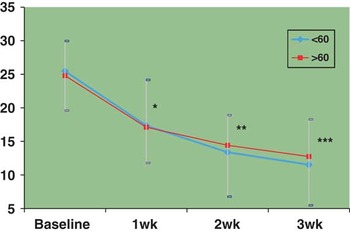
Both the group <60 years old (n = 66) and >60 years old (n = 36) showed significant HAM-D mean reduction at the end of treatment, with a mean HAM-D reduction respectively of −13.93; SD: 6.72 (mean % HAM-D variation: −54.34%; SD: 22.64; ANOVA × repeat. meas.: F: 283.55, gl: 1.65, p < .001), and of −12.06; SD: 7.51 (mean % HAM-D variation: −46.68%; SD 24.92; ANOVA × repeat. meas.: F: 92.67, gl: 1.35, p < .001). The responder's rates in the <60 subgroup and in the >60 subgroup at the end of the treatment were respectively 62.12% (n = 41) and 47.22% (n = 17). A significant reduction of HAM-D mean score was observed from the first week of treatment in both groups (<60 years old: −8.12, SD: 5.89, F: 125.58, df: 1.65, p < .001; >60 years old: −7.31, SD: 6.98, F: 39.47, df: 1.35, p < .001), see Table 2 and Figure 2.
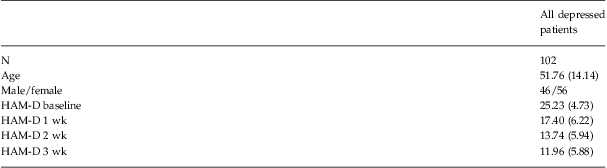
Table 1 and Figure 1 resume the HAM-D variation along the treatment period. Figure 1 shows the HAM-D variations along the treatment period. Both the subgroups (<60/>60 years old) showed a significant reduction of HAM-D score (p < .001) at the end of the 1st week of treatment, and this trend of variation toward score reduction continues at the 2nd and 3rd weeks, always statistically significant compared to the previous week's mean score.
Demographic data and HAMD scores along the rTMS treatment period in the whole group of depressed subjects (n = 102) and in the age-related subgroups
With respect to baseline, ANOVA × repeated measures
a: F: 125.6, gl: 1.65, p < .001.
b: F: 198.6, gl: 1.65, p < .001.
c: F: 283.5, gl: 1.65, p < .001.
d: F: 39.5, gl: 1.35, p < .001.
e: F: 73.8, gl: 1.35, p < .001.
f: F: 92.7, gl: 1.35; p < .001.
rTMS treatment in subjects with depression. Response in < 60 years old (n = 66) and > 60 years old (n = 36) subgroups along the 3-week treatment period. ANOVA × repeated measures compared to previous week: * p < .001 for both groups; ** p < .001 for the < 60 years old group, p < .01 for the > 60 years old group; *** p < .01 for the < 60 years old group, p < .05 for the > 60 years old group.

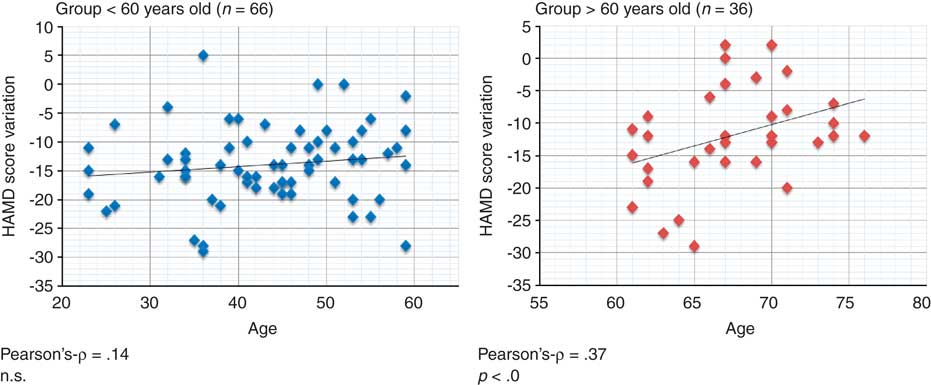
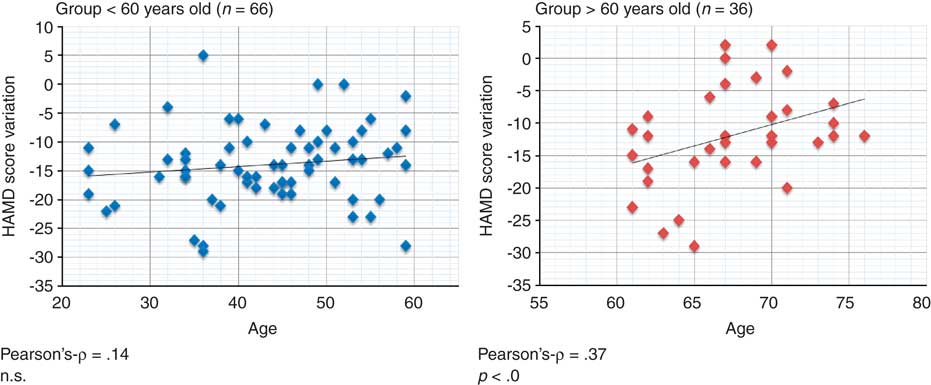
In the whole group of depressed subjects (n = 102), an inverse relationship was found between the reduction of HAM-D score and the age at the end of the rTMS treatment (Pearson's-ρ = −.21, valid cases, 102; p < .04.). Taking into account the two subgroups previously considered, a significant inverse relationship between HAM-D reduction and age was found in the “older” (>60 years old) group (Pearson's-ρ = −.37, valid cases: 36, p < .03), not in the “younger” (<60 years old) group (Pearson's-ρ = .14, valid cases: 66, not significant).
Responders (HAM-D reduction >50%) in the whole group and among the <60 years old and > 60 years old subgroups of depressed patients

Pearson correlation analysis at the end of rTMS treatment in the two subgroups of depressed subjects, based on age (< 60/> 60 years old). Age and response inversely correlate in older subjects.
Discussion
The aim of our study was to retest the effectiveness and safety of low-frequency rTMS in a 3 weeks active treatment in a group of resistant-depressed patients and to investigate the role of age in the response to stimulation treatment.
Results from this study show that low-frequency rTMS over the right DLPFC, with a relatively low number of pulses (420 pulses per session) and a relatively short period of treatment, is effective in the treatment of resistant patients in a 3-weeks treatment protocol. In our sample, we observed a significant reduction of mean HAM-D scores in the entire group of patients at the end of treatment and a 56.86% rate of responders. Furthermore, rTMS was well tolerated, and there were no serious adverse events reported by the patients during the study.
Investigating the effects of age on stimulation response, we found that the responder's rate in the “younger” (<60 years old) subgroup was greater (62.12%) than in the “older” (>60 years old) subgroup (47.22%). Both of the observed groups showed significant HAM-D mean reduction. However, only in the “older” subgroup was a significant inverse relationship between HAM-D reduction and age found. These results partially confirm our initial hypothesis of a greater response in younger patients and an inverse correlation between age and treatment response.
These results are in agreement with several previously published studies of high-frequency stimulationReference Kozel, Nahas and deBrux23, Reference Fregni, Marcolin and Myczkowski24 and with a previous study of low-frequency stimulation.Reference Aguirre, Carretero and Ibarra17 Even if our study was not sham-controlled, when compared to the latter study our work showed positive results with a smaller number of pulses per session (420 vs. 1200), a shorter period of treatment (3 weeks vs. 4 weeks), a larger patient sample (102 vs. 34), and stricter inclusion criteria. Indeed, we enrolled a sample of very resistant patients, e.g., we included only patients who failed at least two previous antidepressant trials.
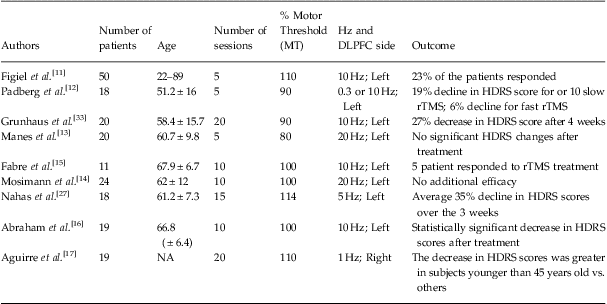
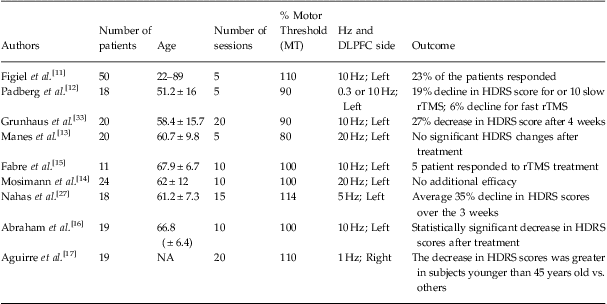
However, the correlation between age and response is still a controversial issue and there is no strong evidence to date. In fact, several studies failed to find any correlation between age and rTMS response.Reference Mosimann, Schmitt and Greenberg14, Reference Herwig, Fallgatter and Höppner25, Reference Lisanby, Husain and Rosenquist26 A possible explanation for this heterogeneity is that the previously mentioned studies highly differ in terms of stimulation intensity and frequency, duration of treatment, and inclusion/exclusion criteria. A summary of the key characteristics of previously published studies is reported in Table 3.
Previous reports of rTMS efficacy on depression in elderly patients
The correlation between age and TMS response that we and other authors found might be explained by three main hypotheses: (a) issues concerning stimulation parameters (more problematic reachability of the selected neural population by the magnetic field due to putative higher levels of prefrontal cortical atrophy in older patients), (b) differences in rTMS effects on neuroplasticity in older vs. younger depressed patients, and (c) a combination of the both.
With regard to the first hypothesis, Kozel et al. found that individuals older than 55 years with a prefrontal skull–cortex distance greater than 17 mm (a measure of cortical atrophy) did not respond to therapy, even if they failed to find a direct relationship between antidepressant response and prefrontal distance.Reference Kozel, Nahas and deBrux23 In a successive pilot study, the same group adjusted the intensity of stimulation to account for MRI-measured prefrontal atrophy, with good results in terms of safety and response rate.Reference Nahas, Li and Kozel27 However, as Wagner et al. state in a computer-based brain model study,Reference Wagner, Eden and Fregni28 oversimplifications based on skull–cortex distance alone to adjust the stimulation intensity should not be pursued in a clinical setting because many other factors, such as alteration in magnitude, orientation, and location of current density distribution are present under a condition of atrophy and may have important roles in the modulation of the response of the stimulated neural elements, and could therefore affect the safety and usefulness of the procedure.
With regard to the second hypothesis, many studies to date have shown that neuroplasticity has a key role in the treatment of major depression. Recently, a large meta-analysis showed that brain-derived neurotrophic factor levels (BDNF), an index of neuroplasticity, are lower in depressed patients than in healthy controls and that they significantly increased after antidepressant treatments.Reference Brunoni, Lopes and Fregni29 At the same time, Zanardini et al. found a significant increase of serum BDNF after rTMS treatment of depressed patients, suggesting that neuroplasticity has a key role in the treatment effects of rTMS.Reference Zanardini, Gazzoli and Ventriglia30 However, the rate at which new neurons are generated dramatically declines as people age.Reference Shankar31 Thus, a possible explanation for the correlation between age and rTMS response could be the reduced neuroplasticity of older patients. In order to avoid possible bias in this hypothesis, we excluded patients undergoing stable corticosteroid treatment that could affect neuroplasticity, as demonstrated by several studies.Reference Numakawa, Yokomaku, Richards, Hori, Adachi and Kunugi32
The main limitation of the present study is the lack of a sham comparison group. Another weak point that should be considered when interpreting the presented results is that no complex neuronavigational systems were used when locating the stimulation areas, resulting in possible non-efficacious or reduced stimulation. Finally, further research is needed to clarify the best rTMS treatment options and parameters in older depressed patients.
Disclosures
Prof. Pallanti has served as speaker for Abbott and Pfizer Inc., and as a consultant for Transcept Pharmaceuticals. The other authors do not have an affiliation with or financial interest in any organization that might pose a conflict of interest.
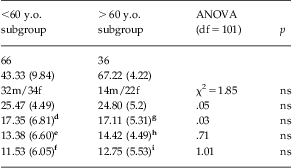
Respect to previous week, ANOVA × repeated measures
a: F: 159.1; gl: 1,101; p < .001
b: F: 35.3; gl: 1,101; p < .001
c: F: 16.6; gl: 1,101; p < .001
d: F: 125.6; gl: 1,65; p < .001
e: F: 27.1; gl: 1,65; p < .001
f: F: 12.6; gl: 1,65; p < .01
g: F: 39.5; gl: 1,35; p < .001
h: F: 8.6; gl: 1,35; p < .01
i: F: 4.3; gl: 1,35; p < .05