





Introduction
The growing number of older adults with cancer has essential implications for oncology services and posttreatment follow-up care (Alfano et al. Reference Alfano, Leach and Smith2019). Cancer affects not only the person diagnosed but also their family. The shift from inpatient to outpatient care, along with shorter hospital stays, has transferred more caregiving responsibilities to the home. In the United States, the National Caregivers Alliance reported that 63 million people cared for an adult in the previous year; in 7% of these cases, cancer was the primary diagnosis (AARP and National Alliance for Caregiving 2025). In Mexico, an estimated 58.3 million people require home-based care, including individuals with disabilities or dependency needs. Among them, 64.5% receive care from a household member or from someone outside the household. While national estimates of caregiver burden are lacking, approximately 32 million Mexicans provide unpaid care to members of their own households or to individuals in other households. Of these caregivers, 75.1% were women, who devoted an average of 37.9 hours per week to caregiving (Instituto Nacional de Estadística y Geografía 2022). Among Mexican caregivers of patients with advanced or terminal cancer, institution-based studies using the Zarit Burden Interview have reported caregiver burden in 20%–34% of participants (Chavarri Guerra et al. Reference Chavarri Guerra, Ramos-lopez and Sánchez-román2022; Soriano Ursúa et al. Reference Soriano Ursúa, Castrejón Salgado and Ávila Jiménez2022). A caregiver is an individual who assumes responsibility for assisting a person who is unable to perform basic activities of daily living independently, thereby becoming a central figure in the patient’s care. Caregivers generally do not receive remuneration for their work and are most often family members, partners, or close friends (Alfano et al. Reference Alfano, Leach and Smith2019; Adashek and Subbiah Reference Adashek and Subbiah2020). The caregiver’s role is usually characterized by the tendency to place their own needs second. With little or no formal training, caregivers are expected to perform a wide range of tasks, including medical care (e.g., management of symptoms and side effects such as cancer pain and nausea, medication administration), personal care (assisting with activities of daily living such as bathing and eating), household tasks (e.g., meal preparation), emotional support (helping to manage fear and anxiety), and social accompaniment (e.g., accompanying the patient to treatment appointments or social outings). When these responsibilities become overwhelming, caregivers become overburdened (Adashek and Subbiah Reference Adashek and Subbiah2020).
Caregiver burden is a state of emotional exhaustion, stress, and fatigue in which the adverse effects of caregiving manifest across multiple areas of life (MAPI Research Trust 2025). Several factors may contribute to caregiver burden, including providing care for more than 12 hours a day (Mirshahi et al. Reference Mirshahi, Farsi and Sajadi2025) and assisting the patient with advanced activities of daily living, such as going to the bathroom, moving around, or feeding themselves (Alsirafy et al. Reference Alsirafy, Nagy and Hassan2021; El-Sherif et al. Reference El-Sherif, Shaban and Abbas2024). A positive correlation has been reported between emotional distress and caregiver burden (Galindo‐Vazquez et al. Reference Galindo‐Vazquez, Benjet and Cruz‐nieto2015; Montero Pardo et al. Reference Montero Pardo, Jurado Cárdenas and Méndez Venegas2015; El-Sherif et al. Reference El-Sherif, Shaban and Abbas2024), whereas family and social support have been negatively correlated with caregiver burden (Montero Pardo et al. Reference Montero Pardo, Jurado Cárdenas and Méndez Venegas2015). Specific patient characteristics have also been associated with increased caregiver burden, including a recent diagnosis, advanced disease stage, patient age, and a duration of more than 5 years since diagnosis (Shefeek et al. Reference Shefeek, Joy and Olickal2024; Mirshahi et al. Reference Mirshahi, Farsi and Sajadi2025). At the same time, evidence on the association between sociodemographic characteristics and caregiver burden among cancer patients is mixed. Overall, caregivers’ age and sex do not appear to have a significant effect (Montero Pardo et al. Reference Montero Pardo, Jurado Cárdenas and Méndez Venegas2015; Alsirafy et al. Reference Alsirafy, Nagy and Hassan2021; Schwartz et al. Reference Schwartz, Beebe-dimmer and Hastert2021; Soriano Ursúa et al. Reference Soriano Ursúa, Castrejón Salgado and Ávila Jiménez2022; Shefeek et al. Reference Shefeek, Joy and Olickal2024; Mirshahi et al. Reference Mirshahi, Farsi and Sajadi2025). Although some authors, such as Gjerset et al. (Reference Gjerset, Kiserud and Wisløff2023), reported a marginal association between female sex and health-related caregiver burden (p = 0.05), no associations were observed in the financial, esteem, or lack-of-support domains. The influence of marital status remains controversial, with studies reporting a positive effect (Schwartz et al. Reference Schwartz, Beebe-dimmer and Hastert2021), a negative impact (Chindaprasirt et al. Reference Chindaprasirt, Limpawattana and Pakkaratho2014), or no effect (Alsirafy et al. Reference Alsirafy, Nagy and Hassan2021; Shefeek et al. Reference Shefeek, Joy and Olickal2024; Mirshahi et al. Reference Mirshahi, Farsi and Sajadi2025). The association between education and caregiver burden is also inconsistent across studies – some report a positive (Schwartz et al. Reference Schwartz, Beebe-dimmer and Hastert2021), a negative (Soriano Ursúa et al. Reference Soriano Ursúa, Castrejón Salgado and Ávila Jiménez2022), or no association (Chindaprasirt et al. Reference Chindaprasirt, Limpawattana and Pakkaratho2014; Alsirafy et al. Reference Alsirafy, Nagy and Hassan2021; Shefeek et al. Reference Shefeek, Joy and Olickal2024; Mirshahi et al. Reference Mirshahi, Farsi and Sajadi2025). Similarly, findings regarding the caregiver–patient relationship are conflicting. Caregivers who are siblings (Chindaprasirt et al. Reference Chindaprasirt, Limpawattana and Pakkaratho2014), spouses (Kim et al. Reference Kim, Kim and Kim2016), or second- and third-degree relatives (Soriano Ursúa et al. Reference Soriano Ursúa, Castrejón Salgado and Ávila Jiménez2022) report greater burden; other studies found no significant association (Alsirafy et al. Reference Alsirafy, Nagy and Hassan2021; Schwartz et al. Reference Schwartz, Beebe-dimmer and Hastert2021; Mirshahi et al. Reference Mirshahi, Farsi and Sajadi2025). Burden affects physical and psychological health as well as interpersonal relationships (Onyeneho and Ilesanmi Reference Onyeneho and Ilesanmi2021; Shefeek et al. Reference Shefeek, Joy and Olickal2024), and caregivers are at increased risk of depression, anxiety, and social isolation (Alfano et al. Reference Alfano, Leach and Smith2019). Furthermore, burden is one of the main determinants of quality of life (Alnajar et al. Reference Alnajar, Mosleh and Almalik2022). Therefore, it is essential to prevent, detect, and correct caregiver burden. Understanding the factors associated with caregiver burden enables nurses, clinicians, and health policymakers to identify high-risk caregivers early, provide psychosocial and educational support, and develop preventive interventions to improve caregivers’ well-being and sustain the quality of patient care.
Family networks and distinct sociocultural factors may shape caregiving experiences. However, empirical research on caregiver burden among cancer caregivers remains limited in Latin America, particularly in Mexico (Montero Pardo et al. Reference Montero Pardo, Jurado Cárdenas and Méndez Venegas2015; Valencia et al. Reference Valencia, Meza-osnaya and Pérez-cruz2017; Soriano Ursúa et al. Reference Soriano Ursúa, Castrejón Salgado and Ávila Jiménez2022). This, together with inconsistent evidence on specific characteristics associated with caregiver burden, highlighted the need for the present study. We aimed to estimate the magnitude of caregiver burden and identify related factors among informal caregivers of cancer patients in northeast Mexico. In this region, cultural norms, gender roles, and family functioning may shape the caregiving experience differently from those in other countries.
Methods
This cross-sectional study was conducted at a single University Cancer Center from 2017 to 2020. The study population consisted of informal caregivers of cancer patients who were consecutively invited to participate during outpatient consultations in medical oncology, surgical oncology, and radiotherapy at the University Cancer Center. Participants were eligible if they were adults (≥18 years) who self-identified as the primary caregiver, defined as the person who provides most of the patient’s unpaid daily assistance (e.g., personal care, mobility assistance, and/or medication management) for at least 2 months. Those who reported being on anxiolytic or antidepressant treatment were excluded. All patients had cancer confirmed by histopathology with 3 modalities of cancer treatment: surgery, chemotherapy, and radiotherapy. The a priori sample size was 267, based on a 50% prevalence of the burden, with a precision of 6% and a 95% confidence level (Junta de Galicia y Organización Panamericana de la Salud 2006). However, there were 277 participants. Additionally, the sample size exceeded the minimum required according to the rule of 10 events per predictor for multivariate logistic regression models, considering burden as the event of interest with 10 predictors (k) and a hypothetical prevalence of 50% (p) (n = EPV × k)/p (n = 200) (Peduzzi et al. Reference Peduzzi, Concato and Kemper1996).
Study variables
Caregiver burden. This was assessed using the Zarit Burden Interview (ZBI-22), which evaluates physical, emotional, financial, and interpersonal concerns. It has been translated into several languages (MAPI Research Trust 2025). The Spanish version has been validated in cancer patients, showing the following 3 subscales (Galindo‐Vazquez et al. Reference Galindo‐Vazquez, Benjet and Cruz‐nieto2015): (a) Impact, for example, feeling overwhelmed by trying to combine caregiving with other responsibilities such as work or family (14 items, Cronbach’s α = 0.825). (b) Interpersonal relationships, for example, thinking that caring for this person negatively affects relationships with other family members (6 items, Cronbach’s α = 0.617). (c) Self-efficacy expectations, for example, thinking that they could take better care of the person in their charge (2 items, Cronbach’s α = 0.775). Each item is answered on a 5-point Likert scale ranging from 0 (never) to 4 (nearly always). The total score is the sum of the scores and varies from 0 to 88. Higher scores indicate a greater burden. Interpretation of the score: 0–20: minimal or no burden, 21–40: mild burden, 41–60: moderate burden, 61–88: severe burden (MAPI Research Trust 2025).
Emotional distress. The 28-item General Health Questionnaire (GHQ-28) was used to identify individuals at risk of emotional disorders by detecting disruptions in normal functioning due to difficulties performing usual activities (Goldberg and Hillier Reference Goldberg and Hillier1979). The questionnaire has been translated into several languages, including Spanish (Molina et al. Reference Molina, Andrade-rosa and González-parra2006). It comprises 4 subscales with 7 items each: (a) Somatic symptoms (Cronbach’s α = 0.790), (b) anxiety (Cronbach’s α = 0.814), (c) social dysfunction (Cronbach’s α = 0.616), and (d) depression (Cronbach’s α = 0.793). Each item is rated on a 4-point Likert scale from 0 (not at all) to 3 (much more than usual). Each subscale score ranges from 0 to 21. The total score, obtained by summing the subscales, ranges from 0 to 84, with higher scores indicating greater burden.
Effectiveness of family functioning. The Friedemann Family Functioning Effectiveness Scale was used. The Spanish version has been validated, with 17 items (EEFF-17) (Chavez Aguilera et al. Reference Chavez Aguilera, Friedemann and Alcorta Garza2000). For example, in the family, we enjoy talking and accepting opinions that are sometimes wrong (Cronbach’s α = 0.749). Each item is answered on a 3-point Likert scale: 1 (no), 2 (rarely), and 3 (yes). The total score is the sum of the scores and ranges from 17 to 51, with higher scores indicating greater family functioning.
Other variables: Information on the caregiver’s place of residence, sex, age, marital status, education, occupation, and relationship to the care recipient was collected using a self-administered questionnaire. Data on the patient’s age, comorbidities (e.g., diabetes, hypertension, and/or dyslipidemia), primary cancer site, stage, and performance status were obtained from the medical record. The Eastern Cooperative Oncology Group (ECOG) performance status was used to categorize physical functioning and ability to carry out self-care or work activities as follows: 0 = fully active, no restrictions; 1 = restricted in physically strenuous activity but able to perform light or sedentary work (e.g., office work, household chores); 2 = capable of self-care but unable to perform work activities, spending more than 50% of waking hours out of bed; 3 = limited self-care, confined to bed or chair more than 50% of waking hours; and 4 = completely disabled, unable to carry out any self-care, confined to bed or chair.
Statistical analysis
Descriptive statistics were computed using means and standard deviations for continuous variables and frequency distributions for categorical variables. Multiple binary logistic regression was applied to identify factors associated with caregiver burden: the dependent variable was coded as yes/no, where “yes” indicated a ZBI-22 score ≥21, corresponding to mild, moderate, or severe caregiver burden (MAPI Research Trust 2025). Caregiver and patient characteristics were analyzed separately. In the caregiver model, independent variables included sociodemographic characteristics, dimensions of emotional distress, and family functioning effectiveness. Prior to model fitting, correlations among the subscales were examined to assess potential multicollinearity. The highest correlation was observed between anxiety and somatic symptoms (r = 0.67, p < 0.001). However, collinearity diagnostics indicated no multicollinearity among somatic symptoms, anxiety, social dysfunction, and depression (all Variance Inflation Factors [VIFs] <2). Therefore, these variables were retained in the multivariable model to evaluate their independent associations with caregiver burden. In the patient model, sex and clinical characteristics (comorbidity, stage, and ECOG performance status) were included as independent variables. Stage and ECOG performance status were not included simultaneously because they capture related aspects of disease severity and patient functioning. Odds ratio (OR) and 95% confidence interval (95% CI) were calculated.
Results
The mean age of caregivers was 45.3 ± 14.4 years; most were female, single, and homemakers. Among patients aged <18 years, the mother was the predominant caregiver, whereas among those aged ≥18 years, the spouse was the predominant caregiver (Table 1). The mean age of patients was 44.5 ± 20.9 years; 14.5% were under 18 years, and most were female. Among women, gynecological cancers were the most common, whereas among men, genitourinary cancers predominated (Table 2).
Caregivers’ sociodemographic profile (N = 277)

Table 1 Long description
Counts and percentages are reported for caregiver characteristics, including sex, marital status, education, occupation, and relationship with the patient by patient age group. Education includes elementary 71, 26.4 percent; middle school 78, 29.0 percent; high school 76, 28.3 percent; and bachelors or postgraduate degree 44, 16.4 percent. Occupation includes homemaker 158, 58.1 percent; student 10, 3.7 percent; employee 80, 29.4 percent; and unemployed or retired 24, 8.8 percent. For relationship with patient under 18 years, categories are mother 20, 66.7 percent; father 5, 16.7 percent; grandmother 1, 3.3 percent; sister 1, 3.3 percent; and other 3, 10.0 percent. For relationship with patient greater than or equal to 18 years, categories are spouse 54, 31.0 percent; daughter or son 39, 22.4 percent; mother or father 38, 21.8 percent; sister 22, 12.6 percent; grandfather or grandmother 3, 1.7 percent; and other 18, 10.4 percent.
Patients’ sociodemographic and clinical profile (N = 277)

Table 2 Long description
Characteristics are reported with columns for n and Percentage. Women had primary cancers listed as gynecological 67 at 37.9 percent, breast 54 at 30.5 percent, digestive system 22 at 12.4 percent, genitourinary 6 at 3.4 percent, and other 28 at 15.8 percent. Men had primary cancers listed as genitourinary 33 at 33.0 percent, digestive system 23 at 23.0 percent, breast 1 at 1.0 percent, and other 43 at 43.0 percent. Stage was I 21 at 7.6 percent, II 36 at 13.0 percent, III 57 at 20.6 percent, IV 90 at 32.5 percent, and no data 73 at 26.4 percent. ECOG was 0 129 at 46.6 percent, 1 53 at 19.1 percent, 2 21 at 7.6 percent, 3 4 at 1.4 percent, and unclassified 70 at 25.3 percent. Diabetes marked with footnote a was 33 at 11.9 percent, hypertension marked with footnote a was 42 at 15.2 percent, and dyslipidemia marked with footnote a was 7 at 2.5 percent.
a The percentages for diabetes, hypertension, and dyslipidemia are not mutually exclusive; therefore, they are not expected to sum to 100%.
Caregiver burden
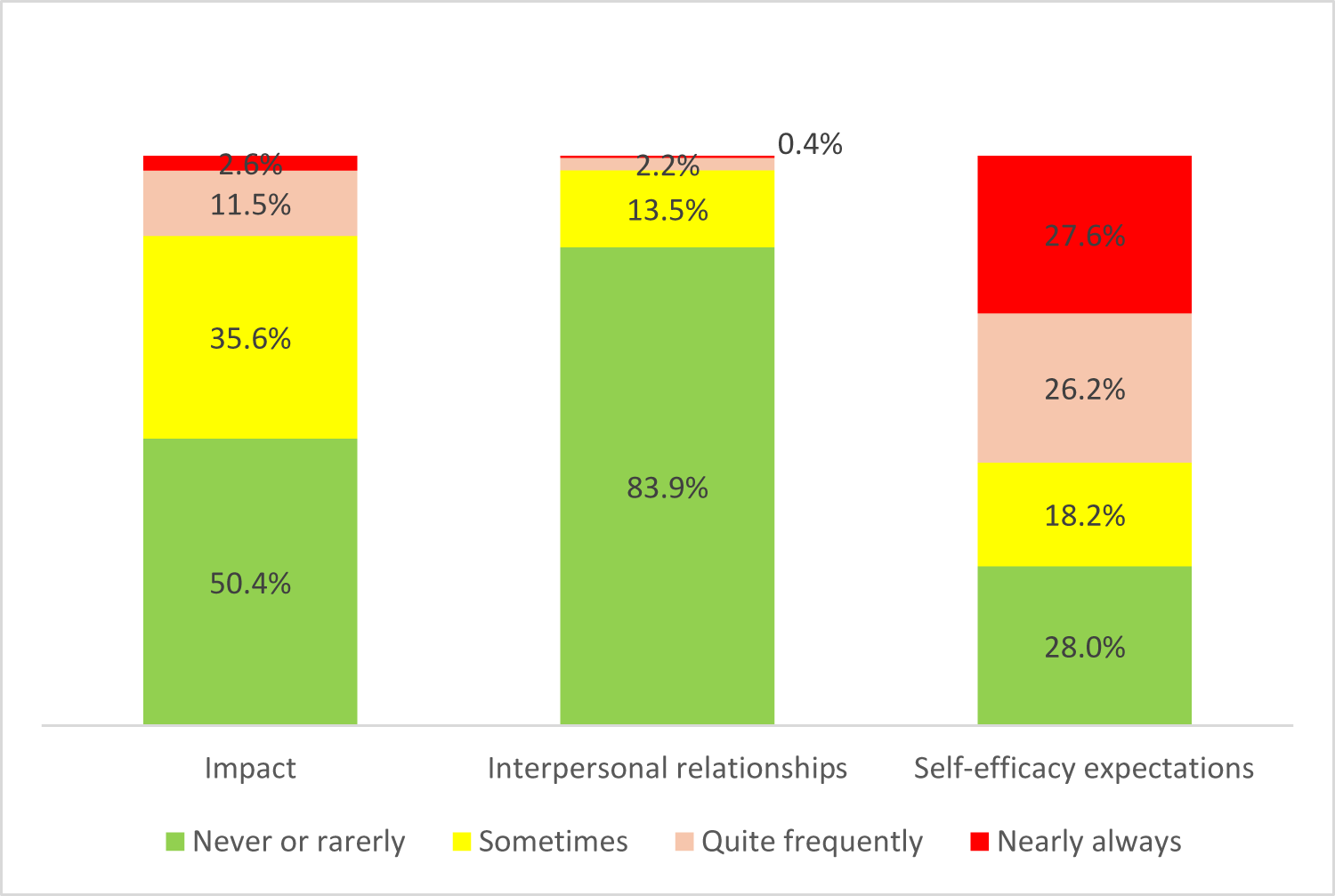
The mean overall score was 21.8 ± 12.9 (median = 20); 52% of caregivers reported minimal or no burden, 39% mild, 8.6% moderate, and 0.4% severe. Analysis by dimensions indicated that the most affected domain was self-efficacy expectations; nearly one-third of caregivers reported consistently thinking about what they should do more or how they could provide better care for the patient (Figure 1). The item with the highest frequency of responses “sometimes,” “quite frequently,” or “nearly always” concerned the perception of economic impact: 69.5% of caregivers thought their income was insufficient to cover both caregiving and other expenses. In contrast, the item with the fewest caregivers selecting these responses concerned interpersonal relationships; less than 10% reported feeling angry when around the person they cared for (Table A1).
Percentage distribution of Zarit-22 dimensions.

Emotional distress
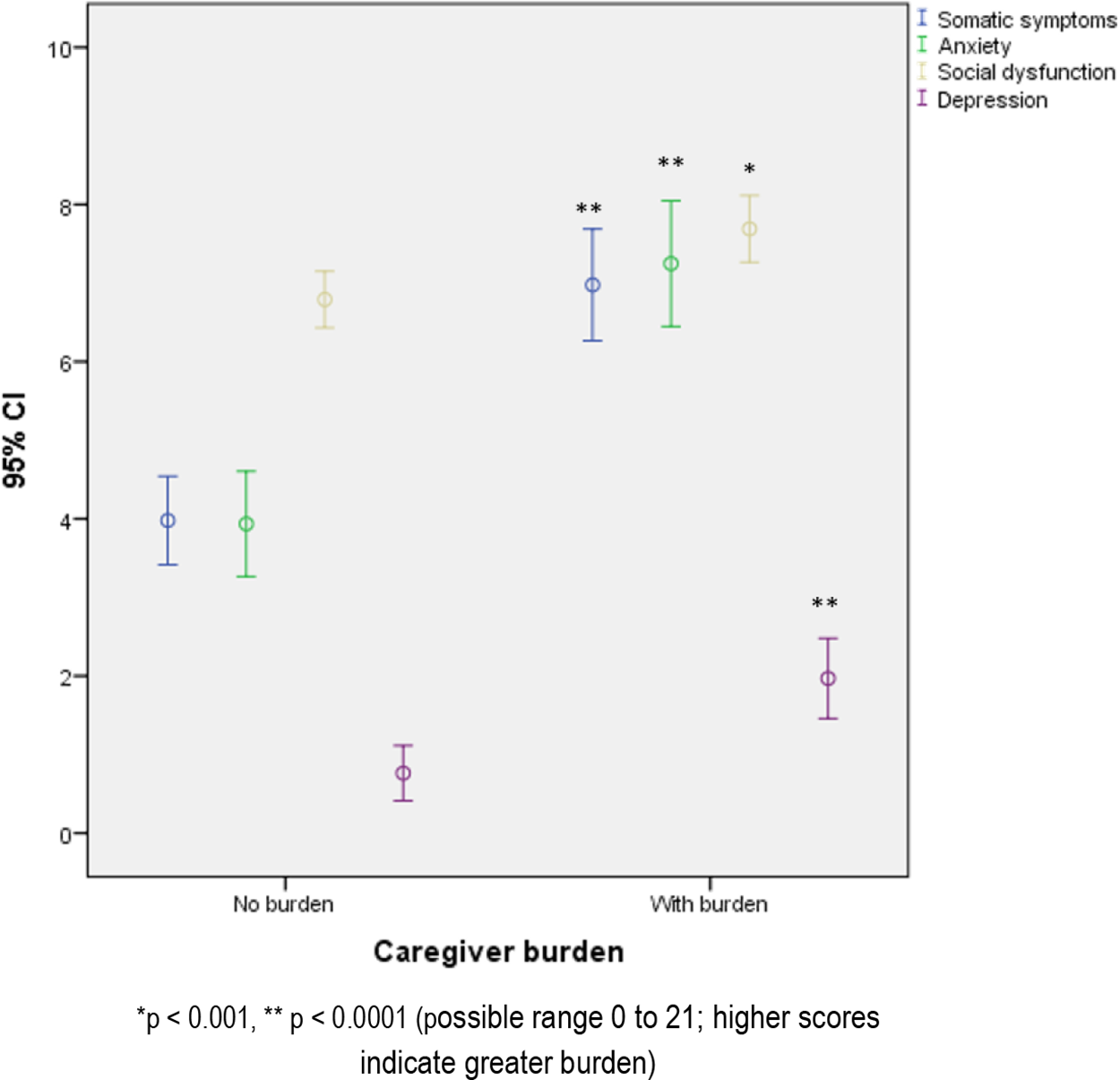
The mean emotional distress score was 19.4 ± 10.4 (median = 17) and was higher among caregivers with burden (23.9 ± 10.5 vs. 15.4 ± 8.7, p < 0.001). The most affected domain was social dysfunction (mean = 7.3, 95% CI: 7.0–7.5), followed by anxiety (mean = 5.5, 95% CI: 4.9–6.0), somatic symptoms (mean = 5.4, 95% CI: 4.9–5.8), and depression (mean = 1.3, 95% CI: 1.0–1.6). Mean scores for all domains were higher among caregivers who reported burden. Somatic symptoms: 4.0 ± 3.4 vs. 7.0 ± 4.1, p < 0.0001; anxiety: 3.9 ± 4.0 vs. 7.2 ± 4.6, p < 0.0001; social dysfunction: 6.8 ± 2.1 vs. 7.7 ± 2.4, p < 0.001; and depression: 0.8 ± 2.1 vs. 2.0 ± 2.9, p < 0.0001 (Figure 2).
Comparison of emotional distress dimensions by caregiver burden.

Effectiveness of family functioning
The mean effective family functioning score was 44.2 ± 4.5 (median = 45). Caregivers who were burdened had significantly lower scores than those without burden (42.8 ± 5.1 vs. 45.5 ± 3.6, respectively; p < 0.0001).
Factors associated with burden, caregiver characteristics
Somatic symptoms, anxiety, social dysfunction, and depression were significantly associated with caregiver burden in bivariate analyses, and these associations remained largely unchanged after adjustment for sociodemographic characteristics. However, when the GHQ-28 dimensions were included simultaneously in the multivariable model, the associations for anxiety, social dysfunction, and depression were no longer statistically significant, whereas somatic symptoms remained independently associated with caregiver burden. Somatic symptoms were positively associated with caregiver burden, with each 1-point increase in the somatic symptoms score associated with a 13% increase in the odds of burden (OR = 1.13; 95% CI: 1.02–1.27). In contrast, greater family functioning was associated with lower odds of caregiver burden (OR = 0.89; 95% CI: 0.82–0.96; p = 0.003). No sociodemographic characteristics were significantly associated with caregiver burden (Table 3).
Factors associated with burden, caregiver characteristics

Table 3 Long description
Caregiver characteristics are compared between burden groups, Yes with n 129 and No with n 140, alongside odds ratio and 95% confidence interval. Age averaged 44.2 plus or minus 13.3 for Yes and 46.0 plus or minus 15.1 for No, with odds ratio 0.98 and 95% confidence interval 0.96 to 1.01. Male sex was 19.4% for Yes and 21.4% for No, odds ratio 0.77, 95% confidence interval 0.27 to 2.15; no partner was 76.8% for Yes and 73.7% for No, odds ratio 1.16, 95% confidence interval 0.48 to 2.81. Education categories list Elementary 29.6% Yes and 22.8% No, odds ratio 1.26, 95% confidence interval 0.43 to 3.66; Middle school 27.2% and 32.4%, odds ratio 0.82, 95% confidence interval 0.3 to 2.24; High school 28.0% and 27.9%, odds ratio 0.88, 95% confidence interval 0.33 to 2.38; Bachelors or postgraduate degree 15.2% and 16.9%, marked as the reference. Occupation lists Student unemployed retired 12.8% Yes and 12.2% No, odds ratio 1.44, 95% confidence interval 0.5 to 4.12; Homemaker 62.4% and 56.1%, odds ratio 1.63, 95% confidence interval 0.64 to 4.13; Employee 24.8% and 31.7%, marked as the reference. Relationship with the patient lists Mother father 27.4% Yes and 32.8% No, odds ratio 0.86, 95% confidence interval 0.36 to 2.06; Daughter son 26.5% and 17.6%, odds ratio 1.89, 95% confidence interval 0.72 to 4.97; Spouse 29.9% and 22.9%, odds ratio 1.8, 95% confidence interval 0.69 to 4.65; Other 16.2% and 26.7%, marked as the reference. Mean scores were higher in the Yes group for Somatic symptoms at 7.0 plus or minus 4.1 versus 4.0 plus or minus 3.4, odds ratio 1.13, 95% confidence interval 1.02 to 1.27; Anxiety at 7.2 plus or minus 4.6 versus 3.9 plus or minus 4.0, odds ratio 1.06, 95% confidence interval 0.97 to 1.15; Social dysfunction at 7.7 plus or minus 2.4 versus 6.8 plus or minus 2.1, odds ratio 1.09, 95% confidence interval 0.93 to 1.27; and Depression at 2.0 plus or minus 2.9 versus 0.8 plus or minus 2.1, odds ratio 1.01, 95% confidence interval 0.87 to 1.17. Effective family functionality averaged 42.8 plus or minus 5.1 for Yes and 45.5 plus or minus 3.6 for No, with odds ratio 0.89 and 95% confidence interval 0.82 to 0.96.
* p < 0.05, ** p < 0.01, *** p < 0.001.
Factors associated with burden, patient characteristics
Stage IV cancer was associated with a 3-fold increase in the likelihood of caregiver burden, independent of age, sex, and comorbidities. In the ECOG multiple logistic regression model, male sex and performance status 1 or 2 were associated with 2- and 3-fold higher odds of caregiver burden, respectively. Diabetes was significant in the bivariate analysis but no longer significant in the multivariate analysis (Table 4).
Factors associated with burden, patient characteristics

Table 4 Long description
Burden status is compared across patient characteristics for two models, one labeled Cancer stage model and one labeled ECOG model, with columns for Yes, No, OR, and 95% CI. In the Cancer stage model, male sex is 42.6% for Yes and 30.7% for No, with OR 1.71 and 95% CI 0.88, 3.31. Cancer stage percentages for Yes versus No are: stage I 7.0% versus 13.3%, stage II 10.0% versus 24.5% with OR 0.77 and 95% CI 0.22, 2.69, stage III 26.0% versus 28.6% with OR 1.85 and 95% CI 0.62, 5.57, and stage IV 57.0% versus 33.7% with OR 3.04 and 95% CI 1.05, 8.78 with an asterisk marker. In the Cancer stage model, diabetes is 15.50% versus 7.90% with OR 2.17 and 95% CI 0.86, 5.47; hypertension is 17.10% versus 14.30% with OR 1.01 and 95% CI 0.44, 2.35; dyslipidemia is 3.90% versus 1.40% with OR 1.43 and 95% CI 0.21, 9.68. In the ECOG model, male sex is 42.6% with an asterisk marker versus 30.7%, with OR 2.04 and 95% CI 1.08, 3.85 with an asterisk marker. ECOG percentages for Yes versus No are: ECOG 0, fully active, 51.5% versus 75.2%; ECOG 1, light activities and sedentary work, 32.7% with a double asterisk marker versus 16.8% with OR 3.03 and 95% CI 1.50, 6.12 with a double asterisk marker; ECOG 2, capable of self-care but unable to work, 15.8% with a double asterisk marker versus 7.9% with OR 3.00 and 95% CI 1.14, 7.87 with an asterisk marker. In the ECOG model, diabetes is 15.5% with an asterisk marker versus 7.9% with OR 1.90 and 95% CI 0.76, 4.74; hypertension is 17.1% versus 14.3% with OR 0.72 and 95% CI 0.31, 1.65; dyslipidemia is 3.9% versus 1.4% with OR 0.93 and 95% CI 0.14, 6.15.
Age was present in the model with a p-value > 0.05. *p ≤ 0.05, ** p < 0.001.
Discussion
The objective of this study was to measure the burden and explore associated factors among informal caregivers of cancer patients. The mean total burden score was low to moderate (21.8 ± 12.9). This score was higher than that reported in the United States (13.3 ± 11.5) (Schwartz et al. Reference Schwartz, Beebe-dimmer and Hastert2021), which may reflect dissimilarities in access to formal support services and a greater reliance on family rather than institutional care networks. The prevalence of caregiver burden, using the ZBI-22 cutoff of 21, was 48%, lower than figures reported in other countries (59%–82%) (Akpan-Idiok et al. Reference Akpan-Idiok, Ehiemere and Asuquo2020; Alsirafy et al. Reference Alsirafy, Nagy and Hassan2021; Onyeneho and Ilesanmi Reference Onyeneho and Ilesanmi2021) but higher than that documented in the United States (20%) (Schwartz et al. Reference Schwartz, Beebe-dimmer and Hastert2021). These differences highlight the importance of considering sociocultural context and available resources when interpreting caregiver burden. Regarding severity, the prevalence of moderate-to-severe burden (9%) fell within the range documented in the literature, from 6% (Chindaprasirt et al. Reference Chindaprasirt, Limpawattana and Pakkaratho2014) to 19.8% (Onyeneho and Ilesanmi Reference Onyeneho and Ilesanmi2021). The item on economic impact received the highest proportion of affirmative responses: 7 out of 10 caregivers thought that their income was insufficient to cover both caregiving and other expenses. Previous studies have identified financial pressure as a key factor contributing to caregiver burden in cancer care (Kisangala et al. Reference Kisangala, Mbivnjo and Webb2024; Mirshahi et al. Reference Mirshahi, Farsi and Sajadi2025). Dimension-specific analysis showed that the most affected area was self-efficacy expectations: almost one-third of caregivers reported constantly thinking about what they should do or how they could provide better care. Caregiver self-efficacy can significantly modulate perceived burden, acting as a protective factor against anxiety, depression, and emotional distress, which are central components of burden (Phongtankuel et al. Reference Phongtankuel, Moxley and Reid2023). Strengthening self-efficacy through multidisciplinary teams may be a key strategy for reducing caregivers’ burden and improving their emotional well-being.
Factors associated with burden
A secondary objective of the study was to explore factors associated with caregiver burden, with caregiver and patient characteristics analyzed separately. Caregivers were mainly young adult females, unmarried, homemakers with basic, middle, or high school education. None of these characteristics were associated with burden. These findings are consistent with studies that also fail to find significant associations (Chindaprasirt et al. Reference Chindaprasirt, Limpawattana and Pakkaratho2014; Alsirafy et al. Reference Alsirafy, Nagy and Hassan2021; Schwartz et al. Reference Schwartz, Beebe-dimmer and Hastert2021; Soriano Ursúa et al. Reference Soriano Ursúa, Castrejón Salgado and Ávila Jiménez2022; Shefeek et al. Reference Shefeek, Joy and Olickal2024; Mirshahi et al. Reference Mirshahi, Farsi and Sajadi2025), but contrast with Gjerset et al. (Reference Gjerset, Kiserud and Wisløff2023), who identified a marginal association between female sex and health-related caregiver burden. We observed that the caregiver’s relationship with the patient depended on age. Among patients under 18 years, the mother was the primary caregiver (66.7%), followed by the father (16.7%) and other relatives (16.6%), a pattern similar to that reported in another Mexican study (91% mothers, 5% fathers, 4% other relatives) (Montero Pardo et al. Reference Montero Pardo, Jurado Cárdenas and Méndez Venegas2015). Among adult patients (≥18 years), the primary caregiver was most often the spouse (31.0%), followed by children (22.4%) and parents (21.8%). International comparisons show different distributions of caregiver relationships: in the United Kingdom, over 80% are spouses (Harding et al. Reference Harding, Gao and Jackson2015), and in Thailand, the filial role predominates (62%), in accordance with norms of family reciprocity (Chindaprasirt et al. Reference Chindaprasirt, Limpawattana and Pakkaratho2014). These differences likely reflect cultural variations in family reciprocity across Western, European, and Asian contexts. The caregiver-patient relationship was not associated with burden, consistent with previous studies reporting no association (Alsirafy et al. Reference Alsirafy, Nagy and Hassan2021; Schwartz et al. Reference Schwartz, Beebe-dimmer and Hastert2021; Mirshahi et al. Reference Mirshahi, Farsi and Sajadi2025), but differing from La et al. (Reference La, Johantgen and Storr2021), who reported that being a spouse was associated with higher burden during active cancer treatment.
Other variables analyzed in relation to burden were emotional distress and family functioning. The level of distress was low, with a mean score of 19.4 ± 10.4 on a scale from 0 to 84. The most affected dimension was social dysfunction, as most participants reported some difficulty performing or being satisfied with their daily activities, though not at severe levels. This was followed by somatic symptoms and anxiety, with even lower scores, reflecting a low intensity of physical complaints and emotional stress. Depressive symptoms were minimal among the caregivers evaluated. Despite the low average level of somatic symptoms, they were associated with a higher likelihood of caregiver burden; no such association was observed for the other dimensions of emotional distress. Other studies have reported a positive correlation between emotional distress, anxiety, depression, and caregiver burden (Galindo‐Vazquez et al. Reference Galindo‐Vazquez, Benjet and Cruz‐nieto2015; Montero Pardo et al. Reference Montero Pardo, Jurado Cárdenas and Méndez Venegas2015; Karimi Moghaddam et al. Reference Karimi Moghaddam, Rostami and Zeraatchi2023). Informal caregivers require preparation to manage the demands of their new roles, including psychological, spiritual, and social support. Additionally, impaired family flexibility and adaptive functioning limit the family’s ability to respond to needs, including caregiver burden (Mirsoleymani et al. Reference Mirsoleymani, Matbouei and Vasli2021). In this study, the mean family functioning score was 44.2 ± 4.5, indicating high functionality, which was protective against burden (OR < 1). Feeling that one can count on emotional, instrumental, or affective support in situations of need or stress has been negatively correlated with burden (Kaya Akdoğan and İlhan Reference Kaya Akdoğan and İlhan2024). Other studies reveal that as social support increases, the caregiver’s burden decreases (Montero Pardo et al. Reference Montero Pardo, Jurado Cárdenas and Méndez Venegas2015; Karakurt et al. Reference Karakurt, Tuncer and Çiltaş2020; Maximiano‐Barreto et al. Reference Maximiano‐Barreto, Alves and Monteiro2022). Family support, therefore, plays a key role in preventing caregiver burden.
Regarding patient characteristics, late-stage disease predominated, although most patients had an ECOG performance status indicating regular activity or restrictions only during intense exertion. Stage IV disease and functional capacity limitations (stages 1 and 2) were associated with a 3-fold increase in the likelihood of caregiver burden, regardless of age, sex, or comorbidities, consistent with previous reports (Karimi Moghaddam et al. Reference Karimi Moghaddam, Rostami and Zeraatchi2023; Mirshahi et al. Reference Mirshahi, Farsi and Sajadi2025). Male gender was associated with a higher likelihood of caregiver burden, independent of performance status. Evidence on the relationship between patient sex and caregiver burden is mixed: studies in Iran and Greece report greater burden among caregivers of male patients (Govina et al. Reference Govina, Kotronoulas and Mystakidou2015; Mirsoleymani et al. Reference Mirsoleymani, Rohani and Matbouei2017), whereas research in Ethiopia shows higher burden among caregivers of female patients (Ali et al. Reference Ali, Abraham and Samuel2023), and a study in Spain found no sex differences (Viñolas et al. Reference Viñolas, Garcia-campelo and Majem2020). When the patient is male, the caregiver’s family situation may become more vulnerable due to traditional expectations that men serve as primary income earners and financial providers. In some cultural contexts, including Iran, men are often expected to play a more prominent economic and social role, which may increase the perceived impact of illness on the household (Mirsoleymani et al. Reference Mirsoleymani, Rohani and Matbouei2017). Men may resist receiving care, increasing caregivers’ emotional demands. At the same time, male patients may perceive that their illness obligates caregivers to accommodate their needs, further intensifying caregiving demands. These dynamics may be shaped by individual psychological factors, such as attachment patterns, emotional expressiveness, and patients’ ambivalence toward the giving and receiving of care. In addition, sociocultural gender norms that portray men as strong and self-reliant may further contribute to increased caregiver burden. Future research should investigate the specific mechanisms underlying this association to inform interventions aimed at preventing caregiver burden.
Clinical implications
Measuring the magnitude of caregiver burden has important clinical implications. It enables clinicians to prioritize caregivers who require psychological or social support. Quantifying burden also allows health professionals to monitor changes over time, evaluate the effectiveness of supportive interventions, and allocate resources efficiently. Identifying factors associated with caregiver burden helps detect vulnerable caregivers before severe burden develops, enabling timely psychological, educational, and social support. By distinguishing modifiable factors – such as emotional distress, family functioning, or patient dependency – clinicians can design targeted interventions to strengthen coping skills and reduce stress. Overall, identifying risk factors supports proactive, family-centered care that protects caregiver well-being and, in turn, enhances patient outcomes.
Study limitations
The cross-sectional design of this study limits the ability to determine temporal relationships among the evaluated factors. In other words, it is not possible to establish whether emotional distress or family functioning precedes caregiver burden, or whether it is, conversely, a consequence. Longitudinal studies are needed to clarify these causal relationships. Emotional distress is more likely to accumulate in long-term caregivers, whereas those with shorter caregiving durations may experience anxiety or anticipatory worry without perceiving physical or social burden. Additionally, individual factors, such as coping strategies and resilience, can modulate the intensity of distress; unfortunately, information on these variables was not available. Further research in this area is needed to provide a more comprehensive understanding of caregiver burden. Although data collection ended in 2020, the findings remain relevant because the factors associated with caregiver burden continue to affect clinical practice. Furthermore, these data provide important information on caregivers in this setting, particularly given the limited evidence available from similar populations.
Conclusions
This study, conducted among caregivers of cancer patients, found that nearly 1 in 2 caregivers experienced caregiver burden. The most affected domain was self-efficacy expectations. Caregiver burden was primarily associated with caregiver factors, specifically somatic symptoms, rather than other dimensions of emotional distress, as well as effective family functioning, and patient factors (advanced disease stage and reduced ability to perform daily activities). Our findings reinforce well-established associations while extending international evidence to a region previously unrepresented in the literature. Moreover, the absence of associations between caregivers’ sociodemographic characteristics and caregiver burden, together with the finding that male patient sex was associated with greater caregiver burden, may help explain previously reported inconsistencies in the literature. The results support policy advocacy for institutional resources – such as psychological services and family counseling – within oncology care, particularly in resource-constrained regions.
Data availability statement
The datasets used and/or analyzed in the current study are available from the corresponding author upon reasonable request.
Funding
This research did not receive a specific grant from funding agencies in the public, commercial, or not-for-profit sectors.
Competing interests
The authors declare that the research was conducted without commercial or financial relationships that could create a conflict of interest.
Ethical approval
The protocol was approved by the Ethics, Biosafety, and Research Committees of the Dr. José Eleuterio González Hospital of the Autonomous University of Nuevo León, Mexico (ON16-00010). The study adhered to the Declaration of Helsinki for medical research involving human participants.
Ethics and consents
Participation was voluntary, and participants could withdraw at any time without needing to justify their decision. All participants signed informed consent forms before commencing data collection for the study.
Appendix
Percentage distribution of items on the Zarit-22

Table A1 Long description
Percent distributions are listed for 22 Zarit 22 items by subscale, with response columns, Never, Rarely, and Sometimes, Quite frequently, Nearly always. For impact items, Sometimes, Quite frequently, Nearly always is highest for not having enough money to take care of a relative at 69.5%, feeling the relative is dependent at 61.2%, and being afraid of the future at 55.6%. Self efficacy expectations items show Sometimes, Quite frequently, Nearly always at 57.8% for feeling you could do a better job and 56.7% for feeling you should be doing more. Several impact items have higher Never than Sometimes, Quite frequently, Nearly always, including feeling strained around the relative at 72.8% Never and 21.7% Sometimes, Quite frequently, Nearly always, and feeling uncertain what to do at 79.6% Never and 15.3% Sometimes, Quite frequently, Nearly always. Interpersonal relationships items mostly have high Never, including feeling embarrassed by the relatives behavior at 89.1% Never and 7.2% Sometimes, Quite frequently, Nearly always, and feeling angry around the relative at 88.4% Never and 6.9% Sometimes, Quite frequently, Nearly always. The highest Sometimes, Quite frequently, Nearly always among interpersonal relationships items is 34.8% for feeling the relative asks for more help than needed, while social life suffering is 25.7% Sometimes, Quite frequently, Nearly always and 64.1% Never.




 Open access

