Individuals have highly-specialized sensory receptors in their hands, especially in the fingertips. At the fingertips, conflicts arising from the sometimes incongruent demands of thermoregulation, protection from thermal injury, and haptic perception are mediated by a coordinated neuronal system. This system affects an individual’s sensations of temperature, pain, and object characteristics (Green, Reference Green2004), sensations that are often crucial to a person’s planning and control of precise manual movements (Heus, Daanen, & Havenith, Reference Heus, Daanen and Havenith1995). Interestingly, although a wealth of research has described how cutaneous thermal sensitivity deceases with age (Castellani et al., Reference Castellani, Young, Ducharme, Giesbrecht, Glickman and Sallis2006; Smolander, Reference Smolander2002; Young & Lee, Reference Young and Lee1997), little study has been dedicated to how sensitivity will affect the way older persons perform routine manual tasks in ambient cold temperatures. In northern countries, where the winter climate can persist for more than half a year, sensitivity to cold is a vital concern. In Canada, for instance, as the workforce ages, an increasing number of older persons find themselves in the position of having to perform tasks that require functional manual dexterity in cold environments (i.e., handling small objects like batteries or micro-electronics outdoors). Even getting on a streetcar during a cold, winter day in Toronto, for instance, requires one to reach for a token (which itself may be cold), grasp it with a fine pincer-like grasp, and drop it in the small opening of the collection container. Significant reductions in haptic “perceptual acuity” that increase the challenges of this routine task may result in frustrating delays and errors (Enander, Reference Enander1987; Heus et al., Reference Heus, Daanen and Havenith1995; Palinkas, Reference Palinkas2001).
This study explored the influence that exposure to cold ambient temperature has on older persons’ haptic perceptual acuity and manual performance. To do so, we compared younger and older persons’ tactile perceptions and psychomotor performances in both room and cold temperature environments. Our study used a quantitative, bottom-up approach to localize the specific characteristics of haptic perception and motor functioning that are hindered or enhanced by ambient cold. Using a state-of-the-art simulated cold environment room (Labwork International Inc., Vaughn, ON) located at the Toronto Rehabilitation Institute (TRI; Toronto), the study participants performed a battery of tests designed to evaluate facets of manual functioning. Tests included (a) sensory-perceptual acuity (the von Frey hair test; the two-point discrimination test), (b) perceptual motor accuracy (the grooved pegboard; the Minnesota Manual Dexterity Test-Placing), (c) bi-manual coordination (the Minnesota Manual Dexterity Test-Turning), and (d) inter-digit coordination (precision force generation).
Given that tactile acuity diminishes as a function of age (Dinse et al., Reference Dinse, Kalisch, Ragert, Pleger, Schwenkreis and Tegenthoff2005; Kalisch, Tegenthoff, & Dinse, Reference Kalisch, Tegenthoff and Dinse2008) as does older persons’ sensitivity to low temperature (Castellani et al., Reference Castellani, Young, Ducharme, Giesbrecht, Glickman and Sallis2006; Smolander, Reference Smolander2002; Young & Lee, Reference Young and Lee1997), our main hypothesis was that older persons will display poorer haptic acuity (i.e., according to von Frey hair and two-point discrimination test performances) than younger persons, and that such acuity will be even more pronounced in the ambient cold environment.
Our hypotheses surrounding the relative impacts of cold ambient temperature on the younger and older persons’ performances at the various tasks of manual functioning were less clear. Prolonged exposure of the hands to a cold environment results in a decrease in temperature at the digits (Zander & Morrison, Reference Zander and Morrison2008) and in the generation of large grip forces (Carnahan, Dubrowski, & Grierson, Reference Carnahan, Dubrowski and Grierson2009). Moreover, the prolonged exposure is generally experienced as unpleasant (Palinkas, Reference Palinkas2001). Research investigating these effects on human performance has indicated that they can adversely affect haptic-motor performance (e.g., Castellani, Lieberman, & Sawka, Reference Castellani, Lieberman and Sawka2008; Danielsson, Reference Danielsson1996; Pilcher, Nadler, & Busch, Reference Pilcher, Nadler and Busch2002; see Hancock, Ross, & Szalma, Reference Hancock, Ross and Szalma2007 for a review). At the same time, through arousal-inducing benefits, these effects can augment haptic-motor functioning (Daanen, van de Vliert, & Huang, Reference Daanen, van de Vliert and Huang2003; Imamura, Rissanen, Kinnunen, & Rintamaki, Reference Imamura, Rissanen, Kinnunen and Rintamaki1998; Chen, Liu, & Holmér, Reference Chen, Liu and Holmér1996).
So, although it is possible that the ambient cold manipulation will elicit a uniform effect on group performances across tasks, we expected that certain performances will be affected by cold exposure while others will not. In summarizing the results, our hope was to identify the task performances that are most susceptible to cold temperature, and to determine the point at which age interacts as a factor in this susceptibility. We believe these data will be valuable to occupational therapists, health-care clinicians, and those who work to design effective interventions and adaptive strategies that will help individuals overcome environmental barriers to optimal manual functioning.
Methods
The study participants comprised 10 healthy younger persons (2 males, 8 females, mean age = 26 ± 2.4 years) and 8 healthy older persons (5 males, 3 females, mean age = 68 ± 4.4 years).Footnote 1 All participants were self-reported right-handers. All participants provided informed consent according to the guidelines set out by the Toronto Academic Health Science Research Ethics Board.
The procedure the participants followed took place during a single visit to the TRI laboratory. During the visit, the participants performed a battery of psychomotor tests under two temperatures: one was a room temperature (23 °C), and one was a temperature just cold enough to cause shivering (1 °C). The temperature manipulation was achieved and stabilized using a state-of-the-art simulated cold environment room (Labwork International Inc., Vaughn, ON). Room thermostats were monitored regularly to ensure that the temperatures remained constant throughout testing. Prior to performing under either temperature condition, participants spent five minutes becoming accustomed to that condition’s particular environment. All participants wore long pants and a long-sleeved shirt to the laboratory and were permitted to wear a light jacket in the cold condition. However, they were prohibited from wearing gloves or pocketing their hands throughout experimentation.
Participants performed all tests under one temperature condition before moving to the next temperature condition. In total, participants spent approximately 40 minutes in each temperature environment. The order of the temperature condition presentation was counter-balanced across participants. The battery was composed of tests designed to highlight the various aspects of the sensory-perceptual-motor continuum that impact on tactile acuity and manual dexterity. The order of tests within the battery was randomized across participants.
Test Battery
von Frey Hair Test. The von Frey hair test uses a series of monofilaments (Touch-Test Sensory Evaluators, North Coast Medical Inc., CA) to establish an individual’s cutaneous sensation threshold. To begin, the participant’s vision was occluded while the smallest filament was pressed against the skin at a 90-degree angle until the filament bowed. Participants were asked to respond when they felt the touch of the filament. If they did not respond, the next largest filament was chosen and the process repeated. The size of the filament to which participants first responded was recorded as the measure of cutaneous sensation threshold. In particular, the monofilaments were applied to the index finger, thumb, little finger, and back of the hand. In this study, the von Frey hair test was performed at each location three times.
Two-point Discrimination Test. The two-point discrimination test involves the use of aesthesiometers (#16011 and #16012, Lafayette Instruments, Lafayette, IN). An aesthesiometer is a basic device that measures an individual’s cutaneous two-point perceptual threshold. The aesthesiometer is arranged with its two points close together, and both points are touched to the skin of the hand simultaneously. In this test, without the aid of vision, participants reported whether they felt one or two points. The points were gradually separated from each other and reapplied to the skin simultaneously until participants reported perceiving two points. The distance separating the two points was read from the aesthesiometer and provided an accurate measure of the two-point threshold. As a control measure, single point contact was made with the skin of hand intermittently throughout the procedure. Two-point discrimination was tested three times in the study at each of the index finger, thumb, little finger, and back of the hand.
Grooved Pegboard Test. The Grooved Pegboard (Lafayette Instruments, Lafayette, IN) consists of small pin wells and 25 holes. The pins are outfitted with keys that must be rotated to match the hole before they can be inserted. The key holes are oriented randomly. Participants were asked to use their dominant hand to remove the pegs from the well and to place them into the holes. The time it took to complete the pegboard was recorded as a measure of finger dexterity and visuomotor coordination.
Minnesota Manual Dexterity Test (MMDT). The MMDT (Lafayette Instruments, Lafayette, IN) is a standardized test for the evaluation of an individual’s ability to move small objects various distances. It is used as a measure of simple but rapid eye-hand coordination as well as arm-hand dexterity. The MMDT is divided into a placing test and a turning test. The placing test measures how quickly one can put the 60 MMDT disks into the holes on the MMDT board with the dominant hand. The time it took study participants to complete this subset of the test was recorded as a dependent measure and an indication of the individual’s manual dexterity and visuomotor coordination. The turning test measured how quickly a participant could pick the disks out of the hole with one hand, turn them over into the other hand and replace them to the hole. The time it took to complete this subset of the test was recorded as a dependent measure and an indication of individual’s bi-manual and visuomotor coordination.
Precision Grip Force Generation. In this study, Tekscan’s Elf pressure sensors (Tekscan’s FlexiForce, Tekscan Inc., South Boston, MA) were attached to a weight (300 g) that participants were asked to lift with a right-handed middle finger-and-thumb precision grip (grip aperture = 45mm). The participants lifted the weight from a standard starting position upon a table to a platform located 5.4 cm above the tabletop. The participants performed six lifts in both room temperature and cold temperature environments. The amount of pressure applied to move the object was measured at both the finger and the thumb in each occasion, and the average of this applied force was calculated. The application of pressure by the participant to the active sensor led to an altering of the element’s resistance in inverse proportion to the force applied. Using an inferential calibration process, the inverse pressure value obtained at this stage was transformed into Newtons (N). The dependent measure from this test was the magnitude of the average force (N) across the thumb and finger.
Prior to and after completing each test, participants completed a subjective cold sensation (SCS) questionnaire. On the SCS questionnaire, participants rated their perception of cold sensation on a scale of 0 to 10 (i.e., 0 = do not feel cold; 10 = extremely cold). The SCS values taken before and after performing each test were each averaged to provide the independent measures used in analysis. Also, prior to and following each test, the participants’ skin temperature at the tips of their first and second fingers was recorded via a DT48 Infrared Skin Thermometer (Radiant Innovation Inc., HsinChu, Taiwan). All skin temperature values associated with a particular test were averaged. Furthermore, upon completing each test, participants rated the effort they had exerted using a reported perceived exertion (RPE) scale (0 = no effort; 10 = maximum effort). To summarize, for each test in the battery four dependent measures were collected: the outcome measure, the SCS score, the RPE score, and the participant’s skin temperature.
The first analysis performed sought to identify that the temperature manipulation was effective at reducing the physiological temperature at the finger tips. To this end, the younger persons’ and older persons’ mean temperature data from the tests were subjected to a two-age group (younger, older) by two-temperature conditions (room temperature, cold temperature) analysis of variance (ANOVA). Second, the participants’ SCS scores were subjected to an ANOVA to determine differences in the participants’ subjective experience of the ambient cold temperature. The ANOVA measured the two-age group (younger, older) by two temperatures (room, cold) by six tests (von Frey hair, two-point discrimination, grooved pegboard, MMDT-Placing, MMDT-Turning, and precision force generation). Third, both the performance measure associated with each test and the participants’ RPE scores for each test were analyzed in independent of two temperatures (room, cold) by the two-age group (younger, older) ANOVAs, with repeated measures on the first factor.Footnote 2 Alpha was set at p < .05 for all statistical tests. Effects constituting more than two means were decomposed using Tukey’s HSD (honestly significant difference) methodology.
Results
Skin Temperature at the Fingertips. The analysis of fingertip temperature revealed a significant main effect for the temperature condition, F(1, 16) = 632.6, p < .01, d = 1.9AQ1: Is the F a variable that should be italicized like the d? If so, please italicize them throughout. Italicized in English abstract but not French.. Regardless of age, skin temperature was significantly lower in the cold environment (13.4 ± 0.5 °C) than in the room temperature environment (28.0 ± 0.7 °C).
Subjective Cold Sensation Scores. The analysis of the participants’ subjective cold sensation score revealed main effects for temperature – F(1, 16) = 154.3, p < .01, d = 1.7 – and for age group, F(1, 16) = 10.6, p < .01, d = 0.3. Not surprisingly, the temperature effect indicated that participants experienced the cold temperature as colder than the room temperature. Further examination of the age group main effect highlighted how both temperatures were experienced as less cold for the older persons than for the younger persons.
von Frey Hair Test Performances. The analysis of the von Frey hair test performances revealed no significant age group or temperature condition effects and indicated that younger and older persons have similar cutaneous sensation thresholds, regardless of ambient temperature (grand mean = 3.22 ± 0.16).
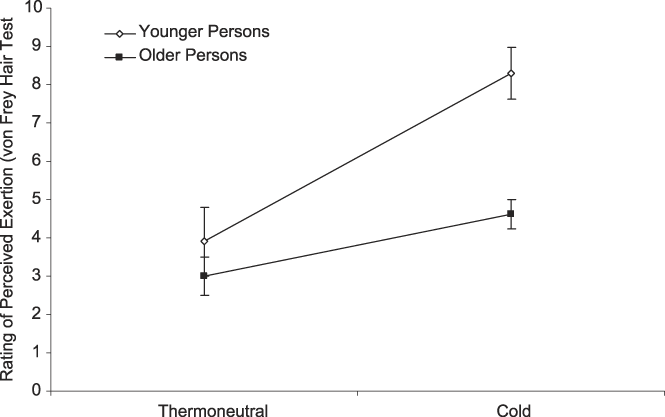
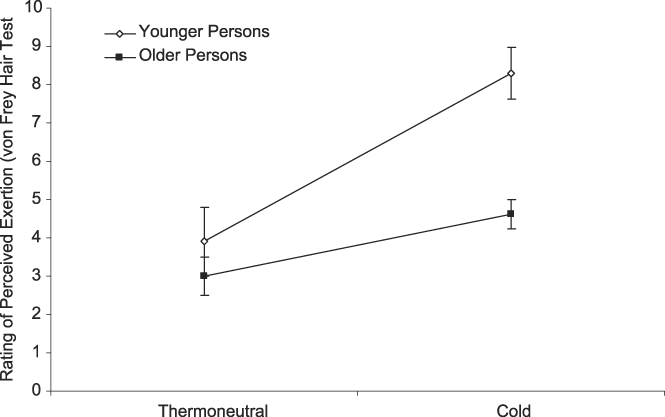
However, the analysis of the participants’ RPE revealed a significant age-group-by-temperature condition, F(1, 16) = 7.58, p < .01, d = 2.9. Post hoc decomposition of this effect indicated that the older persons found the task to be as difficult in room or cold temperatures as the younger persons did in room temperature. However, the younger persons found the hair test to be significantly more challenging in the cold temperature (see Figure 1).
The mean (± SE) ratings of perceived exertion (RPE) for the von Frey hair test plotted as a function of temperature condition (room, cold) and age group (younger persons, older persons)
Two-point Discrimination Test Performances. The analysis of the two-point discrimination test scores yielded an age-group main effect, F(1, 16) = 8.09, p < .01, d = 1.1. Post hoc analysis of this effect revealed that the two-point discrimination threshold was smaller for younger persons (0.52 ± 0.05 mm) than for older persons (1.27 ± 0.3 mm).
The analysis of RPE during the two-point discrimination tests yielded significant main effects for temperature condition, F(1, 16) = 9.55, p < .01, d = 0.4, and age group, F(1, 16) = 35.24, p < .01, d = 1.5. Post hoc analysis of the temperature effect indicated that participants found they exerted more effort to perform the task in the cold temperature (6.15 ± 0.7) than in the room temperature (4.79 ± 0.9). The decomposition of the age group effect revealed that younger persons (8.0 ± 0.7) perceived exerting more effort during the two-point discrimination test than the older persons (2.9 ± 0.6).
Grooved Pegboard Performances. The analysis of grooved pegboard scores indicated that younger persons (57.1 ± 1.4 s) performed the test quicker than did older persons (71.4 ± 5.0 s) regardless of the temperature manipulation, F(1, 16) = 10.83, p < .01, d = 2.7.
The analysis of RPE scores form the grooved pegboard test yielded no age group or temperature condition differences (grand mean = 8.75 ± 0.42).
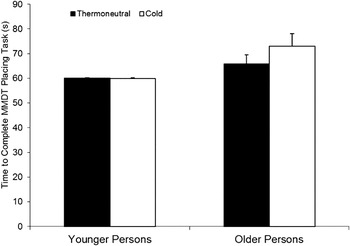
MMDT-Placing Performances. The analysis of the MMDT-Placing scores revealed a significant age group by temperature condition interaction, F(1, 16) = 10.23, p < .01, d = 1.4. Post hoc analysis of this interaction indicated that younger persons performed the MMDT-Placing test faster than the older persons in either temperature. However, the older persons were significantly quicker in the room temperature than they were in the cold temperature (see Figure 2).
The mean (± SE) times to complete the placing portion of the Minnesota Manual Dexterity Tests plotted as a function of temperature condition (room, cold) and age group (younger persons, older persons)

The RPE analysis of the MMDT-Placing test revealed no significant effects of age group or temperature (grand mean = 8.6 ± 0.35).
MMDT-Turning Performances. The analysis of the MMDT-Turning test scores also revealed a significant age group by temperature condition interaction, F(1, 16) = 18.9, p < .01, d = 1.6. Post hoc decomposition of this interaction indicated that younger persons performed this task faster in the cold (52.4 ± 1.2 s) than in room temperature (56.7 ± 1.1 s), and in both temperatures, faster than the older persons (room temperature = 63.7 ± 4.3 s; cold temperature = 67.8 ± 3.9 s).
The RPE analysis of the MMDT-Turning test also revealed no significant effects of age group or temperature (grand mean = 8.8 ± 0.37).
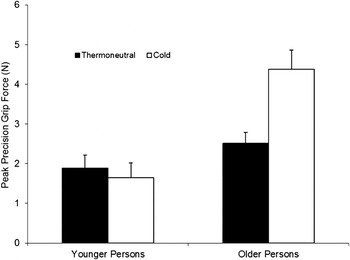
Precision Grip Force Performances. The analysis of precision grip force generation revealed a significant age group by temperature condition interaction, F(1, 16) = 18.97, p < .01, d = 0.2. The post hoc analysis of this interaction indicated that younger persons, in both the cold and room temperatures, generated significantly less force than the older persons. The older persons generated significantly more force in the cold temperature than they did in the room temperature (see Figure 3).
The participants’ mean (± SE) peak precision grip force (N) plotted as a function of temperature condition (room, cold) and age group (younger persons, older persons)

No age group or temperature condition differences were yielded from the RPE analysis (6.2 ± 0.31).
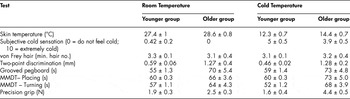
The means (± SE) for measures of skin temperature, subjective cold sensation, and test performance presented as a function of temperature condition and age group

MMDT = Minnesota Manual Dexterity Test
N = Newtons
s = seconds
Discussion
With respect to the study’s main hypothesis, note that the analysis of skin temperature at the fingertips indicated that the cold ambient temperature manipulation successfully altered the fingertip temperature of our participants but did not yield any differences between older and younger persons. Importantly, although the younger persons displayed better haptic acuity than the older persons on the two-point discrimination test, they did not do so on the von Frey hair test, nor did cold exposure influence the acuity of either group on either test. However, older persons reported the cold ambient temperature as less uncomfortable (SCS scores), and both tests of haptic acuity as less demanding (RPE scores), in the cold than did younger persons.
Looking at the manual performance differences across the test battery, we see that the younger persons outperformed the older persons on each test. However, of greater relevance to the present work are the instances in which the cold ambient temperature manipulation produced significant effects wherein age group also interacted as a factor. Specifically, the cold temperature enhanced the MMDT-Turning performances of the younger persons, but did not impact the older persons’ generally slower performances. However, the cold temperature slowed older persons’ completion of the MMDT-Placing test and led them to generate significantly more force during the precision force generation test (Carnahan et al., Reference Carnahan, Dubrowski and Grierson2009), while it had no impact on the younger persons’ ability to perform these tests.
The implication with the RPE score is that perceived exertion reflects the amount of energy the task required. That the RPE effects occur for the perceptual acuity tasks suggests that both age and cold impact the demands on attention associated with these tasks in a meaningful way. This pattern of results suggests that the discernment of sensory differences at the level of the von Frey hair test and two-point discrimination test may require contributions from an energy-dependent cognitive process such as working memory, the process responsible for capturing, manipulating, and storing task-relevant pieces of information in a computational space (Becker & Morris, Reference Becker and Morris1999; Martin & Benton, Reference Martin and Benton1999; Oberauer, Reference Oberauer2002; Weiss, Reference Weiss1986). With respect to age, younger persons are documented as having greater available working memory resources than older persons (Caplan, Dede, Waters, Michaud, & Tripodis, Reference Caplan, Dede, Waters, Michaud and Tripodis2011; Waters & Caplan, Reference Waters and Caplan2005). In this view, their better two-point discrimination performance may be a function of this available additional resource. When considered also with respect to the impact of temperature, the younger persons’ increased RPE scores in the cold suggest that there is an attempt to redirect computational resources to the task of discerning accurate perceptions when immersed in environments of degraded sensory afference, but only when those resources are available.
In localizing the facets of the sensorimotor system in which older age interacts to exacerbate the impacts elicited by exposure to cold ambient temperature, the results suggest that older persons have more difficulty performing tasks that require gross manual dexterity and precision force generation in the cold. Interestingly, these performance deficits occur without an apparent impact of the cold on older persons’ haptic perceptual acuity. This suggests that the performance decrements are not a function of some cold-induced problem with afferent processing. Rather, the impact of cold exposure seems to lie in motor output. It may be that cold exposure impacts the properties of efferent nerve conduction, vasoconstriction, and/or joint mechanics in older persons. However, the performance decrements may also be a function of the ambient cold impacting cognitive aspects of movement control. The environmental stress may prompt older individuals to over- or misallocate their limited attentional resources in appraising the task demands. The older persons’ reduced discomfort in the cold further hints that they may be unaware of some important environmental information.
Conclusion
Winter’s cold ambient temperatures can be particularly perilous for older persons. A reduced ability to perceive and react to cold stress elicits physical risk, often leads to inappropriate clothing choices (i.e., not wearing gloves), and plays a major role in the onset of thrombosis, cerebrovascular disease, and ischaemic stroke during the winter months (Donaldson, Rintamaki, & Näyhä, Reference Donaldson, Rintamaki and Näyhä2001; Eurowinter Group, Reference Keatinge, Donaldson, Bucher, Cordioli, Dardanoni and Jendritzky1997; Keatinge et al., Reference Keatinge, Coleshaw, Cotter, Mattock, Murphy and Chelliah1984). With respect to the design of effective interventions and adaptive strategies for an aging population, the results of this study have two salient points. First, older persons have more difficulty identifying reductions in ambient temperature. Thus, there is a need for this population to recognize other cues that the environmental temperature has decreased. By doing so, older persons can make appropriate decisions regarding outdoor attire and the amount of time they will spend outside. Second, the production of overabundant force may be detrimental to the manual actions of older persons in a number of ways. With higher force generation comes a concomitant increase in movement variability, which often compromises the control and accuracy of upper-limb movements (see Elliott et al., Reference Elliott, Hansen, Grierson, Lyons, Bennett and Hayes2010 for a review). A decrease in accuracy can lead to frustrations (Palinkas, Reference Palinkas2001), fatigue, and repetitive strain injury (Carnahan et al., Reference Carnahan, Dubrowski and Grierson2009), as well as to incidents that are potentially dangerous. For example, if an older person reaches for an urban stairway railing in a manner that is overabundant in force from what they anticipate, they may overshoot the rail, lose their balance, and fall (King et al., Reference King, Lee, McKay, Scovil, Peters and Pratt2011). It is our position that the difficulty displayed by the older persons in modulating their precision force generation in the cold may also be at the root of their longer MMDT-Placing times under the same condition. Work expanding or restructuring skills in the cold should help older persons incorporate strategic elements that may facilitate online corrective processes that will mitigate error when it occurs.
Further inquiry into the impact of cold ambient temperature would do well to explore a wider range of environmentally relevant temperatures, to focus on how activities of daily living are impacted and to investigate populations of individuals with known manual functioning deficiencies (i.e., persons with arthritis, Parkinson’s disease, or those who are recovering from stroke). In this way, knowledge may be generated that will help meet the goal of developing strategies to assist older persons in performing well day-to-day.