I. INTRODUCTION
Direct methanol fuel cell (DMFC) is an attracting technology that can provide power sources for micro and portable devices utilizing methanol as fuel without any fuel processing beforehand.Reference Neburchilov, Martin, Wang and Zhang1 The main technical barriers for commercialization of DMFC are slow methanol oxidation and methanol crossover through polymer electrolyte membrane (PEM). The latter results in significant decrease in cell potential and fuel efficiency due to oxidation of methanol at the cathode side.Reference DeLuca and Elabd2–Reference Ahmed and Dincer4
Sulfonated poly(ether ether ketone) (SPEEK) is one of the major potential PEMs for the DMFC,Reference Kim, Krishnan, Lee, Hwang, Kim, Jeong, Lee, Cho, Lee, Han, Ha and Lim5–Reference Carbone, Pedicini, Portale, Longo, D’Ilario and Passalacqua15 which due to its high thermal stability, high mechanical strength, low methanol permeability, and moderate proton conductivity. However, SPEEK membranes exhibit high swelling in water when reaching critical degree of sulfonation (DS) (>70%); or when reaching critical temperature (>60–80 °C), which leads to poor mechanical properties and low ion permselectivity. An extensive approach utilized for swelling reduction of SPEEK membranes is through blending with another swelling-tolerant materials such as inorganic additivesReference Jaafar, Ismail, Matsuura and Nagai7, Reference Zhong, Cui, Fu and Na10, Reference Erce, Erdener, Akay, Yuecel, Bac and Eroglu16–Reference Ramaganthan, Sivakumar and Dharmalingam21 and hydrophobic/hydrophilic polymers.Reference Zhang, Zhang, Xu, Zhao, Ma, Li, Zhang, Xu, Jiang, Sun and Na6, Reference Li, Zhang, Ma, Zhao, Zhang, Han, Zhu, Liu, Wu and Na8, Reference Guhan, Muruganantham and Sangeetha22–Reference Fu, Manthiram and Guiver24 However, in most cases, polymer blends are immiscible due to their high molecular weights, the difference in their chemical structure, and the hydrophobic/hydrophilic nature of their backbone.
To enhance the miscibility of the polymer blend, it is important to insure the existence of favorable specific intermolecular interactions between the two components of polymer blend matrix, such as dipole–dipole, π–π, charge transfer, or hydrogen bonding interactions.Reference Coleman, Serman, Bhagwagar and Painter25 Among the different intermolecular interactions, the interassociated hydrogen bonds were utilized as a strategy for compatibilization of many polymer blend systems,Reference Coleman, Serman, Bhagwagar and Painter25–Reference Kuo28 including developing miscible polymers with superior properties as alternative membranes for fuel cells applications.Reference Kerres29–Reference Zhu, Liang, Pan, Jian and Zhang33 SPEEK was blended with different polymers that are capable of forming intermolecular hydrogen bonds, and in most cases, the resulted blend membranes showed enhanced swelling reduction and better thermal stabilities, without critical loss of their proton conductivities. This includes basic polymers containing (–N–H) functionality such as aminated polysulfone (PSU),Reference Kerres, Ullrich, Meier and Haring34, Reference Jorissen, Gogel, Kerres and Garche35 polyvinylidene fluoride,Reference Ren, Sun, Li, Wu, Jin, Chen, Xin and Yang36–Reference Jung and Park39 and polybenzimidazoleReference Zaidi40, Reference Pasupathi, Ji, Bladergroen and Linkov41; acidic polymers containing (–SO3H) functionality such as sulfonated polyphenylsulfonesReference Sgreccia, Di Vona and Knauth42; polymers containing hydroxyl (–OH) functionality such as polyvinyl alcoholReference Yang43; polymers bearing both proton donor and proton acceptor sites such as poly(amide imide),Reference Wu, Ma, Li, Lee, Chen, Chiang and Wu44 sulfonated polybenzimidazole,Reference Thomas, Peckham, Thanganathan, Yang and Holdcroft45 and phosphonated polyethers containing pyridine basic functionality.Reference Papadimitriou, Andreopoulou and Kallitsis46
Recently, phosphonated ionomer membranes gained more attention as alternative materials for developing new polyelectrolyte membrane for fuel cells applications (PEMFCs).Reference Papadimitriou, Andreopoulou and Kallitsis46–Reference Tienda, Yu, Constandinidis, Fortney, Feld and Fossum52 In comparison to sulfonated ionomer membranes, phosphonic acid functionalized membranes showed number of superior properties such as higher thermal stability, lower methanol crossover, and low water swelling at higher temperatures.Reference Lafitte and Jannasch53
Indeed, polymers with amphoteric phosphonic acid functionality (–PO3H2) are capable of forming strong hydrogen bonds with acidic polymers such as SPEEK and hence can be utilized for preparation of blend membranes for PEMFCs, targeting swelling reduction with minimum scarification of proton conductivity. Therefore, the objectives of this study are to prepare blend membranes composed of SPEEK and phosphonic acid functionalized polysulfones (PPSU-As), with different degrees of phosphonation, and evaluation of the blend membranes characteristics for possible use in the area of PEMFCs.
II. EXPERIMENTAL
A. Materials
Sulfonated poly(ether ether ketone) (SPEEK) was supplied by Fumatech company (St. Ingbert, Germany); PSU (Aldrich, Milwaukee, WI; 35 kg/mol) was dried overnight at 60 °C under vacuum. Triethyl phosphite (Fluka, Buchs, Switzerland; >97%), paraformaldehyde (Fluka), chlorotrimethylsilane (Aldrich; +99%), stannic chloride fuming (Fluka; >98%), diethyl carbitol (Fluka; >98%), methanol (Aldrich; 99.8%), chloroform (Aldrich; >99%), dimethylacetamide (DMAc) (Aldrich; >99%), and N-methyl-2-pyrrolidinone (NMP) (Aldrich; 98%) were used as received.
For the sake of clarity, the following polymers will be referred to by their acronyms: sulfonated poly(ether ether ketone) as SPEEK; polysulfone as PSU; phosphonated polysulfone (PPSU) in the ester form as PPSU-E; PPSU in the acid form as PPSU-A (Fig. 1).
Structures of (a) SPEEK and (b) Phosphonated PSU.

B. Synthesis of PPSUs
The detailed procedure for the synthesis and characterization of phosphonated polysulfones in the acid form (PPSU-A) with different degree of phosphonation (DP) can be found in our previous published work.Reference Abu-Thabit, Ali and Javaid54
C. Preparation of blend membranes
Since SPEEK and PPSU-A polymers are soluble in DMAc at room temperature, DMAc was selected as the casting solvent. A desired weighed amounts of the used polymers SPEEK/PSU or SPEEK/PPSU-A were dissolved together in DMAc to form 10–15 wt% solutions. The solutions were stirred overnight and then kept for 24 h to release air bubbles. The solutions were poured into Petri dishes and the solvent was evaporated at 60 °C. The formed membranes were dipped in ultrapure deionized water for few hours to be released out. Then, the membranes were dried under vacuum at 90 °C for 3 h and stored in ultrapure deionized water for subsequent use.
D. Characterization
1H nuclear magnetic resonance (NMR) spectra of the blend polymers were recorded for structural characterization. Data were collected on a JEOL LA 500 MHz spectrometer using deuterated dimethyl sulfoxide (DMSO-d6). Infrared spectra were recorded for the dried membranes using NICOLET 6700 FTIR equipped with Smart Orbit (Thermo Electron Corporation, Madison, WI); 32 scans were collected for each sample in the range of 400–4000 cm−1.
E. Solvent uptake, ion exchange capacity and lambda (λ)
To study the water and methanol uptake (W solvent), the prepared membranes were first dried under vacuum at 80 °C overnight to obtain their dry weights (W dry) and then immersed in deionized water/pure methanol for 3 h at the desired temperatures. Excess water/methanol was quickly removed from both surfaces before the weights of the swollen membranes (W wet) were obtained. The solvent uptake was then calculated as:

For the determination of ion exchange capacity (IEC) of the polymer blend, the membrane in the acid form (∼0.5 g) was immersed in 1 M NaCl solution for 3 days to allow complete release of HCl from the membrane sample. Then, the released H+ was back titrated with 0.1 M NaOH solution using phenolphthalein as indicator. The IEC is the amount of acid equivalents per gram of dry polymer and can be calculated as following:

Lambda (λ) represents the average number of water molecules for each acid group (sulfonic/phosphonic). It can be calculated using the value of IEC and water uptake (WU) as shown in Eq. (3).

F. Thermal stability
Thermogravimetric analysis (TGA) experiments were carried out using Shimadzu DTG-60H equipment (Shimadzu Corporation, Kyoto, Japan). All the prepared membranes were vacuum dried at 120 °C for at least 1 h before the analysis. The samples were heated from 25 to 800 °C at 10 ° C/min under air.
G. Proton conductivity measurements
The proton conductivity of the blend membranes was measured by electrochemical impedance spectroscopy technique. It was performed over the frequency range 0.1–1.2 × 10⁶ Hz with 10 mV amplitude. A potentiostat (Model 283) and lock in amplifier (Model 5210) connected to a PC through general purpose interface bus (GPIB) card were used to measure the impedance data. Membrane samples of around 1.5 × 1.5 cm were neatly cut and put between the stainless steel electrodes of the conductivity cells. Before the test, all the blend membranes were soaked in deionized water at 60 °C for 30 min and the final thickness of the resulted membranes were used in calculations. The conductivity (σ) of the blend membranes was calculated from the impedance data, using the relation σ = t/RA, where t is the thickness of the membrane, A the face area, and R is derived from the impedance data.
H. Methanol permeability measurements
Methanol permeability experiment was carried out using a test cell, which included two compartments separated by the tested membrane. The volume of each compartment was 100 mL and the effective membrane area was 5.10 cm2. The feeding compartment (A) was filled with 1 M methanol solution and the permeate compartment (B) was filled with ultrapure water. Both compartments were continuously stirred by magnetic stir bars during permeability measurements. The methanol concentration in compartment (B) was determined at different time intervals by high performance liquid chromatography (HPLC; Waters 2695, Milford, MA) using a μBondapak C18 125 Ao column (3.9 × 300 mm).
Methanol permeability (P) through the PEM was then calculated from the slope of the time–concentration curve of methanol in compartment (B) as expressed in the following equation:

where m is the slope of the linear plot of C B versus t (dC B/dt); V B is the volume of compartment B; C A is the concentration of methanol in compartment A; L is the thickness of the membrane; S is the effective area of the membrane.
I. Scanning electron microscopy
The morphology of the blend membranes was investigated by scanning electron microscopy (SEM) using Oxford system for energy-dispersive x-ray spectroscopy analysis system. The specimens for the SEM were prepared by freezing the dried membrane samples in liquid nitrogen and by breaking them to produce a cross-sectional fractured surface. Individual membranes were mounted on aluminum specimen stubs with double-sided carbon adhesive tape and sputter-coated with a gold layer to provide a conductive layer to reduce the buildup of charges on the surface of the sample. Morphology was analyzed by the image analyzer program Tescan Lyra-3 (Tescan, Brno, Czech Republic).
J. Mechanical analysis
Tensile tests were conducted using Lloyd LF-Plus tensile instrument (Lloyd Instruments Ltd., West Sussex, UK), equipped with a 100-N load cell and pneumatic grips, in accordance with ASTM D-882 standard.55 Five samples were tested for each membrane composition and the average values of the properties were reported. All tests were conducted at a constant grip separation speed of 5 mm/min and a gauge length of 15 mm. The slope of the initial curve of stress versus strain was used for obtaining the modulus. The area under the stress strain curve was used to determine the toughness.
III. RESULTS AND DISCUSSION
A. Synthesis of PPSUs
In our recent paper,Reference Abu-Thabit, Ali and Javaid54 we have successfully synthesized phosphonated polysulfones by two-step procedure, chloromethylation of PSU backbone followed by phosphontion utilizing Michaelis–Arbuzov reaction. The degree of chloromethylation and phosphonation was controlled from 0.4 up to 2 without crosslinking side reactions. Then, the PPSUs in the ester form were quantitatively hydrolyzed to the corresponding acid form by refluxing in aqueous hydrochloric acid. Phosphonic acid functionalized polysulfones with DP ≤ 1 were soluble in common organic solvents such as DMAc, NMP, and DMSO. The obtained membranes were characterized by low proton conductivity, high thermal stability, and insignificant change in their WU at temperatures around 100 °C.
B. Preparation of the blend membranes
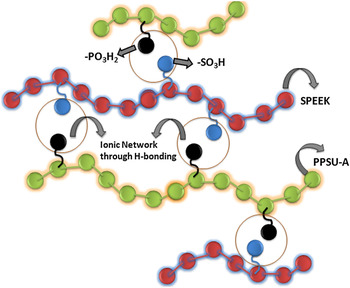
All the blend membranes were casted using DMAc as solvent. The phosphonic acid content in the blend membranes was controlled by varying both the DP and the percentage of PPSU-As in the blend membranes. Both sulfonic and phosphonic acid functionalities, located on the polymeric backbones, are expected to exhibit strong intermolecular interactions through formation of hydrogen bonding bridges and ionic networks between SPEEK-75 and PPSU-As polymers as illustrated below:
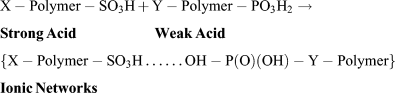
All the resulted blend membranes were flexible and transparent to visible light, which indicates the successful formation of ionic networks through strong hydrogen bonding interactions between the amphoteric phosphonic acid groups and strong proton donor SPEEK containing aryl sulfonic acid moieties, as illustrated in Fig. 2.
Formation of ionic networks between SPEEK and PPSU-A polymer blends through hydrogen bonding interactions.

C. FTIR and 1H NMR analysis for the blend polymers
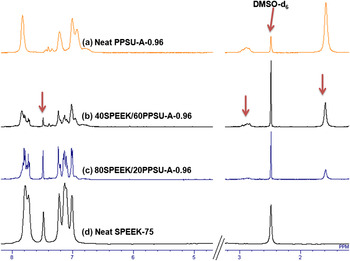
Different polymer compositions of SPEEK-75 and PPSU-A-96 were dissolved in DMSO-d6 and 1H spectra were recorded as shown in Fig. 3. The recorded spectrum clearly shows the distinct peaks for PPSU-A-0.96 at δ 1.6 and 2.9 ppm. Likewise, the presence of SPEEK-75 was obvious from its distinct peak at δ 7.5 ppm.
1H NMR spectra of neat PPSU-A-0.96 (a), polymer blends (b and c), and neat SPEEK-75 (d).

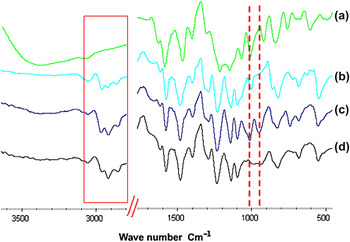
FTIR spectra of the utilized polymers are shown in Fig. 4. There is a clear overlap between the FTIR bands of pure SPEEK and pure PSU membranes in most of their characteristic peaks, which can be attributed to structure similarity of both polymers [Figs. 4(a) and 4(b)].
FTIR spectrum of (a) neat SPEEK DS = 75%; (b) neat PSU; (c) PPSU-E-0.75; and (d) PPSU-A-0.75.

Comparison of the FTIR spectra of the PPSU-E with the FTIR spectra of neat PSU, three new absorption bands at 1018, 746, and 956 cm−1 can be identified [Fig. 4(c)]. These bands are overlapped with SPEEK peaks in the same range. The former three bands are disappeared after the quantitative hydrolysis of the PPSU-Es to the corresponding acid form PPSU-As [Fig. 4(d)]. The characteristic absorption bands at 2871, 2942, and 2965 cm−1, which is attributed to CH-stretching of the bisphenol-A(CH3)2 moiety of PSU, PPSU-E, and PPSU-A polymers, confirm the presence of the phosphonated polymers in the blend membranes.
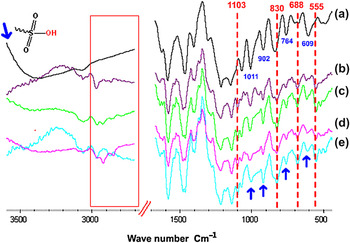
Figure 5 shows the FTIR spectra of the pure SPEEK membrane (a), SPEEK/50PPSU-E-0.75 (b), and SPEEK/PPSU-As (c–e) blend membranes. Compared to pure SPEEK membrane, all phosphonated membranes in both ester and acid forms clearly display the characteristic FTIR bands in the range of 2870–2970 cm−1. In addition, new FTIR absorption bands for the polymer blends were observed at 1103, 830, 688, and 555 cm−1. Furthermore, the intensity of SPEEK absorption bands in the polymer blends at 1011, 902, 764, and 609 cm−1 is decreased.
FTIR spectrum of (a) neat SPEEK DS = 75%; (b) 50PPSU-E-0.75; (c) 50PPSU-A-0.4; (d) 50PPSU-A-0.75; and (e) 50PPSU-A-0.96.

Moreover, when the percentage of SPEEK polymer is above 40%, sulfonic acid –OH stretching band, around 3400 cm−1, became invisible. This could be attributed to the high level of ionic crosslinking in the corresponding polymer blend as well as the low concentration of free SO3H groups.
D. Properties of the blend membranes
1. WU and methanol uptake
WU is considered to be a critical property for the membranes intended to be used as PEMFCs. There is an established relationship between the type of the acid functionality and the WU capability for the corresponding membrane. For example, sulfonic acid group (PKa < 1)Reference Lafitte and Jannasch53 can be easily solvated by the surrounding water molecules and causes the membrane to swell because of adequate WU levels. In comparison, the protons of amphoteric phosphonic acid group (PKa1 ∼ 2.3 and PKa2 ∼ 7.6)Reference Lafitte and Jannasch53 are stabilized by self hydrogen bonding (autoprotolysis), and as a result, phosphonic acid ionomers are known to have much lower WU values compared to the sulfonic acid ionomers with similar IEC. Hence, blend membranes with mixed sulfonic and phosphonic acid functionalities are expected to show reasonable and average amounts of WU levels, without excessive swelling of the blend membranes.
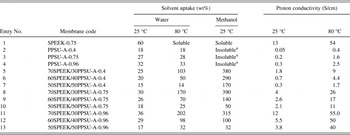
Table I shows the WU values for the prepared blend membranes. It is evident that the incorporation of PPSUs reduced the WU levels in the blend membranes as they became water insoluble up to 80 °C. The blend membranes showed WU values in the range of 15–36 wt% at room temperature and 14–200 wt% at 80 °C.
Solvent uptake and proton conductivity values of different SPEEK/PPSU-A blend membranes.

a Synthesized polymers were isolated and purified by precipitation in methanol solvent, see Ref. Reference Abu-Thabit, Ali and Javaid54.
This reduction in WU levels can be attributed to the formation of interpolymeric sulfonate–phosphonium complexes. However, when the phosphonic acid content exceeds certain limit, self hydrogen bonding between the PPSUs predominates, and as a result, the access of water molecules turns out to be more hindered, providing lower WU values for the blend membranes.
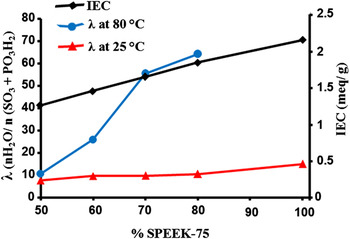
Figure 6 represents the IEC and lambda values for the SPEEK/PPSU-A-0.75 blend membranes. Although the value of the IEC decreases as the percentage of the PPSU-A-0.75 increases in the polymer blend, reasonable lambda values were maintained at room temperature in the range of (8–10) water molecules per acid functionality, which could be attributed to the presence of adequate number of highly dissociated sulfonic acid protons in the blend membranes. When the temperature increased to 80 °C, lambda values were dramatically increased, especially for the blends with less than 30 wt% SPEEK. Hence, the percolation threshold of lambda at 80 °C for the SPEEK/PPSU-A-0.75 blend membranes is around 40–50 wt% PPSU-A-0.75 content.
IEC and lambda (λ) values for SPEEK/PPSU-A-0.75 blend membrane.

Methanol uptake values for the blend membranes are displayed in Table I. All the blend membranes were insoluble in methanol at room temperature and showed methanol uptake values in the range of 32–280% of their weight. This suggests that these blend membranes may exhibit lower methanol permeability, which will be advantageous in case of DMFC operation.
2. Proton conductivity
Proton conductivity generally has a strong tradeoff in its relationship with the WU. Membranes containing 30% PPSU with moderate WU values showed proton conductivities in the range of 1.8–12 S/cm at room temperature and 9–55 S/cm at 80 °C (Table I, entries 2, 5, and 8). Unfortunately, further increase in the percentage of PPSU-A resulted in significant lowering in proton conductivities as a result of partial blocking of proton transporting channels by the formation of interpolymeric sulfonate–phosphonium complexes.
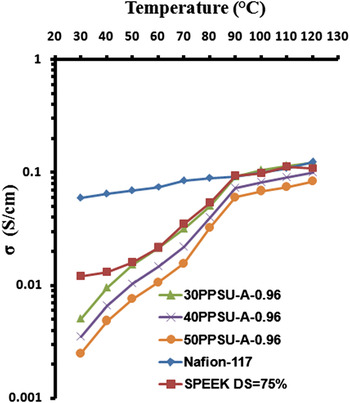
Proton conductivities of the blend membranes SPEEK/PPSU-A-0.96 are shown in Fig. 7. The conductivity of SPEEK membranes increased with increasing temperature and reached about 0.098 S/cm at 100 °C, which is comparable to Nafion 117 membrane. 30PPSU-A-0.96 blend membrane showed slightly higher proton conductivities at temperatures above 50 °C compared to the neat SPEEK membrane. This behavior continues up to 120 °C to reach a conductivity of 0.124 S/cm, which is comparable to Nafion 117 membrane at this temperature.
Proton conductivity data for SPEEK/PPSU-A-0.96 blend membranes under fully humidified conditions.

The enhanced proton conductivity at temperatures above 80 °C could be attributed to the higher lambda values as well as the improvement of water retention property in the blend membranes through the formed ionic networks. Increasing the percentage of PPSU-A-0.96 in the blend membrane to 40% and 50% resulted in a slight decrease in proton conductivities at temperatures between 80 and 120 °C, and the later membranes reached a proton conductivities of 0.10 and 0.094 S/cm at 120 °C, respectively. This reduction in proton conductivity could be attributed to the lower WU values of the later membranes compared to 30PPSU-A-0.96 membrane.
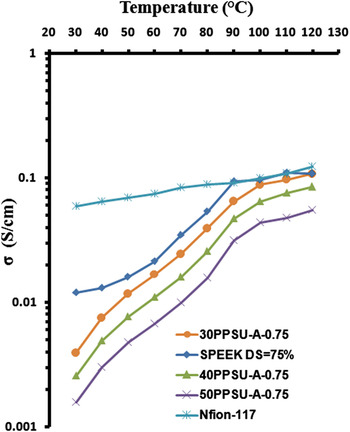
SPEEK/PPSU-A-0.75 blend membranes exhibited proton conductivity trend similar to that of SPEEK/PPSU-A-0.96, as shown in Fig. 8. Unfortunately, blend membranes with the lowest phosphonic acid functionality (40%) displayed a remarkable and significant decrease in their proton conductivities (Table I, entries 2–4). This could be attributed to the low levels of WU and the smaller number of formed ionic networks in these blends membranes.
Proton conductivity data for SPEEK/PPSU-A-0.75 blend membranes under fully humidified conditions.

3. Methanol permeability of the SPEEK/PPSU-As blend membranes
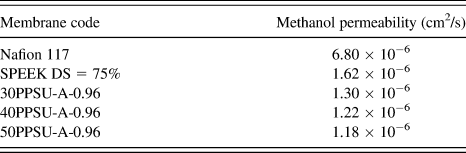
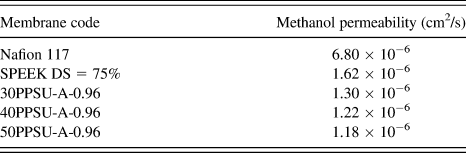
The blend membrane with highest proton conductivity SPEEK/PPSU-A-0.96 was selected for methanol permeability measurements. Although pure SPEEK-75 membrane is soluble in methanol, methanol permeability of pure SPEEK-75 membrane is about 4 times lower than that of Nafion 117; this considerably high permeability is attributed the high DS. Nevertheless, SPEEK/PPSU-A-0.96 blend membranes showed slightly lower methanol permeabilities in comparison with neat SPEEK-75 membrane as displayed in Table II. This behavior was expected as the blend membranes are insoluble in methanol at room temperature.
Methanol permeability data for Nafion 117, SPEEK DS = 75%, and SPEEK/PPSU-A-0.96 blend membranes.
4. SEM morphological study of the blend membranes
Tough transparent SPEEK/PPSU-A blend membranes containing up to 50 wt% of phosphonic acid functionalized polysulfone have been successfully made. In contrast, to the SPEEK/PPSU-A blend membranes, SPEEK/PSU blend membranes were opaque.
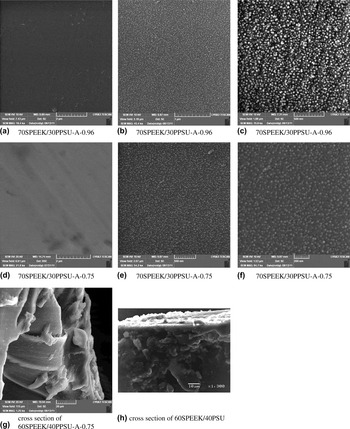
Figure 9 shows the SEM images of selected SPEEK blend membranes prepared in this study. Blending highly hydrophilic SPEEK with hydrophobic PSU resulted in poor quality and brittle membranes due to large phase separation as shown in Fig. 9(h). However, this phase separation was not observed in the SEM cross-sectional images for 60SPEEK/40PPSU-A-0.75 blend membrane [Fig. 7(g)]. It is clear that the miscibility between both hydrophilic polymers was significantly improved as a result of hydrogen bonding interactions between the pendent sulfonic and phosphonic acid moieties on the poly(arylene ether) backbones.
SEM micrographs of selected SPEEK blend membranes.

Furthermore, SEM images of SPEEK/PPSU-As blend membranes have very interesting morphologies as shown in Figs. 9(a)–9(f). Phosphonic acid functionalized polysulfones are evenly dispersed in the SPEEK/PPSU-A blend matrix and the morphology of blend membranes showed the existence of microphases with dimensions smaller than the visible light, in the order of 10–20 nm. Hence, SEM images provided further indication of the enhanced miscibility between the two polymers through the hydrogen bonding interactions.
5. Thermal and mechanical properties of the blend membranes
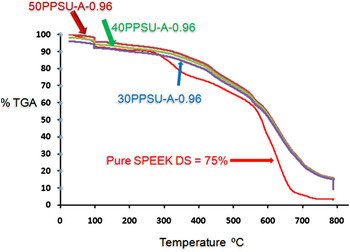
Figure 10 shows the comparison of the thermal stability behavior of pure SPEEK membrane and the whole series of the highest proton conductivity blend membranes PPSU-A-0.96 (i.e., containing 30, 40, and 50 wt% of PPSU-A-0.96 polymer). SPEEK membrane showed a remarkable degradation in the temperature range of 250–350 °C due to the loss of sulfonic acid groups. However, all the three blend membranes showed enhanced thermal stability and less weight loss in the same temperature range, which could be attributed to the formation of ionic networks between sulfonic and phosphonic acid groups. Furthermore, the blend membrane with 50% PPSU-A-0.96 exhibited the highest thermal stability in the series, which could be attributed to the formation of highest number of hydrogen bridges between the PPSU-A-0.96 and SPEEK. Thus, the thermal stability increases as the percent of PPSU-A-0.96 increases in the blend membranes.
TGA analysis comparison between the whole PPSU-A-0.96 series blend membranes.

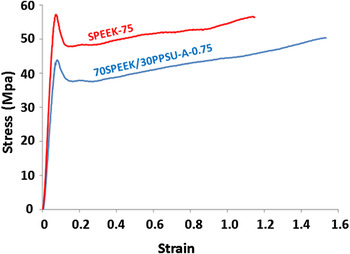
To assess the effect of blending the two polymers (SPEEK and PPSU-A) on the membrane reliability, the tensile test of the blend membrane 70SPEEK/30PPSU-A-0.75 was carried out and presented in (Fig. 11). The mechanical properties of the neat SPEEK-75 and the blend (70SPEEK/30PPSU-A-0.75) membranes were summarized in Table III. Compared to the neat SPEEK-75, the blend membrane showed a remarkable increase of 38% in the modulus of elasticity, 31% in yield strength, and 26% in tensile strength as shown in Table III. Even though reductions in the strain at break (ductility) and in the toughness were observed with the blending, the 70SPEEK/30PPSU-A-0.75 membrane showed high ductility of 100%. This overall improvement in mechanical properties could be attributed to the formation of the intramolecular ionic networks via hydrogen bonding interactions between the amphoteric phosphonic acid and the sulfonic acid functionalities. Improvements in mechanical properties were also reported for the acid–base ionically crosslinked membranes such as: blends of polybenzimidazole/Nafion,Reference Zhai, Zhang, Zhang and Xing56 polybenzimidazole/butylsulfonated polybenzimidazole,Reference Lin, Hu, Su, Chou and Lin57 and Chitosan/sodium alginate.Reference Smitha, Sridhar and Khan58 In addition, both SPEEK-75 and 70SPEEK/30PPSU-A-0.75 membranes showed better mechanical properties when compared to Nafion 117 membraneReference Hill, Kim, Einsla and McGrath59 (tensile strength of 35 MPa).
Tensile plots of SPEEK-75 and 70SPEEK/30PPSU-A-0.75.

Tensile properties for SPEEK-75 and 70SPEEK/30PPSU-A-0.75 membranes.

a Tests were carried out for dry membranes at room temperature.
IV. CONCLUSIONS
In this study, phosphonated polysulfones in the acid form were blended with SPEEK to fabricate new PEMFCs. The blend membranes showed a wide range of characteristics depending on the DP and polymer composition of the blend.
Blend membranes fabricated with phosphonated polysulfones in their acid form (PPSU-As) were transparent and stable in water up to 80 °C. This stability behavior was attributed to the formation of strong hydrogen bonding bridges, which can hold the two polymers connected through formation of ionic networks between the sulfonic and phosphonic acid groups.
In addition, the presence of ionic networks led to water swelling reduction of the blend membranes compared to neat SPEEK membrane. This reduction in water swelling was accompanied by lower methanol uptake as well as lower methanol permeability, without remarkable loss of proton conductivity. Likewise, the blend membranes showed enhanced thermal stability in a similar way to the acid–base blend membranes prepared earlier in the literature. Furthermore, the formed flexible ionic networks led to an overall improvement in the mechanical properties of the blend membranes.
These promising results address the possibility of utilization of such blend membranes as alternative materials for PEMFCs at temperatures around 100 °C.
ACKNOWLEDGMENTS
The authors would like to thank the Center of Research Excellence in Renewable Energy (CoRE-RE) at King Fahd University of Petroleum and Minerals for funding this research under project number (RERE-08). Special thanks to Dr. M. Al-Daous for TGA analysis, Mr. M. Arab for NMR analysis, and Dr. Abbas Hakeem at CENT/KFUPM for SEM analysis.