INTRODUCTION
The artistic tradition defined as Mixteca-Puebla, or more recently as Nahua-Mixteca (Pohl Reference Pohl, Smith and Berdan2003, Reference Pohl2007) flourished in the Mesoamerican areas of central Mexico and Oaxaca in the three centuries leading up to the Spanish Conquest (Nicholson Reference Nicholson and Wallace1960, Reference Nicholson and Boone1982; Nicholson and Quiñones Reference Nicholson and Keber1994; Vaillant Reference Vaillant1950), a period called the Late Postclassic (a.d. 1200–1521). Known for its distinctive style and iconography (Boone Reference Boone, Illius and Laubscher1990; Boone and Smith Reference Boone, Smith, Smith and Berdan2003), the Mixteca-Puebla tradition includes a diversity of artworks, among which painted manuscripts or codices are a premier example (Escalante Reference Escalante Gonzalbo2010). A distinctive feature of these codices is a wide variety and particular vividness in colors. This article focuses on the materiality of these colors, that is, their material origins as well as their formal characteristics.
Recent scientific analyses have dramatically improved our knowledge of the materiality of the Mixteca-Puebla codices. In the last decade, non-invasive physicochemical studies have brought to light interesting data regarding their constituent materials, in particular the coloring materials that were used to paint them. To date, the results of the analyses of two Nahua codices—the Cospi and the Fejérváry Mayer—and two Mixtec codices—the Colombino and the Zouche-Nuttall—have been published (Domenici et al. Reference Domenici, Buti, Miliani, Brunetti, Sgamellotti, Sgamellotti, Brunetti and Miliani2014; Higgit Reference Higgitt2013; Miliani et al. Reference Miliani, Domenici, Clementi, Presciutti, Rosi, Buti, Romani, Minelli and Sgamellotti2012; Zetina et al. Reference Zetina, Ruvalcaba, Cáceres, Falcón, Hernández, González, Arroyo and Turbanti-Memmi2011, Reference Zetina, Ruvalcaba, Falcón, Alatorre, Yanagisawa, Icaza Longoria, Hernández, Sgamellotti, Brunetti and Miliani2014). It is worth adding that a non-invasive physicochemical study of another Nahua manuscript, the Codex Borbonicus from the Valley of Mexico, is currently in process, the first results of which have been exposed (Pottier et al. Reference Pottier, Michelin, Andraud, Goubard and Lavédrine2014, Reference Pottier, Michelin, Andraud, Goubard and Lavédrine2016). The evidence obtained through these scientific analyses give a first, but consistent, idea of the coloring materials employed to paint the Mixteca-Puebla codices.
This article posits that historical research in colonial sources, as well as macroscopic inspections of whole original manuscripts, have much to contribute to the understanding of the materiality of color in the pre-Columbian codices. Indeed, the macroscopic examination of the totality of a codex—in general, physicochemical studies only focus on specific pages—grants special insight into the painting techniques used by the artists to obtain certain colors, as well as the complexity of the chromatic palettes within each manuscript. Historical accounts, in turn, often confirm, complement, or illuminate the information obtained through scientific analysis and macroscopic examination. More broadly, they enrich our knowledge of the Mesoamerican art of painting manuscripts. The historical records thus allow the formulation of stimulating hypotheses regarding some codices’ colors, in particular those whose material origin remains unknown because their characterization represents a challenge for the scientists.
Even though the compositional studies of the Mixteca-Puebla codices are still in process, the purpose of this article is to bring together the everyday, more abundant scientific data about the material constituents of these documents, with references within the Colonial era historical accounts, as well as notes resulting from my macroscopic inspection of the originals of the pre-Columbian Nahua codices. In doing so, I propose an enriched reconstruction of the materiality of colors in these manuscripts that will contribute to shed light on the available scientific results—and perhaps inspire future campaigns of analysis—at the same time that it clarifies aspects of the historical accounts about Nahua painting materials that were poorly understood until now.
THE DOCUMENTARY CORPUS
The Mixteca-Puebla codices are among the most important surviving artistic and historical documents of the pre-Columbian cultures of Mesoamerica. Among them, five manuscripts that are jointly defined as the Borgia Group stand out on the basis of their thematic affinities (Seler Reference Seler, Thompson and Richardson1990:39–44). The principal components of the group are the Codex Borgia, after which the whole corpus is named, the Codex Cospi, the Codex Fejérváry-Mayer, the Codex Laud, and the Codex Vaticanus B. While these five codices deal with similar topics, their style can be markedly distinct—with the exception of the Fejérváry-Mayer and the Laud—suggesting that they were created in different regions and at different times. Nevertheless, over a century of scholarly research has demonstrated that, despite their unknown precise origin and stylistic differences, these codices are clearly associated with the Nahua civilization that thrived throughout Postclassic central Mexico. In particular, comparisons with polychrome murals and ceramics indicate that the Codex Borgia and the obverse of the Codex Cospi Footnote 1 were painted in the Puebla-Tlaxcala Valley (Boone Reference Boone2007; Caso Reference Caso1927; Contreras Reference Contreras Martínez, Anders, Jansen and Loo1994; Pohl Reference Pohl1997), whereas the Codex Laud might have been created in the Valley of Tehuacan (Álvarez Icaza Reference Álvarez Icaza Longoria2014).
Another outstanding Nahua manuscript is the Codex Borbonicus, which was created in the Valley of Mexico (Graulich Reference Graulich2008; Nicholson Reference Nicholson, Josserand and Dakin1988; Paso y Troncoso Reference Paso y Troncoso1898:14; Robertson Reference Robertson1959:87), a territory dominated by powerful city-states during the Late Postclassic, such as Tenochtitlan, the Mexica capital. If the unknown provenance of the Borgia Group has given rise to considerable debate, the pre-Columbian or Colonial dating of the Codex Borbonicus is unclear and has, similarly, originated a scholarly dispute that has lasted for decades (Anders et al. Reference Anders, Jansen and García1991a:27–32). It is not my purpose to recall the arguments of this controversy; rather, I would like to stress that, although we do not know if the Codex Borbonicus was painted before or after the Spanish Conquest, it is, nevertheless, interesting to include it in the corpus under discussion here because this manuscript exhibits a native painting technique and chromatic palette, as recently revealed. Indeed, this codex as well as the Borgia Group codices were recently submitted to physicochemical studies and new macroscopic inspections of the totality of their pages.
RESEARCH ON THE CODICES MATERIALITY
During the twentieth century, several scholars investigated the materiality of the Mesoamerican codices through physicochemical techniques, aiming to identify the technology behind their manufacture and to characterize their component materials. In this field, the first published report appeared in Reference Schwede1912, when Rudolf Schwede presented the results of his research on three Maya manuscripts: the Madrid, Paris and Dresden Codices. This investigation revealed they were made of bark paper from fig trees (Ficus sp.) and covered with calcium carbonate (CaCO3) (Buti et al. Reference Buti, Domenici, Miliani, Sáiz, Espinoza, Villalba, Casanova, de la Mata, Romani, Presciutti, Doherty, Brunetti and Sgamellotti2014:167). In the 1960s, the Mixteca-Puebla codices known as Colombino and Becker I—originally parts of the same manuscript from the Mixtec region of Oaxaca—also underwent physicochemical characterization studies (Nowotny and Strebinger Reference Nowotny and Strebinger1959; Strebinger Reference Strebinger and Nowotny1961; Torres et al. Reference Torres, Sotomayor, Álvarez, Caso and Smith1966). In the 1990s, an investigation was carried out to define the composition of the white background of one of the Borgia Group codices: the Codex Cospi (Laurencich et al. Reference Laurencich Minelli, Gasparotto and Valdrè1993). These initial scientific studies were invasive, and often times destructive, commonly involving the sampling of the white background and the pictorial layer of the manuscripts for transport and analysis.
Today, with increased mobility and heightened performance of analytical instruments, non-invasive and non-destructive techniques have become the preferred method for investigating the Mesoamerican codices, alleviating them from transport and sampling. The pre-Columbian Nahua manuscripts have been among the first documents to be examined with these new procedures. A multidisciplinary team of scholars from the Universities of Perugia and Bologna, and the Institute of Molecular Sciences and Technologies of the Italian National Research Centre have made use of a Mobile Laboratory—known as MOLAB—to perform physicochemical characterization studies of the Borgia Group codices. The data obtained from the Codex Cospi and the Codex Fejérváry-Mayer have been published (Domenici et al. Reference Domenici, Buti, Miliani, Brunetti, Sgamellotti, Sgamellotti, Brunetti and Miliani2014; Miliani et al. Reference Miliani, Domenici, Clementi, Presciutti, Rosi, Buti, Romani, Minelli and Sgamellotti2012), while the results of the studies executed on the Codices Borgia, Laud and Vaticanus B are still being processed. Concurrently, an in-depth and non-invasive material study of the Codex Borbonicus has been executed by a team from the Museum National d'Histoire Naturelle in Paris, which has already presented some substantial results (Pottier et al. Reference Pottier, Michelin, Andraud, Goubard and Lavédrine2014, Reference Pottier, Michelin, Andraud, Goubard and Lavédrine2016).
It is worth underlining that four pre-Columbian codices from the Mixtec region have also been submitted to compositional analyses through these non-invasive techniques. The MOLAB team have carried out the study of the Codices Bodley and Selden, whose results are still unpublished, and of the Codex Zouche-Nuttall, a manuscript that shares stylistic features and, as we will see, a mainly organic palette with the Borgia Group (Higgitt Reference Higgitt2013). Another Mixteca-Puebla manuscript with a similar palette is the Codex Colombino, which was subjected to invasive studies in the past and has recently been analyzed with non-invasive techniques by scholars from the Universidad Nacional Autónoma de México and the Biblioteca Nacional de Antropología e Historia in Mexico City (Zetina et al. Reference Zetina, Falcón, Arroyo, Ruvalcaba, Wolf and Connors2011, Reference Zetina, Ruvalcaba, Falcón, Alatorre, Yanagisawa, Icaza Longoria, Hernández, Sgamellotti, Brunetti and Miliani2014).Footnote 2
In addition to these Mixteca-Puebla manuscripts, two Maya codices as well as several colonial documents have undergone physicochemical characterization studies, either through the invasive techniques used until the end of the twentieth century, or the non-invasive methods now implemented. Beside Schwede's pionner research on the Maya codices, the Codex Madrid, a Postclassic manuscript created in Yucatán, and the Codex Grolier, a controversial document whose authenticity has been clearly established (Coe et al. Reference Coe, Houston, Miller, Taube, Golden, Houston and Skidmore2015), were examined in the last decade (Buti et al. Reference Buti, Domenici, Miliani, Sáiz, Espinoza, Villalba, Casanova, de la Mata, Romani, Presciutti, Doherty, Brunetti and Sgamellotti2014; Ruvalcaba et al. Reference Ruvalcaba, Zetina, del Castillo, Arroyo, Hernández, Van der Meeren, Sotelo, Vandiver, McCarthy, Tykot, Ruvalcaba-Sil and Casadio2008). Regarding those manuscripts painted in the Colonial era, they have been as extensively investigated as the pre-Columbian ones (Baglioni et al. Reference Baglioni, Giorgi, Arroyo, Chelazzi, Ridi, Magaloni Kerpel, Wolf and Connors2011; Dark and Plesters Reference Dark and Plesters1959; González Reference González Tirado1998; Haude Reference Haude1998; Magaloni Reference Magaloni Kerpel, Wolf and Connors2011, Reference Magaloni Kerpel, Miller and Mundy2012; Newman and Derrick Reference Newman, Derrick, Miller and Mundy2012; Rodgers and Albro Reference Rodgers Albro and Albro1990; Zetina et al. Reference Zetina, Ruvalcaba, Falcón, Hernández, González, Arroyo and Cáceres2008, Reference Zetina, Ruvalcaba, Cáceres, Falcón, Hernández, González, Arroyo and Turbanti-Memmi2011, Reference Zetina, Falcón, Arroyo, Ruvalcaba, Wolf and Connors2011b), with a special emphasis on the central Mexican manuscripts, such as the Codex Tudela, the Codex Mendoza, the Codex Vaticano A, the Codex de la Cruz-Badiano, and the Florentine Codex.Footnote 3
Parallel to the characterization of the component materials of the codices through physicochemical analysis, macroscopic examination also provides interesting insight into the materiality of the supports and pictorial layers of these art pieces (Álvarez Icaza Reference Álvarez Icaza Longoria2014; Batalla Reference Batalla Rosado2008a, Reference Batalla Rosado2008b; Dupey Reference Dupey García2017; Dupey and Álvarez Icaza Reference Dupey García, Álvarez Icaza Longoria, Gonzalbo, Álvarez and Longoria2017; Laurencich Reference Laurencich Minelli1999; Magaloni Reference Magaloni Kerpel, Wolf and Connors2011, Reference Magaloni Kerpel, Miller and Mundy2012; Mikulska Reference Mikulska2015; Paso y Troncoso Reference Paso y Troncoso1898:11–12). In fact, observing a codex with the naked eye and a magnifying glass brings to light notable details regarding its creation process and painting technique. For example, the examination of the initial sketch and of the position the line that frames each figure reveals the steps followed by the artists. As with color, macroscopic inspection cannot designate the origins and preparatory procedure of the coloring materials, but it informs us about the palettes and the formal characteristics of the colors in each manuscript.
In the last decade, I have conducted macroscopic examination of the Codex Borbonicus and of several codices of the Borgia Group, namely the Borgia, the Cospi, the Laud, and the Vaticanus B (Dupey Reference Dupey García2017; Dupey and Álvarez Icaza Reference Dupey García, Álvarez Icaza Longoria, Gonzalbo, Álvarez and Longoria2017). On each occasion, I thoroughly inspected the pages of the entire manuscript, which has enabled me to recognize its full color palette(s), and to discern the chromatic similarities and differences between the items of the corpus and within a single document. In the case of the Codex Vaticanus B, for instance, six pages—specifically pages 12, 20, 71, 72, 95, and 96—have been completely or partially repainted (Figure 1), as previously noted by Cassidy (Reference Cassidy2004:82, 125, 127, 135–136). My own investigation of this manuscript revealed that at least four chromatic palettes, different than the original one, were used on these pages (Dupey and Álvarez Icaza Reference Dupey García, Álvarez Icaza Longoria, Gonzalbo, Álvarez and Longoria2017). Concurrently, I observed that the grayish-green hues of blue in the Codex Borgia set it closer to the Codex Cospi, supporting other identified affinities between these two manuscripts (Boone Reference Boone, Illius and Laubscher1990, Reference Boone2007:227–228; Seler Reference Seler, Thompson and Richardson1990:39–44, 74). Other clues in the original codices suggest the artists created some colors superimposing layers, as will be discussed in detail later.
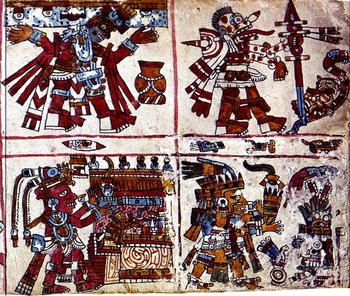
A repainted page of the Codex Vaticanus B. The bottom right quarter of the page was repainted in antiquity, after a bright white material was applied to re-plaster the area. Codex Vaticanus B, p. 20. Image ©Vatican Apostolic Library, Rome.

The fresh evidence obtained from the recent physicochemical studies and the macroscopic examination of the Mesoamerican codices reveal a diversity of painting techniques. The specificities and commonalities of these traditions are presently under analysis by Domenici (Reference Domenici2013, Reference Domenici2016; also Domenici et al. Reference Domenici, Buti, Miliani, Brunetti, Sgamellotti, Sgamellotti, Brunetti and Miliani2014) and will not been fully discussed here. It is worth highlighting, however, that the pre-Columbian Nahua codices from central Mexico—together with the Mixtec manuscripts from Oaxaca—share a common point: their chromatic palettes are complex and primarily organic in origin. These significant features distinguish them from the pre-Columbian Maya codices and the colonial manuscripts that were also illuminated with paints obtained from mineral sources and, in the case of the Maya codices, with a reduced range of colors. So, even if the compositional analyses on the pre-Columbian Nahua codices are still ongoing, I believe that the available data already offer a representative panorama of their material components, which deserve to be analyzed as a whole and compared with the historical records. In fact, to investigate the Late Postclassic Nahua society from central Mexico we have at our disposal colonial accounts that constitute a rich source of complementary information on coloring materials, in particular concerning their origins, their production process—extraction from the natural environment, technological procedure for fabrication—and their acquisition, either locally or through trade or tribute.
THE HISTORICAL SOURCES
Beyond the scientific analyses to which the Codex Borbonicus and the Borgia Group codices have been recently submitted, this corpus of manuscripts is interesting because of its association with Nahua society, peoples for whom painting practices as well as the production of colors are documented in historical records. Under the Spanish rule in Mexico, a corpus of documents was produced that addresses the extraction, preparation, procurement, and uses of the raw materials employed by the Nahua for artistic creation. For instance, testimonies about the sale and tribute of pigments and dyes occurs in various instances throughout the writings of the conquistadors (Cortés Reference Cortés1993:236; Díaz del Castillo Reference Díaz del Castillo1972:172) and chroniclers (Alva Ixtlilxóchitl Reference Alva Ixtlilxóchitl1975–1977:vol. 2, p. 108; Durán Reference Durán1995:vol. 1, p. 260), as well as in painted manuscripts like the Codex Mendoza (Berdan and Anawalt Reference Berdan and Anawalt1992) and the Matrícula de Tributos (Berdan and Durand-Forest Reference Berdan and Durand-Forest1980).
The most prominent sources pertaining to coloring materials, however, are the Florentine Codex by the Franciscan friar Sahagún (Reference Sahagún, Dibble and Anderson1953–1982, Reference Sahagún1979, Reference Sahagún, Austin and Quintana2000) and the books derived from the royal physician and naturalist Hernández's (Reference Hernández, del Pozo and d'Ardois1959–1960, Reference Hernández1998) research on the plants, animals, and minerals of New Spain. Both works contain data obtained in collaboration with indigenous informants during the second half of the sixteenth century. As such, they provide the Nahuatl names of the materials used in creating colors, as well as descriptions and images of their natural characteristics, preparation, and utilization. Additionally, the Historia antigua de México written by the eighteenth-century Jesuit Clavijero (Reference Clavijero1991) includes a chapter on “canvas and colors” (lienzos y colores), which compile information gathered from colonial documents, some of them lost today. As a whole, these historical records provide us with a rare source for the identification and understanding of the pre-Columbian and early Colonial coloring materials and artistic practices. Hence, this body of evidence can interestingly be compared with the results of physicochemical studies and macroscopic examination of the codices; even though, in doing so, some precautions must be taken.
First, we should be conscious that the data about the production, utilization, and procurement of pigments and dyes contain in the historical accounts can be incomplete and biased because these sources are often framed through the Colonial perspective of exploiting New World resources and riches. In other words, the Colonial texts addressing coloring materials can reflect the Spaniards’ interest for specific, exotic products with functional and economic potential in Europe. In that sense, it is striking that Hernández (Reference Hernández, del Pozo and d'Ardois1959–1960:vol. 3, pp. 112–113) shows interest in the Mesoamerican coloring plants, such as indigo (Indigofera suffruticosa), that could be profitably introduced or exported to Spain. In his translation of the Florentine Codex from Nahuatl to Spanish, Sahagún (Reference Sahagún, Austin and Quintana2000:vol. 3, bk. 11, pp. 1130–1131), in turn, modifies and complements the information about cochineal (Dactylopius coccus) provided by his indigenous informants, in order to stress the economic potential of the insect. This is confirmed by his statement that…
…this cochineal is well known in this land and out of it, and it is traded as far as China and Turkey. Almost all around the world it is prized and esteemed (esta grana es muy conocida en esta tierra y fuera de ella, y grandes tratos della llega hasta la China y hasta Turquía. Casi por todo el mundo es preciada y tenida en mucho) (Sahagún Reference Sahagún, Austin and Quintana2000:vol. 3, bk. 11, 1131; translation by author).
Unsurprisingly, Sahagún's declaration is in line with the enthusiasm cochineal awakened in the Spaniards during the sixteenth century (Burgoa Reference Burgoa1934:vol. 1, p. 279; Cervantes de Salazar Reference Cervantés de Salazar1952:105; Hernández Reference Hernández, del Pozo and d'Ardois1959–1960:vol. 2, pp. 315–316; Motolinía Reference Motolinía or Benavente1971:198; see also Dahlgren Reference Dahlgren De Jordan1963; Lee Reference Lee1948).
While this characteristic of the colonial sources should definitely be taken into account, we should also stress that Sahagún's indigenous collaborators demonstrate in the Florentine Codex a robust knowledge about the codices palettes. In this work, a whole chapter (Chapter 11 of Book XI) is devoted to the coloring materials used by painters, scribes, and dyers at the end of the pre-Columbian period and the beginning of the Colonial era (Dupey Reference Dupey García2015c; Sahagún Reference Sahagún, Dibble and Anderson1953–1982:vol. 12, bk. 11, pp. 239–245). As I have shown elsewhere (Dupey Reference Dupey García2015a:156–158), apart from its contents, the structure of this specific chapter is illustrative, because it reveals how the Nahua categorized coloring materials as a function of their uses. Significantly, the first part of the chapter concerns the materials used by the painters of codices—for the images of that section only depict artists illuminating manuscripts—whereas the second part discusses materials employed both to paint codices and to dye fibers (Falcón Reference Falcón Álvarez2014:31–33), as well as paints that were obtained with a method close to dyeing, that is through fixing a colorant on a mineral substrate. The rest of the chapter deals with the pigments employed to color sculpture, pottery and murals, amongst other media. This is, of course, revealing because it shows that Sahagún's informants were particularly interested in, and aware of, the art of manuscript painting, for they centered the two first parts of the Florentine Codex chapter on colors on the topic of paints for codices (see also Magaloni Reference Magaloni Kerpel2014:26–27, 19–20).
Returning to our attempt to contrast the historical data and the results of the scientific analyses, this effort is complicated by our ignorance of the exact provenance of the Borgia Group codices. Although the Nahua affiliation of these manuscripts has been proven, we cannot assume a priori the existence of a consistent color technology through the entire Nahua cultural area during the Late Postclassic. As aforementioned, however, the physicochemical characterization studies revealed that, from a material perspective, the pre-Columbian Nahua manuscripts shared—together with the Mixtec codices from Oaxaca—some distinctive features within the broader corpus of Mesoamerican codices, among which are their palettes largely based on organic coloring materials. This convergence suggests that, despite probable geographical and temporal variations, the Nahua area presented important common traits in terms of color technology and codex-painting tradition. Such assertion is confirmed by the data recorded in Sahagún and Hernández's works, where the prevalence of an organic palette to paint codices is also documented. Moreover, it is significant that the information about coloring materials contained in these colonial texts often match, suggesting certain standardization in the artists’ palettes.
In sum, I state that it is worth bringing together and comparing the information on the materiality of color obtained from science, with references within the Colonial era historical accounts. As we will see, the Colonial literature helps to fill gaps left by the physicochemical studies—which still struggle to characterize some organic components—and, therefore, historical documentation contributes to the reconstruction of the chromatic palettes used by the Nahua painters of codices in the years preceding the conquest of Mexico.
WHITE BACKGROUND
The Mixteca-Puebla codices were painted on bark paper or bands of animal hide. The dimensions of the latest suggest that they came from either white tail deer (Odocoileus virginianus) or pronghorn (Antilocapra americana)—a hypothesis supported by the only existing analysis of the hide base of a Mixteca-Puebla manuscript, of the Codex Colombino specifically, which indicates that it came from one of the two aforementioned animal species (Álvarez Reference Álvarez, Caso and Smith1966:102). These bands of hide were subjected to a careful process of preparation that included cleaning, depilation, and tanning (Maldonado and Maldonado Reference Maldonado Alvarado and Alvarado2004; Zetina et al. Reference Zetina, Ruvalcaba, Falcón, Alatorre, Yanagisawa, Icaza Longoria, Hernández, Sgamellotti, Brunetti and Miliani2014), before being covered with a plaster that became the firm background to which colors were applied. Macroscopic inspections of the codices suggest that this preparatory layer of plaster was burnished before the painting sessions started, in order to guarantee the homogeneity and smoothness of the ground (Álvarez Icaza Reference Álvarez Icaza Longoria2014; Cassidy Reference Cassidy2004; Dupey Reference Dupey García2017).
Physicochemical characterization studies carried out on the Mixteca-Puebla codices revealed their preparatory layers of plaster are mostly composed of calcium sulfate (CaSO4·2H2O), commonly known as gypsum. Specifically, the Cospi’s preparatory layer is made of gypsum with minor traces of calcium carbonate, while the Fejérváry-Mayer’s is a mixture of gypsum and anhydrite (CaSO), the anhydrous form of calcium sulfate (Domenici et al. Reference Domenici, Buti, Miliani, Brunetti, Sgamellotti, Sgamellotti, Brunetti and Miliani2014:101; Laurencich et al. Reference Laurencich Minelli, Gasparotto and Valdrè1993:204; Miliani et al. Reference Miliani, Domenici, Clementi, Presciutti, Rosi, Buti, Romani, Minelli and Sgamellotti2012:674–675). Variable amounts of gypsum were also applied on the bark paper of the Codex Borbonicus (Pottier et al. Reference Pottier, Michelin, Andraud, Goubard and Lavédrine2016), as well as the hide base of the Mixtec codices (González Reference González Tirado1998:50; Higgitt Reference Higgitt2013; Strebinger Reference Strebinger and Nowotny1961:23; Torres et al. Reference Torres, Sotomayor, Álvarez, Caso and Smith1966:91; Zetina et al. Reference Zetina, Falcón, Arroyo, Ruvalcaba, Wolf and Connors2011:352–353, Reference Zetina, Ruvalcaba, Falcón, Alatorre, Yanagisawa, Icaza Longoria, Hernández, Sgamellotti, Brunetti and Miliani2014:127, 135). Moreover, preparatory layers of gypsum—sometimes mixed with clay or calcium carbonate—have been identified in colonial manuscripts from central Mexico, the Mixtec region, and the Mexican state of Guerrero (Dark and Plesters Reference Dark and Plesters1959:532; González Reference González Tirado1998:27–28, 89; Zetina et al. Reference Zetina, Ruvalcaba, Cáceres, Falcón, Hernández, González, Arroyo and Turbanti-Memmi2011:353). This leads to the conclusion that gypsum was probably the most common material used to prepare pre-Columbian codex plasters throughout central Mexico and Oaxaca.
In Mesoamerican codices, the white plaster that supports the pictorial layer also serves to represent the white color. In other words, painters did not use a pigment to paint things white; they rather let the white background appear in the figures where white was needed. When artists partially or even totally covered particular sections of their work before repainting them, however, they often used visibly different whites to do so. This is evident in the Codex Borbonicus (Anders et al. Reference Anders, Jansen and García1991b:11, 12; see also Paso y Troncoso Reference Paso y Troncoso1898:2–3, 6–7) and the Codex Borgia (Anders et al. Reference Anders, Jansen and García1993a:11–15, 49, 53; see also Mikulska Reference Mikulska2015:172–177), where the retouches are executed with a more covering material and, in the case of the Borgia, also a more brilliant one than the dull white of the preparatory layer. Some of the repainted pages of the Vaticanus B (Anders et al. Reference Anders, Jansen and García1993b:12, 20, 71–72, 95–96) are similarly covered with a new white plaster, whose distinctive shine results from small crystals discernible to the naked eye (Figure 1). The physicochemical study of the Codex Borbonicus shows that the correction material has the same composition than the preparatory layer: it is made of gypsum (Pottier et al. Reference Pottier, Michelin, Andraud, Goubard and Lavédrine2016). In the Borgia Group, the identification of the correcting whites has not been revealed yet, but their distinct appearance invites some remarks.
The physicochemical characterization studies performed on the Codices Cospi and Fejérváry-Mayer have revealed that the white plaster that served as a preparatory layer was applied to the hide base in a single episode, independently of the subsequent painting sessions (Domenici et al. Reference Domenici, Buti, Miliani, Brunetti, Sgamellotti, Sgamellotti, Brunetti and Miliani2014:102–103; Miliani et al. Reference Miliani, Domenici, Clementi, Presciutti, Rosi, Buti, Romani, Minelli and Sgamellotti2012). This scientific discovery recalls Cortés’ (Reference Cortés1993:326) letters, in which the conqueror wrote that in Tlatelolco's market “deer hides with and without hair, dyed white and variously colored” (cueros de venado con pelo y sin él, teñidos blancos y de diversas colores) were sold (translation by author). This excerpt suggests that the preparation of the hide base of the codices—including the application of the preparatory layer—was perhaps not part of the painters’ work and, as so, was not carried out in their workshops. If the artists could acquire the hide base of would-be codices already whitened in the market, then it is logical that they did not always have the white material used to plaster the ground on hand when they were making corrections while painting. This could explain why in the Codices Borgia and Vaticano B, we observe such a difference between the dull white plaster smeared on the support and the brilliant whites used on the pentimenti.
We know that white products obtained from calcium carbonate or diatomite—a sedimentary rock formed by the fossilized siliceous skeletons of some microscopic algae, known as diatoms—were available in the painters’ workshops. Physicochemical characterization studies have demonstrated that some of the colors applied in the pre-Columbian and Colonial manuscripts, for instance the Codex Borbonicus and the Codex Zouche-Nuttall, were mixed with calcium carbonate in order to lighten their hue (Higgitt Reference Higgitt2013; Pottier et al. Reference Pottier, Michelin, Andraud, Goubard and Lavédrine2016; see also Baglioni et al. Reference Baglioni, Giorgi, Arroyo, Chelazzi, Ridi, Magaloni Kerpel, Wolf and Connors2011:90; Rodgers and Albro Reference Rodgers Albro and Albro1990; Torres et al. Reference Torres, Sotomayor, Álvarez, Caso and Smith1966:92). Likewise, diatomite—known as tizatl in Nahuatl (Díaz Lozano Reference Díaz Lozano1917; Sánchez Reference Sánchez Tornero2013)—was employed to lighten cochineal according to Sahagún's informants (Dupey Reference Dupey García2015c:225, 232). Consequently, it is worth considering that the shiny white materials used for corrections in the Codices Borgia and Vaticanus B could have come from other materials than gypsum, for example calcium carbonate and diatomite. Hopefully, future scientific studies will confirm or refute this hypothesis.
The historical records bring further information on the white materials from which codices’ plasters were obtained. The chapter on colors of Sahagún's Florentine Codex mentions four kinds of white minerals. One of them was called xicaltetl, which literally means “gourd stone.” As its name indicates, this inorganic product was related to certain varieties of gourds that the Nahua peoples called xicalli and tecomatl (Dupey Reference Dupey García2015c:228, 240; Hernández Reference Hernández, del Pozo and d'Ardois1959–1960:vol. 3, p. 410). From pre-Columbian times until the present, these items have been divided into halves in order to make bowls, plastered, and decorated through painting. Hernández (Reference Hernández, del Pozo and d'Ardois1959–1960:vol. 3, p. 410) indicates that the xicaltetl was actually the …
… white and mineral colorant with which they first coat what they called xícaras, for the colors they will applied later will adhere more firmly and cannot be scrape (colorante blanco y mineral con que se untan primero las llamadas xícaras, para que los colores después aplicados se adhieran más firmemente y no puedan rasparse ni borrarse de manera alguna; translation by author).
Interestingly, this technique is still in use today among the maque artists from the state of Guerrero, who apply a powdered white mineral, still known as “xicaltetl stone” (texicaltetl) in the eighteenth-century (Meave Reference Meave and Alzate y Ramírez1831[1791]:215), to the surface of the gourds after they have been coated with oil and before covering them with colors.Footnote 4
The other white materials described in Sahagún's work seems to all be related, as each includes the word tizatl in its name. These were tizatl, tetizatl or “tizatl stone,” and chimaltizatl or “tizatl shield” (Dupey Reference Dupey García2015c:227–228, 239–241). As above said, tizatl was the term employed to refer to diatomite. With regard to tetizatl and chimaltizatl, I posit that these names could have been given to the calcium sulfate-based minerals used to prepare the plaster of Nahua codices. Sahagún's informants state that the tetizatl was applied to different kinds of surfaces (Dupey Reference Dupey García2015c:228, 240), but Hernández (Reference Hernández, del Pozo and d'Ardois1959–1960:vol. 3, p. 408) stressed that it was the white stone used by painters. Regrettably, the Colonial records are not more specific when it comes to tetizatl and translations of this word by sixteenth century authors also lack precision. Sahagún (Reference Sahagún, Austin and Quintana2000:vol. 2, bk. 10, pp. 906, 920) interprets it either as “cooked gypsum” (hueso [sic] cocido) or as “clay” (greda), whereas his order brother Molina (Reference Molina1970:pt. 1, f. 74r, pt. 2, f. 159r) attributes the same meaning of “gypsum” (yeffo) to tetizatl, but also to xicaltetl.
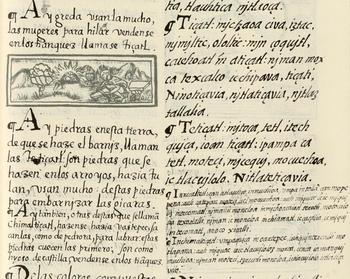
Some modern scholars, on the other hand, translate tetizatl as limestone (Dibble and Anderson in Sahagún Reference Sahagún, Dibble and Anderson1953–1982:vol. 12, bk. 11, p. 244; Miriello et al. Reference Miriello, Barca, Crisci, Barba, Blancas, Ortíz, Pecci and Luján2011:1121), which is a sedimentary stone mostly composed of calcite, a mineral formed of calcium carbonate crystals. Miriello et al. (Reference Miriello, Barca, Crisci, Barba, Blancas, Ortíz, Pecci and Luján2011:1121) even identified the tetizatl with the limestone the Mexica brought from the area surrounding Tula in the Mexican state of Hidalgo—where important deposits existed in pre-Columbian times—to fabricate the lime plasters of the Great Temple of their capital, Tenochtitlan. This hypothesis is based on a passage of the Spanish text of the Florentine Codex, which mentions that the tetizatl was extracted from “the streams, towards Tullan” (los arroyos, hacia Tullan) (Sahagún Reference Sahagún, Austin and Quintana2000:vol. 3, bk. 11, p. 1132). The interpretation of this excerpt is doubtful, however, for it combines, either by mistake or intentionally, the attributes of the tetizatl and the xicaltetl. These attributes are otherwise differentiated in the Nahuatl text of the Florentine Codex, which makes clear that the white rock that comes from nearby Tollan is the xicaltetl, not the tetizatl (Figure 2; Dupey Reference Dupey García2015c:228, 240).
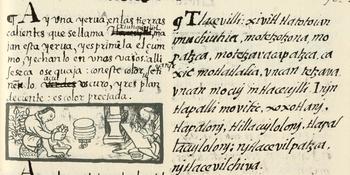
Illustrated description of the white materials tizatl, tetizatl, xicaltetl, and chimaltizatl in the Florentine Codex of Sahagún. The Spanish column of the text (on the left) combines the data about the tetizatl and the xicaltetl, although these two minerals are differentiated in the Nahuatl column (on the right). The illustration shows the tetizatl being fired and grounded, as well as a vessel that suggests this material was used to whiten ceramics. Florentine Codex, vol. 3, bk. 11, f. 372r (detail). Image ©Biblioteca Medicea Laurenziana, Florence.

Furthermore, the identification of the tetizatl with lime is debatable because the Nahuatl name for quicklime is not tetizatl (“tizatl stone”) but tenextli (“ash stone”), while the stones used to prepare it were called tenextetl (“tenextli stone”). In Sahagún's (Reference Sahagún, Dibble and Anderson1953–1982:vol. 12, bk. 11, p. 264) treatise on the natural world, these stones are not described among coloring materials but among the building materials. Consequently, it is worth considering the possibility that tetizatl was the term Nahua peoples employed to refer to gypsum, or at least to some kind of gypsum, in view of Sahagún and Molina's translations. In favor of this identification, it should be mentioned that the calcination of the stones described in the preparation of the tetizatl recalls the process of making plaster through burning gypsum. Also, the historical accounts relate, as previously mentioned, that the tetizatl was used to whiten a diversity of surfaces in Nahua art (Figure 2). This coincides with what is known about the artistic uses of gypsum in central Mexico, which could serve as both slip for ceramics (Sánchez Reference Sánchez Tornero2013:250, 261) and plaster for codices.
Turning to the chimaltizatl, the “shield tizatl,” the colonial literature describes it as a transparent and brilliant white mineral with a laminar structure. It is from this trait that its Nahuatl name is derived, because the chimaltizatl stone tends to separate itself in sheets that the Nahua compared to shields (Hernández Reference Hernández, del Pozo and d'Ardois1959–1960:vol. 3, p. 405). These features allow the identification of this white mineral with a crystalline and lamellate variety of gypsum, currently known as selenite and referred to as “specular stone” in sixteenth-century Spanish. This identification, based on correspondence of physical characteristics, is also supported by comments about the chimaltizatl found in historical texts: Hernández (Reference Hernández, del Pozo and d'Ardois1959–1960:vol. 3, p. 405) indicates that “it is a kind of gypsum” (una especie de yeso); Sahagún (Reference Sahagún, Austin and Quintana2000:vol. 3, bk. 11, p. 1132) writes it is like “gypsum from Castilla” (yeso de Castilla); and Molina (Reference Molina1970:pt. 2, f. 21r, pt. 1, f. 18v) is more precise, defining it as a “specular stone's gypsum” (yeso de espejuelo).
As with other kinds of gypsum, selenite can be transformed into a pigment by calcining the raw stones obtained in nature. Interestingly, this information appears in the historical sources, which reveal that the chimaltizatl stones were burned, then ground, and, finally, mixed with an orchid gum binder called tzacutli, in order to prepare a material to paint things white (Dupey Reference Dupey García2015c:228, 241; Hernández Reference Hernández, del Pozo and d'Ardois1959–1960:vol. 2, p. 118, vol. 3, p. 405). Thus, according to Domenici et al. (Reference Domenici, Buti, Miliani, Brunetti, Sgamellotti, Sgamellotti, Brunetti and Miliani2014:103), the chimaltizatl “is the best candidate as the Nahuatl name of the gypsum used on the Borgia Group and Mixtec codices.” I agree with this idea on the basis of some additional evidence provided by Sahagún (Reference Sahagún, Austin and Quintana2000), Molina (Reference Molina1970), and Clavijero (Reference Clavijero1991), which confirm that the chimaltizatl specifically served to plaster the codices. The last of these authors mentions this material in a passage of his book devoted to the colors used to paint canvas, which actually concerns codices (Clavijero Reference Clavijero1991:249). Sahagún (Reference Sahagún, Austin and Quintana2000:vol. 3, bk. 11, p. 1132) and Molina (Reference Molina1970:pt. 2, f. 21r, pt. 1, f. 18v), in turn, describe the chimaltizatl as one of the white varnishes employed by the Nahua. In sixteenth century Spain, the word “varnish” (barniz) referred to a mixture of resin and oil that was applied to hide, paper, or fabric surfaces to give them rigidity and prepare them to receive colors and inks (Covarrubias Reference Covarrubias Orozco, Arellano and Zafra2006:ff. 351r, 441v, 448v). Although this western organic varnish was quite different from the inorganic chimaltizatl, it is viable that friars like Sahagún and Molina considered the use of these two materials—which confer rigidity to diverse painting supports—similar enough to warrant their shared categorization as “varnish.” In doing so, they corroborate that the variety of gypsum known as chimaltizatl in Nahuatl was one of the white mineral that served to manufacture the plaster applied as a preparatory layer on the Nahua codices.
COLORS
Scientific research on the materiality of the Mixteca-Puebla codices has revealed that, unlike the white mineral plasters discussed above, their chromatic palettes mostly originated in organic materials, that is, they were produced using dyes. This finding recalls an observation by the Franciscan friar Motolinía (Reference Motolinía or Benavente1971:218), who explained that…
…the Indians make many colors from flowers, and when the painters want to pass the brush from one color to another, they clean the brush in their mouths, since the colors are made of flowers (muchas colores hacen los indios de flores, y cuando los pintores quieren mudar el pincel de una color en otra, con la boca limpian el pincel, por ser las colores de flores; translation by author).
More specifically, the colors of the codices could be dyes that were extracted, purified, mixed with a binder, and directly used to paint. Most of these dyes, however, were converted into organic-inorganic coloring materials, so as to reach the stability and aesthetic quality that their application in the codices required. Among these, we find lake-pigments that were obtained by precipitating one or various dyes on metallic salts—alum (KAl(SO4)2·12H2O), niter (KNO3), and copperas (FeSO4)—as well as other organic-inorganic colors originated in dyes and specific types of clay (Dark and Plesters Reference Dark and Plesters1959:537–539; Falcón Reference Falcón Álvarez2014:9–15; Wallert Reference Wallert, Vandiver, Druzik, Galvan Madrid, Freestone and Wheeler1995:654). In both cases, the creation of these hybrid paints was reminiscent of the dyeing process (Zetina et al. Reference Zetina, Ruvalcaba, Falcón, Alatorre, Yanagisawa, Icaza Longoria, Hernández, Sgamellotti, Brunetti and Miliani2014:137), since it involved heating up the organic and inorganic materials together in order for the dye to fix itself onto the inert substrate particles (Cardon Reference Cardon2007:20–50; Roquero Reference Roquero2006:89–105). The resulting precipitate was filtered and left to dry so that it could be converted into a color for painting.
Black-Related Palette
In the Codex Borbonicus and the Borgia Group, the visual properties of the black color are extremely consistent. In general, the blacks are brilliant, opaque, and their texture is homogeneous. This observed uniformity coincides with the results of the physicochemical characterization studies carried out on this body of manuscripts and, more broadly, on the Mixteca-Puebla codices. These studies have shown that the blacks used in these art pieces are composed of vegetal carbon-based materials (Domenici et al. Reference Domenici, Buti, Miliani, Brunetti, Sgamellotti, Sgamellotti, Brunetti and Miliani2014:104; Miliani et al. Reference Miliani, Domenici, Clementi, Presciutti, Rosi, Buti, Romani, Minelli and Sgamellotti2012:675; Pottier et al. Reference Pottier, Michelin, Andraud, Goubard and Lavédrine2016; Strebinger Reference Strebinger and Nowotny1961:23; Torres et al. Reference Torres, Sotomayor, Álvarez, Caso and Smith1966:92; Zetina et al. Reference Zetina, Falcón, Arroyo, Ruvalcaba, Wolf and Connors2011:352–353, Reference Zetina, Ruvalcaba, Falcón, Alatorre, Yanagisawa, Icaza Longoria, Hernández, Sgamellotti, Brunetti and Miliani2014:132, 135–136). Similarly, the utilization of carbon to draw and paint has been detected in some colonial documents (Dark and Plesters Reference Dark and Plesters1959:532; González Reference González Tirado1998:27, 85–87; Haude Reference Haude1998; Newman and Derrick Reference Newman, Derrick, Miller and Mundy2012:98; Rodgers and Albro Reference Rodgers Albro and Albro1990; Zetina et al. Reference Zetina, Ruvalcaba, Falcón, Hernández, González, Arroyo and Cáceres2008, Reference Zetina, Ruvalcaba, Cáceres, Falcón, Hernández, González, Arroyo and Turbanti-Memmi2011:353), in spite of the introduction of iron tannin inks—in particular iron gall ink—by the Spaniards in the sixteenth century (Baglioni et al. Reference Baglioni, Giorgi, Arroyo, Chelazzi, Ridi, Magaloni Kerpel, Wolf and Connors2011; Hidalgo Reference Hidalgo2014; Pottier et al. Reference Pottier, Michelin, Andraud, Goubard and Lavédrine2016; Zetina et al. Reference Zetina, Ruvalcaba, Falcón, Hernández, González, Arroyo and Cáceres2008).
Historical records dealing with the pre-Columbian Nahua culture confirm the utilization of vegetal carbon for the color black, among other substances that served to make ink. As some colleagues emphasized (Domenici et al. Reference Domenici, Buti, Miliani, Brunetti, Sgamellotti, Sgamellotti, Brunetti and Miliani2014:104; Miliani et al. Reference Miliani, Domenici, Clementi, Presciutti, Rosi, Buti, Romani, Minelli and Sgamellotti2012:675), colonial texts also provide the Nahuatl name of this material and explain the technique used by the natives to prepare it. When defining the archetype of the painter, Sahagún's (Reference Sahagún, Dibble and Anderson1953–1982:vol. 11, bk. 10, p. 28) informants refer to his tools, among them a material they call tlilli and they present as a synonym of tecolli, “charcoal.” In the text based on this passage that Sahagún (Reference Sahagún, Austin and Quintana2000:vol. 2, bk. 10, p. 875) composed in Spanish, he mentions this same detail, writing that the profession of the painter is “to know how to use colors and to draw or draft the images with charcoal” (saber usar de colores y debuxar o señalar las imágines con carbón; translation by author). Molina (Reference Molina1970:pt. 2, f. 147v), in contrast, translates tlilli as “ink” (tinta), without stating its presumably black color nor its source. Opportunely, the chapter on colors of the Florentine Codex contributes to reconcile both definitions of tlilli, ink and charcoal, explaining that it is the “pine smoke, pine soot” (ocotl ipocyo, ocotl icalcuichiyo), which was grinded and diluted in water in order to make a black color to draw and paint (Dupey Reference Dupey García2015c:227, 238). The same idea is expressed by Sahagún (Reference Sahagún, Austin and Quintana2000:vol. 3, bk. 11, p. 1132), who says that “the natives make ink from the smoke of torches, and it is a very fine ink. They call it tlilli ocótl” (Hacen estos naturales tinta del humo de las teas, y es tinta bien fina. Llámanla tlilli ócotl; translation by author). Hernández (Reference Hernández, del Pozo and d'Ardois1959–1960:vol. 3, p. 409), for his part, casts light on the preparation procedure of the ocotlilli, which was made
…with the smoke of the splinters of any kind of pine (ócotl in the native language, from which the ink got its name) that are condensed inside of closed pots into small spheres, which are frequently sold in the market after they are extracted (con humo de astillas de cualquier pino (ócotl en la lengua vernácula y de donde la tinta toma el nombre), que dentro de vasijas cerradas se condensa en pelotillas, las cuales arrancadas luego se venden con frecuencia en los mercados; translation by author].
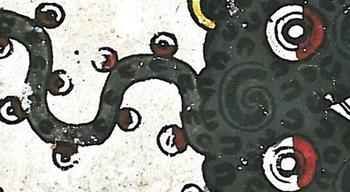
The physicochemical characterization studies performed on the grays that appear in Mixteca-Puebla codices also suggest that they were created from carbon-based materials. The study of the Codex Colombino, for instance, reveals that its gray color was a mixture of the black paint employed in this manuscript with calcium carbonate (Torres et al. Reference Torres, Sotomayor, Álvarez, Caso and Smith1966:92). My inspection of the Codex Borbonicus and the Borgia Group codices has led me to discover that they display at least one gray shade, sometimes two—a lighter one and a darker one—as in the Cospi reverse and the Borgia. While many of these gray shades were probably obtained by thinning the carbon black or lightening it with a white pigment, it is also worth considering that darker gray tones could resulted from a superimposition of layers. On page 36 of the Codex Borgia, for example, volutes of light and less saturated gray emerge from a dark gray shape, suggesting the application of several layers to obtain the central darker tone (Figure 3).
Gray tones in the Codex Borgia. The darker gray (on the right) seems to result from the superimposition of at least two layers of the light gray (on the left). Codex Borgia, p. 36 (detail). Image ©Vatican Apostolic Library, Rome.

Red Palette
Red is another color whose visual properties are generally consistent in the pre-Columbian Nahua codices. Most of the reds in this body of documents are vivid and saturated (Dupey Reference Dupey García2017; Dupey and Álvarez Icaza Reference Dupey García, Álvarez Icaza Longoria, Gonzalbo, Álvarez and Longoria2017), while their hue is reminiscent of the color of cochineal. These remarks are based on the examination of the original manuscripts and coincide with the results of the scientific studies executed on the Codices Borbonicus, Cospi, and Fejérváry-Mayer (Domenici et al. Reference Domenici, Buti, Miliani, Brunetti, Sgamellotti, Sgamellotti, Brunetti and Miliani2014; Miliani et al. Reference Miliani, Domenici, Clementi, Presciutti, Rosi, Buti, Romani, Minelli and Sgamellotti2012; Pottier et al. Reference Pottier, Michelin, Andraud, Goubard and Lavédrine2014, Reference Pottier, Michelin, Andraud, Goubard and Lavédrine2016), as well as the pre-Columbian Mixtec manuscripts (Higgitt Reference Higgitt2013; Nowotny and Strebinger Reference Nowotny and Strebinger1959; Strebinger Reference Strebinger and Nowotny1961; Torres et al. Reference Torres, Sotomayor, Álvarez, Caso and Smith1966; Zetina et al. Reference Zetina, Ruvalcaba, Falcón, Alatorre, Yanagisawa, Icaza Longoria, Hernández, Sgamellotti, Brunetti and Miliani2014). With different degrees of certainty, these studies show that the red colors in the Mixteca-Puebla codices were prepared with an organic material of animal origin, whose features are similar to those of cochineal. Specifically, a hybrid organic-inorganic color made of cochineal probably precipitated on clay was characterized on the Codex Fejérváry-Mayer (Domenici et al. Reference Domenici, Buti, Miliani, Brunetti, Sgamellotti, Sgamellotti, Brunetti and Miliani2014:105–106), whereas the red paints of the Codex Borbonicus were identified as cochineal lake-pigments, apparently elaborated with aluminum (Pottier et al. Reference Pottier, Michelin, Andraud, Goubard and Lavédrine2014, Reference Pottier, Michelin, Andraud, Goubard and Lavédrine2016). On the reverse pages of the Cospi only cochineal has been observed, but on the obverse pages this material was mixed with another organic red (Miliani et al. Reference Miliani, Domenici, Clementi, Presciutti, Rosi, Buti, Romani, Minelli and Sgamellotti2012:675, 677). Red mixtures also appear in the colonial corpus, where cochineal—occasionally associated with alum and clay—was also detected, as well as inorganic substances like hematite, minium (Pb3O4) and cinnabar (HgS), sometimes mixed together or with dyes in order to generate new hues (Baglioni et al. Reference Baglioni, Giorgi, Arroyo, Chelazzi, Ridi, Magaloni Kerpel, Wolf and Connors2011; Dark and Plesters Reference Dark and Plesters1959; González Reference González Tirado1998; Haude Reference Haude1998; Magaloni Reference Magaloni Kerpel, Wolf and Connors2011, Reference Magaloni Kerpel, Miller and Mundy2012; Newman and Derrick Reference Newman, Derrick, Miller and Mundy2012; Zetina et al. Reference Zetina, Ruvalcaba, Cáceres, Falcón, Hernández, González, Arroyo and Turbanti-Memmi2011).
As stated above, the use of cochineal as a coloring material appealed to Sahagún and is extensively described in his Florentine Codex. Chapter 11 of Book XI first cites the nocheztli, literally “prickly pear blood,” which can easily be recognized as the insect Dactylopius coccus that lives on the prickly pear (Opuntia spp.). In the words of Sahagún's informants, the accumulation of these insects on the leaves are like bloody wounds and their “color is not clean, it is only of dark surface, still like dry blood” (Inin tlapalli ayamo chipahuac, zan ixtlilectic, zan oc iuhquin ezuacqui) (Dupey Reference Dupey García2015c:225, 229–230). This description clears up that the term nocheztli designated the raw or just collected cochineal. According to Molina (Reference Molina1970:pt. 1, f. 66v), tlapalli, in contrast, was the name that the Nahua gave to the “refined cochineal” (grana refinada); a data also mentioned by Sahagún's informants, who name the cochineal used to dye and paint, tlapalatl, “tlapalli water,” tlacuahuac tlapalli, “hard tlapalli,” and tlapalnextli, “ashen tlapalli,” depending on its origin, quality, and preparation (Dupey Reference Dupey García2015c:225–227, 231–232, 236). They also resort to tlapalli or the root tlapal- when they explain the possible uses of cochineal (Dupey Reference Dupey García and Carastro2009:213–214, Reference Dupey García2010:45–49).
In Nahuatl, the word tlapalli was polysemous. It literally means “something dyed,” but the Nahua also used tlapalli and its derivatives to refer more generally to “color,” as well as to all kinds of coloring materials, like paints, dyestuffs, and cosmetics. Besides transmitting the meanings of “color” and “coloring material,” tlapalli was often employed to designate and describe red things. Making the most of the polysemy of this word, the Nahua used it to name cochineal, the material par excellence to paint and dye in red. It is complex to establish if its meanings of “coloring material” and “red” determined the use of tlapalli to designate cochineal, or, if to the contrary, the link between tlapalli and dying activities and dyestuffs motivated its use as a referent to red things. It is clear, however, that tlapalli’s multiple meanings made it the ideal name for cochineal, especially if we also consider the ties between the words tlapalli and eztli, “blood,” within the context of Nahuatl metaphors, as well as the affinities the Nahua perceived between blood and cochineal (Dupey Reference Dupey García and Carastro2009, Reference Dupey García2010:22–60, Reference Dupey García and Goldman2016).
Returning to the presence of cochineal in the palettes of codices, I concur with Falcón (Reference Falcón Álvarez2014:26) that tlacuahuac tlapalli or “hard tlapalli” was the Nahuatl name for at least one of the cochineal-based paints used in the Mixteca-Puebla manuscripts. Sahagún's informants say that the tlacuahuac tlapalli was “excellent, firm, […] very red, red like blood, like fresh blood” (cualli chicahuac […] huel chichiltic, huel eztic; iuhquin xoxouhqui eztli) (Dupey Reference Dupey García2015c:225, 231; translation by author), a description that coincides with the visual qualities of the red hues that appear in the pre-Columbian Nahua codices. Additionally, the historical records relate that this cochineal-based color was used by the painters, who acquired it in the form of dried cakes—called “tortilla” (tlaxcalli) by the Nahua—on the market stall of the merchant of colors (Dupey Reference Dupey García2015c:225, 231–232; Hernández Reference Hernández, del Pozo and d'Ardois1959–1960:vol. 2, p. 315; Sahagún Reference Sahagún, Dibble and Anderson1953–1982:vol. 11, bk. 10, p. 77, Reference Sahagún, Austin and Quintana2000:vol. 2, bk. 10, p. 906, vol. 3, bk. 11, p. 1130). As demonstrated by Falcón (Reference Falcón Álvarez2014:27–36), Sahagún and Hernández's texts even allow a more precise understanding of the origin and the nature of the tlacuahuac tlapalli, since they explain that it was accomplished by mixing and warming up cochineal with alum, copperas—that intensifies colors—and the leaves of the tezuatl plant (Miconia sp.) that contain aluminum and act as a vegetal mordent (see also Anderson Reference Anderson1963:76, 80; Donkin Reference Donkin1977:19; Roquero Reference Roquero2006:94–95, 103, 140). It was thus a red lake-pigment made with cochineal and aluminum, just like the red paints used in the Codex Borbonicus (Pottier et al. Reference Pottier, Michelin, Andraud, Goubard and Lavédrine2014, Reference Pottier, Michelin, Andraud, Goubard and Lavédrine2016).
Beside the hybrid organic-inorganic colors based on cochineal, the central Mexican painters of codices resorted to other red coloring materials obtained from diverse organic sources. As stated above, the physicochemical study of the Codex Cospi has revealed the presence on the obverse pages of a mixture made of two red dyes, one of which was probably cochineal, while the other has not yet been identified (Miliani et al. Reference Miliani, Domenici, Clementi, Presciutti, Rosi, Buti, Romani, Minelli and Sgamellotti2012:677). Under these circumstances, the historical sources provide—as already shown by Domenici et al. (Reference Domenici, Buti, Miliani, Brunetti, Sgamellotti, Sgamellotti, Brunetti and Miliani2014:105–106)—an interesting avenue to formulate hypotheses regarding the origin and preparation of the codices’ colors. In fact, apart from cochineal, Sahagún and Hernández's texts refer to various plants and trees that served to create red paints. Among them, the annatto (Bixa orellana) stands out. This plant and the coloring material derived from it are also known as achiote, a name that comes from the Nahuatl term achiyotl.
Together with the coloring materials derived from cochineal, the achiyotl is described in the first part of the Florentine Codex’s chapter on colors (Dupey Reference Dupey García2015c:226, 233–234), which makes special emphasis, as I mentioned above, on the paints used to illuminate the manuscripts. For his part, Hernández (Reference Hernández, del Pozo and d'Ardois1959–1960:vol. 2, p. 28) stresses that the annatto seeds “serve the painters to make the scarlet color” (sirve a los pintores para dar el color escarlata; translation by author), and roughly explains how the Nahua prepared it. His description mentions that the seeds were soaked in water and agitated, then “sediment” was extracted and left to settle before being shaped in the form of small loaves of bread that were sold in the market (see also Clavijero Reference Clavijero1991:249; Sahagún Reference Sahagún, Austin and Quintana2000:vol. 3, bk. 11, p. 1131). Although Hernández's record does not reveal if some other ingredients were added to the annatto seeds in this recipe, Vázquez de Ágredos (Reference Vázquez de Ágredos Pascual2010:103; also Vázquez de Ágredos et al. Reference Vázquez de Ágredos Pascual, Batista dos Santos and Yusa-Marco2010:99) indicates that they need to be crushed and soaked in alkaline solutions—generally obtained from the fat oils of chia (Salvia hispanica L.), Mexican prickly poppy or chicalote (Argemone mexicana L.), pumpkin (Curcubita pepo) seeds, and mamey zapote (Pouteria sapota)—in order to precipitate as sediment.
For Sahagún's informants, the difference between the colors made with annatto and those prepared with cochineal lays in their tonality. The shade of the cochineal lake-pigment known as tlacuahuac tlapalli was defined as chichiltic and eztic, while that of the annatto color called achiyotl was said tlatlauhqui and tlatlactic (Dupey Reference Dupey García2015c:225–226, 230–231, 233–234). These four terms are adjectives that refer to different red hues in Nahuatl (Dupey Reference Dupey García2010:280–284). This stated tonal difference between the colors obtained from cochineal and annatto could explain why, according to Motolinía (Reference Motolinía or Benavente1971:218), these two coloring materials were blended together to create a composite red paint; a piece of information that recalls the red paint applied on the Codex Cospi obverse, made of cochineal combined with another organic red.
It is also possible, however, that the mixed red in the Cospi might have been created by mixing cochineal and brazilwood. Indeed, the Colonial records reveal that the ancient Nahua elaborated red paints from one of the species belonging to this family, the Haematoxylon brasiletto that they named huitzcuahuitl or “thorn tree” (Roquero Reference Roquero2006:119–129). Sahagún and Hernández's treatises agree that a red coloring material was extracted from the splinters of the huitzcuahuitl. These were macerated in water with alum in order to clarify or intensify the color, but the historical sources differ about how this material was used. Sahagún (Reference Sahagún, Austin and Quintana2000:vol. 3, bk. 11, p. 1131) and his informants maintain that it did not serve to paint, only to dye (Dupey Reference Dupey García2015c:226, 234–235). Hernández (Reference Hernández1998:vol. 2, pp. 380–381), on the other hand, affirms that the water in which the wood macerated with alum was strained to make a color for the painters—that is a lake-pigment—whose “red was more beautiful than cinnabar” (rojo más bello que el cinabrio; translation by author; see also Fernández de Oviedo Reference Fernández de Oviedo y Valdés1944:vol. 2, p. 298). According to the Florentine Codex, the tonality of the coloring material extracted from the huitzcuahuitl was close to that of cochineal, because Sahagún's informants resorted to the same color term—chichiltic—to describe both of them (Dupey Reference Dupey García2015c:225–226, 230–231, 234–235; see also Baglioni et al. Reference Baglioni, Giorgi, Arroyo, Chelazzi, Ridi, Magaloni Kerpel, Wolf and Connors2011). This source also confirms that the color obtained from the brazilwood was an intense red, for the other two chromatic adjectives Sahagún's informants employed to define it, chilpatic and chilpatzcaltic, end with the suffixes -paltic and -patzcaltic that expressed the intensity of a color in Nahuatl (Dupey Reference Dupey García2010:310–314).
Red-Related Palette
With some of the red coloring materials just mentioned, pre-Columbian artists created some of the orange, pink, purple, and even brown hues that appear in the Mixteca-Puebla codices. It is the case in the Codex Borbonicus, where the orange and brown tones were obtained through mixing the manuscript's cochineal-based lake-pigments with other substances (Pottier et al. Reference Pottier, Michelin, Andraud, Goubard and Lavédrine2014, Reference Pottier, Michelin, Andraud, Goubard and Lavédrine2016). In the same way, orange was obtained from red in some Mixtec codices, either by blending or layering. In the Codex Zouche-Nuttall, an orange hue has been identified as a mixture of the yellow and red paints in use in this document (Higgitt Reference Higgitt2013), while one of the oranges in the Codex Colombino was made by superimposing layers of yellow and red (Zetina et al. Reference Zetina, Ruvalcaba, Falcón, Alatorre, Yanagisawa, Icaza Longoria, Hernández, Sgamellotti, Brunetti and Miliani2014:132, 138). Neither of these methods, however, is described in the historical texts, which only refer to the making of orangeish-yellow lake-pigments with organic materials, as will be discussed later.
Regarding pink and purple, even if some figures in the Codex Borgia (Anders et al. Reference Anders, Jansen and García1993:12) display a purplish red shade derived from the application of a layer of red over a layer of blue, these cases seem isolated. Instead, the available scientific and historical data coincide and reveal that the purple and pink hues of Nahua pre-Columbian codices were prepared with cochineal. This statement relies on the physicochemical characterization study of the Codex Borbonicus, which has shown that, as in the case of orange and brown hues, the pinks and purple shades were obtained through mixing or diluting—in the case of the pink—the cochineal reds used in the manuscript. Also, Sahagún's investigation states that the dark reds and purples, together with the pinks, employed by the painters of codices were made with cochineal.
Alongside the raw cochineal (nocheztli) and the cochineal-based lake-pigment called tlacuahuac tlapalli, the Florentine Codex chapter on colors discusses the pink coloring material known as tlapalnextli or “ashen tlapalli.” According to Sahagún's informants, this name was originated in the flour or the diatomite (tizatl) that were mixed with cochineal in order to create this paint, which does not resemble blood, but was colorless, “grayish, whitish” (nexectic, ticehuac) (Dupey Reference Dupey García2015c:225, 232, Reference Dupey García2010:305–307). Molina (Reference Molina1970:pt. 2, f. 130v) verifies that pink hues, as well as orange shades, could come from cochineal, for he translates the Nahuatl word tlapalpoyactic as “pink color or orange color” (color rofado o naranjado). This chromatic term originates in the noun tlapalli that referred to cochineal (among other things) and poyactic, an adjective used to express lighter tones of a color (Dupey Reference Dupey García2010:291–292).
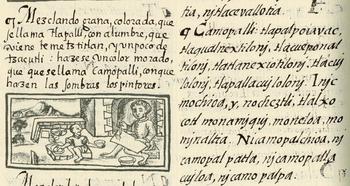
Returning to purple, Clavijero (Reference Clavijero1991:249) asserts the Nahua made “purple and other beautiful colors with cochineal” (el morado y otros bellos colores, de la cochinilla; translation by author), an affirmation probably based on Sahagún's work, where we read that cochineal was used to produce a purplish or dark red lake-pigment called camopalli (Dupey Reference Dupey García2015c:228, 242; also Sahagún Reference Sahagún, Austin and Quintana2000:vol. 3, bk. 11, p. 1133). The camopalli, literally the “sweet potato dye,” was made with cochineal—designated as nocheztli or tlapalli—mixed with alum. The source also says that this color was mixed with the orchid gum binder called tzacutli, which served to suspend coloring materials to paint as described previously. Moreover, one of the Florentine Codex’s illustrations depicts the camopalli preparation process and an artist illuminating a manuscript with it (Figure 4; Sahagún Reference Sahagún1979:vol. 3, bk. 11, f. 372v). Sahagún (Reference Sahagún, Austin and Quintana2000:vol. 3, bk. 11, p. 1133) adds that this lake-pigment was used to paint in purple; a piece of information corroborated by the meaning “dark red” which the noun camopalli and its derivatives often convey in Nahuatl texts (Dupey Reference Dupey García2010:299–300).
The illustrated description of the purple paint known as camopalli in the Florentine Codex of Sahagún. The illustration shows a painter using this material in order to illuminate a manuscript. Florentine Codex, vol. 3, bk. 11, f. 372v (detail). Image ©Biblioteca Medicea Laurenziana, Florence.

Blue Palette
With the color blue, the palettes of the pre-Columbian Nahua codices become more complex. Different tones and hues of blue appear in throughout the pages of these manuscripts and constitute distinct families (Dupey Reference Dupey García2017; Dupey and Álvarez Icaza Reference Dupey García, Álvarez Icaza Longoria, Gonzalbo, Álvarez and Longoria2017). In particular, a family of grayish and greenish blues is characteristic of the Codex Borgia and the Codex Cospi obverse—with some especially pronounced grayish shades in the Borgia—while some touches of grayish-greenish blue appear in the second part of the Codex Borbonicus. Most of the blues in this manuscript, however, present a turquoise hue, as in the Codices Laud and Fejérváry-Mayer, an observation that coincides with the identification of Maya Blue in the Fejérvary-Mayer and the Borbonicus (Domenici et al. Reference Domenici, Buti, Miliani, Brunetti, Sgamellotti, Sgamellotti, Brunetti and Miliani2014:110; Pottier et al. Reference Pottier, Michelin, Andraud, Goubard and Lavédrine2016), but also in the Cospi reverse (Miliani et al. Reference Miliani, Domenici, Clementi, Presciutti, Rosi, Buti, Romani, Minelli and Sgamellotti2012:676), the Mixtec Codices Zouche-Nuttall, Colombino, and Becker I (Higgitt Reference Higgitt2013; Torres et al. Reference Torres, Sotomayor, Álvarez, Caso and Smith1966:93; Zetina et al. Reference Zetina, Ruvalcaba, Falcón, Alatorre, Yanagisawa, Icaza Longoria, Hernández, Sgamellotti, Brunetti and Miliani2014:135), and in certain colonial documents (Baglioni et al. Reference Baglioni, Giorgi, Arroyo, Chelazzi, Ridi, Magaloni Kerpel, Wolf and Connors2011:94–97; Haude Reference Haude1998; Magaloni Reference Magaloni Kerpel, Miller and Mundy2012:83–85; Newman and Derrick Reference Newman, Derrick, Miller and Mundy2012:94–95).
Maya Blue is a hybrid color that was fabricated through precipitating the dye from the indigo plant onto white clay minerals, especially palygorskite [(Mg,Al)2Si4O10(OH)·4(H2O)]. Although this organic-inorganic material was one of the most widely used in Mesoamerican art, including the pre-Columbian Nahua codices, previous researchers have argued Maya Blue is not described in the central-Mexican historical texts (Reyes Reference Reyes Valerio1993; Wallert Reference Wallert, Vandiver, Druzik, Galvan Madrid, Freestone and Wheeler1995:654). It is true that these colonial records do not include the recipe to create this coloring material, nor do they refer to a clay mineral with the features of palygorskite. Instead, Sahagún and Hernández works mention the indigo, as well as two hybrid organic-inorganic colors made with the matlalxochitl, a plant identified as Commelina coelestis and commonly called dayflower because of its short life.
Regarding indigo, Sahagún and Hernández provide the Nahuatl names of the plant—xiuhquilitl—and of the dye extracted from its leaves—tlacehuilli (Dupey Reference Dupey García2015c:227, 236–237; Hernández Reference Hernández, del Pozo and d'Ardois1959–1960:vol. 3, pp. 112–113). These accounts define its color as mohuitic, that is, of a dark and purplish blue (Dupey Reference Dupey García2010:284–286; Sahagún Reference Sahagún, Austin and Quintana2000:vol. 3, bk. 11, p. 1131). They also include a detailed procedure for the extraction and preparation of the indigo dye (Hernández Reference Hernández, del Pozo and d'Ardois1959–1960:vol. 3, pp. 112–113, Reference Hernández1998:vol. 1, pp. 356–359; see also Clavijero Reference Clavijero1991:249). In addition, Sahagún's (Reference Sahagún1979:vol. 3, bk. 11, f. 371r) informants as well as the artists that illustrated the Florentine Codex refer to the use of tlacehuilli to iluminate manuscripts (Figure 5; Dupey Reference Dupey García2015c:227, 236–237). To date, the use of indigo to paint for dark blue and purplish color in pre-Columbian codices has not been observed, but we know it was employed in colonial codices, for example in the Florentine Codex (Baglioni et al. Reference Baglioni, Giorgi, Arroyo, Chelazzi, Ridi, Magaloni Kerpel, Wolf and Connors2011:97; see also González Reference González Tirado1998:27, 89; Haude Reference Haude1998; Zetina et al. Reference Zetina, Ruvalcaba, Cáceres, Falcón, Hernández, González, Arroyo and Turbanti-Memmi2011:352).
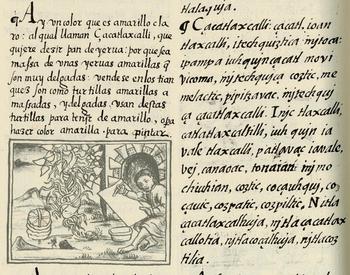
The illustrated description of the indigo (xiuhquilitl) and the procedure used by ancient Nahua to transform it into a painting material (tlacehuilli), in the Florentine Codex of Sahagún. The illustration shows a man making the color with the indigo leaves and the round cakes of tlacehuilli, as well as a painter of codices using this material to paint. Florentine Codex, vol. 3, bk. 11, f. 371r (detail). Image ©Biblioteca Medicea Laurenziana, Florence.

Besides indigo, the historical records mention two materials used to paint in blue that seems closely related to one other, as both are said to come from the matlalxochitl or dayflower: the matlalli and the texotli. Even though Hernández (Reference Hernández, del Pozo and d'Ardois1959–1960:vol. 3, pp. 34–35) only refers the colonial utilization of the matlalxochitl or matlalin to dye wools a “sea green or blue color” (color verdemar o azul; translation by author), it is proved that the dayflower also served to create paints in pre-Columbian times. In Sahagún's Florentine Codex, the matlalli is described in the first part of the chapter on colors (Dupey Reference Dupey García2015c:226, 233), which presents the materials specifically used for painting codices as above said (see also Clavijero Reference Clavijero1991:249). Eloquently, the image that accompanied this description depicts—as stated by Falcón (Reference Falcón Álvarez2014:39)—an artist painting a manuscript with a brush that he soaks in a bowl from which a matlalxochitl sticks out (Figure 6; Sahagún Reference Sahagún1979:vol. 3, bk. 11, f. 369v).
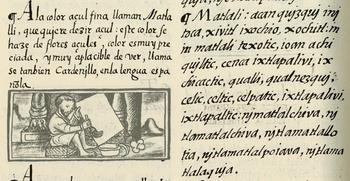
The illustrated description of the matlalli—a coloring material elaborated with dayflower petals—in the Florentine Codex of Sahagún. The image shows an artist painting a manuscript with a brush that he soaks in a bowl from which a flower very similar to the dayflower sticks out. Florentine Codex, vol. 3, bk. 11, f. 369v (detail). Image ©Biblioteca Medicea Laurenziana, Florence.

Unfortunately, the Nahua recipe to prepare the matlalli has not survived, but Sahagún's informants offer an interesting evidence about this coloring material when they say it is “blue, a little green” (texotic, ihuan achi quiltic) (Dupey Reference Dupey García2015c:226, 233)—data that echoes Hernández's definition of the matlalli as providing sea green or blue colors. In fact, recent analyses performed on the Codex Borbonicus have confirmed that the dayflower was actually used to make blue paints for codices. In the second part of this codex that comes from the very same region where Sahagún's Florentine Codex was created—the Valley of Mexico—a transparent greenish-grayish blue was, in all likelihood, elaborated with matlaxochitl petals (Pottier et al. Reference Pottier, Michelin, Andraud, Goubard and Lavédrine2016). It is feasible that these were processed with alum to obtain a lake-pigment, because Dark and Plesters (Reference Dark and Plesters1959:533) have detected in the colonial Codex Selden a blue elaborated with this metallic salt and an unidentified dye, which was not indigo and, therefore, was perhaps extracted from the dayflower. Interestingly, the grayish-greenish blue of the Codex Cospi obverse was also obtained from an unidentified blue dye that was not indigo, in this case mixed with a yellow paint (Miliani et al. Reference Miliani, Domenici, Clementi, Presciutti, Rosi, Buti, Romani, Minelli and Sgamellotti2012:676–677).
As about the texotli, even if Sahagún (Reference Sahagún, Austin and Quintana2000:vol. 3, bk. 11, p. 1132) explains that it comes from the same flowers as the matlalli, I posit this Nahuatl term designated more broadly the category of hybrid colors made through precipitating blue dyes on clay, among them Maya Blue. This hypothesis is based on a body of evidences that reveal the proximity of this celebrated Mesoamerican color and the texotli. First, the seemingly conflicting descriptions of the texotli in the colonial sources point out the hybrid nature of this coloring material, which was at once organic and inorganic. As above mentioned, Sahagún thinks that the texotli was prepared with the dayflower, but Hernández (Reference Hernández, del Pozo and d'Ardois1959–1960:vol. 3, p. 407) sees it as “a sort of earth extracted from the mountains in some regions of New Spain” (una especie de tierra extraída de los montes en algunas regiones de Nueva España; translation by author), a view that concurs with the literal meaning of the word texotli, which translates to “blue stone.” Reconciling these differing opinions is possible if we consider that texotli was the name given to the hybrid colors obtained through fixing blue dyes on clay using a method close to dyeing. In this sense, it is significant that the texotli is described in the second part of Sahagún's chapter on colors, which focuses on materials employed to paint codices that were also related to dyeing activities (Dupey Reference Dupey García2015a:156–158; Falcón Reference Falcón Álvarez2014:31–33).
Second, it must be stressed that beyond the link of the texotli with the dayflower claimed by Sahagún, the account of its chromatic characteristics in the Florentine Codex rather suggests that this term designated Maya Blue. In fact, Sahagún's informants define the texotli as a material whose color is an intense turquoise blue, just like the most common Maya Blues in Mesoamerican art. Concretely, they use the terms “xoxoctic, xoxohuic, xoxoxohuic, xoxouhqui” (Dupey Reference Dupey García2015c:227), these being adjectives meaning “blue-green” in Nahuatl, while the accumulation of chromatic terms in this description, alongside the reduplication of the initial syllable in the form xoxoxohuic, indicate that the color of the texotli is intense (Dupey Reference Dupey García2010:263–269, 271–280, 314–317, 343–347, 355–367).
Third, the description of the texotli in the Florentine Codex is brief and lacks precision, being in line with the fact that Maya Blue was, in all likewood, not manufactured in the center of Mexico during the Late Postclassic. The painters of the Nahua codices possibly provided themselves with this prized blue from the Maya area through trade or tribute (Milbrath and Peraza Lope Reference Milbrath and Lope2003:30, 35, 41), for the major deposits of palygorskite are located in the Sierra de Ticul (López et al. Reference López Luján, Chiari, Austin and Carrizosa2005:26–27; Ortega Reference Ortega Avilés2003:11), in northern Yucatán, a region that was also engaged in a large-scale indigo production during the sixteenth century (Arnold Reference Arnold2005; Arnold et al. Reference Arnold, Bohor, Neff, Feinman, Williams, Dussubieux and Bishop2012; Ruz Reference Ruz1979; Torres Reference Torres, Sayre, Vandiver, Druzik and Stevenson1988). Last but not least, in the Florentine Codex chapter on colors, the texotli is described just before another ambiguous material called tecozahuitl, a word that designated some hybrid organic-inorganic colors made of clay and yellow dyes.
Yellow-Related Palette
As with blue shades, the yellow, orange, and brown palettes of the pre-Columbian Nahua codices are rich and complex. With the exception of the Codex Cospi reverse, these manuscripts all display diverse hues and tones of yellow-related colors (Dupey and Álvarez Icaza Reference Dupey García, Álvarez Icaza Longoria, Gonzalbo, Álvarez and Longoria2017), some of which have been subjected to physicochemical characterization studies. These have revealed that the particularly brilliant yellow that appears in the Codices Cospi (reverse) and Fejérváry-Mayer comes from orpiment (As2S3) (Domenici et al. Reference Domenici, Buti, Miliani, Brunetti, Sgamellotti, Sgamellotti, Brunetti and Miliani2014:108; Miliani et al. Reference Miliani, Domenici, Clementi, Presciutti, Rosi, Buti, Romani, Minelli and Sgamellotti2012:675–678), a mineral that was also applied on the obverse of the Codex Zouche-Nuttall (Higgitt Reference Higgitt2013) and in the colonial corpus, there alongside with ochre (Baglioni et al. Reference Baglioni, Giorgi, Arroyo, Chelazzi, Ridi, Magaloni Kerpel, Wolf and Connors2011:100; Zetina et al. Reference Zetina, Ruvalcaba, Falcón, Hernández, González, Arroyo and Cáceres2008). Moreover, the Codices Cospi (obverse) and Fejérváry-Mayer include various coloring materials with shades ranging from yellow, orange, and brown that have been characterized as dyes precipitated on clay (Domenici et al. Reference Domenici, Buti, Miliani, Brunetti, Sgamellotti, Sgamellotti, Brunetti and Miliani2014:108; Miliani et al. Reference Miliani, Domenici, Clementi, Presciutti, Rosi, Buti, Romani, Minelli and Sgamellotti2012:675–678). In the Codex Borbonicus, lake-pigments prepared with dyes fixed on alum and niter have been observed (Pottier et al. Reference Pottier, Michelin, Andraud, Goubard and Lavédrine2016)—a tradition of making yellow colors that perpetuate after the Spanish conquest as can be seen in some colonial documents like the Codex Selden and the Florentine Codex (Baglioni et al. Reference Baglioni, Giorgi, Arroyo, Chelazzi, Ridi, Magaloni Kerpel, Wolf and Connors2011:98–100; Dark and Plesters Reference Dark and Plesters1959:533, 538). Dyes used to create yellow and orange paints were likewise detected in the Mixtec Codices Zouche-Nuttall (reverse) and Colombino-Becker I (Higgitt Reference Higgitt2013; Torres et al. Reference Torres, Sotomayor, Álvarez, Caso and Smith1966:92–93; Zetina et al. Reference Zetina, Falcón, Arroyo, Ruvalcaba, Wolf and Connors2011:352, Reference Zetina, Ruvalcaba, Falcón, Alatorre, Yanagisawa, Icaza Longoria, Hernández, Sgamellotti, Brunetti and Miliani2014:137), though in the Mixteca some orange hues were obtained either by blending or layering, as mentioned above.
Neither of these methods—blending and layering—is described in the colonial records, which only refer the manufacture of yellow and orange colors with organic materials. That said, the historical data contained in these sources are of key importance, for the actual dyes used to create the yellow, orange, and brown paints applied on the Mixteca-Puebla codices have not been clearly characterized through science. To my knowledge, one of the few scientific evidence available arises from the invasive physicochemical study of the colonial Codex Selden, which revealed that its orangeish-yellow color is a lake-pigment prepared with alum and a dye with a flavonoid origin (Dark and Plesters Reference Dark and Plesters1959:533, 538). Also, the Florentine Codex complex palette includes a yellow lake-pigment made with alum and a dye extracted from a plant belonging to the dodder family (Cuscuta sp.) (Baglioni et al. Reference Baglioni, Giorgi, Arroyo, Chelazzi, Ridi, Magaloni Kerpel, Wolf and Connors2011:99–100). In the face of such scarcity of data, the colonial treatises on color making among the ancient Nahua provide an interesting avenue to enrich our understanding of the source and preparation of the yellows that served to illuminate the Mixteca-Puebla codices. Indeed, they mention two lake-pigments—known as xochipalli and zacatlaxcalli in Nahuatl—elaborated with vegetal dyes and mineral salts, whose respective origin echoes the results of the studies of the Codex Selden and the Florentine Codex. In addition, the historical records refer to a yellow coloring material whose nature and chromatic characteristics deserve due attention.
Zacatlaxcalli, literally “dry herb tortilla,” was the name of an intense yellow lake-pigment prepared with the carotenoid dyes extracted from various species of parasitic plants that belong to the dodder family. Regarding this coloring material, Hernández (Reference Hernández, del Pozo and d'Ardois1959–1960:vol. 2, p. 124) writes:
When [the zacatlaxcalli] is mature [and yellow] it is pulled out from the trees where it sprouts, it is crushed and given the form of a round cake, from which it gets its name. These are soaked in water (to which alum and niter are added) and shaped in the form of shells, to be used by the painters to color their paintings in yellow (Cuando está maduro se arranca de los árboles en que nace, se machaca y se le da forma de tortas, de donde toma el nombre. Maceradas éstas con agua [a la vez que se agregan alumbre y nitro] y modeladas en forma de conchas, sirven a los pintores para dar a sus pinturas el color Amarillo; translation by author).
Sahagún's informants, in turn, refer to the zacatlaxcalli in the first part of the Florentine Codex chapter on colors, along with other paints for codices: the cochineal-based lake-pigment tlacuahuac tlapalli, the annatto-based lake-pigment achiyotl, and the lake-pigment matlalli made with the petals of the dayflower. Furthermore, the Franciscan's informants and the Florentine Codex artists present the zacatlaxcalli as an intense yellow color that was applied to manuscripts (Figure 7; Dupey Reference Dupey García2015c:226, 233; Sahagún Reference Sahagún1979:vol. 3, bk. 11, f. 369v). Indeed, the text in Nahuatl of the Florentine Codex says that it is “coztic, cozauhqui, cozahuic, cozpatic, cozpiltic”; coztic being the generic term used to refer to yellow in Nahuatl, while the intense yellow hue of the coloring material is deduced from the accumulation of color terms in this description, as well as from the utilization of the -patic and -piltic suffixes (Dupey Reference Dupey García2010:271–277, 310–317). This chromatic quality of the zacatlaxcalli coincides with the vividness of some of the yellows that can be observed in the pre-Columbian Nahua codices. In light of this coincidence, I agree with colleagues (Baglioni et al. Reference Baglioni, Giorgi, Arroyo, Chelazzi, Ridi, Magaloni Kerpel, Wolf and Connors2011:99–100; Dark and Plesters Reference Dark and Plesters1959:533) who have proposed that some species of Cuscuta served to create the bright yellow lake-pigments used to paint the Mixteca-Puebla codices and some Colonial period documents, such as the Florentine Codex.
The illustrated description of the zacatlaxcalli—a lake-pigment made with plants belonging to the dodder family—in the Florentine Codex of Sahagún. The illustration shows the parasitic plant growing in a tree and the round cakes of zacatlaxcalli, as well as a painter of codices using this material to paint. Florentine Codex, vol. 3, bk. 11, f. 369v (detail). Image ©Biblioteca Medicea Laurenziana, Florence.

With regard to the xochipalli, this word means “flower dye” and designated a lake-pigment made with the flowers of the sulfur cosmos (Cosmos sulphureus), whose coloring principle is a flavonoid (Wallert Reference Wallert, Vandiver, Druzik, Galvan Madrid, Freestone and Wheeler1995:657–659). Hernández (Reference Hernández, del Pozo and d'Ardois1959–1960:vol. 3, p. 212) reveals that the flower of the xochipalli plant were employed to “paint figures in a reddish yellow, for which [it] is cooked adding niter, after that the juice is squeezed and strained” (pintar figuras de color amarillo tirando a rojo, para lo cual se cuece agregándole nitro, y después se le exprime el jugo, que se cuela; translation by author). Sahagún's (Reference Sahagún1979:vol. 3, bk. 11, f. 369r) work advises that the xochipalli was used, alongside with the zacatlaxcalli, to paint manuscripts (Figure 8; Dupey Reference Dupey García2015c:225, 232). This source also verifies the orangeish-yellow shade of the xochipalli, because the contexts in which the color term xochipaltic—derived from xochipalli—occurs throughout the extensive Nahuatl text of the Florentine Codex shows that its meaning was close to “orange” (Dupey Reference Dupey García2010:284–285). So here, again, I agree with scholars (Dark and Plesters Reference Dark and Plesters1959:533; Domenici et al. Reference Domenici, Buti, Miliani, Brunetti, Sgamellotti, Sgamellotti, Brunetti and Miliani2014:108) who have postulated that some of the orangeish-yellow and orange lake-pigments of the pre-Columbian and colonial codices probably originated in the sulfur cosmos flowers.
The illustrated description of the xochipalli—a lake-pigment elaborated with the flowers of the Cosmos sulphureus—in the Florentine Codex by Sahagún. The image shows an artist painting a manuscript and a bowl from which a flower sticks out. Florentine Codex, vol. 3, bk. 11, f. 369r (detail). Image ©Biblioteca Medicea Laurenziana, Florence.

While historical texts provide information on the yellow lake-pigments based on metallic salts—alum and niter—created with sulfur cosmos and dodder plants, the organic-inorganic yellow materials with a clay base are not clearly mentioned in this corpus of sources, despite their presence in the Borgia Group—specifically in the Codices Cospi and Fejérváry-Mayer. The description of a mineral with features that fit with those of orpiment has not been found either in the colonial records. In sixteenth century treatises, the only yellow coloring material that seems inorganic is the tecozahuitl, defined as a yellow stone that serves to dye and paint by Sahagún's informants (Dupey Reference Dupey García2015c:227, 237; Sahagún Reference Sahagún1979:vol. 3, bk. 11, f. 371r). Hernández (Reference Hernández, del Pozo and d'Ardois1959–1960:vol. 3, p. 410) alternatively describes it as “some sort of yellow ocher or yellow earth […], which the painters use to give this color” (cierta especie de ocre o tierra amarilla […], con que los pintores dan dicho color; translation by author), but also as a cosmetic that benefit the chapped skin (Figure 9; see also Berdan and Anawalt Reference Berdan and Anawalt1992:vol. 3, f. 40r). This piece of evidence suggests that clay was one of the components of the tecozahuitl, for the hydrating virtue of this kind of mineral is well known.
Tribute of tecozahuitl powder coming from western Mesoamerica. The gloss says: “[t]wenty small pots of tecozahuitl, which is a yellow varnish with which they paint themselves” (Veinte caçueletas de tecoçahuitl/ ques un barniz amarillo/ con que se enbixaban). Codex Mendoza, f. 40r. Image © Bodleian Library, Oxford.

At the same time, this identification contradicts what we read in the Florentine Codex, where the tecozahuitl is referred to as a material used to dye. Though clay can serve as a mordent in the dying process, yellow clays are not employed as dyestuffs unto themselves (Cardon Reference Cardon2007:42–46). More curiously even, while Sahagún and Hernández define the tecozahuitl as a material with a mineral origin (a stone or an earth), another expert in the Nahua culture and language, the Franciscan friar Olmos (Reference Olmos, Sybille and Marc2004:1), translates tecozahuitl as “yellow herb” (yerva amarilla). As a parallel example, the Florentine Codex mentiones a link between the dye called cuappachtli and the coloring material tecoxtli, whose name is a variant of tecozahuitl and likewise means “yellow stone.” On top of that, there is also confusion about the identification of the cuappachtli: Sahagún's informants say it is an unidentified lichen—possibly from the genus Dolichocarpus (Roquero Reference Roquero2006:191–192; Torres Reference Torres Montes and Carrasco2001:347; see also Dupey Reference Dupey García2015c:243–244)—used to dye materials dark yellow or brown (Dupey Reference Dupey García2015c:228–229, 243–244), while the Franciscan explains that it derived from the mixture of the stone tecoxtli with the aforementioned orchid gum binder, known as tzacutli (Sahagún Reference Sahagún, Austin and Quintana2000:vol. 3, bk. 11, p. 1133).
Again, these opposite views are reconciled if we consider that just as texotli conceivably named the hybrid colors made from clay and blue dyes, the word tecozahuitl—and its variant tecoxtli—was possibly the Nahuatl term that designated the broad category of hybrid colors obtained through precipitating yellow dyes on clay. This is supported by the morphological affinities between texotli and tecozahuitl: the construction of these words is parallel for it is based on the word tetl, “stone,” and the color lexemes xo- and coz-, which respectively refer to “blue” and “yellow.” Thus, texotli means, “blue stone,” while tecozahuitl can be translated as “yellow stone.” Significantly, these two materials are cited one after the other in the second part of the Florentine Codex chapter on colors, which, as above said, describes jointly coloring materials used as paints for manuscripts but also related to dyeing activities. Finally, the economy of the descriptions of these coloring materials in the Florentine Codex also suggests that the tecozahuitl, just as the Maya Blue-texotli, was not produced in central Mexico, but instead arrived there already prepared in the form of yellow stones or powder, as we can see in the list of tributes received by Mexico Tenochtitlan from the occidental regions of Mesoamerica (Figure 9; Berdan and Durand-Forest Reference Berdan and Durand-Forest1980:10v; Berdan and Anawalt Reference Berdan and Anawalt1992:vol. 3, f. 40r).
Green Palette
Green is also an amazingly diverse color in the pre-Columbian Nahua codices (Dupey Reference Dupey García2017; Dupey and Álvarez Icaza Reference Dupey García, Álvarez Icaza Longoria, Gonzalbo, Álvarez and Longoria2017). In fact, several of these manuscripts include hues of green so different that Nahua peoples were likely not classifying them in the same chromatic category. For instance, the Codex Laud comprises light and dark greens that display in a variety of vivid shades, as well as brownish green hues that only appear in specific sections of the document (Álvarez Icaza Longoria Reference Álvarez Icaza Longoria2014:141–142). Something similar occurs in the Codices Borbonicus and Fejérváry-Mayer, where a range of bright hues of green coexist (Álvarez Icaza Reference Álvarez Icaza Longoria2014:165–167; Pottier et al. Reference Pottier, Michelin, Andraud, Goubard and Lavédrine2016). The situation is somehow simpler in the rest of the corpus, for a yellowish-brownish tonality distinguishs all the greens of the Codex Borgia and most of the greens of the Codex Vaticanus B (except in its repainted pages), at times more yellow and at other times browner. Finally, the Codex Cospi obverse is characterized by a bright vegetal green, while on the reverse pages a bluish-green appears.
In light of this diversity, it is not surprising that the physicochemical characterization studies of Mixteca-Puebla codices provide a multiplicity of results. In numerous cases, though, scientific investigations report that green hues are derived from mixtures of yellow with blue materials. Among the yellow materials employed to make green, the studies executed on the Borbonicus and the Fejérváry-Mayer have detected the utilization of dyes that in both cases remain unidentified (Domenici et al. Reference Domenici, Buti, Miliani, Brunetti, Sgamellotti, Sgamellotti, Brunetti and Miliani2014:110; Pottier et al. Reference Pottier, Michelin, Andraud, Goubard and Lavédrine2016). In the Borbonicus, however, the quantities of metallic salts observed in the green paints suggest that they were prepared with the yellow lake-pigments used in the manuscript (Pottier et al. Reference Pottier, Michelin, Andraud, Goubard and Lavédrine2016). By contrast, orpiment was used in the Mixtec Codex Zouche-Nuttall and the colonial Codex Badiano (Higgitt Reference Higgitt2013; Zetina et al. Reference Zetina, Ruvalcaba, Falcón, Hernández, González, Arroyo and Cáceres2008). Regarding the blue component of these mixtures, Maya Blue has been discovered in most of the greens that underwent physicochemical analysis, specifically in the Codices Borbonicus and Fejérváry-Mayer (Domenici et al. Reference Domenici, Buti, Miliani, Brunetti, Sgamellotti, Sgamellotti, Brunetti and Miliani2014:110; Pottier et al. Reference Pottier, Michelin, Andraud, Goubard and Lavédrine2016), as well as in the Codex Zouche-Nuttall and the Florentine Codex (Baglioni et al. Reference Baglioni, Giorgi, Arroyo, Chelazzi, Ridi, Magaloni Kerpel, Wolf and Connors2011:100; Higgitt Reference Higgitt2013).
Coming to the Cospi obverse, its greenish-grayish blue is not due to Maya Blue, as above said, but instead it was created by mixing a blue dye with a hybrid material obtained through precipitating a yellow dye on clay. Similarly, the green applied on this part of the codex is unlike the green colors discussed above, which were prepared by mixing Maya Blue with different kinds of yellows. My close examination of this manuscript has revealed that the green on the Cospi obverse was made through painting a layer of yellow over a layer of blue, or vice versa (Figure 10a). Interestingly, this practice also occurs in the Codices Borgia and Vaticanus B, as well as in some Mixtec documents—the pre-Columbian Codex Colombino and the colonial Codex Selden—where the superimposition of layers to generate green colors was first observed (Dark and Plesters Reference Dark and Plesters1959:533; Torres et al. Reference Torres, Sotomayor, Álvarez, Caso and Smith1966:96; Zetina et al. Reference Zetina, Ruvalcaba, Falcón, Alatorre, Yanagisawa, Icaza Longoria, Hernández, Sgamellotti, Brunetti and Miliani2014:132). Indeed, Domenici and I noticed that, in the Borgia, the green hues were achieved by superimposing a layer of yellow or orange over layers of dark colors—possibly grayish blue, gray, and black—or vice versa (Figure 10b). Regarding the original palette of the Codex Vaticanus B, it includes several light greens with a yellowish tonality and a dark green that can even be confused with brown. There is no doubt that as in the Borgia and the Cospi, some of these hues were obtained by superimposing layers (Anders et al. Reference Anders, Jansen and García1993:50). In particular, a dark color was applied on an orange layer to obtain the dark brownish green (Figures 10c–10d; Anders et al. Reference Anders, Jansen and García1993:2).
Greens obtained through layering in: (a) the Codex Cospi, p. 12, detail. (Image ©Biblioteca Universitaria di Bologna); (b) the Codex Borgia, p. 11 (Image ©Vatican Apostolic Library); and (c–d) the Codex Vaticanus B, pp. 2, 50, details. (Images ©Vatican Apostolic Library).

As in the case of the orange shades produced by the superimposition of yellow and red materials, the Colonial records do not address the possibility of making greens through layering. Instead, the chapter on colors of the Florentine Codex describes the manufacture of two green paints by mixing the same yellow and blue materials: zacatlaxcalli and texotli. One of these greens is named quiltic and is defined by Sahagún's informants as “a little blue-green, a little dark-yellow” (achi xoxouhqui, achi ixcoziayauhqui) (Dupey Reference Dupey García2015c:228, 241–242). They also state that, “in order to make it, texotli and zacatlaxcalli are joined together” (Inic mochihua, i, in texotli, zacatlaxcalli monamictia), while Sahagún (Reference Sahagún, Austin and Quintana2000:vol. 3, bk. 11, p. 1133) adds that…
…mixing the light blue pigment, they call texotli, with yellow, they call zacatlaxcalli, adding more yellow, they make a fine light green that is called quiltic (Mezclando color azul claro, que se llama texotli, con amarillo, que se llama zacatlaxcalli, echando más parte del amarillo, que no dél, hace un color verde claro fino que se llama quíltic); translation by author].
The other green mixture was known as yappalli, a word that means “black maize dye” because it combines the verb pa, “to dye,” with the substantive yahuitl, “black maize ear.” Sahagún (Reference Sahagún, Austin and Quintana2000:vol. 3, bk. 11, p. 1133) says it is a “dark green,” while his informants explain that for the making of the yappalli…
… zacatlaxcalli [and] texotli join together, texotli is mixed, texotli is joined with zacatlaxcalli. It is not completely blue-green. It is not yellow. The yellow produced from [this mixture] is very dark (zacatlaxcalli texotli quinamiqui, texotli mominaltia, texotli monamictia in zacatlaxcalli: amo cenca xoxoctic, amo no coztic, cancan poyahuac in coztic itech neci) [Dupey Reference Dupey García2015c:228, 241; translation by author].
These descriptions are noteworthy since the cited ingredients recall the physicochemical characterization of some of the greens applied on the Codices Borbonicus and Fejérváry-Mayer. As we have seen, the compositional analyses performed on these manuscripts have shown that these greens were mixtures of Maya Blue with yellow dyes or lake-pigments (Domenici et al. Reference Domenici, Buti, Miliani, Brunetti, Sgamellotti, Sgamellotti, Brunetti and Miliani2014:110; Pottier et al. Reference Pottier, Michelin, Andraud, Goubard and Lavédrine2016). One of the latter could have been zacatlaxcalli, for we have seen that this yellow lake-pigment stands out in historical accounts that refer to the materials used by codex painters. As with the blue component of the mixture, it is significant to find a mention of the texotli in the preparatory instructions for the quiltic and yappalli greens, because I have argued above that texotli was the Nahuatl name for the broad category of blue paints made through precipitating dyes on clay, among them Maya Blue.
Besides detailing the ingredients employed to prepare green paints, the descriptions of the yappalli and the quiltic in Sahagún's work are remarkable because they, in turn, suggest that the dissimilar green hues of the pre-Columbian Nahua codices were classified into at least two indigenous categories. Although yappalli and quiltic were made with the same ingredients, they desserved different names because their chromatic characteristics were distinct. While the quiltic is defined as a little blue-green, a little dark-yellow, or as a light green, the yappalli is said to be dark yellow or dark green. From these descriptions, it is evident that the quiltic was a green mixture resulting from the balanced association of blue and yellow. This statement is also supported by the name of this material, which is called by the generic term for “green” in Nahuatl and means “like a green vegetable” (Dupey Reference Dupey García2010:277–280). Consequently, I believe quiltic could have been the name given to the bright green paints derived from the roughly equal mixture of yellow and blue that appear in some Nahua codices, for example the Borbonicus and the Fejérváry-Mayer, where the greens were prepared with the vivid Maya Blue.
Regarding yappalli, it would be tempting to interpret this Nahuatl word as the name of the brownish-green and dark green colors displayed in some of the Borgia Group codices. Alongside the former definition of yappalli as a “dark yellow” paint, the occurrences of the noun yappalli and the adjective yappaltic in the Nahuatl text of the Florentine Codex demonstrate that these color terms belonged to the dark green category of the Nahua chromatic system that intertwined with the brown and blackish category (Dupey Reference Dupey García2010:287–294). In fact, Sahagún (Reference Sahagún, Austin and Quintana2000:vol. 1, bk. 2, p. 177, vol 2, bk. 6, p. 670, vol. 3, bk. 11, pp. 1003, 1133) sometimes translates yappalli as “dark green,” and some other times as “tawny” and “chestnut.” In their description of the rainbow, Sahagún's (Reference Sahagún, Dibble and Anderson1953–1982:vol. 8, bk. 7, p. 18) informants similarly place yappalli and yappaltic at the boundary of the green and yellow categories, that is, at the end of the list of green terms and just before the list of yellow terms begins.
Yet, while the Florentine Codex chapter on colors makes clear that the yappalli paint was created through mixing the texotli and the zacatlaxcalli, the inspection of the Codices Borgia and Vaticanus B evidence that their brownish-green shades were obtained through superimposing layers of different coloring materials. So, although their hue coincides with the definition of the yappalli, their preparation does not. The visible uniformity of the yellowish- and brownish-greens of the Codices Laud and Fejérváry-Mayer, by contrast, suggests that they were obtained through mixing. Further scientific research on the green palettes of these manuscripts will hopefully shed light on the preparation process or painting techniques underlying these specific greens hues and, in doing so, will perhaps allow us to determine if they deserve the denomination of yappalli.
FINAL REMARKS
When he sought to describe the palette of the pre-Columbian painters of codices, Clavijero (Reference Clavijero1991:249) wrote:
The colors they used in their paintings, which were numerous and really beautiful, they extracted them from the wood and leaves of various plants, from the flowers, the fruits and the mineral earths (Los colores que empleaban en sus pinturas, que eran muchos y bellísimos, los sacaban de la madera y hojas de varias plantas, de flores, de frutas y tierras minerales; translation by author).
This account provided by the eighteenth-century Jesuit chronicler accurately reflects the tradition of using a few colored minerals and many organic dyes to make the colors employed to paint manuscripts in Late Postclassic central Mexico. Physicochemical characterization studies executed on some pre-Columbian Nahua codices, specifically on the Codex Borbonicus and the Borgia Group, have identified these minerals, which were mostly required to prepare the white backgrounds. Concerning the dyes, scientific studies have shown they were commonly converted in hybrid organic-inorganic paints, but they still struggle to systematically clarify their origin.
Beyond Clavijero's brief description of the nature of the codices’ colors, additional historical records offer evidences about the processes of making and using coloring materials in pre-Columbian times. In particular, the Florentine Codex by Sahagún (Reference Sahagún, Dibble and Anderson1953–1982; Dupey Reference Dupey García2015c) devotes a whole part and several short passages of its chapter on colors to the materials used to create and illuminate the manuscripts. Along with the treatises resulting from Hernández's (Reference Hernández, del Pozo and d'Ardois1959–1960, Reference Hernández1998) research on the natural resources of New Spain, Sahagún's work interestingly complement the data provided by the scientific analyses. Together, these colonial texts reveal the names of the animals, minerals and plants from which organic-inorganic colors were produced in order to paint the codices. Hence, they help to interpret further the results of the physicochemical studies, as well as to formulate hypotheses in view of forthcoming campaigns of analysis.
For example, the description in the Florentine Codex of the blue material included in the palette of the painters of codices as a lake-pigment obtained from the dayflower strongly supports the recent identification of a grayish-blue paint prepared with dayflower petals in the Codex Borbonicus. Similarly, the historical reference to colors for codices made with annatto and brazilwood incites to consider these possible sources for red—together with cochineal, whose utilization has already been evidenced—in the scientific studies to be performed on Mesoamerican manuscripts. The same is true of the yellow, orange, and brown organic-inorganic coloring materials, as well as the pink and green mixtures described in Sahagún's and Hernández's works. Their chromatic features closely match the characteristics of the colors observed in our corpus of codices, and their origin and manufacture, unveiled by the colonial authors, represent significant clues for the research on the materiality of the pre-Columbian codices. This is not to mention the historical information regarding the other ingredients—that is, the non-coloring ones—involved in the recipes for creating organic-inorganic coloring materials, which have already proved to be extremely useful data for the recreation of such coloring materials in the laboratory, with the aim of comparing them with the originals colors.
Colonial literature, then, undoubtedly contributes to the scientific study of the coloring materials applied on Nahua manuscripts during the late pre-Columbian era. Inversely, reading the historical texts in the light of the results of the physicochemical characterization studies brings exciting discoveries. Our knowledge—thanks to science—of the hybrid nature of the codices’ colors, as well as the proximity of their manufacture technology with the dyeing process, allow us to comprehend some specific parts of the chapter on colors in the Florentine Codex, which were previously poorly understood or misinterpreted. In particular, the prior interpretation of the tecozahuitl and the texotli as minerals is difficult to support, since we now see that they bear the typical features of the organic-inorganic colors of the pre-Columbian codices from central Mexico and this is why they were included in a section of Sahagún's work that emphasizes the relationship between the dyeing practice and certain painting materials. Analyzing the tecozahuitl and the texotli through the prism of the scientific data thus leads us to claim that these terms probably designated the categories of hybrid colors made through precipitating respectively yellow and blue dyes on clay. Beyond the codices’ palettes, identifying the materials that are named by means of these and others Nahuatl terms is a major step towards understanding the pre-Columbian uses of colors. Indeed, it allows us to know which specific materials are meant when their names appear in the historical sources, not only in accounts of artistic practices, but also in descriptions of apparel and religious performance.
It is worth adding that alongside physicochemical analyses and philological studies, macroscopic examination of the codices likewise contributes to our knowledge of the materiality and use of color in these documents. For example, this approach reveals that the Nahua painters, like the Mixtecs, superimposed layers in order to create certain hues. Since this painting technique is not mentioned in the historical records, such observation enriches our understanding of the making of colors for codices, at the same time that it invites us to reflect on spatiotemporal particularities in this artistic practice. Beyond contributing to the reconstruction of the chromatic palettes used in the pre-Columbian Nahua codices, this research emphasizes the necessity of an interdisciplinary method to study coloring materials and, more broadly, colors in ancient Mesoamerica. An unexpected and enriched insight into the materiality of color in Mesoamerican art can be obtained through comparing the results of physicochemical characterization analyses and macroscopic examination with the data on painting materials available in the colonial literature, especially the discourses and images indigenous people created to describe and depict the colors and their material basis.
RESUMEN
Durante el posclásico tardío (1200–1521 d.C.) floreció en Mesoamérica—especialmente en las áreas del México central y de Oaxaca—una tradición artística conocida como Mixteca-Puebla o Nahua-Mixteca. El estilo y la iconografía de esta tradición se manifestaron en diversos artefactos y obras de arte, en particular en los manuscritos pintados llamados códices. Uno de los rasgos definitorios de los códices Mixteca-Puebla es la profusión y la viveza de sus colores, de ahí que el estudio del color es un tema fundamental para la comprensión de estos documentos, a nivel artístico pero también histórico. Este ensayo investiga la materialidad del color en un corpus de manuscritos nahua que pertenecen a tradición Mixteca-Puebla y se conocen como el Códice Borbónico y los Códices del Grupo Borgia.
Investigaciones codicológicas y físico-químicas recientes han mejorado substancialmente nuestro conocimiento de la materialidad del Códice Borbónico y de los códices del Grupo Borgia, en particular de las materias colorantes utilizadas para pintarlos. Al mismo tiempo, este grupo de manuscritos es interesante porque está asociado con la cultura nahua que prosperó en el México central durante el posclásico y cuyas paletas cromáticas y prácticas artísticas fueron documentadas en las fuentes coloniales. El presente artículo reúne y coteja los datos acerca de la materialidad del color en los códices procedentes de estos dos tipos de fuentes: los testimonios históricos y los análisis científicos. Concretamente, este estudio se basa en los estudios físico-químicos de caracterización del color que se han llevado a cabo en el Códice Borbónico y los códices del Grupo Borgia. Descansa, asimismo, en mi inspección macroscópica de los originales de dichos manuscritos. Paralelamente, este estudio indaga la literatura colonial, prestando una atención especial a las formas nativas de nombrar y describir las materias colorantes, así como a las imágenes que representan a los artistas preparándolas y utilizándolas.
El cotejo de estos datos revela que las fuentes coloniales contribuyen significativamente al conocimiento del proceso de creación de los códices prehispánicos y de sus paletas cromáticas, al confirmar, aclarar e incluso enriquecer los resultados científicos, en particular al permitir la formulación de hipótesis de identificación para las materias colorantes que la ciencia no ha conseguido caracterizar aún. Por otra parte, las comparaciones que se llevan a cabo esclarecen ciertos aspectos de los textos históricos acerca de las materias colorantes que eran anteriormente poco o mal comprendidos. De tal manera que el diálogo entre la información histórica y las evidencias científicas que promueve este artículo desemboca en una reconstrucción afinada de las paletas cromáticas y de las técnicas pictóricas empleadas en los códices nahua prehispánicos.
ACKNOWLEDGMENTS
I thank the Bibliothèque de l'Assemblée Nationale (Paris), the Vatican Apostolic Library (Rome, Italy), the Bodleian Library (Oxford, United Kingdom), the Biblioteca Universitaria di Bologna (Italy), and their respective directors and manuscripts curators, for allowing me to study the originals of the Codices Borbonicus, Borgia, Vaticanus B, Laud, and Cospi. I also thank Dumbarton Oaks Research Library and Collection (Washington, DC) and the Getty Research Institute (Los Angeles) for supporting my research on the materiality of color in Nahua culture. I acknowledge the Centre EREA du LESC (CNRS, Paris, France) for supporting my visits to the repositories of the Borgia Group codices. A very special thanks goes to Davide Domenici, who invited me to be part of the campaign of scientific analyses performed on the Codices Borgia and Vaticanus B in 2014, and for his generosity in sharing information and exchanging ideas on the materiality of the pre-Columbian codices. I am also grateful to María Isabel Álvarez Icaza, Fabien Pottier, Tatiana Falcón, and David Buti for our discussions on colors and codices. I am indebted to Franco Rossi, Nawa Sugiyama, Gabrielle Vail, Debra Nagao, Helen Ellis, Juan José Batalla, Guilhem Olivier, Jesús Quiroz, and Bridget Gazzo for their valuable help in the preparation of this paper.