Introduction
Ostrinia furnacalis (Guenée 1845) (Lepidoptera: Crambidae), commonly known as the Asian corn borer, is a major pest that severely impacts maize production worldwide. It infests multiple parts of the maize plant, including leaves, stalks, and ears, leading to significant yield losses (Yang et al., Reference Yang, Xu, Wei, Chen, Peng, Wang and Xu2023; Alam et al., Reference Alam, Abbas, Ali, Liangzhu, Shakeel, Ullah, Xiao, Weibo, Haichao and Jiali2024). The ability of O. furnacalis to adapt to a wide range of environmental conditions and feeding environments further complicates efforts to develop effective and sustainable control measures (Alam et al., Reference Alam, Abbas, Ali, Liangzhu, Shakeel, Ullah, Xiao, Weibo, Haichao and Jiali2024, Reference Alam, Abbas, Hafeez, Shakeel, Abbas, Khan, Ghramh, Ali, Tonğa and Chen2025). Beyond maize, O. furnacalis also damages other economically important crops, such as bell pepper, cotton, hops, millet, sugarcane, sorghum, and ginger (Zhang et al., Reference Zhang, He and Wang2016). In countries like China, where maize is a vital crop, the economic toll of O. furnacalis infestation is particularly severe, resulting in substantial annual losses (Guo et al., Reference Guo, Qi, He, Wu, Bai, Zhang, Zhao and Wang2019; Abbas et al., Reference Abbas, Saddam, Ullah, Hassan, Shoukat, Hafeez, Alam, Abbas, Ghramh and Khan2025). Traditional pest control methods, particularly the use of chemical pesticides, have been the primary means of managing O. furnacalis. However, the extensive use of these chemicals has led to numerous negative outcomes, including the development of pesticide resistance, the emergence of secondary pest outbreaks, and adverse effects on non-target organisms, such as beneficial insects. Additionally, the environmental and human health risks associated with chemical pesticides are becoming increasingly problematic (Wang et al., Reference Wang, Ding, Fu, Guo, Zhan, Yuan, Jia, Zhou, Jiang and Osman2022a; Liang et al., Reference Liang, Xiao, Ojo, Chao, Ahmad, Alam, Abbas, Abdelhafez, Rahman and Khan2025). These challenges underscore the urgent need for alternative pest control strategies that are both effective and environmentally sustainable.
A promising alternative to chemical pesticides is the use of volatile organic compounds (VOCs), which are naturally emitted by plants as part of their defence mechanisms againstherbivores. VOCs act as defence elicitors, triggering induced plant defence that enhances the plant’s resistance to pest damage (Pare et al., Reference Pare, Farag, Krishnamachari, Zhang, Ryu and Kloepper2005; Bruce et al., Reference Bruce, Matthes, Chamberlain, Woodcock, Mohib, Webster, Smart, Birkett, Pickett and Napier2008; Brilli et al., Reference Brilli, Loreto and Baccelli2019; Munawar et al., Reference Munawar, Zhang, Zhong, Ge, El‐Ela, Mao, Ntiri, Mao, Zhu and Zhou2022; He et al., Reference He, Wang, Munawar, Zhu, Zhong, Zhang, Guo, Zhu, Baldwin and Zhou2025). These compounds exert their effects on pests in two primary ways: first, by altering the plant suitability or attractiveness to herbivores, making it less conducive to feeding or reproduction; and second, by attracting natural enemies of pests, such as predators and parasitoids, thereby enhancing biological control (Maurya, Reference Maurya2020; Ali et al., Reference Ali, Wei, Mahamood, Zhou, King, Zhou and Shamsi2023; Munawar et al., Reference Munawar, Xu, El-Ela, Zhang, Zhong, Mao, Chen, Guo, Zhang and Sun2023; Ahmad et al., Reference Ahmad, Ali, Alam, Abbas, Huang, Zhao, Hamza, Ali, Khan and Ghramh2025).
Exogenous application of synthetic analogues of plant-derived VOCs has been demonstrated to enhance plant defences against a variety of pests (Hu et al., Reference Hu, You, Li, Hua and Wang2017; Ali et al., Reference Ali, Covaci, Roberts, Sobhy, Kirk and Bruce2021, Reference Ali, Xiao, Alam, Li, Ji, Chao, Weibo, Xie, Zengyi and Hafez2024). These synthetic VOCs can influence insect behaviour, including feeding deterrence, oviposition disruption, and physiological changes in pests (Hegde et al., Reference Hegde, Nelson, Natarajan, Kumar and Arumugam2018; Kalaivani et al., Reference Kalaivani, Kalaiselvi and Senthil-Nathan2018). Consequently, VOCs have emerged as a valuable tool for integrated pest management, offering an environmentally sustainable alternative to conventional chemical pest control strategies (Birkett et al., Reference Birkett, Campbell, Chamberlain, Guerrieri, Hick, Martin, Matthes, Napier, Pettersson and Pickett2000; Razo-Belman and Ozuna, Reference Razo-Belman and Ozuna2023). Given the significant impact of O. furnacalis on maize production, there is a growing demand for innovative pest management approaches that mitigate environmental damage. VOCs have the ability to modulate insect behaviour and enhance plant defences, representing a promising eco-friendly alternative to traditional chemical pesticides (Belete, Reference Belete2018; Zhou et al., Reference Zhou, Zhou, Wang and Zhou2023). The use of plant-derived compounds has long been practiced, contributing to the reduction of reliance on chemical insecticides (Kumar et al., Reference Kumar, Ramlal, Mallick and Mishra2021; Şengül Demirak and Canpolat, Reference Şengül Demirak and Canpolat2022).
In this study, we focused on evaluating the direct effects of five synthetic VOCs, such as methyl salicylate, methyl benzoate, methyl eugenol, methyl chavicol, and allyl isothiocyanate, on O. furnacalis and its natural enemy Trichogramma ostriniae. Previous studies have demonstrated that these VOCs possess a range of bioactivities: methyl salicylate exhibits contact toxicity, ovicidal activity, oviposition deterrence, and repellency (Mahmood et al., Reference Mahmood, Awan, Naqvi and Mansoor2024); methyl benzoate has fumigant and ovicidal properties (Mostafiz et al., Reference Mostafiz, Hassan and Lee2022); allyl isothiocyanate shows strong fumigant and biocidal effects (Zhang et al., Reference Zhang, Fang, Yan, Ji, Chen, Guo, Song, Li, Cao and Wang2024); and methyl eugenol and methyl chavicol are known attractants and antifeedants (Xu et al., Reference Xu, Zheng, Yang, Tian, Lu, Tan, Heong and Lu2015; de Menezes et al., Reference de Menezes, Carvalho, Alves, Aazza, de Carvalho, de Oliveira Ramos, Pinto and Bertolucci2020). These VOCs were selected based on their reported bioactivity in previous research against a range of insect pests. However, their efficacy against O. furnacalis has not been explored before, presenting a novel approach to pest management. Importantly, the compounds in this study were applied exogenously, independent of any host plant system, allowing us to isolate and directly assess their toxicological and behavioural effects on both the target pest and parasitoid. This approach is distinct from studies examining VOC-induced plant defence mechanisms, enabling us to focus exclusively on the compounds’ direct physiological and behavioural impacts.
To comprehensively evaluate the direct effects of these compounds, we conducted a series of controlled bioassays excluding plant interactions. These bioassays included egg dipping (for ovicidal effects), larval toxicity assays on both artificial and maize-based diets (for larvicidal effects), oviposition preference tests (in both lab and greenhouse conditions), and olfactometer assays (to assess behavioural orientation). Additionally, the foraging behaviour of T. ostriniae in response to each VOC was tested in a two-choice set-up to evaluate any alteration in host-seeking efficiency. The results of these assays set the foundation for the next section, where we will discuss the implications of VOCs in pest management strategies.
Materials and methods
Insects
Ostrinia furnacalis adults were collected in early August 2023 from maize fields at the College of Plant Protection, Jilin Agricultural University (JLAU), Changchun, China (43.815°N, 125.391°E). Male and female adults were paired in insect cages (30 × 30 × 30 cm). Butter paper was placed on the top of the cages for oviposition. A cotton swab soaked in a honey-water solution (10% honey) was provided in a Petri dish (10 cm diameter) as adult diet. Eggs were collected every 2–4 days of incubation and transferred to plastic containers (20 × 20 × 20 cm). Larvae were reared on an artificial diet composed of water, wheat germ flour, yeast powder, agar, sucrose, vitamin C, sorbic acid, and nipagin, following the protocols of Abbas et al. (Reference Abbas, Alam, Abbas, Abbas, Ali, Schilthuizen, Romano and Zhao2024), Alam et al. (Reference Alam, Abbas, Ali, Liangzhu, Shakeel, Ullah, Xiao, Weibo, Haichao and Jiali2024), and Shabbir et al. (Reference Shabbir, Quan, Wang, Bravo, Soberón and He2018). Pupae were then transferred to separate plastic containers. The rearing process was conducted under controlled laboratory conditions in a growth chamber with 25 ± 5°C, 65 ± 5% RH, and a 16L:8D photoperiod.
Trichogramma ostriniae colonies were obtained from the College of Biological Control, JLAU, China. The parasitoids were reared on O. furnacalis eggs under the same controlled laboratory conditions. The colonies were reared for five successive generations on O. furnacalis eggs before being used in experiments.
Plants
Maize seeds were sourced from JLAU. The plants were grown individually in plastic pots (12 cm in diameter and 10 cm in height) filled with compost provided by Jilin Jinyi Organic Fertilizer Co., Ltd. The plants were maintained under controlled greenhouse conditions (25 ± 5°C, 65 ± 5% RH, and a 16L:8D photoperiod). Treated and control plants were placed in separate compartments to prevent interactions between them.
VOC elicitor applications
Five VOCs were tested in this study: methyl salicylate (≥99%), methyl benzoate (≥97%), allyl isothiocyanate (97%), methyl eugenol (98%), and methyl chavicol (96%). Solutions of these VOCs were prepared using Tween 80 (as a surfactant) and ethanol (as a co-solvent) in distilled water (primary solvent) (Elfiyani et al., Reference Elfiyani, Amalia and Pratama2017). All chemicals, along with Tween 80 and ethanol, were sourced from Xinhua Biological Products, Beijing, China. A stock solution (100 mg/L) was prepared by dissolving 100 mg of each VOC with 1 mL of ethanol, followed by the addition of 1 mL of Tween 80, and 89 mL of distilled water. This stock solution was subsequently diluted to prepare concentrations of 75, 50, and 25 mg/L. A control solution was prepared by mixing 1 mL of ethanol and 1 mL of Tween 80 in 89 mL of distilled water. These concentrations were chosen based on preliminary trials and previous studies (Xu et al., Reference Xu, Zheng, Yang, Tian, Lu, Tan, Heong and Lu2015; de Menezes et al., Reference de Menezes, Carvalho, Alves, Aazza, de Carvalho, de Oliveira Ramos, Pinto and Bertolucci2020; Singh et al., Reference Singh, Diksha and Sohal2022; Ali et al., Reference Ali, Wei, Mahamood, Zhou, King, Zhou and Shamsi2023; Ramadan et al., Reference Ramadan, Mosallam and Phillips2024), which demonstrated their economic viability, safety for use in field, and physiological responses without phytotoxicity in plants.
The foliar application of these VOC elicitors was conducted using a 100 mL spray bottle, with three trigger pulls delivering a total volume of 250 µL from a distance of 30 cm (Ali et al., Reference Ali, Wei, Mahamood, Zhou, King, Zhou and Shamsi2023). The VOC elicitors were applied in the following ways for checking their direct effects: directly on eggs (for ovicidal effect assessment), on diet surfaces (for larvicidal effect evaluation), on cotton swabs as odour sources (for adult behavioural orientation studies), and on maize plants (for oviposition preferences and foraging behaviour studies with parasitoids).
Effect of VOC elicitors on O. furnacalis egg quality
Eggs of O. furnacalis were treated with VOC elicitor solutions at various concentrations (control, 25 mg/L, 50 mg/L, 75 mg/L, and 100 mg/L for each compound) using a dipping method described by Javaregowda and Naik (Reference Javaregowda and Naik2007). For each treatment, 150 ± 5 eggs were selected, with 10 replicates. The eggs were individually dipped in the respective VOC solutions for 3–4 s to ensure complete exposure. Once the solvent had evaporated, eggs were placed in plastic containers (10 cm × 20 cm × 20 cm) lined with moistened filter paper and maintained in a growth chamber under controlled environmental conditions (25 ± 5°C, 65 ± 5% RH, and a 16L:8D photoperiod). Egg hatching was monitored daily until the final hatching. The hatching ratio was calculated by dividing the number of hatched neonate larvae by the total number of treated eggs.
Effect of VOC elicitors on O. furnacalis larval mortality
A topical bioassay was conducted using both artificial and natural diets (maize plant) to evaluate larval mortality with oral ingestion through feeding over 24 h to ensure larval feeding for exposure purpose (Dong et al., Reference Dong, Chen, Men, Li, Kong, Yuan and Ge2023). Maize plants at the five-leaf stage were tested 24 h after VOC application to check plant-induced defence. Third-instar larvae were intentionally left starving for 4 h prior to the experiment and then employed in bioassays.
For the natural diet bioassay, larvae were initially reared on maize leaves to simulate natural conditions. During the bioassay, fresh maize leaf discs (25 cm2) treated with VOCs were used. Leaf discs were chosen to ensure uniform exposure of larvae to the chemicals on a defined surface area. For the artificial diet bioassay, 2 mg of artificial diet was treated with the same VOC solutions. The solutions were sprayed onto both sides of the leaf discs and artificial diet and then allowed to air-dry at room temperature (25 ± 5°C) to facilitate solvent evaporation. Each larva was placed individually in a plastic cup (100 mL) containing a treated leaf disc or a piece of treated artificial diet. After the specified feeding time, mortality was recorded as the number of dead larvae. Each treatment was replicated 20 times.
Oviposition preference of O. furnacalis
Laboratory experiment
Oviposition preference was evaluated using choice and no-choice experiments, where eggs were laid on chemically treated butter paper. We used butter paper to avoid the involvement of other induced plant defence effects. In the no-choice experiment, five butter paper sheets (10 cm × 10 cm) were prepared for each VOC at five concentrations (control, 25 mg/L, 50 mg/L, 75 mg/L, and 100 mg/L). These sheets were affixed to the top of mesh cloth cages (20 cm × 20 cm × 20 cm) using glue, with each concentration tested in a separate cage. In the choice experiment, five butter paper sheets (10 cm × 10 cm; 1 control and 4 treated) were arranged equidistantly on the top inside a custom-made pentagon-shaped mesh cloth cage. The pentagon-shaped mesh cage had five sides, each measuring 60 cm, with a total perimeter of 300 cm. The spacing between the butter paper sheets was sufficient to allow adult insects to select oviposition sites based on their highly sensitive olfactory systems (Ali et al., Reference Ali, Wei, Mahamood, Zhou, King, Zhou and Shamsi2023).
The VOCs were sprayed onto the butter paper and left to dry at ambient temperature (25 ± 5°C). A cotton swab soaked in a honey-water solution (10% honey) was provided in a Petri dish (10 cm diameter) for adult diet. After complete solvent evaporation, three pairs of newly emerged adult insects were introduced into each cage and allowed to mate and lay eggs for 3 days. The cages were maintained in a controlled growth chamber set at 25 ± 5°C, 65 ± 5% RH, and a 16L:8D photoperiod. After 3 days, the adult insects were removed, and the butter paper containing egg masses was carefully detached and individually placed in 100 mL plastic cups. The number of eggs laid on the butter paper in both choice and no-choice experiments was recorded near the black-head stage to facilitate an accurate assessment. Each treatment was replicated 20 times.
Greenhouse experiment
Both choice and no-choice experiments were conducted for each VOC and its respective concentrations to assess oviposition preference based on the number of eggs laid on maize plants. In the no-choice experiment, five plants were used for each VOC concentration (control, 25 mg/L, 50 mg/L, 75 mg/L, and 100 mg/L). Each plant was placed individually inside a mesh cloth cage (20 cm × 20 cm × 20 cm). In the choice experiment, five plants (1 control and 4 treated) were arranged equidistantly inside a custom-made pentagon-shaped mesh cloth cage. The pentagon-shaped mesh cage had five sides, each measuring 60 cm, with a total perimeter of 300 cm. The spacing between plants was sufficient to allow adults to select oviposition sites because of their highly sensitive olfactory systems (Ali et al., Reference Ali, Wei, Mahamood, Zhou, King, Zhou and Shamsi2023).
Plants were sprayed with their respective VOCs and left for 24 h before the experiment. To minimise plant–plant interactions, treated and control plants were maintained in separate greenhouse compartments under controlled conditions (25 ± 5°C, 65 ± 5% RH, and a 16L:8D photoperiod). A cotton swab soaked in a honey-water solution (10% honey) was provided in a Petri dish (10 cm diameter) for adult diet. Three pairs of newly emerged adult insects were introduced into each cage and allowed to mate and lay eggs for 3 days. The cages were maintained under the same controlled conditions as in the laboratory experiment. After 3 days, adult insects were discarded, and the leaves containing egg masses were carefully detached and individually placed in 100 mL plastic cups. The number of eggs laid on the plants in both choice and no-choice experiments was recorded near the black-head stage to ensure easy and accurate counting. Each treatment was replicated 20 times.
Behavioural assay tests with Y-tube olfactometer
Behavioural bioassays were conducted using a glass-made Y-tube olfactometer. The Y-tube measured 15 cm in total length, comprising a 10 cm stem and two 5 cm arms, with an inner diameter of 5 cm. The olfactometer set-up allowed for the assessment of direct insect responses to specific VOCs under controlled conditions and minimising environmental effects.
Mated female insects were used in all behavioural assessments due to their egg-laying behaviour. In the Y-tube olfactometer, one arm was connected to a 50 mL glass bottle containing the VOC treatment, while the other arm was connected to a 50 mL glass bottle serving as the control. Both bottles contained cotton swabs as odour sources. The VOC treatment bottle contained a VOC solution (5 mL) absorbed onto a cotton swab, whereas the control bottle contained ethanol (5 mL) on a swab. Zea mays plants were not included in this study to avoid potential interactions between plant volatiles and the tested VOCs.
Air filtered through activated charcoal was pumped into both glass bottles at a rate of 500 mL/min using flow meters. Individual mated females were released at the base of the Y-tube olfactometer and given 5 min to make a choice. The observation period ended when the insect reached the end of one arm or remained in the middle for the entire duration. After each trial, glass bottles were washed with neutral soap and distilled water, rinsed with 70% alcohol, and dried in an oven at 120°C for 2 h. Observations were conducted under artificial white light (1676 lx) at a temperature of 25 ± 5°C and 65 ± 5% RH. Each treatment was replicated 30 times.
Foraging behaviour of the egg parasitoid
This experiment investigated the effects of VOCs on the foraging duration of T. ostriniae. A single VOC-treated maize plant was placed in an open-fronted cage (30 cm × 30 cm × 30 cm). A single adult female parasitoid was introduced inside cage using a glass vial (10 cm × 3 cm). Upon release, the total time spent by the parasitoid on the plant was recorded using a timer (Huawei Honor 20S). The trail ended when the parasitoid either left the plant or remained inactive for 25 min observation period. Each replicate consisted of one female parasitoid, and a total of 20 replications were conducted for each treatment.
Statistical analysis
Experimental data were analysed using generalised linear models (GLMs) with appropriate distributions: quasibinomial for hatching ratio, binomial for larval mortality and behavioural orientations, Poisson for oviposition preferences, and Gaussian for foraging behaviour (Faraway, Reference Faraway2016; Dunn and Smyth, Reference Dunn and Smyth2018). The car package was used to generate the results of likelihood ratio tests for each GLM model via the ANOVA() function. Tukey’s multiple comparison tests were employed to determine the differences between treatments of specific interest, using either emmeans or multcomp packages depending on flexibility. All figures were generated using ggplot2, with additional customisation from RColourBrewer, dplyr, and ggpubr. Statistical analyses were performed in the open-source statistical environment R (v4.4.1) using a Quarto document (v1.5.57) within RStudio (v2024.09.0+375) (R Core Team, 2024).
Results
Effect of VOC elicitors on O. furnacalis egg quality
Our overall model covering the effects of the factors, compound, concentration, and their interaction (compound × concentration) has revealed that the hatching ratio of O. furnacalis neonate larvae from eggs was significantly affected by treatments (table 1). The concentration factor for each compound separately also yielded significant effects of treatments (table 1). The multiple comparison tests have revealed that the increase in the concentrations of the compounds caused a consistent trend of reduction in the hatching ratio of the neonate larvae in all compounds (fig. 1A–E).
The effect of different compounds (A = allyl isothiocyanate, B = methyl benzoate, C = methyl chavicol, D = methyl eugenol, and E = methyl salicylate) with a range of concentrations on the hatching ratio (mean ± SEM) of Ostrinia furnacalis neonate larvae from eggs. The legend shows the range of concentrations in each plot. The lower cases on the bars depict the differences between the hatching ratios of different egg groups as a result of multiple comparison tests.

The likelihood ratio test results for generalised linear models with quasibinomial distribution established for overall factor effect (VOCs × concentration) and individualised factor (concentration|VOCs) effect on the hatching ratio of O. furnacalis neonate larvae from eggs. The column level is based on the significance level presented in the column P

*** for p < 0.001, ** for p < 0.01, * for p < 0.05 – indicates the significance levels.
Effect of VOC elicitors on O. furnacalis larval mortality
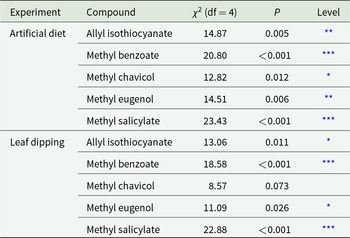
The binomial GLMs generated for binary response of mortality to the compounds and more specifically to their concentrations have revealed that all compounds exhibited significant larvicidal effects in artificial diet and leaf dipping bioassays (table 2, fig. 2A–G, I, J), except for methyl chavicol treatments, which were not significant in leaf dipping bioassays (table 2, fig. 2H).
Logistic regression curves along with jittered incidence of mortality frequency in Ostrinia furnacalis larvae treated with allyl isothiocyanate (A = artificial diet, B = leaf dipping method), methyl benzoate (C = artificial diet, D = leaf dipping method), methyl chavicol (E = artificial diet, F = leaf dipping method), methyl eugenol (G = artificial diet, H = leaf dipping method), and methyl salicylate (I = artificial diet, J = leaf dipping method).

The likelihood ratio test results for generalised linear models with binomial distribution established for compounds individually to reveal the significance level of association between the survival status of larvae of O. furnacalis and the concentration of each respective compound

*** for p < 0.001, ** for p < 0.01, * for p < 0.05 – indicates the significance levels.
Oviposition preference of O. furnacalis
The oviposition preference of O. furnacalis adults differed among concentrations of each compound significantly in both choice and no-choice experiments under both laboratory and field conditions (table 3). The increase in concentration of each compound consistently lowered the oviposition preference of the adults based on the number of eggs laid in choice (figs. 3A and 4A) and no-choice (figs. 3B and 4B) experiments under laboratory (fig. 3A,B) and field conditions (fig. 4A,B).
The number of eggs laid by Ostrinia furnacalis females on the paper loaded with compounds in choice (A1–A5) and no-choice (B1–B5) experiments under laboratory conditions (A1 and B1 = allyl isothiocyanate, A2 and B2 = methyl benzoate, A3 and B3 = methyl chavicol, A4 and B4 = methyl eugenol, and A5 and B5 = methyl salicylate). Each concentration in the legend refers to the corresponding colour in the plots. The different lower cases presented over bars represent the significant differences among the treatments.

The number of eggs laid by Ostrinia furnacalis females on the paper loaded with compounds in choice (A1–A5) and no-choice (B1–B5) experiments under greenhouse conditions (A1 and B1 = allyl isothiocyanate, A2 and B2 = methyl benzoate, A3 and B3 = methyl chavicol, A4 and B4 = methyl eugenol, and A5 and B5 = methyl salicylate). Each concentration in the legend refers to the corresponding colour in the plots. The different lower cases presented over bars represent the significant differences among the treatments.

The likelihood ratio test results for generalised linear models with Poisson distribution established for compounds with different concentrations on the oviposition choices of O. furnacalis females in choice and no-choice experiments under laboratory and greenhouse conditions

*** for p < 0.001, ** for p < 0.01, * for p < 0.05 – indicates the significance levels.
Behavioural assay tests with Y-tube olfactometer
The first choice of O. furnacalis adults toward each arm of Y-type choice platform was significantly affected by treatments (table 4, fig. 5) for methyl benzoate and methyl salicylate when tested in 75 and 100 mg/L concentrations, where the insect consistently avoided the treated arm. Neither lower concentrations of both compounds nor other compounds in any concentration affected female choice. However, our representative data has shown a relative preference toward methyl eugenol and allyl isothiocyanate over methyl benzoate and methyl salicylate (Supplementary fig. S1).
The first choices of Ostrinia furnacalis females toward the treatment and control arms of the choice platform. The colour palette in the legend represents respective concentrations of tested compounds: allyl isothiocyanate (A1–A4), methyl benzoate (B1–B4), methyl chavicol (C1–C4), methyl eugenol (D1–D4), and methyl salicylate (E1–E4). The asterisks on the panels indicate the level of significance (**P < 0.01, ***P < 0.001, ns = not significant).

The likelihood ratio test results for generalised linear models with binomial distribution established for compounds with different concentrations on the behavioural choices of O. furnacalis female adults

*** for p < 0.001, ** for p < 0.01, * for p < 0.05 – indicates the significance levels.
Foraging behaviours of egg parasitoid
The factors, compound, concentration, and compound × concentration significantly affected the foraging behaviour of T. ostriniae (table 5). Similarly, the concentration factor, when alone for each compound, significantly affected the foraging behaviour of the parasitoid (table 5). All concentrations of all tested compounds consistently increased the foraging behaviour of the parasitoid, indicating an increasing trend over the elevated concentrations (fig. 6).
The effect of different compounds (A = allyl isothiocyanate, B = methyl benzoate, C = methyl chavicol, D = methyl eugenol, and E = methyl salicylate) with a range of concentrations on the foraging duration (mean ± SEM, in min) of Trichogramma ostriniae. The legend shows the range of concentrations in each plot. The lower cases on the bars depict the differences between the foraging duration of each group of parasitoids as a result of multiple comparison tests.

The likelihood ratio test results for generalised linear models with Gaussian distribution established for overall factor effect (compound × concentration) and individualised factor (concentration|compound) effect on the foraging duration of T. ostriniae. The column level is based on the significance level presented in the column P

*** for p < 0.001, ** for p < 0.01, * for p < 0.05 – indicates the significance levels.
Discussion
The present study investigates the efficacy of various synthetic analogues of VOC elicitors against O. furnacalis, focusing on their potential for pest control through ovicidal, larvicidal, and oviposition deterrent effects. Given the significant economic impact of O. furnacalis on maize production, exploring alternative pest management strategies is crucial. The VOCs tested are noted for their relative safety and effectiveness compared to traditional chemical pesticides.
The experiments began by evaluating the ovicidal effects of VOCs, where hatching ratios of O. furnacalis larvae from eggs treated with different concentrations of each VOC were measured. The results demonstrated a significant reduction in hatching success, with some VOCs causing near-complete inhibition of egg hatching. For example, at the highest concentration of a particular VOC, the hatching ratio fell below 10%, indicating that these VOCs can disrupt the developmental cycle of O. furnacalis at the egg stage. This finding is consistent with previous research reporting similar ovicidal activities (Singh et al., Reference Singh, Koul, Rup and Jindal2011; ABD-EL-AZIZ and Sayed, Reference ABD-EL-AZIZ and Sayed2014; Natikar and Balikai, Reference Natikar and Balikai2015; Alouani et al., Reference Alouani, Rehimi and Soltani2018; Akutse et al., Reference Akutse, Kimemia, Ekesi, Khamis, Ombura and Subramanian2019; Takeda et al., Reference Takeda, Takata, Arai, Sasaya, Noyama, Wakisaka, Ghazy, Voigt and Suzuki2020; Sawadogo et al., Reference Sawadogo, Ahissou, Somda, Nacro, Legrève and Verheggen2022), supporting the role of VOCs in sustainable pest management.
After assessing ovicidal assessment, the study evaluated the larvicidal effects of VOCs on both artificial and natural diets. In this phase, O. furnacalis larvae were exposed to VOC-treated diets. Larval mortality rates were significantly higher in treated groups compared to control, confirming the effectiveness of these compounds in reducing larval survival (von Mérey et al., Reference von Mérey, Veyrat, D’Alessandro and Turlings2013; De Lange et al., Reference De Lange, Laplanche, Guo, Xu, Vlimant, Erb, Ton and Turlings2020; Phambala et al., Reference Phambala, Tembo, Kasambala, Kabambe, Stevenson and Belmain2020; Sun et al., Reference Sun, Li, Wang, Feng, Tian, Liu, Li, Yin, Wang and Wei2022; Dong et al., Reference Dong, Chen, Men, Li, Kong, Yuan and Ge2023; Olaboro et al., Reference Olaboro, Kyamanywa, Lutaakome, Paparu, Halerimana, Nkalubo and Otim2024). Notably, larvicidal activity was more pronounced in early instar larvae, with mortality rates exceeding 80% in some treatments. These findings suggest that VOCs not only inhibit egg hatching but also exert strong toxic effects during the larval stage, effectively interrupting the pest life cycle.
In addition to direct mortality, the study also examined the oviposition behaviour of O. furnacalis adults in response to VOC treatments. Both no-choice and choice experiments showed that adult females significantly avoided laying eggs on VOC-treated surfaces. The reduction in egg deposition on treated surfaces, compared to controls, was statistically significant, highlighting the oviposition deterrent properties of these VOCs (Sun et al., Reference Sun, Li, Wang, Feng, Tian, Liu, Li, Yin, Wang and Wei2022; Dong et al., Reference Dong, Chen, Men, Li, Kong, Yuan and Ge2023; Guo et al., Reference Guo, Miao, Ai, Zhang, Yan and Du2023; Hajdu et al., Reference Hajdu, Molnár, Waterman, Machado, Radványi, Fónagy, Khan, Vassor, Biet and Erb2024; Sharanappa et al., Reference Sharanappa, Bheemanna, Prabhuraj, Naik, Naik, Rao, Moussa, Alsubki, Ullah and Elansary2024; Tian et al., Reference Tian, Xu, Li, Lin, Chen, Chen, Yang and Wei2024). The oviposition deterrence index values further supported these findings, with certain concentrations causing a marked decline in the number of eggs laid. This behavioural response is critical for pest management, as it reduces the potential number of larvae and influences the overall population dynamics of O. furnacalis.
Behavioural assays using a two-choice olfactometer further assessed female adult preferences for untreated versus VOC-treated areas. The results revealed a consistent preference for untreated surfaces, with adults avoiding VOC-treated areas. This suggests that the VOCs emit volatiles that are repellent, providing additional evidence for their potential as effective deterrents in pest management programs (von Mérey et al., Reference von Mérey, Veyrat, D’Alessandro and Turlings2013; Salamanca et al., Reference Salamanca, Souza, Lundgren and Rodriguez-Saona2017; Ortiz-Carreon et al., Reference Ortiz-Carreon, Rojas, Cisneros and Malo2019; Volpe et al., Reference Volpe, Zanardi, Magnani, Luvizotto, Esperança, Freitas, Delfino, Mulinari, Carvalho and Wulff2020; Yuan et al., Reference Yuan, Zhao, Du, Yu, Shi, Chen and Chen2022; Ibrahim et al., Reference Ibrahim, Omer, Fouad and Gendy2023). Furthermore, the study evaluated the foraging behaviour of T. ostriniae, a key parasitoid of O. furnacalis. The parasitoids were observed for the time spent on VOC-treated maize plants compared to untreated plants. The results showed no significant difference in foraging time between VOC-treated and untreated plants. These findings suggest that VOCs may support the activity of natural enemies (Indhumathi et al., Reference Indhumathi, Muthukrishnan, Durairaj, Thavaprakaash and Soundararajan2019; Kurtanovic et al., Reference Kurtanovic, Hofferberth and Ruther2022; Tai et al., Reference Tai, Zhang, Xiao, Tang, Liu, Bai and Wang2022; Wang et al., Reference Wang, Hou, Benelli, Desneux, Ali and Zang2022b; Ali et al., Reference Ali, Wei, Mahamood, Zhou, King, Zhou and Shamsi2023; Foba et al., Reference Foba, Shi, An, Liu, Hu, Hegab, Liu, Zhao and Wang2023; Lami et al., Reference Lami, Burgio, Magagnoli, Depalo, Lanzoni, Frassineti, Marotti, Alpi, Mercatante and Rodriguez-Estrada2024), which may have implications for biological control strategies. While VOCs effectively target O. furnacalis, their impact on beneficial insects like T. ostriniae raises concerns about the potential disruption of natural pest control mechanisms in agricultural ecosystems.
It is also essential to consider that the stability and biological effectiveness of VOCs are strongly influenced by environmental factors. As gaseous compounds, VOCs are subject to rapid volatilisation and degradation under open-field conditions, where temperature, humidity, wind, and sunlight can alter their dispersion and persistence (Munawar et al., Reference Munawar, Zhang, Zhong, Ge, El‐Ela, Mao, Ntiri, Mao, Zhu and Zhou2022). While our study demonstrated the effectiveness of VOCs under controlled environments, these findings may not fully translate to field conditions without appropriate formulation or delivery systems. Therefore, future studies should include field-based trials and explore innovative techniques such as slow-release carriers or encapsulated formulations that enhance VOC stability and ensure consistent performance in diverse agricultural settings.
Conclusively, the findings of this study highlight the potential of synthetic VOCs as sustainable tools for managing O. furnacalis, a major pest in maize production. The VOCs demonstrated multifaceted pest control efficacy, significantly reducing egg hatching, increasing larval mortality, and strongly deterring oviposition. Behavioural assays further confirmed the repellency of VOC-treated surfaces to adult moths, emphasising their role in disrupting pest population dynamics. Among the tested compounds, methyl salicylate and methyl benzoate exhibited superior insecticidal and deterrent effects compared to allyl isothiocyanate, methyl eugenol, and methyl chavicol, underscoring their potential as eco-friendly alternatives to conventional pesticides. Additionally, this study demonstrated that VOC applications did not adversely affect non-target organisms, such as the parasitoid T. ostriniae, as evidenced by its consistent foraging behaviour on VOC-treated plants. This finding emphasises the need to integrate these VOCs into pest management strategies that consider their potential impact on beneficial insects and the overall balance of agroecosystems. Future research should focus on elucidating the mechanisms underlying these behavioural and physiological responses, as well as evaluating the long-term impacts of VOCs on pest populations and natural enemies across different agricultural settings. Such studies will contribute to the development of VOCs for sustainable pest management strategies that balance pest control with the conservation of beneficial species in agroecosystems.
Supplementary material
The supplementary material for this article can be found at https://doi.org/10.1017/S0007485325100266.
Acknowledgements
The authors extend their appreciation to the Deanship of Research and Graduate Studies at King Khalid University through the Large Groups Project under grant number RGP2/535/45.
Author contributions
A.A.: Conceptualisation; Methodology; Formal analysis; Writing – original draft preparation; Writing – review & editing. S.A.: Writing – review & editing. B.A.: Writing – review & editing. M.S.: Writing – review & editing. J.Y.: Writing – review & editing. K.A.K.: Writing – review & editing. H.A.G.: Writing – review & editing. Y.D.: Writing – review & editing. J.A.: Visualisation; Data curation; Writing – original draft preparation; Writing – review & editing. A.T.: Formal analysis; Software; Data curation; Visualisation; Writing – original draft preparation; Writing – review & editing. L.Q.: Writing – review & editing. R.C.: Conceptualisation; Supervision; Validation; Visualisation; Resources; Project administration; Writing – review & editing; Funding acquisition.
Financial support
We sincerely thank the People’s Government of Jilin Province (20220203198SF), the Ministry of Science and Technology of China (2022YFD1500701), and the Ministry of Agriculture of the People’s Republic of China (15226025) for their financial funding of this research.
Competing interests
All authors have declared that they have no conflicts of interest. They have read and approved the final version of the manuscript for publication.
Declaration of AI Assistance
The authors acknowledged the use of AI-based tools, including ChatGPT, in order to check grammar and enhance the readability of this manuscript. However, all ideas, scientific content, and results presented in this work are the authors’ own, and the final version has been thoroughly reviewed and approved by the research team.