Introduction
Each year traumatic injuries result in approximately 45 million disabilities and 5.8 million mortalities worldwide.Reference Katona, Douglas, Lena, Ratner, Crothers, Zondervan and Radis 1 , Reference Mock and Cherian 2 The World Health Organization (WHO; Geneva, Switzerland) predicts that trauma-related deaths will rise by 28% between 2004 and 2030 and will eventually surpass infectious disease to become the leading cause of mortality.Reference Kendrick, O’Brien and Christie 3 Over 80% of trauma deaths in low-income countries occur out of the hospital. In high-income countries, such as the United States, this rate drops to 59%.Reference Anderson, Suter and Mulligan 4 , Reference Mock, Jurkovich, Arreola-Risa and Maier 5 This difference is due to the greater number of skilled professionals in wealthy countries who are able to administer care within the immediate post-injury period.Reference Mock 6 To increase the availability of urgent care in low-income countries with minimal medical infrastructure, the WHO recommends implementing programs that strengthen prehospital trauma care, such as training lay people in first aid.Reference Mock, Jurkovich, Arreola-Risa and Maier 5 Basic first aid administered at the scene of an injury has been shown to decrease morbidity and mortality.Reference Boyd and Cowley 7 – Reference Henry and Reingold 9
The challenges presented by traumatic injuries are especially acute in South Sudan. The population exceeds 11 million people, 83% of whom live in rural areas. Decades of conflict and poverty have eroded the health infrastructure and stymied efforts to provide basic medical care to those in need. 10 , 11 South Sudan is almost 50% larger than Texas (USA) and fewer than 250 physicians work in the country. The majority of these doctors and other health care workers are concentrated in major cities. 10 Government-run Primary Health Care Units (PHCUs) provide basic health care but suffer from lack of funding and understaffing. The average population per PHCU ranges from 4,000 to 34,000, leaving only one-third of the country with access to adequate health services. 11
The Kit region of South Sudan is rural and lacks basic medical resources. 10 It is 90 miles south of the capital, Juba, and lies along the country’s only paved highway. Kit is serviced by one PHCU and two pharmacies. Health data from Kit are limited, but anecdotal reports reveal that deaths from traumatic injury are common and affect many families emotionally, psychologically, and financially. The paved road in Kit is a major source of accident and injury. The absence of formal Emergency Medical Services requires victims of serious traumatic injury to find their own way to Juba—a 2-hour drive. 10
In communities such as Kit where trauma is common and medical resources are limited, wilderness first aid (WFA) training is a promising way to minimize suffering due to injury. Trainees require no prior medical experience and are taught life-saving measures applicable to remote settings using improvised and readily available materials. 12 Stonehearth Open Learning Opportunities (SOLO; Conway, New Hampshire USA) is the oldest, continuously operating wilderness medical school in the world, and has built a WFA curriculum targeted to remote communities in developing countries.Reference Johnson, Schimelpfenig and Hubbell 13 Stonehearth Open Learning Opportunities has taught this course in many villages over the past decade; however, the effectiveness of these trainings has never been studied. The present study was designed to test the efficacy of one SOLO WFA course administered to community members in Kit, South Sudan in July 2013.
Methods
A pre-test/post-test study was conducted in Kit, South Sudan, from July 23-25, 2013. The University of New England (Biddeford, Maine USA) Institutional Review Board approved the study [IRB20130426KATOL]. Trainers from SOLO, volunteers from the Maine-African Partnership for Social Justice (MAPSJ; Peaks Island, Maine USA), and medical students from the University of New England College of Osteopathic Medicine conducted the course. The course and assessments were administered in English and translated in real-time to Acholi and Arabic, the two languages most spoken in the Kit region.
Informed consent was obtained from all participants at the beginning of the study. The purpose of the study, details about the procedures, the risks and benefits of taking part in the study, and confidentiality measures were communicated thoroughly to the entire group. On an individual basis, participants had the opportunity to ask questions and verbally provide consent to a member of the study team.
Participants
Study participants were a sample of Kit villagers selected by the Kit Village Health Committee, with help from MAPSJ, to take part in the intensive 3-day WFA course. Of the 50 training course enrollees, 46 (92%) agreed to take part in the research component. Of the 46 participants, 28 were men (61%) and 18 were women (39%). The average age of the participants was 30.85 years (SD=7.36) with an age range of 19-45 years.
Wilderness First Aid Course
The 3-day WFA course was developed by SOLO and consisted of six hours of lecture and 12 hours of hands-on practical training. The course covered body substance isolation, wound cleaning and dressing, treatment of dislocations and fractures, animal bites, and patient transport. Classes began at 8:00 am and ended at 4:00 pm, with breaks from 10:00-10:30 am and 2:30-3:00 pm for morning and afternoon tea, respectively, and 12:00-1:00 pm for lunch.
Participating in the course did not require literacy. Participants were provided with a picture-based first aid manual, and a poster-sized version of the manual was used as the primary lecture material. Instructors lectured with the poster-sized manual as a visual aid while participants followed along with their own manuals.
After course concepts were introduced in lecture, the class split into groups and practiced the skills and techniques they learned. These hands-on practical application sessions allowed participants to apply the presented material immediately. Instructors taught how to use widely available materials such as sticks and blankets to make splints, slings, and transport beds. Skill learning was cumulative, each lesson building on previous material.
Knowledge Assessment
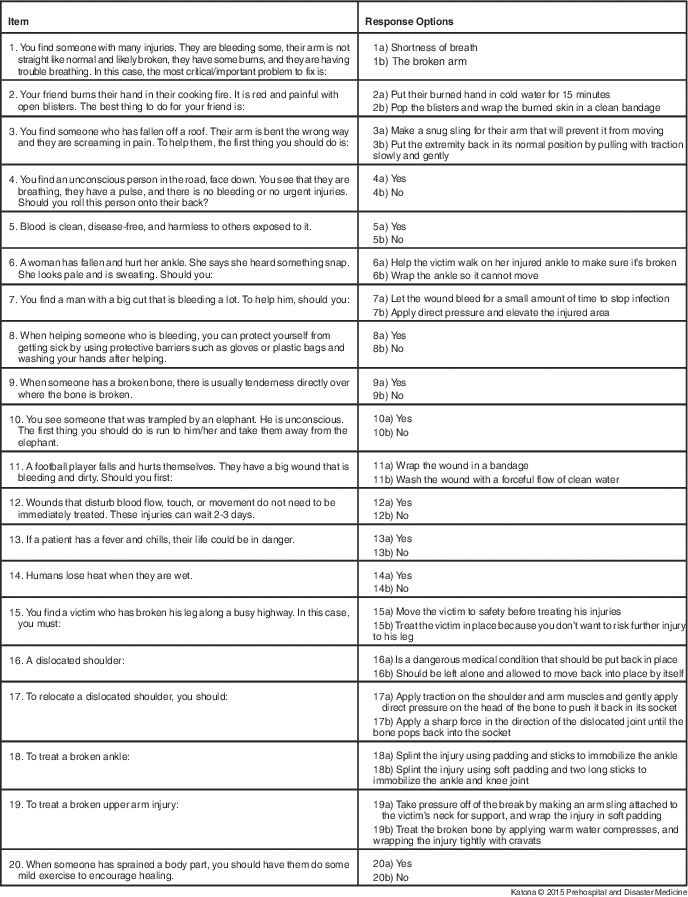
To assess the effectiveness of the course, a 20-item first aid questionnaire was developed and delivered to participants before (ie, “pre-test”) and after (ie, “post-test”) the training course. Prior to arriving in Kit, the research team consulted with members of the Portland, Maine (USA) South Sudanese community regarding the language and cultural sensitivity of the questionnaire. The questions assessed knowledge of basic first aid theory and technique and posed brief trauma scenarios to which the participants chose the best response (Table 1).
South Sudan First Aid Questionnaire

The questionnaire was designed to be delivered orally. Each participant was assigned a unique study identification number and given an individual answer sheet to record responses to the questionnaire. All questions were multiple-choice with two response options. Answer sheets were numbered 1-20 (corresponding to the twenty questions), each with “A” and “B” answer choices. For the pre-test, participants listened to each question in their native language(s) and marked their answer appropriately on their answer sheet.
After completing the pre-test, participants took part in the 3-day first aid training program facilitated by SOLO as described above. Following the training, the same questionnaire (post-test) was administered to course participants to assess changes in their responses. For the post-test, participants were given the option to read the questionnaire on their own or listen to the live translation. Upon completion of the test (both pre- and post-), no discussion of the questions or their answers took place. Scores were not shared with participants because the assessments were collected for research purposes on the aggregate level and not to grade participants on their individual performance.
Statistical Analysis
Seven of the 46 participants did not fill out the pre-test questionnaire. These participants (all female) were excluded from analyses because their change in knowledge could not be assessed. After gathering the completed questionnaires, the research team entered the data into Microsoft Excel for Mac 2011 spreadsheet Version 14.4.4 (Microsoft Corporation; Redmond, Washington USA). An analysis using IBM SPSS Statistics for Macintosh software Version 22.0 (IBM Corporation; Armonk, New York USA) was performed upon returning to the United States. The main analysis was a paired t-test to examine if first aid knowledge increased from pre-test to post-test. The next analysis examined whether gender moderated this effect. The effect of gender on test performance was analyzed using a 2 x 2 mixed-design ANOVA, with time of assessment (pre- vs post-test) as a within-subjects factor and gender (female or male) as a between-subjects factor. Finally, correlations were conducted between age and pre-test scores, post-test scores, and knowledge change (pre-test to post-test).
Results
Comparison of Pre-test to Post-test Scores
Before participating in the first aid training course, the average test score was 67% (13.41/20; SD=2.56). After the 3-day course, the mean test score improved to 75% (15.03/20; SD=1.63). A paired t-test indicated a significant improvement in general knowledge due to the training: t(38)=3.94; P<.001.
Gender and First Aid Knowledge
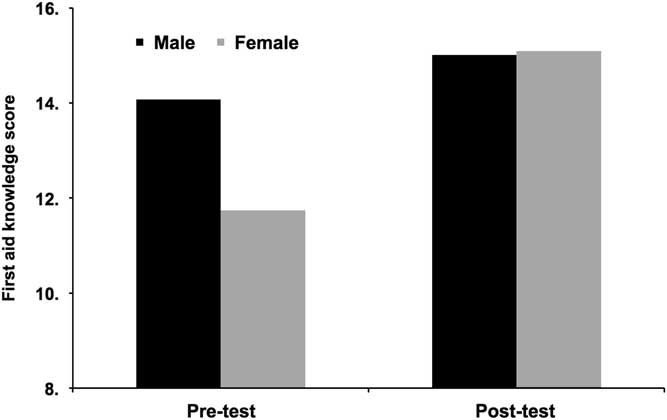
Results did not indicate a significant main effect of gender, F (1, 37)=3.61; P=.07, revealing slightly higher, but statistically indistinguishable, overall test scores for males than for females. These results were qualified, however, by a significant gender x time of assessment interaction: F (1, 37)=8.56; P=.006 (Figure 1). Paired comparisons revealed that males scored higher than females on the pre-test (M=14.07; SD=2.40 vs M=11.73; SD=2.24): t(37)=2.79; P=.008, but there was no significant difference of gender on the post-test, (M=15.00; SD=1.74 vs M=15.09; SD=1.38): t(37)=1.56; P=.88. In addition, both males and females scored better on the post-test than the pre-test (men: t(27)=2.13; P=.04; women: t(10)=4.61; P=.001), supporting the positive effect of training on first aid knowledge regardless of gender.
First Aid Knowledge as a Function of Gender and Time of Assessment.

Age and First Aid Knowledge
Correlation analyses revealed a non-significant trend for the relationships between age and pre-test scores, r(39)=−0.26; P=.11, and age and post-test scores, r(39)=−0.25; P=.12, suggesting a negative (but not statistically significant) correlation between age and knowledge at both time points. There was no significant correlation between age and change in knowledge: r(39)=0.10; P=.54.
Discussion
Overall, this study provides preliminary evidence that despite language and cultural barriers, a WFA course can teach basic first aid knowledge effectively to people with varying levels of education and professional experience in a rural setting. In support of the empirical findings, the research team anecdotally reported that the training participants were fast learners and quickly gained confidence in conducting patient assessments, splinting, casting, wound care, and transport.
Employing WFA trainings as a means for improving medical care in rural communities is promising, but the long-term efficacy and scalability of such trainings is unknown. This study provides a foundation for future researchers to build on in order to investigate whether participants retain first aid knowledge and skills over time, whether they use these skills in actual emergency situations, and if there are better outcomes in communities where these trainings take place.
Limitations
While these results are encouraging, there are several important limitations. For instance, given the fact that some of the statistical tests neared, but did not meet, statistical significance and the sample size was low due to the logistical constraints of this applied work, it is likely that several of the analyses were underpowered. As a result, future research investigating the effects of first aid training in South Sudan and other developing countries should aim for larger sample sizes. Additionally, conducting the course in English with live translation rather than directly in the participants’ native languages may have contributed to some concepts being lost during the translation. Thus, it is possible that these results underestimate the efficacy of the 3-day training course. Another limiting aspect is that a lack of quantitative assessment of the hands-on techniques might have prevented capturing the extent of the knowledge acquired during the training.
Conclusion
This investigation showed that a WFA training course administered by SOLO Schools significantly improved participants’ first aid knowledge and revealed an improvement for both males and females. This knowledge improvement was not influenced by age. Wilderness first aid training is particularly promising for rural communities with limited medical resources because it is designed to teach people how to use objects in nature to treat injuries. In South Sudan, a country with a shortage of trained health care professionals and a lack of basic health care infrastructure, teaching WFA to villagers has great potential to improve outcomes from traumatic injuries. The course is economical and sustainable because it does not require trainees to have access to expensive supplies and minimizes reliance on outside medical professionals when basic medical care is needed. It is also adaptable to varying environments and could be expanded into other parts of South Sudan and rural communities worldwide. While death and disability due to trauma are significant problems, providing WFA training is one way to mitigate such suffering.