INTRODUCTION
In the 1980s ivermectin (IVM), which belongs to the macrocyclic lactone (ML) class of anthelmintics, was introduced onto the agricultural market. Its broad-spectrum activity and high safety profile soon made it the cornerstone of modern anthelmintic therapy for treating many endo- and ecto-parasites in livestock (Geary, Reference Geary2005). However, widespread ML resistance has developed in some nematode parasites of sheep, goats and cattle (Jackson and Coop, Reference Jackson and Coop2000; Kaplan, Reference Kaplan2004; Wolstenholme et al. Reference Wolstenholme, Fairweather, Prichard, von Samson-Himmelstjerna and Sangster2004). The mechanisms of ML resistance are poorly understood at present, but may involve target-site mutations or non-specific mechanisms involved in the transport and/or metabolism of the anthelmintics. Previous studies have suggested that genetic variability within the glutamate-gated chloride channels (Prichard, Reference Prichard2005; von Samson-Himmelstjerna, Reference von Samson-Himmelstjerna2006) and amphidial neurone genes (Freeman et al. Reference Freeman, Nghiem, Li, Ashton, Guerrero, Shoop and Schad2003; Guerrero and Freeman, Reference Guerrero and Freeman2004; Yates et al. Reference Yates, Portillo and Wolstenholme2003) may affect the phenotypic expression of ML resistance. In the case of the non-specific mechanisms, decreased cuticular penetration of the drug (Scott, Reference Scott1989), increased drug metabolism (Scott, Reference Scott1989) and possible effects on the influx/efflux of xenobiotics by multidrug resistance transporters have been implicated in ML resistance. (Beugnet et al. Reference Beugnet, Gauthey and Kerboeuf1997; Kerboeuf et al. Reference Kerboeuf, Guegnard and Le Vern2002, Reference Kerboeuf, Blackhall, Kaminsky and von Samson-Himmelstjerna2003; Prichard and Roulet, Reference Prichard and Roulet2007; Xu et al. Reference Xu, Molento, Blackhall, Ribeiro, Beech and Prichard1998).
P-glycoprotein (P-gp) is a membrane-bound protein belonging to the ATP binding cassette (ABC) transporter family, whose main function is the active efflux of various structurally unrelated exogenous compounds, thus protecting both vertebrate and invertebrate organisms against potentially toxic molecules (Gottesman and Pastan, Reference Gottesman and Pastan1993). The over-expression of P-gp has been demonstrated in tumour cells in response to chemotherapy and severely restricts anti-cancer drug effectiveness (Borst et al. Reference Borst, Evers, Kool and Wijnholds1999). Interestingly, efflux pumps from the P-gp family of transporters have also been described in C. elegans (Broeks et al. Reference Broeks, Janssen, Calafat and Plasterk1995) and H. contortus (Blackhall et al. Reference Blackhall, Liu, Xu, Prichard and Beech1998; Le Jambre et al. Reference Le Jambre, Dobson, Lenane and Barnes1999; Prichard and Roulet, Reference Prichard and Roulet2007) and have been implicated in nematode resistance to all 3 broad-spectrum anthelmintics: benzimidazoles (Beugnet et al. Reference Beugnet, Gauthey and Kerboeuf1997; Kerboeuf et al. Reference Kerboeuf, Guegnard and Le Vern2002), imidazothiazoles/tetrahydropyrimidines (Rothwell and Sangster, Reference Rothwell and Sangster1997) and MLs (James and Davey, Reference James and Davey2009; Sangster et al. Reference Sangster, Bannan, Weiss, Nulf, Klein and Geary1999; Xu et al. Reference Xu, Molento, Blackhall, Ribeiro, Beech and Prichard1998).
It has been clearly established that the administration of P-gp inhibitors in vivo to animals increases the bioavailability of ML (Lespine et al. Reference Lespine, Alvinerie, Vercruysse, Prichard and Geldhof2008) providing a possible strategy to increase drug efficacy. Since all these data point to the importance of the role played by P-gp in the modulation of ML pharmacokinetics, it seems reasonable to assume that they have some potential as bio- or molecular targets for ML resistance.
The aim of the present study was to investigate the potential of various P-gp interfering agents to enhance the in vitro susceptibility of resistant and sensitive nematode isolates to IVM. Although mammalian and nematode P-gps have a low homology, and since no cell cultures over-expressing nematode efflux pumps are available, cells over-expressing mammalian P-gp were used to test the ability of various compounds to inhibit P-gp transport activity and to provide a concentration range of these compounds for use in the larval feeding inhibition test (LFIT) (Alvarez-Sanchez et al. Reference Alvarez-Sanchez, Perez Garcia, Bartley, Jackson and Rojo-Vazquez2005). Compounds identified in this way were used to determine changes in sensitivity to IVM using both sensitive and resistant Teladorsagia circumcincta and Haemonchus contortus isolates.
MATERIALS AND METHODS
Chemicals
Ivermectin, rhodamine 123 (Rho123), verapamil hydrochloride (VER), quercetin (QUER) and pluronic P85 (P85) were obtained from Sigma-Aldrich (St Louis, MO, USA). Valspodar (VAL) was a gift from Novartis (Basel, Switzerland). Ketoconazole (KET) was from ICN Biochemicals (CA, USA). All the compounds were dissolved in dimethylsulphoxide (DMSO) with the exception of P85 which was dissolved in water.
Cell culture and P-gp transport activity
In order to determine the concentration of P-gp inhibitors to be used for larval feeding inhibition tests (LFIT), P-gp transport activity was assayed by following Rho123 accumulation in an in vitro model of a recombinant pig kidney epithelial cell line LLC-PK1 over-expressing murine P-gp as previously described (Lespine et al. Reference Lespine, Martin, Dupuy, Roulet, Pineau, Orlowski and Alvinerie2007). The effect of 5 P-gp interfering compounds on P-gp activity transport was explored. Prior to the experiments, the cells were plated into 24-well cluster plates and incubated for 2 h in Hank's Buffered Salt Solution containing 10 μm Rho123 with or without IVM (0·05–15 μm), VAL (0·01–10 μm), VER (0·1–10 μm), KET (1–100 μm), QUER (1–100 μm) or P85 (1–110 μm). The final DMSO concentration in the medium never exceeded 0·2% (v/v). The intracellular fluorescence was then measured in cell lysates and the values were normalized to the protein content per well. Valspodar was used as the reference compound for maximal inhibition of P-gp transport activity. The results obtained were expressed as percent of total valspodar inhibition.
Nematode isolates
Two T. circumcincta (MTci3, MTci4) and 2 H. contortus isolates (MHco3 and MHco4) were characterized using the LFIT. MTci3 and MHco3 are phenotypically IVM sensitive (unpublished data) whilst MTci4 (Jackson et al. Reference Jackson, Coop, Jackson, Scott and Russel1992) and MHco4 (van Wyk et al. Reference van Wyk, Malan, Gerber and Alves1987) are phenotypically IVM resistant. The isolates were passaged through parasite naïve lambs that were housed under conditions that precluded contamination with other nematode species prior to use.
Larval feeding inhibition test (LFIT)
Nematode ova from the faeces of monospecifically infected animals were extracted as described previously (Bartley et al. Reference Bartley, Jackson, Johnston, Coop, Mitchell, Sales and Jackson2003). The harvested eggs were washed, resuspended in water in a 10 cm Petri dish prior to being incubated for 16 h at 22°C. Following this incubation period, the embryonated eggs were placed in a mini-Baermann apparatus (mesh aperture 25 μm) which was submerged in water in a 6-well cluster plate and incubated at 22°C until the eggs hatched and the emerging first-stage larvae (L1) migrated through the mesh. The L1 concentration was adjusted so that 1498 μl of water in a 2 ml microcentrifuge tube contained 100 larvae.
For the LFIT, IVM concentrations ranged from 0·07 to 35 ng/ml (0·08–40 nm) whilst maintaining a single concentration of P-gp interfering compound: VAL 5 μm; VER and QUER 50 μm; KET 10 μm and P85 22 μm. Control assays were performed with only DMSO or P-gp interfering agents alone at the concentration described above. All tests were run in duplicate. The microcentrifuge tubes were incubated horizontally at 25°C for 2 h after which time 10 μl of fluorescein isothiocyanate (FITC)-labelled Escherichia coli (Geary et al. Reference Geary, Sims, Thomas, Vanover, Davis, Winterrowd, Klein, Ho and Thompson1993) were added. The tubes were again incubated horizontally for a minimum of 18 h at 25°C. Following this incubation, the tubes were centrifuged at 3000 g for 20 sec and 750 μl of supernatant was then removed. Larvae were transferred onto a glass slide for counting and were examined at a magnification of ×100 using an inverted fluorescence microscope fitted with a UV blue range filter (495 nm). Larvae with FITC-labelled E. coli visible throughout the gastrointestinal tract were considered to be feeding.
Statistical analysis
The LFI99 estimates i.e. the concentration of IVM at which 99% of the L1 did not feed was performed using a probit model on uncorrected raw data. The analyses were carried out using Genstat 6.0. Sensitivity factors were determined for each of the isolates using the standard formula: (LFI99 estimate of IVM alone)÷(LFI99 estimate of IVM+inhibitor). Resistance factors were determined using the equation (LFI99 estimate of resistant isolate)÷(LFI99 estimate of IVM sensitive isolate).
RESULTS
Characterization of P-gp interfering agents
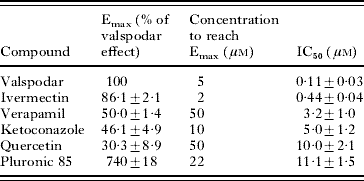
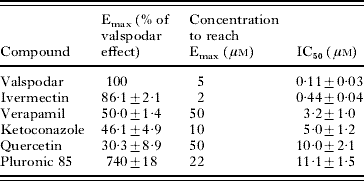
As shown in Table 1, IVM was a potent P-gp inhibitor, with a maximum effect (Emax) of 86% obtained at 2 μm, and a half-maximal inhibition (IC50) of 0·4 μm, compared with the reference inhibitor VAL (Emax of 100% obtained at 5 μm and IC50=0·11 μm). KET and VER induced Rho123 accumulation with respective Emax values that were 46% and 50% of those seen with VAL, obtained at 10 and 50 μm with IC50 values of 5 and 3·2 μm, respectively. P85 produced the greatest effects on Rho123 accumulation greater than that seen with VAL (740%) at a concentration for Emax of 22 μm and an IC50 value of 11 μm. QUER was the least potent inhibitor with an Emax of 30% of that recorded with VAL, at a concentration of 50 μm and an IC50 value of 10 μm. The concentration giving the Emax for each inhibitor was selected for use in the LFIT.
Influence of several selected compounds on P-gp transport activity in LLC-PK1-mdr1a cells
(LLC-PK1-mdr1a cells were incubated in the presence of rhodamine123 (rho123) with increasing concentrations of the compounds of interest. Maximal effect (Emax) was calculated relatively to the maximal effect obtained in the presence of valspodar (100%). IC50 was the concentration needed to reach 50% of rho123 efflux inhibition. Values are mean±s.d. of 3 experiments.)
Isolate sensitivity to IVM and effects of P-gp interfering agents on the LFIT
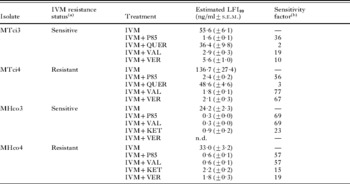
Table 2 contains details of the isolate nomenclature, their IVM resistance status, the effects of P-gp inhibitor on feeding behaviour, together with estimates of the LFI99 and changes in sensitivity resulting from exposure to the inhibitors in combination with IVM.
Probit analysis estimates of in vitro larval feeding of two Teladorsagia circumcincta and two Haemonchus contortus isolates
(Larvae feeding inhibition was performed by treating larvae with IVM from 0·07 to 35 ng/ml (0·08–40 nm) in the presence or not of interfering agents: valspodar (VAL, 5 μm), verapamil hydrochloride (VER, 50 μm), quercetin (QUER, 50 μm), pluronic P85 (P85, 22 μm) or Ketoconazole (KET, 10 μm). LFI99 values are mean±s.e.m. of 3 experiments, except for MHco3 for VAL and KET that were done only in duplicate. For technical reasons no results were obtained for VER for MHco3.)

(a) IVM resistance status as determined by faecal egg count reduction or controlled efficacy test (references in text).
(b) Sensitivity factor was determined using the standard formula [(estimated LFI99 of IVM alone)÷(estimated LFI99 of IVM+inhibitor)].
n.d., Not determined.
Isolate sensitivity
As expected, the concentration of IVM required to inhibit 99% of larval feeding (LFI99) was lower in IVM sensitive isolates than in IVM resistant ones (Table 2). The LFI99 estimates were 56 and 24 ng/ml for the 2 IVM sensitive isolates, MTci3 and MHco3 respectively compared with 137 and 33 ng/ml for the 2 IVM resistant isolates MTci4 and MHco4 respectively. Resistance factors were 2·5 and 1·4 for T. circumcincta and H. contortus respectively. Based on the LFI99 estimates the resistant and sensitive H. contortus isolates were 2·3- and 4·1-fold more sensitive to the effects of IVM when compared with the corresponding T. circumcincta isolates.
Effects of P-gp interfering agents
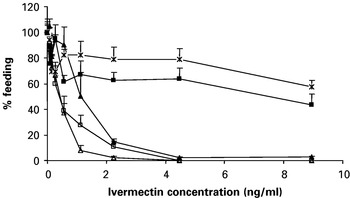
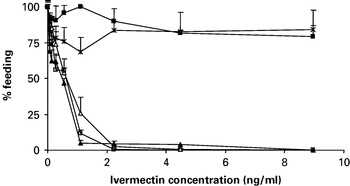
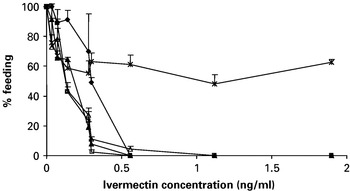
The effects of the P-gp interfering agents on larval feeding behaviour varied between species, isolates and drug sensitivity, as shown in Table 2. Figures 1, 2 and 3 show the dose-response curves for MTci3, MTci4 and MHco4 and clearly show in all cases a curve shift to the left in the presence of P-gp inhibitors, reflecting a decrease in larval feeding. The feeding of both IVM resistant and sensitive isolates of T. circumcincta (Figs 1 and 2) and H. contortus (Fig. 3) was influenced by the co-administration of interfering agents with IVM compared with IVM alone. For the T. circumcincta isolates the IVM was between 3- and 77-fold more potent, as determined by changes in sensitivity factors, whilst with the H. contortus isolates the increase in potency ranged between 19- and 69-fold (Table 2). The effect obtained was more pronounced with P85, VAL and VER than with QUER.
Larval feeding inhibition dose-response curves generated for the Teladorsagia circumcincta IVM-sensitive isolate (MTci3) using IVM from 0·07 to 35 ng/ml (0·08–40 nm) (x) with or without pluronic P85, 22 μm (▵);valspodar, 5 μm (□);verapamil 50 μm (▴) or quercetin, 50 μm (▪). The IVM concentration range shown in this figure is from 0·07 to 10 ng/ml.

Larval feeding inhibition dose-response curves generated for the Teladorsagia circumcincta IVM-resistant isolate (MTci4) using IVM from 0·07 to 35 ng/ml (0·08–40 nm) (x) with or without pluronic P85, 22 μm (▵); valspodar, 5 μm (□); verapamil 50 μm (▴) or quercetin, 50 μm (▪).The IVM concentration range shown in this figure is from 0·07 to 10 ng/ml.

Larval feeding inhibition dose-response curves generated for the Haemonchus contortus IVM-resistant isolate (MHco4) using IVM from 0·07 to 35 ng/ml (0·08–40 nm) (x) with or without pluronic P85, 22 μm (▵); valspodar, 5 μm (□);verapamil, 50 μm (▴) or ketoconazole, 10 μm (◆). The IVM concentration range shown in this figure is from 0·07 to 1·9 ng/ml.

LFI99 estimates with IVM+P85 tended to be lower than those with the other inhibitors and ranged between 0·3 and 2·4 ng/ml (Table 2). In the 3 isolates (MTci3, MTci4 and MHco4) that were tested with IVM+VAL the LFI99 estimates were also low, ranging from 0·6 to 2·9 ng/ml. In the T. circumcincta isolates quercetin had the least effect upon LFI99 estimates, ranging from 36·4 (MTci3) to 48·6 ng/ml (MTci4). As a consequence of their low LFI99 estimates both P85 and VAL gave the highest sensitivity values which produced an average 46-fold increase in sensitivity in the T. circumcincta isolates compared with a 63-fold increase in H. contortus isolates.
DISCUSSION
The aim of this study was to investigate the ability of various P-gp interfering compounds to enhance IVM efficacy in both sensitive and resistant isolates of Teladorsagia circumcincta and Haemonchus contortus. This drug combination could be useful for preventing the emergence of drug resistance, increasing efficacy, or shortening the course of treatment of gastro-intestinal nematodes in livestock.
In this study, we showed, as expected, that the resistant T. circumcincta and H. contortus larvae required more IVM than sensitive larvae (1·4- and 2·5-fold, respectively) for full feeding inhibition. These results are in full agreement with previous studies (Sangster, Reference Sangster1996; Kotze, Reference Kotze1998; Sheriff et al. Reference Sheriff, Kotze, Sangster and Martin2002) which have shown inter-specific and inter-isolate differences in IVM sensitivity. The difference in resistance factors may reflect either differences in the ways that the two species handle IVM exposure or may be related to differences in the way that resistance was selected in these particular isolates, since the treatment regime has been shown to be an important factor in determining the phenotypic responses to anthelmintic treatment (Le Jambre et al. Reference Le Jambre, Dobson, Lenane and Barnes1999; Sutherland et al. Reference Sutherland, Brown, Leathwick and Bisset2003). The small differences in resistance factors observed within these tests are similar to those seen in previous in vitro characterization studies using larval development and larval migration tests (Gill et al. Reference Gill, Redwin, van Wyk and Lacey1995, Reference Gill, Kerr, Shoop and Lacey1998; Gill and Lacey, Reference Gill and Lacey1998; Le Jambre et al. Reference Le Jambre, Gill, Lenane and Lacey1995). Gill and Lacey, (Reference Gill and Lacey1998) reported 2 to 3-fold reductions in the in vitro sensitivity of pre-parasitic stages to IVM in a number of H. contortus and T. circumcincta isolates while the in vivo efficacy of IVM against the adult stages of the same isolates ranged between 33 and 100%. Larger differences in resistance factors have been reported in controlled efficacy tests, where IVM treatments were directed against adult parasites (23 and 6 for T. circumcincta and Trichostrongylus colubriformis, respectively) (Shoop et al. Reference Shoop, Haines, Michael and Eary1993). The data from the various trials suggest that there are inter and intra (Gill and Lacey, Reference Gill and Lacey1998; Shoop et al. Reference Shoop, Haines, Michael and Eary1993) as well as stage (Bartley et al. Reference Bartley, Jackson, Sargison and Jackson2005) and age of infection (Borgsteede and Couwenberg, Reference Borgsteede and Couwenberg1987; Kerboeuf et al. Reference Kerboeuf, Hubert and Mallet1989; Scott et al. Reference Scott, Bairden, Holmes and McKellar1989) specific differences in the way that nematodes handle anthelmintics. In the present in vitro studies, it is unclear why such a relatively small shift in sensitivity is sufficient to overcome IVM resistance, but it might be related to the low drug concentrations that are required to induce marked effects on the key biological processes used in the in vitro tests.
The mechanisms of anthelmintic resistance in nematodes are poorly understood and defined (Jabbar et al. Reference Jabbar, Iqbal, Kerboeuf, Muhammad, Khan and Afaq2006; Sangster et al. Reference Sangster, Song and Demeler2005; Wolstenholme et al. Reference Wolstenholme, Fairweather, Prichard, von Samson-Himmelstjerna and Sangster2004) but changes in the distribution of the drug in the organism brought about by ABC transport proteins such as P-gp homologues have been proposed as one mechanism that nematodes might use in handling a range of different parasiticides (Prichard, Reference Prichard2007). For this reason we investigated the effect of various P-gp inhibitors on IVM efficacy. The compounds used in this study: valspodar, verapamil (Didier and Loor, Reference Didier and Loor1996) and ketoconazole (Ward et al. Reference Ward, Stelman, Morgan, Zeigler, Azzarano, Kehler, McSurdy-Freed, Proksch and Smith2004), the natural flavonoid quercetin (Hsiu et al. Reference Hsiu, Hou, Wang, Tsao, Su and Chao2002) and a poloxamer, pluronic P85 (Kabanov et al. Reference Kabanov, Batrakova, Sriadibhatla, Yang, Kelly and Alakov2005), are all known to interfere with P-gp function. We showed that the presence of P-gp inhibitors increased the sensitivity to IVM in both IVM- sensitive and resistant isolates of the two parasite species. These results support the previous view that P-gp analogues play an important role in both the overall distribution of IVM and the mechanisms of IVM resistance of the free-living stages of parasitic nematodes (James and Davey, Reference James and Davey2009; Kerboeuf et al. Reference Kerboeuf, Blackhall, Kaminsky and von Samson-Himmelstjerna2003; Prichard, Reference Prichard2007; Xu et al. Reference Xu, Molento, Blackhall, Ribeiro, Beech and Prichard1998). The findings of this current study are in complete agreement with a previous study (Molento and Prichard, Reference Molento and Prichard1999) which demonstrated that verapamil potentiated the efficacy of IVM and moxidectin against unselected and IVM-selected strains of H. contortus. In the same vein, recent studies have demonstrated that exposure to verapamil or valspodar completely restores sensitivity to IVM in IVM resistant C. elegans (James and Davey, Reference James and Davey2009). However, no interactive effect of P-gp inhibitors and IVM aglycone was found on the feeding of H. contortus L1 (Kotze, Reference Kotze1998). There are no simple explanations for these different findings but they may be due to target specificity, differences in inhibitor concentrations or lower affinity for P-gp of the avermectin analogues used in the trials. Also one cannot exclude the possibility that this is solely a stage-specific phenomenon and that distinct drug-transport mechanisms may be involved at different stages of the parasite life cycle (Kotze et al. Reference Kotze, Dobson, Tyrrell and Stein2002). However, there is some evidence from in vivo studies using P-gp inhibitors that some mechanisms may be common to different life-cycle stages (Lanusse and Prichard, Reference Lanusse and Prichard1993; Lifschitz et al. Reference Lifschitz, Sallovitz, Imperiale, Suarez, Cristel, Ahoussou and Lanusse2007; Bartley et al. Reference Bartley, Dupuy, Alvinerie, Jackson and Lespine2009).
Since it is unclear to what extent activity in vitro can be correlated with activity in vivo, any extrapolation of results from laboratory studies to the field situation needs to be approached with caution. Nevertheless, studies of the interactions of P-gp and/or detoxification enzyme modulators administered to non-parasitized sheep have demonstrated that the co-administration of ML anthelmintics with compounds such as loperamide (Lifschitz et al. Reference Lifschitz, Virkel, Sallovitz, Imperiale, Pis and Lanusse2002), quercetin (Dupuy et al. Reference Dupuy, Larrieu, Sutra, Lespine and Alvinerie2003), verapamil (Molento et al. Reference Molento, Lifschitz, Sallovitz, Lanusse and Prichard2004), ketoconazole, piperonyl butoxide (Virkel et al. Reference Virkel, Lifschitz, Sallovitz, Ballent, Scarcella and Lanusse2009) or itraconazole (Ballent et al. Reference Ballent, Lifschitz, Virkel, Sallovitz and Lanusse2006) can significantly increase plasma drug concentrations. Work in parasitized animals is less readily available, but concomitant administration of verapamil (Xu et al. Reference Xu, Molento, Blackhall, Ribeiro, Beech and Prichard1998), methimazole (Lanusse and Prichard, Reference Lanusse and Prichard1993), piperonyl butoxide (Benchaoui and McKellar, Reference Benchaoui and McKellar1996), loperamide (Lifschitz et al. Reference Lifschitz, Sallovitz, Imperiale, Suarez, Cristel, Ahoussou and Lanusse2007), ketoconazole or pluronic P85 (Bartley et al. Reference Bartley, Dupuy, Alvinerie, Jackson and Lespine2009) with an anthelmintic has generally resulted in an enhancement of drug efficacy.
Most of our current understanding on the structure and function of P-gp and substrate/inhibitor interaction derives from mammalian studies. Since some of the inhibitors of mammalian P-gp used in this study, such as P85 and valspodar, were able to partially restore IVM sensitivity in IVM-resistant nematodes, this suggests that they may also inhibit nematode P-gp homologues. If this is the case then it seems likely that the substrate binding regions of nematode P-gps share some characteristics with mammalian P-gp and may contain overlapping substrate specificities. Furthermore, it is interesting to note that the differences in the efficiency of the P-gp inhibitors identified using mammalian cells are similar when used to inhibit nematode P-gps. However, given the low amino acid identity (around 40%) between mammalian and nematode P-gps (Kerboeuf et al. Reference Kerboeuf, Blackhall, Kaminsky and von Samson-Himmelstjerna2003), we may expect some differences in some other drug interactions between them.
IVM also interacts with ABC-transporters other than P-gp such as the multidrug resistance associated proteins (MRPs) (Lespine et al. Reference Lespine, Dupuy, Orlowski, Nagy, Glavinas, Krajcsi and Alvinerie2006) which are also involved in multidrug resistance (Lautier et al. Reference Lautier, Canitrot, Deeley and Cole1996). Homologues of MRPs have been described in nematode parasites (Prichard, Reference Prichard2007) and MRP inhibitors have been shown to reverse IVM resistance in C. elegans (James and Davey, Reference James and Davey2009). Since most P-gp inhibitors tested here also bind with mammalian MRP transporters (Seelig et al. Reference Seelig, Blatter and Wohnsland2000), we cannot exclude the possibility that MRPs may also play some role in IVM resistance mechanisms.
In conclusion, this study demonstrates that P-gp inhibitors are able to increase and restore sensitivity to IVM in sensitive and resistant nematode isolates of T. circumcincta and H. contortus. These findings support the view that ABC transport proteins, in particular P-gp homologues, play an important role in the mechanisms of resistance of the free-living stages of parasitic nematodes against IVM. Even though further investigation is required to test other P-gp inhibitors and concentrations and to clarify the role played by ABC transporters in nematodes, these observations open new perspectives for using compounds which selectively target nematode P-gps and thus improve the efficacy of anthelmintic treatment.
The authors gratefully acknowledge the staff of the Bioservices Department at Moredun Research Institute for all their efforts, and the Scottish Executive Rural and Environment Research and Analysis Directorate (REERAD) and the European Union (PARASOL, http://www.parasol-project.net/project/parasol.php) for their financial support.