Introduction
This paper considers the extent to which village services, or rural community-based services and activities, are able to promote the social inclusion of people aged 70 or more years living in remote rural communities in England. It draws on data and insights generated by a recent qualitative study that focused on six services for older people (lunch clubs, welfare rights information and advice, befriending and community warden support) provided in villages, hamlets and dispersed rural settings in three regions of the country (the East Midlands, the West Midlands and the East of England). In one sense, therefore, the paper explores the impact of types of provision for older people that have previously been referred to as ‘low-level’ services (Clark, Dyer and Horwood Reference Clark, Dyer and Horwood1998), although this term which has been criticised for devaluing the positive impact that mundane services can make in promoting the wellbeing of older people (Raynes, Clark and Beecham Reference Raynes, Clark and Beecham2006). The village services under consideration are certainly ‘low level’ in terms of both funding and relative profile in comparison to mainstream, expensive health and social care services including residential care.
Population ageing in the English countryside
The definition of what constitutes a rural space in highly developed and densely populated countries is increasingly problematic (Burholt et al. Reference Burholt, Windle, Naylor, Jones, Riley, Oades, Humphries, Kennedy and Clifford-Jones2007), and a sharp dividing line between urban and rural no longer exists (Champion and Hugo Reference Champion and Hugo2004). Nonetheless, evidence suggests that key urban–rural differences, such as settlement size, influence people's life chances (Denham and White Reference Denham and White1998). Although the distinctions between urban and rural are less clear-cut than formerly, the notion of rurality continues to thrive, not least in the policy domain, as when considering how service providers may most effectively meet the needs of dispersed rural populations (Champion and Shepherd Reference Champion, Shepherd, Lowe and Speakman2006).
Dissatisfaction with a simple rural–urban dichotomy led to a new official way of defining English and Welsh urban and rural areas using population density and the dominant settlement type in ‘Census Output Areas’ (COAs) (Office for National Statistics 2008).Footnote 1 Areas with settlements of more than 10,000 population are defined as ‘urban’, and others labelled ‘rural’ and further classified according to the type of settlement in which most people live as ‘rural town and fringe’, ‘village’ or ‘hamlet/dispersed’ (seeBibby and Shepherd Reference Bibby and Shepherd2004 for more detail). The six community-based services discussed here operated in villages, hamlets and dispersed rural settings with populations of 3,000 inhabitants or less. Rural areas have an increasingly older population and ‘the issue of ageing is a dominant and pronounced one for the English countryside’ (Milne, Hatzidimitriadou and Wiseman Reference Milne, Hatzidimitriadou and Wiseman2007: 479; Wenger Reference Wenger2001). There are several manifestations, including the rising average age of the population, an increase in the absolute numbers of older people, and the rise in the proportion of the population who are older (Rees Reference Rees2003). For rural England, all three changes are occurring simultaneously and set to continue for the next two decades (Help the Aged et al. 2005). The ageing demographic profile of English rural areas is shaped by two main factors. First, by the out-migration of younger adults to urban areas – over the past two decades, the proportion of people aged 15–24 years in rural areas has dropped from 21 to 15 per cent (Commission for Rural Communities 2007a), and second, by the in-migration to rural areas of adults in mid-life and later-life from elsewhere in the UK.
The paper has two central aims. The first is to consider how aspects of ageing and rurality interact to produce social exclusion for older rural residents. The second is to explore the extent to which village services promote social inclusion and wellbeing among older people living in rural settings. Having established that population ageing is pronounced in rural England, the paper briefly reviews debates about social inclusion and exclusion and ageing in rural settings. This is followed by an overview of the methods used in the study that informs subsequent discussions. Using the qualitative data, the initial focus is on whether or not rural settings per se promote social exclusion. The value of village services in combating social exclusion among older rural residents in remote settings is then addressed.
Social exclusion, ageing and rurality
A recent, comprehensive review defines social exclusion as ‘a complex and multi-dimensional process. It involves the lack or denial of resources, rights, goods and services, and the inability to participate in the normal relationships and activities, available to the majority of people in a society’ (Levitas et al. Reference Levitas, Pantazis, Fahmy, Gordon, Lloyd and Patsios2007: 9). A broader concept than poverty, social exclusion encompasses debates about the ways in which limited material resources impact negatively on people's lives, and considers how ‘discrimination, chronic ill health, geographical location or cultural identification’ constrains individuals from effective participation in society (Hills, Le Grand and Piachaud Reference Hills, Le Grand and Piachaud2002: 6). A detailed consideration of debates around social inclusion and exclusion is not the primary task here, but it is pertinent to consider its relevance for older rural residents.
Several studies have considered the part that population ageing plays in social exclusion. Utilising data from the English Longitudinal Study of Ageing (ELSA), a government report itemised access to seven types of relationship and services as meaningful indicators of the social inclusion/exclusion of older people: social relationships (e.g. contact with family and friends), cultural and leisure activities (going to cinema or theatre), civic activities (membership of a local interest group, voluntary work, voting), basic services (health and social services, shops), neighbourhood (safety and friendliness of local people), financial products (bank accounts, pensions) and material goods (consumer durables, central heating). The report concluded that whilst approximately half of older people are not excluded on any of these seven dimensions, 29 per cent are excluded on one, 13 per cent on two, and 7 per cent face multiple or severe exclusion, or in other words are excluded on three or more dimensions (Barnes et al. Reference Barnes, Blom, Cox, Lessof and Walker2006). Another recent report suggested that 1.2 million people aged 50 or more years face multiple exclusion (Age Concern England 2008), and that the problems intensify beyond the age of 75 (Demakakos Reference Demakakos2008). Nonetheless, older people's social exclusion arguably was a secondary concern for the previous Labour administration (succeeded in 2010), which prioritised the reduction of child poverty and unemployment among those of working age (Age Concern England 2008; Craig Reference Craig2004).
It is increasingly recognised that specific types of disadvantage accrue to older people living in rural settings (Shucksmith Reference Shucksmith2003), and four aspects of social exclusion have been given particular attention (Scharf and Bartlam Reference Scharf, Bartlam and Keating2008). First, exclusion from adequate material resources is a feature of many older rural residents' lives. Evidence suggests ‘a clear geographical dimension to income in old age [and that] those in remote rural areas are the worst off’ (Gilbert, Philip and Shucksmith Reference Gilbert, Philip, Shucksmith, Lowe and Speakman2006: 89). Second, low income in turn may exacerbate exclusion from the local community, particularly if the ‘community’ changes with the arrival of affluent newcomers or commuters. Third, living in the countryside can be isolating and lonely, particularly for those who live alone, are impaired or have limited access to transport. The physical isolation of those who live in remote locations leads many to be excluded from wider social relations. Fourth, as local amenities diminish (e.g. shops, post offices, public transport and doctors' surgeries), many older people in rural areas are effectively excluded from service provision; a point reiterated by the Rural Advocate who argues that the continuing erosion of local services increases older rural residents' vulnerability (Burgess Reference Burgess2008).Footnote 2
A lack of accessible public transport has been highlighted as the ‘the most significant issue’ facing older people in the countryside (Commission for Rural Communities and the Housing Corporation 2006). People living in rural areas are also less likely than those in urban environments to receive social care services (Pugh et al. Reference Pugh, Scharf, Williams and Roberts2007). The problems of many older rural residents in accessing general practitioner services, hospital appointments, home helps and community-care services are unlikely to diminish given the additional costs of providing services in rural areas and the tendency towards their increasing centralisation (Department for Environment, Food and Rural Affairs 2006). As Cattan noted, ‘Older people in rural areas are at a particular disadvantage, with the multiple problems of poor public transport and few amenities and services within acceptable travelling distance’ (2001: 3–4). However, the social exclusion experienced by older rural residents is often less visible than that experienced by other groups. Alongside a tendency for older rural residents to ‘downplay and internalise their experience of disadvantage’ (Scharf and Bartlam Reference Scharf, Bartlam and Keating2008: 107), concentrated clusters of rural deprivation are rare given the dispersal and low density of the population in many rural areas.
Attempts to address the particular problems of service delivery in rural areas have featured in several recent national initiatives. For example, ‘rural proofing’, introduced in 2000, is a mechanism designed to ensure that when developing and implementing a policy, national and regional bodies assess the differential impact on rural areas as compared to urban areas, and if these are significant, that policy and delivery are appropriately amended. Rural proofing appears, however, to have had limited uptake and to have been applied haphazardly (Commission for Rural Communities 2007b). The modest impact of such policies leads some to argue that ‘older people in rural areas are invisible, or at best, peripheral to policy development in England’ (Milne, Hatzidimitriadou and Wiseman Reference Milne, Hatzidimitriadou and Wiseman2007: 484). It is over simplistic to suggest that all older people resident in rural areas routinely experience social exclusion. Their diverse circumstances (reflecting variable incomes, lengths of residence, ages, gender and levels of impairment) have been recognised (Manthorpe, Malin and Stubbs Reference Manthorpe, Malin and Stubbs2004; Wenger Reference Wenger2001), but the social exclusion of many older rural residents, particularly those with relatively few material resources who live alone (Scharf and Bartlam Reference Scharf, Bartlam and Keating2008), needs to be more widely acknowledged (Burholt et al. Reference Burholt, Windle, Naylor, Jones, Riley, Oades, Humphries, Kennedy and Clifford-Jones2007; Craig and Manthorpe Reference Craig and Manthorpe2000).
Methods
Drawing on an approach developed in previous work (seeDwyer Reference Dwyer2000), the project utilised a user-participatory approach (Barnes Reference Barnes, Becker and Bryman2004) underpinned by an abductive research strategy (seeBlaikie Reference Blaikie1993 for further discussion). This offers the possibility of recognising and valuing the various understandings and concerns of both village service users and providers and of iterating between their accounts to develop a more comprehensive understanding based on grounded data of the pertinent issues. Our chosen methodological approach informed several more practical decisions. These included, first, being clear and honest with participants about the basis of their involvement. Second, all fieldwork interviews were conducted in environments, and in a manner, which put older service users at ease. Third, all older users interviewed received a £10 store voucher as thanks for their participation. Fourth, a retired senior citizen was employed as a project researcher to assist with the fieldwork. Fifth, we aimed to recruit six volunteer senior citizens to undertake the individual interviews with older users alongside a project researcher.Footnote 3 These older volunteers received a £20 store voucher for undertaking each interview.
Generating and analysing the data
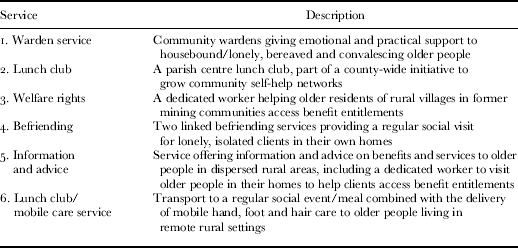
The current national research and policy literature was initially reviewed and additional ‘grey literature’ related to the six village services was subsequently gathered in the field. Semi-structured interviews were undertaken with key informants involved in the provision of each village service (routinely the manager, a paid worker, a volunteer worker and a funder). Simultaneously, interviews with older service users were carried out. It was our intention to conduct a focus group with six to eight users from each of the chosen services and supplement these with two additional individual interviews with service users in their homes. As a result of the users' wide dispersal and the inability of some to attend a focus group because of impairments or transport difficulties, it was accepted that a more flexible approach was required, and individual, joint (usually with partnered couples) and focus group interviews were undertaken. The fieldwork was carried out between July and December 2007 in several remote rural locations in three English regions, the East Midlands, the West Midlands, and the East of England. Local branches of the national charity that funded the research were invited to nominate the village services which they delivered for inclusion in the study. Six services, two in each of the three regions, were subsequently chosen (see Table 1). Services 1, 2, 4 and 6 aimed to alleviate the social isolation of older rural people in various ways. Services 3 and 5 offered information/advice and, importantly, personalised help in accessing welfare benefits and services.
The six ‘village services’
Sixty-nine people participated in the study, including 44 older rural residents and users of one of the six village services (32 women and 12 men). The other 25 were key informants involved in the management, day-to-day delivery, or financing of the services. All but four of the service users were aged 70 or more years at the time of interview (range 58–93 years). The sample included both partnered people and those living alone, and all the service users were white. The individual interviews lasted between 35 and 75 minutes and the focus groups from one hour to one and a half hours. Various appropriate locations were used for the interviews, including participants' offices, homes and the village halls and community centres used by service providers. To allow for meaningful comparison of similar themes (e.g. inclusion/exclusion, service delivery, rurality, finance), across the six services, and to ensure consistency of approach, semi-structured question guides were developed, piloted and refined in initial interviews.
Two basic principles, informed consent and anonymity, underpinned the fieldwork. An introductory session preceded all interviews. Each participant received a written information sheet that outlined the scope and purpose of the study. Anonymity was explained and respondents were asked to record their willingness to participate by filling in a consent form. Participants were given the opportunity to pose any questions and it was emphasised that they could withdraw from the study at any time if they wished. Each interview was routinely recorded on audiotape and additional field notes were taken. Tapes were transcribed verbatim and the resultant transcripts analysed using grid analysis (Knodel Reference Knodel and Morgan1993), cross-sectional thematic code and retrieval methods, and in situ non-cross-sectional analysis as appropriate (Mason Reference Mason2002; Ritchie, Spencer and O'Connor Reference Ritchie, Spencer, O'Connor, Ritchie and Spencer2003).Footnote 4 All participants subsequently received a paper copy of their transcript by post and were invited to feed back any further responses or corrections to the transcript. Ten participants responded but no substantive changes were suggested.
A final point about the sampling is worth comment. At an initial research meeting, the possibility of sampling a number of older rural residents who did not use village services was discussed and rejected by the funding organisation. This decision was motivated partly by the limited funds and also because the charity financing the research was keen primarily to access users' and providers' perceptions and experiences of services to inform and improve future provision. Whilst this was not, perhaps, the ideal situation, the participants sampled in the study nonetheless produced a rich and varied set of data about the key characteristics of social exclusion as experienced by older rural residents and the potential role of village services in its alleviation.
A rural dimension of older peoples' social exclusion?
Analysis of the data generated from the interviews with both service users and key informants highlighted several strong and recurrent themes about the ways in which rural locations may exacerbate social exclusion for older people. The key informants spoke consistently about the mounting challenges of service delivery, with increasing transport costs and diminishing financial resources very much to the fore. Transport issues were also a major feature of the service users' accounts. In many cases a lack of viable transport options, the closure of local shops and services, and the onset of personal impairments had combined to reduce opportunities for everyday social interaction. Although older users spoke of the ‘community spirit’ inherent in rural populations, for many geographical isolation brought increasing loneliness.
The ‘rural premium’ inherent in delivering village services to dispersed populations of older users was a constant challenge for service providers (Craig and Manthorpe Reference Craig and Manthorpe2000). Given the long distances that separated individuals' homes, transport costs in terms of both time and money limited the number of older people whose needs could be met. The availability and recruitment of staff in the required locations with access to a car (a key resource in five of the six services), was an additional problem emphasised by service managers. As one said:
It can be difficult to get workers and volunteers. Simply providing the service is difficult. It's also very expensive you have to have transport to get around to visit somebody's home. You can be talking about a farm track a mile and a half off the next tarmac road.
The manager of Service 6, which had a minibus both to transport older people from the outlying countryside to the regular lunch clubs in the village halls and to facilitate its mobile hand, foot and hair care, highlighted the extent to which transport costs were a constant headache:
The southern region of the area that we administer is very sparse. We therefore have our own minibus. … For transport alone last year was £6,100. … You're looking at something like £1,500 for insurance purposes, and obviously the physical running and cost of the vehicle, which of course last year was not helped by the fluctuation in the fuel prices anyway.
For the younger and more affluent rural residents, the progressive loss of local shops and services from many English villages is relatively unproblematic (Burgess Reference Burgess2008). Ownership of a car and the ability to drive bring supermarkets and other services within reach. By contrast, however, the geographical isolation of others, the limited mobility brought about by the physical impairments of late old age and the cost of car ownership, combined with a lack of or poor public transport, excluded many older people from routine participation in their communities. Immobility, leading to isolation, was a strong, recurrent theme in interviews with older service users. For example, a 70-year-old woman said, ‘the days are rather long at times. I can't get out you see, I can't go anywhere, can't walk very far. In a small village I can't go and wait for a bus, it's a long wait. … You are cut off in this village’. Another woman, aged 80 years, described the very isolated situation of a lady living in the same parish:
Isolated is not too strong a word. [She] lives a mile along a narrow winding road … over a mile from the village, she has osteoporosis quite badly, she can't drive any more. She's 84, I think … she cannot go out because she can't walk a distance down the road and she can't drive. Now there are only two other properties up there. So if she doesn't see her neighbour, she doesn't see anybody. She's not ill enough to have home help or nurses or carers because she is able to get about in the house, but she can't go out.
Mobility is vital to the wellbeing of older adults (Dobbs and Strain Reference Dobbs, Strain and Keating2008), but a lack of transport options is a major issue for many older rural residents (e.g. Cattan Reference Cattan2001; Clough et al. Reference Clough, Manthorpe, Green, Fox, Raymond, Wilson, Raymond, Sumner, Bright and Hay2007; Manthorpe, Malin and Stubbs Reference Manthorpe, Malin and Stubbs2004). The previous New Labour government policy of funding free bus travel for senior citizens across England may not be the most effective solution to the transport problems faced by older residents in dispersed rural communities. First, for the policy to be effective there needs to be a regular, frequent bus service, not the case in many rural areas. Second, for some older people with impairments, bus travel is not viable.
Given such challenges, those involved in delivering village services tended to focus on the negative aspects of rural settings. In contrast, the remarks of the older users of village services were consistently more positive about living in the countryside, at least initially. An 81-year-old man's comment was typical: ‘All want to know one another and all do things for one another. I've only got to say “I've got to pick some pills up” and that's it’. Many believed that rural life engendered a shared community spirit and regularly praised the informal support they received from family, friends and neighbours (cf. Heenan Reference Heenan2006). The general peacefulness and safety of rural life, compared to urban living, was a consistent theme, as noted by a 76-year-old woman:
Out here we don't have any problems. We've no trouble with yobbos. … We don't have anybody raving about or anything like that. I think we're all right only thing is that you have to travel six miles to shop. There is no shop here at all. There's no pub, so we can't go and have a pint.
None of the older participants expressed a desire to live in a town or city. Indeed, a number had chosen to relocate to the countryside on retirement. Many were making the most of their lives and spoke of the advantages of living in idyllic (scenically) rural locations. Underneath this apparent general satisfaction, however, there was also a widespread recognition of the isolation and loneliness that growing old in the countryside could bring, particularly for those living alone. As an 81-year-old woman succinctly put it, ‘I mean [there are] wonderful views and everything but you do need human contact’.
Loneliness, of course, is not inevitable or limited to those living in rural isolation. Many older people in urban environments lead lonely lives living in close proximity to others. There are also different facets of loneliness, some of which may become more prevalent with age. For example, emotional loneliness may emerge through the loss of a partner or significant other, and social loneliness (i.e. a lack of wider social networks) may increase as friends die, younger family members move away, former work ties diminish and people succumb to the impairments associated with ageing (for further discussion seeBurholt et al. Reference Burholt, Windle, Naylor, Jones, Riley, Oades, Humphries, Kennedy and Clifford-Jones2007; Victor, Scambler and Bond Reference Victor, Scambler and Bond2009; Victor et al. Reference Victor, Scambler, Bowling and Bond2005). It is important to note that many of the older rural residents interviewed had in their earlier years lived fulfilling and self-contained lives in the countryside with their partner or family. Living in a remote rural location and geographical isolation only became problematic when they were widowed or increased frailty limited their ability to leave their home.
Although the provision of services to older people, dispersed over large geographical areas creates additional costs (in both time and money) for service providers, there is nothing intrinsically problematic about ageing in a rural setting (Wenger Reference Wenger2001). Indeed, older people, including many participants in our study, cite the quality of the rural environment, its relative peace and quiet, and the availability of informal support as positives. The benefits that living in the countryside have for older residents should not be dismissed lightly (Burholt and Naylor Reference Burholt and Naylor2005), but as people become older, the loss of life partners, diminishing material resources and increased frailty alongside a lack of access to local services, including accessible transport, combine to exacerbate the social exclusion of senior citizens living in the countryside (Milne, Hatzidimitriadou and Wiseman Reference Milne, Hatzidimitriadou and Wiseman2007).
Village services: promoting inclusion
The six services investigated all had a significant positive effect in combating the social isolation of older rural residents. Those focused on welfare rights advice and support also improved substantially the financial wellbeing of many older service users. Users clearly valued the support they received and had nothing but praise for those who delivered the services.
Overcoming isolation: the social impacts of village services
Older rural residents routinely spoke of lives characterised by loneliness and of being cut off from routine social engagements but, as users of village services, they also stressed the ways in which the support they received enhanced their daily lives. The services on offer provided them with opportunities for social interaction and companionship. A visit from a warden or volunteer befriender, or the chance to regularly attend a lunch club, provided a focal point, something to look forward to, and something to be actively enjoyed. For example, an 83-year-old woman who attended a lunch club two days a week expressed great appreciation:
When you live by yourself you spend so much time alone. … I spend hours and hours sitting by myself. I've got two sons that visit me from time to time but I spend a lot of time by myself and I find by coming here and chatting to people, having a nice meal … I manage to cook in between times for myself. But I must admit I look forward to Tuesdays and Thursdays.
Another woman, aged 70 years, spoke warmly about her community warden:
She brightens up my morning. I wish she would stay longer but she has to go to see quite a lot of other people. … She just sits and talks. … I'm lucky to have someone like that calling. I've never said much to her about it. If you like, tell her she's a very nice person.
Village services play an important role in sustaining older rural residents by providing points of contact with the wider community. Even those with access to familial support networks appreciate the opportunities they provide for the routine social interaction that is vital in promoting wellbeing in later life (Victor et al. Reference Victor, Scambler, Marston, Bond and Bowling2006). For older rural residents living alone in rural settings, without regular contact with family members or neighbours, they are a vital resource.
Combating poverty: the material impact of rural information and advice services
Alongside social isolation, limited and often diminishing financial resources have been highlighted as a key factor in promoting social exclusion in later life (Burholt and Windle Reference Burholt and Windle2006; Craig Reference Craig2004). Such poverty in old age is often made worse by the reluctance of older people to claim social benefits. The more particular challenges of improving benefit take-up in rural areas have been acknowledged by the government and service providers (Gibson-Ree Reference Gibson-Ree2004). An aversion to claiming state benefits featured strongly in the study. As one voluntary worker noted: ‘They are the old school. Don't want to claim anything. Don't think they are entitled to it. They say, “We can manage on what we've got”’. The reasons for non-take-up of social security benefits by older people are many and varied but certainly include ignorance about entitlements and the often complicated forms that claims entail. Additionally, an abhorrence towards the idea of living on ‘charity’, and the view that claiming benefits is a sign of personal failure (Moffatt and Higgs Reference Moffatt and Higgs2007) are prevalent among an older rural population which prides itself on hard work and self-reliance (Eales, Keefe and Keating Reference Eales, Keefe, Keating and Keating2008; Heenan Reference Heenan2006). Allied to these factors, previous dealings with the welfare state, particularly when means testing was involved, have deterred some older people from claiming their welfare entitlements. Having fallen foul of means testing as a young widow in the 1940s, an 86-year-old woman swore that she would never again seek benefits:
My husband and I are both frightened that we are trying to cadge something. … I've worked hard all my life. Unfortunately my first husband got killed in a motorbike accident [in the late 1940s]. We didn't have any money. … They were so good at the factory where he worked, the collection was £300 … I was told that if I got some help with my rent then my children could have free meals at school. Well, because I'd got that money in the bank apparently I wasn't entitled to anything. So I vowed then, that I would never apply for anything! I would just work and work. Luckily my health was good until I was 80.
Sixty years on from the death of her first husband the direct intervention of the welfare advisor from Service 5 was instrumental in challenging her lifelong aversion to applying for welfare benefits. Having been cajoled into claiming Attendance Allowance,Footnote 5 she was able to pay for extra physiotherapy to aid her recovery from a double hip fracture and, ultimately, to continue caring for her partner at home. As she explained:
I paid privately. Thanks to the money coming in, I could do it and it's worked out beneficial. … What I would have done without [worker's name]? … I just want to emphasise that I was so lucky that she came along and I was awarded the allowance. It's made me feel so happy about it because you do not feel as if you're begging.
Services 3 and 5 employed part-time workers whose roles involved promoting rights for older people alongside practical help (as with form filling) to enhance access to entitlements. Without the help and individualised support of these workers, it is highly unlikely that the participants we interviewed would have received their entitlements. The additional benefits generated clearly enhanced their clients' lives. Many were extremely grateful to the advisors who visited them in their homes. One such, a 64-year-old woman, said:
[Name] fought to get extra help with his disability. She helped us fill everything in, she did everything for us … Pension Credit, rent rebate and council tax. She did all that for us. … A letter come and it come and we were told how much we could get money-wise, leaving me in tears. It still chokes me about it now. Because we have never, ever, ever been able to go out and buy something without thinking – ooh, you know, simple things. It made such a big difference to our lives, it really did.
Funding individual home visits to help rural clients access their entitlements is expensive but effective. Highly-individualised practical support is required if older people's reticence to making claims is to be overcome. Face-to-face home visits offer practical benefits beyond general telephone or internet advice lines. The positive knock-on effects of services where workers actively reach into rural communities also should not be overlooked. Home visits spread the message about entitlements to wider audiences. On several occasions, an initial visit to one person alerted others to their benefit rights and instigated further successful claims, as a family carer explained: ‘because of [name] getting it, my parents got Attendance Allowance as well. … They [service name] are the experts on this, they know exactly what to do’. Making a similar point, a service manager said, ‘I remember [front-line worker] saying that she helped everyone on the street. It just went down the doors, all the way through, everyone heard about it’. Individualised welfare advice and information services clearly enhance older rural residents access to welfare rights and actively reduce pensioner poverty and promote social inclusion (cf. Moffatt and Scrambler Reference Moffatt and Scrambler2008). Discussions have focused on whether these services qualitatively enhance the lives of older rural residents, but the quantitative impact was clear from our study – Services 3 and 5 claimed to have generated £690,000 and £750,000, respectively, of successful benefit claims over the two- and three-year periods since their establishment.
A preventative dimension to village services
Those charged with delivering village services reported that their routine contacts with older users encouraged timely interventions into situations that otherwise could lead to negative and expensive future outcomes. For example, the manager of Service 1 noted how the provision of something as mundane as the toe-nail cutting service helped to prevent falls and the associated injuries and disabilities (cf. Raynes, Clark and Beecham Reference Raynes, Clark and Beecham2006). A colleague emphasised that identifying problems and persuading reluctant older people to seek remedies helped prevent later complications:
An ulcer on her leg and she wouldn't go to the doctor. Now once the foot-care lady had said to me, ‘there's a problem’, I can then take them to one side … or I can contact the doctor and say, ‘I think this lady needs a visit’. … It's not major things, but its preventative … preventing them from falling, which can cause something else. … There was a lady, maybe about six months ago, I don't think she'd had her toe nails cut for a year. How she walked I do not know, but we caught that in time, you see, because we managed to persuade her. It's little things.
Similarly, the worker from Service 5 who had initially made contact with an isolated older man to explore the possibility of instigating a benefit claim on his behalf reported that she had managed to persuade him to seek medical help for a festering wound that could have led to his long-term hospitalisation. The intrinsic value that village services offer, in terms of promoting independent living, and also in potentially saving hard cash through the early identification and treatment of problems, was apparent to key informants. Another service manager said:
We spend £25 to put a rail up and, okay by a big leap of imagination, we stop somebody having a hip replacement. … Why isn't that sensible? … Some days it's hard work trying to convince people why things like this should happen, but the payback comes when you see somebody living an independent life.
Village services play an important role in maintaining older rural residents in their own homes for as long as possible. Such services routinely delay or negate the need for more expensive formal health and social care packages and promote independent living among senior citizens in the countryside. As the above discussion has shown, village services enhance the material and social wellbeing of service users and thus help to alleviate the social exclusion of older people and, more particularly, older women living in the English countryside.
A woman's world?
The overwhelming majority of older users of the village services investigated in this study were women.Footnote 6 Similarly, with the exception of two voluntary workers (for Services 3 and 6), those with a direct role in the day-to-day delivery of services were female. Given that women generally live longer than men and predominate in the care workforce, this was not surprising. Nevertheless, the fact that both the clientele and workers of village services are highly feminised places may be a significant factor in the lack of male engagement with the services. This was particularly the case for Services 1, 2, 4 and 6 that had the primary aim of overcoming social isolation. As the following quote from a part-time paid worker indicates, managers and workers were aware of the problem:
Luncheon clubs or coffee clubs are not necessarily how men will socialise at any time in their life, and so its kind of Hobson's choice when they get older. There's nothing else. … So maybe part of it is we've set up a service that meets some clients' needs but doesn't always meet others. I do think that befriending, just by its very nature, is not naturally where men go: ‘Oh yes, fantastic, I want a befriender!’ … One gentleman is totally blind. He is honest about the fact that, if things were different, he wouldn't have a befriending service and he wouldn't have got to day care, but because he can't see he hasn't got a choice.
Some instances of male engagement with these ‘social care’ type services appeared to be triggered by specific individual circumstances. First, as noted, illness or impairment could limit men's options and leave them with few choices. As an 80-year-old widow recollected:
My husband was disabled, not severely … you suddenly become very withdrawn when you've had a stroke. And we weren't able to go to hardly anything. … We actually were extremely happy to find somewhere we could have a lunch out once a fortnight where people took no notice of the fact that my husband couldn't use a knife properly. He didn't have to be embarrassed, because we are all in the same boat.
For other men who used these services, they attended alongside their wife or partner, at times begrudgingly. A part-time paid worker had other insights into the low take-up by men:
I'm not aware of any more clubs that actually seek out older men, to encourage them to join. … They may originally have started with their partner and then their partner may have died and they've continued on that basis. But I can understand if you're a lone man with 40 women then it may not be your ideal environment.
A 92-year-old user of a club was blunt about his attendance. He said, while looking at his wife, ‘I come because the wife comes … too many women. … I've got to come’. There were also instances of men being involved through a prior connection to those who delivered the service. As an 83-year-old said:
[The manager] is related to my wife's side of the family and my wife died seven years ago and she asked me if I'd like to come along as I lived by myself. … I was the only man there for a long time. There's one more now. It doesn't bother me though. I'm happy to sit there. I enjoy my food and a chat.
The reluctance of many older men to admit they had support needs or to seek help resonated with the information and advice services (cf. Lofts Reference Lofts2008). Among the key informants, the prevalent view was that women were instrumental in getting their partners to engage with services. The point is made in the next two quotes from a service manager and a part-time volunteer:
Men tend to access things via their partner. … They are a specific group who we do need to target … so, yes, while we aim to do it, women are much more accessible in terms of gathering information and passing it on to husbands.
Especially if the wife or the partner is sitting with them, men will say, ‘Oh I can do that. I can do that’. And of course the partner then chimes in, ‘Well you can't. I've got to help you get dressed. I've got to help you do this’.
‘Fred’ exemplified the problems that village service providers faced in trying to engage with older rural men. A widower, deaf and with poor mobility, he had lived all his 85 years within 200 metres of his birthplace in a tiny, scenic village. Orphaned at an early age, for many years he had previously provided for his own family and his younger siblings by working on local farms. The cottage he lived in was basic, and around him the village had been transformed. Many of his neighbours were affluent commuters living in very expensive, well-maintained cottages. Fred was of very limited means but was used to seeing himself in the provider role and proud of his ‘independent’ status. Without the intervention of the benefits advisor from Service 5 and a successful claim for Attendance Allowance, he would no doubt have followed the habits of a lifetime and ‘soldiered on’, heavily reliant on the support of his daughter who lived over 60 minutes drive away.
The reluctance of many older rural men to seek help is linked to the (stereotypical) gender roles that they have been socialised into throughout their lives (Sopp, Miller and Gunnell Reference Sopp, Miller and Gunnell2007). Similarly, many older women's previous roles, as ‘kin keepers’ and informal carers, connected them earlier in their lives to wider social and community networks. The use of village services such as lunch clubs and befriending services in later life may thus reflect earlier gendered norms and practice. Such services can be alien and daunting for older men, whose work-oriented informal networks tend to diminish on retirement and who have developed identities around the role of worker and family provider (Arber, Davidson and Ginn Reference Arber, Davidson and Ginn2003; Ruxton Reference Ruxton2006). Maintaining a façade of the self-reliant ‘independent man’ may mitigate against older men recognising the new needs that growing older can bring. Once the barriers are overcome, however, as the following quote from an 85-year-old illustrates, older countrymen appear to value opportunities for social interaction as much as women, provided that the kind of support on offer is deemed by them to be appropriate.
She arranged an interview with a man and he befriended me. … We talk about things which are men's talk. … He meets me half way in conversation and we get on very well together. … When they asked me to join, I said, ‘I don't want to play silly games’.
The collected evidence suggests that older men prefer to attend what they regard as ‘normal clubs’ that reflect their longstanding interests rather than designated ‘old folks’ clubs'. Attending such clubs is seen by many older men as a last resort; as almost a public admission of defeat (Davidson, Daly and Arber Reference Arber, Davidson and Ginn2003; Pain, Mowl and Talbot Reference Pain, Mowl and Talbot2000). The needs of older, male, rural residents obviously vary and it would be wrong to suggest that all such men lead lonely, isolated lives in dire need of company and support. Nonetheless, it is hard to avoid the conclusion that many village services currently offer support that is more appropriate for older women than older men (Sopp, Miller and Gunnell Reference Sopp, Miller and Gunnell2007).
Conclusions
This paper has considered wider debates about ageing and social inclusion and exclusion in the English countryside through a discussion of the impact of six village services on the lives of older rural residents. In some ways, a rural setting may exacerbate the social exclusion of older residents living in dispersed villages and hamlets. Physical isolation, the lack of public transport, an inability to afford or drive a car in old age, and a lack of specialised local services, can combine to the detriment of older people in remote rural settings. Nevertheless, it is important to avoid simplistic problematisation of older rural residents' lives. Rural settings and the needs of their older residents are diverse (Milne, Hatzidimitriadou and Wiseman Reference Milne, Hatzidimitriadou and Wiseman2007; Wenger Reference Wenger2001) and rural settings have advantages. For example, a village setting may have a positive impact on older people lives, in part, because of the often ‘high levels of informal support [that] exist despite apparent service fractures’ (Manthorpe, Malin and Stubbs Reference Manthorpe, Malin and Stubbs2004: 102).
For comparatively little financial outlay, village services enhance the daily lives of older people in remote rural settings. Rural befriending schemes, lunch clubs and warden services all promote social inclusion in old age by helping combat loneliness and social isolation. Although a recent systematic review of loneliness alleviation and prevention interventions noted that the effectiveness of one-to-one contacts (such as home visiting and befriending schemes) was unclear (Cattan et al. Reference Cattan, White, Bond and Learmouth2005), the evidence presented here indicates their benefits for older adults living in dispersed rural settings. Likewise, welfare rights and advice schemes, targeted at specific rural communities, alleviate rural poverty in old age by alerting people to their entitlements and enhancing benefit take-up; particularly when they offer individualised benefit claims support in older users' homes. In the rural context, the value of relatively low-level interventions, like the village services considered here, has been recognised (Commission for Rural Communities and the Housing Corporation 2006). Such community-based services and activities offer that ‘little bit of help’ required to enable many older rural residents to stay in their own homes for as long as possible, and in many cases delay the need for more intrusive and expensive support services (Clark, Dyer and Horwood Reference Clark, Dyer and Horwood1998).
A note of caution needs to be added. The lack of male engagement with village services has been highlighted. In the words of one service manager, many older rural men are faced with ‘Hobson's choice’; that is, a choice between what is offered and nothing at all. Whilst, it is clear that there is no deliberate attempt to exclude men, a key challenge for the providers of village services is to find new and innovative ways of engaging with older men in rural areas. Thought needs to be given to the specific needs of older men, and how village services can be tailored to their particular, gendered requirements. Increasing the presence of male staff and volunteers in village services for older people could prove fruitful (Ruxton Reference Ruxton2006). That said, other studies have identified the vulnerability of very old women, living in rural settings (e.g. Manthorpe, Malin and Stubbs Reference Manthorpe, Malin and Stubbs2004). Providing better support for older rural men should not come at a cost to their female counterparts.
Rural settings present many challenges to those attempting to deliver services, including the comparatively high costs in time and money of serving dispersed populations (Keating and Phillips Reference Keating, Phillips and Keating2008). For providers of village services, overcoming the issue of the ‘rural premium’ is often compounded by the insecurity of the funding (Craig and Manthorpe Reference Craig and Manthorpe2000). Complex systems of competitive tender for contracts from the local authority, health-care agency or charity (often for time-limited funding), underpin many village services. Whilst this may initially stimulate innovation in that providers are able to identify available pots of money and, if successful set up services that meet the needs of older rural residents, such time-limited funding undermines the long-term stability and quality of services. Securing a County Council contract was no better, for this usually meant an annual battle to maintain the funding (for further discussion seeHardill and Dwyer Reference Hardill and Dwyer2010).
This paper has presented new evidence of the positive and vital role that village services, i.e. the community-based services and activities on offer to older rural residents, play in promoting the social inclusion of older people in the English countryside. Village services are clearly valued by and enhance the social inclusion of those who use them. The presented evidence has provided new insights into the gendered character of many existing village services and how this unintentionally promotes the exclusion of older rural men. Many of those involved in providing such services recognise the need to reach out to new client groups – including older men (Harrop Reference Harrop2007). Given the continuing global financial crisis, and a future in which the three major UK political parties are committed to protecting National Health Service budgets but envisage drastic spending cuts in other areas (cf. Conservative Party Reference Conservative2010; Wintour Reference Wintour2010), the expansion of supposedly ‘low-level’ village services, so that they can better meet the needs of older rural men, remains highly unlikely for the foreseeable future.