Cowpea production is relatively minor in the United States, but provides a significant source of income in several small communities throughout the Midsouth and southeastern U.S. regions. Cowpea (black-eyed pea) is produced as either fresh green or dry edible beans, but is also used as forage or cover crop. The major production areas in the United States are located in the drier regions, including California, Arizona, and Texas, with smaller acreage in several of the southern states. In 2016, the United States produced 259 metric tons of cowpea, representing a 20% increase in production from two years prior (USDA NASS 2017). This yield increase was attributed to an increase of approximately 20% in planted land area and new releases of higher-yielding cultivars, reflecting an increase in demand for this crop. While production area might have increased, the literature does not show major changes in management practices that could have contributed to increased production. Weed management research on cowpea has been minimal, but should be considered as a factor for yield improvement.
Cowpea production is often included in the discussion of dry edible beans (Phaseolus vulgaris L.) including navy, pinto, black, pink, and kidney beans. The critical weed-free period for dry edible beans, established from experiments in navy and kidney beans, is 3 to 5 weeks after planting (Burnside et al. Reference Burnside, Weins, Holder, Weisberg, Ristau, Johnson and Cameron1998). Any management strategy aimed at removing weeds during this time, or an early-season herbicide program that extends into or through this period, will maximize yield. Research on modified production strategies for red dry beans indicates that narrow row spacing and increased in-row planting densities can increase yield by 19% and 17%, respectively (Blackshaw et al. Reference Blackshaw, Molnar, Muendel, Saindon and Li2000). If combined with a residual and/or POST herbicide, yield is improved significantly. An effective mechanical-based strategy for weed control includes use of a rotary hoe to remove weeds in the mid to late-season (Leblanc and Cloutier Reference Leblanc and Cloutier2001). While a single cultivation event is not enough to improve yield, multiple cultivation events can. In general, the bean crops are adaptable to different nonchemical management strategies that allow for effective diversified weed control.
Herbicide-based weed control methods have been investigated more broadly than cultural methods and are used as a primary weed management tool in dry edible bean production. Imazethapyr (Group 2) is a standard commercial herbicide that can be applied from preplant through postemergence. Imazethapyr application POST may cause some stunting and slight chlorosis, with minor impact on yield, but application to soil has no adverse effects (Wilson and Miller Reference Wilson and Miller1991). Most herbicides registered for use in soybean can also be used on dry edible beans. Information regarding herbicides for cowpea production is lacking, warranting further research.
Currently, eight herbicides are registered in the southeastern U.S. region for cowpea, three of which are selective grass herbicides (Kemble Reference Kemble2016). In Arkansas, significant research into potential cowpea herbicides has taken place in recent years, increasing the number of registered herbicides to 11, two of which are grass-only herbicides. Fomesafen (Group 14), sulfentrazone (Group 14)-based premixtures with S-metolachlor (Group 15) or carfentrazone (Group 14), and trifluralin (Group 3) are registered for use in Arkansas, but not in all the southern states. Trifluralin is an older herbicide chemistry and is applied preplant-incorporated, primarily for small-seeded annual grass and broadleaf weed control. Since its adoption, primarily in other agronomic cropping systems, resistance has evolved to this mode of action in goosegrass [Eleusine indica (L.) Gaertn] and Palmer amaranth populations in Arkansas and several other states (Heap Reference Heap2017). Fomesafen (Reflex®) is registered for residual and POST applications in cowpea. Its efficacy and crop safety had been studied previously in dry edible bean production, specifically in black, great northern, kidney, navy, and pinto beans (Wilson Reference Wilson2005) as well as in cowpea (Burgos et al. Reference Burgos, Brandenberger, Stiers, Shivrain, Motes, Wells, Eaton, Martin and Morelock2007). Thus far, it is the most effective POST herbicide for Palmer amaranth and morningglory (Ipomoea) species, but concerns over acceptable levels of injury have reduced its adoption in the South. Sulfentrazone is a residual herbicide that controls annual grasses including giant foxtail (Setaria faberi Herrm); sedges including yellow nutsedge (Cyperus esculentus L.); and broadleaves including morningglory species, common ragweed (Ambrosia artemisiifolia L.), velvetleaf (Abutilon theophrasti Medik.), tall waterhemp [Amaranthus tuberculatus (Moq.) J. D. Sauer], and Palmer amaranth (Dirks et al. Reference Dirks, Johnson, Smeda, Wiebold and Massey2000; Niekamp and Johnson Reference Niekamp and Johnson2001). Dry bean response to sulfentrazone with and without imazethapyr is characterized by low early-season injury (<20%) that does not impact crop yield (Soltani et al. Reference Soltani, Shropshire and Sikkema2014). Much of the research into the utility of sulfentrazone has been in soybean production systems. Sulfentrazone and sulfentrazone tank-mixtures are safe for soybeans; however, some differences in cultivar sensitivity are noted (Dayan et al. Reference Dayan, Owens, Tranel, Preston and Duke2014; Dirks et al. Reference Dirks, Johnson, Smeda, Wiebold and Massey2000; Krausz et al. Reference Krausz, Kapusta and Matthews1998; Niekamp and Johnson Reference Niekamp and Johnson2001). The same was observed with cowpea cultivars (Burgos et al. Reference Burgos, Brandenberger, Stiers, Shivrain, Motes, Wells, Eaton, Martin and Morelock2007). Greater injury occurs under low temperatures and high soil moisture (Swantek et al. Reference Swantek, SNeller and Oliver1998). These cultivar response differences caused by environmental stress are important factors to consider when using this herbicide. The University of Arkansas recommendations list sulfentrazone (PRE) and fomesafen (POST) among the most effective herbicides for the management of Palmer amaranth in cowpea and soybean production systems (Scott Reference Scott2017). Unfortunately, due to overdependence on fomesafen in soybeans for Amaranthus species control, resistant populations of Palmer amaranth and waterhemp species had evolved in Arkansas and several other states (Salas et al. Reference Salas, Burgos, Tranel, Singh, Glasgow, Scott and Nichols2016; Shoup et al. Reference Shoup, Al-Khatib and Peterson2003; Wuerffel et al. Reference Wuerffel, Young, Matthews and Young2015). Resistance to residual protoporphyrinogen IX oxidase (PPO) inhibitors like sulfentrazone is less common, and oftentimes populations resistant to foliar-applied PPO herbicides are susceptible to PRE applications of these herbicides. However, reduced sensitivity of PPO-resistant waterhemp populations to soil-applied PPO herbicides has been reported (Shoup et al. Reference Shoup, Al-Khatib and Peterson2003; Wuerffel et al. Reference Wuerffel, Young, Matthews and Young2015). While the threat to the long-term viability of PPO-inhibiting herbicides is a concern, they still provide effective residual activity for major problematic weed species in these systems.
Sulfentrazone received a 24(C) registration in Arkansas in the past several years, but its benefit in herbicide programs has not been evaluated. Other soybean herbicides should also be evaluated to expand the herbicide options for cowpea. The objectives of this research were 1) to evaluate the tolerance of cowpea to sulfentrazone-based herbicide programs and 2) to identify potential new herbicides for use in cowpea production.
Materials and Methods
Experiment Establishment and Crop Management
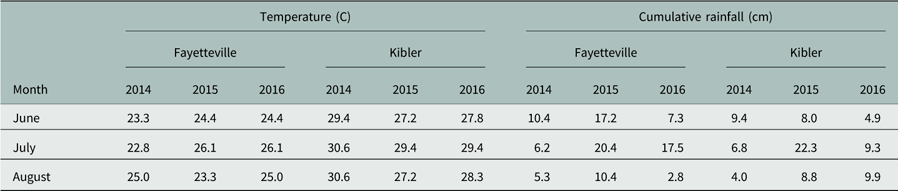
Field studies were conducted in 2014, 2015, and 2016 at the Arkansas Agricultural Research and Extension Center, Fayetteville, AR (36°05'57.0“N, 94°10'43.9“W) and the Vegetable Research Station, Kibler, AR (35°23'56.3“N, 94°13'56.7“W). ‘Top-Pick’ pinkeye cowpea was planted at approximately 220,000 seeds ha−1. At Fayetteville, fields were prepared using standard tillage practices and the crop was planted on a Captina silt loam (fine-silty, siliceous, active, mesic Typic Fragiudult) soil, on raised beds spaced 91 cm apart on June 11, July 1, and May 31, in the respective years. The crop was furrow-irrigated or overhead-irrigated with sprinklers as necessary, generally three times per cropping season. At Kibler, the crop was planted into flat beds on a Roxana silt loam soil (coarse silty, mixed, superactive, nonacid, thermic Typic Udifluvents), with crop rows separated 91 cm apart on June 25, June 23, and June 10. The crop was irrigated via lateral-moving sprinklers at approximately 6.3 cm ha−1 as needed. Cumulative rainfall and average monthly temperatures for both locations and all years are presented in Table 1.
Average monthly temperature and cumulative rainfall at the Arkansas Agricultural Research and Extension Center, Fayetteville, Arkansas, and the Vegetable Research Station, Kibler, Arkansas during the crop growing months, 2014 to 2016.

Plots, regardless of location, were 6.1 m long and two crop rows (1.8 m) wide. At Fayetteville, treatments were separated by a single, nontreated crop row on both sides. At Kibler, each plot was separated by an unplanted tractor pass, which was maintained weed-free throughout the season. In 2014 and 2015, a mixture of weed seeds common to the production areas of Arkansas was spread and incorporated prior to crop planting to provide an even distribution of weeds for evaluation. The seed mixture included Palmer amaranth, hemp sesbania [Sesbania herbacea (Mill.) McVaugh], morningglory species (Ipomoea), and annual grasses including foxtails, large crabgrass [Digitaria sanguinalis (L.) Scop.], and barnyardgrass [Echinochloa crus-galli (L.) P. Beauv.]. In 2016, the tests were located in blocks with sufficient natural weed population and thus were not overseeded with weeds. At both Fayetteville and Kibler, the natural weed infestation included annual grasses, morningglories, and mixed populations of herbicide-susceptible and herbicide-resistant Palmer amaranth.
Herbicide Treatments and Application
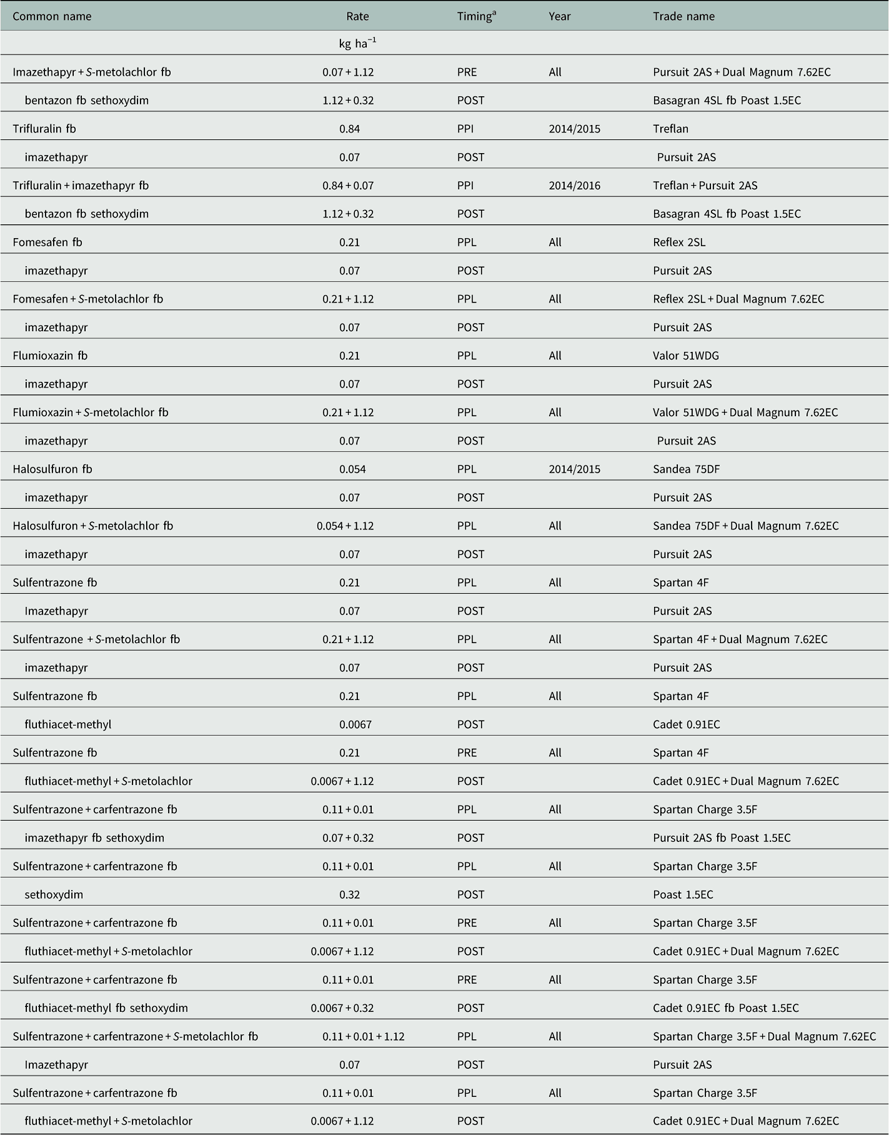
Herbicide programs with application rates, timings, and product information are listed in Table 2. Studies conducted in 2014 and 2015 were designed to define the use of sulfentrazone as a residual herbicide, while the 2016 trials sought to validate the previous years’ findings. All studies were established as a randomized complete block design with four replications. In 2014 and 2015 three commercial standard herbicide programs were included: imazethapyr plus S-metolachlor fb bentazon fb sethoxydim (current standard), trifluralin fb imazethapyr, and trifluralin plus imazethapyr fb bentazon fb sethoxydim (classical standards). In 2016, a selected set of programs were evaluated. Four potential herbicide application timings were included: preplant (2 weeks prior to planting), preplant incorporated (PPI; mechanically incorporated less than 24 h prior to planting), PRE (within 24 h of planting), and postemergence (2- to 3-trifoliate). Weedy and weed-free checks without herbicide treatment were included. Postemergence applications were made approximately three weeks after planting (WAP). Herbicides were applied using a CO2-pressurized backpack sprayer calibrated to deliver 187 L ha−1 with a 2-L tank volume. The herbicide was applied with a four-nozzle boom covering two treated rows and fitted with nozzles spaced 46 cm apart and an effective swath of 1.8 m.
Herbicide programs evaluated for cowpea tolerance and weed control efficacy, Arkansas Agricultural Research and Extension Center, Fayetteville, Arkansas, and the Vegetable Research Station, Kibler, Arkansas, from 2014 to 2016.

a Abbreviations: PPI, preplant incorporated; PPL, preplant; POST, postemergence; PRE, preemergence.
Data Collection and Analysis
Crop stand was counted in a 1-m2 segment of the treated rows 2 WAP. This was expressed as a percentage of the average crop stand in the weed-free check plots for analysis. Crop injury was evaluated visually at early-season (2 to 3 WAP) and midseason (4 to 6 WAP) timings using a range of 0%, indicating no injury, to 100%, indicating no crop emergence or complete death. Crop injury was evaluated late-season (8 to 9 WAP) if apparent, and prior to harvest. The crop was harvested when the beans were at 16% moisture with a two-row plot combine. Seed yield from each plot was weighed and the moisture content was recorded using a moisture meter (Dickey-john Harvest Hand Moisture Tester, Dickey-john®, Auburn, IL). Yield was expressed as a percentage of the average yield of the nontreated, weed-free control plots for analysis.
Weed control evaluations were done at the same timings as the crop injury evaluations. At the 2-week timing, weed density was counted by species in a 1- by 1-m quadrat placed at the center of the treated rows. At the follow-up evaluations, total weed control was evaluated visually on a scale of 0% (weedy) to 100% (weed-free). Data were analyzed using ANOVA (P≤0.05) and significant means were separated using Fisher’s protected LSD (α=0.05). Data for crop tolerance and weed control were analyzed with year and location included in the analysis as random factors (data not shown). Due to significant interactions between year, location, and treatments, data were analyzed and presented by year and by location.
Results and Discussion
Herbicide Efficacy and Crop Response in 2014
Fayetteville Location
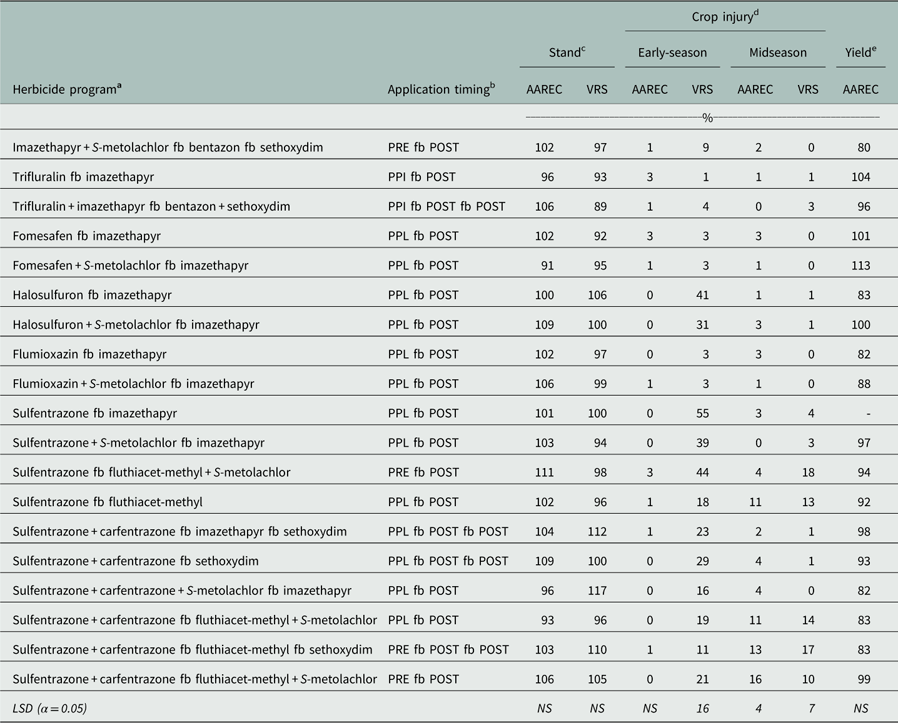
Crop injury was minimal (<3%) from the PRE herbicide applications. Crop stand was at least 93% that of the nontreated weed-free control (Table 3). Some POST treatments caused necrosis and stunting 3 weeks after treatment, but generally the herbicide programs caused minimal injury (10% to 16%). The highest injury was observed when fluthiacet-methyl was tank-mixed with S-metolachlor, but this injury was transient. The weed-free check yielded 1,278 kgha−1, but was not different from other treatments, which yielded 82% to 113% relative to the check.
Effect of herbicide programs on cowpea stand, injury, and yield at the Arkansas Agricultural Research and Extension Center (AAREC), Fayetteville, Arkansas, and the Vegetable Research Station (VRS), Kibler, Arkansas, in 2014.

a Plus sign (+) indicates a tank-mixed or premixed herbicide prior to application; fb, followed by.
b Application timings: PPL, preplant (2 weeks prior to application); PPI, preplant incorporated; PRE, preemergence; POST, postemergence (2 to 3 trifoliate).
c Stand count was assessed in a 1-m2 area at the center of the plot and converted to a percent relative to the nontreated weed-free check (AAREC, 43 plant m−2; VRS, 30 plants m−2).
d Evaluation timings: Early-season, 2 to 3 weeks after planting; midseason, 4 to 6 weeks after planting or 2 to 3 weeks after POST application.
e Yield was analyzed as percentage relative to the nontreated weed-free check plots, which yielded 1,278 kg ha−1.
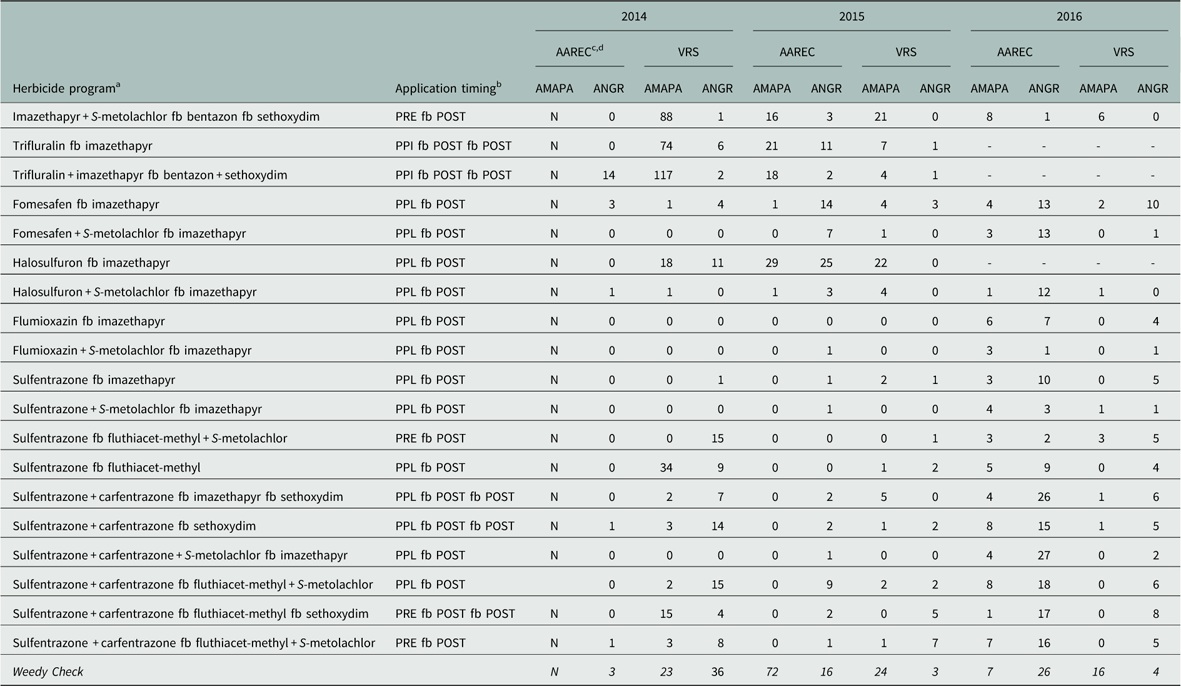
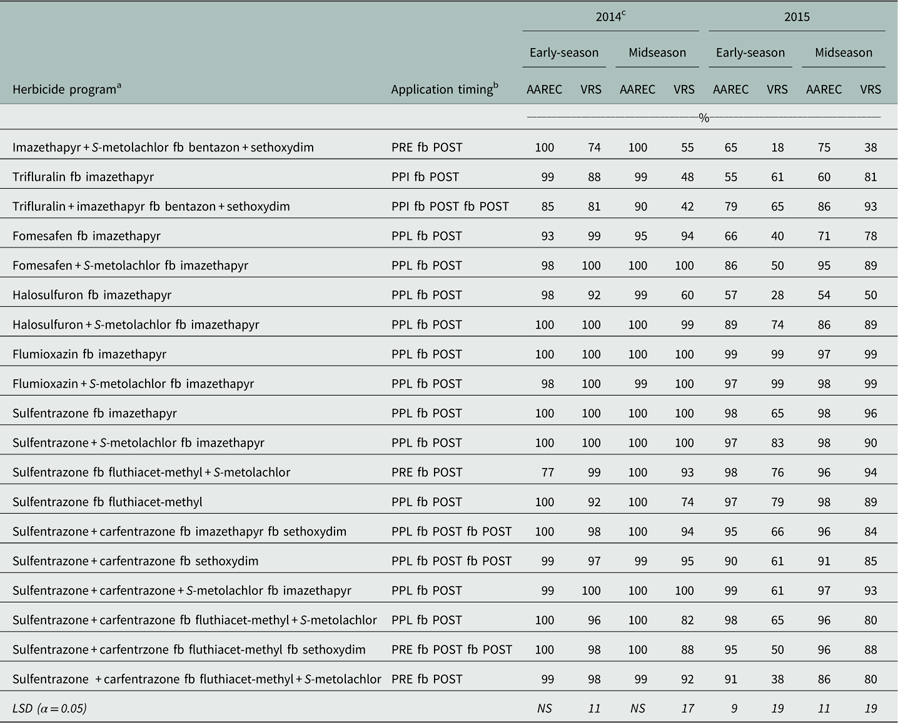
The weed seeds that were spread prior to planting had poor emergence. The primary species were annual grasses including goosegrass, large crabgrass, and fall panicum (Panicum dichotomiflorum Michx.) (Table 4). In general, weed density 2 WAP was low, averaging 3 plants m−2 in the weedy check plots, but the highest density of grasses occurred in the trifluralin plus imazethapyr (PPI) treatment (14 plants m−2). This was reflected in the early-season control evaluation, in which all PRE treatments except trifluralin plus imazethapyr PPI had greater than 90% weed control (Table 5). Sulfentrazone-containing programs had greater than 99% weed control at the earliest evaluation. At midseason, all effective PRE treatments retained their residual efficacy, providing >90% weed control.
Average Palmer amaranth and annual grass weed density in a 1- by 1-m quadrat at the Arkansas Agricultural Research and Extension Center (AAREC), Fayetteville, Arkansas, and the Vegetable Research Station (VRS), Kibler, Arkansas, from 2014 to 2016.

a Plus sign (+) indicates tank-mixed or premixed herbicide prior to application; fb, followed by.
b Application timings: PPL, preplant (2 weeks prior to application); PPI, preplant incorporated; PRE, preemergence; POST, postemergence (2 to 3 trifoliate).
c Abbreviations for weed species: AMAPA, Palmer amaranth; ANGR, annual grasses (including barnyardgrass, goosegrass, large crabgrass, goosegrass, and fall panicum).
d N indicates not present.
Visual assessment of total weed control (%) at the early- and midseason evaluation timings at the Arkansas Agricultural Research and Extension Center (AAREC), Fayetteville, Arkansas, and the Vegetable Research Station (VRS), Kibler, Arkansas, in 2014 and 2015.

a Plus sign (+) indicates tank-mixed or premixed herbicide prior to application; fb, followed by.
b Application timings: PPL, preplant (2 weeks prior to application); PPI, preplant incorporated; PRE, preemergence; POST, postemergence (2 to 3 trifoliate).
c Evaluation timings: Early-season, 2 to 3 weeks after planting; midseason, 4 to 6 weeks after planting or 2 to 3 weeks after POST application.
Kibler Location
At Kibler, crop stand did not differ among the herbicide programs (Table 3) as was observed in Fayetteville. Early-season crop injury was higher than anticipated: >20% in several instances. Sulfentrazone caused more stunting than did the other herbicides, with injury ratings as high as 55%. Both PPL and PRE applications of sulfentrazone had similar levels of injury. By midseason, crop injury had declined to <20% in all treatments. Midseason injury was observed in treatments with fluthiacet-methyl, as was seen in Fayetteville. The injury caused by fluthiacet-methyl was transient, but was more pronounced if the crop was already stunted by sulfentrazone. All other herbicide programs were safe to cowpea.
Total weed control was an assessment of treatment efficacy on Palmer amaranth and annual grass species including barnyardgrass, fall panicum, goosegrass, and red sprangletop [Dinebra panicea (Retz.) P. M. Peterson & N. Snow]. Weed densities, especially Palmer amaranth, were higher at Kibler than they were at Fayetteville (Table 4). The weedy checks had 23 Palmer amaranth m−2 and 36 annual grasses m−2. The highest densities of Palmer amaranth were observed in the three commercial standard plots, with an excess of 74 to 117 plants m−2; however, these treatments had excellent control of annual grasses, resulting in <10 plants m−2. Herbicide programs with sulfentrazone plus carfentrazone as the only PRE herbicide had a higher density of annual grasses. Early-season weed control was >90% with all herbicide programs except for the three commercial standards (Table 5). With a high density of Palmer amaranth and low density of annual grasses, total weed control was 74% for the current standard. Trifluralin treatments had <90% control. Sulfentrazone (PPL) fb fluthiacet-methyl (POST) midseason was the least effective of these sets of treatments. Fluthiacet-methyl is not an acceptable POST grass herbicide, nor did it control Palmer amaranth adequately. Adding imazethapyr (POST) to sulfentrazone (PPL) increased weed control to 100%. Halosulfuron (PRE) alone did not have adequate weed control at midseason (60%), but application of S-metolachlor (PRE) increased weed control to 99%. The commercial standard programs averaged 50% total weed control. This is not acceptable and further emphasizes the need for the adoption of new weed control programs.
Herbicide Efficacy and Crop Response in 2015.
Fayetteville Location
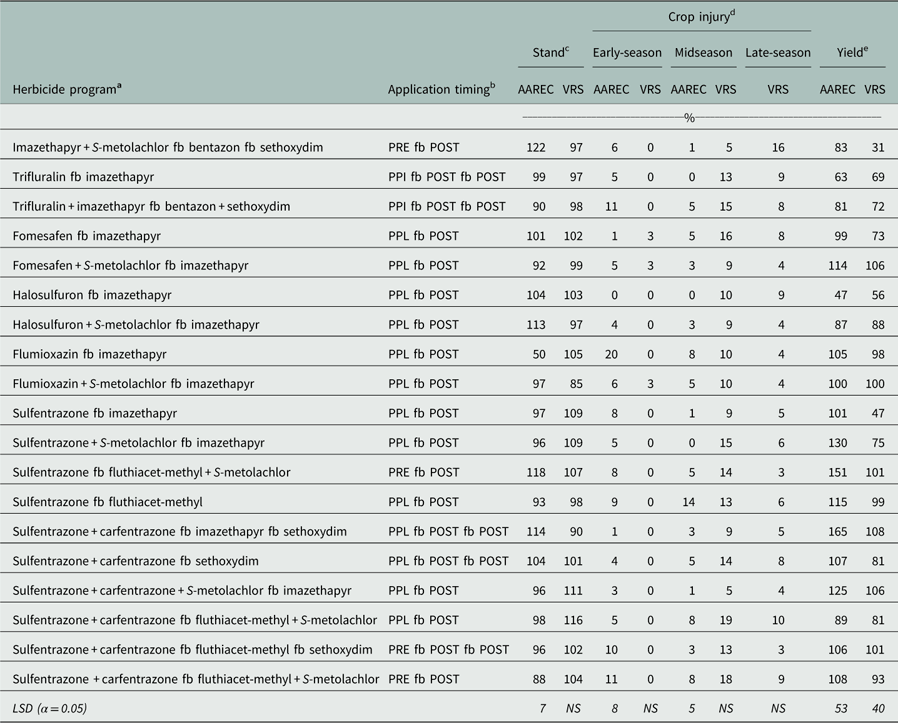
Due to heavy Palmer amaranth infestation, bentazon was replaced with fomesafen (0.28 kgha−1) in two of the commercial standard programs. Most treatments had >90% stand relative to the weed-free check, as was observed in 2014 (Table 6). Across all herbicide programs, the PPL/PRE applications affected crop stand significantly. Flumioxazin (PPL) reduced crop stand 50%; however, flumioxazin plus S-metolachlor (PPL) had similar stand density to the weed-free control (97%). The flumioxazin-only treatment caused the highest injury (20%); all other programs had 11% or less injury. By midseason, fluthiacet-methyl following sulfentrazone (PPL) (14%) was the highest while still acceptable. Yield differed across herbicide treatments; this difference was attributed to weed competition rather than herbicide phytotoxicity.
Effect of the herbicide programs on cowpea stand, visible injury, and yield at the Arkansas Agricultural Research and Extension Center (AAREC), Fayetteville, Arkansas, and the Vegetable Research Station (VRS), Kibler, Arkansas, in 2015.

a Plus sign (+) indicates tank-mixed or premixed herbicide prior to application; fb, followed by.
b Application timings: PPL, preplant (2 weeks prior to application); PPI, preplant incorporated; PRE, preemergence; POST, postemergence (2 to 3 trifoliate).
c Stand count was assessed in a 1-m2 area at the center of the plot and converted to a percentage relative to the nontreated weed-free check: 27 plants m−2 at AAREC and 27 plants m−2 at VRS.
d Evaluation timings: Early-season, 2 to 3 weeks after planting; midseason, 4 to 6 weeks after planting or 2 to 3 weeks after POST application; late-season, 8 to 9 weeks after planting.
e Yield was analyzed and presented as a percentage relative to the nontreated weed-free check: 673 kg ha−1 at AAREC and 626 kg ha−1 at VRS.
Overall, crop yield benefitted from the higher-than-average rainfall. The commercial standard treatments and halosulfuron (PRE) fb imazethapyr (POST) were among the weediest plots late in the season; these programs also had the lowest yields. Flumioxazin (PPL), which had the highest stand reduction and early-season injury, yielded 5% more than the weed-free control. All but one of the sulfentrazone-based programs had greater than 100% relative yield; the sulfentrazone plus carfentrazone fb fluthiacet-methyl plus S-metolachlor plots produced 89% relative yield. Neither injury nor stand loss was observed; therefore, yield performance was not influenced by herbicide phytotoxicity but by herbicide efficacy.
Weed pressure was higher in the 2015 cropping season; the weedy check plots averaged 72 Palmer amaranth m−2 and 16 annual grasses m−2 (Table 4). The three commercial standard herbicide programs and halosulfuron (PRE) fb imazethapyr (POST) did not reduce the density of Palmer amaranth nor annual grasses to acceptable levels. All other treatments, including the sulfentrazone-containing programs, had <10 weeds m−2. All herbicides performed well at midseason, with >90% control except for the standard and halosulfuron (PRE)-based programs mentioned previously. The current commercial standard had poor early-season weed control (18%) and only 38% control by midseason (Table 5). Trifluralin-containing programs were slightly better than the current standard, but still had unacceptable levels of early-season control (61% and 65%). By midseason, follow-up treatments with bentazon and sethoxydim improved weed control to 85%, similar to that of the other programs. Halosulfuron (PRE) alone controlled only about half the weeds in the plots (57% early-season and 54% midseason). Applying S-metolachlor with halosulfuron increased weed control by over 30%.
Kibler Location
Crop stand at Kibler was not affected by any of the herbicide programs (Table 6). On average, it was 90% to 116% of the weed-free check, which had 27 plants m−2 on average. Early-season injury was barely perceptible at 3%. At midseason, sulfentrazone plus carfentrazone (PPL or PRE) fb fluthiacet plus S-metolachlor (POST) caused 18% and 19% injury, respectively. However, injury was not different among treatments. A late-season evaluation was done to assess if the standing water at midseason had impacted crop response to herbicides. Crop injury was not different among herbicide programs and was <10% in all but the imazethapyr plus S-metolachlor (PRE) program. Crop yield was affected by a combination of poor crop vigor and high weed pressure caused by the intermittent standing water in the field. The commercial standards had low relative yields (<75%). Two sulfentrazone-based programs, sulfentrazone (PPL) and sulfentrazone plus S-metolachlor (PPL), had yields similar to the commercial standards at 47% and 75%, respectively. This was not consistent with sulfentrazone (PPL) fb fluthiacet-methyl with or without S-metolachlor, which had comparable yields to the other sulfentrazone containing programs (≥80% relative yield). Flumioxazin (PPL)-based programs were equivalent to the nontreated, weed-free check (approximately 100%). Overall, while the intermittent standing water reduced overall yield compared to 2014, the herbicide programs did not compromise crop performance.
Weed pressure was lower in 2015 than it was in 2014. Palmer amaranth density was 34 plants m−2, and annual grass density was 3 plants m−2 in the weedy check plots (Table 4). As observed previously, the commercial standard programs and halosulfuron (PPL) by itself had the highest weed densities. The current commercial standard and halosulfuron treatments had 21 and 22 Palmer amaranth plants m−2. Annual grasses were less prevalent. The early-season weed control was lower than at Fayetteville and in 2014 (Table 5) due to the high rainfall that increased herbicide dissipation. The imazethapyr plus S-metolachlor–based programs controlled only 18% of the weeds, while the trifluralin-based programs had 61% to 65% weed control. Fomesafen- and halosulfuron-based programs performed poorly (<75%). Flumioxazin had the best control (99%) due to its stronger activity on Palmer amaranth and longer soil persistence. The sulfentrazone treatments were weak under these suboptimal conditions, with ratings of 38% to 83%. Herbicide programs with residual herbicides and follow-up POST herbicide application were more effective than other treatments by midseason. Exceptions are the imazethapyr plus S-metolachlor- and halosulfuron (PPL)-based programs, with 38% and 50%, respectively. The flumioxazin-based programs consistently performed the best (99%).
Herbicide Efficacy and Crop Response in 2016
Fayetteville Location
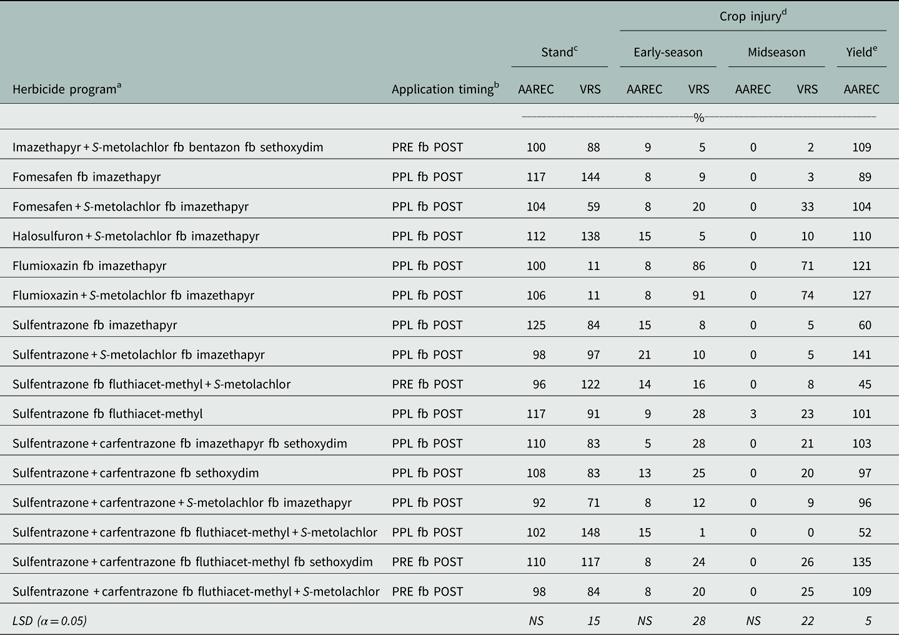
Crop injury at Fayetteville was negligible, and residual herbicides did not reduce crop stand (13 plants m−2) (Table 7). At the early-season evaluation, the crop injury was not different across treatments, ranging from 5% in the sulfentrazone plus carfentrazone (PPL) treatments to 21% in the sulfentrazone plus S-metolachlor (PPL) treatments. While the observable injury was minimal to null, yield variability within treatment was high; the weed-free checks yielded 626 kgha−1. High background variability was due to environmental factors. The current commercial standard herbicide program was among the highest-yielding treatments in the study (109%). Programs with flumioxazin, the more potentially injurious herbicide, yielded more than did the weed-free check and were the two highest-yielding programs in the study (121% and 127%). All but two of the sulfentrazone programs had similar (98%) or greater (135%) yield compared to the weed-free check. Crop yield at Fayetteville was high despite the limiting field conditions.
Effect of the herbicide programs on cowpea stand, visible injury, and yield at the Arkansas Agricultural Research and Extension Center (AAREC), Fayetteville, Arkansas, and the Vegetable Research Station (VRS), Kibler, Arkansas, in 2016.

a Plus sign (+) indicates tank-mixed or premixed herbicide prior to application; fb, followed by.
b Application timings: PPL, preplant (2 weeks prior to application); PPI, preplant incorporated; PRE, preemergence; POST, postemergence (2 to 3 trifoliate).
c Stand count was assessed in a 1-m2 area at the center of the plot and converted to a percent relative to the nontreated weed-free check (AAREC, 13 plant m−2; VRS, 30 plants m−2).
d Evaluation timings: Early-season, 2 to 3 weeks after planting; midseason, 4 to 6 weeks after planting or 2 to 3 weeks after POST application.
e Yield was analyzed and presented as a percentage relative to the nontreated weed-free check, which yielded 807 kg ha−1.
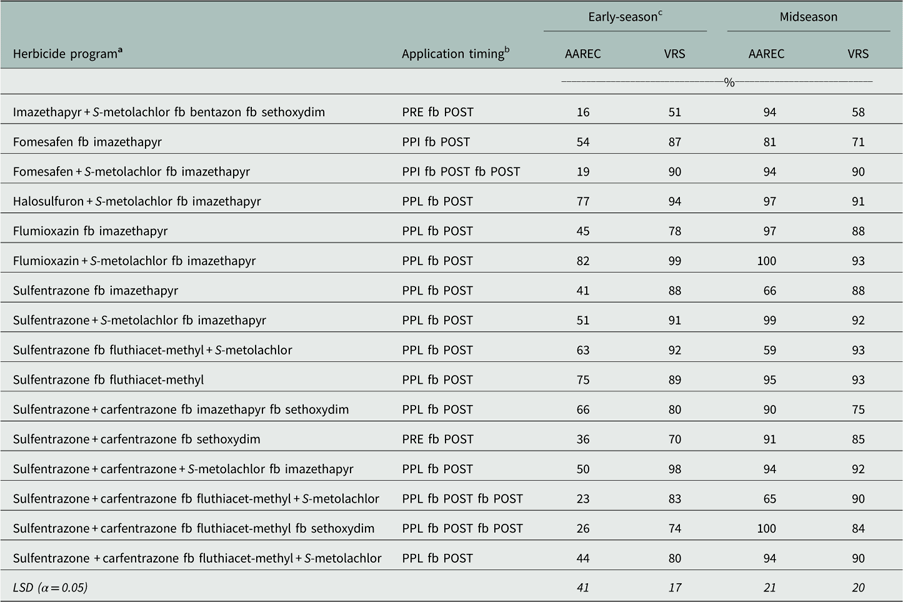
Weed control was variable across plots due to intermittent high rainfall early in the season, which affected weed density and relative dominance. Palmer amaranth density was lower than it was in previous years (7 plants m−2), while annual grass densities were high (26 plants m−2) (Table 4). The commercial standard program reduced the annual grasses, but did not adequately reduce Palmer amaranth density (8 plants m−2). Fomesafen and sulfentrazone were ineffective on annual grasses, reducing infestation to only about half that of the weedy check (15 plants m−2). Palmer amaranth infestation was generally less than in previous years, but control was lower than observed previously, which may be due to the high rainfall. Total weed control early in the season was low, ranging from 16% with the commercial standards to 82% with flumioxazin plus S-metolachlor (Table 8). Sulfentrazone, if used as the only residual herbicide in the program, was ineffective (<50% control). The addition of S-metolachlor increased total weed control by approximately 30%, but control was still unacceptable. Because the dominant weeds were annual grasses, all programs containing a grass-active herbicide fared better. Both imazethapyr and sethoxydim increased weed control to over 90%. Fluthiacet-methyl (POST) was not effective on annual grasses and did not benefit the programs (<70% control).
Visual assessment of total weed control (%) at the early- and midseason evaluation timing at the Arkansas Agricultural Research and Extension Center (AAREC), Fayetteville, Arkansas, and the Vegetable Research Station (VRS), Kibler, Arkansas, in 2016.

a Plus sign (+) indicates a tank-mixed or premixed herbicide prior to application; fb, followed by.
b Application timings: PPL, preplant (2 weeks prior to application); PPI, preplant incorporated; PRE, preemergence; POST, postemergence (2 to 3 trifoliate).
c Evaluation timings: Early-season, 2 to 3 weeks after planting; midseason, 4 to 6 weeks after planting or 2 to 3 weeks after POST application.
Kibler Location
Recurring high rainfall early in the season affected herbicide performance and crop response. The flat seedbed in Kibler delayed soil drainage and might have contributed to crop tolerance differences between locations. Crop stand was variable, with the commercial standard programs having 88% stand relative to the nontreated check (Table 7). Flumioxazin and fomesafen plus S-metolachlor treatments reduced the stand to 59% and 11%, respectively. Sulfentrazone-based programs were variable, but the PPL treatment often had fewer plants than did the PRE treatment. Stunting was apparent, with injury exceeding 20% for several programs. The flumioxazin programs caused 86% and 91% crop injury. High rainfall around the time of planting had leached the herbicide into the seed zone, causing high crop injury. By midseason, the injury had mostly subsided to <10%. Injury from several sulfentrazone treatments, the fomesafen plus S-metolachlor, and both flumioxazin treatments persisted into the midseason (>20%). The elevated injury from the flumioxazin treatments (~70%) is a concern, but the crop recovered. A soil-borne disease associated with periodic prolonged standing water spread quickly across the block at pod-filling stage, killing ~80% of the crop prior to harvest. Thus, yield data was not obtained.
Weed densities were typical for Kibler as compared with previous years; Palmer amaranth predominated (16 plants m−2) and annual grasses were present at lower densities (4 plants m−2) (Table 4). The current commercial standard (imazethapyr plus S-metolachlor) had the highest density of Palmer amaranth (6 plants m−2). Fomesafen (PPL) treated plots had the highest density of annual grasses (10 plants m−2). Sulfentrazone without an effective tank-mix partner controlled Palmer amaranth but not annual grasses (5 to 8 plants m−2). Early-season weed control was lowest for the commercial standard programs (51%) but variable across the sulfentrazone treatments (74% to 92%) (Table 8). Flumioxazin was weaker than previously observed (78%), but the addition of S-metolachlor increased weed control to near 100%. At midseason, programs containing an effective grass herbicide POST resulted in better total weed control. Most herbicide programs containing both effective broadleaf and annual grass herbicide had greater than 80% weed control.
Taken together, cowpea generally had excellent tolerance to the herbicide programs evaluated. However, rainfall is a critical factor in crop safety and efficacy of sulfentrazone-, flumioxazin-, and fomesafen-based programs. Crop tolerance was acceptable and expected. The concern with commercial standard programs is related to overall efficacy. Overall, the three commercial standard programs were not as effective as the new programs. The primary targets of these herbicide programs are Palmer amaranth and annual grasses. In general, these programs were good to excellent and tended to result in near weed-free plots if the dominant species were grasses. However, these programs showed weakness on high infestations of Palmer amaranth. Reduced efficacy on Palmer amaranth at Kibler is a concern, particularly because this location has a long history of S-metolachlor use. Resistance to imazethapyr (ALS inhibitor) and trifluralin (mitotic inhibitor) is documented in Arkansas and this area of the state, but the possible reduced efficacy of S-metolachlor is new. This should be investigated further. The poor activity of these standard herbicides led to high weed pressure that reduced yield severely.
Fomesafen (Reflex®) is registered PRE and POST for use in cowpea and causes phytotoxicity from POST application (Wilson Reference Wilson2005). In this experiment, it was evaluated as a residual herbicide to expand the current recommendation for Palmer amaranth management early in the season. It was effective for this purpose, but also needs a partner to improve grass control. Fomesafen was more effective when used as a POST component of an herbicide program, and its residual activity will keep the crop weed-free until canopy closure.
Several of the new herbicide programs contained herbicides not yet investigated thoroughly for use in cowpea, including the halosulfuron- and flumioxazin-based residual programs. Halosulfuron was safe for use on cowpea, but was susceptible to leaching with heavy rainfall. Several of the research blocks had yellow nutsedge that was controlled with this program, but the program did not effectively control the major weeds—Palmer amaranth and grasses (data not shown). The halosulfuron-based program should include an effective residual tank-mixture partner such as S-metolachlor applied PRE. Flumioxazin-based programs were excellent across locations and years. In general, crop tolerance was good, except under the abnormally high rainfall around planting time in 2015. Yield was reduced only when flumioxazin was tank-mixed with S-metolachlor at Fayetteville in 2015. Flumioxazin is considered the current standard PRE herbicide in Arkansas soybean production and has potential to expand into cowpea for its excellent control of Palmer amaranth. A tank-mix partner is necessary to expand the annual grass spectrum, as practiced in soybean production. A follow-up experiment should be conducted to determine the best program with flumioxazin as a base residual herbicide and to define use patterns and tank-mix partners across a broader geography; then registration for use in cowpea may be pursued.
Sulfentrazone-based programs were the primary target for this experiment. Both formulations had comparable performance in these studies and both products were safe on the crop. The timing of application occasionally elicited some crop phytotoxicity. This was associated with heavy rainfall. The crop can recover and yield would not be affected. The difference between the two products was primarily in the sulfentrazone rate: Spartan® Charge contained lower sulfentrazone than did Spartan®. Thus, the residual activity of the Spartan Charge–containing program was shorter than that of the program containing Spartan. An effective POST herbicide component would overcome this deficiency. These herbicides were less effective on annual grasses than some of the others evaluated. Thus, the inclusion of S-metolachlor is highly beneficial. At a minimum, a POST selective grass herbicide should be included in these programs. There is a need for alternative residual and POST herbicides in cowpea production, because current commercial standards are not 100% effective on primary weeds. The registrations of sulfentrazone-based products greatly enhanced weed control in cowpea. The need for effective residual products for Palmer amaranth is critical for cowpea and these products provide the necessary activity.
Acknowledgements
The authors thank the team at the Vegetable Station for their crop management knowledge and assistance. They also thank Seth Abugho, Pamela Carvalho de Lima, Josiane Argenta, and Leonard Piveta for their assistance in different phases of research implementation.