




No CrossRef data available.
Article contents
- Abstract
- Domestic Public Opinion in Times of Foreign Conflict
- Iraq as War on Terror
- A Content Analysis of the Bush Administration's Rhetoric
- Wither the Opposition?
- How the Public Responded to Bush's Rhetoric
- Was It WMD?
- Alternative Theories
- Responsible Use of Powerful Frames
- Epilogue
- Appendix A: Speeches and Newspaper Codings
- References
Shaping Public Opinion: The 9/11-Iraq Connection in the Bush Administration's Rhetoric
Published online by Cambridge University Press: 26 August 2005
Article contents
- Abstract
- Domestic Public Opinion in Times of Foreign Conflict
- Iraq as War on Terror
- A Content Analysis of the Bush Administration's Rhetoric
- Wither the Opposition?
- How the Public Responded to Bush's Rhetoric
- Was It WMD?
- Alternative Theories
- Responsible Use of Powerful Frames
- Epilogue
- Appendix A: Speeches and Newspaper Codings
- References
Abstract
We suggest that the 2003 war in Iraq received high levels of public support because the Bush administration successfully framed the conflict as an extension of the war on terror, which was a response to the September 11, 2001, attack on the World Trade Center and the Pentagon. Our analysis of Bush's speeches reveals that the administration consistently connected Iraq with 9/11. New York Times coverage of the president's speeches featured almost no debate over the framing of the Iraq conflict as part of the war on terror. This assertion had tremendous influence on public attitudes, as indicated by polling data from several sources.Amy Gershkoff (agershko@princeton.edu) and Shana Kushner (skushner@princeton.edu) are graduate students in the Department of Politics, Princeton University. The authors thank Larry Bartels, Gary Jacobson, Douglas Foyle, seminar participants at Princeton University, and three anonymous reviewers for helpful comments and suggestions. An earlier version of this paper was presented at the 2004 annual meeting of the Midwest Political Science Association. Authors' names listed in alphabetical order.
Information
- Type
- Research Article
- Information
- Copyright
- © 2005 American Political Science Association
On March 19, 2003, the United States declared war on Iraq. More than 70 percent of Americans supported the war. The question is why. According to most theories of public opinion, support for this war should have been extremely low. Many casualties were expected; most Americans anticipated a long conflict, detrimental to the U.S. economy; and most Americans thought war in Iraq would increase the likelihood of terrorist activities in the United States. Large antiwar demonstrations broke out in Los Angeles, New York, Berlin, London, Paris, and across the Middle East. The United Nations did not authorize the action; on the contrary Russia and France, permanent members of the Security Council, threatened to veto any measure allowing force. Yet support for the war was high among both Republicans and Democrats, both men and women. It was high regardless of whether or not weapons of mass destruction (WMD) were found in Iraq, whether or not thousands of American soldiers died, and whether or not the war continued for more than a year. To be sure, we expected that patriotism would generate support for the war; but previous academic accounts of the rally-around-the-flag effect suggest that while it might boost support,1
it could not by itself explain why approval was as high as it was.We suggest that the principal reason that three-quarters of the American public supported the war was that the Bush administration successfully convinced them that a link existed between Saddam Hussein and terrorism generally, and between Saddam Hussein and al Qaeda specifically. Framing the war on Iraq in this way connected it intimately with 9/11, leading to levels of support for this war that stretched nearly as high as the levels of support for the war in Afghanistan.2
ABC News/Washington Post Afghanistan Attack Poll 2.
President Bush never publicly blamed Saddam Hussein or Iraq for the events of September 11, but by consistently linking Iraq with terrorism and al Qaeda he provided the context from which such a connection could be made. Bush also never publicly connected Saddam Hussein to Osama bin Laden, the leader of al Qaeda.3
In fact, mention of bin Laden dropped completely out of speeches after February 2002 and only appeared in one speech prior to that, in the September 2001 address to a joint session of Congress. White House 2001; White House 2002a.
First, we briefly outline the relevant academic theories explaining American public opinion on military conflict and the role the press plays in shaping public opinion in times of war. Next we present our Iraq-as-war-on-terror4
We use the term war on terror to facilitate our analysis of the president's language; in no way do we intend to judge the legitimacy of the terminology.
Domestic Public Opinion in Times of Foreign Conflict
Researchers have long recognized that Americans tend to remain uninformed about politics, especially foreign affairs.5
However, wars can inspire the public to become better informed and dramatically increase their news consumption.6 Furthermore, we know that Americans who are uninformed take cues from opinion leaders, and that often it is the interpretation of the events by elites, rather than the events themselves, that help shape public opinion.7 In other words, “[T]hose who control the language control the argument, and those who control the argument are more likely to successfully translate belief into policy.”8 Issue frames affect beliefs and the relative importance individuals attach to beliefs.9The media also have an opportunity to shape public opinion through tone, content manipulation, and issue frames.10
Since much of the media coverage of any political event prominently features quotes from political leaders and excerpts of official speeches, such media coverage gives public officials a second venue, beyond their direct pronouncement, from which to propagate their message, and one in which the generally uninformed public is likely to hear, believe, and respond.How should the public respond to presidential rhetoric? We know that members of a president's party are more likely than the members of the outparty to support the president's policy in any area.11
We also know that if opposition and debate occur among elites, this is reflected in media coverage; however, when this conflict is muted or nonexistent, a one-sided information flow emerges, even if citizens or foreign critics hold other viewpoints.12 This seemed to ring true even more so after September 11, when the press acted deferentially to government officials' frames.13However, while Americans are generally politically uninformed, they do have strong views on war. Americans generally respond unfavorably to foreign conflict in which ground troops must be committed, especially when large numbers of American casualties are expected. In addition, they tend to prefer multilateral efforts.14
This makes the large, unconditional support for the war in Iraq all the more surprising.Finally, we also know that in times of war and national crisis, Americans “rally around the flag,” increasing their approval of the president, often dramatically.15
Polsby 1964; Mueller 1970, 1973.
Iraq as War on Terror
The Bush administration successfully framed the war in Iraq as an extension of its response to September 11 and the war on terror. The administration juxtaposed allusions to Iraq with the terms terror, bin Laden, and al Qaeda. Furthermore, there was little elite opposition to this rhetoric, leaving the American public with a one-sided flow of information. The more people watched television news about the war in Iraq, the more they were exposed to the Bush administration's rhetoric.18
Given that Colin Powell's speech to the United Nations was the only time this link was explicitly stated by a member of the Bush administration, hearing Colin Powell's speech should increase an individual's likelihood of connecting Iraq with al Qaeda, even controlling for general Iraq war news consumption.
The Iraq-as-war-on-terror framing results that we demonstrate below are not merely statistical artifacts or functions of our methodology or coding scheme; in fact, other scholarship and quotations in the media suggest that Bush himself believed that Saddam Hussein and Osama bin Laden were connected. As early as September 17, 2001, Bush said, “I believe Iraq was involved,” when asked about the September 11 attacks.19
And according to Bob Woodward's account of National Security Council meetings, from the moment the September 11 terrorist attacks occurred, the Bush administration framed the U.S. response in terms of a global war on terrorism, with targets including not just Afghanistan, but other nations as well, including Iraq. Thus it seems that Bush sincerely believed in the Iraq-9/11 connection.A Content Analysis of the Bush Administration's Rhetoric
In order to measure Bush's rhetoric on the Iraq war, we analyzed presidential speeches dealing with terrorism and/or Iraq given from September 11, 2001, to May 1, 2003—the declared end of hostilities in Iraq.20
See appendix A for a description of the content analysis methodology.
We excluded press conferences and interviews, as we were interested in the polished language of speeches intended to be persuasive. A list of the speeches is available at www.princeton.edu/∼agershko/iraqwar.htm.
The language of Bush's speeches mattered. The language used to describe a conflict allows the president to shape citizens' interpretations of events and information.22
As Donald Kinder states, “Frames seek to capture the essence of an issue. They define what the problem is and how to think about it; often they suggest what, if anything, should be done to remedy it.”23 Whether the prevailing frame for a conflict is World War II or Vietnam has real consequences for how willing the public is to support it, which matters since positive public opinion is an “essential domino” of successful military operations.24 In 2002 the terrorism frame was available, believable, and understandable to a country scarred by September 11, making the frame powerful and convincing.What should we expect to see from the Bush rhetoric under the Iraq-as-war-on-terror frame? Before President Bush's speech about Iraq to the United Nations on September 12, 2002, we expect terrorism to appear prominently in rhetoric and mentions of Iraq to be rare. However, after that date, when the Bush administration began to make a case for invading Iraq, we expect to see Iraq figure more prominently, together with, instead of substituting for, references to terrorism.25
Strong emphasis on Iraq in presidential speeches did not begin in earnest until September 12, 2002, which is why we focus only on September 2002–May 2003 in this section.
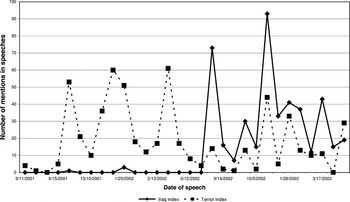
To test this, we created an “Iraq index,” which counted how many times Bush used the terms Iraq and Saddam Hussein, and a “terrorism index,” which counted use of the terms terror, Afghanistan, Taliban, bin Laden, and al Qaeda.26
We divided the Iraq index and terrorism index by speech word count for a normalized score. However, figure 2 presents the raw counts because they are both substantively and visually easier to interpret.

Iraq and terrorism indices
However, the number of mentions incompletely assesses the rhetoric. Thus we also coded term proximity, that is, whether the president referred to Iraq/Saddam Hussein and terrorism in the same parts of speeches. From September 12, 2002, to May 2003, the subjects of terrorism and Iraq were intertwined on a regular basis. Of the 13 speeches given in this period, 12 referenced terror and Iraq in the same paragraph and 10 placed them within the same sentence. In 4 speeches, a discussion of terrorism preceded the first mention of Iraq, giving the impression that Iraq was a logical extension of the terrorism discussion.
The president's speech to the United Nations on September 12, 2002, is an example of this kind of structure. His remarks commenced with a remembrance of the September 11 attacks, continued with a discussion of the war in Afghanistan, and addressed the threat to world peace from outlaw regimes and terrorists—all before focusing specifically on Iraq, which was thus rhetorically linked with terrorism. Further in the speech, Bush stated, “Iraq's government openly praised the attacks of September the 11. And al Qaeda terrorists escaped from Afghanistan are known to be in Iraq.”27
While not explicitly stating that Iraq was involved in the terrorist attacks on the United States, the president allowed the listener to come to that conclusion. The administration gave no specific intelligence to verify the claim that known terrorists were harbored in Iraq until Colin Powell's speech four months later.Another notable construction in Bush's speeches is the juxtaposition of Iraq/Saddam Hussein with September 11, as seen in the above quotation. Seven of 13 speeches from September 2002 to May 2003, place September 11 and Iraq in the same paragraph, while four speeches place them in the same sentence. Three times in this period, Bush speeches proposed a hypothetical situation in which the September 11 hijackers were armed with WMD provided by the Iraqi government. For example, in a March 8, 2003, radio address the president said, “The attacks of September 11, 2001 showed what the enemies of America did with four airplanes. We will not wait to see what terrorists or terror states could do with weapons of mass destruction.”28
Bush proposes that the “enemies” of the United States are indistinguishable and allied by the use of terror; furthermore, “terrorists” and “terrorist states” have designs to use WMD and must be dealt with in the same manner. This combination provided the logical basis for attacking Iraq; the regime was linked to al Qaeda and therefore to September 11.The Iraq-as-war-on-terror frame is also apparent in the transitions in the state of the union address of 2003. Following a long discussion of domestic issues, the president turned to foreign affairs. After mentioning the successes in the war against terrorism, the speech introduced the topic of outlaw regimes, including the two other “axis of evil” countries, Iran and North Korea, priming the connection of Iraq and the fight against terrorism. Thus, there was a direct transition from September 11, to outlaw regimes in the context of the war on terror, to WMD, and finally, to Iraq. The speech also offered another example of the metaphorical use of September 11 hypothetical scenario:
Before September the 11, many in the world believed that Saddam Hussein could be contained. But chemical agents, lethal viruses and shadowy terrorist networks are not easily contained. Imagine those 19 hijackers with other weapons and other plans—this time armed by Saddam Hussein. It would take one vial, one canister, one crate slipped into this country to bring a day of horror like none we have ever known. We will do everything in our power to make sure that that day never comes.29
This scenario occurred after discussions of the war on terror, Iraq's failure to disarm, and after a description of Saddam Hussein as a “brutal dictator, with a history of reckless aggression, with ties to terrorism.”30
At the end of the address, the president promised to bring food and medicine to Iraqi citizens in case of war, as troops did in Afghanistan, furthering the parallels between the two conflicts. Thus the Iraq war was framed by the Bush administration as part of a larger war on terrorism. What other frames did the public hear?Wither the Opposition?
The public's acceptance of the administration's argument was considerably aided by the fact that it had little competition. According to John Zaller's theory of public opinion, when elite discourse favors a given policy, it produces a one-sided “mainstream pattern” in which the most aware members of the public subscribe strongly to the elite consensus.31
Zaller 1992, 185.
To evaluate information flow during the months preceding the war in Iraq, we analyzed New York Times coverage of major Bush speeches from September 11, 2002, to May 1, 2003, for the two days following each of the speeches considered above.33
Due to the large amount of coverage of the Iraq War, we limited the analysis to only front-page stories under the assumption that these are the most read and therefore most influential stories in a newspaper.
See for example, Page 1996; Bennett and Paletz 1994; Bartels 1996.
To some extent, this was the case. Of the 35 newspaper stories coded, 17 were neutral, nine had a slightly positive tone, and nine were negative.36
See appendix A for a fuller account of the coding of tone.
Who is quoted affects the frame and tone of newspaper stories. Thirty of the 35 stories quoted at least one member of the Bush administration, with 21 quoting Bush directly. In contrast, only 12 stories quoted Democrats, and 14 stories quoted criticism from members of the United Nations.37
There was an overlap of five stories that quoted both Democrats and critics of U.S. policy from UN members other than the United States.
Alison Mitchell, “Democrats, Wary of War in Iraq, Aso Worry about Battling Bush,” New York Times, September 14, 2002, A1.
Alison Mitchell, “Democrats, Wary of War in Iraq, Aso Worry about Battling Bush,” New York Times, September 14, 2002, A1.
While some debated the policy of war, there was little debate within the Times' news coverage on the framing of the conflict in terms of terrorism. The press plays a selectively critical role; if the country supports the person making statements, journalists are less likely to challenge him or her.40
This would appear especially true for President Bush, whose approval ratings hovered between 60 and 70 percent from September to December 2002, declined slightly at the beginning of 2003, and rose again in March 2003.41 After the September 2002 speech to the United Nations, a news analysis by Patrick Tyler did state that “Mr. Bush made no case today that Mr. Hussein's government in Baghdad was connected in any way to the terrorists who plotted the hijackings and assault on the United States.”42Patrick Tyler, “A New Face in the Sights,” New York Times, September 13, 2002, A1.
James Dao, “US may give the UN data on Iraqi labs,” New York Times, January 30, 2003, A1.
The paucity of quotes from nonelite opponents, including members of peace movements, is striking. Quotes from Iraqi leaders and citizens appeared sparsely, in only four stories, while only one article quoted an average American citizen. The small number of stories coded does not allow us to make definitive conclusions about media criticism, but it suggests that the press accepted the administration's framing and policy. It appears that the information flow remained one-sided for the months preceding the Iraq war. The administration's frame was not countered by intense, sustained criticism by either the press or the Democratic Party.44
Zaller's theory proposes that public attitudes toward major issues are a response to the relative intensity of competing political communications on those issues. See Zaller 1992, 210.
How the Public Responded to Bush's Rhetoric
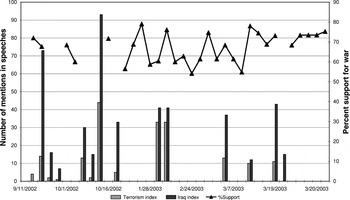
Since the first polling done about Iraq took place on September 11, 2002, in figure 2 we plot the Iraq and terror indices beginning at that point and the corresponding support for the war beginning the same date. As noted above, the Iraq and terror indices move in tandem; moreover, public support frequently is higher following increases in the Iraq and terror indices.

Bush's rhetoric and public opinion
Throughout this period, support for the war never dipped below 55 percent. As we mentioned earlier, this is surprising given that several factors should have resulted in low levels of support for the war: on average, 55 percent of Americans expected the war to be long; 44 percent expected large numbers of casualties; 50 percent thought the war would adversely affect the U.S. economy; 62 percent thought that the war increased the short-term risk of terrorism at home; 76 percent thought that the war increased the short-term risk of chemical or bioterrorism at home; and 35 percent thought that the war would result in the reinstatement of the draft.45
Based on averages across all polls where question was asked; percentages vary slightly by question wording and polling organization. Sources: ABC News/Washington Post Poll, April 16, 2003, N=504, margin of error [MoE] ± 4.5; Los Angeles Times Poll Study 484, April 2–3, 2003, N=745, MoE ± 4; CNN/USA Today/Gallup Poll, March 29–30, 2003, N=1012, MoE ± 3; Newsweek Poll, March 27–28, 2003, N=1004, MoE ± 3; CBS News Poll, March 26–27, 2003, N=868, MoE ± 3; ABC News/Washington Post Poll, March 20, 2003, N=506, MoE ± 4.5; ABC News/Washington Post Poll, March 17, 2003, N=510, MoE ± 4.5; CBS News Poll, March 15–16, 2003, N=1049, MoE ± 3.
Based on data from ABC News/Washington Post polls from the following dates: March 23, 2003, March 27, 2003, April 3, 2003, April 2–6, 2003, April 9, 2003, and April 16, 2003. ABC News/Washington Post polls taken from August 29, 2002 to March 20, 2003 all reflect levels of support over 55 percent. Dates of these polls are: August 29, 2002, September 12–14, 2002, October 2–6, 2002, December 2002, January 16–20, 2003, January 27, 2003, January 28, 2003, January 30–February 1, 2003, February 5, 2003, February 6–9, 2003, February 19–23, 2003, March 5–9, 2003, March 20, 2003. Other polls from other sources such as Los Angeles Times, Newsweek, FOX News/Opinion Dynamics, Pew Research Center for the People and the Press, CNN/USA Today/Gallup yielded similar results, although the exact percentage of those approving of the war varies slightly by question wording, polling organization, and survey date.
But Americans did not merely support the war, they did so rather strongly. More than 40 percent felt that those opposed to the war should not be allowed to speak out or hold protest marches or rallies because it might hurt the war effort.47
Percentage varies by question wording. Average across five polls is 41.0 percent, with nonresponses and “don't knows” excluded from analysis. Los Angeles Times Poll Study 481, January 30–February 2, 2003, N=1385, MoE ± 3; Los Angeles Times Poll Study 482, February 7–8, 2003, reinterview of 809 respondents from Study 481, MoE ± 3; ABC News/Washington Post poll March 27, 2003; ABC News/Washington Post poll March 22, 2003; ABC News/Washington Post poll March 20, 2003; CBS News Poll, March 26-27.
Average over 4 polls is 64.1 percent, with non-responses and “don't knows” excluded from analysis. Sources: Los Angeles Times Poll Study 481; Los Angeles Times Poll Study 482; CNN/USA Today/Gallup Poll March 22–23, 2003, N=1020, MoE± 3; CBS News/New York Times Poll March 22, 2003.
This high, unconditional support for the war in Iraq is even more surprising when we compare it to the war in Afghanistan. In October 2001, the eve of the conflict in Afghanistan, 80 percent of Americans approved of sending troops there,49
ABC News/Washington Post Afghanistan Attack Poll 2, October 2001 [computer file], Horsham, PA: Taylor Nelson Sofres Intersearch [producer], Ann Arbor, MI: Inter-university Consortium for Political and Social Research [distributor], 2002, http://webapp.icpsr.umich.edu/cocoon/ICPSR-STUDY/03299.xml.
The data show the impact of this connection. For example, after hearing Bush's 2003 state of the union address, discussed above, 9 percent of Americans changed from not supporting to supporting the war in Iraq and, strikingly, credit Bush's speech as the reason for their transition. Indeed, in one survey taken just days after the address, when asked which statement best described their views about the Iraq war, 9 percent of respondents thought that the statement best describing their feelings before and after the speech was: “Before the speech I did not favor U.S. military action against Iraq, but the speech changed my mind and I favor it now.”50
Los Angeles Times Poll Study 481 (emphasis added). Many of the polls cited in preceding endnotes show an increase in support for the war of approximately the same magnitude following the state of the union address.
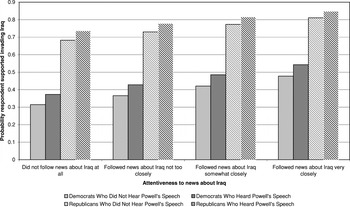
More generally, we expect those who regularly heard the Bush administration's rhetoric to be more likely to perceive a strong connection between Saddam Hussein and terrorism, and thus more likely to support the war in Iraq. Figure 3 shows that in fact the more closely a respondent followed news coverage about Iraq, the more likely she was to support invasion, all else held constant.51
PIPA-Knowledge Networks Poll: Americans on Iraq and the UN Inspections II, February 12–18, 2003, N=3163 (N=2186 adults nationwide were sampled randomly, with an additional 977 over sampled from California, Florida, Illinois, New York, and Texas, with the full sample weighted so that it is correctly proportional to the geographic distribution of the US population) MoE ± 2.6. Figure 4 shows the predicted probabilities that result from a logistic regression of whether or not the respondent supported invading Iraq (1 if yes, 0 if no) on attentiveness to news coverage about Iraq (1 if least attentive, … , 4 if most attentive), party identification dummy variables (independents were the base case), whether or not the respondent believed Iraq was responsible for 9/11 (1 if yes, 0 if no), and whether or not the respondent heard Powell's speech to the United Nations (1 if yes, 0 if no). For the predicted probabilities, whether or not the respondent believed Iraq was responsible for 9/11 was set equal to 1; when this variable is set to zero, all predicted probabilities are lower, but the differences in the probability of supporting the war in Iraq between low and high attentiveness to news coverage, viewing of the Powell speech versus not viewing the speech, and so forth, remain nearly identical to those displayed in figure 4.
The 15 percent figure was calculated as follows. First, 4 differences were calculated: (1) the predicted probability of supporting the war for Democrats who heard Powell's speech and followed news about the Iraq War closely minus the predicted probability of supporting the war for Democrats who heard Powell's speech and did not follow news about the Iraq War closely; (2) the predicted probability of supporting the war for Republicans who heard Powell's speech and followed news about the Iraq War closely minus the predicted probability of supporting the war for Republicans who heard Powell's speech and did not follow news about the Iraq War closely; (3) the predicted probability of supporting the war for Democrats who did not hear Powell's speech and followed news about the Iraq War closely minus the predicted probability of supporting the war for Democrats who did not hear Powell's speech and did not follow news about the Iraq War closely; (4) the predicted probability of supporting the war for Republicans who did not hear Powell's speech and followed news about the Iraq War closely minus the predicted probability of supporting the war for Republicans who did not hear Powell's speech and did not follow news about the Iraq War closely. These four differences were averaged, and the result was 15.

Probability of support for Iraq war by attentiveness to Iraq war news coverage
Colin Powell's speech to the United Nations on February 5, 2003, had an additional effect on public support. His speech provided more evidence than any other official administration speech about the links between Iraq and al Qaeda. The data show that, even controlling for general media consumption, those who reported hearing Powell's speech were more likely to support the war in Iraq, as shown in figure 3.53
We realize the biases inherent in self-reporting; however, we expect that the probability of over-reporting is uncorrelated with the other variables in the model. Additionally, the proportion of respondents who reported hearing Powell's speech in PIPA-Knowledge Networks Poll February 12–18, 2003, is very similar to that reported in Los Angeles Times Poll Study 482.
Los Angeles Times Poll Study 482 (emphasis added).
The reason for the shift in opinion is clear; there was a 30-point jump in the number of Americans who felt convinced of a link between Saddam Hussein and al Qaeda following Powell's speech to the United Nations. Indeed, in the two days following Bush's state of the union address in 2003, respondents were asked whether or not enough evidence had been provided to show that Saddam Hussein and al Qaeda were connected; only 38 percent of respondents said yes. However, when those same respondents were reinterviewed following Powell's speech to the United Nations, 68 percent agreed.55
Los Angeles Times Poll Study 481 and Los Angeles Times Poll Study 482.
Additional polls corroborated our conclusions. To pick just one additional example, respondents who thought al Qaeda was the most important threat facing the United States were more likely to support the invasion of Iraq than those who thought al Qaeda was America's second, third, or fourth most important problem.56
PIPA-Knowledge Networks Poll: Americans on Iraq after the UN Resolution, November 19–December 1, 2002, N=1106, MoE ± 3.
By “better predictor,” we mean that the partial correlation between the Iraq war variable and the importance of the al Qaeda problem variable was higher than the partial correlation between the Iraq war variable and the importance of the Iraq problem variable. Moreover, in a regression of war support on the importance of the al Qaeda problem, the importance of the al Qaeda problem was a statistically significant predictor of war support in a two-tailed test at the 5 percent level, whereas in a regression of war support on the importance of the Iraq problem, the importance of the Iraq problem was not a statistically significant predictor of war support in a two-tailed test at the 5 percent level.
Was It WMD?
One of the stated goals of the war was to rid Iraq of WMD. In a speech to the United Nations on September 12, 2002, and again in his 2003 state of the union address, Bush claimed that Saddam Hussein's refusal to account for and destroy banned weapons compelled the United States to disarm him.58
White House, 2002b; White House 2003a.
Could the public's support for the Iraq war have originated from a belief that Hussein had WMD and must be disarmed in accordance with United Nations directives? This is highly improbable, given the public opinion data. If the public supported the war because they believed that he had WMD, then we would expect support for the war to be higher contingent on finding the weapons. But 82 percent of Americans said they would support the war, whether or not any WMD were found in Iraq,60
Los Angeles Times Poll Study 484.
Based on 4 poll average, with a range from 40.4 to 83.0 percent. Sources: Los Angeles Times Poll Study 481; Los Angeles Times Poll Study 482; CNN/USA Today/Gallup Poll, March 22–23, 2003; ABC News/Washington Post Poll, March 20, 2003.
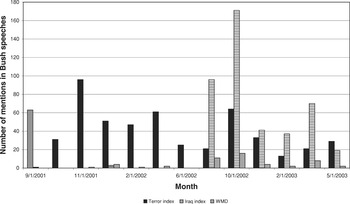
We do not see WMD as a prominent frame in Bush's rhetoric. While WMD are certainly part of the oratory, they are a much smaller percentage than discussions of terrorism. Bush began discussing WMD at the same point he began discussing Iraq: the January 29, 2002, state of the union address. Bush consistently referred to “weapons of mass destruction” (or alternatively “weapons of mass murder”) from January 2002 to May 2003. Of 22 speeches coded in this time period, 17 referenced WMD at least once, with a mean of 2.3 mentions per speech. In this same period, however, the average number of references to terrorism was 12.2 per speech (see fig. 4). Clearly, then, terror, not WMD, was the primary rhetorical frame.

Iraq index, terrorism index, and mentions of WMD
A speech on October 7, 2002, titled “Outlining the Iraqi Threat,” referred to WMD seven times, the most of any address; however, the same speech alluded to terror or terrorism 35 times, five times as often. Both Iraq and Saddam Hussein were placed in the same sentence as the word terrorism, and the president stated explicitly that associations existed between the Iraqi state and terrorism. This same pattern is apparent in the other speeches. Only once, in the March 19, 2003, address that declared the beginning of the war, did WMD appear more than discussion of terrorism. The president employed the term WMD once in that speech, never mentioning terrorism.
Alternative Theories
There are other possible explanations for Americans' support of the Iraq war. Perhaps support for the Iraq war was just a by-product of Bush's high approval ratings.62
Bush's high approval ratings are documented in, for example, Jacobson 2003 and Brody 2003.
A second possibility is that high levels of support for the war were due to the rally-around-the-flag effect. We calculate, in fact, that a rally effect explains approximately 9 percent of support for the war.65
Nine percent is the difference in the average approval for the war between October 2002 and March 7, 2003, and March 8, 2003, through the declared end of hostilities in Iraq on May 1, 2003.
Prior to March 8, 2003, none of the conditions necessary for a rally effect were present. According to John Mueller, in order to qualify as a rally event, an event must be international, directly involve the United States in general and the president in particular, and be “specific, dramatic and sharply focused.”66
Mueller 1973, 209, as quoted in Baum 2002, 275.
Another possibility is that the public supported the Iraq war in 2003 because they felt that the 1991 Iraq war was never completely finished. In 1991 support for the war was high, and Americans' dislike of Saddam Hussein registered long after the war's end. Perhaps the American public had a decade-plus-long hankering to “finish” the earlier war. Again, this is not borne out by the data. If Americans supported the 2003 war for this reason, then we should have seen high support from the first time the president mentioned the idea in a speech. Bush first hinted at the possibility of war with Iraq in the 2002 State of the Union address, yet support for the 2003 war did not reach high, almost unconditional levels until about a year later. Indeed, support does not begin to increase until the war with Iraq is closely and repeatedly tied to the war on terror.
A final alternative explanation for public support of the Iraq war is that Americans wanted to punish Muslims for 9/11. Xenophobia has been a repeated flaw in American history; however, the data strongly suggest that this was not a factor. Whether or not a respondent had a favorable or unfavorable opinion about Islam and whether or not a respondent reported being generally suspicious of people of Arab descent made him or her no more likely to support the war with Afghanistan.67
ABC News/Washington Post Afganistan Attack Poll 2. Several regressions and Chi-square tests bore out these results; this analysis can be obtained from the authors upon request. Questions addressing these xenophobic concerns were not available for data on the Iraq war. After about November 2001, these sorts of questions disappear from public opinion polls.
Responsible Use of Powerful Frames
Knowing that the Iraq-as-war-on-terror frame effectively rallied support for the war effort, what can we say about the normative implications for democratic theory? First, we might be concerned with the lack of deliberation among elites and the media in the months preceding the war.The deliberative spectrum, normally constrained by the two moderate political parties, was in this instance further constrained by the lack of dissent among elites. Mass opinion relies on dialogues of the political elite, and the fact that the framing of the war and the policy itself were scarcely discussed facilitated high levels of support for an unprecedented foreign policy of unilateral preemption.68
This is not to say that Americans would not have supported the war in the face of Democratic or media opposition, but rather that their conversion might not have been so complete nor so quick. Antiwar protesters were making themselves heard on city streets; with more elite deliberation, more mass deliberation might have followed.We might worry about whether the use of the 9/11 frame can lead to unconditional public support for any international policy initiated by the president, especially given that use of such a powerful frame may stifle both deliberation and accountability. One implication of our analysis is that this frame ought to be used sparingly and responsibly by all political elites in both parties, and as citizens, we ought to be vigilant in our examination of the framing of political conflicts. Pictures of the burning World Trade Center on September 11, 2001, evoke deep emotions, which elites can potentially use to increase support for conflict. Political elites of both parties must not improperly use these images to win the support of the American people for particular policy choices.
Epilogue
Not much has changed since we completed our paper in June 2003. The United States military continues to fight in Iraq, and American citizens continue to support the effort, even if cracks in that support are appearing as American casualties increase. A poll released in April 200469
revealed that 20 percent of Americans still believe Iraq is responsible for September 11 and that this misperception is still a significant predictor of whether or not Americans support the ongoing conflict in Iraq. In addition, according to a poll taken a few months before the 2004 election, those who believe that Iraq provided support to al Qaeda were nearly five times more likely to report an anticipated vote for Bush in November.None of this is surprising, given that Iraq and al Qaeda continue to be linked in the Bush administration rhetoric. On September 14, 2003, in an interview on “Meet the Press,” Vice President Cheney said, “If we're successful in Iraq … then we will have struck a major blow right at the heart of the base, if you will, the geographic base of the terrorists who had us under assault now for many years, but most especially on 9/11.”70
Vice President Richard Cheney, Meet the Press, September 14, 2003, quoted in Walter Pincus and Dana Milbank, “Al Qaeda-Hussein link is dismissed,” Washington Post, June 17, 2004, A1.
September the 11th taught us another lesson, that this nation must always deal with threats before they fully materialize…. I want to remind you that I saw a threat. I looked at the intelligence and saw a threat in Iraq…. September the 11th taught us a lesson.71
Given this ongoing entanglement of Iraq and September 11, it is understandable that the public continues to hear and accept erroneous linkages. In a PIPA/Knowledge Networks poll taken in June 2003, 71 percent of respondents once again said that the Bush administration had implied a link between Iraq under Saddam Hussein and 9/11.72
Nevertheless, with continued attacks on American troops and the September 11 Commission finding no evidence of a cooperative link between Iraq and al Qaeda prior to the launch of the Iraq war, we wonder whether the American public will continue to respond to the Iraq-as-war-on-terror frame with high levels of support for this ongoing conflict.Appendix A: Speeches and Newspaper Codings
Our speech coding scheme considered the length of the speech as well as frequency of the terms Iraq, terror, Saddam Hussein, Afghanistan, Taliban, al Qaeda, Osama bin Laden, weapons of mass destruction, rogue nations, and evil. We coded whether the terms terror and Iraq fell in the same sentence or paragraph, and whether the term terror preceded the first mention of Iraq. We also coded whether the speech placed terror and Saddam Hussein in the same sentence or paragraph, and whether 9/11 and Saddam Hussein and/or Iraq were referenced together. The speeches range from the assurances given to the country on September 11, to weekly radio addresses and speeches to interest groups, and from nationally televised prime-time speeches to addresses given to small groups of Republican supporters. The source was the White House Web site (www.whitehouse.gov), which posts all public talks given by the president.
Additionally, we coded articles from page A-1 of the New York Times for the two days following each presidential speech about Iraq. There are 35 articles from January 2002 (after the state of the union address) to May 1, 2003. The newspaper coding scheme included information about the date, length, and author of each article. Each article was coded with 0/1 dichotomous variables to reflect its being positive/accepting, negative/critical, or neutral toward the Bush rhetoric. This decision was made based on our assessment of the language used by the article's authors. We also coded for whether articles accepted the Iraq-al Qaeda connection and Iraq as part of the war on terror. We coded who was quoted as well as the overall tone of the quotation on a scale of 1–5, with 1 being the most positive. A story that used language critical or skeptical of the Bush rhetoric or that did not accept the Iraq-al Qaeda tie or the connection between Iraq and the war on terror was coded as negative or slightly negative in tone. For example, a story by Patrick Tyler stated, “Bush made no case today that Mr. Hussein's government was connected in any way to the terrorists who plotted the hijackings and assault on the United States”; it quoted Bush, but also Kofi Anan and Democrats, and was coded as slightly negative. Stories that interviewed only or almost solely administration officials, used positive language about the Bush speech, and accepted the Iraq-al Qaeda link or did not discuss the validity of the link were coded as positive or very positive. Stories with balanced sources (some Democrats, some Republicans, and some foreign leaders) and balanced language were coded as neutral. Final decisions about tone were based upon the judgment of the tenor of the article based upon the language used by the author.
References
Almond, Gabriel.
1950.
The American people and foreign policy.
New York:
Praeger.
Althaus, Scott L.
2002.
American news consumption during times of national crisis.
PS: Political Science and Politics
35 (3):
517–22.Google Scholar
Bartels, Larry.
1996.
Politicians and the press: Who leads, who follows?
Paper presented at the annual meeting of the American Political
Science Association, San Francisco, CA.
Baum, Matthew.
2002.
The constituent foundations of the rally-round-the-flag
phenomenon.
International Studies Quarterly
46 (2):
263–98.Google Scholar
Bennett, W. Lance.
1990.
Toward a theory of press-state relations in the United
States.
Journal of Communication
40 (1):
103–25.Google Scholar
Bennett, W. Lance, and
David Paletz, eds.
1994.
Taken by storm: The media, public opinion, and US foreign policy in
the Gulf War.
Chicago:
University of Chicago Press.
Brody, Richard.
2003.
The American people and George W. Bush: Two years of rally
volatility and grinding erosion. In
The George W. Bush presidency: An early assessment, ed.
Fred I. Greenstein,
228–44.
Baltimore:
Johns Hopkins University Press.
Campbell, Angus,
Phillip Converse,
Warren Miller, and
Donald Stokes.
1960.
The American voter.
Chicago:
University of Chicago Press.
Cohen, Bernard.
1963.
The press and foreign policy.
Princeton:
Princeton University Press.
Delli Carpini, Michael X., and
Scott Keeter.
1996.
What Americans know about politics and why it matters.
New Haven:
Yale University Press.
Downs, Anthony.
1957.
An economic theory of democracy.
New York:
Harper and Row.
Erikson, Robert,
Michael MacKuen, and
James Stimson.
2002.
The macro polity.
New York:
Cambridge University Press.
Goffman, Erving.
1974.
Frame analysis: An essay on the organization of experience.
Harmondsworth, UK:
Penguin Books.
Iyengar, Shanto.
1991.
Is anyone responsible? How television frames political
issues.
Chicago:
University of Chicago Press.
Iyengar, Shanto, and
Donald Kinder.
1987.
News that matters: Television and American opinion.
Chicago:
University of Chicago Press.
Jacobson, Gary.
2003.
The Bush presidency and the American electorate. In
The George W. Bush presidency: An early assessment, ed.
Fred I. Greenstein,
197–227.
Baltimore:
Johns Hopkins University Press.
Jamieson, Kathleen Hall, and
Paul Waldman.
2003.
The press effect: Politicians, journalists, and the stories that
shape the political world.
New York:
Oxford University Press.
Kinder, Donald.
1998.
Communication and opinion.
Annual Review of Political Science, vol. 1.
Norwood, NJ:
Ablex Publishing Corp.
Klarevas, Louis.
2002.
The “essential domino” of military operations: American
public opinion and the use of force.
International Studies Perspectives
3 (4):
417–37.Google Scholar
Kull, Steven,
Clay Ramsay, and
Evan Lewis.
2003.
Misperceptions, the media, and the Iraq War.
Political Science Quarterly
118 (4):
569–98.Google Scholar
Kull, Steven,
Clay Ramsay,
Stephan Stubias, and
Evan Lewis.
April 22, 2004.
US public beliefs on Iraq and the presidential election.
Program on International Policy Attitudes (PIPA) and Knowledge
Networks.
http://www.pipa.org/OnlineReports/Iraq/IraqReport4_22_04.pdf.
Lawrence, Regina, and
W. Lance Bennett.
2000.
Civic engagement in the era of big stories.
Political Communication
17 (4):
377–82.Google Scholar
Mueller, John.
1970.
Presidential popularity from Truman to Johnson.
American Political Science Review
87 (1):
87–101.Google Scholar
Mueller, John.
1973.
War, presidents and public opinion.
New York:
Wiley.
Nelson, Thomas, and
Zoe Oxley.
1999.
Issue framing effects on belief importance and opinion.
Journal of Politics
61 (4):
1040–67.Google Scholar
Page, Benjamin.
1996.
Who deliberates? Mass media in modern democracy.
Chicago:
University of Chicago Press.
Page, Benjamin, and
Robert Shapiro.
1992.
The rational public: Fifty years of trends in Americans' policy
preferences.
Chicago:
University of Chicago Press.
Paris, Roland.
2002.
Kosovo and the metaphor war.
Political Science Quarterly
117 (3):
423–50.Google Scholar
Polsby, Nelson.
1964.
Congress and the presidency.
Englewood Cliffs, NJ:
Prentice-Hall.
Sobel, Richard.
1998.
Trends: United States intervention in Bosnia.
Public Opinion Quarterly
62 (2):
250–78.Google Scholar
White House.
2001.
Address to a joint session of Congress and the American people.
September 20.
http://www.whitehouse.gov/news/releases/2001/09/20010920-8.html.
White House.
2002a.
President increases funding for bioterrorism. February 5.
http://www.whitehouse.gov/news/releases/2002/02/20020205-4.html.
White House.
2002b.
President's address to the United Nations. September 12.
http://www.whitehouse.gov/news/releases/2002/09/20020912-1.html.
White House.
2002c.
A decade of deception and defiance. September 12.
http://www.whitehouse.gov/news/releases/2002/09/20020912.html.
White House.
2003a.
State of the union. January 28.
http://www.whitehouse.gov/news/releases/2003/01/20030128-19.html.
White House.
2003b.
War on terror: Iraq; denial and deception Weekly radio address.
March 8.
http://www.whitehouse.gov/news/releases/2003/03/20030308-1.html.
White House.
2004.
President discusses homeland security with WI first responders.
March 30.
http://www.whitehouse.gov/news/releases/2004/03/20040330-6.html.
Woodward, Bob.
2002.
Bush at war.
New York:
Simon and Schuster.
Zaller, John R.
1992.
The nature and origins of mass opinion.
Cambridge:
Cambridge University Press.
Iraq and terrorism indices
Bush's rhetoric and public opinion
Probability of support for Iraq war by attentiveness to Iraq war news coverage
Iraq index, terrorism index, and mentions of WMD
 You have
Access
- 103
- Cited by