1. Introduction
The COVID-19 virus has shuttered US businesses as the government moved to stem the spread of the deadly disease. As a result, unemployment claims increased dramatically beginning in March 2020 and earnings for US employees are expected to decline significantly in 2020 and beyond. The sudden decline in average US earnings in 2020 could lead to significant reductions in Social Security retirement benefits for individuals born in 1960, due to the manner in which the Social Security Administration (SSA)'s measure of average wages interacts with the Social Security benefit formula. More modest benefit reductions are possible for succeeding birth cohorts until average economywide wages recover to their previously projected levels.
Retirees as a group are relatively financially insulated from the economic, if not the health, effects of COVID-19. Most retirees are no longer working and so are not at risk of unemployment. Retirees also have a steady and inflation-adjusted source of income via Social Security. Retirees are more subjected to fluctuations in asset prices than working-age households, who will not access their retirement savings until years in the future. Analysis of the Great Recession generally concluded that retirees tended to fare well relative to working-age households. (Gustman et al., Reference Gustman, Steinmeier and Tabatabai2011).
However, one isolated group faces potentially large long-term cuts to their Social Security benefits: Americans who were born in 1960 and are age 60 in 2020. Due to a quirk in the Social Security benefit formula interacting with what is likely to be a sharp decline in wages during 2020, members of the 1960 birth cohort could face a permanent cut to their retirement benefits. Depending upon the duration of an economic downturn, slightly younger age cohorts could also be affected. Using a set of stylized workers I simulate the effects of wage declines in 2020 on the lifetime benefits of Americans in the 1960 birth cohort, finding significant losses in both dollar and percentage terms at all wages levels. Disabled workers becoming eligible for benefits in the year 2022 also would be subject to benefit reductions, of similar percentage proportions to those shown for retirees. So-called auxiliary benefits for spouses and children of an eligible retired or disabled worker would also be reduced by the same percentage amount that the eligible worker's benefits are reduced because auxiliary benefits are based upon the benefit to which the primary participant is eligible. I discuss several methods by which policymakers might address these benefit losses should they choose to do so.
2. Wage-indexing in the Social Security benefit formula
In simplest terms, the Social Security program replaces a progressive percentage of a retiring worker's career-average earnings, with low earners receiving a higher replacement of pre-retirement earnings than high earners. However, both the way the Social Security benefit formula measures a person's career-average earnings and how Social Security's progressive replacement rates are implemented depending upon the growth of average wages in the economy. A sharp decline in economywide wages can have unexpected and exaggerated effects on the Social Security benefits of workers nearing retirement age.
The Social Security benefit formula begins by calculating a measure of a worker's career-average salary, which is referred to as average indexed monthly earnings (AIME). A worker's nominal earnings in any given year are indexed to economywide earnings as of the year the worker turns age 60, which is accomplished by multiplying the nominal earnings in a given year by the ratio of the national average wage index (AWI) in the year the worker turns 60 to the AWI in the year the nominal earnings took place. The AWI is the SSA's measure of the average wage paid to workers covered by Social Security in a given year. Any earnings taking place after age 60 are not indexed but entered into the benefit formula in nominal terms. Age 60 is used as the base year for wage-indexing due to administrative delays in gathering the wage and tax data used to calculate the AWI. Individuals may claim early retirement benefits at age 62, but the AWI value for that year may not be available until roughly 18 months later.
After past earnings are indexed for wage growth to age 60, the Social Security benefit formula selects the highest 35 years of earnings (including any nominal earnings taking place after age 60). The average of those highest 35 years of earnings is then divided by 12 to produce a monthly figure referred to AIME.
In the next step, Social Security calculates a worker's primary insurance amount (PIA) based upon their AIME. The PIA is the basic worker benefit received at the Normal Retirement Age, which for workers currently age 60 in 2020 will be 67. For a worker currently aged 60 and retiring at the normal retirement age, the PIA will be equal to 90% of their first $856 in AIME, 32% of monthly earnings between $857 and $5,157, and 15% of earnings between $5,158 and $9,875, the maximum average monthly earnings subject to payroll taxes.Footnote 1 The dollar values assigned to each percentage replacement factor (known as ‘bend points’) are increased annually along with average wages in the economy. While the AIME indexes pre-retirement earnings through age 60, the bend point formula is wage-indexed and frozen in place as of age 62.
The formula used to calculate Social Security Disability Insurance benefits is very similar to the retirement benefit formula, meaning that DI beneficiaries becoming eligible in 2022 would be subject to similar percentage reductions in their AIME and the benefits they ultimately receive from the program.
3. How much will the AWI fall?
Both the AIME and PIA formulas are indexed based upon changes in Social Security's AWI. The AWI is the SSA's approximation of the average annual wage of workers in the US economy. The AWI is not straightforward. To start, the process divides the total wages paid each year as measured by the SSA by the number of workers who are issued IRS W-2 tax forms (Clingman and Kunkel, Reference Clingman and Kunkel1992). However, the resulting figure is not itself the AWI. Instead, annual percentage changes in this intermediate figure are applied to a base dollar value from the year 1977. This approach is used to maintain the continuity of the wage indexing series in spite of a change in wage measurement methodology that occurred at that time which resulted in somewhat different economywide average wages being reported. SSA maintains that so long as the percentage changes in the AWI series are accurate over time, this methodology will satisfy the spirit and goals of the Social Security benefit formula.
For 2018, the most recent year for which data are available, the AWI was $52,146.Footnote 2 The Social Security Trustees Report (2019) projected that the AWI for 2020 would be $56,396. The Trustees Report projected figure for 2020 is likely to be overstated due to the Coronavirus-related economic downturn currently taking place.
The size of a decline in the AWI is uncertain, but it may be substantial due to the manner in which changes in the AWI are calculated. The AWI is calculated via changes in total annual earnings in a given year divided by the number of W-2 tax forms issued in that year. The number of W-2s issued in 2020 is not likely to decline very much, because employment was very high from January through March of 2020. However, wages will drop significantly as layoffs and furloughs take effect, meaning that aggregate wages in 2020 may be substantially lower than the 2019 Trustees Report projected. As a result, the AWI for 2020 may fall well short of its expected level.
In May 2020, the Congressional Budget Office (2020) published interim projections for changes in a number of economic variables over the years 2020 and 2021, including changes in employment and aggregate wages. These projections allow for calculation of a figure that is similar to the AWI, though differing somewhat in precise dollar values due to the way the current-year AWI is based on accumulated annual percentage changes to the AWI calculated using a different method as of 1977. For that reason, based on the Congressional Budget Office (CBO) figures, I calculate a pseudo-AWI for the years 2019–2021, then apply the percentage changes to those figures to the Social Security's official AWI values. Using the CBO figures, I calculate pseudo-AWIs of $59,318 for 2019, $55,362 for 2020 and $62,597 for 2021. Thus, in nominal terms the pseudo-AWI declines by 6.7% from 2019 to 2020, with a 13.1% increase from 2020 to 2021. However, the Social Security Trustees had in their 2019 Report projected the nominal AWI to increase by 3.5% from 2019 to 2020 and by 4.5% from 2020 to 2021. This implies that the decline in the AWI relative to previously expected levels is 9.8% in 2020 and 2.4% in 2021. In modeling the effects of the 2020 economic recession on Social Security benefits, I apply these percentage declines obtained from the CBO projections to the nominal values of the AWI that had been projected in the 2019 Social Security Trustees Report.
More recently, the Chief Actuary of the SSA declared in Congressional testimony that the SSA estimated AWI will decline by about 5.9% from 2019 to 2020 (Goss, Reference Goss2020). Combined with the previously projected 3.5% increase in wages from 2019 to 2020, this would result in an AWI for 2020 about 9.1% lower than was previously projected for this year by the Social Security Trustees. The Chief Actuary noted ‘that actual experience might be very different’ from these estimates, but the SSA projections are broadly consistent with the estimates that I produced above based upon CBO figures.
Some context on this expected decline in the AWI is warranted. The SSA's AWI series dates back to 1951. In that time, in only 1 year did the AWI decline, falling by 1.5% nominal (and 0.8% inflation-adjusted) from 2008 to 2009 during the Great Recession.Footnote 3 The largest nominal increase in the AWI since 1951 was 10.1% from 1980 to 1981, though adjusted for inflation the rise was 6.2%. A 6.7% decline from 2019 to 2020, as discussed here, would be unprecedented in size.
4. Modeling the effect of average wage declines on Social Security benefits
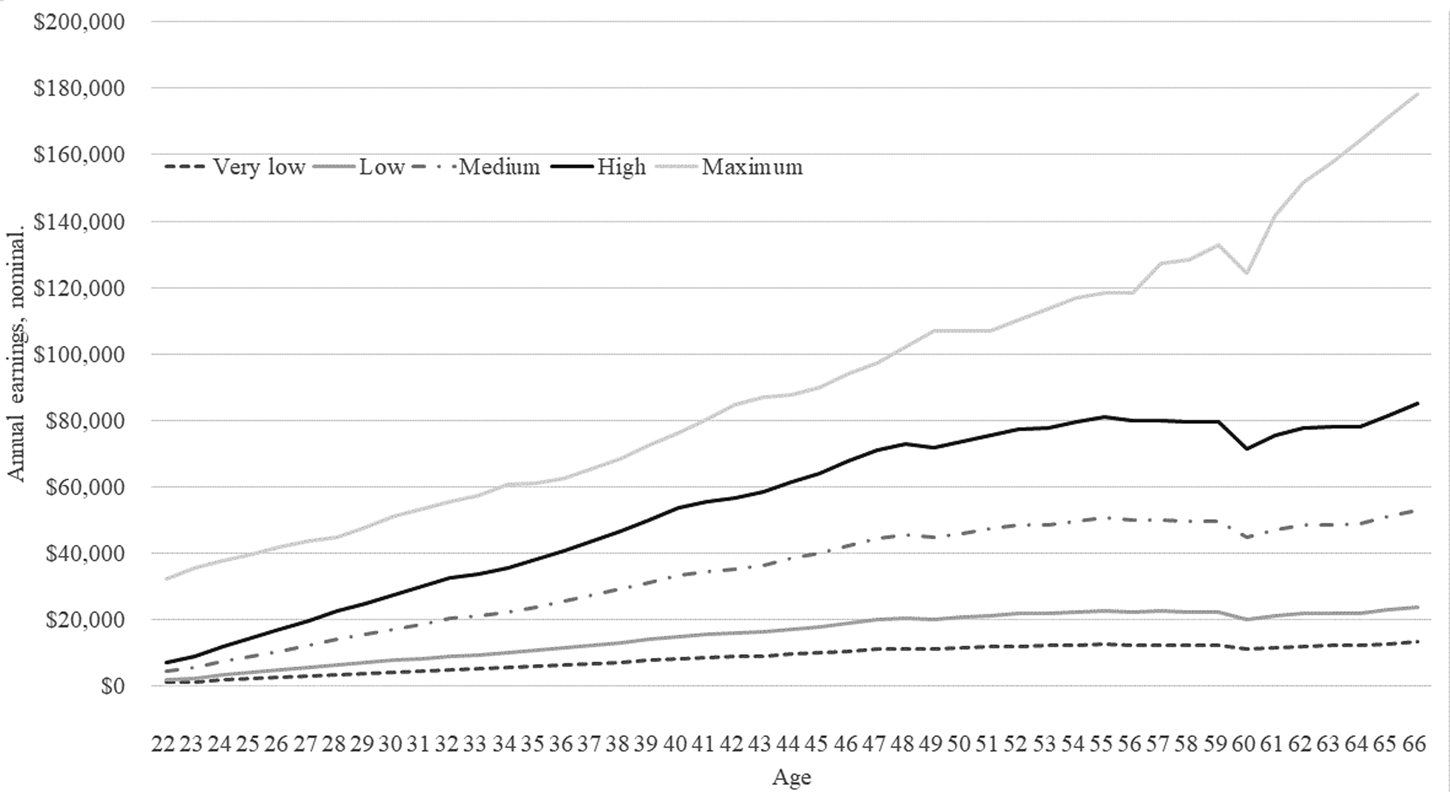
To illustrate the effects of a sudden decline in economywide wages on the Social Security benefits of near-retirees, I utilize a set of stylized earnings patterns generated by the SSA's Office of the Chief Actuary. These so-called ‘scaled earners’ are designed to represent typical lifecycle patterns of earnings and are established at different earnings levels. These earnings levels range from ‘very low,’ with typical annual earnings about one-quarter of the national average wage, to ‘medium,’ which earnings typically about the national average wage, to ‘maximum,’ where the individual is assumed to earn the maximum wage subject to Social Security payroll taxes in each year of their working career. (For details see Clingman and Burkhalter, Reference Clingman and Burkhalter2015.) Each scaled earner type earns a given percentage of the AWI at each age throughout their working career. For years in which the AWI is assumed to decline due to the Coronavirus, the scaled earners' earnings also would decline.
I illustrate using workers who were born in 1960, entered the workforce in 1982 and work continuously through age 66, retiring at the normal retirement age of 67 in 2026. These workers are currently age 60, the age at which the AWI is locked in for the purposes of indexing their prior earnings to the growth of national average wages. The nominal annual earnings for the scaled workers are shown in Figure 1, based upon the historical AWI and AWI projections contained in the 2019 Social Security Trustees Report.
Nominal earnings by age for SSA scaled earners, born 1960.
Source: Clingman and Burkhalter (Reference Clingman and Burkhalter2015) and author's calculations.

A decline in the AWI versus previously forecasted levels affects the benefit formula for Americans born in 1960 in two ways. First, a lower AWI for 2020 reduces the value of the 1960 cohort's AIME. In percentage terms, a shortfall in the AWI versus previously forecast levels does not reduce AIMEs on a one-for-one basis, because earnings after age 60 are included in the AIME calculation in nominal terms. However, the impact remains significant. All other things equal, a lower AIME results in lower Social Security benefits in retirement.
Second, lower growth of the AWI is also carried through to the Social Security bend points used to designate the dollar values of AIME that are replaced on a 90, 32 or 15% basis. I simulate these effects by starting with the bend point values for 2020, through which Social Security replaces 90% of the first $960 in AIME, 32% of AIME between $961 and $5,785, and 15% of AIME in excess of $5,785. I then adjust the bend point dollar values by the change in the model's AWI from 2019 through 2021. For the current law baseline, the model projects benefits similar to those published in the 2019 Social Security Trustees report, differing from the Report's published estimate for a medium wage worker by less than 1%.
For each scaled earner type I report the dollar value of annual benefits under the 2019 Trustees Report assumptions and under my own assumptions regarding declines in the AWI. I also report percentage changes in annual benefits and changes in lifetime benefits. I calculate changes in lifetime benefits assuming differential longevity by lifetime earnings level, such that a very low earner is assumed to survive for 13 years past retirement at age 67, a medium wage worker 18 years, and a maximum wage worker 23 years. These assumptions draw on the discussion in Biggs (Reference Biggs2019). I discount future benefits assuming a 0% real interest rate, which is approximately the yield currently available on Treasury Inflation Protected Securities.
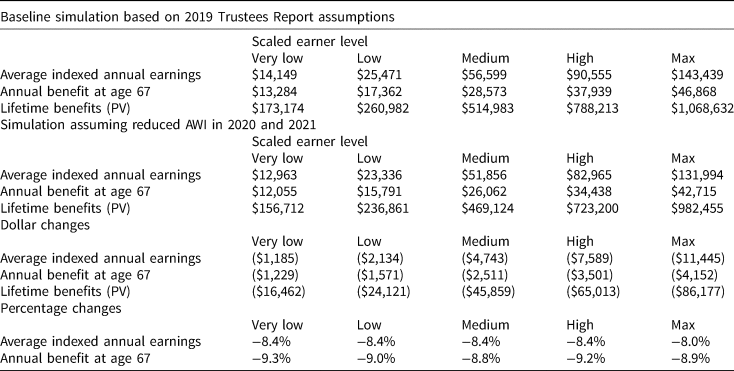
Compared to the baseline simulations using 2018 Trustees Report assumptions, the assumption of lower economywide average wages in 2020 through 2020 reduces the AIME of scaled earners from very low to high earnings by 8.4% and for maximum wage workers by 8.0%.Footnote 4 (Table 1) However, due to the progressivity of the Social Security benefit formula, the reduction in AIMEs is not carried through to lower benefits in a linear fashion. Annual retirement benefits would be reduced by 9.3% for a very low wage worker, 8.8% for a medium wage worker, and 8.0% for a maximum wage worker. In dollar terms, a medium wage worker's annual retirement benefits would decline by $2,511. Annual benefit losses for a very low wage worker would equal $1,229 while a maximum wage worker would lose $4,152 per year.
Simulation results based on 2019 Trustees Report and alternate assumptions for years 2020–2021

Source: Author's calculations from SSA figures and the author's assumptions.
I calculated changes in lifetime benefits assuming differential mortality by lifetime earnings levels, using the assumptions for the scaled earners drawn from Biggs (Reference Biggs2019). For context, the medium wage worker is assumed to survive for 18 years following retirement at age 67; the very low wage worker for 13 years, and the maximum wage worker for 23 years.Footnote 5 For a medium wage earner lifetime benefits are reduced by $45,859 with lifetime losses to a very low wage worker of $16,462 and to a maximum wage earner of $86,177 (Table 1). The value of dollar losses depends in part on assumed differential longevity by earnings level after claiming benefits. If uniform post-retirement mortality were assumed, the dollar value of benefit losses to lower-earning workers would increase and for higher-earning workers, those losses would decline.
Goss (Reference Goss2020) notes that the rebound in the AWI after the 2019–2020 decline would generate a small increase in benefits for Social Security participants who have earnings in the year 2020 and become eligible for benefits after the year 2022. The 2019–2020 decline in the AWI would likely cause an unusually high rate of AWI growth from 2020 to 2021. This growth would cause earnings occurring solely in the year 2020 to be wage-indexed to a higher level than otherwise would be the case, but earnings occurring in 2021 and beyond would be indexed at more or less pre-COVID levels. Overall, benefits for this group of Social Security participants with earnings in 2020 and becoming eligible in 2022 and beyond would rise by around 0.15%.
5. Effects on Social Security tax revenues
In addition to its role in the Social Security benefit formula, the AWI also is used to adjust the maximum annual salary that is subject to the Social Security payroll tax. Each January, the so-called payroll tax ceiling is adjusted by the nominal percentage change in the AWI between the second and third years prior. For instance, the adjustment to the payroll tax ceiling that took place in January 2020 was based upon the increase in the AWI between the years 2017 and 2018.Footnote 6
Under the Social Security Trustees (2019) assumptions for wages, the maximum taxable wage is projected to increase from $137,700 in 2020 to $149,935 in 2022. However, due to the decline in economywide wages in 2020, I project that the payroll tax ceiling in 2022 will in fact decline to $132,485. By 2023 the payroll tax ceiling will recover to $149,800, but this is still below the $156,629 value that would be projected consistently with the Trustees 2019 assumptions.
A decline in the relative value of the payroll tax ceiling has both immediate and longer-term effects since both taxes and benefits are calculated based upon wages up to the ceiling. In the near-term tax revenues would decline relative to a pre-COVID baseline. Social Security Administration (2019) data show that, in 2017, 5.8% of workers had earnings in excess of the maximum taxable wage.Footnote 7 The total number of covered workers in 2022 is projected to be 178.5 million. Assuming that 5.8% of that workforce would have had earnings above the baseline payroll tax ceiling, lost tax revenues due to the effect of a lower AWI on that payroll tax ceiling would equal approximately $22.4 billion in 2022. This amount is equal to $1.137 trillion, implying a 1.97% reduction in revenues for that year. Revenues would also be lower in 2023, though by a smaller amount as the AWI recovered toward baseline projected values.
In the longer term, Social Security's benefit obligations would decline because employees do not become entitled to benefits based upon earnings above the payroll tax ceiling. However, these earnings all take place in the lowest 15% replacement rate zone of the Social Security benefit formula. The present value of the reduction in future benefits earned is almost certainly well below the value of foregone tax revenues, implying that effects of the COVID-19 downturn on the Social Security payroll tax ceiling would negatively impact Social Security's funding health even over the long term. However, the total net effect on Social Security's financing inclusive of benefit reductions for current age-60 year olds, the decline in payroll tax revenues and the decline in future benefit obligations would demand full modeling of the Social Security program's finances to determine.
6. Policy options and discussion
A sharp discontinuity in benefits between two succeeding cohorts of Social Security participants creates what is referred to as a ‘notch.’ Due to policy changes in the 1970s to correct an error in the Social Security benefit formula, Americans born in 1917 received significantly lower benefits than similar participants born in 1916. Even though the correction to the Social Security benefit formula was necessary, this notch was perceived as unfair and for years affected cohorts lobbied (albeit without success) for increases in their benefits. Thus, it would not be surprising if members of the 1960 birth cohort similarly lobbied for redress. Elected officials may consider what, if any, policy changes might be necessary.
One option is to do nothing. Gelber et al. (Reference Gelber, Isen and Song2016) use Social Security administrative data to examine how the Social Security ‘notch’ of the early 1980s influenced the earnings of individuals in the 1917 birth cohort, which due to changes in Social Security benefit rules received lifetime benefits approximately $6,100 lower than individuals in the 1916 birth cohort. However, Gelber et al. find that members of the 1917 cohort made up for lower Social Security benefits by increasing their work and earnings in retirement, sufficient to offset roughly half the decline in Social Security benefits. However, these averages would not imply that certain beneficiaries, in particular, lifetime low earners with few sources of income outside of social security and potentially lower ability to increase their earnings, would not suffer significant reductions to their retirement income adequacy.
Should policymakers wish to address the potential benefit reduction for Social Security participants aged 60 in 2020, several options are available. One option would be an ad hoc benefit increase for members of that cohort, perhaps paid as a flat dollar amount in order to more fully offset the benefit loss for lower-wage participants than for higher earner. For instance, a flat benefit supplement of $100 per month would restore very low wage workers' benefits to approximate the amounts projected for that group in 2019 and would reduce the benefit cut for a medium wage worker by over half.
A second option would temporarily alter the Social Security benefit formula to reduce the effects of the decline in the AWI expected for 2020. One possible approach would base the 2020 AWI on earnings in only the first quarter of 2020 before Coronavirus-related job losses became large. The AWI was calculated based on first-quarter earnings data up through the year 1977, meaning that the use of such data would not be unprecedented. Social Security payroll tax receipts in February 2020 were about 5.4% above those of February 2019, indicating strong wage growth over that period.Footnote 8
Basing the 2020 AWI on first-quarter earnings data would still leave open benefit reductions for members of the 1961 birth cohort, who would turn age 60 in 2021. It remains likely that the AWI for 2021 will be substantially below the levels predicted for it in the 2019 Social Security Trustees Report. However, a temporary fix for the 1960 cohort would give policymakers an additional year to consider the necessity and form of other changes. Over time, wages will presumably return to baseline levels and Social Security benefits will be relatively unaffected by the Coronavirus economic downturn of 2020.
However, neither of the two options mentioned immediately above would address the decline in the Social Security payroll tax ceiling. A third option could at least ameliorate the effects of the COVID downturn on Americans currently age 60 while reducing the effects of a declining AWI on payroll tax revenues. Under this approach, any AWI-indexed values in the Social Security tax and benefit formulas could not be allowed to decline from 1 year to the next. In any year in which the AWI declined, all AWI-indexed values would remain unchanged from the prior year.Footnote 9 This approach is similar to that used for Social Security Cost of Living Adjustments (COLAs), where negative COLAs are not allowed under the law.Footnote 10 Instead, Social Security would pay a zero COLA for as many years as necessary until the Consumer Price Index rose above its prior high value.Footnote 11 Similarly, disallowing negative changes to AWI-indexed variables in the tax and benefit formula would reduce but not eliminate the effects of the COVID-19 economic downturn on Social Security benefits and tax revenues. Because the AWI is generally assumed to rise about 3.5% annually in nominal terms, a zero AWI increase would cause benefits for 60-year olds to decline by about 3% relative to otherwise expected values. Likewise, tax revenues would decline because the Social Security payroll tax ceiling would not rise as quickly as is otherwise expected. However, the benefit and revenue effects would be muted relative to current law which allows AWI-indexed values to decline.
A variation on the above approach would base the AWI used in the Social Security benefit formula on, for instance, a 3 year average of growth in the AWI as measured using the SSA's current approach. For context, there is no 3-year period since data begin in 1951 in which the AWI has declined. This variation would not make a decline in the adjusted AWI impossible, since the AWI could in theory decline 3 years running. However, this smoothing adjustment would reduce the probability of such a decline and the size of a decline contingent upon it occurring.
7. Conclusions
Social Security's benefit formula is in two places indexed for the growth of average wages, which can result in permanent benefit reductions for individuals nearing retirement if average wages decline significantly in those years. Due to the Coronavirus, Social Security's AWI is likely to fall in 2020, which could cause annual retirement benefits for individuals born in 1960 to be roughly 13% lower than had the economic conditions projected in the 2019 Social Security Trustees Report persisted. At the same time, a decline in the AWI will cause the maximum salary subject to Social Security payroll taxes to be lower, thereby reducing revenues to the program. I suggest several ways in which policymakers could enact changes to the Social Security benefit formula to counteract benefit reductions associated with the Coronavirus economic downturn.