1. INTRODUCTION
Until 2003, Japanese lawyers (bengoshi) were prohibited by law from entering full-time employment in governmental bodies. That year, in line with recommendations by the Justice System Reform Council (JSRC), the Lawyers Act was amended to permit lawyers to undertake such employment. The change has been dramatic. While hiring was slow initially, the pace picked up thereafter and, in recent years, there has been a steady increase in the number of lawyers employed on a full-time basis by governmental bodies, at both the national and local levels. This development has far-reaching implications for government and the legal profession alike. Incorporating information and insights from interviews with former government lawyers and other concerned parties, this article examines the rise in the hiring of government lawyers and its impact. The article considers factors that have contributed to the increase, examines the roles played by these lawyers, considers prospects for the future, and discusses implications for government, the legal profession, clients, and legal education and training. The article also seeks to identify a range of issues raised by these developments that warrant further in-depth research.
2. PRIOR PROHIBITION AND ITS ELIMINATION
In Japan, prior to the revision of the Lawyers Act in 2003, Article 30, section 1 of that Act in principle prohibited licensed lawyers (bengoshi) from entering employment for public bodies.Footnote 1 Pursuant to a list of exceptions, bengoshi were permitted to serve in specified cabinet-level positions, as members of the National Diet or local assemblies, and on government advisory committees and in other types of part-time positions for national and local governmental bodies; but they could not enter full-time employment in public bodies.
The prohibition on entering public employment dated from the first Lawyers Act of 1893. It was carried over when a revised Lawyers Act was enacted in 1933, and then again when the current (postwar) Lawyers Act was enacted in 1949. It appears to have been included in order to ensure the independence of the legal profession and to avoid governmental interference in lawyers’ conduct of their practice.Footnote 2 It also lay in accord with the Japanese bar’s traditional conception of itself as an external check on government, symbolized by the phrase zaiya hōsō (non-government, i.e. opposition, legal profession). In addition, that prohibition, as well as the limitations on employment as in-house lawyers at business enterprises, reflected the dominant litigation-centred conception of legal practice.Footnote 3
The prohibition on employment in public bodies reportedly accorded with the wishes of the government side, as well.Footnote 4 Indeed, a lawyer with whom I spoke, who had spent three years working for a municipal government, was convinced the prohibition had been contained in the Civil Servants Acts and not in the Lawyers Act. The National Civil Servants ActFootnote 5 and the Local Civil Servants ActFootnote 6 both require civil servants to devote themselves exclusively to the performance of their duties unless otherwise authorized by law, and also contain other limitations on activities. Moreover, prior to the enactment in 2000 of the Act regarding Special Exceptions for the Hiring and Salaries of Regular (Public) Employees on a Fixed Term Basis,Footnote 7 there evidently was no express statutory authorization for the hiring of lawyers as civil servants.Footnote 8 Yet neither the National nor Local Civil Servants Act expressly prohibited registered lawyers from serving as civil servants.
As a practical matter, until recently, the topic evidently never even attracted much attention. In the early 1960s, an advisory council, the Provisional Justice System Investigation Committee, investigated a broad range of matters relating to the justice system. Among the many recommendations contained in its final report, issued in 1964, the Investigation Committee suggested that lawyers should be encouraged to undertake employment in legislative and administrative bodies, with the observation that doing so would “further strengthen the legal profession’s social standing and ability.”Footnote 9 In reflections the following year, University of Tokyo Professor Emeritus Wagatsuma Sakae, who chaired the Investigation Committee, offered the following as his own vision for reforms:
Personally, I would like to see the number of [successful] candidates ... roughly doubled, resulting in about 1000 new entrants to the legal profession each year. If those new entrants could not all be absorbed as judges, prosecutors, and attorneys, they should enter posts handling legal matters as government officials or join legal departments in banks and companies.Footnote 10
Wagatsuma’s vision was not achieved. The number of bar examination passers hovered at about 500 per year until 1990, and did not reach 1,000 until 1999.Footnote 11 The roles of the legal profession did not expand in the manner he envisioned. Nor was the Investigation Committee’s recommendation that lawyers enter employment in legislative and administrative bodies adopted. In the words of Yukimura Toshiya, who, in January 1999, became one of the first lawyers to undertake full-time employment in a public body, “As recently as the late 1990s it was simply inconceivable for a lawyer to go over to the government side.”Footnote 12
Given that lawyers were prohibited from becoming civil servants, one might ask who represented national and local governments in civil and administrative litigation. As Stephen Green and Luke Nottage have explored in detail, at the national level, that representation has been conducted primarily by so-called shōmu kenji, typically either career prosecutors in the Ministry of Justice (MOJ) or career judges who have been seconded to the MOJ.Footnote 13 In addition, bengoshi in private practice on occasion have been appointed specially to handle litigation on behalf of the government, on a so-called tokunin dairi basis. Local governments typically have retained outside lawyers when needed for litigation.Footnote 14
In 1999, another advisory council, the JSRC, was established by special legislation and given a broad mandate “to clarify the role to be played by justice in Japanese society in the 21st century” and to investigate the entire justice system and identify needed reforms.Footnote 15 In its final report, issued in June 2001, the JSRC set forth its vision for an expanded role for the legal profession, in which “lawyers are expected to respond actively to social needs ... in every corner of society [including] public bodies ..., and to contribute to the sound operation of such entities under the philosophy of the rule of law.”Footnote 16 In line with that vision, the JSRC called for abolishing the restrictions on lawyers in assuming official posts and instead shifting to a reporting system.
In contrast to the controversy that surrounded the JSRC’s calls for a major expansion in the size of the legal profession,Footnote 17 the recommendation for abolishing the restrictions on entering employment in governmental bodies likely ranks as one of the least contentious of all the issues the JSRC considered. In a presentation and accompanying materials for the 28th session of the JSRC, in August 2000, the Japan Federation of Bar Associations (JFBA) itself recommended revising Article 30 of the Lawyers Act so as to facilitate lawyers entering employment in public bodies. With very little debate, at the following meeting, the JSRC reached general agreement on liberalizing those restrictions.
As alluded to above, without even waiting for the JSRC to complete its deliberations, in 2000, the Diet passed a law authorizing national public bodies to hire “persons possessing high professional knowledge and experience” as public servants on fixed-term appointments of up to five years. That law was accompanied by an amendment to the Lawyers Act, creating a new exception to cover these newly authorized fixed-term appointments. Shortly thereafter, at its 44th meeting on 23 January 2001, the JSRC briefly revisited the issue and, with all members in agreement, endorsed abolishing the prohibition and shifting to an after-the-fact reporting system. The JSRC included that proposal in its final recommendations.
While JFBA receptiveness to relaxing the restrictions might have stemmed in part from hopes for new avenues for employment of lawyers, this was not the motivation of the JSRC. In reflections shortly after the JSRC issued its recommendations, Takeshita Morio, vice chair of that council, flatly rejected the notion that the proposal had been included to provide more employment opportunities for the expanded legal profession. To the contrary, he stressed, the JSRC had recommended the reform because it felt lawyers would aid in ensuring compliance and oversight, in raising legal expertise, and in providing broad legal advice for administrative agencies and governmental bodies.Footnote 18
The Expert Consultation Committee on the Legal System, one of 11 follow-up committees charged with developing concrete policy proposals to effectuate the JSRC recommendations, also unanimously endorsed replacing the prior limitations with an after-the-fact reporting system. Article 30 of the Lawyers Act was amended along those lines in 2003.Footnote 19 In addition, in 2002, a law was enacted, paralleling the national act, authorizing local public bodies to hire “persons possessing high professional knowledge and experience” as public servants on fixed-term appointments of up to five years.Footnote 20 Thus, with broad consensus and virtually no opposition, a prohibition that had lasted for 110 years (albeit replete by the end with a long list of exceptions) was abolished.Footnote 21
3. POST-LIBERALIZATION DEVELOPMENTS
3.1 Employment Trends
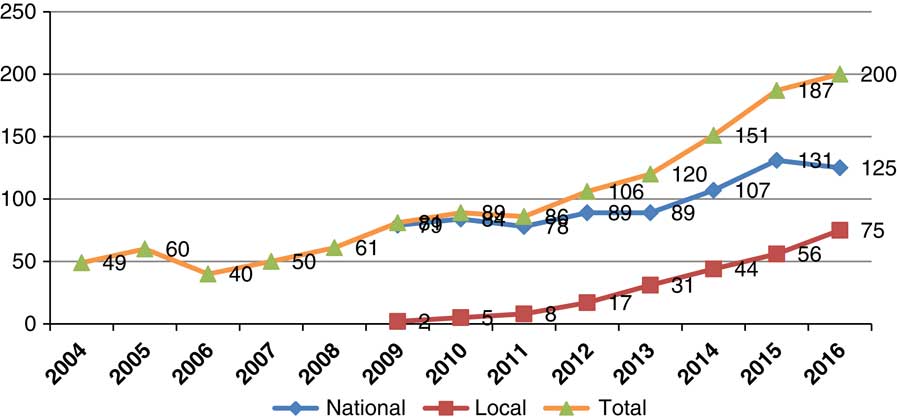
By the time the general prohibition was abolished, some governmental agencies already had begun regularly hiring a few lawyers on a fixed-term basis.Footnote 22 As shown in Figure 1, however, eliminating the prohibition did not result in a sudden surge in hiring. In fact, these figures, compiled by JFBA based on notifications filed by the lawyers with the bar associations to which they belong, show a decline in lawyers on fixed-term appointments in public bodies from 2005 to 2006. Over the decade since, however, the number has risen quite steadily, and the pace has picked up over the past five years.
Trends in the number of fixed-term kōmuin bengoshi Numbers compiled from data contained in various issues of the annual JFBA publication Bengoshi Hakusho ( White Paper on Lawyers). For years 2004 through 2009, data are from Nihon Bengoshi Rengōkai (2009), pp. 6–7. For years 2010 through 2016, data are from the respective White Papers for those years. For 2010 to 2015, links may be found at Nihon Bengoshi Rengōkai (2015c). For 2005, the numbers were compiled as of May; for 2006, as of December; and for years 2007 onward, as of 1 June of each year.

The rise in the number of lawyers employed at national government ministries and agencies, typically on fixed appointments of one to three years, has been steady but rather gradual. As of 2010, 84 lawyers were working in full-time positions for the national government, in a total of 12 ministries, agencies, and other bodies. That year, the Financial Services Agency (FSA) led the way with 19 lawyers, followed by the Japan Fair Trade Commission (JFTC) with ten, the Ministry of Economy, Trade and Industry (METI) with nine, and the Ministry of Foreign Affairs (MOFA), MOJ, and Ministry of Finance (MOF) with eight each.Footnote 23 In 2016, the overall number stood at 125 in a total of 16 ministries, agencies, and other bodies, led by the National Tax Agency (NTA) with 29 (up from just seven in 2010), followed by the METI with 18, FSA with 14, and MOF with 12.Footnote 24
In contrast, until recently, local governments lagged far behind the national government in terms of hiring lawyers. Not surprisingly, Tokyo was the first local government to hire bar-qualified persons, with two such appointments in 2004.Footnote 25 Yet the number of bengoshi working for local government bodies was so low that JFBA did not list that category separately until 2009, when there were still only two. Even including three who had passed the bar examination but had not yet registered as bengoshi and five more who had cancelled their bar registration, as of June 2011, only 22 persons who had qualified for the bar were employed on a full-time basis by local government bodies; and none worked in any of the three prefectures hardest hit by the March 2011 disaster (Fukushima, Miyagi, and Iwate).Footnote 26 By 2014, the number of registered lawyers in such positions nationwide had risen to 44, with nine in the disaster-stricken region. In 2015, the number rose to 56 and, by mid-2016, 75 registered lawyers were working in fixed-term positions in 62 local government bodies, with ten in the disaster zone.Footnote 27 Thus, while the overall number remains modest, the rate of increase has been dramatic, with nearly a tenfold increase between 2011 and 2016.
When one includes those who have qualified for the bar but not registered with a bar association, the increase at the local level is even more striking. Whereas 75 registered lawyers were working for 62 local government bodies as of June 2016, figures from October of that year show that 134 bar-qualified persons were working in a total of 98 local government bodies.Footnote 28 Even allowing for a modest increase in the hiring of registered lawyers during those four months, these figures show that well over a third of the bar-qualified persons working in local government bodies were not registered as lawyers.
These differences in the statistics warrant a brief explanation. A number of government bodies treat bar registration as optional, leaving it up to the employee to decide. The question of whether to maintain or suspend registration has been a matter of debate among the bar-qualified persons who enter government service.Footnote 29 Given the high annual dues for maintaining bar registration in Japan,Footnote 30 however, unless the employing government entity is willing to cover those dues, there is a significant financial incentive to suspend. Incidentally, this pattern does not appear to apply at the national government level. Figures from 2015 for registered lawyers and bar-qualified persons employed by national government bodies, while again from different months, are nearly the same.Footnote 31
A number of lawyers and bar-qualified persons have entered permanent positions at both the national and local levels,Footnote 32 and that cohort also seems likely to expand. Yet most of the lawyers and bar-qualified persons working in government positions have been hired on a fixed-term basis, typically for periods of one to three years. This means there is now a steady flow of lawyers in and out of government positions, with somewhat over 100 new lawyers being hired each year in recent years at the national government level alone. Extrapolating from the numbers in Figure 1, it seems safe to say that, on a cumulative basis, over 1,000 lawyers have now served in government bodies. By US standards, this figure may appear minuscule; as of May 2015, over 125,000 lawyers were working in local, state, and federal government bodies in the US.Footnote 33 In Japan, however, even though the number of lawyers has doubled over the past 15 years, as of March 2016, there were fewer than 38,000 lawyers in the entire nation of over 125 million.Footnote 34 A simple calculation suggests that over 2% of all Japanese lawyers already have served in government positions; and that percentage continues to rise steadily.
Notably, the concentration is far higher among the elite younger cohort of the bar. As of July 2017, over 20% of the junior partners (partners admitted to the bar in 2000 or later) and nearly 20% of the senior associates (associates admitted in 2009 or earlier) at the so-called “Big Five” Tokyo law firms had served or were currently serving in fixed-term appointments in government bodies—a total of 142 lawyers in just those categories. Of those 142, 14 had undertaken multiple postings in Japanese governmental bodies; and five also had served in international or foreign governmental bodies. In addition, nine others had served in Japanese governmental bodies before becoming lawyers.Footnote 35
One final category of government employment, also not reflected in Figure 1 or the above calculation, deserves special mention. As of December 2015, approximately 190 persons qualified for the bar (primarily young registered lawyers, along with some recent bar passers who had not yet registered) were serving as investigative staff members for the Nuclear Power-Related Damage Claim Resolution Centre. That centre (more commonly known as the Nuclear Dispute Alternative Dispute Resolution (ADR) Centre) was established in 2011, under the auspices of the Ministry of Education, Culture, Sports, Science and Technology (MEXT), to aid in resolving disputes arising out of the meltdown at the Fukushima Daiichi nuclear power plant that followed the massive earthquakes and tsunami that struck eastern Japan in March 2011.Footnote 36 By investigating the facts and assembling evidence and necessary documentation, the investigative staff members, who officially serve on a part-time basis but in reality work full time (and often more), assist the claimants and the mediators. While the work of the investigative staff members for the most part falls into the traditional lawyers’ role in dispute resolution, albeit in a highly specialized factual and procedural setting, it is historically unprecedented for a Japanese governmental body to have hired such a large number of lawyers and bar-qualified persons.
3.2 Reasons for the Rise
As a prelude to considering factors that have influenced this rise, it may be helpful to note some of the challenges that have faced employment of lawyers by government bodies. By far the greatest challenge lay in the complete absence of any such tradition. Even national government agencies had never employed lawyers on a full-time basis before, much less local government bodies; and most bodies at both the national and local level had little conception of how they might utilize lawyers and, at least initially, did not perceive any pressing need for their services.Footnote 37 To make matters worse, the traditional attitudes that did exist were not helpful. From the lawyer perspective, government often was viewed as the enemy,Footnote 38 and that feeling was mutual. As mentioned earlier, Takeshita Morio, vice chair of the JSRC, in discussing the benefits that would result from employment of lawyers by government bodies, highlighted the role those lawyers would play in ensuring compliance and adherence to the rule of law by those bodies. By the same token, as former government lawyers have told me, some government officials regarded the hiring of in-house lawyers as a threat, fearing the lawyers might take them to task for any procedural mistakes they may have made in the past. Thus, one key challenge lay on the demand side: convincing government bodies that lawyers could play a valuable role and persuading them that lawyers represent a potential resource and not a threat.
Lack of supply would not seem to have been such a major obstacle, at least at the national government level. Many national government agencies accept lawyers on fixed-term appointments of just one or two years.Footnote 39 For highly qualified young lawyers at large and medium-sized Tokyo firms who seek to specialize in such fields as financial services, anti-monopoly law, international trade, tax, or consumer affairs, the benefit of spending one to three years seconded to a major government agency, dealing with cutting-edge issues in the respective field, might seem obvious. That said, based on interviews with lawyers at large law firms, young associates do not necessarily recognize the value of secondment to government bodies, where the remuneration typically is lower than at the firm.Footnote 40 At least one firm reportedly routinely tops up remuneration, so as to induce associates to take such positions (with the topping up evidently coming after the associate returns to the firm, since providing additional compensation from outside sources during the term of the secondment would give rise to serious conflict of interest concerns). A lawyer from another major firm reported that topping up there occurs on a case-by-case basis, when deemed necessary to persuade an associate to undertake a secondment favoured by the firm. The lawyer added, however, that, in recent years, topping up has become rare at that firm, since by now most associates have come to appreciate the value the secondment will have for their future careers.
The situation for attracting lawyers is more challenging for local government bodies. Compensation levels for lawyers working at local government bodies tend to be somewhat lower than at national ministries or agencies; and, for those lawyers, there is little prospect for topping up by a law firm following completion of service. That said, while pay levels for lawyers in local government positions, reported as of 2013 (albeit based on a small sample size) to range from about JPY 5.5 million to 10 million per year, with pay of about JPY 8 million per year quite typical,Footnote 41 would represent a significant drop for lawyers at the prestigious large firms, the prospect of stable pay at that level likely would be attractive for many lawyers.Footnote 42 Indeed, in a panel discussion in 2012, lawyers working in local government bodies firmly expressed the view that the pay levels do not represent a barrier to hiring.Footnote 43
A more serious barrier than compensation levels, it appears, is the lack of a sense of how a local government position would fit into one’s overall career trajectory. Most local governments desire fixed terms of two or three years.Footnote 44 While “local government law” may someday develop as a specialized field in Japan, as it has in the US, that day, if it ever comes, lies in the future. So the long-term career benefit for lawyers of spending two to three years working for a local government body is not so readily apparent.Footnote 45 On the other hand, for local governments, especially those that had never hired lawyers before, there is little thought of hiring lawyers with no prior experience.Footnote 46 To the contrary, those bodies seek lawyers with a wide range of qualities, including understanding of local administrative matters, rich practical experience, ability to interact effectively with the general public, and ability to work well with others.Footnote 47 Thus, for local government bodies, serious challenges have existed on the supply side, as well.
Given these challenges, what accounts for the recent steady rise in hiring of lawyers by local government bodies? One tempting theory, at least with respect to the supply side, is a large increase in the number of lawyers in Japan over the past 15 years and (to channel a prominent school of thought within the bar) the “resulting glut” in the legal services market.Footnote 48 This may account for a willingness to consider government employment by some candidates who would have preferred to remain in private practice. Most governmental bodies, however, desire strong lawyers with at least a few years of practice experience; and governmental entities—which, after all, always have functioned without lawyers up until now—are unlikely to employ lawyers with weak qualifications simply because that’s all they can attract.
At the local government level, one important structural factor for the rise in lawyers is the recent expansion in the administrative authority of local bodies.Footnote 49 Ever since the passage of the so-called Blanket Decentralisation Act (Chihō Bunken Ikkatsu Hō),Footnote 50 which took effect in 2000, the stated philosophy in Japan has been that of local self-determination. For nearly a decade thereafter, though, the respective roles of the central and local governments remained unclear, and the reality was that most local government bodies continued to defer to decisions made at the central level. In late 2009, following a recommendation from an advisory council, the Cabinet issued an order making clear that local governments may adjust a broad range of national standards to meet local conditions and expanding local government authority to issue ordinances.Footnote 51 As a consequence, a lawyer versed in local administrative law explained in 2012:
Local government bodies have become the locus for undertaking and enacting policies based on local conditions. In doing so, those entities must interpret the relevant statutes, conduct a comprehensive examination through their autonomous legislative authority, and then effectuate the policies adopted. To do so, improvement in legal ability is essential. Furthermore, when disputes arise in the process of effectuating the policies, the local bodies must be prepared to defend the legitimacy of the policies. Local governments are becoming increasingly aware that they cannot deal with these matters only with existing staff members versed in administration, and need staff with legal expertise.Footnote 52
As other relevant structural factors, a discussion group on promoting the utilization of lawyers by local governments, organized under the auspices of the Legal Training System Consideration Council (Hōsō Yōsei Seido Kentō Kaigi), pointed to the increasing need to deal with information disclosure matters and an expansion in the availability of administrative litigation.Footnote 53
Certain special factors also may account for part of the recent rise. Thus, for example, a lawyer who had worked in one national agency told me that a flurry of retirements led to the need to hire a few lawyers on fixed-term appointments. As another special case, in the disaster-stricken region, the national government has provided funds to the prefectures and municipal governments for hiring additional staff needed to deal with recovery efforts, including lawyers.Footnote 54 Perhaps the most striking example of the impact of special factors comes from Akashi City in Hyogo Prefecture. As of 2015, that city, which has fewer than 300,000 residents, had seven lawyers, giving it the highest number of bengoshi of any local government body other than the vastly larger Tokyo and Osaka. It is no coincidence that Akashi’s mayor, Izumi Fusaho, is himself a lawyer.Footnote 55
What likely ranks as the most important reason for the increase in lawyers at the local government level is the assiduous efforts of JFBA and the increasing awareness those efforts have brought about.Footnote 56 As early as 2004, as part of a series on lawyers serving in “unique fields,” reflecting how “the rule of law was extending to every corner of society,” JFBA included articles on the experiences of ninkitsuki kōmuin (lawyers on fixed-term appointments in public service) in two issues of the Association’s newspaper, Nichibenren Shinbun.Footnote 57 The following year, 2005, JFBA included a “special topics” section on ninkitsuki kōmuin in its flagship journal Jiyū to Seigi (literally, Freedom and Justice), with an overview together with essays from five such lawyers. Notably, both the 2004 and 2005 publications included only lawyers who had worked in national government bodies.
In 2006, JFBA undertook the first of what would become a series of surveys regarding opportunities for soshikinai bengoshi (in-house lawyers).Footnote 58 That survey was distributed to 5,252 companies (3,795 domestic Japanese companies and 1,457 foreign-affiliated), 46 national government ministries and agencies, and 849 local government entities.Footnote 59 Questions included whether there were plans for hiring lawyers and reasons for not hiring. At that time, in terms of plans for hiring, national government agencies expressed the highest level of interest, with over 15% indicating plans to hire, followed by foreign-affiliated companies at 5.68%, and domestic Japanese companies at 4.69%. As of 2006, local government bodies lagged far behind; only 1.37% of the responding local government bodies planned to hire lawyers.
Ever since, JFBA has continued efforts to promote hiring of in-house lawyers. Over time, many of the efforts have become more focused on specific categories, notably including local government entities. In October 2011, Jiyū to Seigi devoted a special topics section to lawyers in local government. Even as of that point, though, the section started with the observation that, with the exception of Tokyo, one could easily count all the bar-qualified persons working in local government anywhere in Japan.Footnote 60
JFBA also has continued to conduct surveys, with some of the later surveys focusing specifically on opportunities and challenges for employment of lawyers by local government bodies. Of these, the most noteworthy are a broad survey of local government entities, including the welfare and education sections as well as the general affairs sections of those entities, covering a wide range of attitudes and actual practices regarding hiring of lawyers, conducted from late 2013 through early 2014,Footnote 61 together with a parallel survey, also conducted in late 2013 and early 2014, aimed at 81 lawyers who had worked or currently were working for local government entities (of whom 52 responded), along with the 47 entities for which they had worked (of which 37 responded).Footnote 62 In a striking shift from the 2006 results reported above, by 2013–14, of the 594 responses from general affairs sections, 5% indicated they had concrete plans to hire an in-house lawyer, another 5% were actively considering doing so, and fully 63% more reported they had interest in doing so.Footnote 63
JFBA activities have extended far beyond these publications and surveys. For the local government level, JFBA has undertaken extensive efforts to promote hiring of lawyers by local governments, focused on both the demand and supply sides. On the demand side, JFBA has undertaken outreach to local governments to educate and persuade them regarding the contributions lawyers can make. Those efforts have included organizing gatherings and special sessions aimed at representatives of local governments, as well as preparing pamphlets aimed at local government entities on the merits of hiring lawyers,Footnote 64 together with a Q&A pamphlet addressing various questions relating to the roles played by lawyers, the hiring process, and other matters.Footnote 65 On the supply side, JFBA has conducted numerous symposia and workshops for lawyers with potential interest,Footnote 66 has prepared glossy pamphlets promoting the positive aspects of service in local governments and addressing questions lawyers are likely to have,Footnote 67 and has assembled extensive information on related homepages at the JFBA website.
On both the demand and supply sides, JFBA has sought to address and ameliorate concerns it has identified through its activities. As one notable effort in this regard, JFBA has helped organize a network of law firms that offer to provide positions for lawyers as they transition from their existing positions into fixed-term positions in local government bodies, and as they transition back.Footnote 68 As a final note, JFBA provides a clearinghouse for information about openings and potential candidates,Footnote 69 and both JFBA and local bar associations often have served as intermediaries for connecting candidates with potential employers.
The efforts of one other organization bear note: the Japan In-House Lawyers Association (Nihon Soshikinai Bengoshi Kyōkai) (JILA). JILA, which was established in 2001, currently has over 1,300 members.Footnote 70 While the great majority of the members are either current or former in-house lawyers at companies, one section (Section No. 4) is focused on lawyers in government, including the national and local levels. That section has been active in organizing symposia and other events, and serves as a forum for sharing experiences and promoting knowledge about lawyers in public service.Footnote 71
4. ROLES OF GOVERNMENT LAWYERS
4.1 National Government Level
In October 2015, the MOJ compiled data on various aspects of the work of all 145 lawyers employed in full-time positions in national government bodies as of 1 August of that year (129 in fixed-term positions, 16 in permanent positions).Footnote 72 When classified by primary role, the single largest category, applying to 41 of the 145 lawyers, was “drafting legislation and conducting research on legislation.” When combined with “policy planning and policy drafting” (29), nearly half of the government lawyers were primarily engaged in legislative and policy matters. “Investigation of violations,” with 30 lawyers, was the second largest category (barely squeezing out “policy planning and policy drafting”). After those three, there was a significant drop-off to the next category, “international matters,” with 12. Notably, “handling litigation” constituted the primary role for only seven of the lawyers, followed by “research on the legal system” (six) and “conducting hearings” (four) (with the catchall “other” category accounting for the remaining 16).
A more detailed breakdown contained in the same report shows, not surprisingly, that a number of the lawyers are assigned multiple responsibilities.Footnote 73 That breakdown also reveals wide differences in roles, depending on the ministry or agency involved. At the JFTC, which handles anti-monopoly law matters, for example, all but one of the 19 lawyers handled investigations and hearings; the sole exception had been seconded to the Cabinet Secretariat. In contrast, of the 22 lawyers employed at the Consumer Agency, 15 were primarily involved in policy planning matters; and, at the MOFA, eight of the 11 lawyers were involved in treaty negotiations or economic co-operation matters. With 31 lawyers, the FSA had the highest number of lawyers that year. Within the FSA, the breakdown was rather balanced; 17 of the 31 primarily handled matters relating to legislation and policy planning and 13 primarily handled investigation-related matters. The METI, with 14 lawyers as of that time, explained that those lawyers were not assigned fixed responsibilities, but rather were asked to handle policy planning and other matters depending on what the most essential needs were of the various METI divisions at any given time. As a final note, of the seven lawyers who primarily handled litigation matters, four were at the MOJ (where they presumably handled civil litigation involving the Japanese government), two were at the Ministry of Health, Labour and Welfare, and one was at the Ministry of Internal Affairs and Communications.
4.2 Local Government Level
As reasons why local governments should wish to hire lawyers, the 2011 Jiyū to Seigi special feature highlighted the need for greater efficiency in handling a wide range of legal matters, and pointed especially to a rise in claims from citizens, including lawsuits, following the 2004 revision of the Administrative Case Litigation Act.Footnote 74 That reference was accompanied by the further observation that administrative law had become a mandatory subject at the then relatively new graduate-level law schools, which were established pursuant to recommendations of the JSRC, and on the bar exam.Footnote 75 Thus, at that time, JFBA seemed to envision the contribution lawyers could make in handling administrative litigation as the key selling point for local governments.
While lawyers working for local government bodies are far more likely to be involved in litigation matters than lawyers working for national government bodies, even at the local level, for most it is not the dominant role. Upon examining results from the 2013–14 survey of local government lawyers mentioned above, 56% had served as designated representatives for litigation and another 19% had been involved in litigation in some more limited capacity. Yet 25% had not been involved in handling litigation at all.Footnote 76
Even more striking is the broad range of other activities identified by the respondents. As the top two items, 81% had provided legal advice to other officials and staff members and 79% had conducted training for other officials and staff. The list of functions performed goes on and on: handling debt claims, 68%; reviewing administrative complaints, 60%; formulating compliance measures, 56%; dealing with prefectural/municipal assembly, 51%; reviewing rules and regulations, 47%; directly dealing with citizens, 47%; attending training sessions conducted by outside lawyers, 41%; dealing with election matters, 37%; and drafting ordinances and regulations, 22%.Footnote 77 Another survey of local government lawyers, also conducted in late 2013 and early 2014, by a study group on local government lawyers, found similar items as the four top-ranking activities (albeit with a much sharper drop-off thereafter).Footnote 78 Of 41 respondents, 37 reported that their activities included providing advice to other officials and staff, 22 each reported drafting or reviewing ordinances and conducting staff training, and 21 listed representation in litigation. Needless to say, given the above very long list of functions, lawyers in local government bodies have found themselves handling a wide range of matters.
These lists correspond fairly well with the expectations of the local governments that hired the lawyers. The companion JFBA 2013–14 survey, addressed to the local governments where the lawyers had worked, asked about the abilities and roles the local governments had expected when they hired the lawyers. The top item identified was “improving the legal ability of regular staff members,” followed by “raising awareness of and strengthening efforts for compliance” and “promoting and strengthening legal policy.”Footnote 79 As an interesting side-note, the same survey asked whether there were aspects in which the lawyers’ performance had either exceeded or not lived up to their expectations, with blanks for each. As for the former, aspects that had exceeded expectations, 12 of the 37 entities stated that “the level of legal consultations from other staff members was higher” than they expected, six said other staff members’ performance had become faster and more efficient than expected, and four pointed to improvement in other staff members’ specialized knowledge and practical ability. No respondent listed any aspect in which the lawyers’ performance had not lived up to expectations.Footnote 80
The great majority of local government entities that have hired lawyers to date only have a single lawyer, so the specific needs and requests of the local entity of course have a strong influence over what tasks take precedence. As the earlier long list of tasks reflects, however, legal expertise and experience are relevant for a wide range of tasks. The experiences of the lawyers who have served in local government show that, when there is only one lawyer, the entity often treats the lawyer as a generalist, an all-purpose resource for a broad range of law-related matters.
That said, in most cases to date, the local government entity has never hired a lawyer before or there has been at most one predecessor; and typically the entity has only a general conception of what tasks the lawyer should perform. Given those circumstances, one might expect that the lawyer’s own personal initiative is important in determining what roles she or he will take on. The personal narratives of government and former government lawyers, and my interviews and discussions with lawyers who have served in local government bodies, bear out the importance of personal initiative.
A prominent example of the impact of personal initiative comes from a lawyer who joined the national-level Cabinet Office in 2009, Okamoto Tadashi. Okamoto was one of a number of lawyers who were recruited to assist in administrative reform and deregulation efforts after the Democratic Party of Japan became the ruling party.Footnote 81 His activities took a sharp turn after the March 2011 disaster. He received permission from the Cabinet Office to head up the Emergency Headquarters of JFBA, in addition to his regular responsibilities; and he took the lead in assembling a database of the contents of free consultations being provided by lawyers for victims of the disaster. In turn, analysis of that data provided valuable information for formulating new laws and regulations, together with revised interpretations of existing laws and regulations.
In October 2011, Okamoto left the Cabinet Office. Two months later, he assumed another government-related position, heading up research staff for the Nuclear Dispute ADR Centre. Through his experiences, he became convinced of the importance of having lawyers serve in a broad range of government bodies. Shortly after he became head of the JFBA Emergency Headquarters, he observed that local governments throughout the disaster region were ill-prepared to meet the legal needs they faced and pushed JFBA to exert efforts to persuade the local governments to hire lawyers on a fixed-term basis. To his regret, he reports, the JFBA leadership at the time did not appreciate the importance of the issue. He himself remained so sure of the need for lawyers at the local government level, especially in the disaster area, that he reached out to influential lawyers and academics, and with their support he visited the offices of vice governors, vice mayors, and personnel offices in the region. In January 2013, evidently persuaded by those efforts, Iwate and Miyagi Prefectures hired the first kōmuin bengoshi in the disaster region. At that point, Okamoto observes, JFBA at last threw its weight behind the calls for local governments in the region to hire lawyers.Footnote 82
Okamoto has continued to be a strong advocate for the hiring of kōmuin bengoshi, at both the national and local government levels. He has been an active member of JILA’s section for government lawyers. Most notably, he organized and served as the supervising editor for a book published in the spring of 2016, Kōmuin Bengoshi no Subete (All About Kōmuin Bengoshi),Footnote 83 which contains essays from a total of 26 lawyers, 16 of whom have served in governmental bodies at the national level, eight at the local government level (including four from the disaster region), and two in non-governmental organizations (NGOs) (hospital and university). That book seems certain to serve as a valuable promotional tool on both the government-hiring side and the lawyer-recruiting side.
5. SELECTED OBSERVATIONS
As alluded to earlier, several surveys and studies have been conducted, by various entities, focused on specific categories or aspects of government lawyers. Of these, at the national level, the most significant include the study mentioned earlier, conducted in October 2015 by the Justice and Legal System Bureau of the MOJ Minister’s Secretariat, exploring the circumstances and work responsibilities of all 145 lawyers employed in national government bodies as of that time,Footnote 84 and another study conducted by the same MOJ Bureau the following year, exploring in more detail the circumstances of lawyers working in five bodies (the Cabinet Office; the MOFA; the Ministry of Health, Labour and Welfare; the METI; and the Ministry of Land, Infrastructure and Transport), with an especial focus on bodies involved in policy-making and international affairs.Footnote 85 The latter study, based on hearings with those responsible for hiring lawyers in those five government bodies and the lawyers working in those bodies, explored matters such as motivations, expectations, and evaluations on the hiring side, and expectations, evaluations, and barriers and challenges faced on the lawyer side. At the local government level, important studies include the broad survey of local government bodies conducted by JFBA in 2013–14Footnote 86 ; the parallel survey of local governments that had hired lawyers and the lawyers who were working or had worked at those government bodies, also conducted by JFBA in 2013–14Footnote 87 ; a survey, also aimed at local government bodies that had hired lawyers and the lawyers themselves, conducted in 2013–14 by a research team under the auspices of a grant from Japan Law FoundationFootnote 88 ; and findings, announced in January 2013, by the discussion group on promoting the utilization of lawyers by local governments, organized under the auspices of the Legal Training System Consideration Council, based on a series of hearings with local government bodies.Footnote 89 The following is a selected set of observations based on data from those surveys and studies, supplemented with information I have received from interviews with ten lawyers who have served in government bodies (to whom I have pledged anonymity) and discussions with various people involved in other aspects of the hiring of government lawyers, along with the essays contained in Kōmuin Bengoshi no Subete and special topics sections of Jiyū to Seigi, and other sources. I also have included a few references to the career patterns of the 142 senior associates and junior partners (as of July 2017) from the Big Five Tokyo law firms who have served or are currently serving in government bodies. While admittedly based on a highly selective, elite segment of the bar, those references help give a sense of the circumstances for one core group of government lawyers.
Lest the following comments provide a sense that government lawyers fit into any specific pattern, though, the single most important observation is that the surveys and other data and information show just how varied the backgrounds and experiences are. As Yukimura Toshiya (who, as mentioned earlier, was one of the first lawyers to undertake full-time employment in a public body) commented in the essay that leads off Kōmuin Bengoshi no Subete:
[Kōmuin bengoshi] bear many differences: male/female; national/local; central/regional; short term/long term; full-time/part-time; general staff/professional staff; etc. Some started their careers in law firms; others worked in companies or other positions. While we speak of them collectively as kōmuin bengoshi, the nature of their work also varies widely, including policy planning, preparation of laws and ordinances, dealing with the Diet and local legislative bodies, investigation and research, litigation and dispute resolution, preparation and review of documents, advice and explanation, and many other responsibilities.Footnote 90
5.1 Prior Experience
One of the lawyers with whom I spoke told me that anything less than three years’ prior experience in law practice would not be sufficient to undertake a position in a government body, but beyond five years lawyers typically have so many clients and responsibilities they cannot easily shift to new positions. At least at the national level, the data compiled by the MOJ in 2015 largely bear out this view. Of the 234 lawyers hired by national government bodies in 2014 and 2015 combined, 153 (over 65%) had between two and five years of prior experience as lawyers. Only 17 (7.3%) had fewer than two years of experienceFootnote 91 and only nine (under 4%) had practised for ten years or more. It is worth noting, though, that 43 (over 18%) had six to seven years of experience and 12 more had practised for eight or nine years.Footnote 92
To date, comprehensive data regarding experience levels for kōmuin bengoshi at the local level do not appear to have been reported. According to the 2013–14 JFBA survey, many local governments with interest in hiring lawyers expressed the desire for lawyers with at least five years of practice experience.Footnote 93 Yet, when it came to the minimum qualifications set out in the hiring announcements, of the 30 respondents that had issued such announcements, with the exception of one entity that sought a minimum of ten years, none called for more than three years (including 11 that set no minimum experience requirement at all).Footnote 94 Moreover, of the 29 entities that had completed a recruiting effort as of the time of the survey, only six received more than five applicants; 17 received only one.Footnote 95 These results suggest many local government bodies are not able to demand as much prior experience as they would like.
As Yukimura noted, some kōmuin bengoshi also have non-legal work experience. This should not come as a surprise. A recent study, based on a survey of over 1,900 lawyers, found that nearly 40% had prior work experience before becoming lawyers (although the rate was much lower for those still in their 20s, at just 1.8%, and considerably lower for those in their 30s, at 27%).Footnote 96 As anecdotal evidence, of the ten government lawyers I have interviewed, one had prior non-law work experience, as did the authors of four of the 26 essays contained in Kōmuin Bengoshi no Subete and 12 of the 142 lawyers from the Big Five Tokyo firms. In nearly all of those cases, the lawyers assumed positions in government bodies that matched their prior experience. One might think the prior experience would further enrich their perspectives and enhance their contributions to the government body. The data compiled by MOJ do not include information on non-legal work experience, however, nor at the present time is there any other comprehensive source of information on such experience. This thus represents one of the many aspects as to which further research is warranted.
5.2 Gender
Of the 200 lawyers working in fixed-term positions in government as of June 2016, 55 (27.5%) were women; and the percentages were nearly equal at the national level (34 of 125, 27.2%) and the local level (21 of 75, 28%).Footnote 97 To some readers, these percentages may not seem so high. Yet they substantially exceed the percentage of women lawyers in the bar as a whole, which, as of March 2016, stood at 18.3%.Footnote 98 While that figure includes earlier cohorts, when the percentage of women entering the legal profession was much lower than it is today, the proportion of women lawyers has not been rising greatly in recent years. The percentage of women newly entering the bar reached a peak of 26.2% in 2011, but subsequently has dropped, standing at only 21.2% for those entering in late 2015.Footnote 99 Thus, the percentage of women among government lawyers is higher than the level for recent cohorts of the bar, as well as the overall level.
Notably, the proportion of women among lawyers working in-house in corporations is even higher than for those in government bodies, standing at over 40% as of December 2016.Footnote 100 Surveys have consistently found that work-life balance is one of the key factors in the decision to become a company in-house lawyer.Footnote 101 Similarly, according to the survey of national government lawyers conducted by the MOJ in 2016, many of the respondents pointed to an improvement in “work-life balance” as one of the benefits of working for the government bodies.Footnote 102 In line with these results, a much broader survey conducted by the National Personnel Authority, released in September 2016, found that, among national public servants entitled to take childcare leave in 2015, 100% of the women and 9.5% of the men did so.Footnote 103
Especially striking in connection with gender is the essay in Kōmuin Bengoshi no Subete of Sakamoto Yukari, who worked in the FSA from 2012 to 2014. As a key reason for her decision to join the FSA, she pointed to the ability to co-ordinate work and child rearing. As she noted, many tasks at the FSA and other governmental ministries involve long hours and late nights; but, by the time she joined the FSA, it already had systems in place for co-ordinating work with childcare and other family responsibilities and willingly accommodated her situation. Moreover, she emphasized, the FSA did so not by assigning her and other women to routine work or work with light responsibilities, but by providing rewarding work with heavy responsibility, together with flexibility as to exactly where and when the work is performed.Footnote 104
Her account, and the survey results on work-life balance, may say as much about working conditions at large law firms as they do about conditions in governmental bodies. One lawyer I interviewed told me that, at the large law firm where he works, the stated norm for associates is 200 billable hours per month. When I said that did not seem unusually high to me, he added that many associates routinely work more than 300 billable hours per month, and at times reach 425 billable hours or more. Interviewees from other large firms have reported similar working hours at their firms. As a reflection of those circumstances, another interviewee, who had spent time in both a government agency and a company legal department, captured Sakamoto’s sentiment even more succinctly, saying simply, “If I had not been seconded, I could not have gotten married.”
5.3 Motivations
It should come as little surprise that, from interviews and the personal reflections contained in the various essays, for most of those who have entered positions in the central government ministries and agencies, a major motivation is the opportunity to develop further knowledge and expertise in the fields in which they wished to specialize. Most such lawyers return to their firms and utilize that knowledge and experience in their legal practice. In the case of one “repeater” whom I interviewed, though, the specialized knowledge and expertise he developed through his first position in government later proved to be of great importance to another ministry, which was exploring a similar approach to regulation in its field, so he undertook a second government position there. According to the 2016 MOJ survey, other motivations for lawyers entering national government bodies include broadening their scope of knowledge and expertise and building networks.Footnote 105
For those who have entered local government positions outside the disaster-stricken region, the motivations most frequently mentioned are experiencing new challenges and broadening their horizons. (In one essay included in Kōmuin Bengoshi no Subete, the author characterized his primary initial motivation as the desire “to know the enemy.”Footnote 106 From his essay, it is clear he did not view the government where he works as the enemy for long.) In interviews and discussions I have had with lawyers who have worked in the disaster region, as well as essays by such lawyers, the desire to contribute to the recovery has been a major motivation. In some cases, but by no means all, those lawyers have personal or family ties to the region.
In connection with motivations, an intriguing thread is the relationship with study-abroad opportunities. As far back as 2005, the author of one of the essays contained in the first special topics section on government lawyers to appear in Jiyū to Seigi highlighted this theme. The author wrote that he was planning to go abroad for study, but felt he needed to develop a better understanding of Japan’s business and economy first, so he decided to take a fixed-term position in the FSA.Footnote 107 More recently, nine of the 26 essays in Kōmuin Bengoshi no Subete draw connections between their experiences in government service and study abroad. Two mention their earlier experiences studying abroad as factors in their decisions to pursue government positions. Three more contain reflections about experiences studying abroad, after the authors had worked in government positions. Strikingly, though, four—two each for national and local bodies—report that they considered going abroad for study, just like other lawyers in their cohort, but instead chose fixed-term positions in government as an alternative means of broadening their horizons.
Of the essays by those who did study abroad, especially noteworthy is that of Kanayama Aiko.Footnote 108 After practising law for five years, in 2010, she decided to pursue a position in the Ministry of Land, Infrastructure and Transport. That ministry had never hired a lawyer before and was not seeking to hire one at that time, either. So Kanayama took and passed the ministry’s standard exam and was hired as a full-time permanent official. (Just six years later, she observed with a touch of irony, the ministry now employs nearly ten lawyers.) In 2013–14, she took a leave of absence and studied at the University of California, Berkeley, School of Law. Based in part on her experiences in a UC Berkeley seminar on “legislative advocacy,” her essay is framed as a plea for the development of a tradition of legislative advocacy in Japan, as well, in which lawyers in private practice, and not just those serving in government bodies, will play an active role in the policy formation process. She coupled that with a plea for education at Japanese law schools that will prepare lawyers for that role.
At the elite large law firms, it is common for mid-level associates to undertake study-abroad programmes. Thus, it is not surprising to find that just over half of the 142 government lawyers from the Big Five Tokyo firms also have studied abroad, with the numbers split just about equally between those who studied abroad prior to government service (36) and those who did so afterward (37). The ramifications of these patterns represent another topic worthy of further exploration. One might consider, for example, whether the lawyers who studied abroad before entering government service utilized learning from their study abroad (which increasingly includes business schools and programmes in nations other than the US and England) in their government posts, and how the government work affected the study-abroad experiences for those who went later.
5.4 Work
Having already examined the roles played by government lawyers in detail in Section 4, this section will simply highlight three aspects of the work they perform: investigation and enforcement activities; litigation; and policy-making/law reform.
At the national level, many of the lawyers have been involved heavily in investigation and enforcement activities. Indeed, as one of the strengths that lawyers bring to their work, many of the interviews and essays point to lawyers’ expertise in gathering and evaluating information and evidence. Furthermore, several essays note heightened attention to matters such as bank monitoring, regulation of insider trading, financial regulation, anti-monopoly law enforcement, and tax investigations as reasons for increased hiring of lawyers and other professionals. Thus, for many of those in such bodies as the MOF, FSA, JFTC, NTA, and the Nuclear ADR Centre, much or at least part of their work includes investigation and enforcement activities. Moreover, for most of the lawyers at local governments, part of the work involves responding to and investigating complaints.
In terms of actual litigation, however, for many government lawyers, involvement has been rather limited. At the national government level, litigation continues to be handled largely by shōmu kenji. Thus, the 2015 MOJ study of the 145 lawyers employed on a full-time basis by national government found that only seven were primarily involved in litigation, of whom four were at MOJ. At the local government level, involvement in litigation is more common; the 2013–14 survey of local government lawyers found that over half had served as representatives in litigation and three-quarters had played at least some role in litigation. In the case of the Tokyo metropolitan government (covering a region with over 13 million people), some 250 lawsuits arise each year, with over 100 each for administrative cases and civil cases, so lawyers there have considerable involvement in litigation matters.Footnote 109 Even at the local government level, though, for most of the lawyers, litigation is only a relatively small part of a broad range of activities.
One other notable exception to the limited role of government lawyers in litigation is Akashi City. There, as mentioned earlier, the city has hired seven lawyers and Izumi, the mayor who himself is a lawyer, has declared that the in-house lawyers will handle all city-related litigation matters themselves, without utilizing outside lawyers.Footnote 110 Akashi City also has established broad systems for providing legal consultations and advice for residents.Footnote 111
As a final noteworthy work-related aspect, the survey results, interviews, and essays show that a substantial majority of the government lawyers, at both the national and local levels, have been involved in policy planning; and over a third have played active roles in law reform and legislative drafting.
5.5 Recruiting, Hiring, and the Stance of Law Firms
The manner in which government bodies recruit and hire lawyers for the fixed-term positions, and the role of personal connections and other factors in that process, represents another topic worthy of further in-depth investigation. Many nationalFootnote 112 and localFootnote 113 government bodies post formal job announcements with specified application procedures. Yet many positions (evidently including a fair number of the positions that are formally postedFootnote 114 ) are filled through personal contacts and recommendations. In this connection, in a section examining how government lawyers in national bodies learned of the positions, the 2016 MOJ study reported, “While some said they learned through the Home pages of the government agencies or explanatory meetings organized by JFBA, most said they heard from their supervisors or other more senior lawyers or from friends.”Footnote 115 Interviews with lawyers at both large and smaller firms reveal that many fixed-term positions at national government bodies are filled through introductions and recommendations of associates by partners in their own firms who specialize in the respective field. (Increasingly, those partners themselves previously have held fixed-term positions in the same government bodies.) Indeed, it is evident that, at some ministries and agencies, there are now, in effect, designated slots for associates from certain firms, with the firm expected to nominate appropriate replacements when the previous term comes to an end.
Why, one might ask, would law firms part with some of their best associates for periods of one to three years? The obvious answer, as one interviewee frankly stated, is that “it’s good for business.” He went on to explain that the practice is important both for retaining existing clients and attracting new clients. Clients and potential clients are greatly impressed, he noted, when associates return from positions in which they have been involved in making policy and undertaking cutting-edge law-reform activities, especially if the laws and policies in question relate to business matters of concern to the clients. Clients naturally are eager to obtain up-to-the-minute information about the latest developments and interpretations (as to which, he observed, associates who have just returned often are more knowledgeable than the partners in that same field). For a somewhat different complex of reasons, he added, clients also place great value on associates who have handled investigation and enforcement matters for government bodies. “If the applicable standards are clear,” he commented, “the clients can learn about them on their own and won’t feel a need to consult with lawyers at all. But when clients feel they can find out matters that are not readily available publicly, such as internal priorities and the current mindset of regulators, they’ll willingly retain our services.”
At the local government level, it seems that jobs often are filled through formal job announcements and the resulting application process. Yet, at that level as well, introductions by lawyers also play an important role.Footnote 116 In some cases, the introductions come from a partner in the same firmFootnote 117 ; in others, the introduction comes from contacts through the local bar association or lawyers at other firms.
5.6 Impact on Subsequent Careers
For the lawyers who have worked in central government ministries and agencies, the career connection is clear. In the 2016 MOJ survey of national government lawyers,Footnote 118 one of the topics was what impact the lawyers expected their work to have for their future careers. The first item listed in the report was “developing cutting-edge knowledge in the fields they handle.” Other advantages for future careers highlighted by the lawyers included enhanced ability to assemble relevant information and engage in negotiations with government officials, based on their understanding of administrative procedures and the assessment process; heightened ability to handle compliance and other company law matters, resulting from the experience of learning to co-ordinate with others within a large-scale organization; and appreciation for the importance of taking into account a wide range of views and perspectives.
These expectations closely accord with the accounts from former government lawyers in the interviews and essays. The lawyers who have returned to law firms following stints in national government bodies all report that their practice includes specialization in the fields in which they worked; and many have written books and articles in those fields. Thus, their work for the governmental bodies has translated directly into strengthening their areas of specialization.
To me, a product of US law school education, one of the most striking aspects of the merits identified by the lawyers in response to the 2016 MOJ study was the second item on the list:
While lawyers pride themselves on their understanding of the existing legal standards, they typically are unconcerned with the process by which laws are made. By learning about the process by which laws are established and policies are made through their work in government bodies, the lawyers expect this will improve their ability to interpret laws and provide advice and guidance to clients.Footnote 119
This assessment by lawyers who were currently serving in national government positions—typically among the most elite members of their cohorts—serves as a telling reminder that Japanese legal education and training continue to stress mastering “what the law is,” while ignoring or downplaying legislative considerations and the policy-making process.
For the lawyers who have served in local governments, the reported benefits are more diffuse, including the opportunity to participate in the policy-making process, the opportunity to handle a broad range of issues and responsibilities, and the wide web of interpersonal connections with many different types of people.Footnote 120 In short, they point to “broadening horizons” as a key benefit of the experience. At least in the medium to long term, however, some foresee the likelihood of the development of local government law as a niche specialty.Footnote 121 Among those who were the first lawyer hired by the respective government body, some also point to the challenge and excitement of being able to carve out paths for themselves.
6. IMPLICATIONS
6.1 Likely Future Trends in Hiring
One of the lawyers with whom I spoke expressed concern regarding whether local governments in the disaster region would continue to employ lawyers after the national government stops providing funding for that purpose. Another lawyer, who had worked in the same prefecture, assured me that concern is needless. After local governments have seen the contributions lawyers make, he stated confidently, they would be sure to find funds to hire a replacement when the term ended, even if the national government no longer covered the cost.Footnote 122
Whatever the situation may be in a specific city or region, the overall trend clearly coincides with the latter, optimistic view. At the national level, ministries and agencies that started with just one or two lawyers—or none at all—now are hiring several or more each year, including, in some cases, newly admitted lawyers; and the trend is steadily upward. At the local government level, the number of lawyers has risen by more than 25% every year since 2009. That said, as of October 2016, only 12 prefectures and 86 other local government units employed bar-qualified persons, and most of those have hired only a single such person. With a total of 47 prefectures, nearly 800 registered cities (each with a minimum of 50,000 residents), and many other local government units, there is still great room for many more hires.
6.2 Shifts in Attitudes
The ultimate impact of these trends remains to be seen, but one already can point to several important implications. First and foremost is a major shift in attitudes.
For over a century, the bar regarded itself as a counterweight (zaiya hōsō) to the other two “branches” of the legal profession—the judges and prosecutors (collectively, zaichō hōsō)—and to bureaucrats and the government as a whole. By one account, this “us versus them” mentality became even stronger in the 1960s and 1970s, when many students who had been involved in the protest movement, no matter how outstanding they were, could not obtain jobs in companies or enter the bureaucracy, and instead turned to the legal profession, which was open to anyone who could pass the bar examination.Footnote 123
According to Article 1, section 1 of the Lawyers Act, “An attorney is entrusted with the mission of protecting fundamental human rights and achieving social justice.”Footnote 124 Although the following section adds, “In keeping with [this] mission, an attorney shall ... endeavor to maintain the social order and to improve the legal system,”Footnote 125 many lawyers have viewed their fundamental mission as to protect the weak and to fight against government. Of course, this attitude did not extend to all lawyers, even in earlier years, with so-called business lawyers representing a prominent example of a segment of the bar that was less ideological.Footnote 126 Yet, on the whole, as recently as the late 1990s and into the twenty-first century, there was a widespread, seemingly almost instinctive view among lawyers that government was “the enemy.”Footnote 127 To a large extent, the feeling was mutual. Government officials traditionally had viewed lawyers as critics and gadflies, and as people who brought lawsuits against them.
It would be an overstatement to suggest these attitudes have disappeared. For the older generation of lawyers, it seems inevitable that much of the traditional mindset persists. And, at least in some regions, the attitudes remain deeply rooted.Footnote 128 Indeed, the committee on justice reform at one prominent regional bar association, the Sapporo Bar Association, issued a statement in 2009 decrying the increase in the size of the legal profession, based on the rationale that the increase is leading to more competition, thereby “turning the profession into a business, spurring a rise in lawyers who place priority on pursuing their own self-interest, and greatly weakening the legal profession’s mission of protecting human rights and achieving social justice.”Footnote 129 Other sections of the statement make clear that, in the Sapporo Bar Association committee’s conception of that mission, the lawyer’s key role is “to serve as a bulwark against the exercise of state authority.”Footnote 130 Moreover, some lawyers who have served in government bodies concede there are those in the bar who feel it is inconsistent with their mission of achieving social justice to “lend a hand to those in authority.”Footnote 131 On the government side, as well, even in recent years, observers have pointed to “feelings of distance”Footnote 132 and “anxiety about bringing lawyers into the organisation”Footnote 133 as barriers to the hiring of lawyers.
To assess changes in attitude and the degree of such changes confidently, comprehensive surveys of both lawyers and government officials would be needed, ideally with further breakdowns by age, location, and type of practice or government agency. Even with such a study, one would face the issue of the lack of a comparable baseline study from the pre-liberalization period. Yet one can point to numerous indicia of a major change in attitudes, on both sides.
An initial piece of evidence in this regard is simply the steady rise in the numbers of government lawyers, at both the national and local levels, coupled with a steady expansion in the number and range of government bodies that hire lawyers and, typically, an upward trend in the numbers hired by each such body. Given the fact that most lawyers have been hired on fixed-term appointments of one to three years, the consequent result has been a steady rise in the number and proportion of lawyers who have experienced work in government bodies. To be sure, a considerable percentage of these lawyers fall into the business lawyer category, which traditionally did not have a strong adversarial relationship vis-à-vis the government. That said, with the rise in large law firms, in-house lawyers in corporations, and business-oriented lawyers in medium-sized and smaller firms, that segment of the bar has become far larger than in the past. Moreover, much as the Sapporo Bar Association decried the rise in the size of the legal profession, the phenomenon it identified—the increase in younger lawyers who do not necessarily share the ideological fervour of earlier generations—points to a less adversarial attitude toward government.
Turning to more concrete manifestations of the change in attitudes, in 2005, in the lead article for the first special feature on government lawyers to appear in Jiyū to Seigi, Suzuki Yoshikazu (who was then vice secretary-general of JFBA) highlighted the bar’s mission as set out in the Lawyers Act—namely, to protect fundamental human rights, achieve social justice, and endeavour to maintain the social order and to improve the legal system. Rather than treating this reference as an indictment of the rise in government lawyers, though, he proceeded to express the view that lawyers should meet this mission “by undertaking a broad range of activities in various fields of society,” including serving as government lawyers.Footnote 134 Along the same lines, lawyers who have served in government bodies proudly have stated their conviction that, through their work, they have been performing the bar’s mission of protecting human rights and achieving social justice.Footnote 135 In the words of one lawyer who worked at the local level:
As one responsible for achieving social justice, on the one hand I serve a protective role, by inculcating the spirit of administration according to law and by preventing the infringement of rights through errors in administration, and on the other hand, I play a more proactive role by seeking to improve people’s welfare by promoting policies, through interpretation and legislation, that meet local conditions.
He then added, “While lawyers who recognise the significance of these roles are still in the minority, I believe those who do so are steadily increasing in number.”Footnote 136
A final set of evidence of the change in attitudes lies in the stance of JFBA. As discussed earlier, for nearly 15 years, JFBA has promoted the hiring of government lawyers, through a very broad range of activities. Recently, JFBA has undertaken a campaign to promote the popularity of the legal profession as a career (necessitated in part because the bar was so successful a few years ago in spreading the image of bleak prospects for lawyers, in its effort to stem the rise in the size of the legal profession).Footnote 137 In a striking reflection of the shift in attitudes, in the recent campaign, JFBA has begun promoting the opportunity to serve in government as one of the attractions of a career as a lawyer.Footnote 138
Needless to say, the Japanese bar by no means has become a trustworthy partner or passive observer of government. To the contrary, the bar as a whole, not to mention many teams of lawyers and individual lawyers, remains a fierce critic of many government initiatives and actions. Yet the seemingly instinctive reaction among lawyers that government is always the enemy, and the converse reaction on the government side, has undergone a significant shift over the past 15 years. That shift alone seems likely to hold broad implications for future relations.
6.3 Implications for Governmental Bodies
Turning to implications for the governmental bodies, an important development relates to heightened investigation and enforcement activities. In Authority without Power Footnote 139 and other works, John O. Haley has set forth a strong argument that Japanese government agencies have been placed in the position of having to negotiate with regulated parties, in part because of the lack of sufficient tools and resources for effective enforcement. The recent increases in hiring of lawyers for investigation and enforcement efforts have been coupled with strengthening of various monitoring and enforcement tools, such as raising penalties for anti-monopoly law violations while offering more lenient treatment for businesses that co-operate.Footnote 140 Taken together, these developments may signal an important shift toward “authority with power” for governmental agencies.
A second observation, with implications at both the local and national levels, concerns the value of the legal knowledge and expertise the government lawyers provide. Many Japanese bureaucrats are graduates of undergraduate law faculties, and in that sense they have received basic training in law. Apart from judges and officials in the MOJ, however, to date, few bureaucrats have undertaken advanced professional training in law. While bureaucrats typically rotate through various divisions in their respective ministries or agencies during the course of their careers, they typically do not focus heavily on legal issues. Given these circumstances, one set of strengths for some government lawyers lies in their knowledge and expertise in specialized fields. The traditional rotation system for career bureaucrats is well geared to developing generalists, but not legal specialists. Thus, by hiring lawyers who already have developed expertise in a given field, government bodies can improve their capacity for dealing with specialized matters involving the application of law.
The 2016 MOJ study of national government lawyers bears out the importance of this role.Footnote 141 Those responsible for hiring the lawyers reported an increase in matters at both the international and domestic levels requiring specialized legal knowledge, leading to a need for professionals who can step in and immediately handle such matters. Among others, those officials pointed to such fields as financial law, mergers and acquisitions, intellectual property, international trade, and treaty negotiations as areas in which specialized expertise is needed.
In my interviews, several lawyers who have served in policy-related positions at the national level pointed to a related matter as a key reason the government bodies value the services of kōmuin bengoshi: their understanding of business realities. Career bureaucrats are well versed in administrative matters, but typically have limited knowledge regarding the impact of policies in actual practice. For this reason, the agencies welcome the perspectives and insights of lawyers who are familiar with such matters.
Another set of strengths of some government lawyers is their in-depth knowledge of a wide range of legal fields and their ability to view issues from a broad perspective, taking into account implications from other fields of law. According to one lawyer who has worked in a national ministry, even in the areas of policy-making and legislative reform, lawyers on fixed-term appointments sometimes out-perform career bureaucrats through this ability to place issues into a broader legal context.
Needless to say, government lawyers do not all possess the same level of ability and expertise. A former government lawyer who had worked in an agency that employed lawyers of differing experience levels highlighted this point. Looking back, he observed that lawyers who had several prior years of practice experience specializing in the relevant field typically adapted to the agency setting quickly and were able to play a significant role in policy discussions and enforcement activities. On the other hand, he told me, newly admitted lawyers and those with only one or two years of prior experience often ended up spending a considerable period of time learning about the field and their responsibilities.
Moreover, while government lawyers on fixed-term appointments have distinct strengths, it goes without saying that career bureaucrats possess other sets of qualities. Through their rotations, career bureaucrats are able to develop a comprehensive understanding of the broad range of factors affecting the fields their respective ministries or agencies handle, including economic, social, and political factors, as well as legal factors. In contrast, while government lawyers may be able to place specific legal issues into a broader legal context, they often lack a comprehensive understanding of the vast range of non-legal factors that come into play.
In this general connection, a person who had headed another agency that employs several lawyers raised even more basic issues. While strongly praising the lawyers for their ability to handle legal matters, the former agency head voiced the concern that, perhaps in part because of their training, they tend to regard matters in a rather narrow legal sense, at times without giving sufficient consideration to other factors, and also reported that the lawyers often tend to lack an appreciation of the policy-making process. In the experience of that official, Japanese lawyers frequently are so imbued with the notion that their task is to identify the correct legal answer that they find it difficult to deal with issues of policy and law reform.
Another major topic for inquiry relates to compliance with and the understanding of and attention to legal standards. As mentioned earlier, in explaining why the JSRC recommended allowing governmental bodies to hire lawyers, Takeshita Morio, vice chair of the JSRC, expressed the expectation lawyers would aid in ensuring compliance and oversight and in providing legal advice and expertise for administrative agencies and governmental bodies.Footnote 142 At least with respect to provision of advice and training regarding compliance and applicable legal standards, studies at both the national and local levels suggest that the rise in government lawyers has had a positive impact. At the national level, the 2016 MOJ study highlighted the role of lawyers in compliance and in efforts to improve the operations of the government bodies, often enhanced by the lawyers’ prior experience in handling corporate and commercial matters.Footnote 143 At the local level, as well, in the 2013–14 JFBA survey of local government lawyers, the vast majority of respondents reported that they had provided legal advice and conducted training for other officials and staff members, and over half had been involved in formulating compliance measures.Footnote 144 Moreover, the individual accounts in Kōmuin Bengoshi no Subete contain numerous concrete examples of advice and training efforts, including efforts aimed at promoting awareness of and attention to applicable legal requirements. One can hope these steps will result in greater compliance with the rule of law by governmental bodies.
What of the direct impact of the government lawyers on compliance? Has the rise in government lawyers helped ensure greater compliance by the bodies in which they serve? According to the 2016 MOJ study, those in charge of hiring lawyers at national government agencies identified an increase in the reliability of compliance measures as one of the benefits of the system.Footnote 145 Similarly, with respect to the local level, in a panel discussion in 2012, a partner from an outside law firm who has been deeply involved in promoting the hiring of lawyers by local governments expressed considerable optimism about the ability of lawyers on the inside, in fixed-term positions, to heighten compliance in the local bodies.Footnote 146 One can point to various factors for hope in this regard. Not only do the lawyers have legal training; those who have gone through the law school system, which commenced in 2004, have had a required course in legal ethics, as well. Some of the lawyers, moreover, bring prior experience with compliance matters in the business setting.
Yet this view may be overly optimistic. In the same 2016 MOJ study in which those in charge of hiring pointed to an improvement in compliance as one of the benefits of the system, some of the lawyers themselves expressed doubts. Among the comments from lawyers introduced in that study, two raised specific concerns about the insufficiency of efforts to deal with compliance issues by the government bodies where they had worked and the inadequacy of measures to prevent improper behaviour in the first place.Footnote 147 And, in the 2012 panel discussion, immediately after the outside law firm partner expressed optimism about the impact of the government lawyers on compliance matters, one of the government lawyers voiced doubts, stating:
It would be going too far to suggest that, just because someone is a lawyer, that person can be of service in achieving compliance. For compliance to be effective, it must be carried out on an organisational basis. To take access to information as just one example, the information one can access as an in-house government lawyer is limited.Footnote 148
Along similar lines, one of the lawyers I interviewed said he doubted whether ministries or agencies with sensitive agendas would hire lawyers in the first place, and whether government bodies who do hire lawyers would assign them to divisions with sensitive agendas or place them in positions where they would have access to information about improper behaviour.
A related set of implications for governmental bodies relates to the fact these appointments typically are for terms between one and three years, with a five-year cap for the fixed-term appointments. In some cases, this means that, not long after lawyers have mastered the learning curve and become much more efficient in handling their responsibilities, they are replaced by new hires who must embark on the learning curve all over again. At the same time, these term limits ensure there will be a steady flow of officials in and out. There is no guarantee this employment flow will result in greater transparency of the operations of governmental bodies vis-à-vis the general public. Given strict confidentiality requirements for government employees, those who have served in fixed-term positions face stringent limits on what they can reveal.Footnote 149 (Indeed, in a telling indication of how strict the confidentiality requirements are, one lawyer whom I approached for an interview declined. That lawyer currently is seconded to a government agency, and he reported that the concerns over confidentiality are so great he would have trouble receiving permission.) Nonetheless, the steady flow of fixed-term appointees provides some assurance operations that up until recently had taken place behind closed doors will now be exposed to view by outside eyes. One can hope this change will at least protect against excesses.
In connection with that last point, a lawyer who has served in a national government body pointed to one other noteworthy aspect of the fixed-term appointments. In the past, most public servants, in keeping with the traditional pattern at large business enterprises and other institutions in Japan, have been employed on a career basis, spending most of their working lives within the same organization. While there of course are exceptions, many public servants reportedly feel reluctant to raise concerns or voice opinions to their superiors (much less go public with those concerns), in part out of fear doing so might adversely affect their future careers. Lawyers on fixed-term appointments are largely free of such worries about possible impact on their careers within the governmental body. Coupled with a certain level of respect that comes from their membership in the legal profession, this provides the lawyers with relatively greater leeway to raise concerns and voice opinions than is the case for many career bureaucrats.
In the 2012 panel discussion mentioned above, the same lawyer who expressed reservations about the ability of government lawyers to ensure compliance on their own voiced a very similar view, stating:
In connection with compliance, the way in which lawyers can be effective is by safeguarding efforts to achieve compliance by the top of the organization. If one is a lawyer, one can raise matters with those at the top and, if the upshot is that the lawyer is placed in the position of having to leave the organization, life will go on for the lawyer. Yet it would be unduly harsh to demand the same thing of a regular staff member. In this respect, as a lawyer, no matter who the other party is, one can issue advice and warnings on compliance matters. To put it more directly, if there is an organizational compliance framework and sufficient information can be obtained, in such a case lawyers can be utilized effectively.Footnote 150
6.4 Implications for the Legal Profession
The rise in hiring of lawyers by governmental bodies holds important implications for the legal profession, as well.
At the national level, the rise in hiring of lawyers on fixed-term appointments has gone hand in hand with greater specialization in the legal profession. For ministries and agencies handling fields such as finance, banking, tax, trade, intellectual property, and anti-monopoly law, the chance to hire highly qualified young lawyers who already have begun specializing in those fields, for fixed terms of one to three years, holds considerable appeal. For lawyers who fit that characterization, the opportunity to spend one to three years working on the inside holds even greater appeal. In turn, the experience of working on the inside naturally helps spur even greater specialization by those lawyers.
Another noteworthy development is the increasing involvement of lawyers in the policy-making process. Many kōmuin bengoshi at both the national and local government levels are directly involved in policy-making and law-reform efforts; and many of my interviewees and many of the essays by former government lawyers point to greater understanding of the policy-making and law-reform process as one of the major benefits of the experience. Consequently, one may expect that, after these lawyers return to private practice, some will seek to play a greater role in influencing policy decisions and law-reform efforts.
Most of the lawyers with whom I have spoken say that the experience of working within government has given them a better sense of policies and priorities and thereby has aided them in representing clients, but most eschew the “lobbying” label. As noted earlier, however, one essay in Kōmuin Bengoshi no Subete calls for the development of a tradition of legislative advocacy in Japan, in which lawyers will play an active role in the policy formation process. As an example to demonstrate such a change is already under way, that essay observes that the FSA, in addition to hiring many lawyers to work on law-reform matters, also now conducts hearings at law firms as part of the law-reform processFootnote 151 ; and one of the lawyers I interviewed confirmed that the (different) agency where he worked also conducts hearings at law firms.
Another essay (by a lawyer who also was influenced by experiences studying in the US) refers explicitly to lobbying activities by lawyers on behalf of their clients and expresses hope for development of a “Japan-style revolving door,” in which lawyers will go in and out of government service two or more times during their careers.Footnote 152 The author himself is an example of the potential for such a “Japan-style revolving door.” After a few years in practice, he served in the MOFA from 2005 to 2007, where he was involved in negotiating trade agreements. He returned to practice for nearly eight more years, then again joined the MOFA in 2015, to work on negotiations relating to the Trans-Pacific Partnership.
That type of experience is not unique. Of the 142 government lawyers in the Big Five Tokyo firms, one lawyer has served three stints in government bodies and 13 more have served two stints, some in different sections of the same agency, some in different agencies. In addition, some lawyers reportedly continue to provide advice to the government agencies in which they worked, after completing their appointments and returning to law firm practice.
As these examples reflect, at least at the national level, it seems inevitable that a number of the lawyers who had fixed-term appointments on government bodies will play a role in the policy formation process following their return to private practice. Over time, similar trends are likely to develop at the local level. This holds the potential for enriching the policy-making process by facilitating the input of views of affected parties, through knowledgeable intermediaries with direct personal experience in the relevant governmental bodies. Moreover, by offering constructive recommendations, informed by their own experiences, former government lawyers may help improve the legal system.
One of my students has pointed out another possible implication of the advent of government lawyers: career choices for elite law students. In the past, outstanding students with an interest in law and politics faced a major choice in their late undergraduate years: whether to proceed on the bureaucrat track, through the national civil service examination, or the legal profession track, through the bar examination; and the two tracks were separate. Now that lawyers have the opportunity to experience government service through the fixed-term appointment system, the options have expanded. Offering himself as an example, my student, who passed the civil service examination and received an offer from a government agency but instead elected to proceed to law school and the bar examination, reports that students in law faculties at elite universities are now well aware of the fixed-term appointment system and increasingly are opting for the law track. Definitively establishing such a shift in student preferences and the impact of the advent of the fixed-term appointment system on those preferences represents yet another topic that would require further in-depth research.Footnote 153 Yet, if the student’s observations can be shown to apply broadly, this constitutes yet another important, albeit easily overlooked, effect of the opening of fixed-term appointments, with potential long-term implications for both the legal profession and the bureaucracy.
6.5 Implications for Clients
As reflected by the interviewee’s comments regarding the value of government experience in retaining existing clients and attracting new ones, these developments hold important implications for clients, as well as for businesses (and, as a potential future development, NGOs and other entities) that may hire former government lawyers on an in-house basis. Along with a very long list of concrete reform recommendations, the JSRC, in its final report issued in 2001, announced the fundamental goal of transforming Japanese society from an “excessive advance-control/adjustment type society” to an “after-the-fact review/remedy type society.”Footnote 154 The “excessive advance-control/adjustment type society” to which the JSRC referred was the system centred on “administrative guidance,” in which administrative agencies held broad, vague, and highly discretionary authority. In keeping with recommendations for promoting deregulation and reinforcing “the rule of law,” announced in 1997 by the Administrative Reform Council,Footnote 155 the JSRC endorsed the broad goal of replacing the system centred on discretionary administrative guidance with a system of clear, enforceable rules. In turn, in the view of the JSRC, strengthening the legal profession constituted an essential precondition for this shift. As the JSRC emphasized, the legal profession would need to play a vital role in shaping the rules underpinning the review/remedy approach and in implementing those rules.
How far Japan has come in achieving “rule by law” and clear, transparent, enforceable rules is open to debate.Footnote 156 Yet the calls by the Administrative Reform Council, JSRC, and other bodies did lead to changes in practice. Shortly after those bodies issued their recommendations, I began to hear expressions of frustration from businesspersons who had become accustomed to calling administrative bodies for advice and instead were being told to investigate on their own or contact lawyers for guidance on the applicable legal standards. With the increasing numbers of lawyers who have attained direct hands-on experience in the relevant government agencies, clients who are able to find—and pay—those lawyers now can obtain up-to-date advice on how the standards are interpreted and applied. This in turn should help achieve greater certainty and help ensure compliance with the applicable standards. Thus, the rise in government lawyers and their return to private practice or entry into in-house positions aids in implementing the rules.
At the same time, the rise also is important for clients seeking to shape the rules. However much they may disavow the “lobbying” label, it is clear that a number of former government lawyers are involved in seeking to influence policy and legislation; and it seems certain that clients hoping to achieve changes in policy and legislation, as well as changes in interpretation and application of existing standards, will increasingly rely on the expertise of these lawyers.
6.6 Concerns and Dangers
Needless to say, these developments carry dangers, as well. As one example, I have been told of a former government lawyer who boasted that he had made a piece of legislation on which he worked so complex that only he truly understands it, meaning clients will have no choice but to use his services. The boast may have been meant as a joke. And, even if the speaker was serious, it seems likely that he significantly over-estimated his own influence over the legislation. Yet the story does serve as a rather stark reminder of one set of potential concerns.
In the grand scheme of things, the possibility government lawyers will deliberately make legislation unduly complex so as to enhance their own future career prospects seems like a relatively minor worry. Far greater concerns, I would submit, lie in the potential for significant conflicts of interest, as well as the potential for greater influence over administrative enforcement and the policy-making process by parties with the resources to hire former government lawyers.
Article 25, item 4 of the Lawyers Act states that lawyers may not handle “matters” (jiken) on which they worked as public servants.Footnote 157 The term “matters,” however, evidently refers only to specific matters, not broader responsibilities. Thus, by its terms, that provision apparently would not prohibit a former government lawyer from representing a regulated party, whose case she or he had dealt with while at a government agency, on a different matter before the same agency, with no cooling-off period (although one of the lawyers whom I interviewed assured me this would not happen).
In addition to the limitation in the Lawyers Act, the National and Local Civil Servant Acts both contain rather extensive sets of provisions relating to re-employment following departure from government service.Footnote 158 These provisions are aimed primarily at regulating the practice known as amakudari (which literally means “descent from heaven”), the re-employment by regulated parties of public servants following their retirement, or resignation from public service. How these provisions apply in the case of departure from fixed-term positions has not yet been explored in detail.
In sum, to date, the associated ethical issues involved in the fixed-term employment of lawyers by government bodies have not received much attention. It seems only a matter of time before some scandal brings these issues to the fore. Thus, the time is ripe for further exploration of these aspects, as well.
6.7 Implications for Legal Education
To date, the Japanese bar examination and Japanese legal education have focused heavily on mastery of doctrine, with an especial focus on the so-called core legal subjects of civil and commercial law, civil procedure, criminal law and criminal procedure, and administrative and constitutional law. The graduate-level professional law schools are required to offer instruction in civil and criminal trial practice; and nearly two-thirds of the currently surviving 42 law schools offer clinics, some of which are quite extensive. In addition, the programme at the Legal Research & Training Institute (LTRI) and associated “apprenticeship training,” which bar-exam passers are required to complete before entering the legal profession, focuses heavily on trial practice skills. At the LTRI and most law schools, however, relatively little attention has been given even to transaction-related matters such as negotiation or contract drafting, much less to matters such as the policy-making process, law reform, or legislative drafting.
This approach to legal education is based largely on the unstated assumption that lawyers’ primary role remains handling disputes. As the above discussion has shown, however, that pattern of legal practice is in the midst of a significant shift. As lawyers increasingly enter new fields, including in-house positions in government and corporations, one would hope that law school curricula and the content of the bar exam will be re-examined and adjusted. Given the expanding role of lawyers in policy-making and law-reform activities, it seems more important than ever that law students be exposed to legislative considerations and educated about the policy-making process.
To their credit, some law schools have sought to address the shift. Four law schools (those at Keio University, Kyoto University, Okayama University, and Chuo University) have recently established special programmes aimed at training lawyers for in-house positions, with the Okayama University programme focused especially on positions in local government bodies; and a number of other law schools offer concentration tracks or courses geared to those seeking to enter in-house positions. It is no coincidence, however, that the recently established programmes are largely aimed at newly admitted and young lawyers, rather than law school students. For most law school students, the paramount goal is to pass the bar exam. The dominant focus of that exam—and law school education—continues to rest on mastery of doctrine in a rather narrow range of core legal subjects. If anything, moreover, current trends in legal education and the bar exam seem to be headed toward even greater emphasis on mastery of doctrine in an increasingly narrow range of subjects.Footnote 159
7. CONCLUDING COMMENT
It has been just 15 years since lawyers first were allowed to assume full-time positions in Japanese government bodies. Over most of that period, the increase in hiring has been steady but gradual. Despite the assiduous efforts of JFBA to promote awareness, until recently, the rise in government lawyers has gone largely unnoticed even within Japan. Already, though, that rise has had a substantial impact on government, on the legal profession, and on the interrelationship between government and the profession. Over time, these trends seem destined to influence the policy-making and governance process and the very image and sense of identity of the legal profession in fundamental ways. Tracking the trajectory of these developments and the implications for Japanese law and society is, in the view of this author, an important long-term project. This article represents a preliminary examination of this very broad subject. It has sought to identify a wide range of issues raised by the advent of government lawyers in Japan, with the hope that many of these topics may offer avenues for further in-depth research.